
Motivation Dr Jennifer A Taylor Learning Objectives 7

Motivation Dr. Jennifer A. Taylor
Learning Objectives 7. 1 Describe three key elements of motivation. 7. 2 Compare the early theories of motivation. 7. 3 Contrast the elements of self-determination theory and goal-setting theory. 7. 4 Understand the differences among self-efficacy theory, reinforcement theory, and expectancy theory.
Learning Objectives 7. 5 Describe the forms of organizational justice, including distributive justice, procedural justice, informational justice, and interactional justice. 7. 6 Identify the implications of employee job engagement for managers. 7. 7 Describe how the contemporary theories of motivation complement one another.

Motivation is the processes that account for an individual’s intensity, direction, and persistence of effort toward attaining a goal. The level of motivation varies both between individuals and within individuals at different times.
3 Key Elements of Motivation The three key elements of motivation are: 1. Intensity: concerned with how hard a person tries. 2. Direction: the orientation that benefits the organization. 3. Persistence: a measure of how long a person can maintain his/her effort.
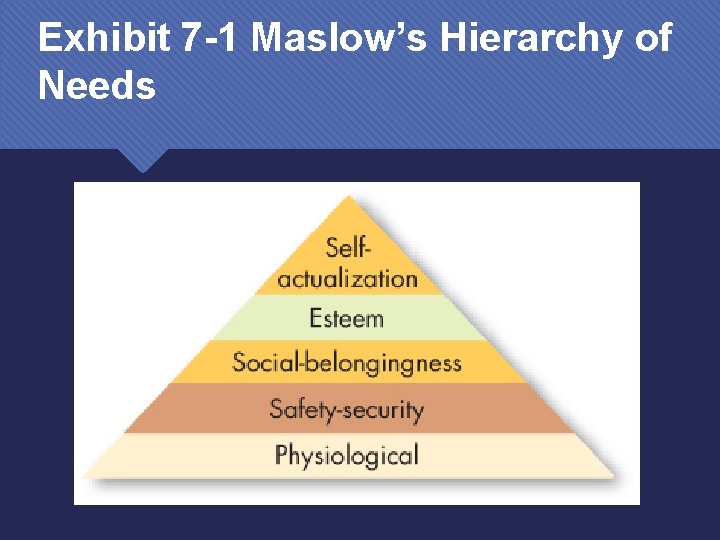
Exhibit 7 -1 Maslow’s Hierarchy of Needs
Abraham Maslow’s need theory has received wide recognition, particularly among practicing managers. It is intuitively logical and easy to understand some research has validated it. However, most research does not, and it hasn’t been frequently researched since the 1960 s.
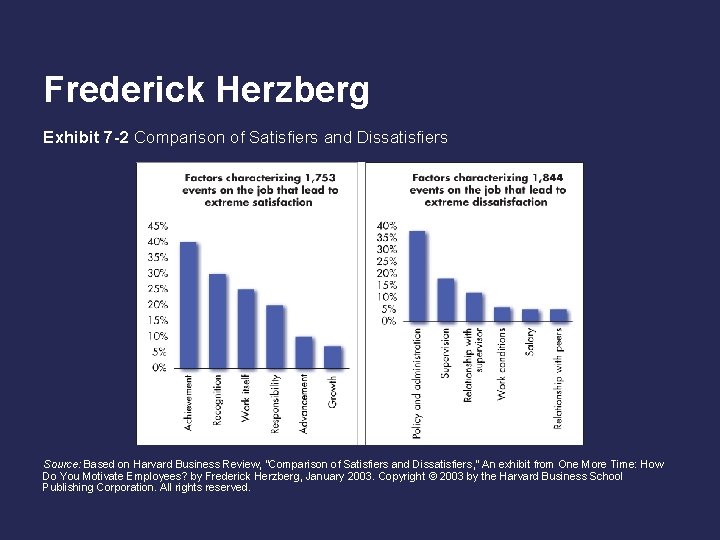
Frederick Herzberg Exhibit 7 -2 Comparison of Satisfiers and Dissatisfiers Source: Based on Harvard Business Review, “Comparison of Satisfiers and Dissatisfiers, ” An exhibit from One More Time: How Do You Motivate Employees? by Frederick Herzberg, January 2003. Copyright © 2003 by the Harvard Business School Publishing Corporation. All rights reserved.
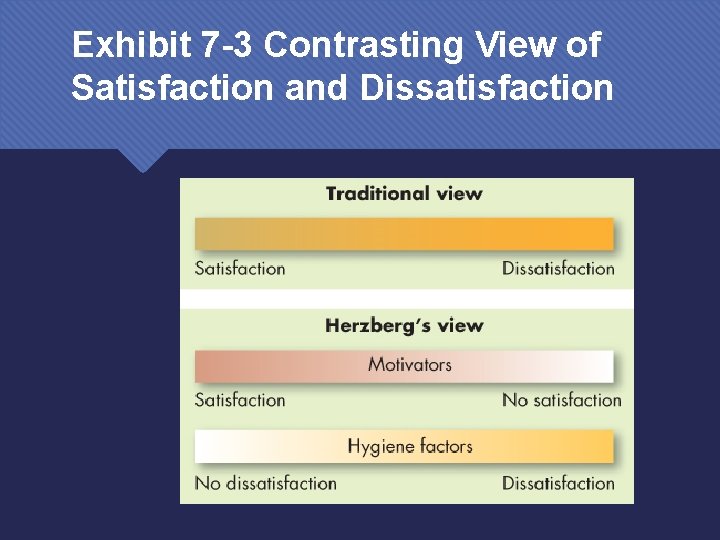
Exhibit 7 -3 Contrasting View of Satisfaction and Dissatisfaction
Herzberg’s Criticisms of Herzberg’s theory: Limited because it relies on self-reports. Reliability of methodology is questioned. No overall measure of satisfaction was utilized.
Mc. Clelland’s Theory of Needs The theory focuses on three needs: Need for achievement (n. Ach): drive to excel, to achieve in relation to a set of standards, to strive to succeed. Need for power (n. Pow): need to make others behave in a way that they would not have behaved otherwise. Need for affiliation (n. Afl): desire for friendly and close interpersonal relationships.
Mc. Clelland’s Theory of Needs Mc. Clelland’s theory has had the best support. It has less practical effect than the others. Because Mc. Clelland argued that the three needs are subconscious—we may rank high on them but not know it—measuring them is not easy. It is more common to find situations in which managers aware of these motivational drivers label employees based on observations made over time.
Self-Determination Theory People prefer to feel they have control over their actions. Focus on the beneficial effects of intrinsic motivation and harmful effects of extrinsic motivation. Cognitive evaluation theory - When people are paid for work, it feels less like something they want to do and more like something they have to do. Proposes that in addition to being driven by a need for autonomy, people seek ways to achieve competence and positive connections to others.
Self-Determination Theory vs. Goal-Setting Theory When extrinsic rewards are used as payoffs for performance, employees feel they are doing a good job. Eliminating extrinsic rewards can also shift an individual’s perception of why he or she works on a task from an external to an internal explanation. Self-determination theory acknowledges that extrinsic rewards can improve even intrinsic motivation under specific circumstances.
Self-Determination Theory vs. Goal-Setting Theory What does self-determination theory suggest for providing rewards? Self-concordance: considers how strongly people’s reasons for pursuing goals are consistent with their interests and core values.
Self-Determination Theory vs. Goal-Setting Theory What does all of this mean? For individuals: Choose your job for reasons other than extrinsic rewards. For organizations: Provide intrinsic as well as extrinsic incentives.
Self-Determination Theory vs. Goal-Setting Theory Goals tell an employee what needs to be done and how much effort is needed. Evidence suggests: Specific goals increase performance. Difficult goals, when accepted, result in higher performance than do easy goals. Feedback leads to higher performance than does nonfeedback.
Self-Determination Theory vs. Goal-Setting Theory Three other factors influencing the goals-performance relationship: Goal commitment Task characteristics National culture
Self-Determination Theory vs. Goal-Setting Theory People differ in the way they regulate their thoughts and behaviors. Those with a promotion focus strive for advancement and accomplishment and approach conditions that move them closer toward desired goals. Those with a prevention focus strive to fulfill duties and obligations and avoid conditions that pull them away from desired goals.
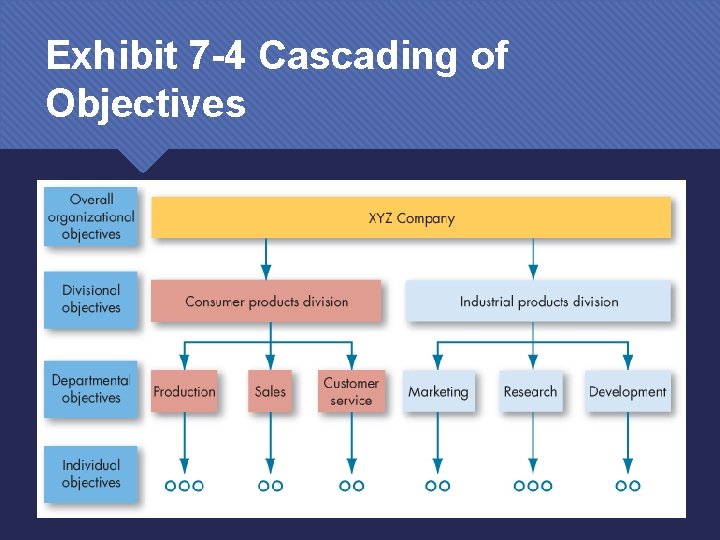
Exhibit 7 -4 Cascading of Objectives
Goal-Setting & Ethics Goal Setting and Ethics The relationship between goal setting and ethics is quite complex: if we emphasize the attainment of goals, what is the cost? We may forgo mastering tasks and adopt avoidance techniques so we don’t look bad, both of which can incline us toward unethical choices.
Self-Efficacy, Reinforcement, and Expectancy Theory Self-efficacy theory is an individual’s belief that he or she is capable of performing a task. Enactive mastery Vicarious modeling Verbal persuasion Arousal Also known as social cognitive theory and social learning theory.
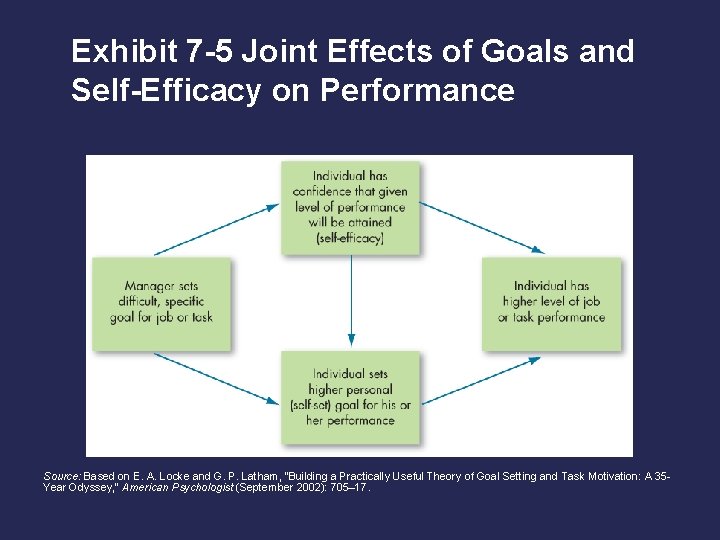
Exhibit 7 -5 Joint Effects of Goals and Self-Efficacy on Performance Source: Based on E. A. Locke and G. P. Latham, “Building a Practically Useful Theory of Goal Setting and Task Motivation: A 35 Year Odyssey, ” American Psychologist (September 2002): 705– 17.
Self-Efficacy, Reinforcement, and Expectancy Theory Implications of self-efficacy theory: The best way for a manager to use verbal persuasion is through the Pygmalion effect. A form of self-fulfilling prophecy – believing in something can make it true. Training programs often make use of enactive mastery by having people practice and build their skills.
Reinforcement Theory Reinforcement theory: behavior is a function of its consequences. Reinforcement conditions behavior. Behavior is environmentally caused. Goal setting is a cognitive approach: an individual’s purposes direct his or her action. Operant conditioning theory: people learn to behave to get something they want or to avoid something they don’t want. B. F. Skinner’s behaviorism.
Social-Learning Theory Social-learning theory: we can learn through both observation and direct experience. Models are central, and four processes determine their influence on an individual: Attentional processes Retention processes Motor reproduction processes Reinforcement processes
Expectancy Theory Expectancy theory: a tendency to act in a certain way depends on an expectation that the act will be followed by a given outcome and on the attractiveness of that outcome to the individual. Three relationships: Effort-performance relationship Performance-reward relationship Rewards-personal goals relationship
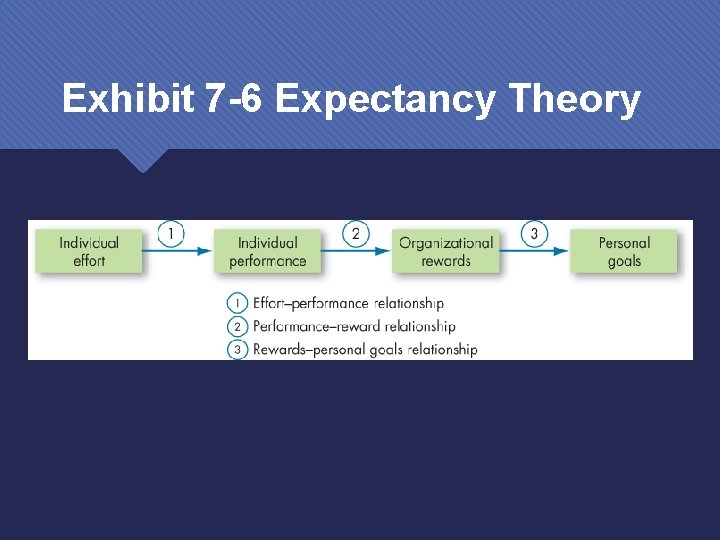
Exhibit 7 -6 Expectancy Theory
Expectancy Theory Expectancy theory helps explain why a lot of workers aren’t motivated and do only the minimum. Three questions employees need to answer in the affirmative if their motivation is to be maximized: If I give maximum effort, will it be recognized in my performance appraisal? If I get a good performance appraisal, will it lead to organizational rewards? If I’m rewarded, are the rewards attractive to me?
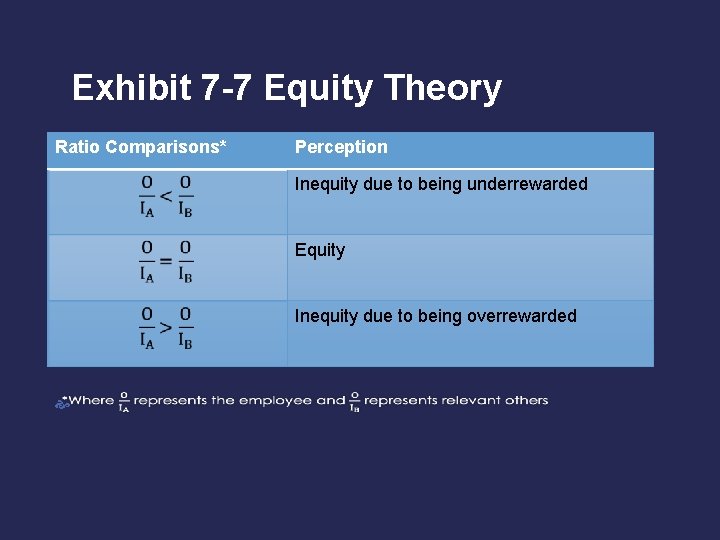
Exhibit 7 -7 Equity Theory Ratio Comparisons* Perception Inequity due to being underrewarded Equity Inequity due to being overrewarded
Forms of Organizational Justice When employees perceive an inequity, they can be predicted to make one of six choices: Change inputs. Change outcomes. Distort perceptions of self. Distort perceptions of others. Choose a different referent. Leave the field.
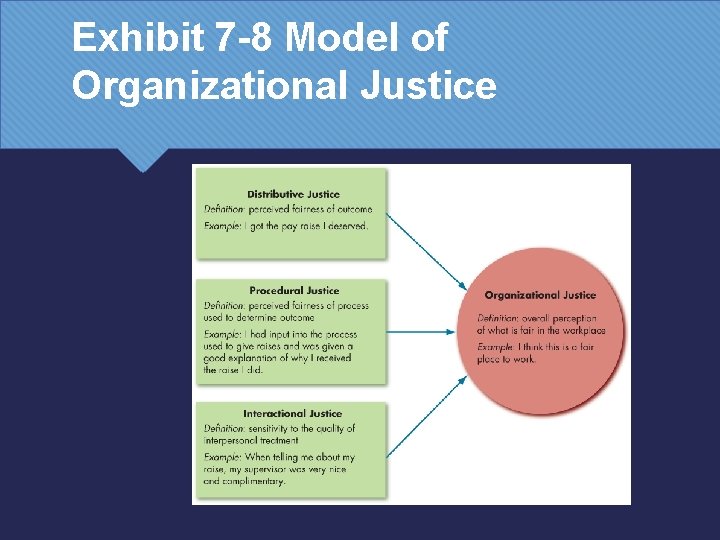
Exhibit 7 -8 Model of Organizational Justice
Forms of Organizational Justice Outcomes All the types of justice discussed have been linked to higher levels of task performance and citizenship. Third-party, or observer, reactions to injustice can be substantial.
Forms of Organizational Justice Promoting Justice Adopting strong justice guidelines in an attempt to mandate certain managerial behavior isn’t likely to be universally effective. Culture and Justice Inputs and outcomes are valued differently in various cultures.
Implications of Job Engagement for Management Job engagement: the investment of an employee’s physical, cognitive, and emotional energies into job performance. Gallup organization: more engaged employees in successful organizations than in average organizations. Academic studies: job engagement is positively associated with performance and citizenship behaviors.
Implications of Job Engagement for Management What makes people more engaged in their job? The degree to which an employee believes it is meaningful to engage in work. A match between the individual’s values and the organization’s. Leadership behaviors that inspire workers to a greater sense of mission.
Implications of Job Engagement for Management Are highly engaged employees getting “too much of a good thing? ” Construct is partially redundant with job attitudes. It may have a “dark side. ” Positive relationships between engagement and workfamily conflict.

Exhibit 7 -9 Integrating Contemporary Theories of Motivation
Implications for Managers Make sure extrinsic rewards for employees are not viewed as coercive, but instead provide information about competence and relatedness. Either set or inspire your employees to set specific, difficult goals and provide quality, developmental feedback on their progress toward those goals. Try to align or tie in employee goals to the goals of your organization. Model the types of behaviors you would like to see performed by your employees.
Implications for Managers Expectancy theory offers a powerful explanation of performance variables such as employee productivity, absenteeism, and turnover. When making decisions regarding resources in your organization, make sure to consider how the resources are being distributed (and who’s impacted), the fairness of the decision, along with whether your actions demonstrate that you respect those involved.
Keys Terms • • • • Self-Determination Theory Cognitive Evaluation Theory Self-Concordance Goal-Setting Theory Promotion Focus Prevention Focus Management by Objectives Self-Efficacy Theory Reinforcement Theory Social–Learning Theory Attentional Processes Retention Processes Motor Reproduction Processes Reinforcement Processes Expectancy Theory • • • • • Expectancy Instrumentality Valence Equity Theory Organizational Justice Distributive Justice Procedural Justice Interactional Justice Informational Justice Interpersonal Justice Job Engagement Hierarchy of Needs Lower-Order Higher-Order Two-Factor Theory Hygiene Factors Need for Achievement Need for Power Need for Affiliation
- Slides: 41