
Motivation Chapter 12 Copyright 2010 Pearson Education Canada
- Slides: 39
Motivation Chapter 12 Copyright © 2010 Pearson Education Canada -1
Chapter Outline • The Hungry Animal: Motives to Eat • The Social Animal: Motives to Love • The Erotic Animal: Motives for Sex • The Competent Animal: Motives to Achieve • Motives, Values, and Well-Being Copyright © 2010 Pearson Education Canada -2
Defining Motivation • Motivation – An inferred process within a person or animal that causes movement either toward a goal or away from an unpleasant situation – Study of motivation dominated by focus on drives: biological urges, such as those to acquire food & water, to have sex, to seek novelty, and to avoid cold and pain – But motivation is more than just biological drives Copyright © 2010 Pearson Education Canada 12 -3
Influences on Motivation • Motivation to reach goals may vary depending on the source: – Intrinsic motivation: the pursuit of an activity its own sake and the pleasure it brings for – Extrinsic motivation: the pursuit of an activity for external rewards, such as money or fame Copyright © 2010 Pearson Education Canada 12 -4
Motives to Eat • Research does not support the idea that people who are overweight are emotionally disturbed • Heaviness not always caused by overeating • Biological mechanisms regulate your body weight & are influenced by genetics Copyright © 2010 Pearson Education Canada 12 -5
Set Point • Set point – Genetically influenced weight range for an individual – maintained by biological mechanisms that regulate food intake, fat reserves, and metabolism – Varies about 10% in either direction – Associated with high levels of heritability – Related to genetically programmed basal metabolism rate Copyright © 2010 Pearson Education Canada 12 -6
Obesity • Genes are involved in some types of obesity – E. g. , Inuit of the Canadian Arctic • Mutations in the ob gene may cause obesity in some individuals – Ob gene causes fat cells to secure protein called leptin that acts on the hypothalamus and helps to regulate appetite – Levels of leptin most critical in early life as sets the brain chemistry involved with eating Copyright © 2010 Pearson Education Canada 12 -7
The Overweight Debate • Prevalence of obesity in Canada – – – Approximately 26% of women & 35% of men Has been increasing over the years Can’t be accounted for solely by genetics • Is it weight or fitness? – Many researchers believe that individuals who are overweight and physically fit are actually healthier than individuals who are sedentary and thin – Lack of fitness related to greater health risks Copyright © 2010 Pearson Education Canada 12 -8
Culture, Gender, & Weight • Cultural changes linked to increased weight: – Increased abundance of fast food – Habit of eating high-calorie food on the run – Use of energy-saving devices – Speed & convenience of driving rather than walking – Growing sizes of typical food servings of food & drink – Preference for watching television & videos rather than doing anything active Copyright © 2010 Pearson Education Canada 12 -9
Culture of Consumption • Eating habits & activity levels shaped by cultural customs and standards of ideal body – Fat may be sign of health & affluence in men; sexual desirability in women – English Canadians hold negative attitudes towards obese people – People on farms used to eat for intrinsic reasons but now more extrinsic motives Copyright © 2010 Pearson Education Canada 12 -10
Gender & the Ideal Body • Cultural ideals for women have been getting thinner, with large breasts but no hips • Cultural ideals for men are to have strong, muscular bodies • Changes in body norms shift with gender & social roles (e. g. , woman’s role being home or work? ) • Differences in weight satisfaction between men & women influence weight norms Copyright © 2010 Pearson Education Canada 12 -11
Eating Disorders • Anorexia – An eating disorder characterized by fear of being fat, a distorted body image, radically reduced consumption of food, and emaciation • Bulimia – An eating disorder characterized by episodes of excessive eating (bingeing) followed by forced vomiting or use of laxatives (purging) Copyright © 2010 Pearson Education Canada 12 -12
Motives to Love • Types of love: – Passionate (romantic) love • Love characterized by a whirlwind of intense emotions and sexual passion • It is the stuff of crushes, infatuations, “love at first sight”, and the early stage of love affairs – Companionate love • Love characterized by affection and trust Copyright © 2010 Pearson Education Canada 12 -13
Motives to Love • Biology of Love – Neurological origins of love begin in infancy with attachment relationships with mother – Key neurotransmitters & hormones involved in pleasure and reward involved in mother-baby and adult bonds • E. g. , oxytocin & endorphins – Similar patterns of neurological activation the brain Copyright © 2010 Pearson Education Canada in 12 -14
Motives to Love • Psychology of Love – Proximity effect: the people who are nearest to you geographically are most likely to be dearest to you too – Similarity effect: similarity in looks, attitudes, beliefs, values, personality, and interests, is attractive to human beings • We tend to choose friends and loved ones who are most like us Copyright © 2010 Pearson Education Canada 12 -15
Attachment Theory of Love • Attachment theory of love – People’s attachment styles as adults derive in large part from how their parents cared for them • Secure: rarely jealous, compassionate, helpful (64%) • Avoidant: distrust others and avoid intimate attachments (25%) • Anxious: agitated in relationships, clingy, fear partners will leave them (11%) Copyright © 2010 Pearson Education Canada 12 -16
Ingredients of Love • Love argued to involve three key ingredients: – Passion: based on emotion – Intimacy: based on deep knowledge – Commitment: based on loyalty • In most relationships, romantic passion subsides and intimacy increases Copyright © 2010 Pearson Education Canada 12 -17
Gender, Culture, & Love • Men and women respond similarly to: – Love at first sight, passionate love, companionate love, unrequited love, being securely or insecurely attached, or suffering when a relationship ends • Men and women do differ in how they express love – Males more likely to express love in actions – Women more likely to express love in words Copyright © 2010 Pearson Education Canada 12 -18
Motives for Sex • Human sexuality influenced by biological, psychological, and cultural factors – Canadian culture relatively sexually active – Canadians have sex at earlier ages than teens in other countries – Average Canadian adult has sex around 150 times a year Copyright © 2010 Pearson Education Canada 12 -19
Biology of Desire • Testosterone promotes sexual desire in both sexes, but relationship unclear • Studies of orgasm have indicated: – Men and women are sexually similar but women have lesser sexual capacity (Kinsey) – Physiological changes during sexual arousal and orgasm similar in both sexes, but female sexual capacity greater due to ability to have multiple orgasms (Masters & Johnson) • Much more individual variation than previously thought Copyright © 2010 Pearson Education Canada 12 -20
The Sex Drive • Men display higher rates of almost every kind of sexual behaviour • Hormones & brain circuits involved in sexual behaviour differ between sexes – Males: wiring for sex overlaps with dominance & aggression – Females: wiring for sex overlaps with nurturance • Other researchers argue that differences in sexuality stem from roles and expectations Copyright © 2010 Pearson Education Canada 12 -21
The Psychology of Desire • Six primary psychological motives for sex: – Enhancement, intimacy, coping, self-affirmation, partner approval, peer approval • Men endorse these motives more than women, except for intimacy (both sexes the same) • Extrinsic motives associated with risky sexual behaviour, and consenting to unwanted sex Copyright © 2010 Pearson Education Canada 12 -22
Sexual Coercion & Rape • Only 6% of sexual assaults in Canada are reported to police, yet rates of victimization among undergraduates may be around 29% – Most victims know their attackers, definitions of sexual coercion differ between men and women • What causes some men to rape? – – Peer approval Anger, revenge, or desire to dominate/humiliate the victim Narcissism and hostility toward women Contempt for the victim & a sadistic pleasure in inflicting pain Copyright © 2010 Pearson Education Canada 12 -23
The Culture of Desire • Cultures transmit rules & regulations about sex to members by: – Gender roles • Collections of rules that determine the proper attitudes and behaviour for men and women – Sexual scripts • Set of implicit rules that specify proper sexual behaviour for a person in a given situation, varying with the person’s gender, age, religion, social status, and peer group Copyright © 2010 Pearson Education Canada 12 -24
Gender, Culture, & Sex • Evolutionary psychologists argue that gender roles & sexual scripts shaped by natural selection • Social & cultural psychologists argue these reflect a culture’s economic, demographic, & social arrangements • Sexual partners often chosen by proximity (availability) & similarity – Differences in sexual behaviour evidenced when either men or women are scarce Copyright © 2010 Pearson Education Canada 12 -25
Biology & Sexual Orientation • Psychological explanations for homosexuality unsupported • Homosexual behaviour documented in over 450 species and may be somewhat heritable in men • Biological inquiries have involved: – – – Prenatal exposure to androgens The “brother effect” Male & female odours that activate sexual response system in hypothalamus Copyright © 2010 Pearson Education Canada 12 -26
Motives to Achieve • Why are we motivated to work? – Not fully explained by meeting survival needs • Motivated by a need for achievement – A learned motive to meet personal standards of success and excellence in a chosen area – Originally measured by variation of the projective Thematic Apperception Test (TAT) Copyright © 2010 Pearson Education Canada 12 -27
The Importance of Goals • A goal is likely to improve motivation & performance when: 1. The goal is specific 2. The goal is challenging but achievable 3. The goal is framed in terms of getting what you want rather than avoiding what you do not want Copyright © 2010 Pearson Education Canada 12 -28
Types of Goals • Approach goals – Goals framed in terms of desired outcomes or experiences, such as learning to scuba dive • Avoidance goals – Goals framed in terms of avoiding unpleasant experiences, such as trying not to look foolish in public Copyright © 2010 Pearson Education Canada 12 -29
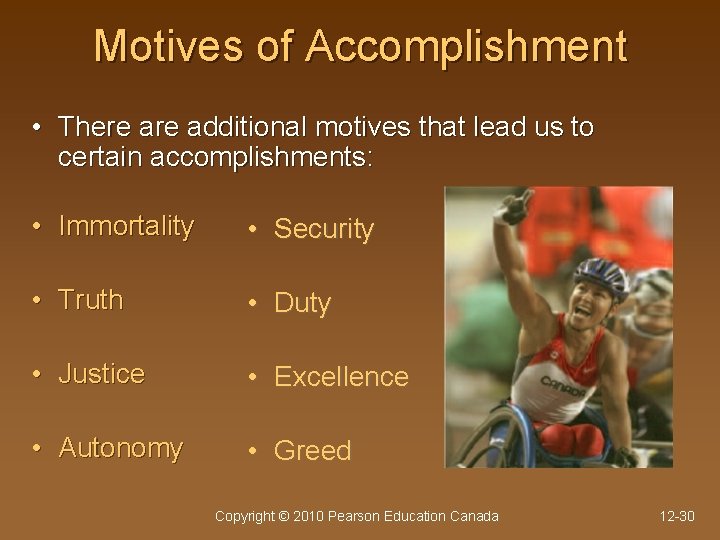
Motives of Accomplishment • There additional motives that lead us to certain accomplishments: • Immortality • Security • Truth • Duty • Justice • Excellence • Autonomy • Greed Copyright © 2010 Pearson Education Canada 12 -30
Effects of Work on Motivation • How does the work that we do & the conditions that we do it in nurture or crush our motivation to succeed? – Environmental factors are key – Working conditions may increase work motivation and satisfaction, and reduce the chances of emotional burnout Copyright © 2010 Pearson Education Canada 12 -31
Good Working Conditions 1. The work feels meaningful & important to employees 2. Employees have control over many aspects of their work 3. Tasks are varied rather than repetitive 4. The company maintains clear & consistent rules 5. Employees have supportive relationships with their superiors and co-workers 6. Employees receive useful feedback about their work so they know accomplishments and areas of improvement 7. The company offers opportunities for employees to learn & advance Copyright © 2010 Pearson Education Canada 12 -32
Working Conditions • Companies that foster these conditions tend to have more productive & satisfied employees • Surprisingly, work motivation is not related to the amount of money you get, but how & when you get paid – Incentive pay: bonuses that are given upon completion of a goal rather than as an automatic raise Copyright © 2010 Pearson Education Canada 12 -33
Opportunities to Achieve • Working condition that affects achievement is having the opportunity to achieve – Failures at work often attributed to lack of internal drives, but may not have been given fair chance to succeed – Gender biases in occupations may influence motivations to work in particular fields • Stereotypes inhibit aspirations Copyright © 2010 Pearson Education Canada 12 -34
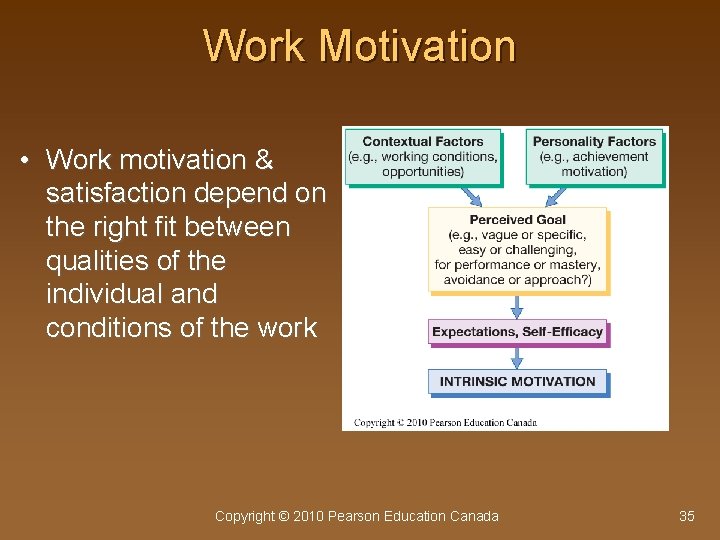
Work Motivation • Work motivation & satisfaction depend on the right fit between qualities of the individual and conditions of the work Copyright © 2010 Pearson Education Canada 35
Motives, Values, & Well-Being • People motivated by intrinsic satisfaction of activities are happier than those motivated by extrinsic rewards only • Intrinsic motivation can be influenced by the goals we set for ourselves • Goals are determined by our values about what is important in life • Emotional stress may arise when the goals and values you choose are in conflict Copyright © 2010 Pearson Education Canada 12 -36
Three Motivational Conflicts 1. Approach-approach conflicts – Conflicts that occur when you are equally attracted to two or more possible goals 2. Avoidance-avoidance conflicts – Conflicts that require you to choose the lesser of two evils because you dislike both alternatives 3. Approach-avoidance conflicts – Conflicts that occur when a single activity or goal has both a positive and a negative aspect Copyright © 2010 Pearson Education Canada 12 -37
Hierarchy of Needs • Maslow proposed that people’s motives formed a pyramid called a hierarchy of needs that reflected the relative importance of different motives – Need for self-actualization (top level) – Esteem needs: self- and other -respect – Social needs: belonging, affection – Security needs: shelter, safety – Survival needs: food, sleep, water (bottom level) Copyright © 2010 Pearson Education Canada 12 -38
End of Chapter 12 Copyright © 2010 Pearson Education Canada -39