
Motivation and Emotion 9 Questions to Consider I
- Slides: 40
Motivation and Emotion 9
Questions to Consider: I. How Does Motivation Activate, Direct, and Sustain Behavior? II. What Determines How We Eat? III. What Factors Motivate Sexual Behavior? IV. How Are Emotions Adaptive? V. How Do People Experience Emotions?
I. How Does Motivation Activate, Direct, and Sustain Behavior? 1. 2. 3. 4. Multiple Factors Motivate Behavior Some Behaviors Are Motivated for Their Own Sake People Set Goals to Achieve People Have a Need to Belong
I. How Does Motivation Activate, Direct, and Sustain Behavior? l l Motivation is defined as the area of psychological science concerned with the factors that energize, or stimulate, behavior 4 Essential Qualities of Motivational States: 1. 2. 3. 4. Energizing: activate or arouse behaviors, cause us to do something Directive: guide behaviors towards satisfying specific goals or needs Persist: continue behavior until goals or needs are satisfied Strength: motives are stronger or weaker depending on internal and external factors
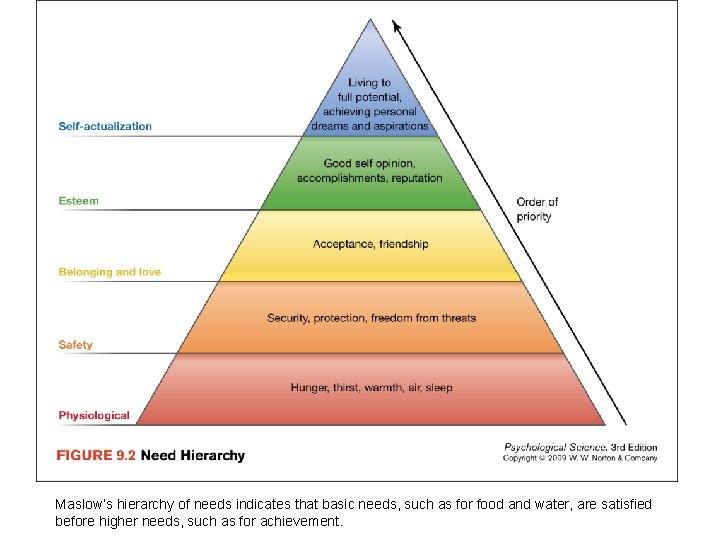
1. Multiple Factors Motivate Behavior l Biological and social needs are defined as a state of deficiency l Maslow’s need hierarchy: l l Satisfy needs in order of survival Popular in education and business, but lacks empirical support
Maslow’s hierarchy of needs indicates that basic needs, such as for food and water, are satisfied before higher needs, such as for achievement.
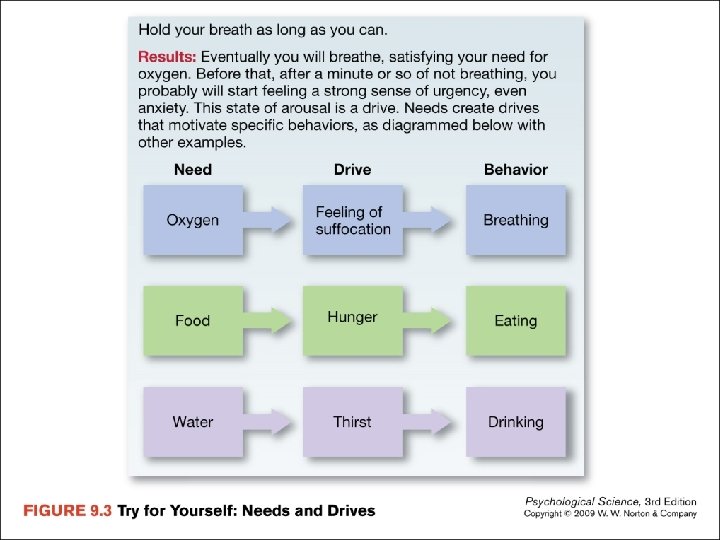
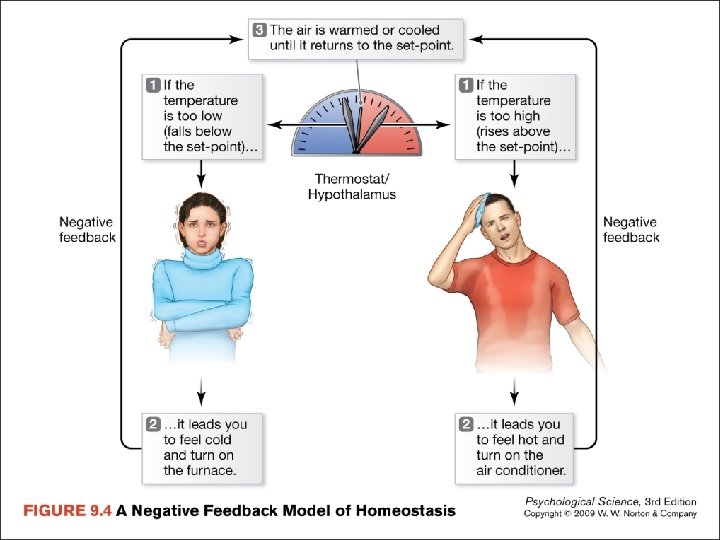
1. Multiple Factors Motivate Behavior l Drives and incentives: l l l Drives are psychological states that encourage behaviors that satisfy needs Needs create arousal that motivates behavior through physiological activation Homeostasis describes the tendency for body functions to maintain equilibrium l Set-point
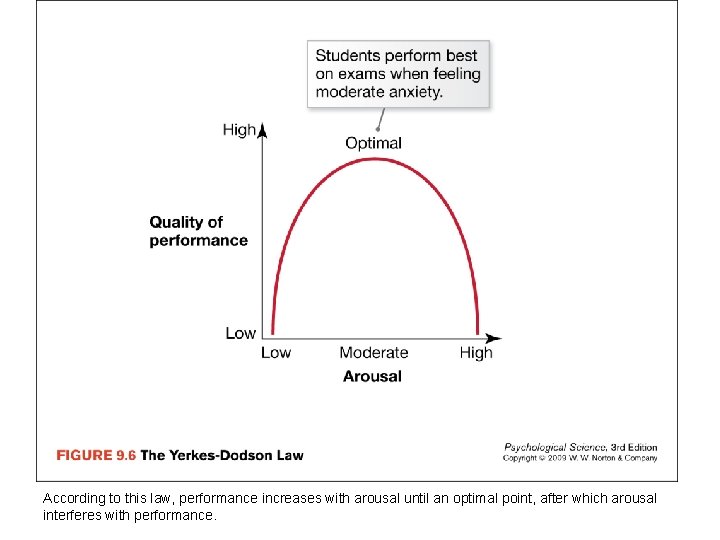
1. Multiple Factors Motivate Behavior l Arousal and performance: l The Yerkes-Dodson law dictates that performance increases with arousal up to an optimal point and then decreases with increasing arousal
According to this law, performance increases with arousal until an optimal point, after which arousal interferes with performance.
1. Multiple Factors Motivate Behavior l Pleasure: l Sigmund Freud and the pleasure principle l From an evolutionary perspective, behaviors associated with pleasure often promote the animals’ survival and reproduction, whereas behaviors associated with pain interfere with survival and reproduction
2. Some Behaviors Are Motivated for Their Own Sake l Extrinsic motivation: l l Emphasizes the external goals an activity is directed toward, such as reducing drive or obtaining a reward Intrinsic motivation: l Refers to the value or pleasure that is associated with an activity but has no apparent biological goal
2. Some Behaviors Are Motivated for Their Own Sake l Playful exploration is characteristic of all mammals and especially primates l Creativity is the tendency to generate ideas or alternatives that may be useful in solving problems, communicating, and entertaining ourselves and others
2. Some Behaviors Are Motivated for Their Own Sake l Rewarding intrinsic motives: l Extrinsic rewards can undermine intrinsic motivation l Extrinsic rewards may reduce intrinsic value because such rewards undermine people’s feeling that they are choosing to do something for themselves
3. People Set Goals to Achieve l l l Murray proposed 27 basic psychosocial needs, such as the need for power, autonomy, achievement, and play Self-regulation of behavior is the process by which people alter or change their behavior to attain personal goals Challenging—but not overly difficult—and specific goals are best
3. People Set Goals to Achieve l Self-efficacy : l Albert Bandura argued that people’s personal expectations for success (self-efficacy) play an important role in motivation
3. People Set Goals to Achieve l Delayed gratification: l The ability to postpone immediate gratification is critical in the pursuit of long-term goals
4. People Have a Need to Belong l The need to belong theory states that the need for interpersonal attachments is a fundamental motive that has evolved for adaptive purposes l Lack of social contact causes feelings of emptiness and despair
II. What Determines How We Eat? 1. Time and Taste Play Roles 2. Culture Determines What We Eat 3. Multiple Neural Processes Control Eating
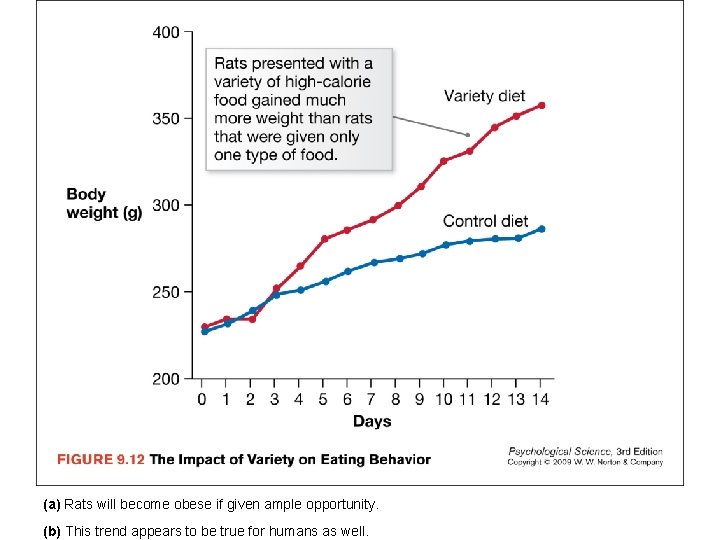
1. Time and Taste Play Roles l We have been classically conditioned to associate eating with regular mealtimes l Animals presented with a variety of foods tend to eat much more than animals presented with only one food type (sensoryspecific satiety) l Humans show the same effect
(a) Rats will become obese if given ample opportunity. (b) This trend appears to be true for humans as well.
2. Culture Determines What We Eat l A general rule that determines preferences is familiarity l l l Although people often enjoy novel ethnic foods, in their regular diets most people prefer the foods of their own culture Local norms for what to eat and how to prepare it —cuisine—reinforce many food preferences Religious and cultural values often tell people which foods to avoid
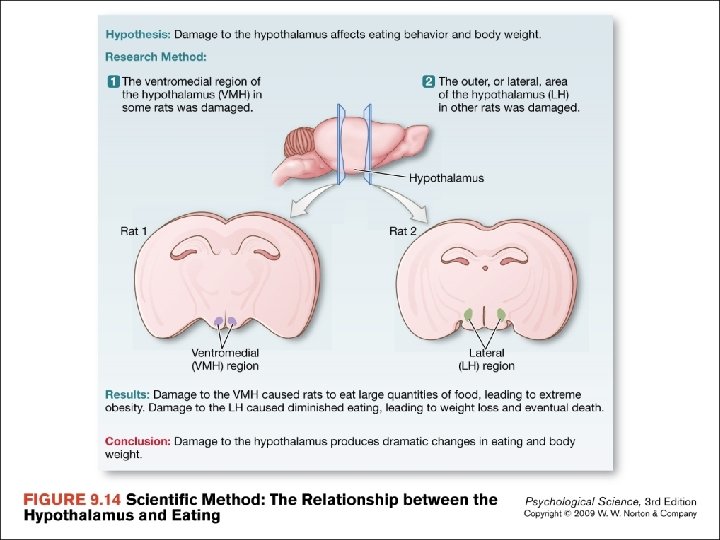
3. Multiple Neural Processes Control Eating l The hypothalamus is the brain structure that most influences eating l Damage dramatically changes eating behavior and body weight l l Hyperphagia: increased eating behavior (damage to VMH) Aphagia : decreased eating behavior (damage to LH)
3. Multiple Neural Processes Control Eating l Peptides and Hormones help regulate eating l l Leptin (fat regulation-slow) Ghrelin (trigger eating)
III. What Factors Motivate Sexual Behavior? 1. 2. 3. 4. Biological Factors Influence Sexual Behavior Cultural Scripts and Cultural Rules Shape Sexual Interactions Mating Strategies Differ between the Sexes People Differ in Sexual Orientation
III. What Factors Motivate Sexual Behavior? l Sex drives vary substantially among individuals and across circumstances and can be explained by individual differences and by society’s dominating influence over how and when individuals engage in sexual activity l Kinsey
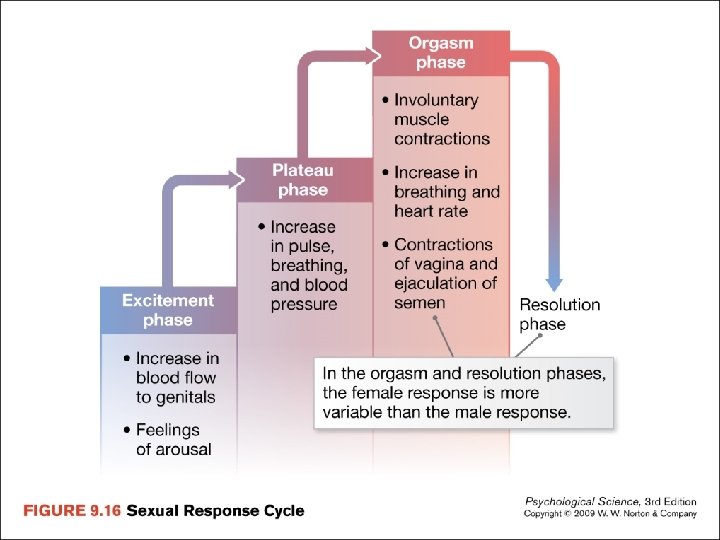
1. Biological Factors Influence Sexual Behavior l The sexual response cycle: l A predictable pattern of physical and psychological responses l Occur in four stages with female responses being more variable than males’: excitement, plateau, orgasm, and resolution
1. Biological Factors Influence Sexual Behavior l Hormones: l In nonhuman animals, hormones profoundly influence sexual activity l Hormones affect human sexual behavior in two ways: They influence physical development of the brain and body l Through motivation, they activate reproductive behavior l
1. Biological Factors Influence Sexual Behavior l In men and women, testosterone—a type of androgen—is involved in sexual functioning: l l Males need a certain amount of testosterone to be able to engage in sex The more testosterone women have, the more likely they are to have sexual thoughts and desires Oxytocin may promote feelings of love between partners In women, the release of hormones varies according to a cycle that repeats itself approximately every 28 days—the menstrual cycle
1. Biological Factors Influence Sexual Behavior l Neurotransmitters l Sexual stimulation leads to nitric oxide production, which then promotes blood flow to both the penis and the clitoris and subsequently plays an important role in sexual arousal, especially penile erections. l Serotonin
2. Cultural Scripts and Cultural Rules Shape Sexual Interactions l Sexual scripts are cognitive beliefs about how a sexual episode should be enacted l In North America, the sexual script involves initial flirtation through nonverbal actions, the male initiating physical contact, the female controlling whether sexual activity takes place, and refusals typically being verbal and direct
2. Cultural Scripts and Cultural Rules Shape Sexual Interactions l Double standard: l Certain activities (such as premarital or casual sex) are morally and socially acceptable for men but not for women
2. Cultural Scripts and Cultural Rules Shape Sexual Interactions l Sex differences in sexual motive: l l Greater male motivation for sexual activity and sexual variety occurs in all cultures Erotic plasticity refers to the extent that sex drive can be shaped by social, cultural, and situational factors l l Evidence suggests that women have higher erotic plasticity than men Sexual strategies theory
3. Mating Strategies Differ between the Sexes l Men and women share in many of the perceptions of characteristics of the ideal mate: attractive, kind, honest, good-natured l Men are more concerned with physical appearance and women are more concerned with status l A finding confirmed across 37 cultures, and supportive of an evolutionary viewpoint
4. People Differ in Sexual Orientation l From an evolutionary perspective, homosexuality appears to make little sense
4. People Differ in Sexual Orientation l Exposure to hormones, especially androgens, in the prenatal environment might play some role in sexual orientation l Discovery of a size difference or activation difference in any one part of the brain (such as the hypothalamus) cannot establish whether this area determines sexual orientation l Correlation does not equal causation
4. People Differ in Sexual Orientation l Biological processes play some role in sexual orientation l Sexual orientation is not easy to change l No good evidence exists that sexual orientation can be changed through therapy