
Motivating Operations Week 8 Antecedent considerations Motivation Operations
- Slides: 30
Motivating Operations Week 8: Antecedent considerations
Motivation Operations • Also referred to as: – Value altering effect: establishing/abolishing – Behavior altering effect: Frequency • Establishing operation: Evocative effect • Abolishing operation: Abative effects
Some clarification • Not just Frequency: Magnitude • Behavior altering effect is not just due to encounter with change in reinforcement frequency: Extinction! • SD is not = MO – SD: Differential availability of reinforcement for a behavior – MO: differential reinforcer effectiveness of an environmental event.
Three types of Motivating Operations • Surrogate: Stimulus paired with another – Not likely to be important to study • Reflexive: Stimulus that preceded some form of worsening improvement – Thanks and holding doors open for people • Transitive: Stimulus that alters value of another stimulus – Must be just as available (Dr. asking for scalpel)
8 UMO • • • Sex Temperature Pain Food Water Sleep Activity Oxygen Key Point: These are not SD’s because to have an SD you must have an Sdelta (neutral stimulus) to signal unavailability of reinforcement is a possible
Altered States • Drugs • Anxiety • Do not cause behavior! They interact with environment however. – Moderation Variables.
What about treatment? • You will never get rid of the UMO effects • You will only weaken momentarily • Must development treatment that focuses on acceptable behavior to gain access to the reinforcer
UMOs & Punishment • Difficult to know for sure • Observation of the abative effect requires the evocative effect of an MO for reinforcement with respect to the punished behavior.
Multiple Effects • Evocative effect: Do what you gotta do • Punishment effect: Decreases probability you engage in the behavior that preceded the MO
SMIRC Model • • • Stimulus Motiviating Operation Individual Response Consequence
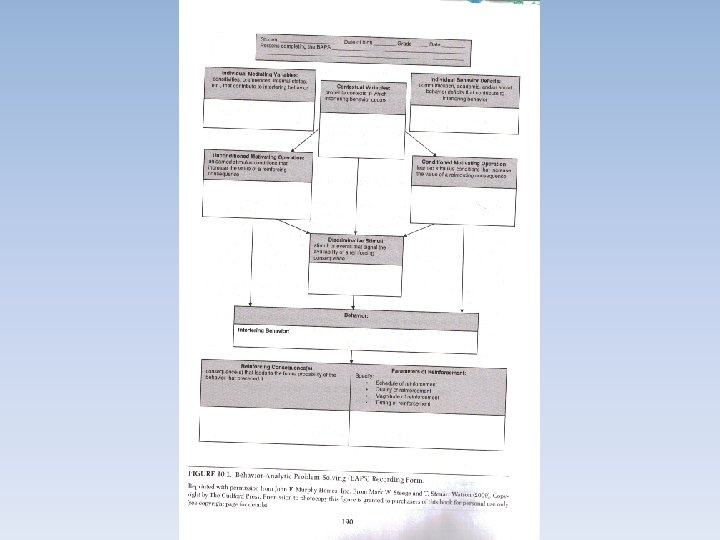
Behavior Analytic Problem. Solving Model Beginning to pull it all together
Components • Contextual Variables: – Behavior occurs in some contexts but not others • Antecedent Stimuli: Environmental Triggers • Individual Mediators: Internal Triggers – UMO & CMO • Individual Behavior Deficits: – Try to reframe all behavior this way (your turn) • Behavior: – Not enough R+ or too much response effort • Consequences: – Consider function (careful of response topography and response class).
Stimulus Discrimination and Stimulus Generalization
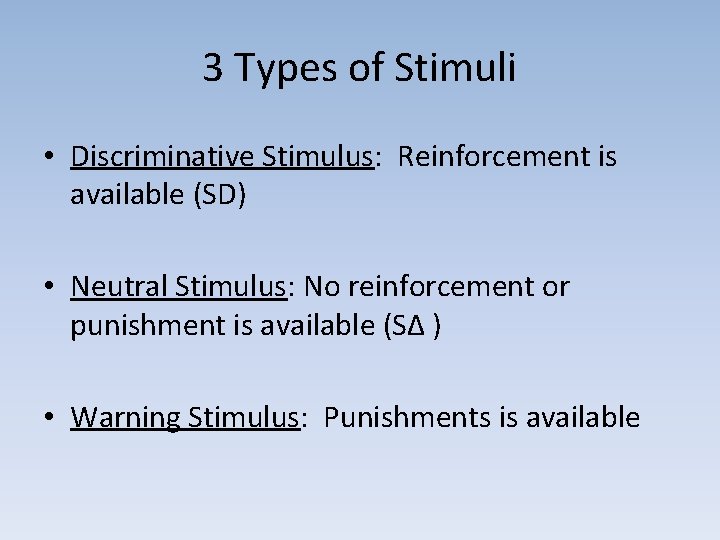
3 Types of Stimuli • Discriminative Stimulus: Reinforcement is available (SD) • Neutral Stimulus: No reinforcement or punishment is available (SΔ ) • Warning Stimulus: Punishments is available
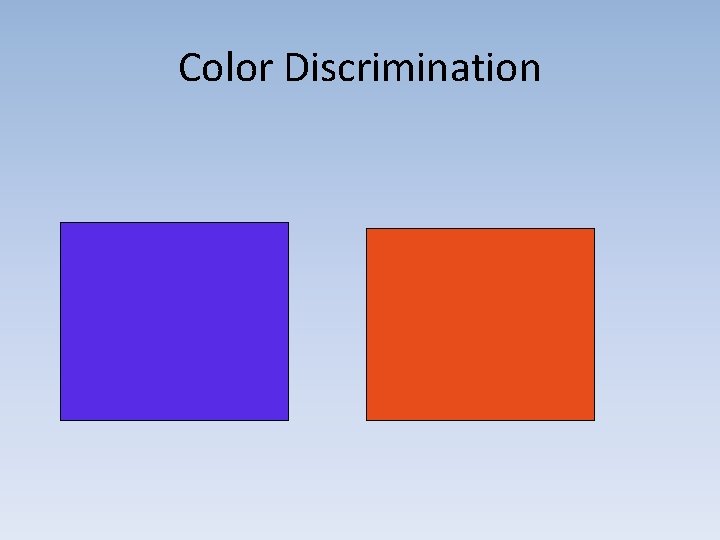
Discrimination Training • Learning when to behave and when not to behave • Reinforcing a response in presence of one stimulus but not another e. g. Colors
Color Discrimination
What about you? • When have you engaged in stimulus discrimination today?
Stimulus Control • Degree of correlation between stimulus and response • Degree to which a behavior occurs in presence of a specific stimulus – e. g. Traffic light • Stimulus Generalization Gradient: Probability of response reinforced in one stimulus condition are emitted in the presence of untrained stimuli.
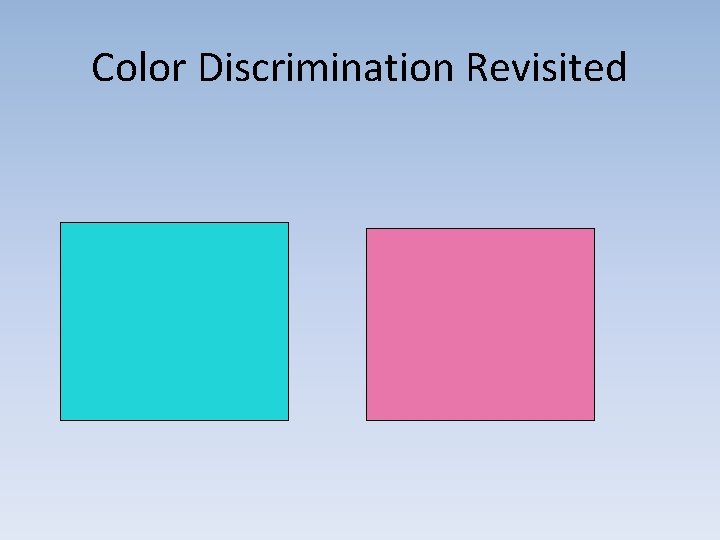
Color Discrimination Revisited
What about you? • What behaviors do you have that are under stimulus control?
Let’s discriminate Learning an Alien Language
Effective discrimination training • • Choose distinct signals Minimize opportunities for error – Minimize stimulus array • • Maximize Number of learning trials Make use of rules
Stimulus Generalization • Responding similarly across two or more stimuli √ The more the stimuli are alike the more likely the response to take place e. g. finding your car
What about you? • What behaviors/responses do you generalize across settings? • Can that response always be generalized? • Should that response always be generalized?
Classes of Stimuli Stimulus Class: Set of stimuli with similar characteristics in common AKA: Concept Equivalence Class: Set of stimuli with different characteristics, but represent the same thing e. g. Written name, verbal name, picture of person
Inducing Stimuli Classes √ Explicit training is not necessarily needed to induce stimulus control across stimuli • • • Symmetry: A = B Reflexivity: A = A Transivity: A = B; B = C; A = C
Discriminating discrimination among other discriminative stimuli Stimulus discrimination and escape e. g. hailing a taxi out in the cold: Must have no patrons in it. Stimulus discrimination and punishment e. g. Boiling pan: Do not touch or you get burned.
Stimulus Discrimination and Differential Reinforcement DR- 2 responses (right way and wrong way)and 1 stimulus e. g. Asking mom for money SD- Two stimuli (Right signal wrong Signal) and 1 response e. g. Asking mom OR dad for money?
Requirements for stimulus control • Attention of the subject • Sensory capabilities of the subject • The stimulus must stand out relative to other stimuli.