
Motivating Employees through Compensation Lesson 11 Learning Objectives
Motivating Employees through Compensation Lesson 11
Learning Objectives After this lecture you should be able to: q Describe employee compensation practices. q Connect motivation theories to compensation practices. q Describe pay surveys and their use to create compensation level strategies. q Explain job-based pay and skill-based pay approaches.

Employee Compensation n It is the process of paying and rewarding people for the contributions they make to an organization. n Compensation is a broad term which includes pay and benefits such as insurance, retirement savings, and paid time off from work. n Compensation represents the total package, both monetary and nonmonetary.

External vs Internal Equity n Employees’ perception of external equity - which concerns the fairness of what the company is paying them compared with what they could earn elsewhere—are critical in such employment relationships. q n An external labor orientation requires a comparison with the compensation offered by other organizations. Employees’ perceptions of internal equity - their beliefs concerning the fairness of what the organization is paying them compared with what it pays other employees. q q q An internal orientation requires a comparison among the organization employees. Pay practices, such as how much each person makes, are usually less secretive in these organizations than in organizations with an external orientation. Internally oriented organizations also use long-term incentives to reward employees who stay with them for long periods.

How does compensation motivate people? n n Motivation can be defined as a force that causes people to engage in a particular behavior rather than other behaviors. Motivation is represented by three elements: q q q Behavioral choice involves deciding whether or not to perform a particular action. Intensity concerns deciding how much effort to put into the behavior. Persistence involves deciding how long to keep working at the behavior.
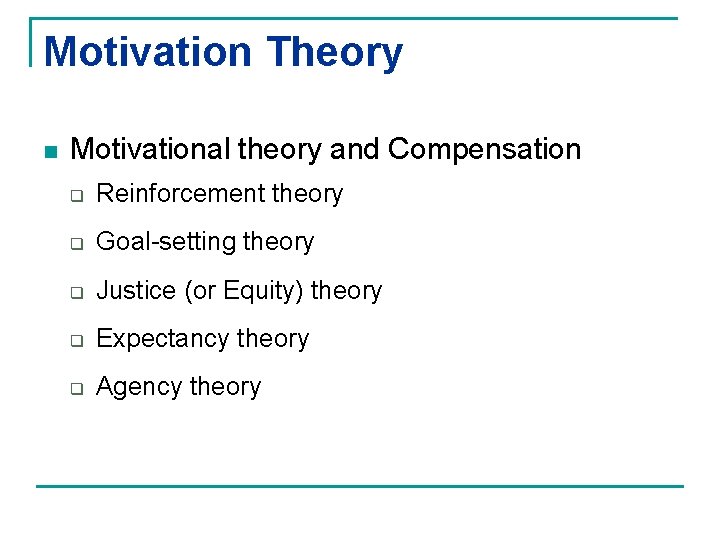
Motivation Theory n Motivational theory and Compensation q Reinforcement theory q Goal-setting theory q Justice (or Equity) theory q Expectancy theory q Agency theory
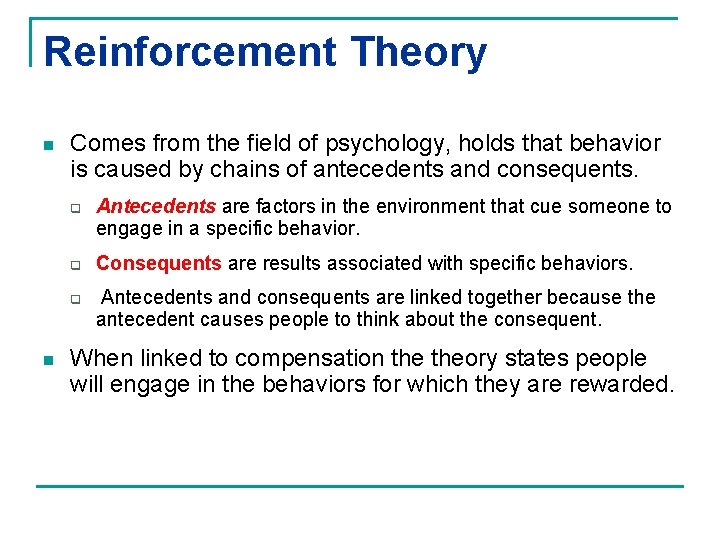
Reinforcement Theory n Comes from the field of psychology, holds that behavior is caused by chains of antecedents and consequents. q q q n Antecedents are factors in the environment that cue someone to engage in a specific behavior. Consequents are results associated with specific behaviors. Antecedents and consequents are linked together because the antecedent causes people to think about the consequent. When linked to compensation theory states people will engage in the behaviors for which they are rewarded.
Goal-Setting Theory n n Goal-setting theory is grounded in cognitive psychology and holds that behavior is motivated by choices. Goals improve performance through four specific motivational processes: q q Goals focus attention away from other activities toward the desired behavior. Goals get people energized and excited about accomplishing something worthwhile. q People work on tasks longer when they have specific goals. q Goals encourage the discovery and use of knowledge.
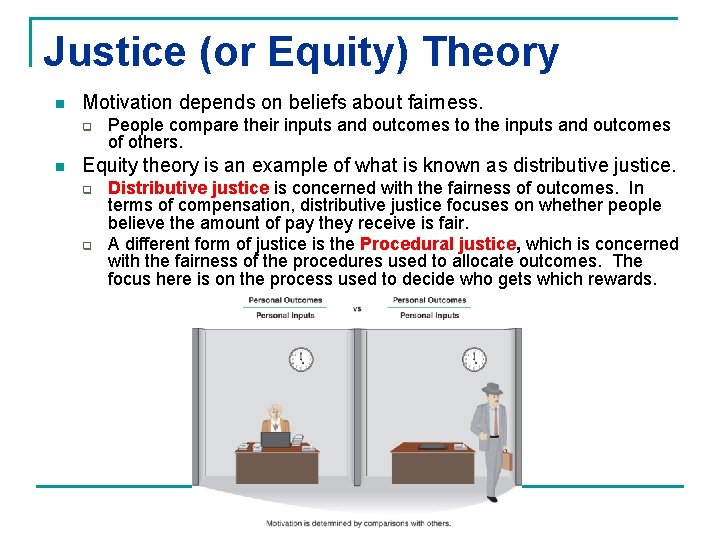
Justice (or Equity) Theory n Motivation depends on beliefs about fairness. q n People compare their inputs and outcomes to the inputs and outcomes of others. Equity theory is an example of what is known as distributive justice. q q Distributive justice is concerned with the fairness of outcomes. In terms of compensation, distributive justice focuses on whether people believe the amount of pay they receive is fair. A different form of justice is the Procedural justice, which is concerned with the fairness of the procedures used to allocate outcomes. The focus here is on the process used to decide who gets which rewards.
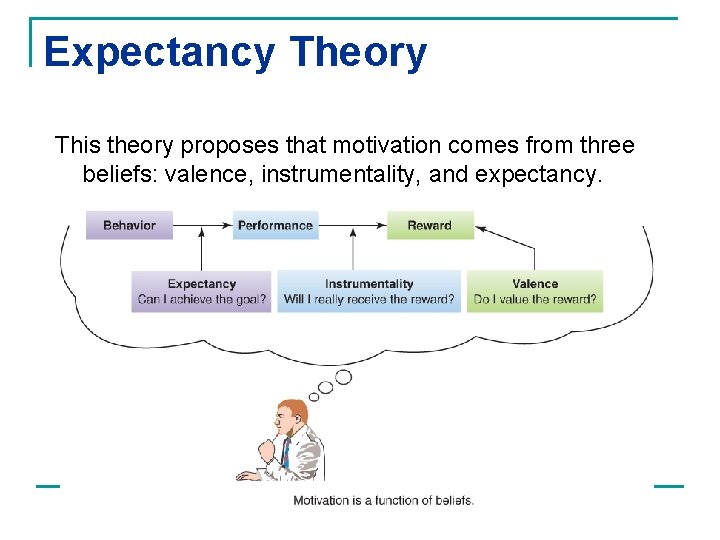
Expectancy Theory This theory proposes that motivation comes from three beliefs: valence, instrumentality, and expectancy.
Agency Theory n n n Agency theory, developed in the 1970 s, focuses on the way management of a firm manages its relations and enters into contractual arrangements with its managers or employees. The conditions under which subordinate agents work with corporate managers may directly influence the behavior of the organization, such as taking risks related with new ventures. Issues such as remuneration, accounting techniques or risk-taking are among the major concerns of both parties in this relationship.
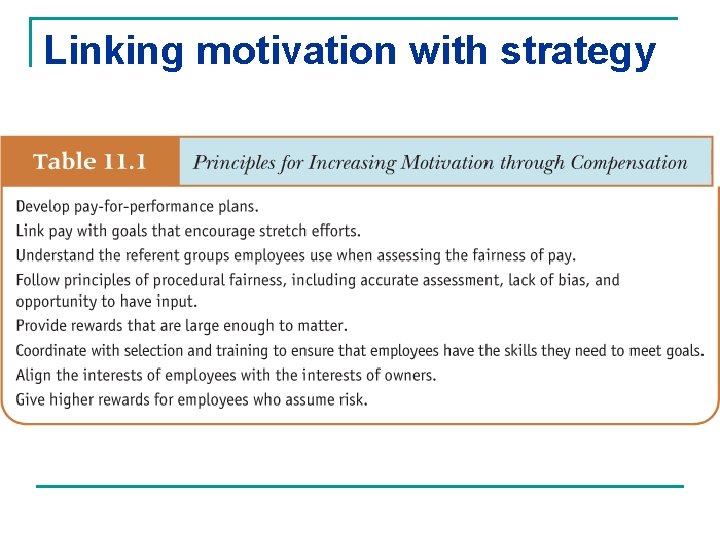
Linking motivation with strategy
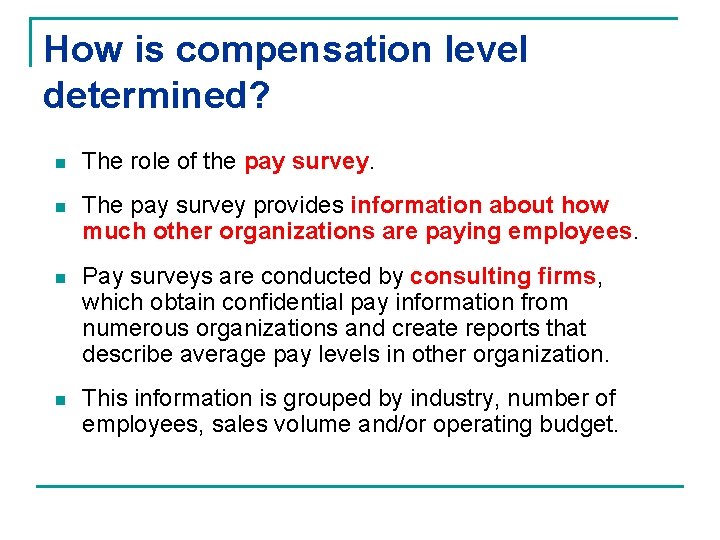
How is compensation level determined? n The role of the pay survey. n The pay survey provides information about how much other organizations are paying employees. n Pay surveys are conducted by consulting firms, which obtain confidential pay information from numerous organizations and create reports that describe average pay levels in other organization. n This information is grouped by industry, number of employees, sales volume and/or operating budget.
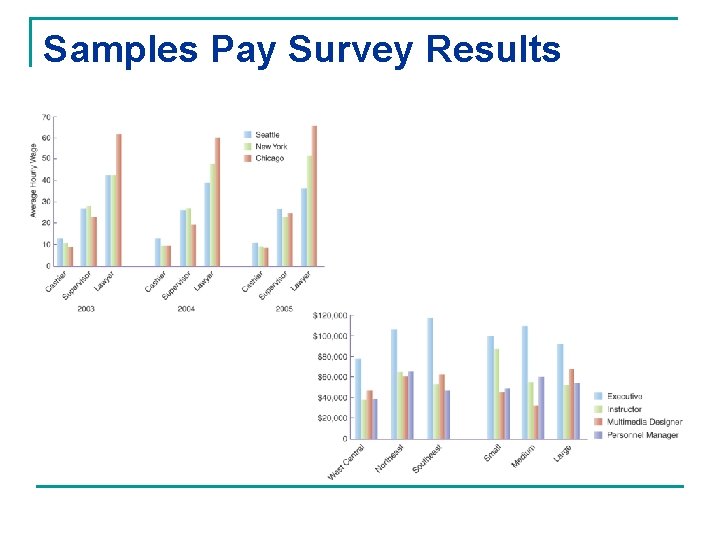
Samples Pay Survey Results
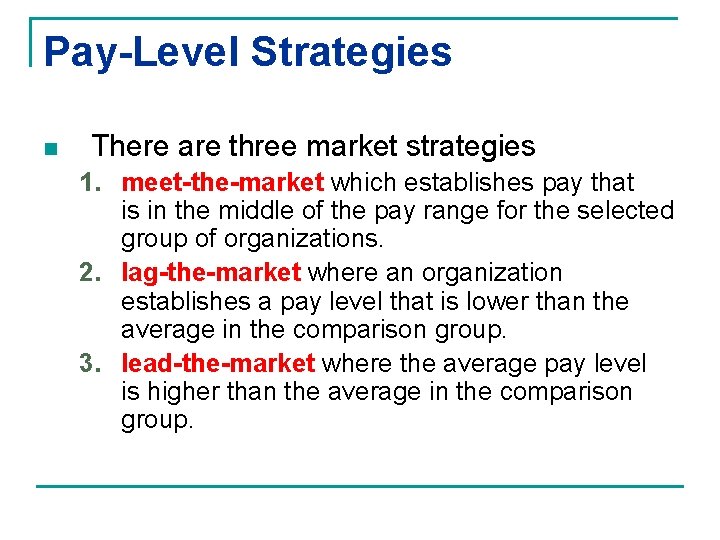
Pay-Level Strategies n There are three market strategies 1. meet-the-market which establishes pay that is in the middle of the pay range for the selected group of organizations. 2. lag-the-market where an organization establishes a pay level that is lower than the average in the comparison group. 3. lead-the-market where the average pay level is higher than the average in the comparison group.
How is compensation structure determined? n The pay structure focuses on how compensation differs for people working in the same organization: q q Job-based pay focuses on evaluating different tasks and duties associated with various jobs in the organization. Skill-based pay focuses on the difference in skill and ability required to perform the job.
- Slides: 16