
MOTIVATING DISENGAGED AND RELUCTANT STUDENTS LEARNERS USING BRAIN

MOTIVATING DISENGAGED AND RELUCTANT STUDENTS (LEARNERS) USING BRAIN BASED STRATEGIES Ernest H. Johnson, Ph. D.
DISENGAGED: The action or process of withdrawing (emotionally or physically) from involvement in an activity, situation, or group. RELUCTANT LEARNERS: They avoid challenges, don’t complete tasks, and are satisfied to “just get by. ” They have the potential to excel but don’t seem to care about achieving in school. How to motivate Disengaged and Reluctant Learners? – Maybe the better question is how can teachers create the conditions for students to discover ways to motivate themselves?
AGENDA 1. Introduce you to my TOOLKit 2. Get you thinking about Disengaged Students 3. Encourage you to think about Intrinsic Drives 4. Inspire you to use a few strategies Ernest H. Johnson, Ph. D. Email: Johnsone@NCCAT. org

STRATEGY 1. ONE SIZE DOES NOT FIT ALL! DEVELOP YOUR OWN TOOLKIT! http: //nclmsliteracyhub. pbworks. com/ • North Carolina Literacy Network Tool. Kit
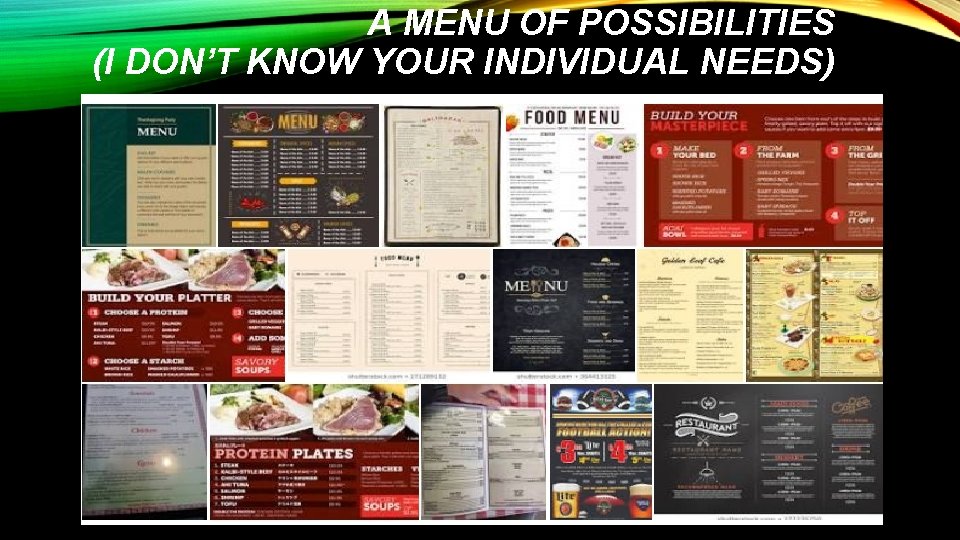
A MENU OF POSSIBILITIES (I DON’T KNOW YOUR INDIVIDUAL NEEDS)
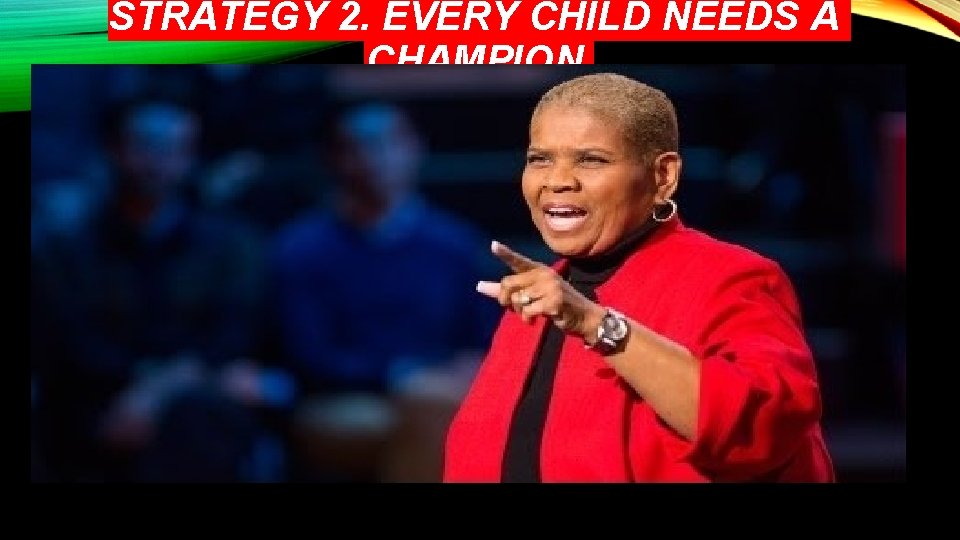
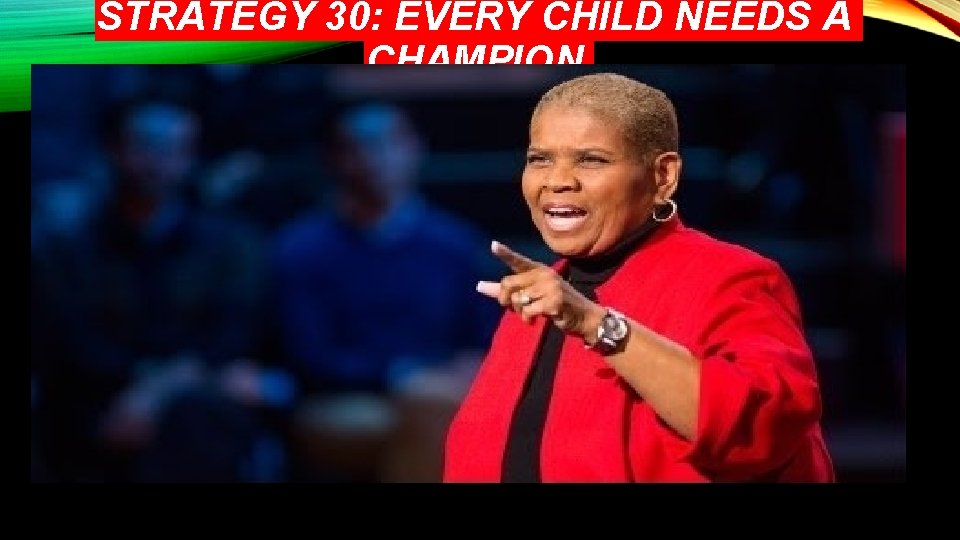
STRATEGY 2. EVERY CHILD NEEDS A CHAMPION

QUESTION HOW DID RITA DEFINE CHAMPION?
RITA PIERSON *An Adult who will never give up on students. *An Adult who understands the power of connections. *An Adults who insists that the student becomes the best they can possibly be. *An Adult who encourages students to not be afraid to take risks and to think!
QUESTION FOR “BUDDY TALK” IN WHAT WAYS ARE YOU A CHAMPION FOR YOUR STUDENTS?

EVERY CHILD NEEDS A CHAMPION • https: //www. youtube. com/watch? v=SFn. MTHh. Kdkw
http: //nclmsliteracyhub. pbworks. com/ North Carolina Literacy Network Tool. Kit Toolkit Motivating Disengaged and Reluctant Students (Learners) Using Brain Based Strategies
STORY (OUR HOOK), TEACH, AND TOOLS/STRATEGIES Motivating Disengaged Students is about. . . Marketing – The Hook!
STORY (OUR HOOK), TEACH, AND TOOLS/STRATEGIES Motivating Disengaged Students is about. . . Effective Marketing – The Hook! https: //youtu. be/IHc. WPVb. DAr. U https: //youtu. be/F 86 J 8 d. Mj. Tlo https: //youtu. be/MImy. Gk. Pzx. SE
STRATEGY 3. STORY (OUR HOOK), TEACH, AND TOOLS
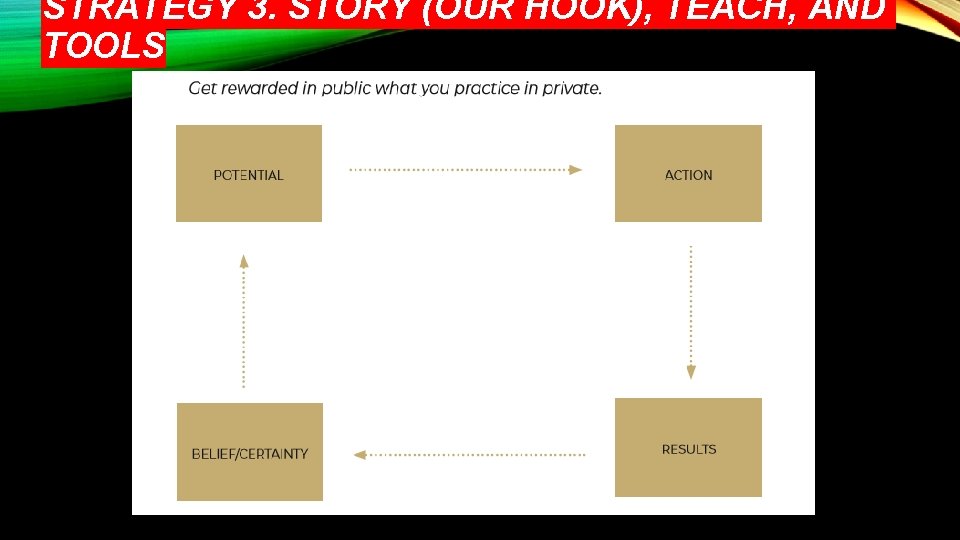
STRATEGY 3. STORY (OUR HOOK), TEACH, AND TOOLS • Reasons aren’t going to get your students (or you) to where you want to go, results come from an obsession with getting them (and you) to TAKE ACTION… • How many students (or teachers) do you know that know what to do but don’t do what they know… Decide up front, why you’re wanting to motivate your students. . . and Your Story! Massive Action + Certainty + Effective Execution = Cure All
STRATEGY 3. STORY (OUR HOOK), TEACH, AND TOOLS QUESTION: What is your story? My story – • Average student in HS – doing enough to get by and stay out of trouble, Reluctant/Dormant Learner • Quiet, but wanted to be part of a group (Basketball Team…and Football) • Got into trouble in 9 th grade – After church on Sunday afternoon – the same year my mother and father got a divorce ((Mrs. Walker’s talk)) • Faith Lee, my 10 th grade Art Teacher: “Its OK for lines to be crooked” • Larry Sturgeon, my 10/11 th grade Marine Biology Teacher: “Don’t settle for less than the best” • Cecil Boyd, my 12 th grade advanced math teacher: “I am not deceived by your performance in my class, I know you are the smartest student in the class”
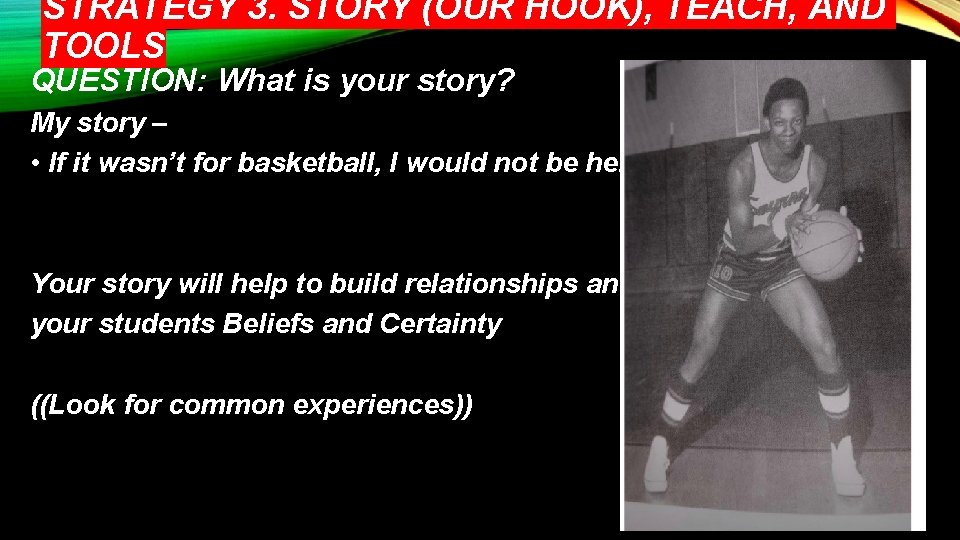
STRATEGY 3. STORY (OUR HOOK), TEACH, AND TOOLS QUESTION: What is your story? My story – • If it wasn’t for basketball, I would not be here… Your story will help to build relationships and shift your students Beliefs and Certainty ((Look for common experiences))
HOW DO YOU CREATE A FIELD OF DREAMS? https: //www. youtube. com/watch? v=5 Ay 5 Gq. Jw. HF 8&list=PL 803 C 9 C 5 ED 35313 F 2 https: //www. youtube. com/watch? v=MYKsbld 6 LII https: //beinspiredchannel. com/morning-motivation-successful-people-first-8 minutes-morning/

HOW DO YOU CREATE A FILED OF DREAMS?
JOURNALING – OUTCOME JOURNALING Use Empowering Questions to Tap Into Compelling Reasons… ((Questions change what we focus on)) *WHY do I need to…Begin with the end in mind? *What will my teaching be like next month (next year or three years from now) if I…Begin with the end in mind?
STRATEGY 4: PLACE THE SPOTLIGHT ON YOUR STUDENTS – CREATING A HOMECOURT ADVANTAGE IN YOUR CLASSROOM Spotlighting is a process for knowing anything you want to know about your students. • If you want to know how to motivate students, then have each student to write down 15 or more ways. • Have the students share one of their ideas with each student in the classroom (the student writes down the name of the student and the idea that was shared). • Then, ask students one at a time to take the spotlight seat, and have each student they shared an idea with to stand up and describe the idea they got from the student.
STRATEGY 4: SPOTLIGHTING Spotlighting Activity ((Locate on PBWorks Site)) 1. In team sports, the term home advantage – also called home court advantage – describes the benefit that the home team is said to gain over the visiting team. 2. This benefit has been attributed to psychological effects supporting fans have on the competitors; to psychological or physiological advantages of playing in familiar situations; to the disadvantages away teams suffer from changing time zones or climates, or from the rigors of travel; and to specific rules that favor the home team. 3. Spotlighting is all about building a "Home Court
SPOTLIGHT - ACTIVITY If I can use Spotlighting to get to know my students, then what is it that I want to know about you (my students)? Question: List five ways to motivate students …Example…
STRATEGY 5: SET GOALS – USE THE 7 HABITS! Begin with the end in mind! This is one of The 7 Habits of Highly Effective People in the famous Stephen Covey 's bestseller. In its most basic form, it refers to always having the image of the end of a task as your frame of reference to evaluate everything else.
JOURNALING – OUTCOME JOURNALING Use Empowering Questions to Tap Into Compelling Reasons… ((Questions change what we focus on)) *WHY do I need to…Begin with the end in mind? *What will my teaching be like next month (next year or three years from now) if I…Begin with the end in mind?
STRATEGY 6: SET GOALS – CLARITY TOOL Fuzzy Targets Don’t Get Hit – Use a “Clarity Tool “ To Choose Your Goals! 1) If you could look back over a year from now with that year being your best year for motivating disengaged and reluctant learner, what did you do? (( 7 Minutes to Write – Make a List))
SETTING GOALS Fuzzy Targets (Goals) Don’t Get Hit – 1) Current Status – Reconciling where to place our attention: What we Have to and Should do and Must do for our job vs What we Want to do for our students! 2) As look back over that year from now, how did those top priority items align with what you have to do and should do and must do?
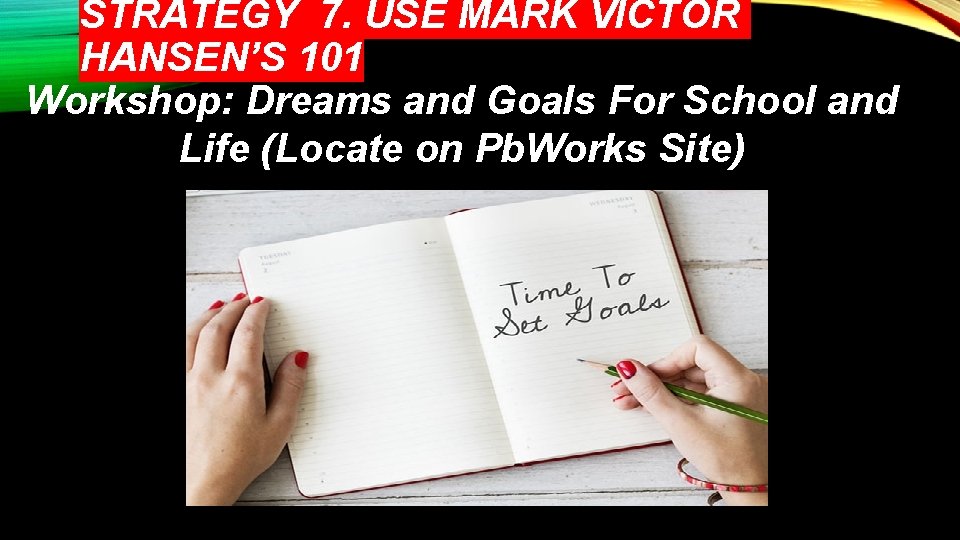
STRATEGY 7. USE MARK VICTOR HANSEN’S 101 Workshop: Dreams and Goals For School and Life (Locate on Pb. Works Site)
SETTING GOALS – TOP 10 TIPS FOR SETTING GOALS 1. Your most important goals must be yours. 2. Your goals must mean something to you. 3. Your goals must be specific and measurable. 4. Your goals must be flexible. 5. Your goals must be challenging, exciting. 6. Your goals must be in alignment with your values. . 7. Your goals must be well-balanced. 8. Your goals must be realistic. 9. Your goals must include contribution.
STRATEGY 7. USE MARK VICTOR HANSEN’S 101 Workshop: Dreams and Goals For School and Life (Locate on Pb. Works Site) I’m spending the time inside of here because with HS students (Soon To Be Adults) we got to help them tap into their own Intrinsic drives!
STRATEGY 8. SPOTLIGHT – ACTIVITY FOR PLC’S – FOCUSING ON WHAT TO DO…RATHER WHAT “WHY” WE HAVE THE PROBLEMS (USE THESE TWO QUESTIONS) 1) What are your biggest obstacles to minimizing disengagement in your classroom? (Let’s Solve It! – Everyone make a list to 10 ways to solve it for Jane’s class…) 2) What your biggest opportunities for minimizing disengagement in your classroom?
SPOTLIGHT (BRIEF FORMAT) – ACTIVITY Make a list of at least 5 ways you minimize disengagement in the classroom. ((Have a compelling talk about each with 5 different people, take notes about what was said and the person name)) The action or process of withdrawing (emotionally or physically) from involvement in an activity, situation, or group.
STRATEGY 9: PLACE THE SPOTLIGHT ON YOUR STYLE AND JBOPPP’S Judgements, Beliefs, Opinions, Positions, Perceptions, Prejudices • Automatic • Unconscious • Habits We are often Prisoners of our own Intellect!

YOUR STYLE: HOW CONSCIOUS ARE YOU OF YOUR STYLE? Questions • How would you describe your (Teaching) Style? • Has your Style hindered your relationships with some students? • Is it important for teachers to know their Style? • Is it important for our students to know their Style? • What professional development and/or training have you had on Styles?
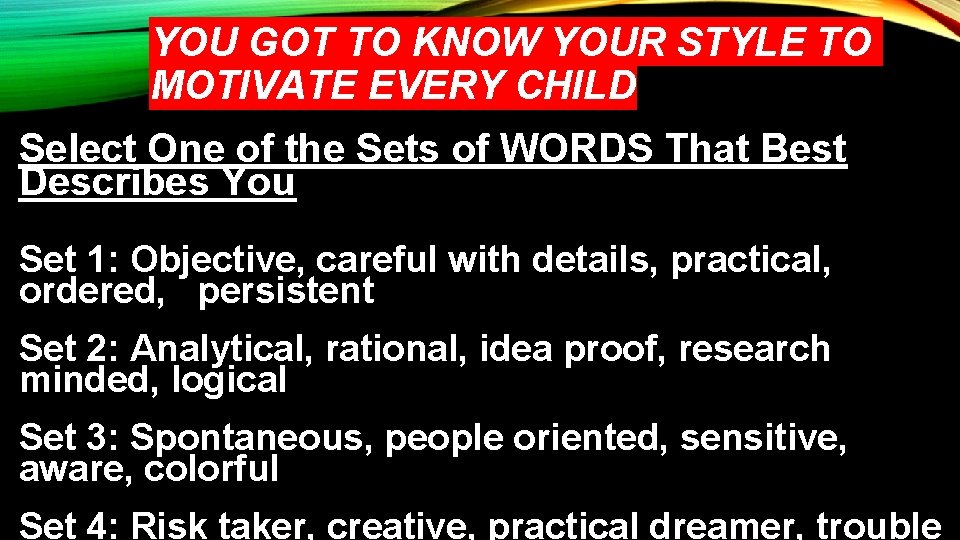
YOU GOT TO KNOW YOUR STYLE TO MOTIVATE EVERY CHILD Select One of the Sets of WORDS That Best Describes You Set 1: Objective, careful with details, practical, ordered, persistent Set 2: Analytical, rational, idea proof, research minded, logical Set 3: Spontaneous, people oriented, sensitive, aware, colorful Set 4: Risk taker, creative, practical dreamer, trouble
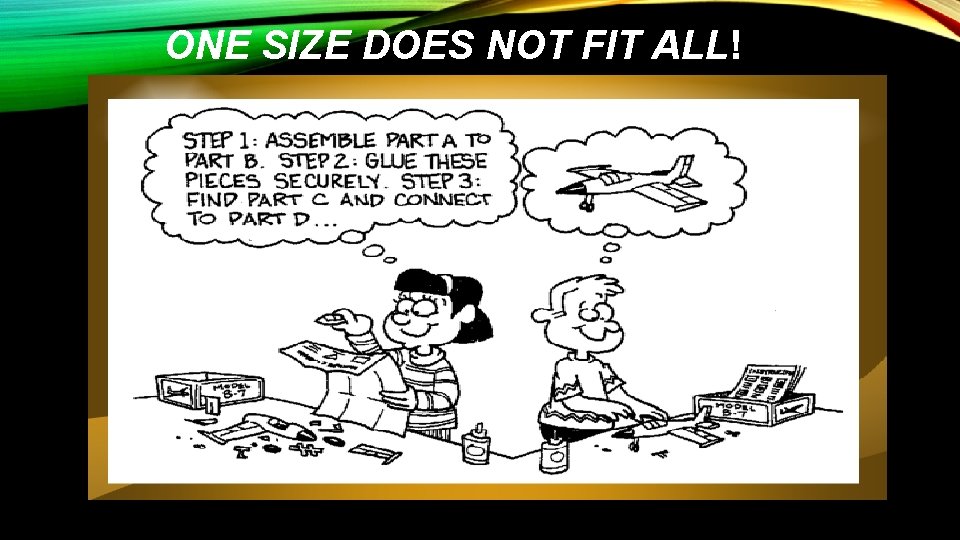
ONE SIZE DOES NOT FIT ALL!

ONE SIZE DOES NOT FIT ALL!
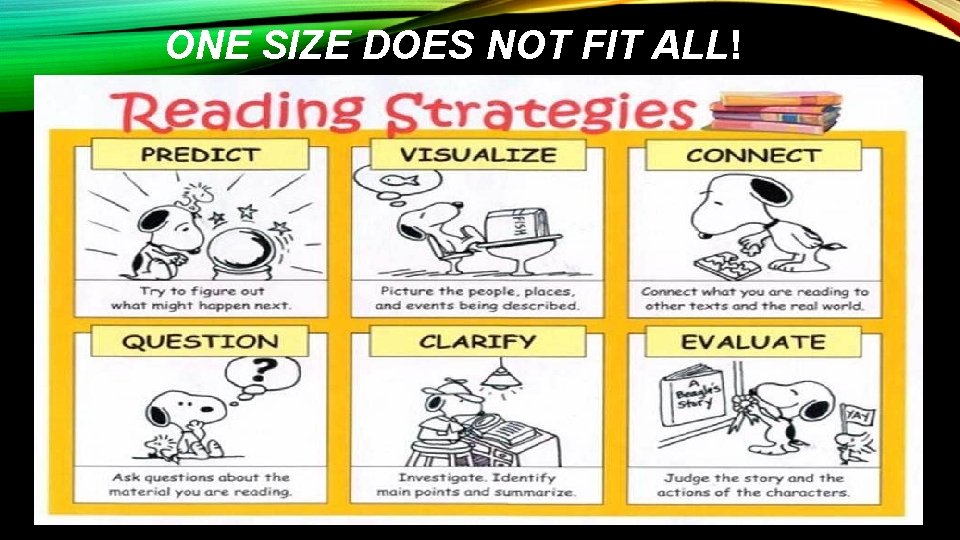
ONE SIZE DOES NOT FIT ALL!
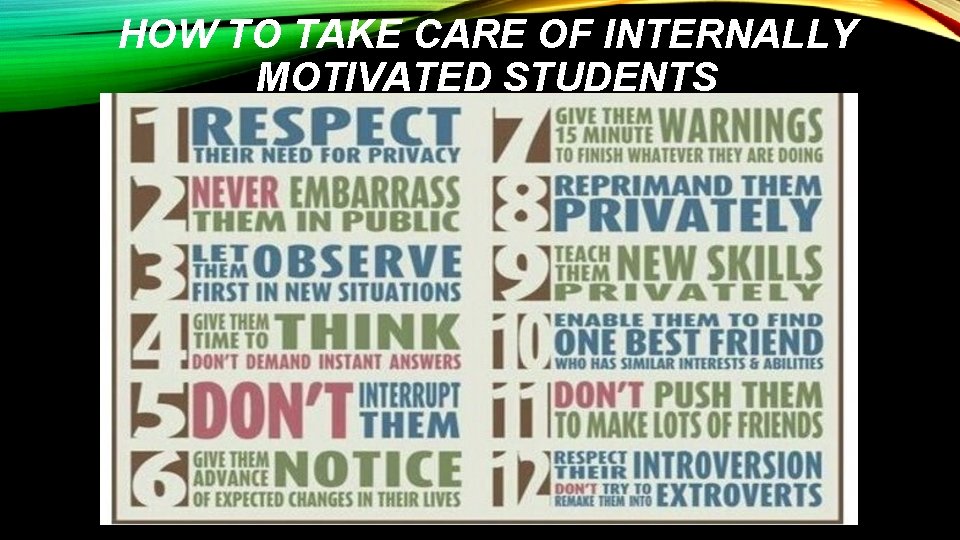
HOW TO TAKE CARE OF INTERNALLY MOTIVATED STUDENTS
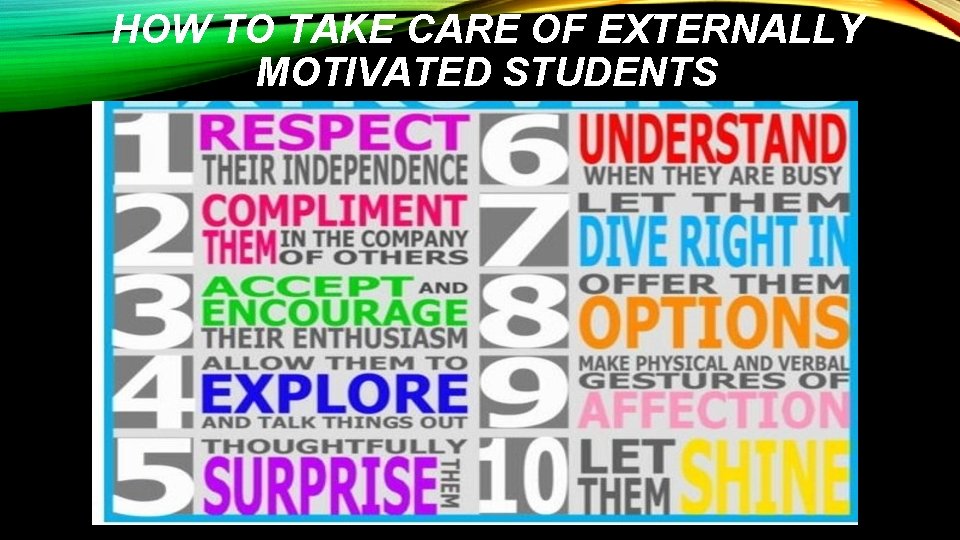
HOW TO TAKE CARE OF EXTERNALLY MOTIVATED STUDENTS
STRATEGY 10: QUICK WRITES Throw out a question and ask students to quickly brainstorm on paper as many answers as they can. • Then do a “popcorn share” where students stand up whenever they want and throw out an idea. This could be an alternative to something like “round-robin reading, ” which puts reluctant learners in the hot seat. In this case, you will set your students up for success by giving them time to brainstorm first -- the answers are right in front of them. This strategy has the added value of forcing students to listen closely to
STRATEGY 10: QUICK WRITES • On a single piece of paper, write down everything you know about Motivating Students ((in 147 seconds)) • Chose your two responses (put a 1 and 2 by these) • Put your name on the page
STRATEGY 11: ENGAGE STUDETS AS SOON AS THEY ENTER For example, 1. Have students come in and look at a list of adjectives on the board, many of which stretch your students’ vocabularies. 2. Then, ask students to greet two other students and use one of the adjectives to describe how they are feeling today. 3. The activity gets them up, moving and ready to learn, plus they’ve used a new vocabulary word in relation to themselves, checking in with their community along the way.
STRATEGY 12: VOTE • Activate students’ brains with a quick round of voting. • Place three learning goals for the day up on the board and asks students to vote for the one they think is most important. All three goals are good ones and there’s no wrong answer ((They are related to your lesson)) • The reluctant learners get to look around the room and see who else thinks just like them. • This quick activity helps create curiosity
STRATEGY 12: VOTE • Place three learning goals for the day up on the board and asks students to vote for the one they think is most important. • 1) Be attentive and discover at least three new ideas or strategies I can use to motivate students… • 2) Look for confirmation about what I’m already doing and develop a plan for getting better… • 3) Let’s go to Bojangles for Coffee and a Biscuit and have our meeting there…
STRATEGY 13: SET CLASSROOM GOALS EVERYDAY 1. A great practice for both teacher and students to set personal learning goals every day that are achievable, believable and measurable. 2. Part of reaching that goal is publicizing that goal. 3. Making goal-setting a regular and visible part of one's teaching practice models it for students, BUT… 4. It’s very important to leave time at the end of the day for students to revisit the goals they set. That opportunity to reflect will help them see and value what they did during the day, as well as where they may have fallen short of the goal.
STRATEGY 14: FORM GROUPS • Get comfortable constantly asking students to break into groups to share with one another, brainstorm or collaborate, and always sets a time limit for the conversation, like 77 seconds. • Use bizarre time limits (77 seonds) and your students will think you are actually watching the clock and they will get to work quicker. • This practice will promote more time on task than a generic five-minute time limit, which students know is just as likely to stretch into eight minutes.
STRATEGY 15: FOCUS ON THE ABCS ACCEPTANCE, BELONGING AND COMMUNITY • Without this set of ABCs, traditional ABCs will not be as successful. • Without any doubt, there is a rush to cover content in many schools and classrooms, but teaching is not about what is covered today, it’s about what is uncovered in students. • Don’t be so standards-driven that you forget
STRATEGY 16: CONTINUALLY CHANGE THE “STATE” OF THE CLASSROOM • These are changes in: 1) Who is providing the information 2) Who is doing the talking 3) The format information is provided. • For every 10 to 15 minutes of content, teachers need to give students two minutes of “chew time. ”
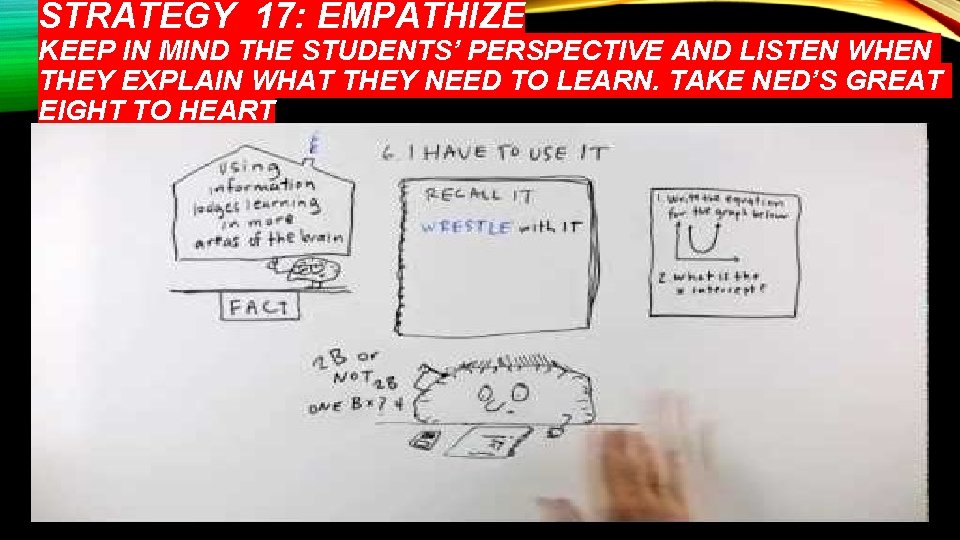
STRATEGY 17: EMPATHIZE KEEP IN MIND THE STUDENTS’ PERSPECTIVE AND LISTEN WHEN THEY EXPLAIN WHAT THEY NEED TO LEARN. TAKE NED’S GREAT EIGHT TO HEART
Take Ned’s Great Eight 1. I feel OK, my basic needs are met 2. It matters and its relevant 3. It’s active – physically, cognitively, and emotionally 4. It stretches me, but I feel that I can learn it 5. I have a coach 6. I have to use it to better understand it 7. I have to think back on it, reflect, meta-cognitive process 8. I plan my next steps and go forward https: //www. youtube. com/watch? v=p_Bskc. XTqp. M#action=share
STRATEGY 18: DO A BRAIN CHECKLIST • Build a safe environment for everyone • Recognize diversity in my classroom • Assessment must be formative, authentic and ongoing • Instructional strategies should be a palette of opportunities • New models Be open to new ideas and adventures. Each day you walk into the classroom, you never know what you’re going to get!
STRATEGY 19: USE QUESTIONS FOR REFELCTIONS AND DEEP THINKING ABOUT LESSONS Some metacognitive questions that can get them thinking this way include: 1. What part of the lesson did you like the best? 2. What part of the lesson was the most difficult for you? 3. What part of the lesson can you use to better your life? 4. Why part of the lesson is related to something you always know?
If you don’t give students time to reflect, to connect, to marinate on the information, they’re going to regurgitate what’s right there in front of them without even thinking. Reflection and rehearsal of what was learned is crucial to move information from working memory into long-term memory ((My story about taking Notes)) If you had to use just one of the Reflection Questions other than #1, which one would you
STRATEGY 20: CHUNK INFORMATION 1. Make information more easily digestible for students by being more purposeful in our delivery of information. Too often teachers deliver an entire lesson without letting students move or discuss once. 2. Students will give up if they are overloaded with facts, and chunking provides a way to pause and let students think over what they’ve learned. Breaks to assimilate information are crucial for mastery. 3. Lesson mastery means students have mastered
STRATEGY 21: PROPS Keep a box of props for when you are teaching. Throws something to a student when it’s their turn to talk so they have something to focus on. This works well for kids with attention problems, as well as for the tactile learners.
STRATEGY 22: BREAKS • Short video clips can be a great brain break. • A great clip can be interpreted in multiple ways. • You can use these breaks to foster divergent thinking. • Funny and Unusual Pictures of Animals
STRATEGY 23: POST-ITS Post-It note discussions are a good way to get all students involved without making anyone uncomfortable by putting them on the spot. Ask an open-ended question. It could be an activator at the beginning, a marinator in the middle, or even a summarizer to test for understanding at the end of a lesson. Students jot down their answers to the prompt on Post-Its. English Language learners or special needs students could write just one word or draw something. Then students share in pairs. Even the most reticent learner is OK sharing one-on-one. Post all the responses on a
STRATEGY 24: MAKE SNOWBALLS The Snowball brain break is a great way to summarize learning at the end of a lesson (and should be done when students are on their way to recess or at the end of the day). Students write answers to a prompt on a piece of paper. On the count of three, they throw their “snowball” randomly up and away (but not at anyone). Then everyone grabs a snowball that landed near them. It’s a way you can purposefully pause, have them reflect and make connections. You can Snowballs in all subjects, sometimes asking students to write three new vocabulary words they learned, or three successes they had in that lesson, or three questions. Students love it and it’s inclusionary because it’s anonymous. Students

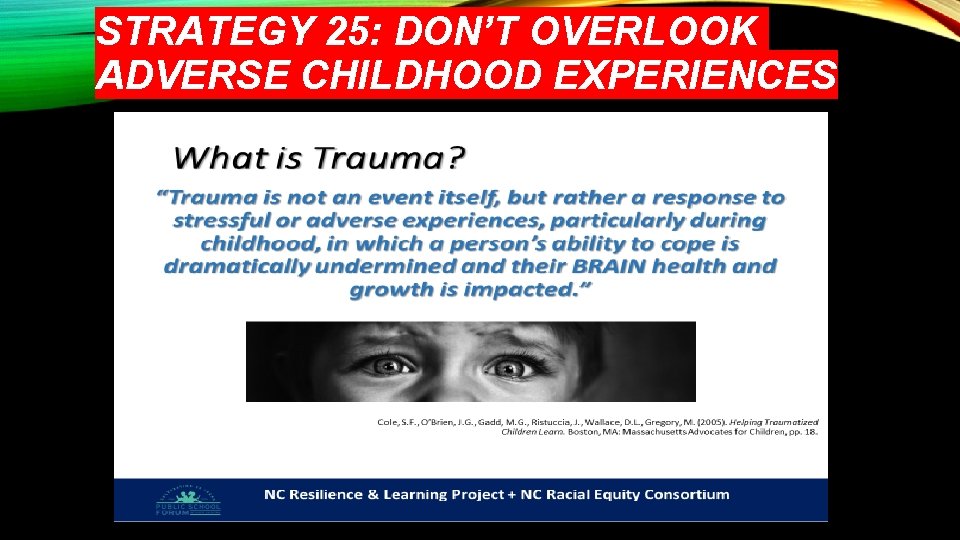
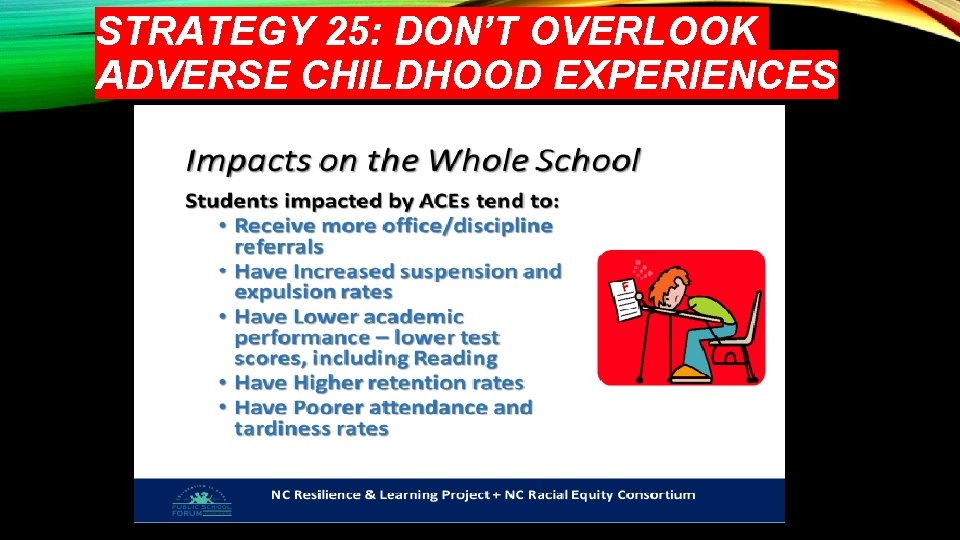
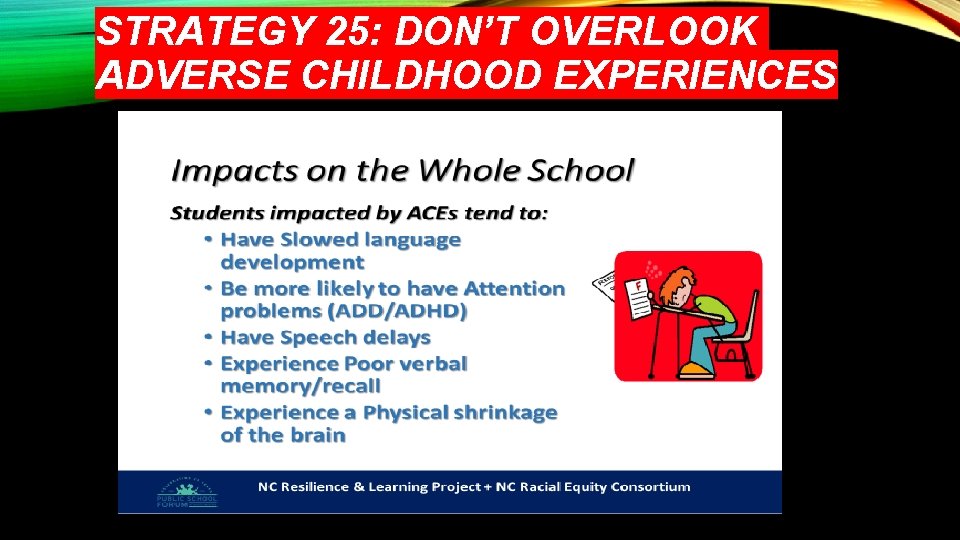
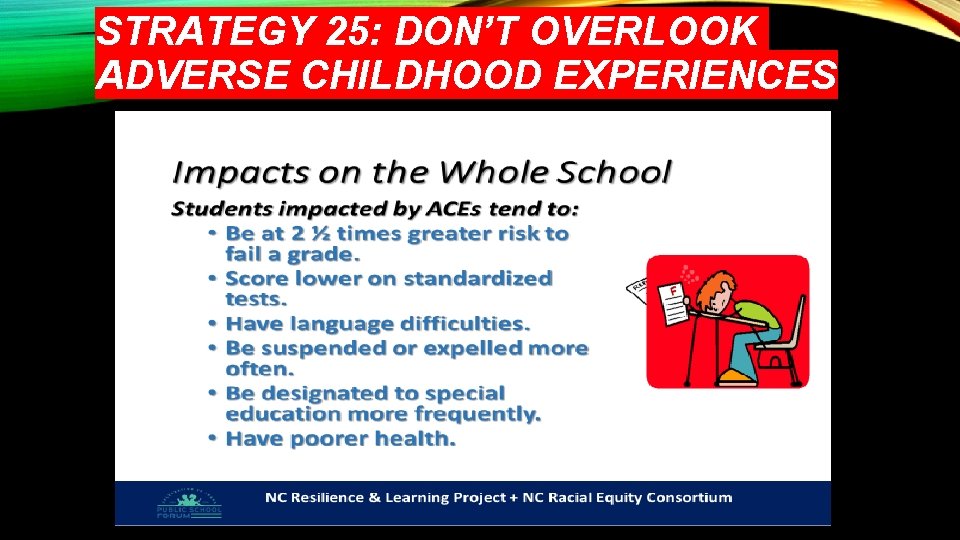
STRATEGY 25: DON’T OVERLOOK ADVERSE CHILDHOOD EXPERIENCES (ACE’S) An ACE score is a tally of different types of abuse, neglect, and other hallmarks of a rough and traumatic childhood. According to the Adverse Childhood Experiences study, the rougher your childhood, the higher your score is likely to be, and the higher your risk for later health problems.
STRATEGY 25: DON’T OVERLOOK ADVERSE CHILDHOOD EXPERIENCES
STRATEGY 25: DON’T OVERLOOK ADVERSE CHILDHOOD EXPERIENCES
STRATEGY 25: DON’T OVERLOOK ADVERSE CHILDHOOD EXPERIENCES
STRATEGY 25: DON’T OVERLOOK ADVERSE CHILDHOOD EXPERIENCES
STRATEGY 26: BALANCED INQUIRY The Interactive Lecture engages students and builds strong permanent memories by leading students through the following four-phase learning process: 1. Connect: The lecture begins with a hook that helps students connect their experiences and background knowledge to the lecture topic. 2. Organize: The lecturer presents information in manageable "chunks, " which students record on visual organizers. 3. Dual-Code: The lecturer uses a variety of presentation techniques to make content more memorable.
STRATEGY 27: MIND-STREAMING Mind-streaming is another fun brain break activity that also gives students a chance to recall what they’ve learned and teach one another. • Have students randomly pair up and then each person teaches the other the most important things they’ve learned in that lesson. (Pair Up and Teach One Concept You Learned Today) • Each person will remember different things, and when there is overlap that will reinforce the concept. • It’s simple, effective and doesn’t require any teacher preparation because students are teaching
STRATEGY 28: BE INTERACTIVE • Always try to make tasks engaging and interactive by giving students enough knowledge, giving them the language to express it, giving them an authentic reason for the interaction they’re engaged in, prime them with interesting questions, establish a community of learners that support each other, and give students a clear understanding of the task. • If these elements are part of every class, all students can be successful.

STRATEGY 29: HOPE Have Only Positive Expectations
STRATEGY 30: EVERY CHILD NEEDS A CHAMPION

EVERY CHILD NEEDS A CHAMPION • https: //www. youtube. com/watch? v=SFn. MTHh. Kdkw
- Slides: 70