
MotionCompensated Noise Reduction of B W Motion Picture
Motion-Compensated Noise Reduction of B &W Motion Picture Films EE 392 J Final Project ZHU Xiaoqing March, 2002
Background/Motivation • Digitization of conventional video data • • Major artifacts of B&W motion picture films: • • Achieving motion picture films Blotches: “dirty” spots and patches Scratch lines Intensity instability(illumination fluctuation) … Previous work • • • General denoising: joint filtering Line Scratch: model-based detection & removal Blotchy noise: seldom addressed specifically My Work
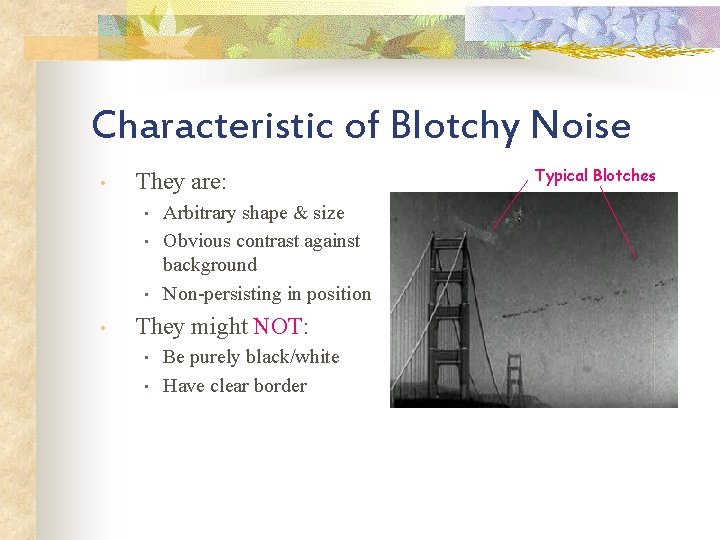
Characteristic of Blotchy Noise • They are: • • Arbitrary shape & size Obvious contrast against background Non-persisting in position They might NOT: • • Be purely black/white Have clear border Typical Blotches
Problems & Challenges • Huge amount of data • • • Motion estimation tricked by : • • • Restrict computational complexity Automatic processing preferred Presence of noise Illumination Change Blurry scene for fast motion … Automatic detection not easy • • Blotchy noise not readily modeled Decision rely on motion compensated results
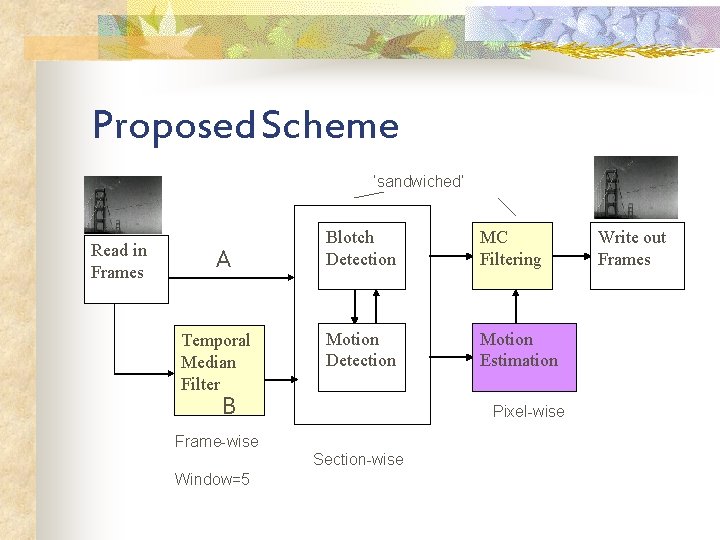
Proposed Scheme ‘sandwiched’ Read in Frames A Temporal Median Filter Blotch Detection MC Filtering Motion Detection Motion Estimation B Pixel-wise Frame-wise Section-wise Window=5 Write out Frames

Pre-processing • • Five-tap temporal median filter Effectiveness: • • • Generally denoising the sequence Already removed blotchy noises Introduced artifacts • • Blurring of spatial details at regions w/ motion missing fast moving lines
Joint Motion/Noise Detection • Section-wise scanning of each frame • • • 8*8 sections, non-overlapped “sandwiched” decision-making Two stage detection: • 1 st step: “change” detection • • • Criterion: Mean Absolute Difference(MAD) & “Edgy Area” Original frame vs. filtered frame 2 nd step: motion or noise • • Criterion: ratio of MAD (should be consistent) Reject changes due to blotchy noise
Motion Trajectory Estimation • • Only computed for detected sections Dense motion vector field estimation • Block-matching: • • Full search • • Neighboring block for each pixel: 9*9 Translational model assuming smoothness of MVF search range (-16, +16) weighted MAE criterion • • Error weighted by reciprocal of frame difference (A-B) rejecting noisy data
Post-processing • • Goal: remove artifact with MC-filtering Available versions of the frame • • Original Temporally median-filtered Motion compensated (bi-directional) Modification strategy: • • • Linear combination Median filter (spatial/temporal/joint) Hybrid method (with edge information)
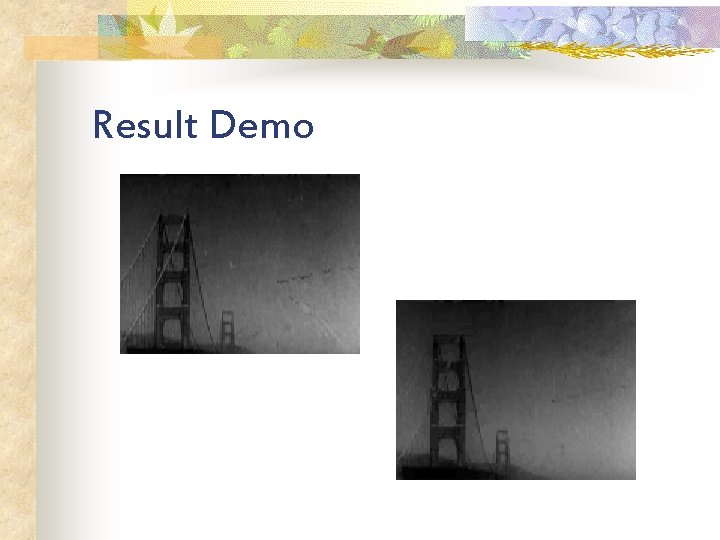
Result Demo
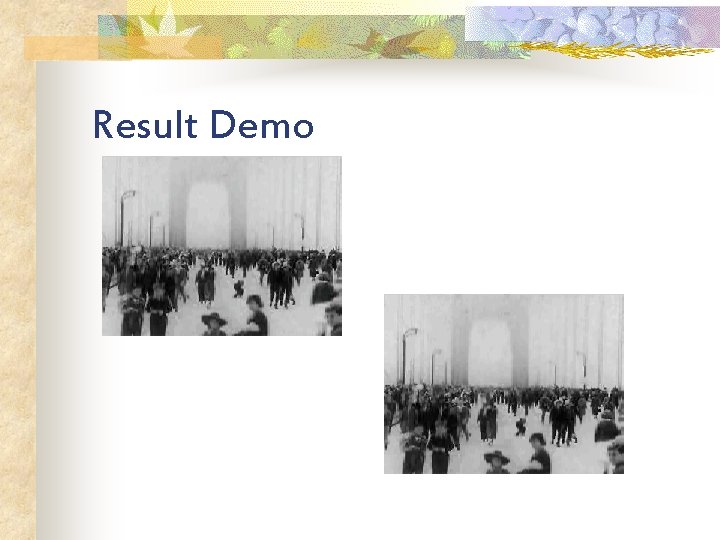
Result Demo
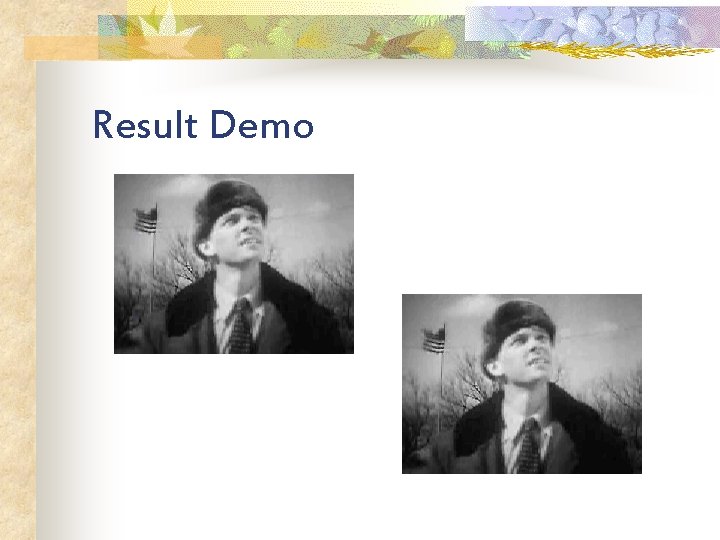
Result Demo
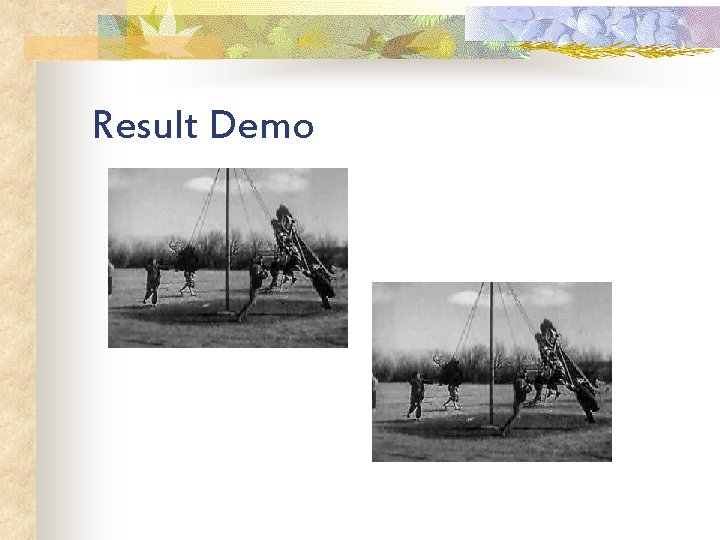
Result Demo
- Slides: 13