
Motion Speed Velocity and Acceleration Frames of Reference
- Slides: 18
Motion Speed, Velocity, and Acceleration
Frames of Reference The object or point from which movement is determined w Movement is relative to an object that appears stationary w Earth is the most common frame of reference w
Questions w What is the frame of reference for the sunset? w What is a frame of reference? w What is the most common frame of reference?
Question w When can you determine how fast you are going in a jet plane?
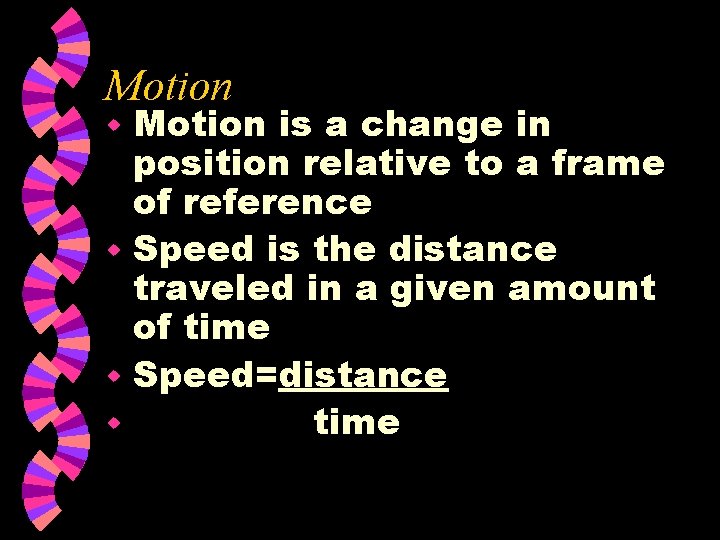
Motion is a change in position relative to a frame of reference w Speed is the distance traveled in a given amount of time w Speed=distance w time w
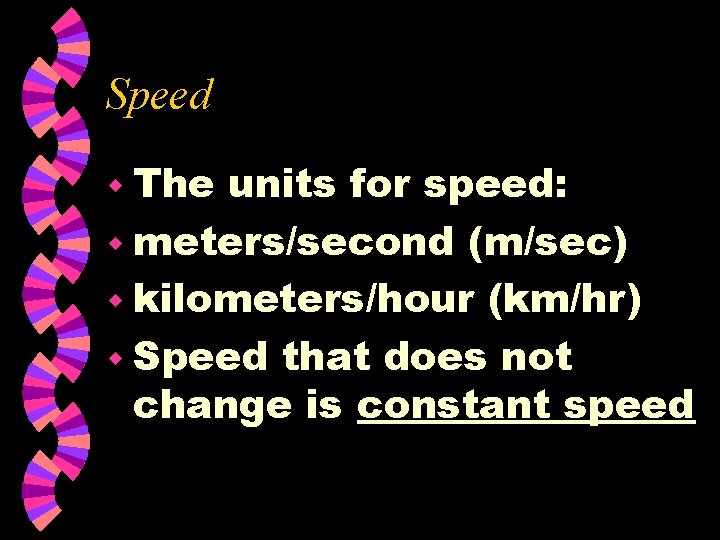
Speed w The units for speed: w meters/second (m/sec) w kilometers/hour (km/hr) w Speed that does not change is constant speed
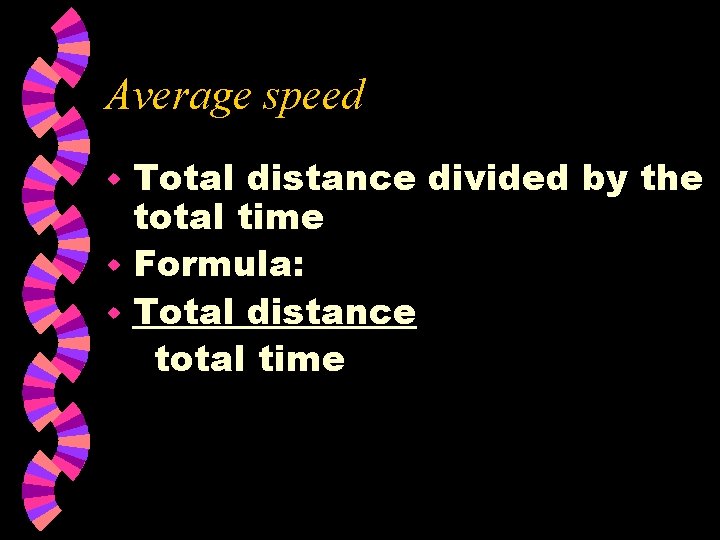
Average speed Total distance divided by the total time w Formula: w Total distance total time w
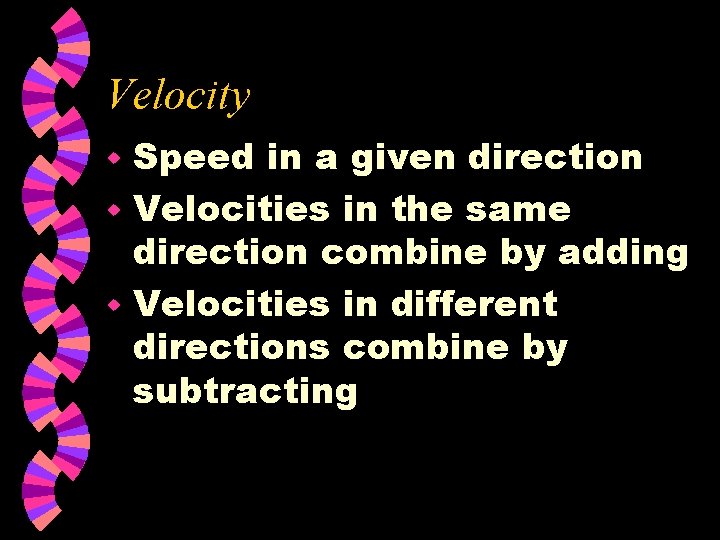
Velocity Speed in a given direction w Velocities in the same direction combine by adding w Velocities in different directions combine by subtracting w
Interesting fact w Rockets are launched in the same direction of the earth’s rotation to get an extra boost of 1800 km/hr to its speed
Questions w What is motion? w What is speed? How is it calculated? w What is average speed?
Questions w How is velocity different from speed? w Which two factors determine an object’s velocity?
Acceleration w The change in velocity w Acceleration is measured in m/sec or m/sec 2 w Formula is: w (final velocity - original velocity)/time
Deceleration vs. Acceleration w. A decrease in velocity is deceleration or negative acceleration w A distance-time graph for acceleration is always a curve
Centripetal Acceleration w Acceleration directed toward the center of circular path
Questions w What is acceleration? w What is the shape of a distance-time graph for acceleration? w What is centripetal acceleration?
Momentum w Momentum is equal to the mass of an object times its velocity w momentum= mass x velocity
Conserving Momentum w The law of conservation of momentum states that the total momentum is NOT lost, only transferred
Questions What is momentum? w What happens to momentum as the mass of a moving object increases? w What is the formula for momentum? w What is the law of conservation of momentum? w