
Motion of Objects Motion Speed and Velocity Vocabulary
Motion of Objects Motion, Speed, and Velocity
Vocabulary for Motion motion acceleration negative acceleration speed momentum positive acceleration velocity reference point instantaneous speed distance average speed displacement
Motion • motion is any change in location • In order to tell if the location has changed, you must use a reference point - a location that is chosen to represent motion • When something is moving relative to a reference point, its position relative to the reference point is changing. You can always choose a reference point depending on the motion of the object you want to describe. • cars • clouds See pg. 303 and Let’s Demonstrate!
Distance and Time • Time is the amount of period an object can take. • Distance is the length of the path between two points. • To be able to calculate the distance of two objects, we need to think of the displacement between them. • Displacement refers to the difference between two points. If an object make a complete circle there is no displacement because they have ended in the same place that they started. However, if an object travels in a straight line, the total distance traveled would then be its displacement.
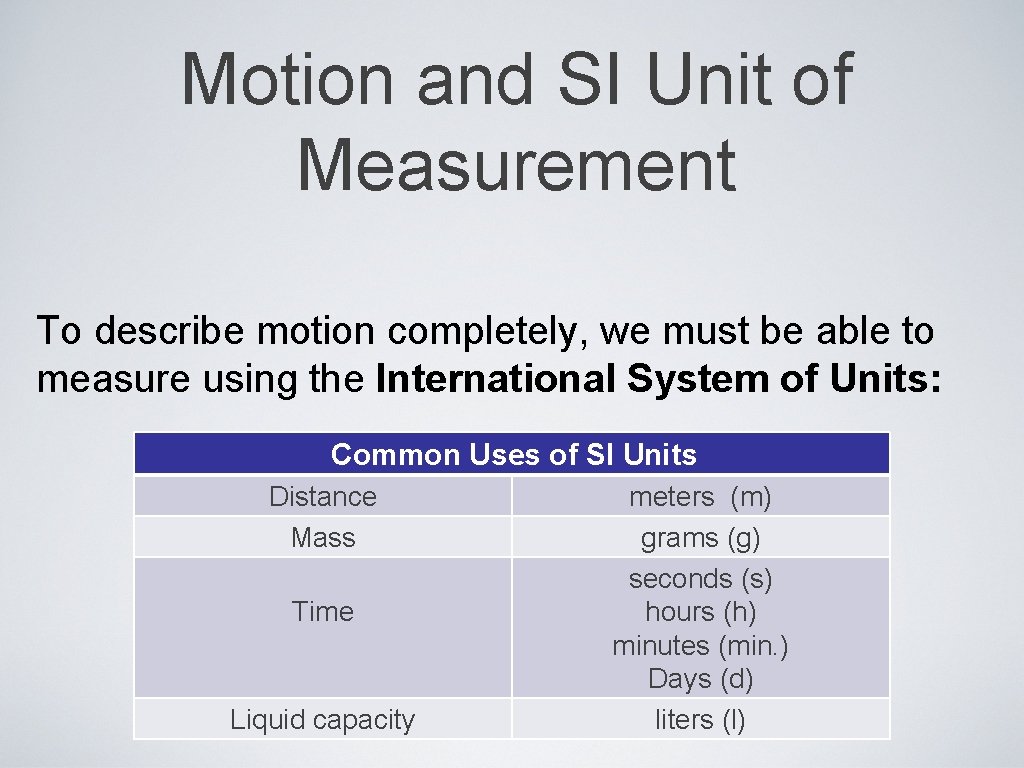
Motion and SI Unit of Measurement To describe motion completely, we must be able to measure using the International System of Units: Common Uses of SI Units Distance Mass Time Liquid capacity meters (m) grams (g) seconds (s) hours (h) minutes (min. ) Days (d) liters (l)
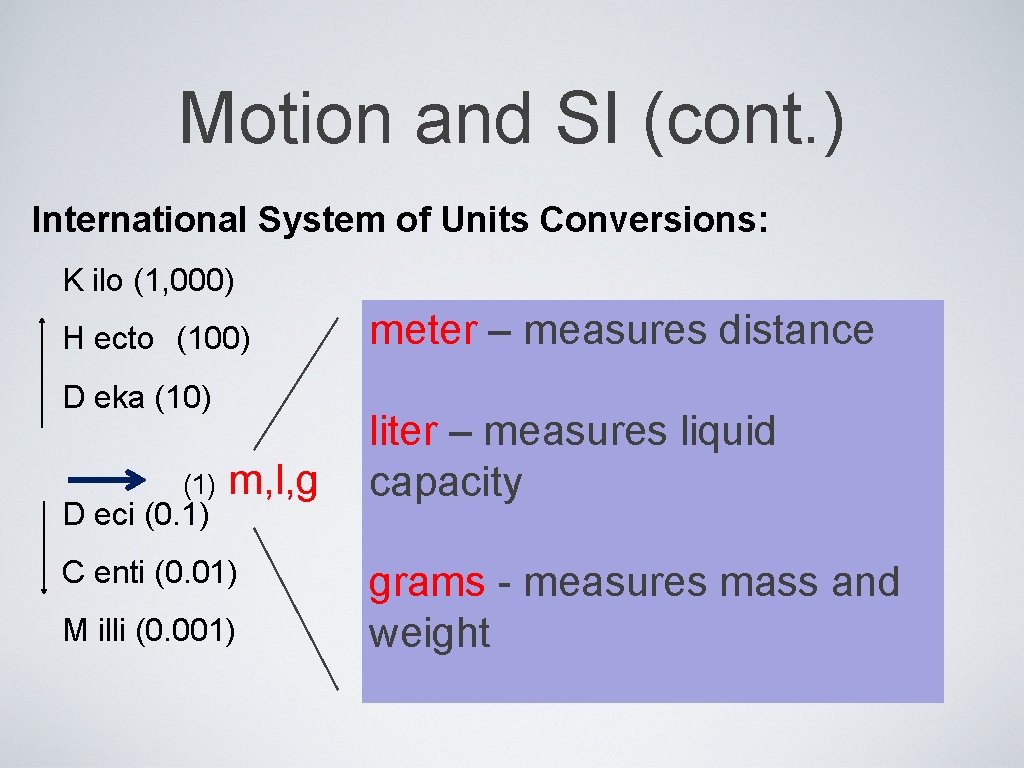
Motion and SI (cont. ) International System of Units Conversions: K ilo (1, 000) H ecto (100) D eka (10) (1) D eci (0. 1) m, l, g C enti (0. 01) M illi (0. 001) meter – measures distance liter – measures liquid capacity grams - measures mass and weight
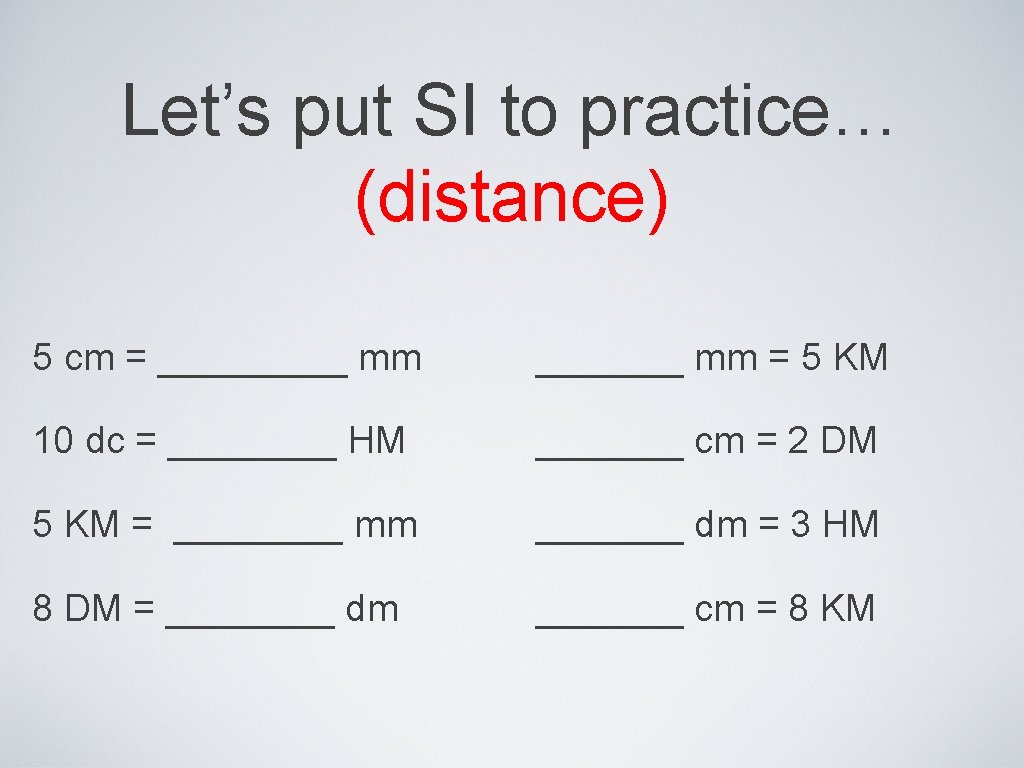
Let’s put SI to practice… (distance) 5 cm = _____ mm _______ mm = 5 KM 10 dc = ____ HM _______ cm = 2 DM 5 KM = ____ mm _______ dm = 3 HM 8 DM = ____ dm _______ cm = 8 KM

Speed and Velocity • The speed of an object is the distance the object moves per unit of time, while velocity is the speed of an object and its direction of motion. • In order to calculate the speed of an object we must use the following formula which calculates the distance traveled divided by the time it takes to travel that distance • EX: V=d/t, Variable Description Measurement v speed m/s = meters per second d distance meters t time seconds

Calculating speed, distance, or time • Remember, V = D/T • Let’s Practice! • If a bicycle travels a total distance of 12 m in 4 s. What is its average speed? • What is the average speed of a sprinter who runs 100 m in 10 s? • What if an airplane travels 1, 350 km in 3 h, what is its average speed? Let’s put our practice to work!

Calculating Velocity Remember, velocity is the speed of an object and its direction of motion. EX: If you were walking N at a speed of 2 m/s, your velocity would be 2 m/s N. EX 2: If you are walking east at the same speed, your velocity would then be 2 m/s E. • Your velocity can change weather you change your speed or your direction!! Let’s Practice on pg. 311!
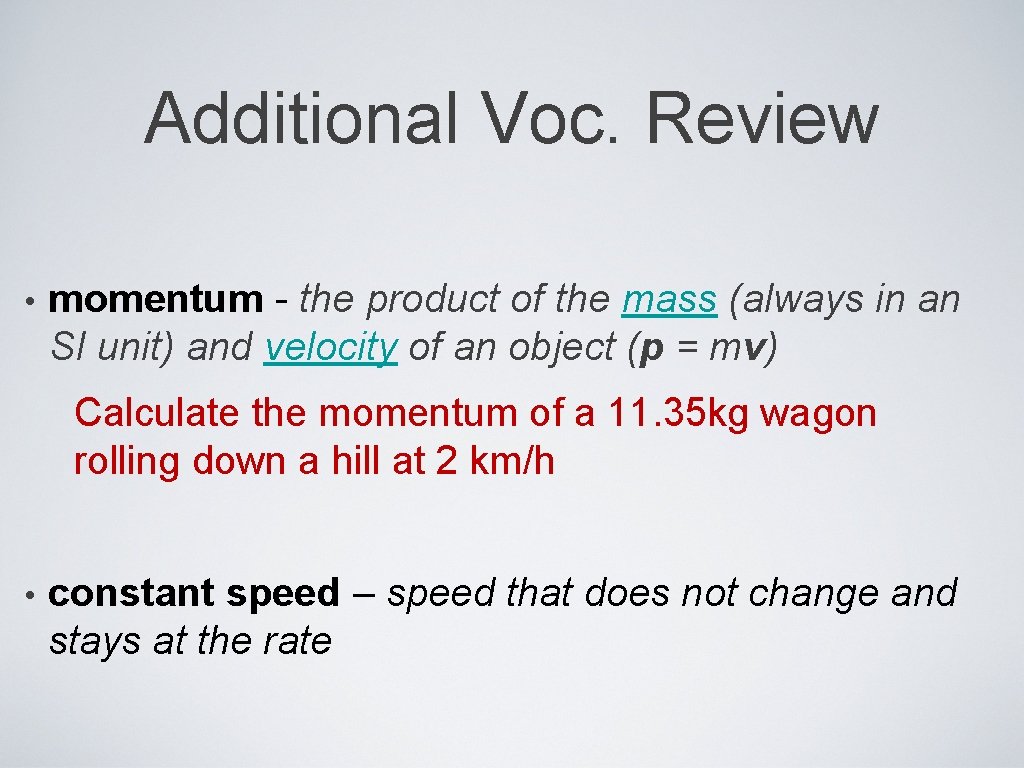
Additional Voc. Review • momentum - the product of the mass (always in an SI unit) and velocity of an object (p = mv) Calculate the momentum of a 11. 35 kg wagon rolling down a hill at 2 km/h • constant speed – speed that does not change and stays at the rate
Graphing Motion • You can show the motion of an object on a line graph by plotting distance versus time. • Graphing the motion of an object allows you to interpret the slope so that you can see how fast one variable changes in relation to the other variables in the graph. • In order to calculate a slope you must follow the following formula: Slope = Rise/Run
Graphing Practice (see pgs. 312 -313)
Acceleration • Acceleration is any change in velocity. Therefore, if either speed or direction changes, so does the acceleration of the object. See pg. 315 pictures as examples Formula: Change in velocity (Vf – Vi) _________ Time Let’s Practice! pgs. 316 and 317
Additional Vocabulary Review • Remember, acceleration is any change in velocity, that means an object is either increasing speed, decreasing speed, or changing direction. • Keeping this in mind, we must understand then, that positive acceleration can be any change in direction but with increasing velocity (speed is increasing). • On the other hand, negative acceleration is the opposite as it refers to either a negative change in direction with a decreasing velocity (speed is decreasing).
Graphing Acceleration (see pgs. 318 -319) You can use both a speed-versus-time graph and a distance-versus-time graph to analyze the motion of an accelerating object.
- Slides: 16