
Motion of a ThreePhase Contact Line Len Pismen




- Slides: 33
Motion of a Three-Phase Contact Line Len Pismen, Technion, Haifa, Israel Hydrodynamic theory of moving contact line and its paradoxes. Intermolecular forces, precursor film and disjoining pressure Influence of intermolecular forces on moving contact line Diffuse interface theory of moving contact line Supported by Israel Science Foundation and Minerva Center for Nonlinear Physics of Complex Systems 9/7/2021 1
Hydrodynamic problems involving moving contact lines (a) spreading of a droplet on a horizontal surface (b) pull-down of a meniscus on a moving wall (a) (b) (c) advancement of the leading edge of a film down an inclined plane (e) (d) condensation or evaporation on a partially wetted surface (e) climbing of a film under the action of Marangoni force 9/7/2021 (d) 2
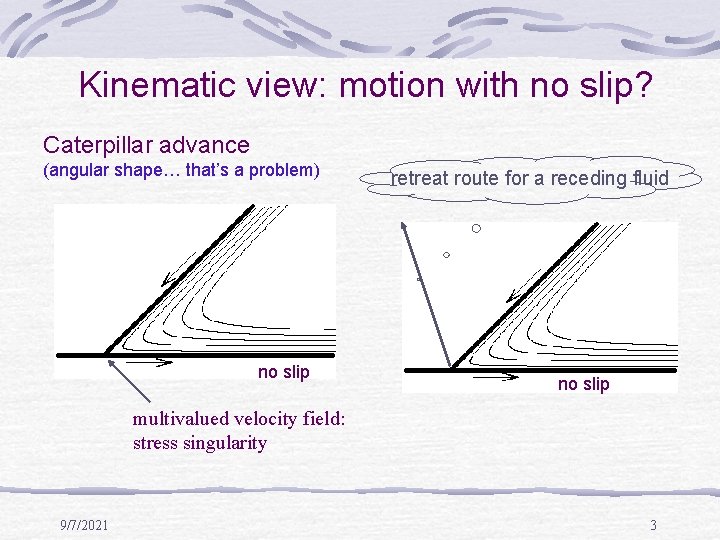
Kinematic view: motion with no slip? Caterpillar advance (angular shape… that’s a problem) no slip retreat route for a receding fluid no slip multivalued velocity field: stress singularity 9/7/2021 3
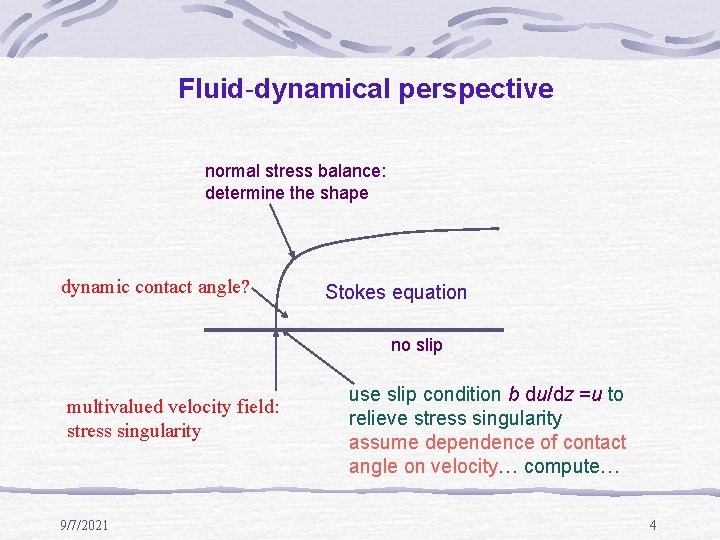
Fluid-dynamical perspective normal stress balance: determine the shape dynamic contact angle? Stokes equation no slip multivalued velocity field: stress singularity 9/7/2021 use slip condition b du/dz =u to relieve stress singularity assume dependence of contact angle on velocity… compute… 4
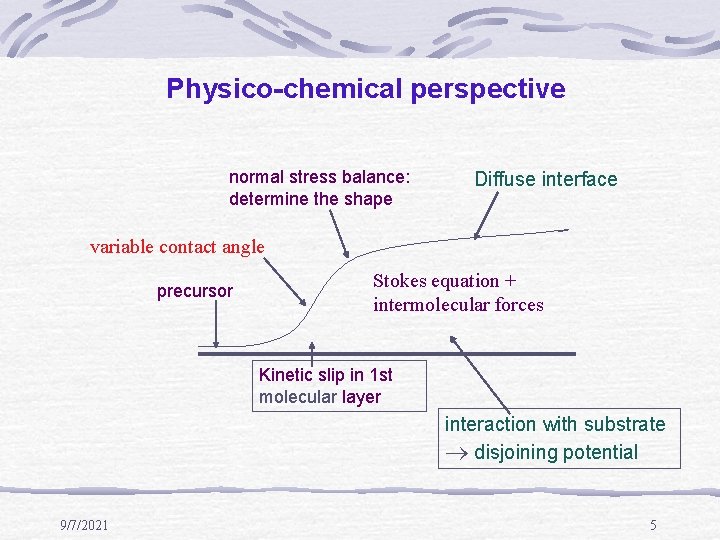
Physico-chemical perspective normal stress balance: determine the shape Diffuse interface variable contact angle precursor Stokes equation + intermolecular forces Kinetic slip in 1 st molecular layer interaction with substrate disjoining potential 9/7/2021 5
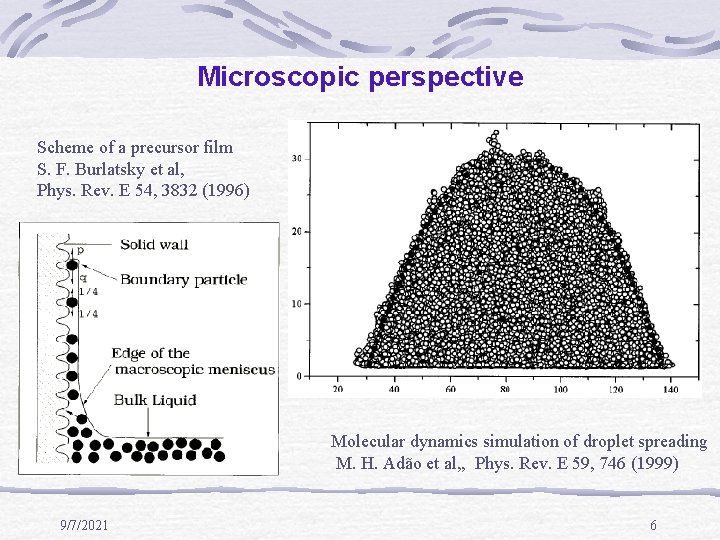
Microscopic perspective Scheme of a precursor film S. F. Burlatsky et al, Phys. Rev. E 54, 3832 (1996) Molecular dynamics simulation of droplet spreading M. H. Adão et al, , Phys. Rev. E 59, 746 (1999) 9/7/2021 6
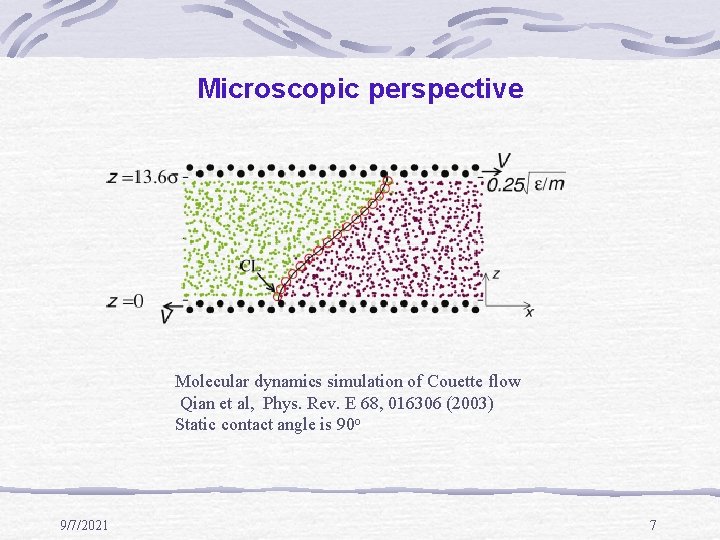
Microscopic perspective Molecular dynamics simulation of Couette flow Qian et al, Phys. Rev. E 68, 016306 (2003) Static contact angle is 90 o 9/7/2021 7
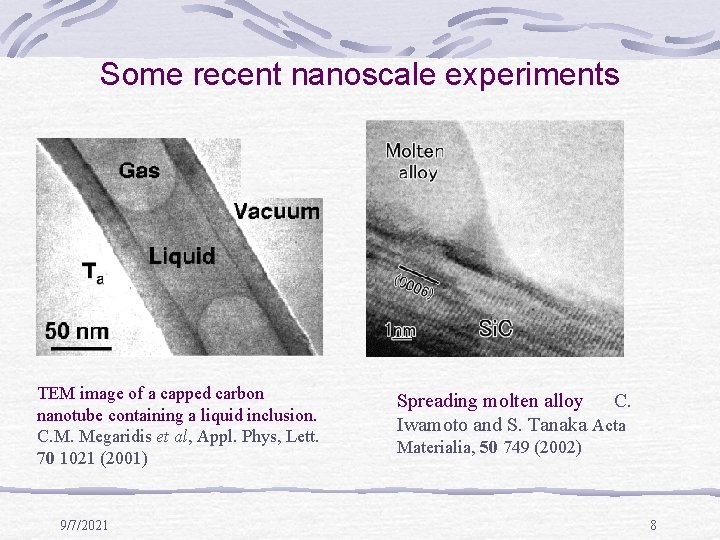
Some recent nanoscale experiments TEM image of a capped carbon nanotube containing a liquid inclusion. C. M. Megaridis et al, Appl. Phys, Lett. 70 1021 (2001) 9/7/2021 Spreading molten alloy C. Iwamoto and S. Tanaka Acta Materialia, 50 749 (2002) 8
Experiments with anisotropic fluids Star-shaped droplet (optical microscopy, excess coverage) Hans Riegler, MPIKG 9/7/2021 Fractal domain (SFM, submonolayer coverage) Hans Riegler, MPIKG 9
Contact line: resolving the paradoxes 9/7/2021 10
Standard Hydrodynamics
Standard hydrodynamic problems spreading of a droplet on a horizontal surface pull-down of a meniscus on a moving wall advancement of a film down an inclined plane 9/7/2021 12
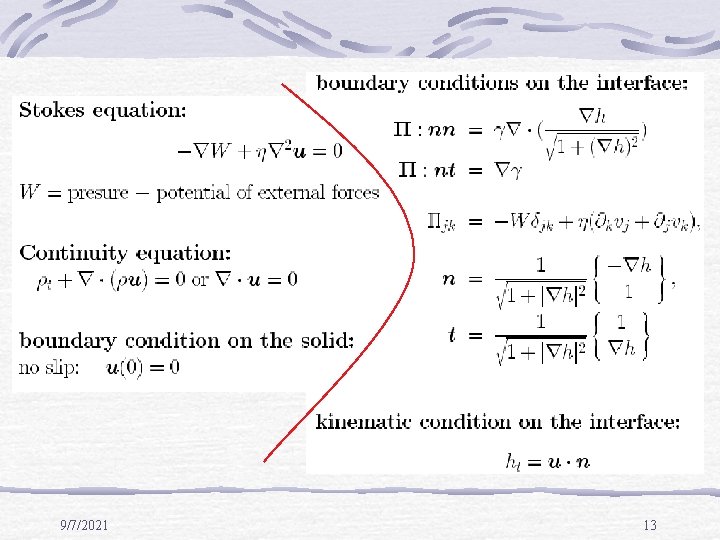
9/7/2021 13
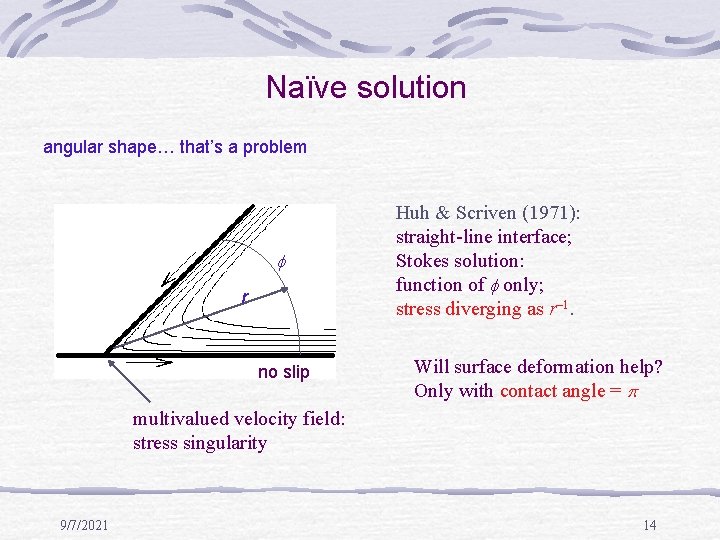
Naïve solution angular shape… that’s a problem f r no slip Huh & Scriven (1971): straight-line interface; Stokes solution: function of f only; stress diverging as r– 1. Will surface deformation help? Only with contact angle = p multivalued velocity field: stress singularity 9/7/2021 14
9/7/2021 15
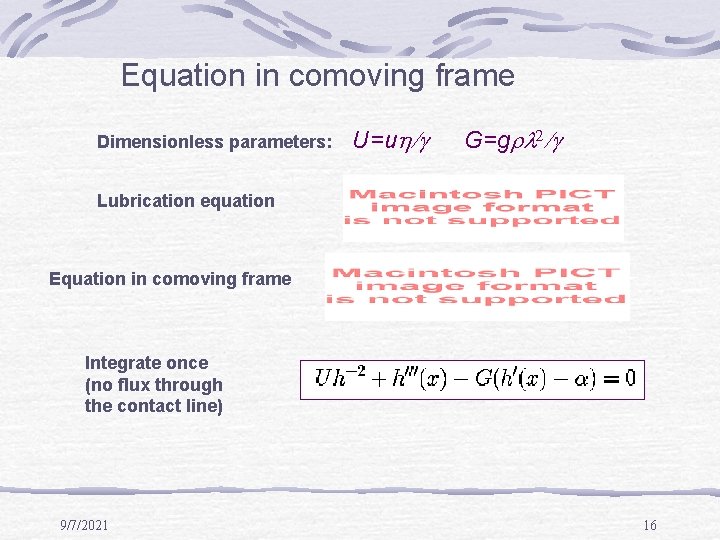
Equation in comoving frame Dimensionless parameters: U=uh/g G=grl 2/g Lubrication equation Equation in comoving frame Integrate once (no flux through the contact line) 9/7/2021 16
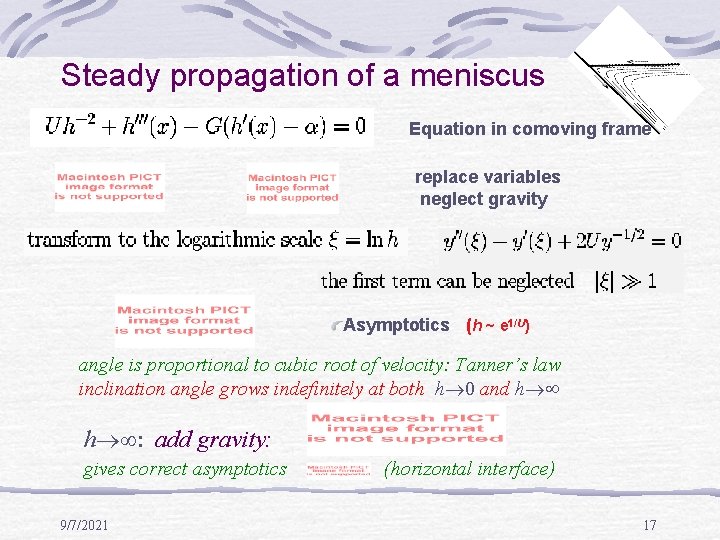
Steady propagation of a meniscus Equation in comoving frame replace variables neglect gravity Asymptotics (h ~ e 1/U) angle is proportional to cubic root of velocity: Tanner’s law inclination angle grows indefinitely at both h 0 and h h add gravity: gives correct asymptotics 9/7/2021 (horizontal interface) 17
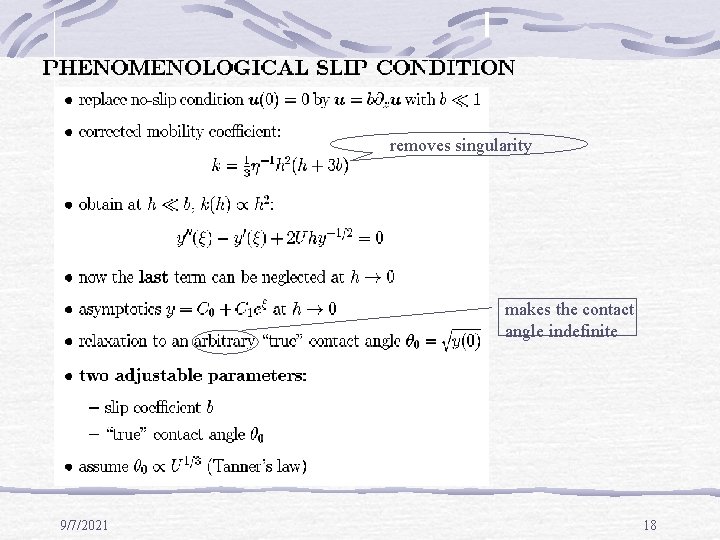
removes singularity makes the contact angle indefinite 9/7/2021 18
Hydrodynamics with intermolecular forces sharp interface
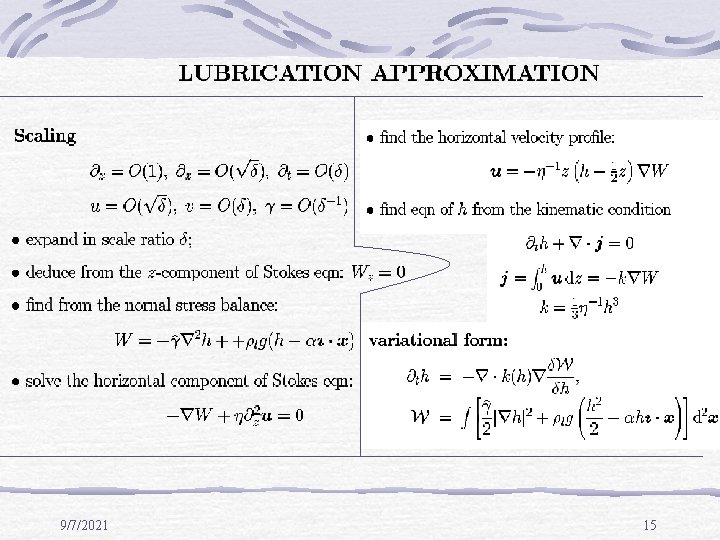
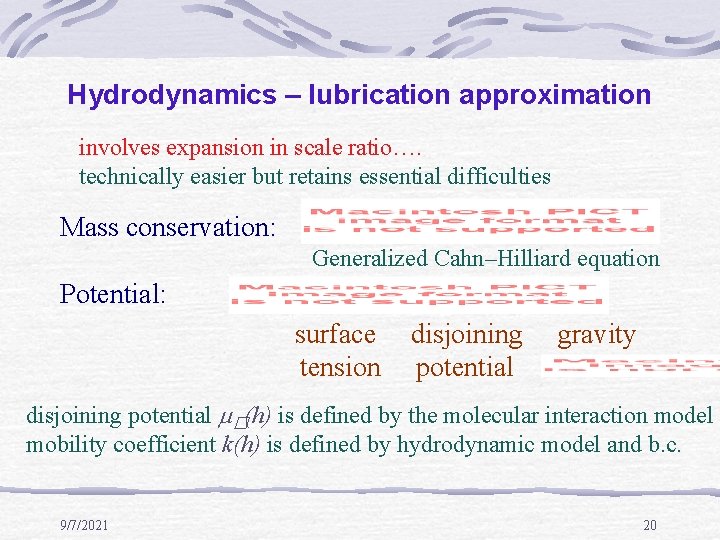
Hydrodynamics – lubrication approximation involves expansion in scale ratio…. technically easier but retains essential difficulties Mass conservation: Generalized Cahn–Hilliard equation Potential: surface tension disjoining potential gravity disjoining potential m�(h) is defined by the molecular interaction model mobility coefficient k(h) is defined by hydrodynamic model and b. c. 9/7/2021 20
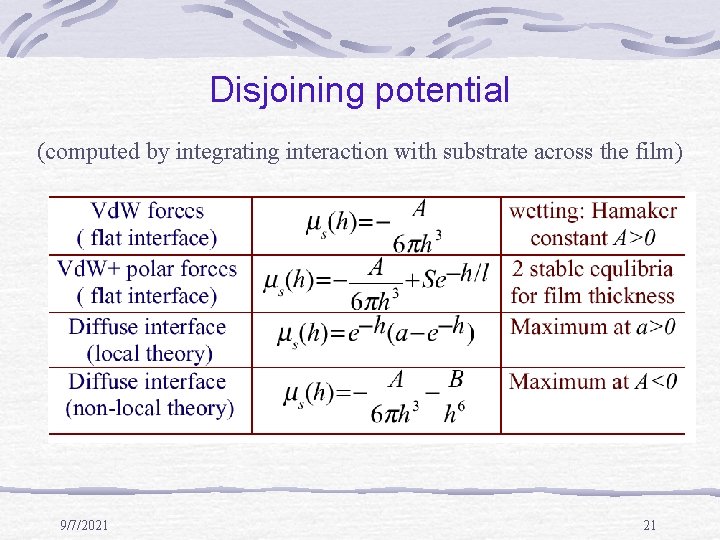
Disjoining potential (computed by integrating interaction with substrate across the film) 9/7/2021 21
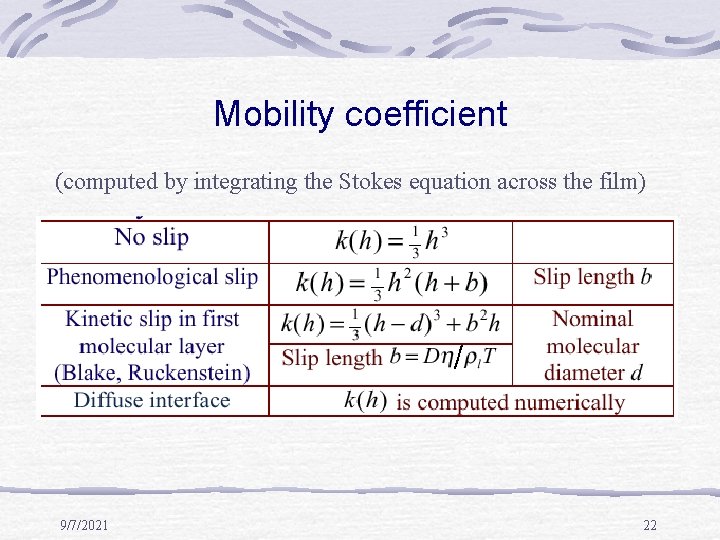
Mobility coefficient (computed by integrating the Stokes equation across the film) 9/7/2021 22
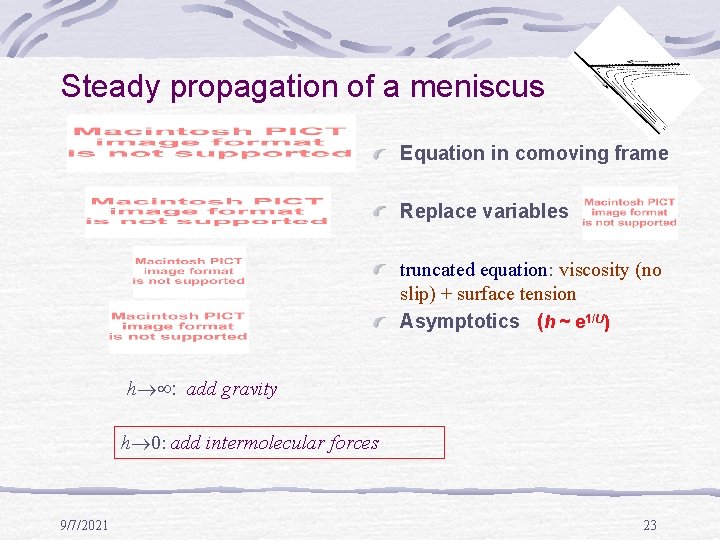
Steady propagation of a meniscus Equation in comoving frame Replace variables truncated equation: viscosity (no slip) + surface tension Asymptotics (h ~ e 1/U) h add gravity h 0: add intermolecular forces 9/7/2021 23
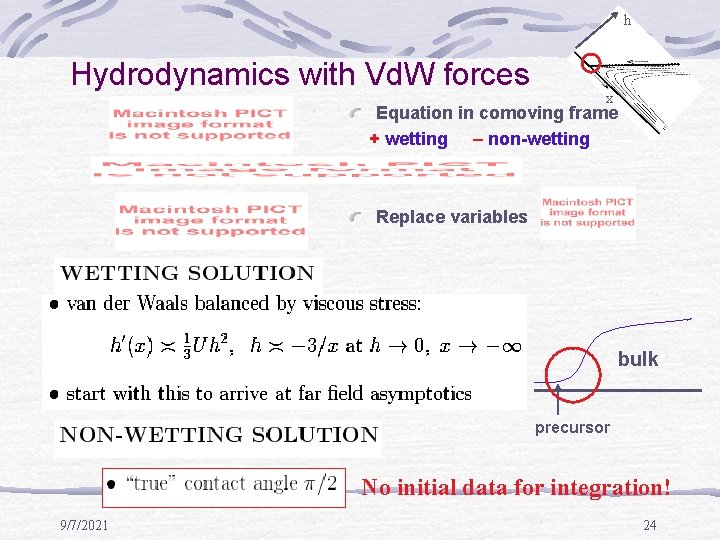
h Hydrodynamics with Vd. W forces x Equation in comoving frame + wetting – non-wetting Replace variables bulk precursor No initial data for integration! 9/7/2021 24
Why perturbing a static solutions does not work 9/7/2021 25
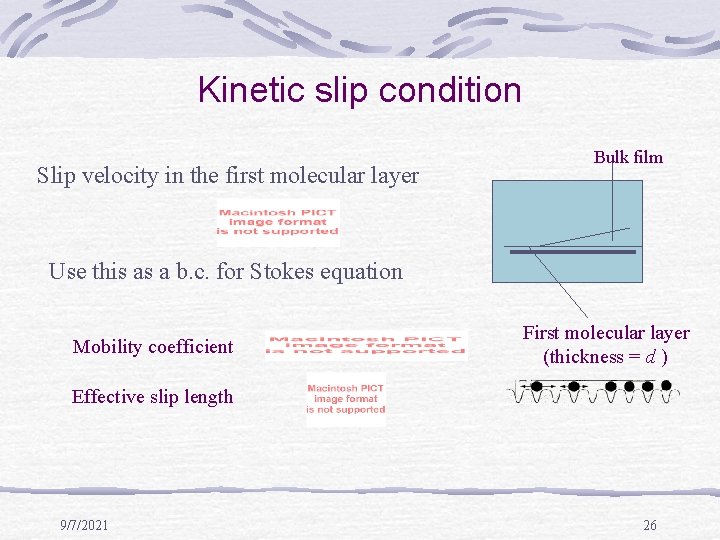
Kinetic slip condition Slip velocity in the first molecular layer Bulk film Use this as a b. c. for Stokes equation Mobility coefficient First molecular layer (thickness = d ) Effective slip length 9/7/2021 26
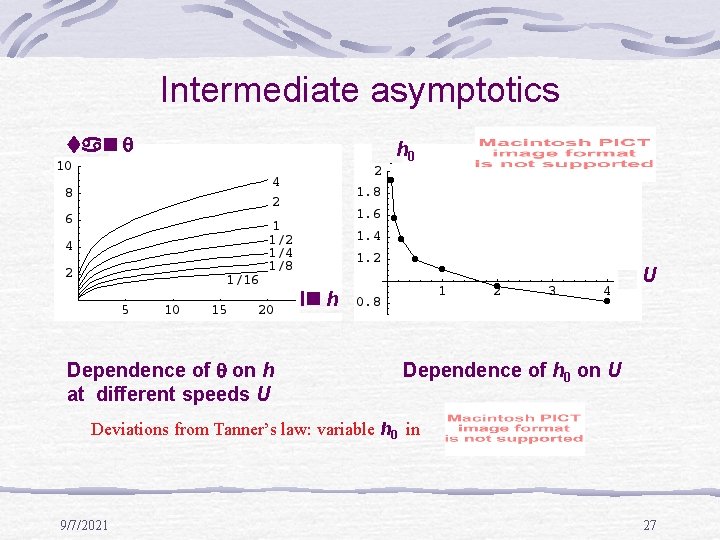
Intermediate asymptotics q h 0 U l h Dependence of q on h at different speeds U Dependence of h 0 on U Deviations from Tanner’s law: variable h 0 in 9/7/2021 27
Integration – include gravity 9/7/2021 28
9/7/2021 29
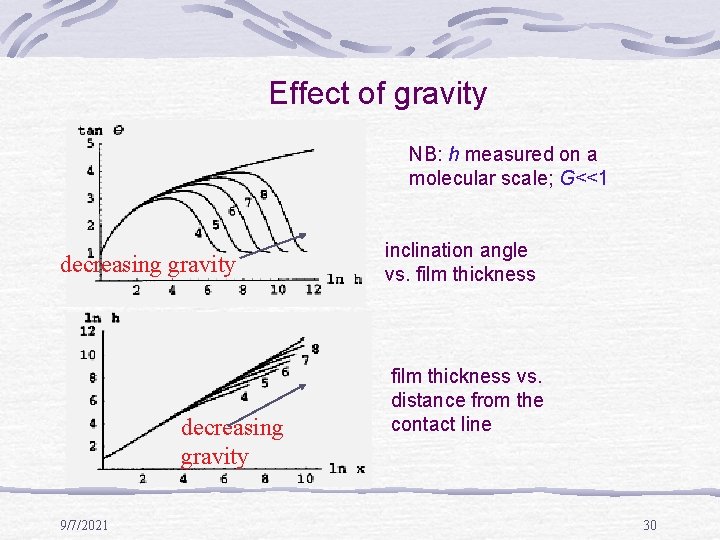
Effect of gravity NB: h measured on a molecular scale; G<<1 decreasing gravity 9/7/2021 inclination angle vs. film thickness vs. distance from the contact line 30
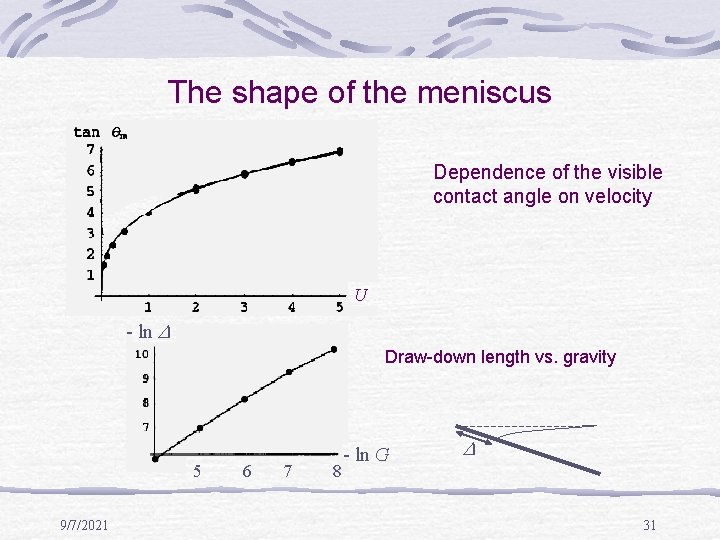
The shape of the meniscus Dependence of the visible contact angle on velocity U - ln D Draw-down length vs. gravity 5 9/7/2021 6 7 8 - ln G D 31
9/7/2021 32
Conclusions Interface is where macroscopic meets microscopic; this is the source of complexity; this is why no easy answers exist The problems of dynamic contact angle and viscous stress singularity are intimately related, and both depend on microscale interactions Near the contact line the physical properties of the fluid and its interface are not the same as elsewhere The influence of microscale interactions extends to macroscopic distances 9/7/2021 33