
Motion in Two Dimensions Chapter 6 Projectile Motion



- Slides: 21
Motion in Two Dimensions Chapter 6
Projectile Motion Lesson 1 Chapter 6
Path of a Projectile • Projectile- any object shot through the air. • You can draw a free-body diagram of a launched projectile and identify the forces acting on it. • If you ignore air resistance after an initial force launches a projectile, the only force on it as it moves through the air is gravity. • Gravity causes the object to curve downward. • Trajectory-path through space (area moving object covers). • You can determine a projectile’s trajectory if you know its initial velocity.
Independence of Motion in Two Dimensions • The motion of projectiles is a combination of two motions: initial horizontal velocity and gravity.
Comparing Motion Diagrams • Refer to page 153. • The horizontal motion of the launched ball (or object) does not affect its vertical motion. • A projectile launched horizontally has initial horizontal velocity, but it has no initial vertical velocity. • Therefore, its vertical motion is like that of an object dropped from rest.
Horizontally Launched Projectiles • Refer to page 154 figure 3 • Remember that all horizontally launched projectiles will have only a horizontal initial velocity not an initial vertical velocity. • Separate motion diagrams- it is easier to analyze the horizontal motion and the vertical motion separately. • Separate motion diagram for the x and y components. • Recall that the horizontal motion of a projectile does not affect its vertical motion.
Horizontal Motion • Notice the horizontal motion vectors in the diagram have the same length, which indicates that the object’s velocity is not changing. • This exactly what we want to see because after the initial force there is no horizontal force acting on the projectile. • Remember we are ignoring air resistance.
Vertical Motion • Each velocity vector has a slightly longer length than the one above it. • The changing length shows that the objects velocity is increasing and accelerating downward. • Should be expected because the force of gravity is acting on the projectile.
Parabolic Path • The horizontal and vertical components at each moments are added to form the total velocity vector at that moment. • you can see how the combination of constant horizontal velocity and uniform vertical acceleration produces a trajectory that has a parabolic shape. • The path the object moves
Questions/Out • Does an object thrown horizontally in the air have a initial vertical velocity? If no what type does it have?
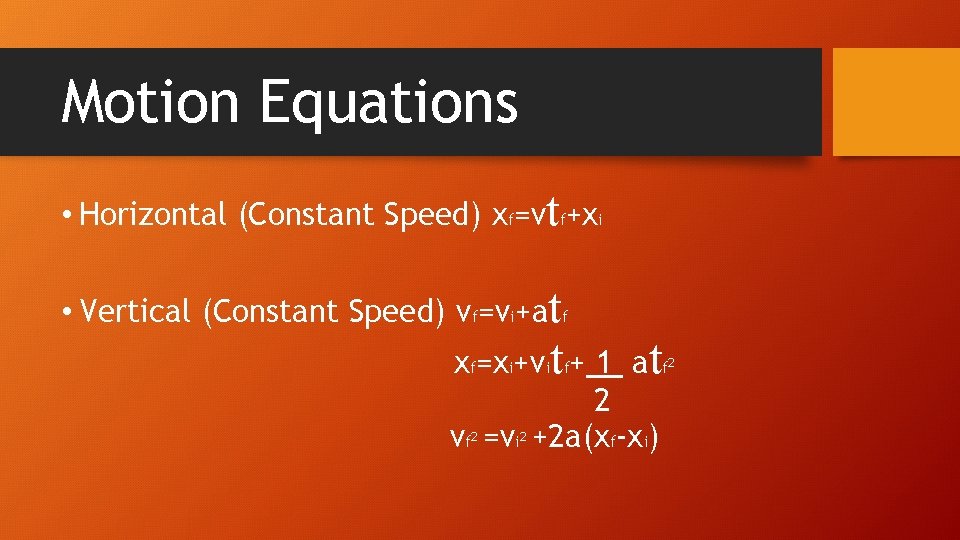
Motion Equations • Horizontal (Constant Speed) xf=vtf+xi • Vertical (Constant Speed) vf=vi+atf xf=xi+vitf+ 1 atf 2 2 vf 2 =vi 2 +2 a(xf-xi)
Angled Launches • When s projectile is launched at an angel, the initial velocity has a vertical component as well as a horizontal component. • If the object is launched upward, like a ball tossed straight up in the air, it rises with slowing speed, reaches the top of its path where its speed is momentarily zero, and descends with increasing speed.
Separate Motion Diagram • The x-axis is horizontal and y-axis is vertical. • At each point in the vertical direction, the velocity of the object as it is moving upward has the same magnitude as when it is moving downward. • The only difference is that the directions of the two velocities are opposite.
Parabolic Path • The maximum height, which is the height of the projectile when the vertical velocity is zero and the projectile has only its horizontal-velocity component. • The other quantity depicted is the range (R), which is the horizontal distance the projectile travels when the initial and final heights are the same.
Circular Motion Chapter 6 Lesson 2
Describing Circular Motion • Consider an object moving in a circle at a constant speed, such as a stone being whirled on the end of a string or a fixed horse on a carousel. • Their direction is changing, the objects must be accelerating.
Uniform Circular Motion • Uniform circular motion-is the movement of an object at a constant speed around a circle with a fixed radius. • Equation: average velocity= __r t • For an object circular motion, the velocity is tangent to the circle. It is in the same direction as the displacement.
Centripetal Acceleration • Centripetal acceleration-an object in uniform circular motion. • Always points to the center of the circle. • Its magnitude is equal to the square of the speed divided by the radius of motion.
Centripetal Force • Centripetal Force-the net force toward the center of the circle. • To analyze centripetal acceleration situations, you must identify the agent of the force that causes the acceleration. • The net centripetal force on an object moving in a circle is equal to the object’s mass times the centripetal acceleration.
Relative Velocity Chapter 6 Lesson 3
Reference Frame • Reference Frame-a coordinate system form which motion is viewed. • When an object moves in a moving reference frame, you add the velocities if they are in the same direction. • You subtract one velocity from the other if they are in opposite directions.