
MOTION IN ONE DIMENSION Velocity and Acceleration Graphing


- Slides: 12
MOTION IN ONE DIMENSION Velocity and Acceleration
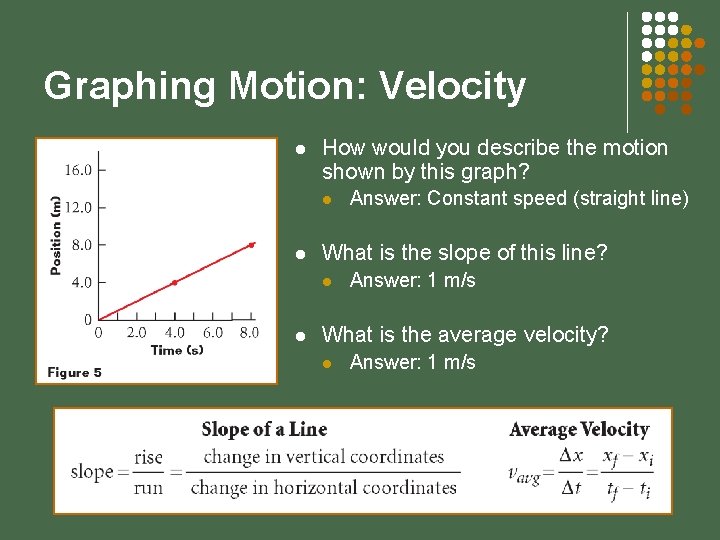
Graphing Motion: Velocity l How would you describe the motion shown by this graph? l l What is the slope of this line? l l Answer: Constant speed (straight line) Answer: 1 m/s What is the average velocity? l Answer: 1 m/s
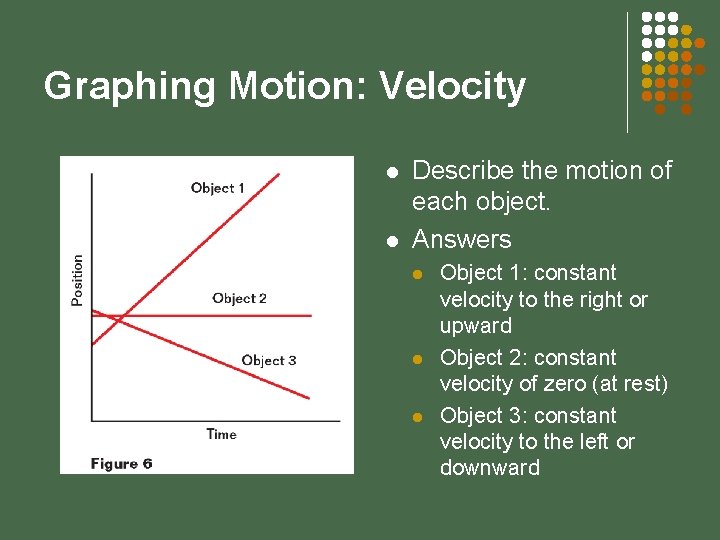
Graphing Motion: Velocity l l Describe the motion of each object. Answers l l l Object 1: constant velocity to the right or upward Object 2: constant velocity of zero (at rest) Object 3: constant velocity to the left or downward
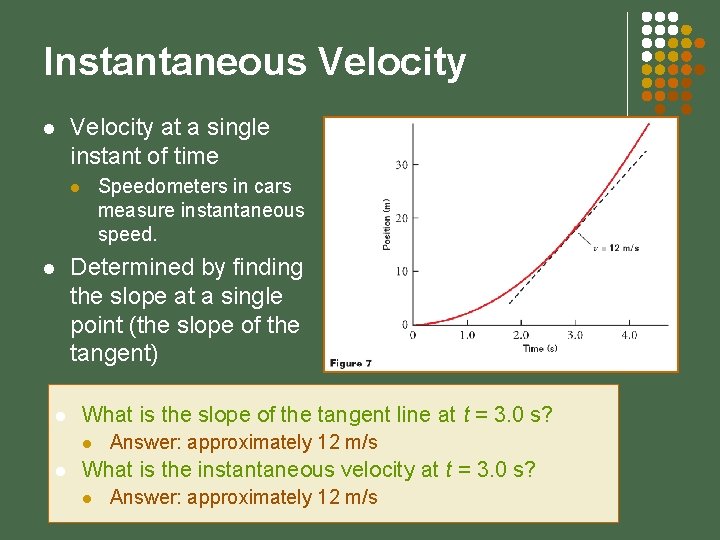
Instantaneous Velocity l Velocity at a single instant of time Speedometers in cars measure instantaneous speed. l l l Determined by finding the slope at a single point (the slope of the tangent) What is the slope of the tangent line at t = 3. 0 s? l l Answer: approximately 12 m/s What is the instantaneous velocity at t = 3. 0 s? l Answer: approximately 12 m/s
What do you think? l Which of the following cars is accelerating? a. A car shortly after a stoplight turns green b. A car approaching a red light c. A car with the cruise control set at 80 km/h d. A car turning a curve at a constant speed l Based on your answers, what is your definition of acceleration?
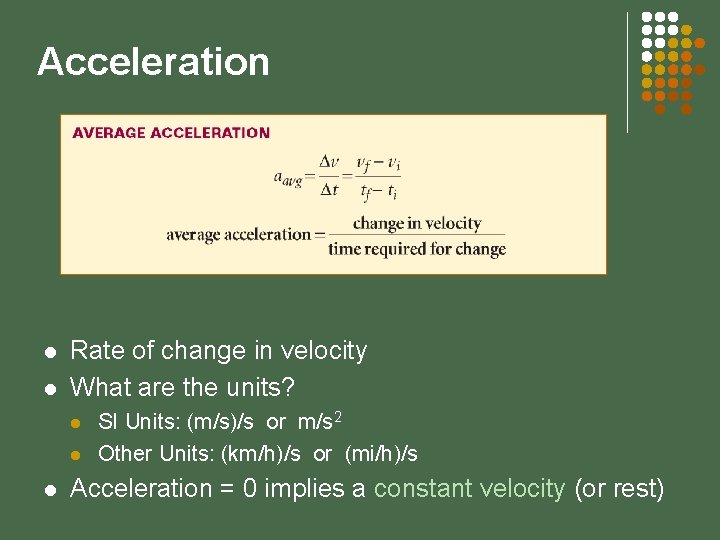
Acceleration l l Rate of change in velocity What are the units? l l l SI Units: (m/s)/s or m/s 2 Other Units: (km/h)/s or (mi/h)/s Acceleration = 0 implies a constant velocity (or rest)
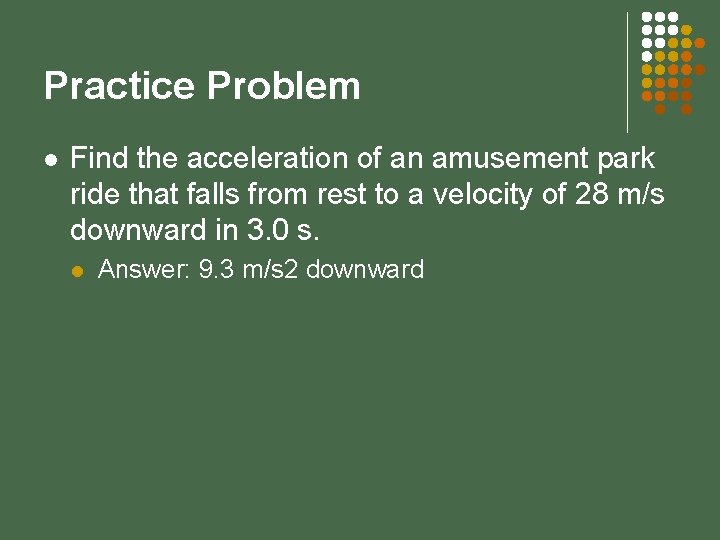
Practice Problem l Find the acceleration of an amusement park ride that falls from rest to a velocity of 28 m/s downward in 3. 0 s. l Answer: 9. 3 m/s 2 downward
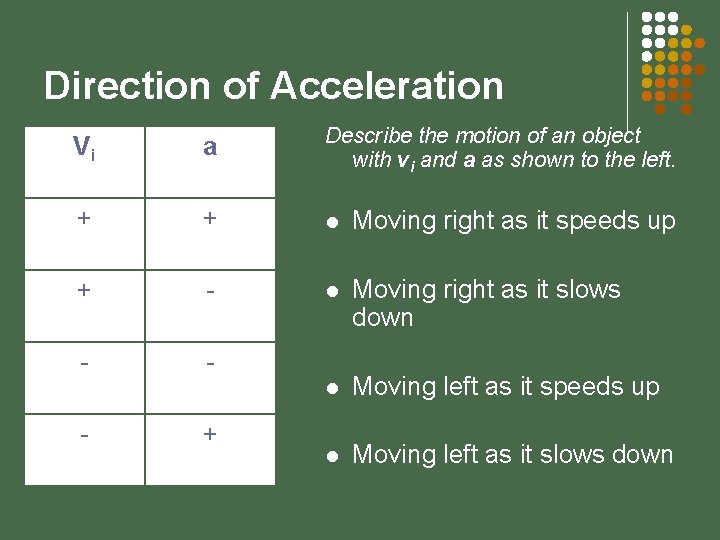
Direction of Acceleration Vi a Describe the motion of an object with vi and a as shown to the left. + + l Moving right as it speeds up + - l Moving right as it slows down - l Moving left as it speeds up l Moving left as it slows down - +
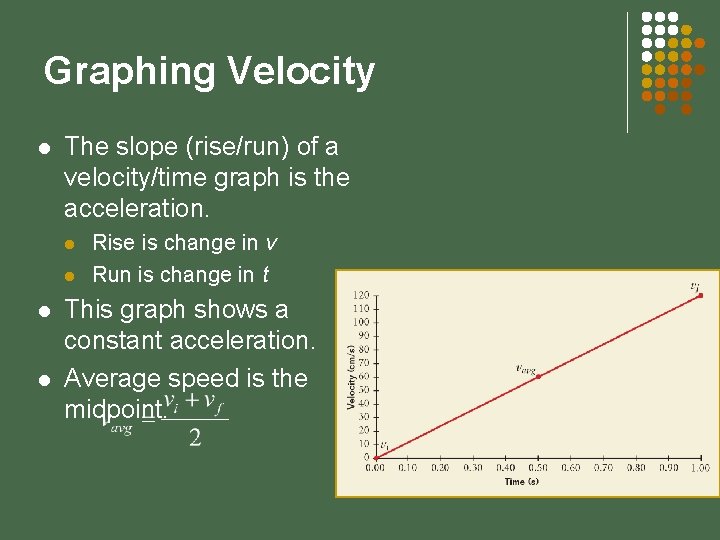
Graphing Velocity l The slope (rise/run) of a velocity/time graph is the acceleration. l l Rise is change in v Run is change in t This graph shows a constant acceleration. Average speed is the midpoint.
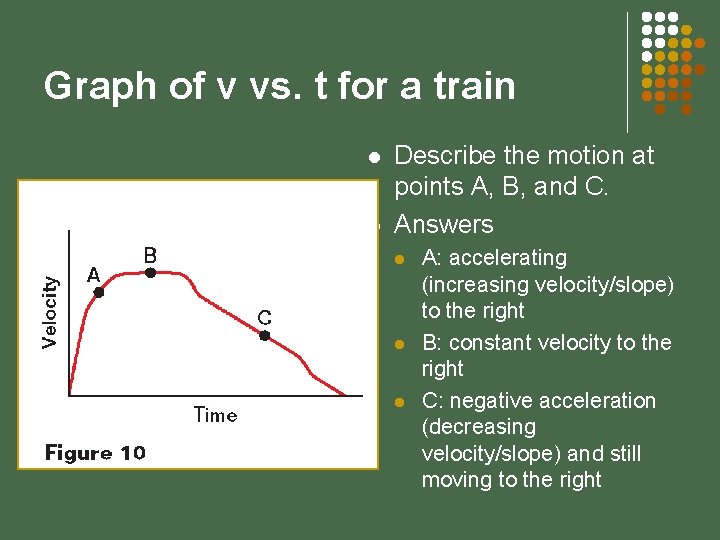
Graph of v vs. t for a train l l Describe the motion at points A, B, and C. Answers l l l A: accelerating (increasing velocity/slope) to the right B: constant velocity to the right C: negative acceleration (decreasing velocity/slope) and still moving to the right
Practice Problems l A bicyclist accelerates from 5. 0 m/s to 16 m/s in 8. 0 s. Assuming uniform acceleration, what distance does the bicyclist travel during this time interval? l l Answer: 84 m An aircraft has a landing speed of 83. 9 m/s. The landing area of an aircraft carrier is 195 m long. What is the minimum uniform acceleration required for safe landing? l Answer: -18. 0 m/s 2
NOW YOU TRY IT! l Do Practice B and C from chapter 2 (pages 49 and 53)