
Motion In One Dimension Review Vocabulary Displacement 13122021
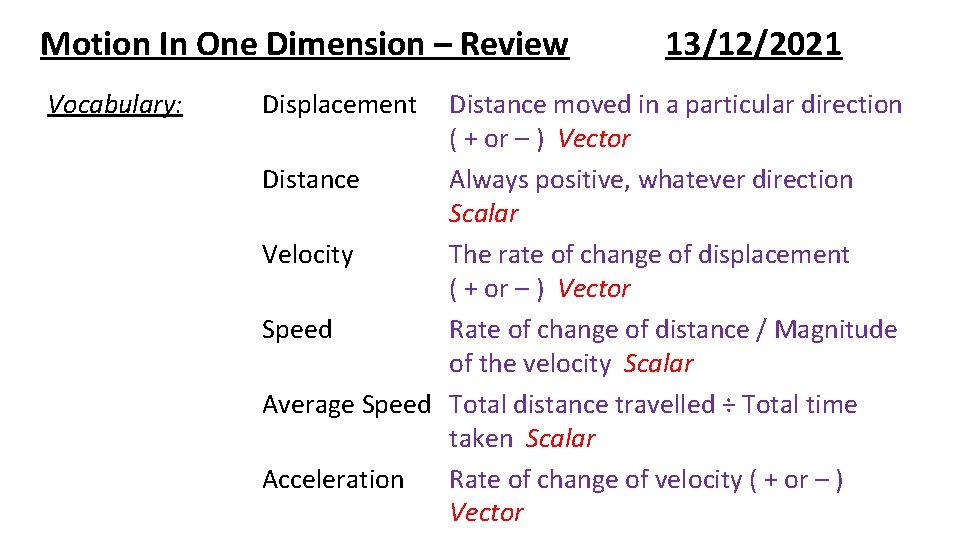
Motion In One Dimension – Review Vocabulary: Displacement 13/12/2021 Distance moved in a particular direction ( + or – ) Vector Always positive, whatever direction Distance Scalar The rate of change of displacement Velocity ( + or – ) Vector Rate of change of distance / Magnitude Speed of the velocity Scalar Average Speed Total distance travelled ÷ Total time taken Scalar Rate of change of velocity ( + or – ) Acceleration Vector
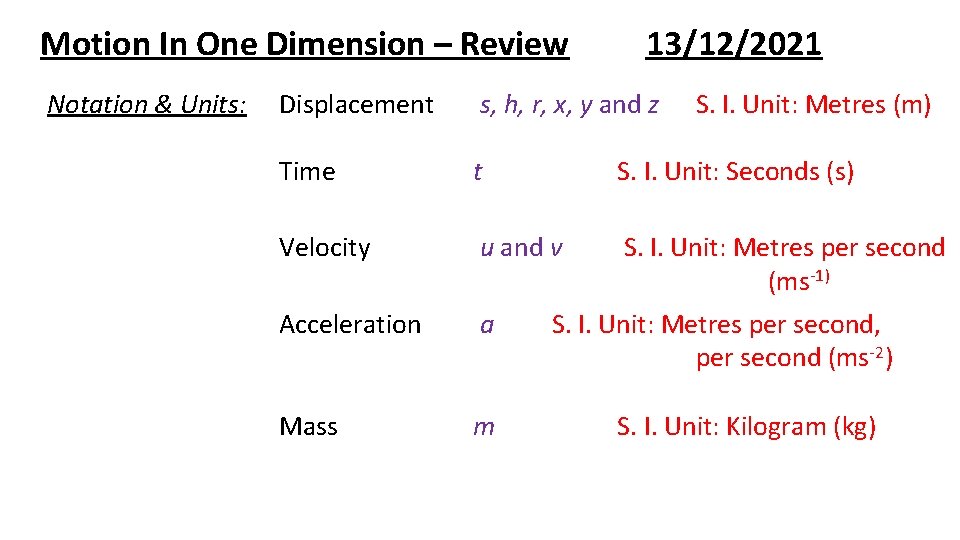
Motion In One Dimension – Review Notation & Units: 13/12/2021 Displacement s, h, r, x, y and z S. I. Unit: Metres (m) Time t S. I. Unit: Seconds (s) Velocity u and v S. I. Unit: Metres per second (ms-1) Acceleration a Mass m S. I. Unit: Metres per second, per second (ms-2) S. I. Unit: Kilogram (kg)
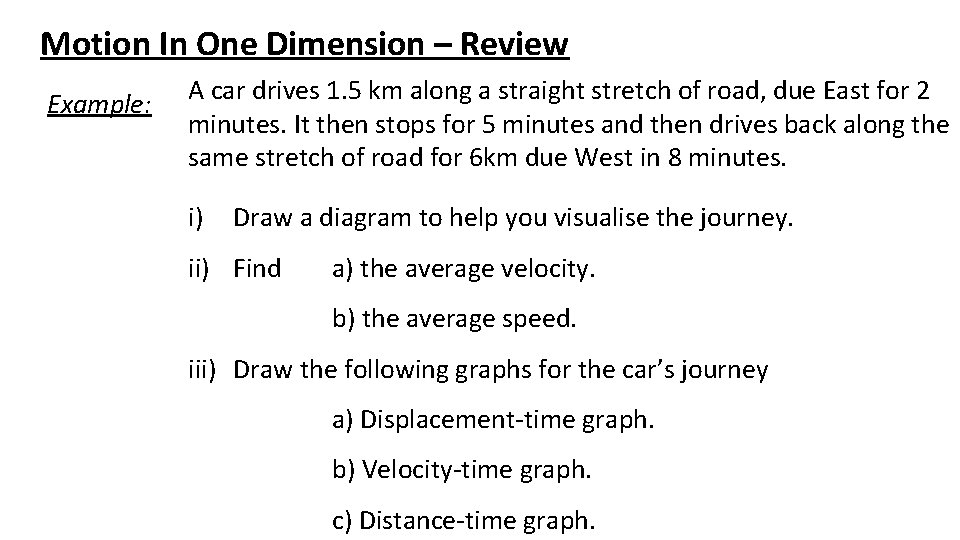
Motion In One Dimension – Review Example: A car drives 1. 5 km along a straight stretch of road, due East for 2 minutes. It then stops for 5 minutes and then drives back along the same stretch of road for 6 km due West in 8 minutes. i) Draw a diagram to help you visualise the journey. ii) Find a) the average velocity. b) the average speed. iii) Draw the following graphs for the car’s journey a) Displacement-time graph. b) Velocity-time graph. c) Distance-time graph.
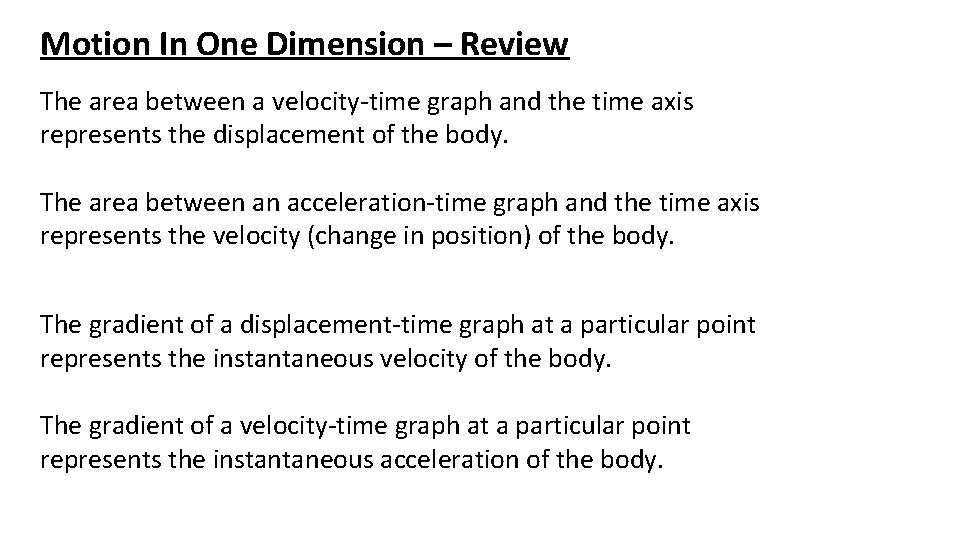
Motion In One Dimension – Review The area between a velocity-time graph and the time axis represents the displacement of the body. The area between an acceleration-time graph and the time axis represents the velocity (change in position) of the body. The gradient of a displacement-time graph at a particular point represents the instantaneous velocity of the body. The gradient of a velocity-time graph at a particular point represents the instantaneous acceleration of the body.

Motion In One Dimension – Review The constant acceleration formulae: SUVAT Common situations involve objects falling under gravity. This is often modelled by assuming air resistance is negligible. g = 9. 8 ms-2 (If the positive direction is assumed to be upwards, gravity will be negative: g = – 9. 8 ms-2)

Motion In One Dimension – Review If acceleration is variable, we cannot use the SUVAT formulae. Instead we must use calculus to find missing values.
- Slides: 8