
Motion in One Dimension Motion in OneDimension 2
- Slides: 42
Motion in One Dimension
Motion in One-Dimension (2 -1) What is it? 1 -D motion is movement that is in only one direction. (either up/down -- +y/-y direction or forward/backward -- +z/-z or left/right -- +x/-x). It does not move in two directions at the same time. Examples: One direction train moving along tracks, driving forward, climbing up a rope. Non-examples: Two directions A rocket traveling at an angle, a basketball being thrown into a hoop.
What do you need for motion? : A frame of reference In order for an object to be in motion, it must move!!!! This sounds obvious, but motion is not always easy to tell. Ex: Are you moving right now? Does the sun move when it rises and sets? Whether or not something is moving depends upon the frame of reference you look from. A frame of reference is where you look to determine if an object is moving or not. Your frame of reference, according to you, is standing still. Ex: If Earth is our frame of reference, then the sun moves as it rises and sets. If the sun is our frame of reference, then the Earth is moving and the sun is
Let’s Try!!! As a little boy looks up in the sky, he sees the clouds pass above. What is his frame of reference? What’s moving? What’s standing still? A little girl looks out the train window and sees a ball roll down the aisle. What is her frame of reference? What’s moving? What’s standing still? An old lady looks out the train window and sees the trees move by. What is her frame of reference? What’s moving? What’s standing still?
What do you need for motion? In order to have motion, then you must move. A physics word for movement is displacement. Displacement: The change in position of an object. According to our reference point, it was in one position and then moved to another position along our reference point.
How do you measure displacement? *To find the displacement* ONLY LOOK AT WHERE THE OBJECT WAS AND WHERE IT ENDED UP, NOT HOW IT GOT THERE. If the starting point is different from the ending point, there was displacement. If it is the same, then there is no displacement. Example: A rat walks 1 meter forward to get cheese. Non-example: A rat walks in a circle
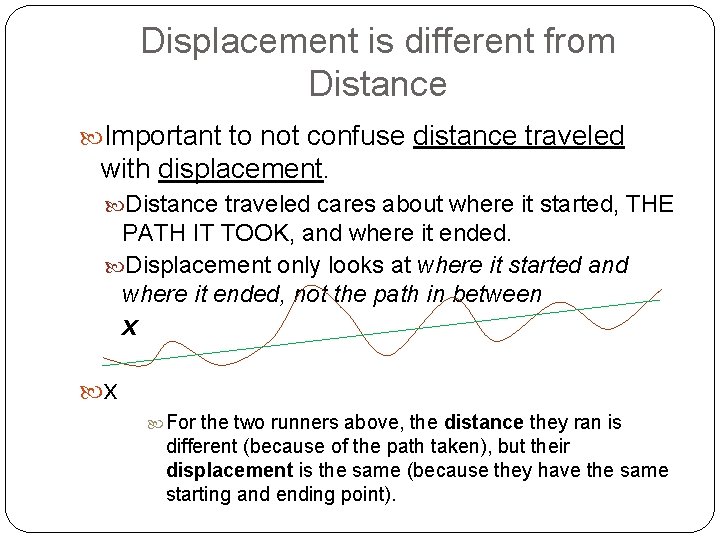
Displacement is different from Distance Important to not confuse distance traveled with displacement. Distance traveled cares about where it started, THE PATH IT TOOK, and where it ended. Displacement only looks at where it started and where it ended, not the path in between x x For the two runners above, the distance they ran is different (because of the path taken), but their displacement is the same (because they have the same starting and ending point).
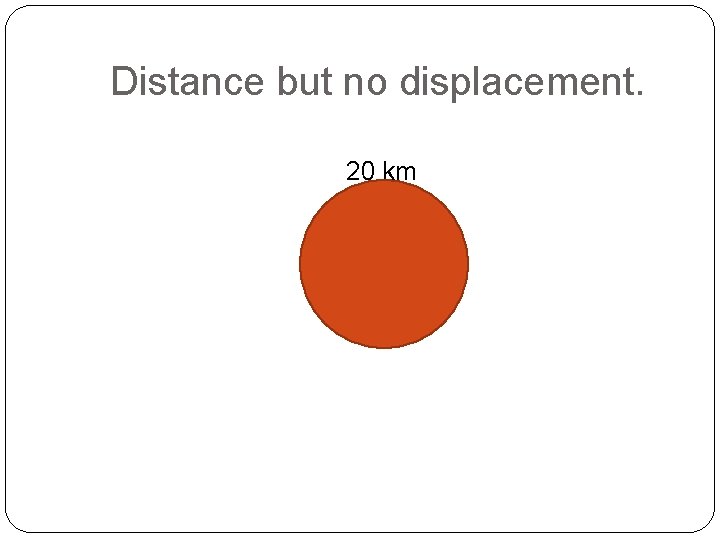
Distance but no displacement. 20 km
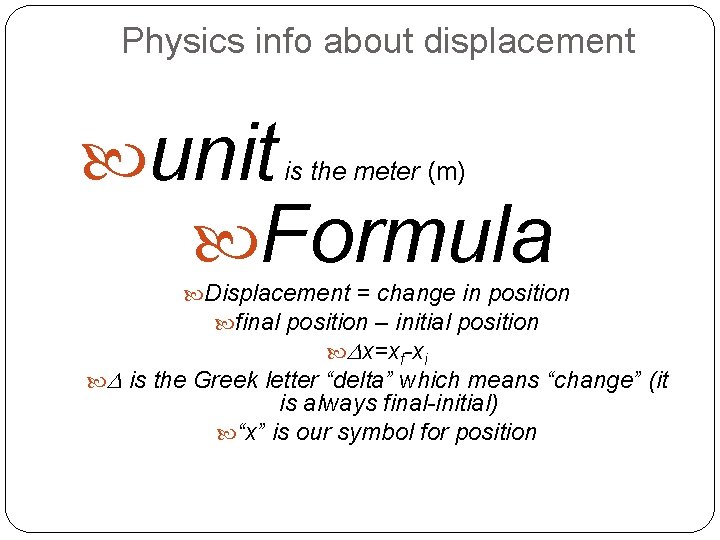
Physics info about displacement unit Formula is the meter (m) Displacement = change in position final position – initial position Dx=xf-xi D is the Greek letter “delta” which means “change” (it is always final-initial) “x” is our symbol for position
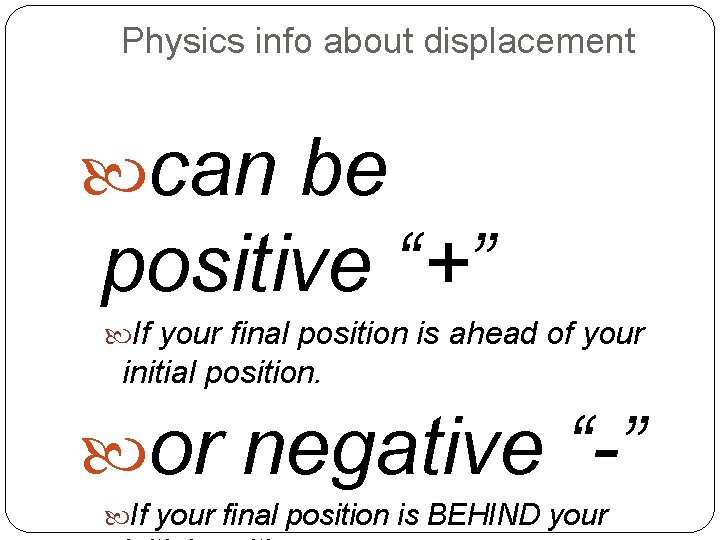
Physics info about displacement can be positive “+” If your final position is ahead of your initial position. or negative “-” If your final position is BEHIND your
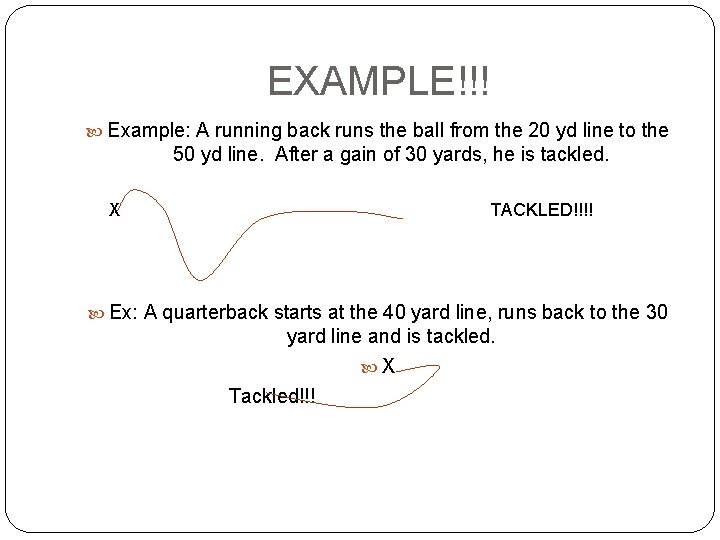
EXAMPLE!!! Example: A running back runs the ball from the 20 yd line to the 50 yd line. After a gain of 30 yards, he is tackled. X TACKLED!!!! Ex: A quarterback starts at the 40 yard line, runs back to the 30 yard line and is tackled. X Tackled!!!
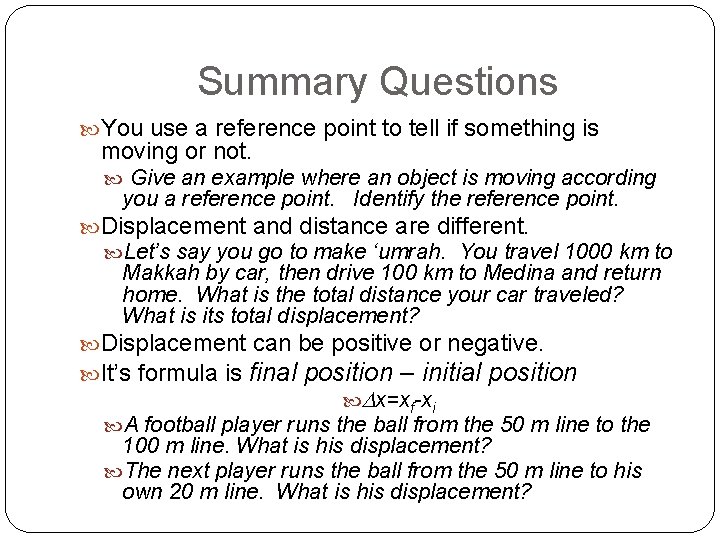
Summary Questions You use a reference point to tell if something is moving or not. Give an example where an object is moving according you a reference point. Identify the reference point. Displacement and distance are different. Let’s say you go to make ‘umrah. You travel 1000 km to Makkah by car, then drive 100 km to Medina and return home. What is the total distance your car traveled? What is its total displacement? Displacement can be positive or negative. It’s formula is final position – initial position Dx=xf-xi A football player runs the ball from the 50 m line to the 100 m line. What is his displacement? The next player runs the ball from the 50 m line to his own 20 m line. What is his displacement?
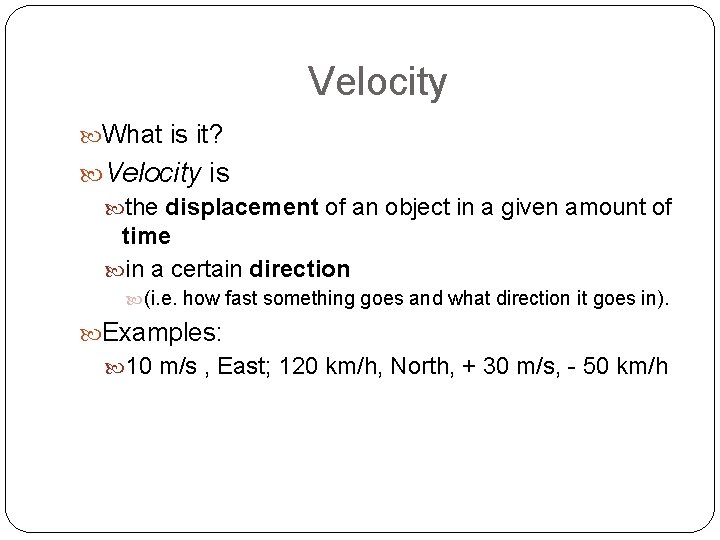
Velocity What is it? Velocity is the displacement of an object in a given amount of time in a certain direction (i. e. how fast something goes and what direction it goes in). Examples: 10 m/s , East; 120 km/h, North, + 30 m/s, - 50 km/h
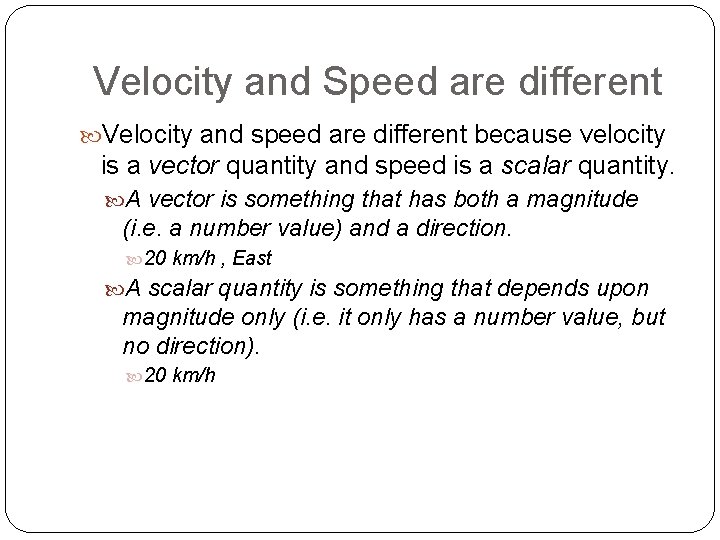
Velocity and Speed are different Velocity and speed are different because velocity is a vector quantity and speed is a scalar quantity. A vector is something that has both a magnitude (i. e. a number value) and a direction. 20 km/h , East A scalar quantity is something that depends upon magnitude only (i. e. it only has a number value, but no direction). 20 km/h
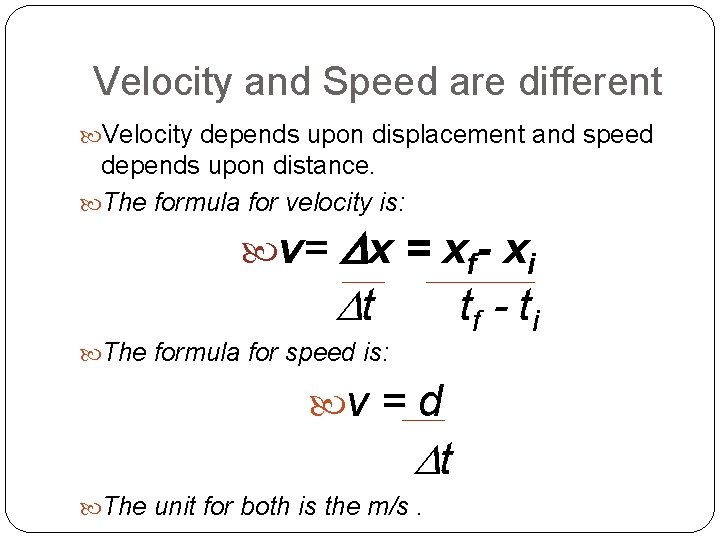
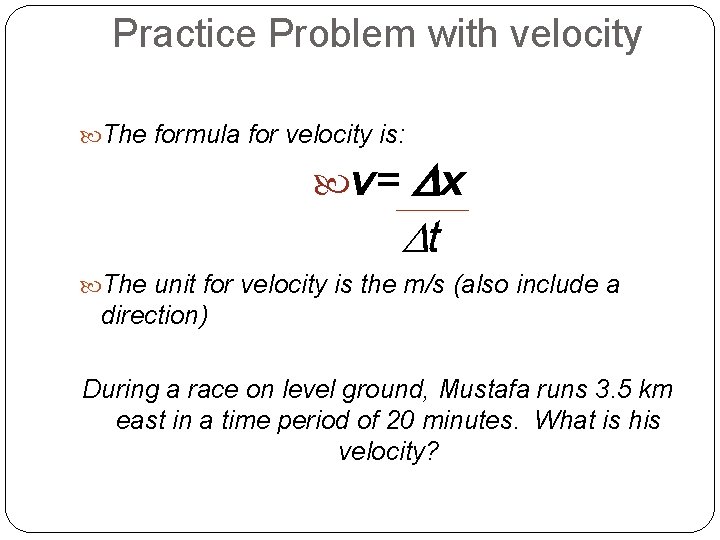
Velocity and Speed are different Velocity depends upon displacement and speed depends upon distance. The formula for velocity is: v= D x = x f- x i Dt t f - ti The formula for speed is: v = d Dt The unit for both is the m/s.
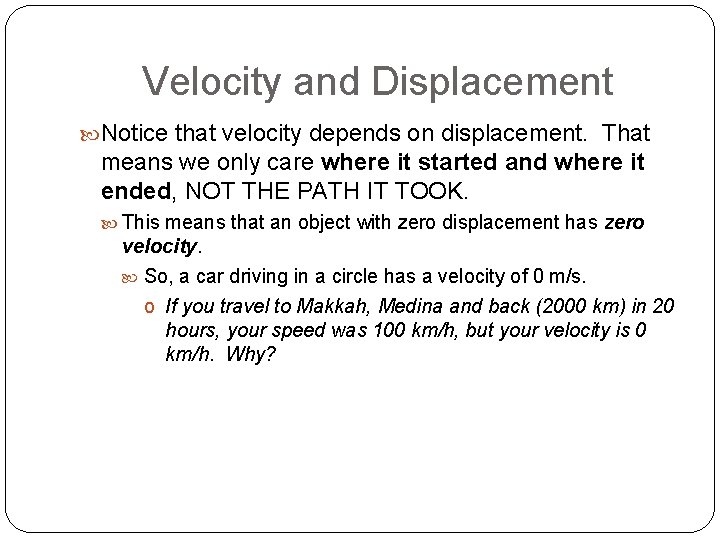
Velocity and Displacement Notice that velocity depends on displacement. That means we only care where it started and where it ended, NOT THE PATH IT TOOK. This means that an object with zero displacement has zero velocity. So, a car driving in a circle has a velocity of 0 m/s. o If you travel to Makkah, Medina and back (2000 km) in 20 hours, your speed was 100 km/h, but your velocity is 0 km/h. Why?
Practice Problem with velocity The formula for velocity is: v= Dx Dt The unit for velocity is the m/s (also include a direction) During a race on level ground, Mustafa runs 3. 5 km east in a time period of 20 minutes. What is his velocity?
Let’s Try !!! Using Algebra to solve a velocity problem Sample Problem A p. 44
You Try!!! Class work/Homework p. 44 Practice A (1, 2, 4, 6)
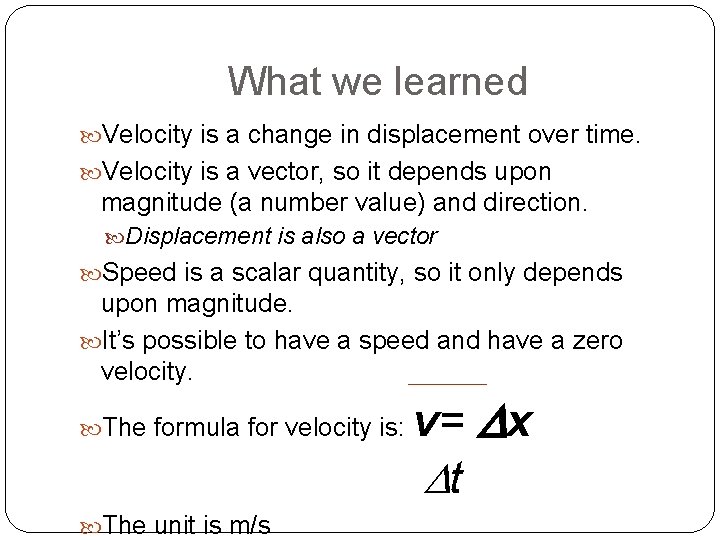
What we learned Velocity is a change in displacement over time. Velocity is a vector, so it depends upon magnitude (a number value) and direction. Displacement is also a vector Speed is a scalar quantity, so it only depends upon magnitude. It’s possible to have a speed and have a zero velocity. The formula for velocity is: The unit is m/s v= Dx Dt
Acceleration (2 -2) What is Acceleration? Acceleration: The rate of CHANGE in velocity over time (i. e. how FAST the velocity changes – no matter if you speed up or slow down) Ex: If you are about to crash into somebody's car and you slam on the breaks you have a very high acceleration (because your velocity is changing very fast – it is slowing down) – This is negative acceleration. A racecar driver who mashes the gas down also has a very high acceleration (because his velocity is changing very fast – it is speeding up). This is positive acceleration.
When is there acceleration? Acceleration occurs whenever your velocity changes. Velocity has a “speed” component and a “direction” component. If you change speed, you accelerate. Like speeding up or slowing down. If you change direction, you accelerate (even if you don’t change speed) Like turning a corner at a constant speed. o Here, the velocity is changing because the direction is changing. • So, in both cases you are accelerating.
Information about Acceleration is a vector. Acceleration will have a magnitude and a direction. If the motion is in the SAME direction as acceleration, the object will speed up. (like slamming on the gas while driving forward) If the motion is in the OPPOSITE direction of acceleration, the object will slow down. (like slamming on the brakes while driving forward) “+” acceleration means you will speed up. “-” acceleration means you will slow down.
More info about Acceleration There are several formulas for acceleration. These formulas are grouped according to the type of acceleration you have. Type 1: Average acceleration (i. e. acceleration changes throughout the trip and you are using the average) Type 2: Constant acceleration (i. e. acceleration does not change for the entire trip)
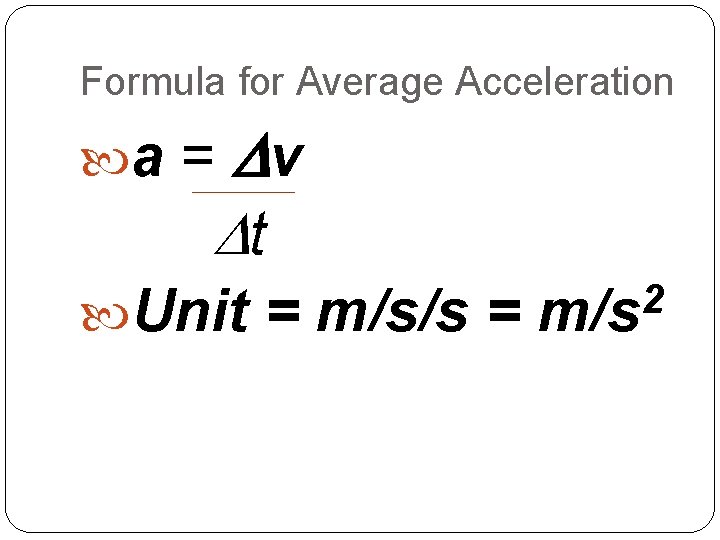
Formula for Average Acceleration a = Dv Dt Unit = m/s/s = 2 m/s
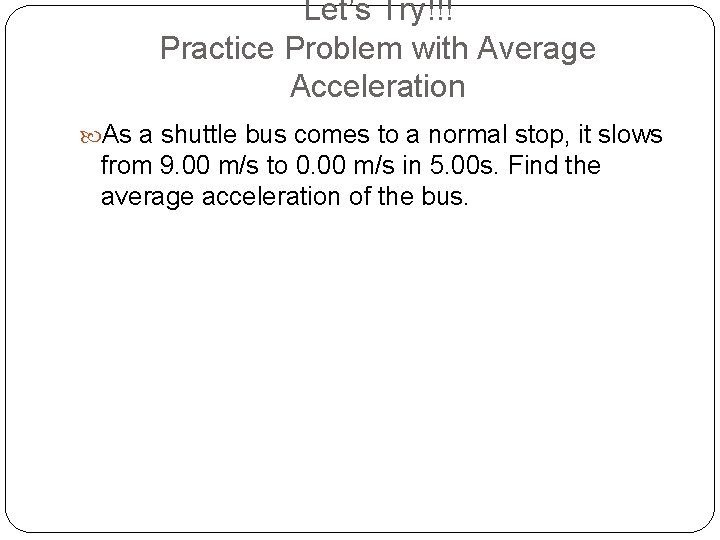
Let’s Try!!! Practice Problem with Average Acceleration As a shuttle bus comes to a normal stop, it slows from 9. 00 m/s to 0. 00 m/s in 5. 00 s. Find the average acceleration of the bus.
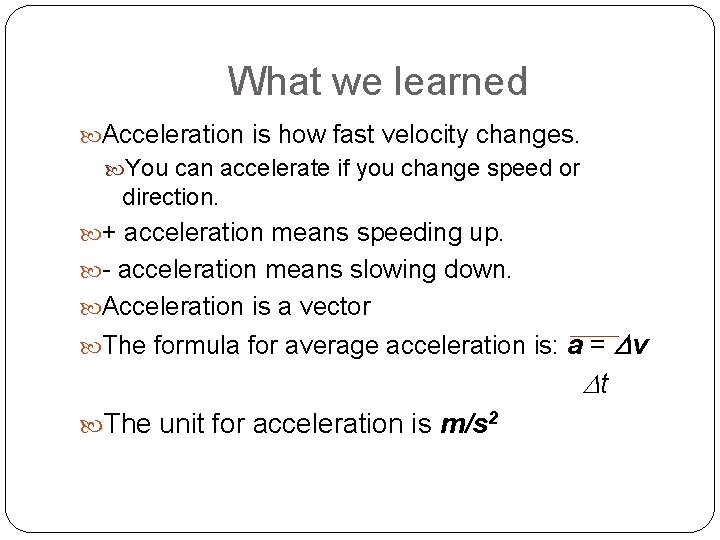
What we learned Acceleration is how fast velocity changes. You can accelerate if you change speed or direction. + acceleration means speeding up. - acceleration means slowing down. Acceleration is a vector The formula for average acceleration is: a The unit for acceleration is m/s 2 = Dv Dt
Let’s Try: Acceleration w/ Algebra p. 49 Practice B
Classwork/Homework p. 49 Practice B 1, 2, 3
Constant Acceleration What is it? Constant acceleration occurs when an object speeds up or slows down at the same rate throughout the duration of its motion. The most common type of constant acceleration is gravity. Gravity pulls all masses toward the Earth at a constant acceleration of -9. 81 m/s 2.
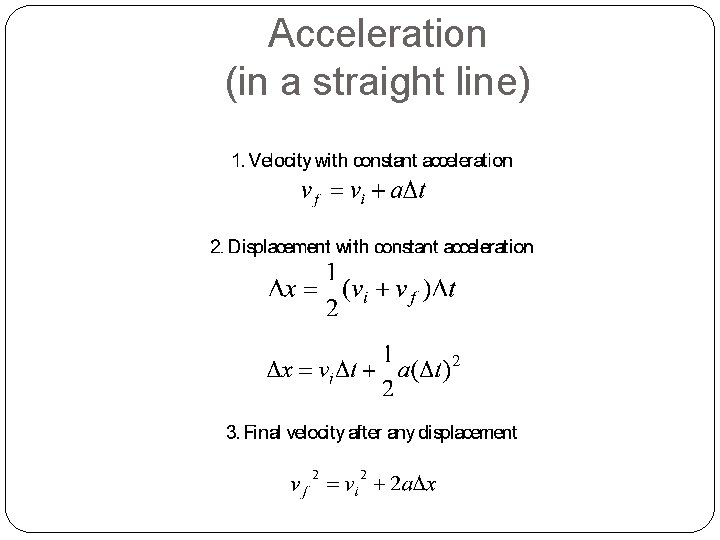
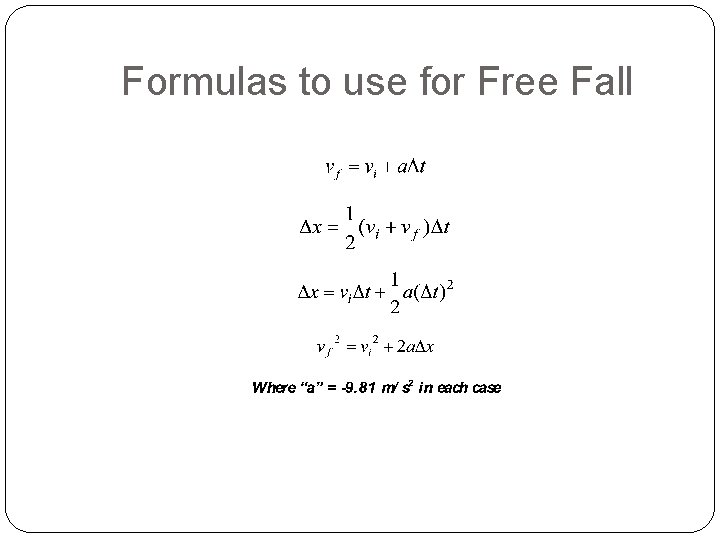
Formulas for Constant Acceleration *WARNING* You CANNOT use constant acceleration formulas to solve a problem for average acceleration! There are several formulas for constant acceleration, and the one you choose depends upon the problem and what your given is.
Acceleration (in a straight line)
Let’s Try!!! Sample Problem C p. 53 Sample Problem D p. 55 Sample Problem E p. 57
CLASSWORK Practice Problems C, D, and E (1 -2 each section)
Free Fall Acceleration (2 -3) What is free fall? Free fall is a term that describes the motion of a body when only the force due to gravity is acting on it. It basically happens when an object is dropped and gravity pulls it down. What is so special about free fall? The amazing thing about free fall motion is that ALL objects regardless of size or mass, all accelerate at the same rate when undergoing free fall acceleration. (see p. 60) On Earth, this cannot be witnessed under normal conditions because air resistance (another force) is also acting on the
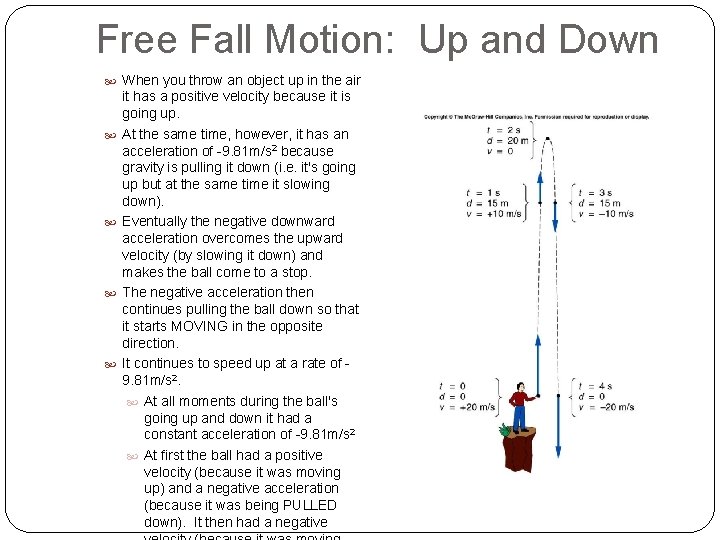
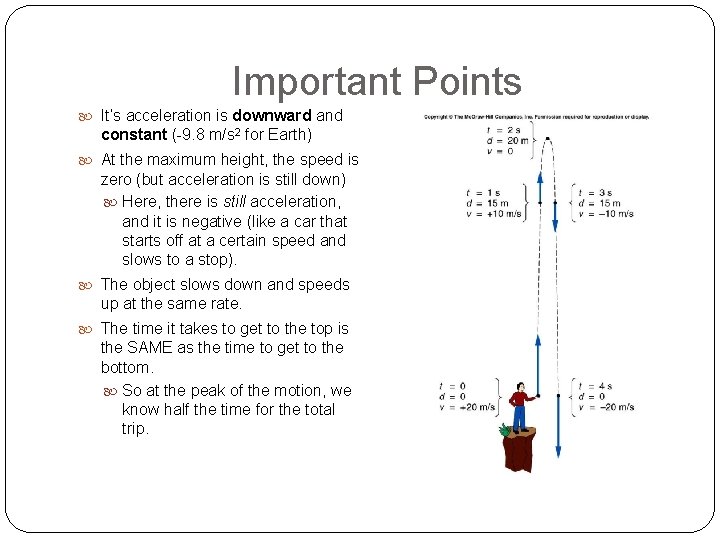
Free Fall Motion: Up and Down When you throw an object up in the air it has a positive velocity because it is going up. At the same time, however, it has an acceleration of -9. 81 m/s 2 because gravity is pulling it down (i. e. it's going up but at the same time it slowing down). Eventually the negative downward acceleration overcomes the upward velocity (by slowing it down) and makes the ball come to a stop. The negative acceleration then continues pulling the ball down so that it starts MOVING in the opposite direction. It continues to speed up at a rate of 9. 81 m/s 2. At all moments during the ball's going up and down it had a constant acceleration of -9. 81 m/s 2 At first the ball had a positive velocity (because it was moving up) and a negative acceleration (because it was being PULLED down). It then had a negative
Important Points It’s acceleration is downward and constant (-9. 8 m/s 2 for Earth) At the maximum height, the speed is zero (but acceleration is still down) Here, there is still acceleration, and it is negative (like a car that starts off at a certain speed and slows to a stop). The object slows down and speeds up at the same rate. The time it takes to get to the top is the SAME as the time to get to the bottom. So at the peak of the motion, we know half the time for the total trip.
Formulas to use for Free Fall
What we learned Free fall acceleration is when an object falls freely due to the force of gravity. Acceleration due to gravity on Earth is constant (9. 81 m/s 2) All things accelerate at the same rate when falling, regardless of size or mass.
Sample Problem A football is kicked straight upward with a velocity of 10 m/s. How long does it take for the football to reach its maximum height? How high does it go? How long does it take before it reaches the ground?
Sample Problem: Falling below our starting point Jason hit a volleyball so that it moves with an initial velocity of 6. 0 m/s straight upward. If the volleyball starts from 1 m above the floor, how long will it be in the air before it strikes the floor? Assume that Jason is the last player to touch the ball before it hits the floor.
Class work / homework Practice F (all)