
Motion in Circles 1 Circular Motion 2 Centripetal
- Slides: 33
Motion in Circles § 1 Circular Motion § 2 Centripetal Force § 3 Universal Gravitation and Orbital Motion
Objectives § § § Calculate angular speed in radians per second. Calculate linear speed from angular speed and vice-versa. Describe and calculate centripetal forces and accelerations. Describe the relationship between the force of gravity and the masses and distance between objects. Calculate the force of gravity when given masses and distance between two objects. Describe why satellites remain in orbit around a planet.
Vocabulary § angular displacement § linear speed § angular speed § orbit § axis § radian § centrifugal force § centripetal acceleration § centripetal force § circumference § ellipse § gravitational constant § law of universal gravitation § revolve § rotate § satellite
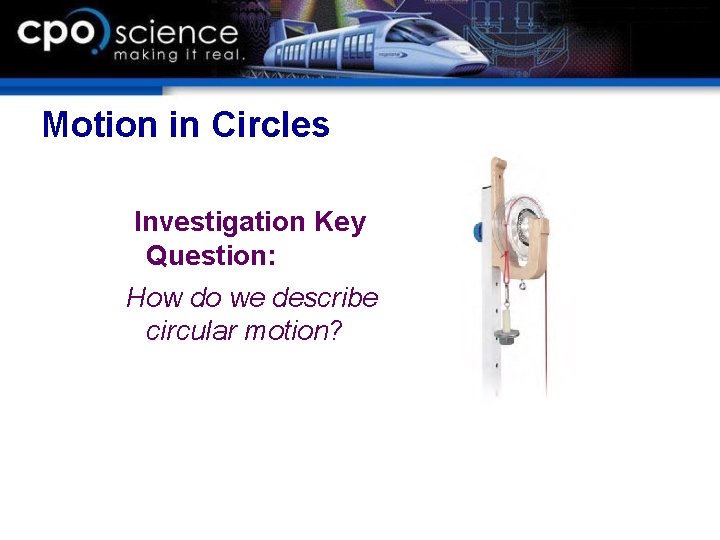
Motion in Circles Investigation Key Question: How do we describe circular motion?
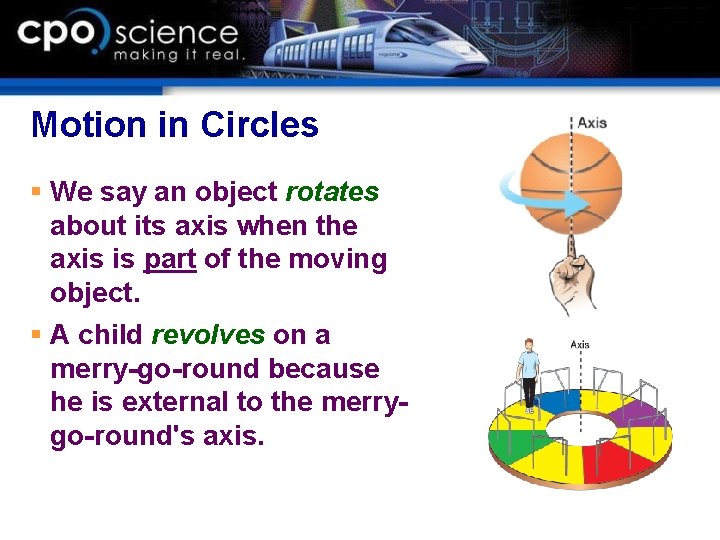
Motion in Circles § We say an object rotates about its axis when the axis is part of the moving object. § A child revolves on a merry-go-round because he is external to the merrygo-round's axis.
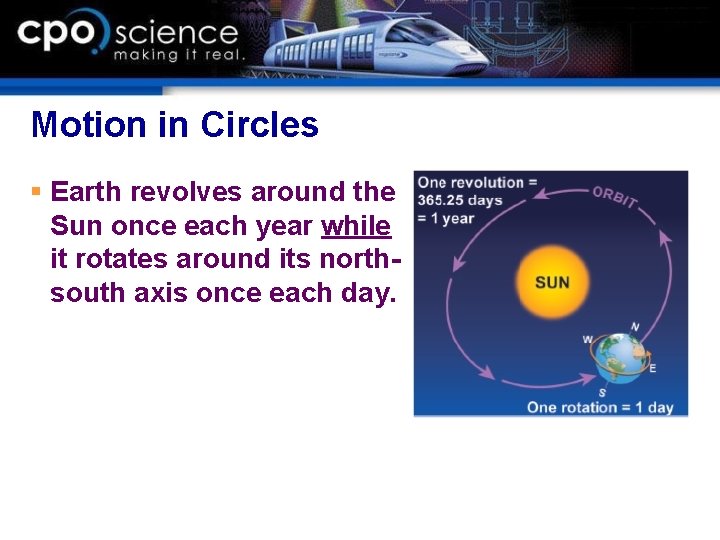
Motion in Circles § Earth revolves around the Sun once each year while it rotates around its northsouth axis once each day.
Motion in Circles § Angular speed is the rate at which an object rotates or revolves. § There are two ways to measure angular speed 4 number of turns per unit of time (rotations/minute) 4 change in angle per unit of time (deg/sec or rad/sec)
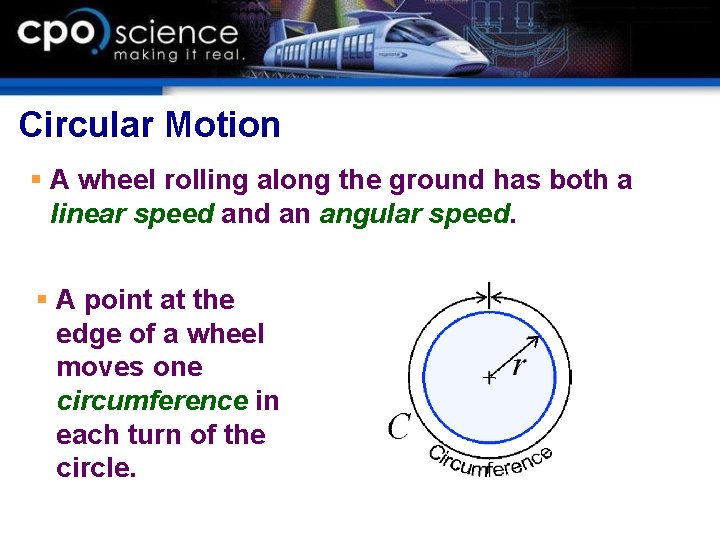
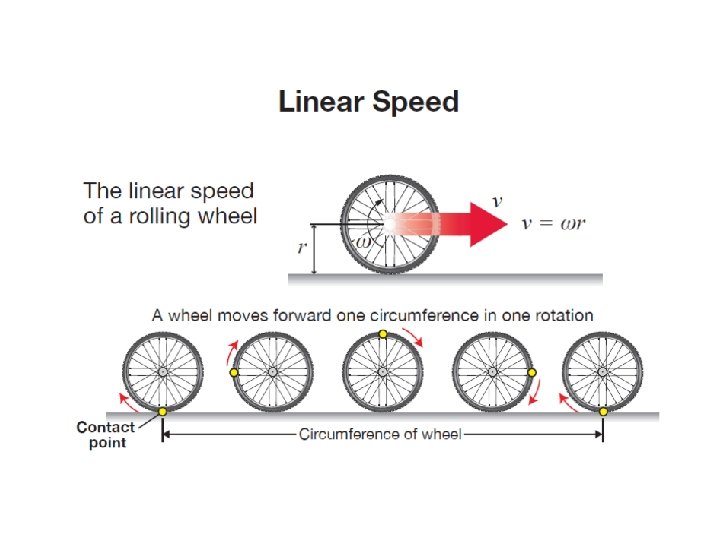
Circular Motion § A wheel rolling along the ground has both a linear speed an angular speed. § A point at the edge of a wheel moves one circumference in each turn of the circle.
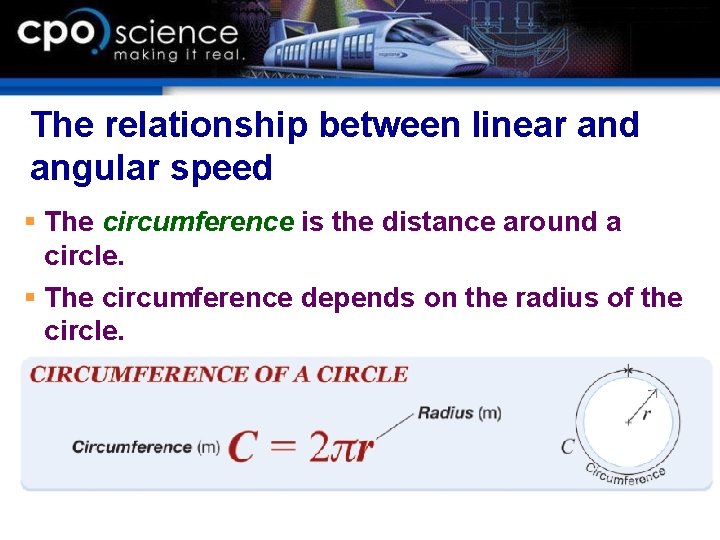
The relationship between linear and angular speed § The circumference is the distance around a circle. § The circumference depends on the radius of the circle.
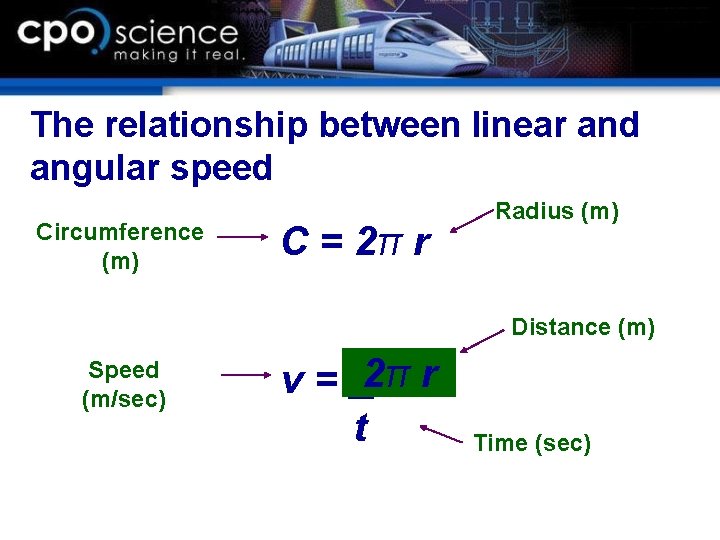
The relationship between linear and angular speed § The linear speed (v) of a point at the edge of a turning circle is the circumference divided by the time it takes to make one full turn. § The linear speed of a point on a wheel depends on the radius, r, which is the distance from the center of rotation.
The relationship between linear and angular speed Circumference (m) C = 2π r Radius (m) Distance (m) Speed (m/sec) v = d 2π r t Time (sec)
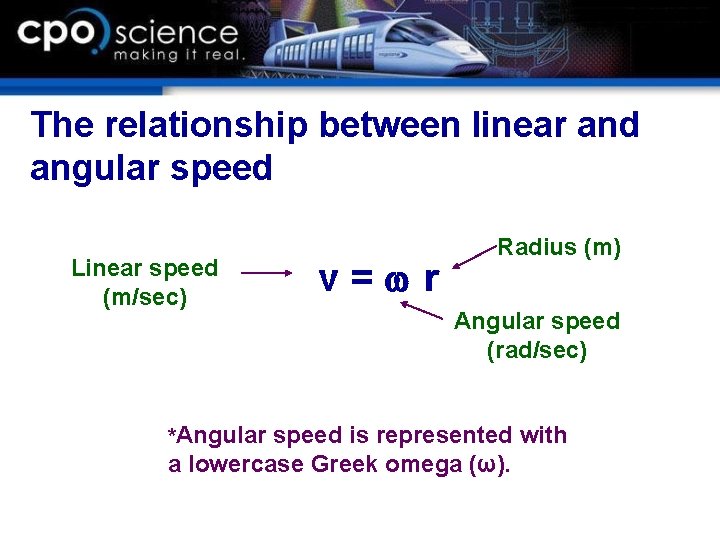
The relationship between linear and angular speed Linear speed (m/sec) *Angular v=wr Radius (m) Angular speed (rad/sec) speed is represented with a lowercase Greek omega (ω).
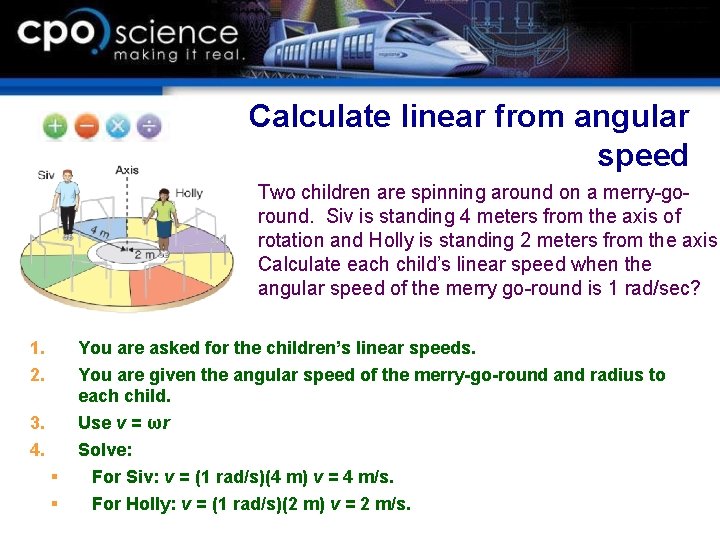
Calculate linear from angular speed Two children are spinning around on a merry-goround. Siv is standing 4 meters from the axis of rotation and Holly is standing 2 meters from the axis. Calculate each child’s linear speed when the angular speed of the merry go-round is 1 rad/sec? 1. 2. You are asked for the children’s linear speeds. 3. 4. Use v = ωr You are given the angular speed of the merry-go-round and radius to each child. § § Solve: For Siv: v = (1 rad/s)(4 m) v = 4 m/s. For Holly: v = (1 rad/s)(2 m) v = 2 m/s.
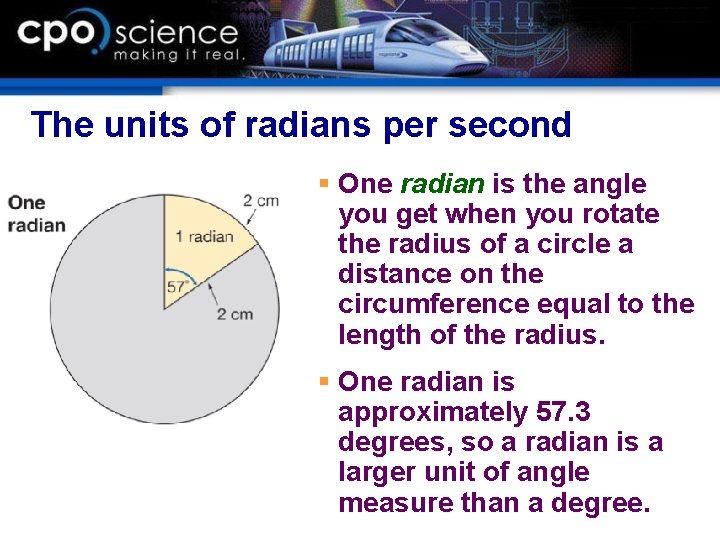
The units of radians per second § One radian is the angle you get when you rotate the radius of a circle a distance on the circumference equal to the length of the radius. § One radian is approximately 57. 3 degrees, so a radian is a larger unit of angle measure than a degree.
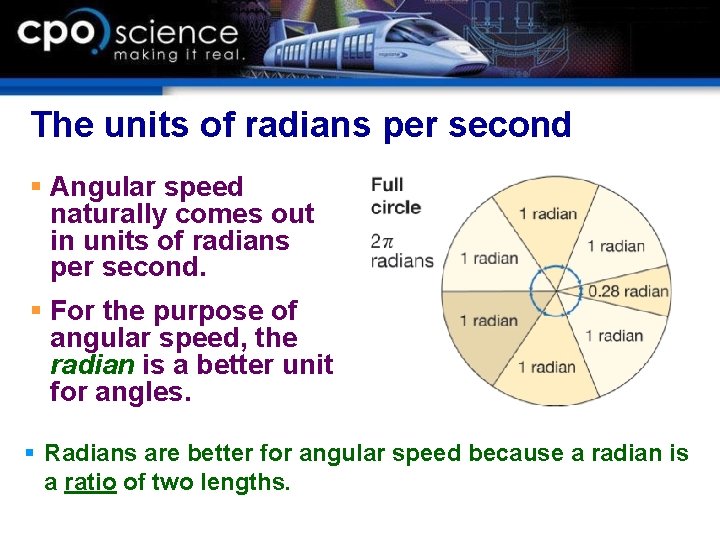
The units of radians per second § Angular speed naturally comes out in units of radians per second. § For the purpose of angular speed, the radian is a better unit for angles. § Radians are better for angular speed because a radian is a ratio of two lengths.
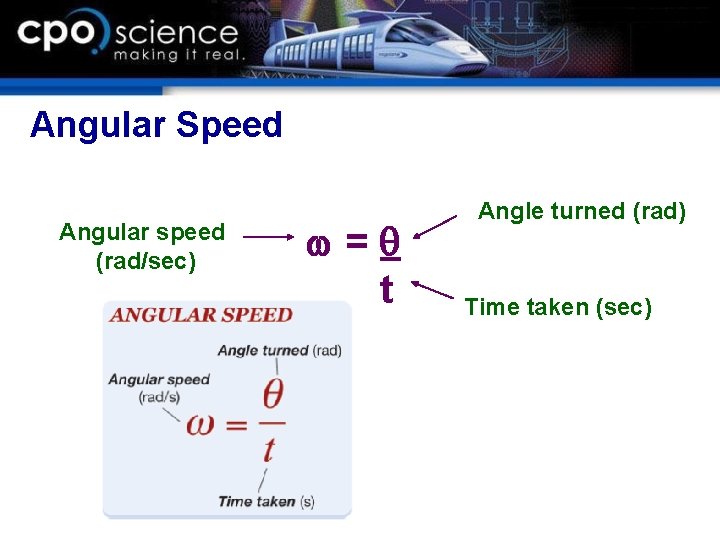
Angular Speed Angular speed (rad/sec) w=q t Angle turned (rad) Time taken (sec)
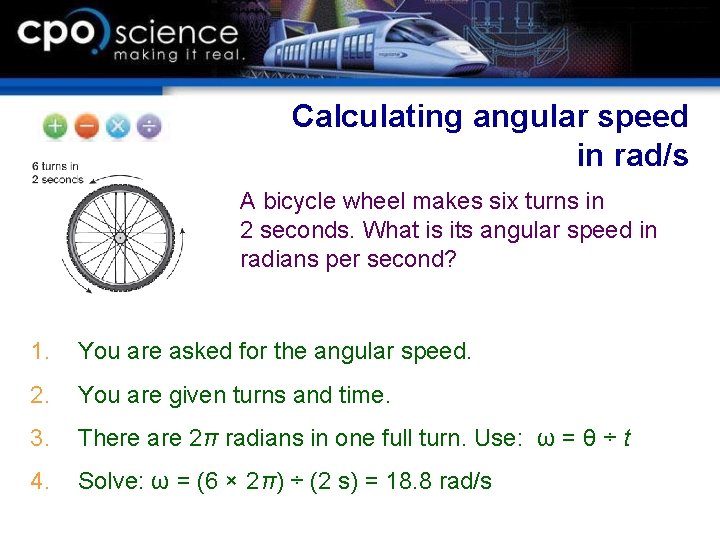
Calculating angular speed in rad/s A bicycle wheel makes six turns in 2 seconds. What is its angular speed in radians per second? 1. You are asked for the angular speed. 2. You are given turns and time. 3. There are 2π radians in one full turn. Use: ω = θ ÷ t 4. Solve: ω = (6 × 2π) ÷ (2 s) = 18. 8 rad/s
Relating angular speed, linear speed and displacement § As a wheel rotates, the point touching the ground passes around its circumference. § When the wheel has turned one full rotation, it has moved forward a distance equal to its circumference. § Therefore, the linear speed of a wheel is its angular speed multiplied by its radius.
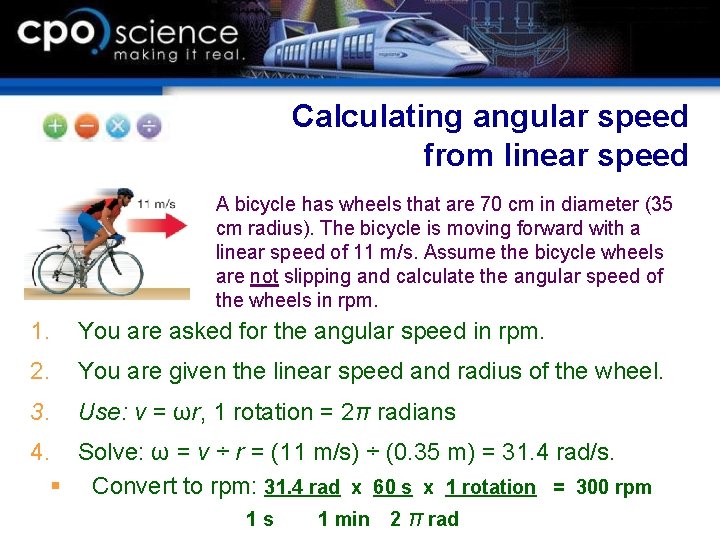
Calculating angular speed from linear speed A bicycle has wheels that are 70 cm in diameter (35 cm radius). The bicycle is moving forward with a linear speed of 11 m/s. Assume the bicycle wheels are not slipping and calculate the angular speed of the wheels in rpm. 1. You are asked for the angular speed in rpm. 2. You are given the linear speed and radius of the wheel. 3. Use: v = ωr, 1 rotation = 2π radians 4. Solve: ω = v ÷ r = (11 m/s) ÷ (0. 35 m) = 31. 4 rad/s. § Convert to rpm: 31. 4 rad x 60 s x 1 rotation = 300 rpm 1 s 1 min 2 π rad
Motion in Circles 1 Circular Motion 2 Centripetal Force 3 Universal Gravitation and Orbital Motion
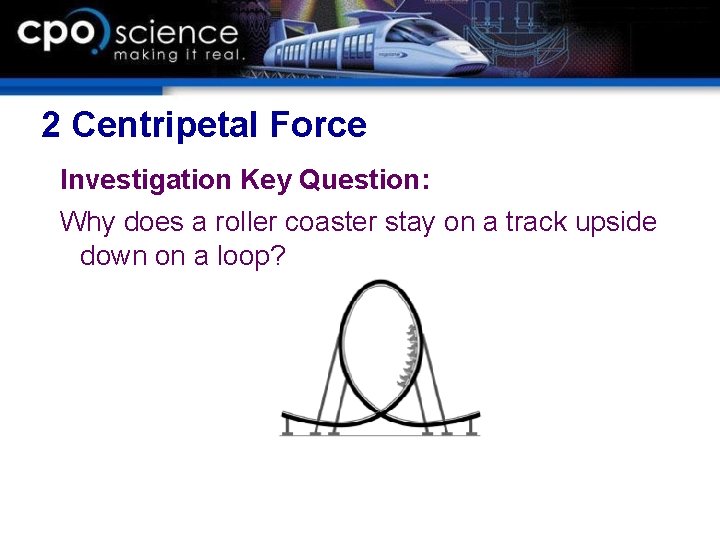
2 Centripetal Force Investigation Key Question: Why does a roller coaster stay on a track upside down on a loop?
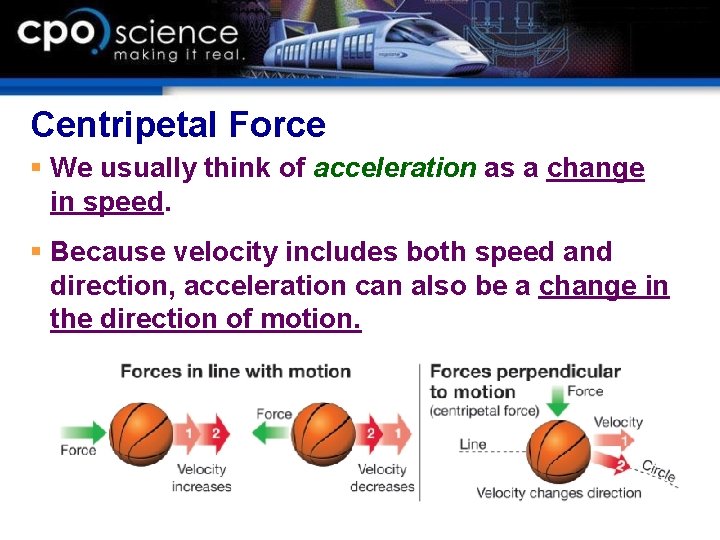
Centripetal Force § We usually think of acceleration as a change in speed. § Because velocity includes both speed and direction, acceleration can also be a change in the direction of motion.
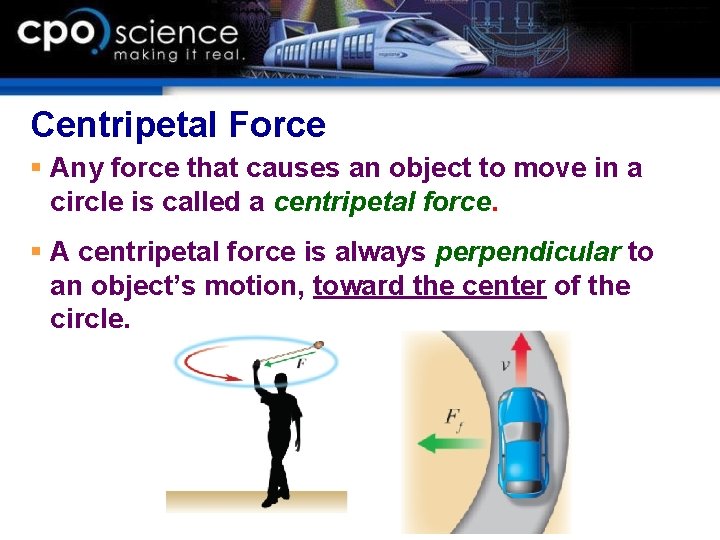
Centripetal Force § Any force that causes an object to move in a circle is called a centripetal force. § A centripetal force is always perpendicular to an object’s motion, toward the center of the circle.
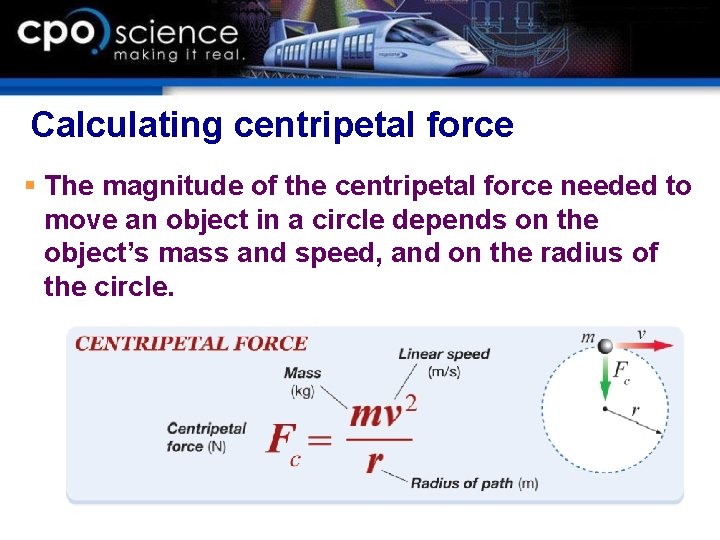
Calculating centripetal force § The magnitude of the centripetal force needed to move an object in a circle depends on the object’s mass and speed, and on the radius of the circle.
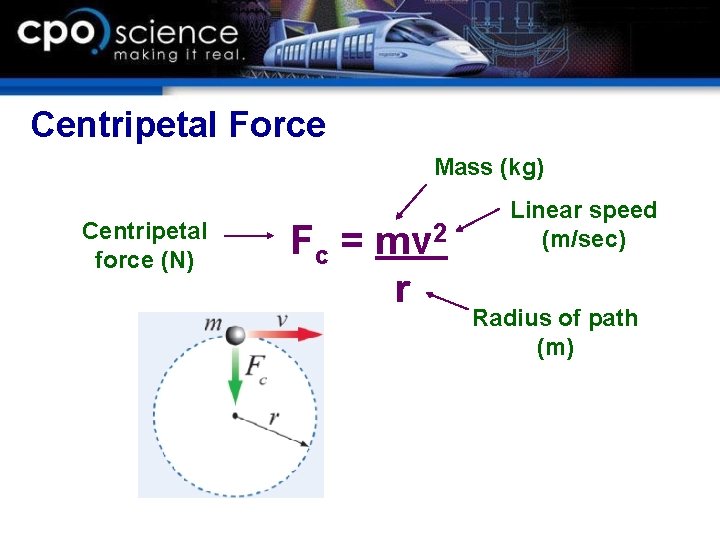
Centripetal Force Mass (kg) Centripetal force (N) Fc = mv 2 r Linear speed (m/sec) Radius of path (m)
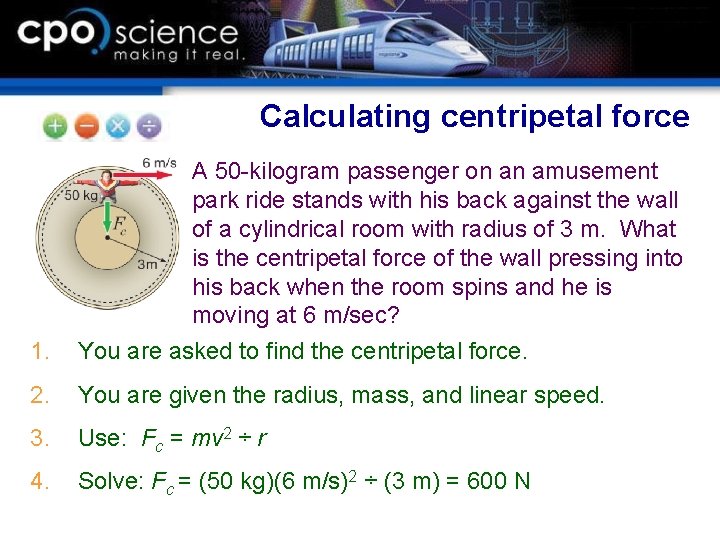
Calculating centripetal force 1. A 50 -kilogram passenger on an amusement park ride stands with his back against the wall of a cylindrical room with radius of 3 m. What is the centripetal force of the wall pressing into his back when the room spins and he is moving at 6 m/sec? You are asked to find the centripetal force. 2. You are given the radius, mass, and linear speed. 3. Use: Fc = mv 2 ÷ r 4. Solve: Fc = (50 kg)(6 m/s)2 ÷ (3 m) = 600 N
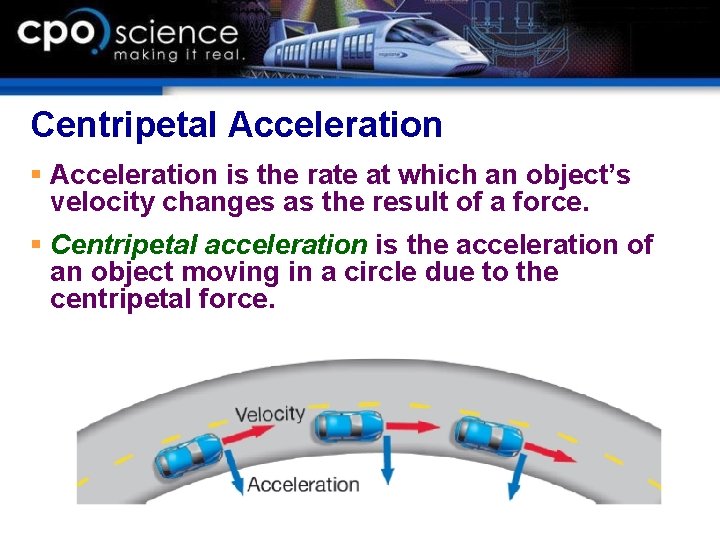
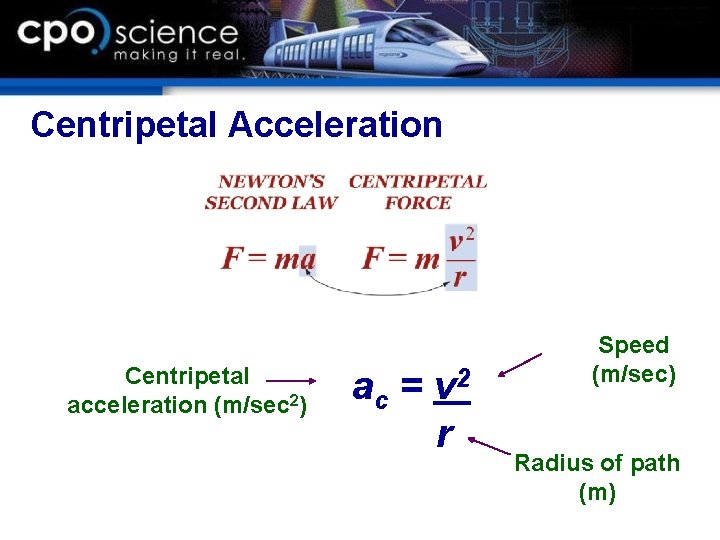
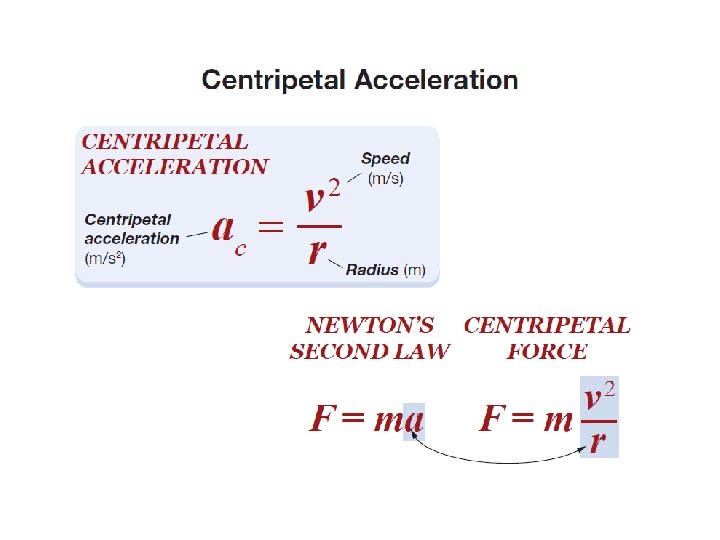
Centripetal Acceleration § Acceleration is the rate at which an object’s velocity changes as the result of a force. § Centripetal acceleration is the acceleration of an object moving in a circle due to the centripetal force.
Centripetal Acceleration Centripetal acceleration (m/sec 2) ac = v 2 r Speed (m/sec) Radius of path (m)
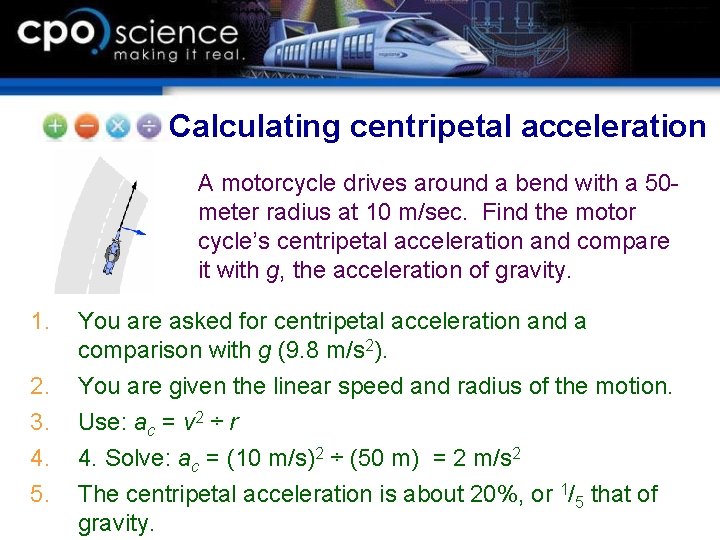
Calculating centripetal acceleration A motorcycle drives around a bend with a 50 meter radius at 10 m/sec. Find the motor cycle’s centripetal acceleration and compare it with g, the acceleration of gravity. 1. 2. 3. 4. 5. You are asked for centripetal acceleration and a comparison with g (9. 8 m/s 2). You are given the linear speed and radius of the motion. Use: ac = v 2 ÷ r 4. Solve: ac = (10 m/s)2 ÷ (50 m) = 2 m/s 2 The centripetal acceleration is about 20%, or 1/5 that of gravity.
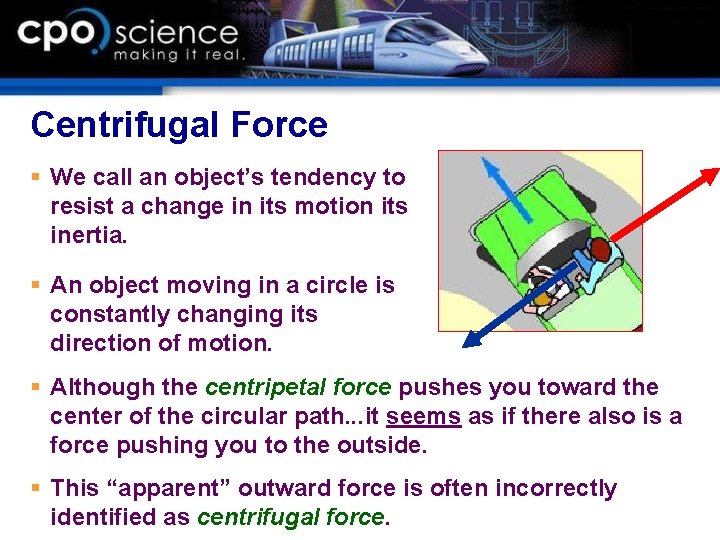
Centrifugal Force § We call an object’s tendency to resist a change in its motion its inertia. § An object moving in a circle is constantly changing its direction of motion. § Although the centripetal force pushes you toward the center of the circular path. . . it seems as if there also is a force pushing you to the outside. § This “apparent” outward force is often incorrectly identified as centrifugal force.
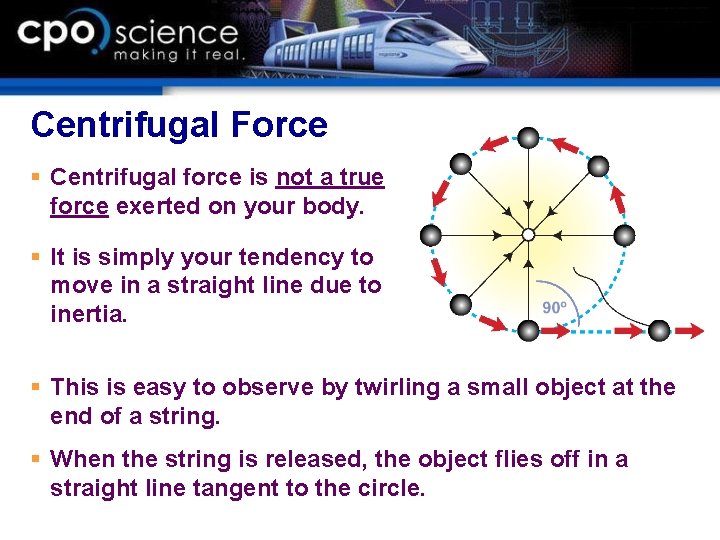
Centrifugal Force § Centrifugal force is not a true force exerted on your body. § It is simply your tendency to move in a straight line due to inertia. § This is easy to observe by twirling a small object at the end of a string. § When the string is released, the object flies off in a straight line tangent to the circle.