
Motion in a Circle Introduction In this chapter



- Slides: 85
Motion in a Circle
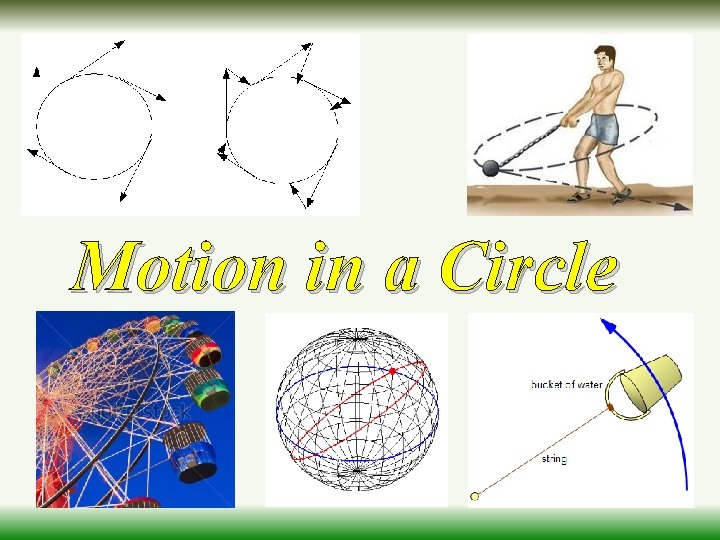
Introduction • In this chapter you will learn to solve problems when a particle is moving in a circle • There are many situations where a particle follows a circular path (often only briefly!) • For example, a car racing round a bend in the road, amusement park rides and the pendulum on a clock…
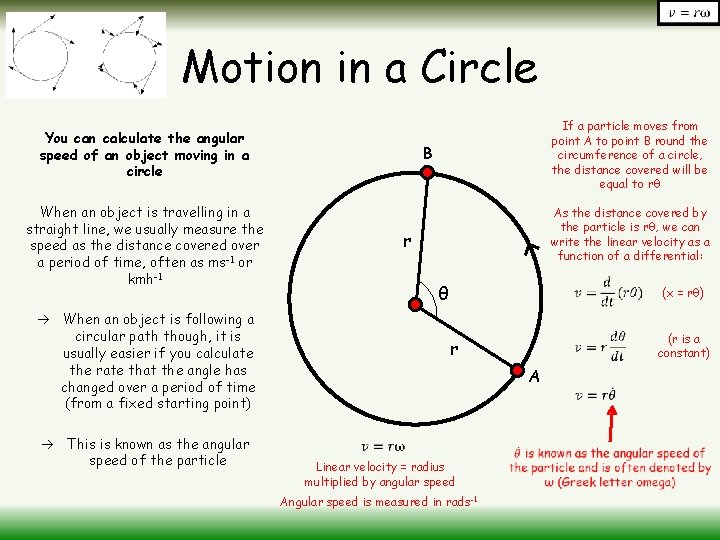
Motion in a Circle You can calculate the angular speed of an object moving in a circle When an object is travelling in a straight line, we usually measure the speed as the distance covered over a period of time, often as ms-1 or kmh-1 When an object is following a circular path though, it is usually easier if you calculate the rate that the angle has changed over a period of time (from a fixed starting point) This is known as the angular speed of the particle If a particle moves from point A to point B round the circumference of a circle, the distance covered will be equal to rθ B As the distance covered by the particle is rθ, we can write the linear velocity as a function of a differential: r θ (x = rθ) (r is a constant) r A Linear velocity = radius multiplied by angular speed Angular speed is measured in rads -1
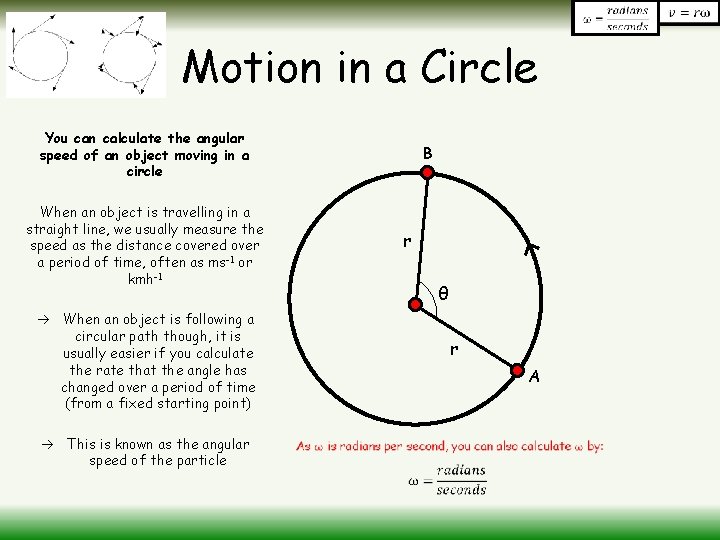
Motion in a Circle You can calculate the angular speed of an object moving in a circle When an object is travelling in a straight line, we usually measure the speed as the distance covered over a period of time, often as ms-1 or kmh-1 When an object is following a circular path though, it is usually easier if you calculate the rate that the angle has changed over a period of time (from a fixed starting point) This is known as the angular speed of the particle B r θ r A
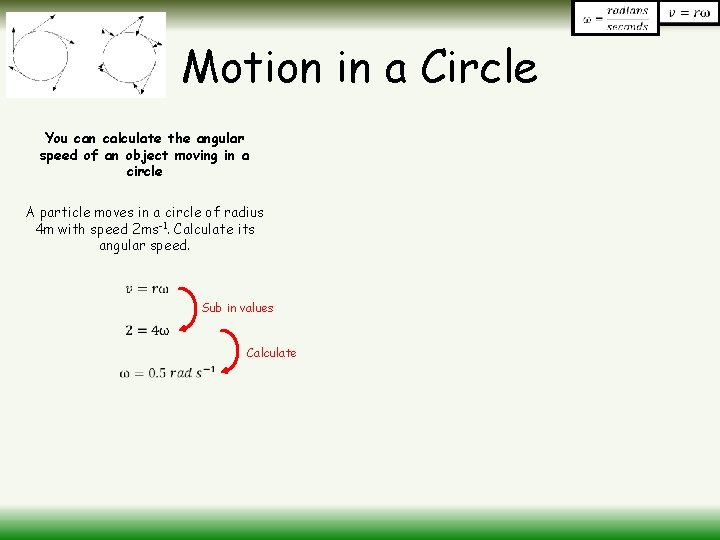
Motion in a Circle You can calculate the angular speed of an object moving in a circle A particle moves in a circle of radius 4 m with speed 2 ms-1. Calculate its angular speed. Sub in values Calculate
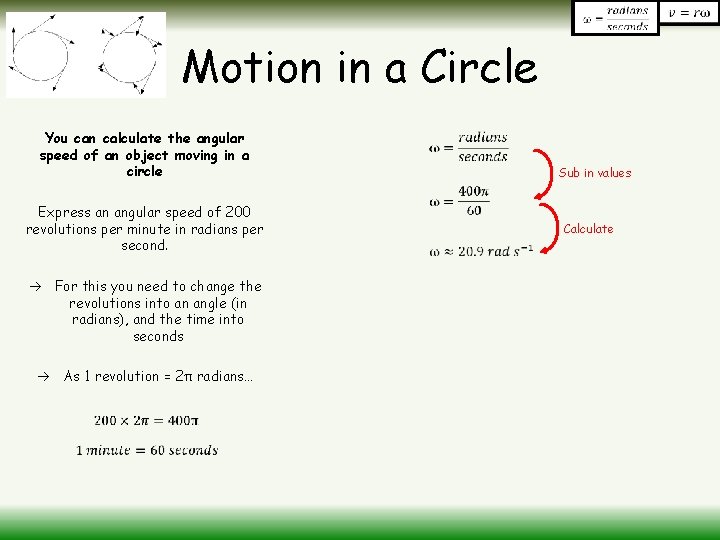
Motion in a Circle You can calculate the angular speed of an object moving in a circle Express an angular speed of 200 revolutions per minute in radians per second. For this you need to change the revolutions into an angle (in radians), and the time into seconds As 1 revolution = 2π radians… Sub in values Calculate
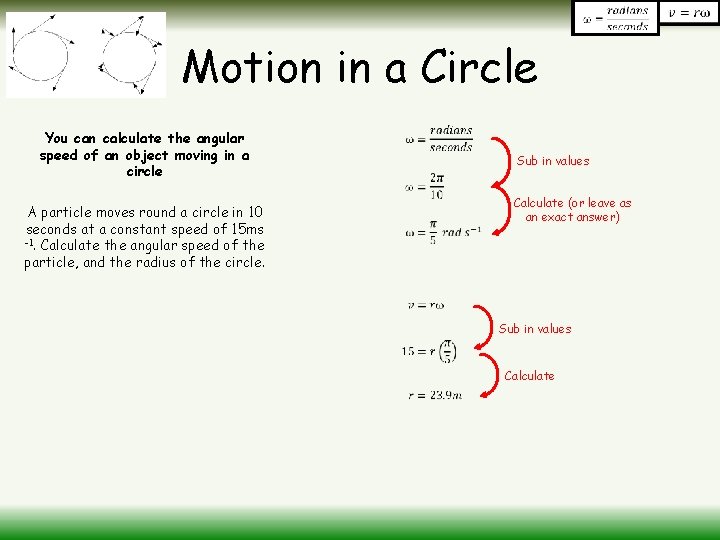
Motion in a Circle You can calculate the angular speed of an object moving in a circle A particle moves round a circle in 10 seconds at a constant speed of 15 ms -1. Calculate the angular speed of the particle, and the radius of the circle. Sub in values Calculate (or leave as an exact answer) Sub in values Calculate
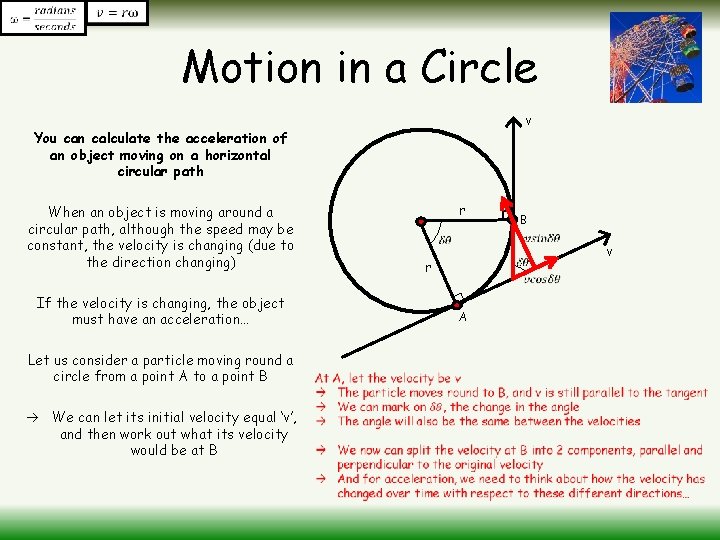
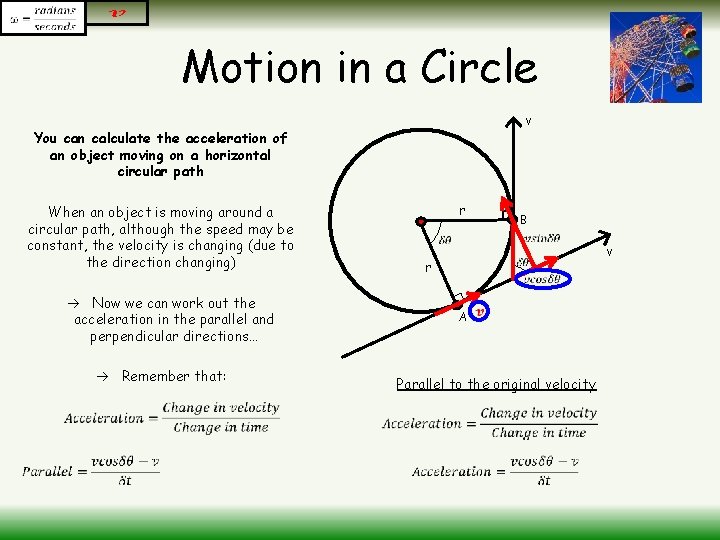
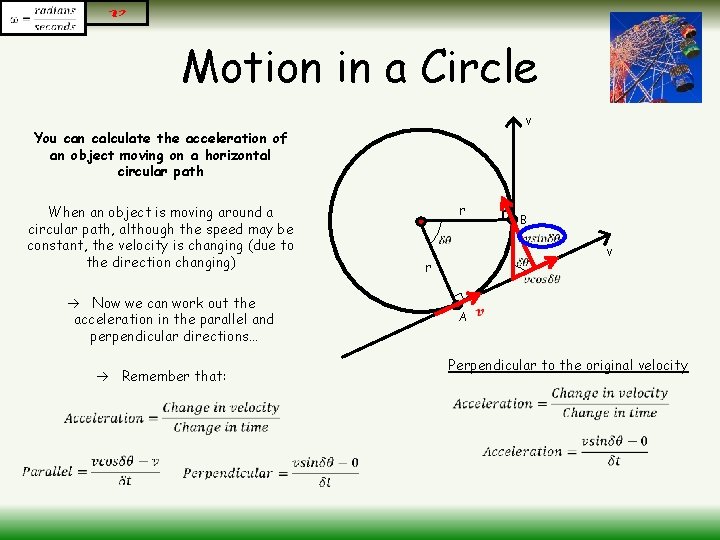
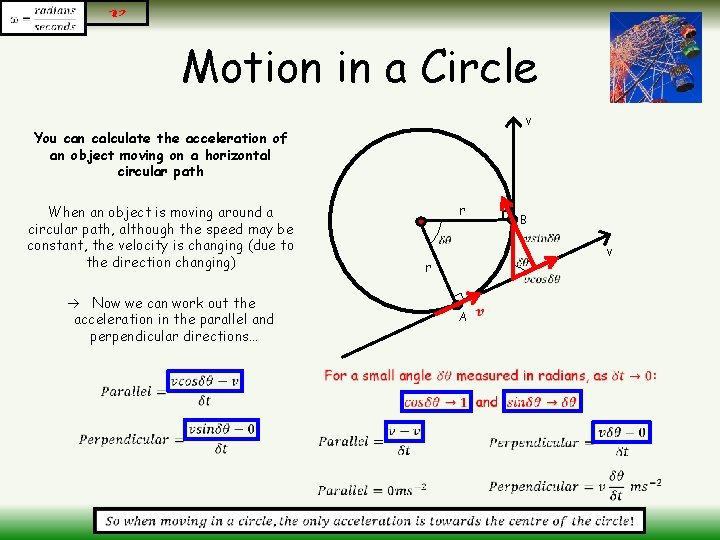
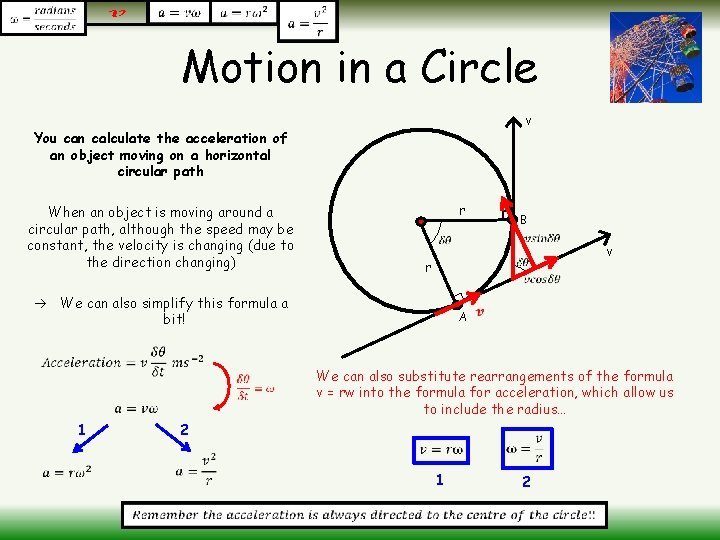
Motion in a Circle v You can calculate the acceleration of an object moving on a horizontal circular path When an object is moving around a circular path, although the speed may be constant, the velocity is changing (due to the direction changing) If the velocity is changing, the object must have an acceleration… Let us consider a particle moving round a circle from a point A to a point B We can let its initial velocity equal ‘v’, and then work out what its velocity would be at B r B v r A
Motion in a Circle v You can calculate the acceleration of an object moving on a horizontal circular path When an object is moving around a circular path, although the speed may be constant, the velocity is changing (due to the direction changing) Now we can work out the acceleration in the parallel and perpendicular directions… Remember that: r B v r A Parallel to the original velocity
Motion in a Circle v You can calculate the acceleration of an object moving on a horizontal circular path When an object is moving around a circular path, although the speed may be constant, the velocity is changing (due to the direction changing) Now we can work out the acceleration in the parallel and perpendicular directions… Remember that: r B v r A Perpendicular to the original velocity
Motion in a Circle v You can calculate the acceleration of an object moving on a horizontal circular path When an object is moving around a circular path, although the speed may be constant, the velocity is changing (due to the direction changing) Now we can work out the acceleration in the parallel and perpendicular directions… r B v r A
Motion in a Circle v You can calculate the acceleration of an object moving on a horizontal circular path When an object is moving around a circular path, although the speed may be constant, the velocity is changing (due to the direction changing) r B v r We can also simplify this formula a bit! A We can also substitute rearrangements of the formula v = rw into the formula for acceleration, which allow us to include the radius… 1 2
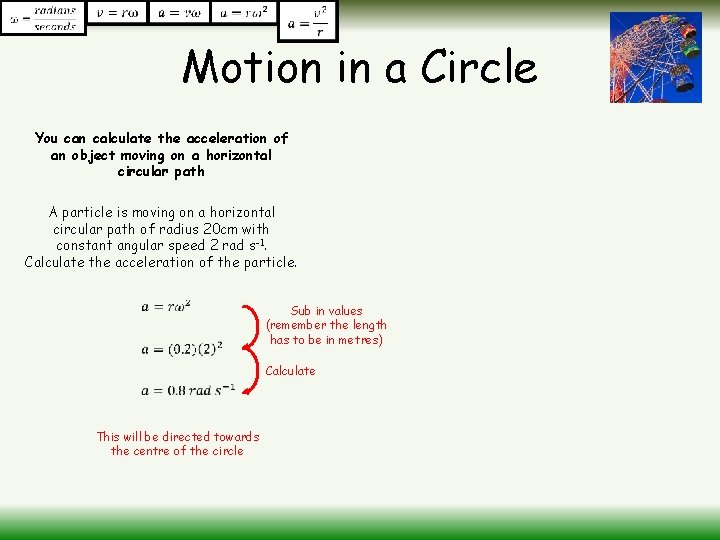
Motion in a Circle You can calculate the acceleration of an object moving on a horizontal circular path A particle is moving on a horizontal circular path of radius 20 cm with constant angular speed 2 rad s-1. Calculate the acceleration of the particle. Sub in values (remember the length has to be in metres) Calculate This will be directed towards the centre of the circle
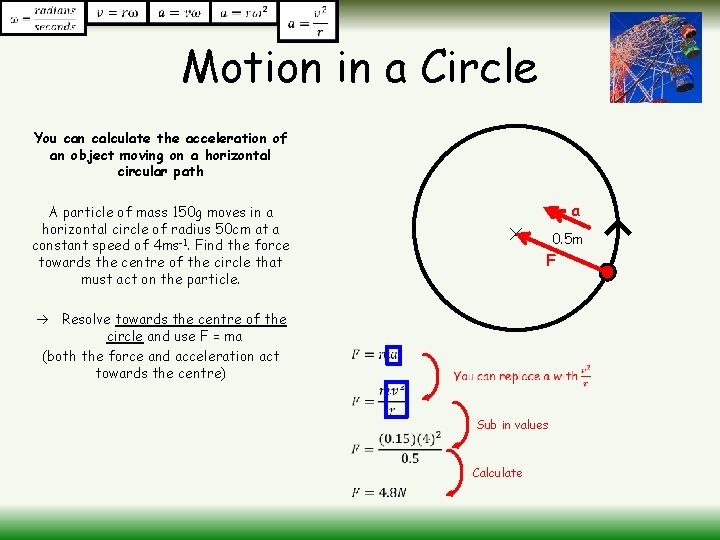
Motion in a Circle You can calculate the acceleration of an object moving on a horizontal circular path a A particle of mass 150 g moves in a horizontal circle of radius 50 cm at a constant speed of 4 ms-1. Find the force towards the centre of the circle that must act on the particle. 0. 5 m F Resolve towards the centre of the circle and use F = ma (both the force and acceleration act towards the centre) Sub in values Calculate
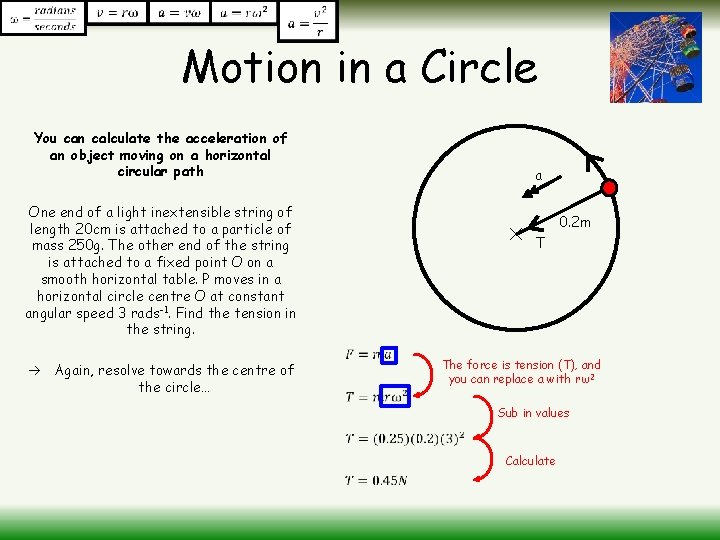
Motion in a Circle You can calculate the acceleration of an object moving on a horizontal circular path One end of a light inextensible string of length 20 cm is attached to a particle of mass 250 g. The other end of the string is attached to a fixed point O on a smooth horizontal table. P moves in a horizontal circle centre O at constant angular speed 3 rads-1. Find the tension in the string. Again, resolve towards the centre of the circle… a 0. 2 m T The force is tension (T), and you can replace a with rω2 Sub in values Calculate
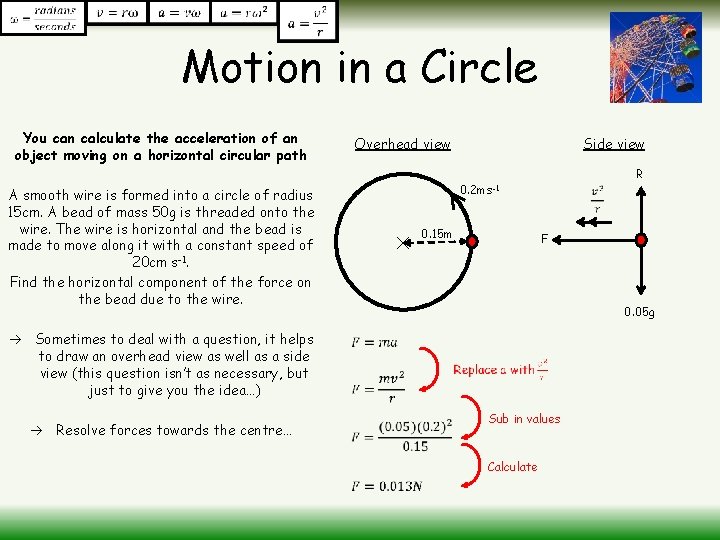
Motion in a Circle You can calculate the acceleration of an object moving on a horizontal circular path A smooth wire is formed into a circle of radius 15 cm. A bead of mass 50 g is threaded onto the wire. The wire is horizontal and the bead is made to move along it with a constant speed of 20 cm s-1. Find the horizontal component of the force on the bead due to the wire. Overhead view Side view R 0. 2 ms-1 0. 15 m F 0. 05 g Sometimes to deal with a question, it helps to draw an overhead view as well as a side view (this question isn’t as necessary, but just to give you the idea…) Resolve forces towards the centre… Sub in values Calculate
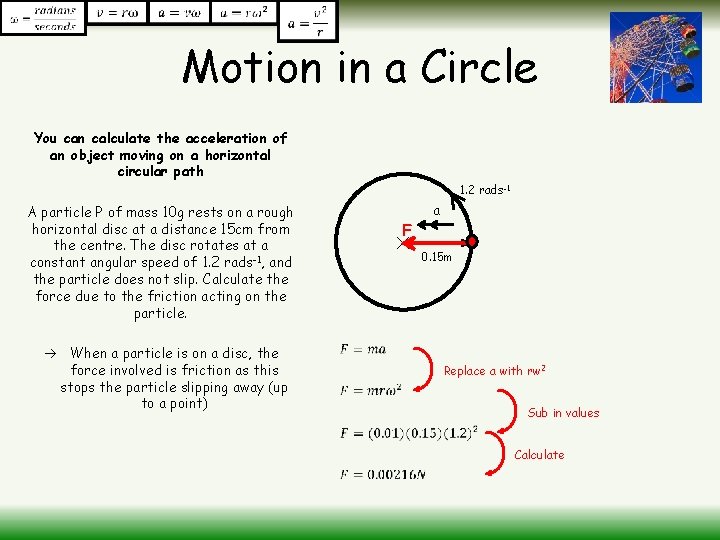
Motion in a Circle You can calculate the acceleration of an object moving on a horizontal circular path 1. 2 rads-1 A particle P of mass 10 g rests on a rough horizontal disc at a distance 15 cm from the centre. The disc rotates at a constant angular speed of 1. 2 rads-1, and the particle does not slip. Calculate the force due to the friction acting on the particle. When a particle is on a disc, the force involved is friction as this stops the particle slipping away (up to a point) F a 0. 15 m Replace a with rw 2 Sub in values Calculate
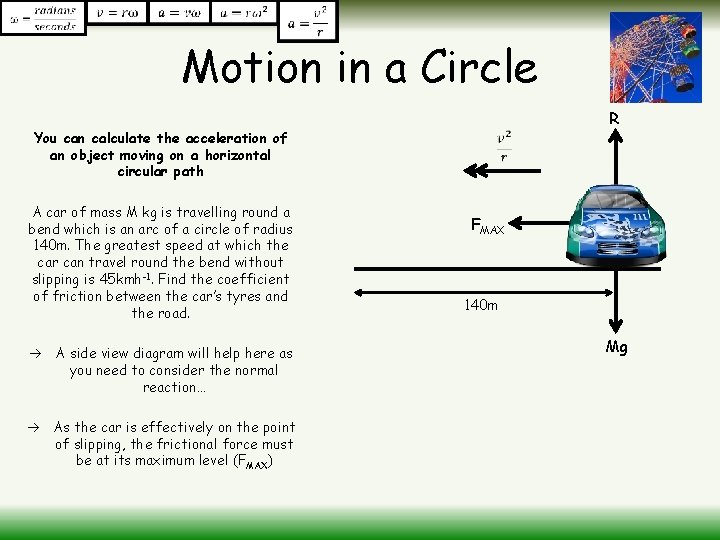
Motion in a Circle R You can calculate the acceleration of an object moving on a horizontal circular path A car of mass M kg is travelling round a bend which is an arc of a circle of radius 140 m. The greatest speed at which the car can travel round the bend without slipping is 45 kmh-1. Find the coefficient of friction between the car’s tyres and the road. A side view diagram will help here as you need to consider the normal reaction… As the car is effectively on the point of slipping, the frictional force must be at its maximum level (FMAX) FMAX 140 m Mg
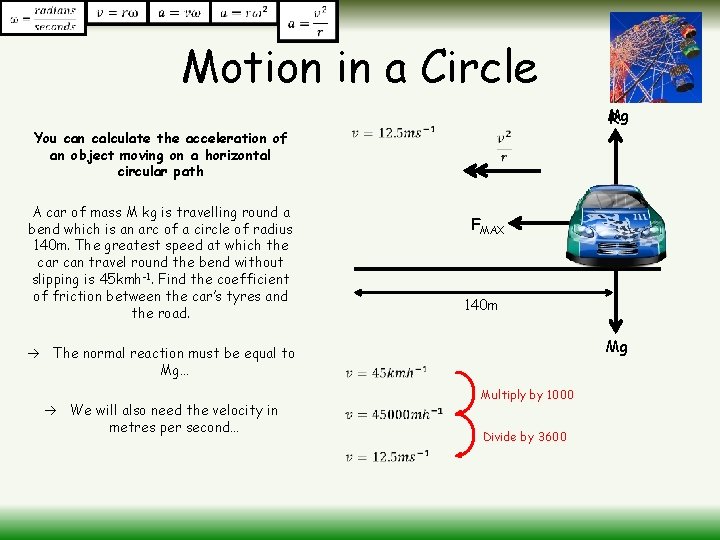
Motion in a Circle Mg R You can calculate the acceleration of an object moving on a horizontal circular path A car of mass M kg is travelling round a bend which is an arc of a circle of radius 140 m. The greatest speed at which the car can travel round the bend without slipping is 45 kmh-1. Find the coefficient of friction between the car’s tyres and the road. FMAX 140 m Mg The normal reaction must be equal to Mg… We will also need the velocity in metres per second… Multiply by 1000 Divide by 3600
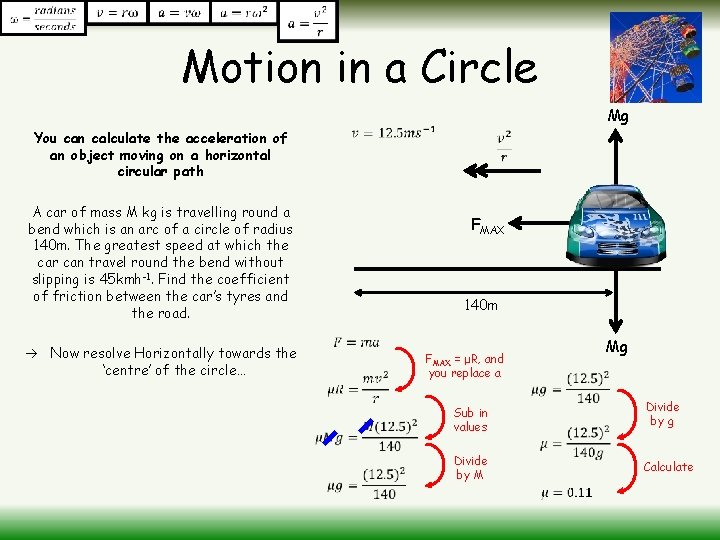
Motion in a Circle Mg You can calculate the acceleration of an object moving on a horizontal circular path A car of mass M kg is travelling round a bend which is an arc of a circle of radius 140 m. The greatest speed at which the car can travel round the bend without slipping is 45 kmh-1. Find the coefficient of friction between the car’s tyres and the road. Now resolve Horizontally towards the ‘centre’ of the circle… FMAX 140 m FMAX = μR, and you replace a Mg Sub in values Divide by g Divide by M Calculate
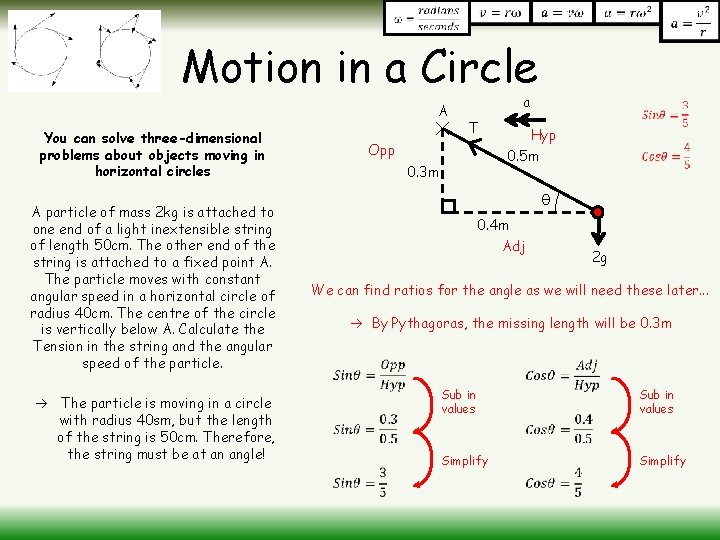
Motion in a Circle A You can solve three-dimensional problems about objects moving in horizontal circles A particle of mass 2 kg is attached to one end of a light inextensible string of length 50 cm. The other end of the string is attached to a fixed point A. The particle moves with constant angular speed in a horizontal circle of radius 40 cm. The centre of the circle is vertically below A. Calculate the Tension in the string and the angular speed of the particle. The particle is moving in a circle with radius 40 sm, but the length of the string is 50 cm. Therefore, the string must be at an angle! a T Opp 0. 3 m Hyp 0. 5 m θ 0. 4 m Adj 2 g We can find ratios for the angle as we will need these later. . . By Pythagoras, the missing length will be 0. 3 m Sub in values Simplify
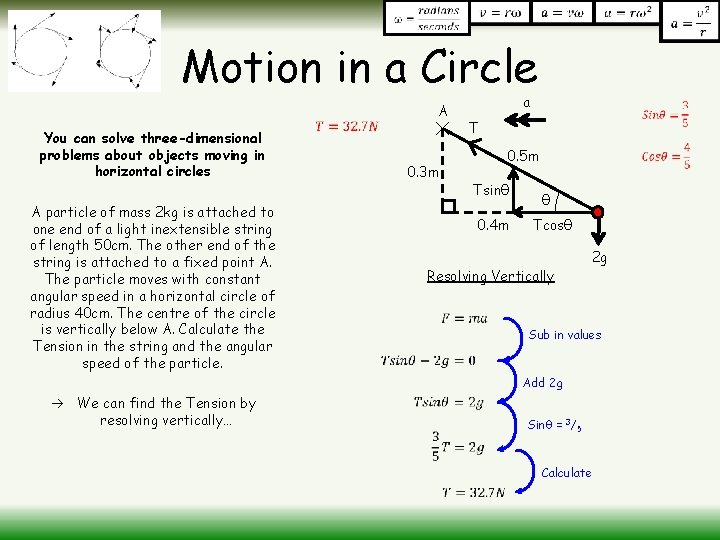
Motion in a Circle A You can solve three-dimensional problems about objects moving in horizontal circles A particle of mass 2 kg is attached to one end of a light inextensible string of length 50 cm. The other end of the string is attached to a fixed point A. The particle moves with constant angular speed in a horizontal circle of radius 40 cm. The centre of the circle is vertically below A. Calculate the Tension in the string and the angular speed of the particle. 0. 3 m a T 0. 5 m Tsinθ 0. 4 m θ Tcosθ Resolving Vertically 2 g Sub in values Add 2 g We can find the Tension by resolving vertically… Sinθ = 3/5 Calculate
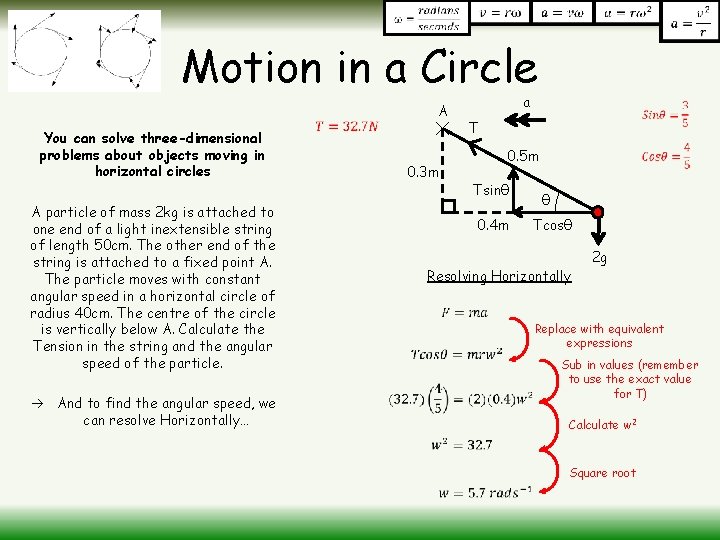
Motion in a Circle A You can solve three-dimensional problems about objects moving in horizontal circles A particle of mass 2 kg is attached to one end of a light inextensible string of length 50 cm. The other end of the string is attached to a fixed point A. The particle moves with constant angular speed in a horizontal circle of radius 40 cm. The centre of the circle is vertically below A. Calculate the Tension in the string and the angular speed of the particle. And to find the angular speed, we can resolve Horizontally… 0. 3 m a T 0. 5 m Tsinθ 0. 4 m θ Tcosθ Resolving Horizontally 2 g Replace with equivalent expressions Sub in values (remember to use the exact value for T) Calculate w 2 Square root
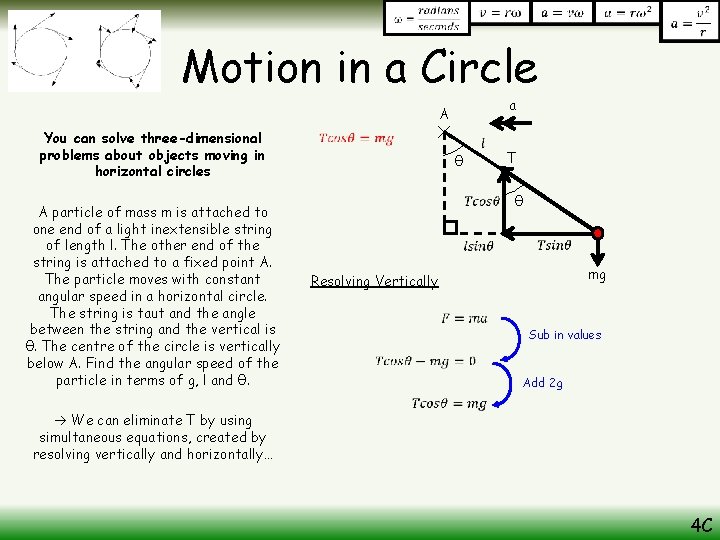
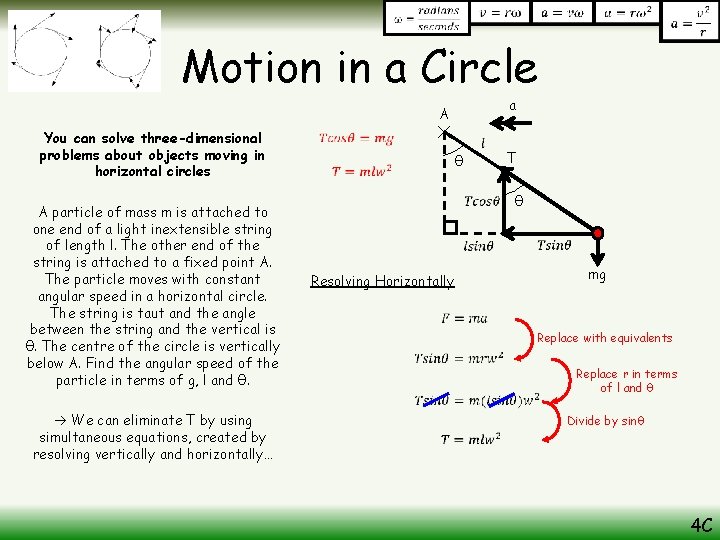
Motion in a Circle a A You can solve three-dimensional problems about objects moving in horizontal circles A particle of mass m is attached to one end of a light inextensible string of length l. The other end of the string is attached to a fixed point A. The particle moves with constant angular speed in a horizontal circle. The string is taut and the angle between the string and the vertical is θ. The centre of the circle is vertically below A. Find the angular speed of the particle in terms of g, l and θ. θ T θ mg Resolving Vertically Sub in values Add 2 g We can eliminate T by using simultaneous equations, created by resolving vertically and horizontally… 4 C
Motion in a Circle a A You can solve three-dimensional problems about objects moving in horizontal circles A particle of mass m is attached to one end of a light inextensible string of length l. The other end of the string is attached to a fixed point A. The particle moves with constant angular speed in a horizontal circle. The string is taut and the angle between the string and the vertical is θ. The centre of the circle is vertically below A. Find the angular speed of the particle in terms of g, l and θ. We can eliminate T by using simultaneous equations, created by resolving vertically and horizontally… θ T θ Resolving Horizontally mg Replace with equivalents Replace r in terms of l and θ Divide by sinθ 4 C
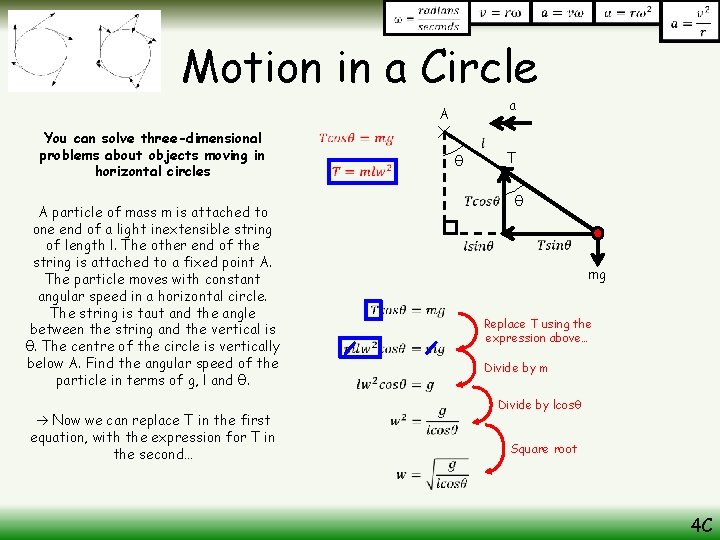
Motion in a Circle a A You can solve three-dimensional problems about objects moving in horizontal circles A particle of mass m is attached to one end of a light inextensible string of length l. The other end of the string is attached to a fixed point A. The particle moves with constant angular speed in a horizontal circle. The string is taut and the angle between the string and the vertical is θ. The centre of the circle is vertically below A. Find the angular speed of the particle in terms of g, l and θ. Now we can replace T in the first equation, with the expression for T in the second… θ T θ mg Replace T using the expression above… Divide by m Divide by lcosθ Square root 4 C
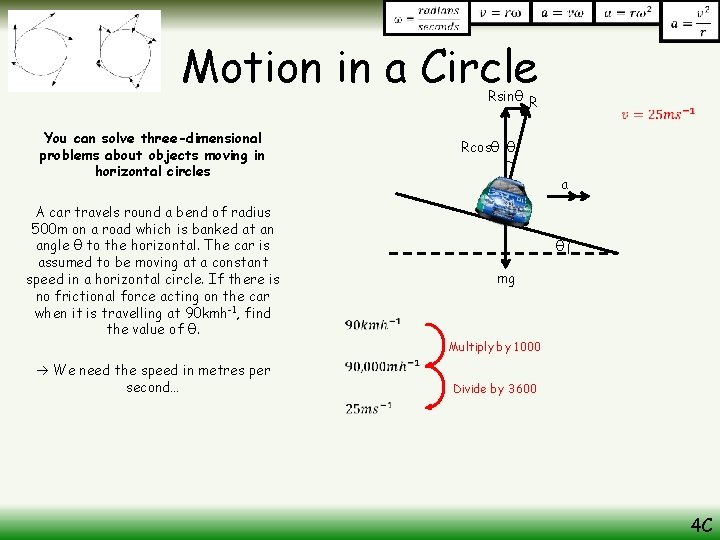
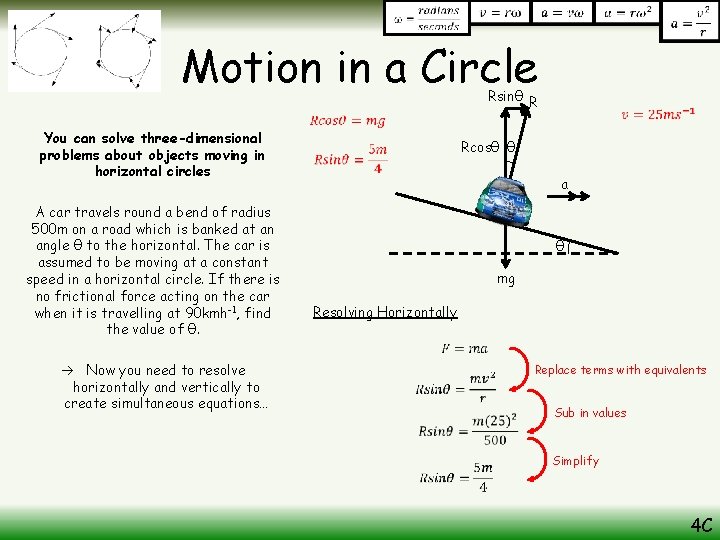
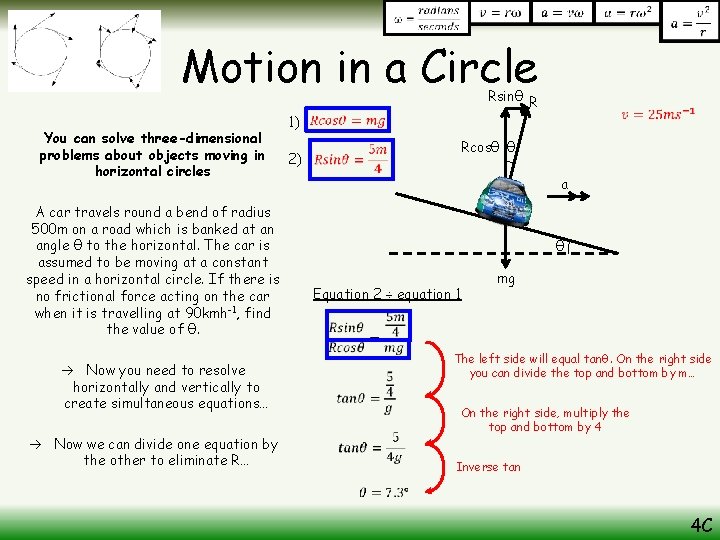
Motion in a Circle Rsinθ R You can solve three-dimensional problems about objects moving in horizontal circles A car travels round a bend of radius 500 m on a road which is banked at an angle θ to the horizontal. The car is assumed to be moving at a constant speed in a horizontal circle. If there is no frictional force acting on the car when it is travelling at 90 kmh-1, find the value of θ. We need the speed in metres per second… Rcosθ θ a θ mg Multiply by 1000 Divide by 3600 4 C
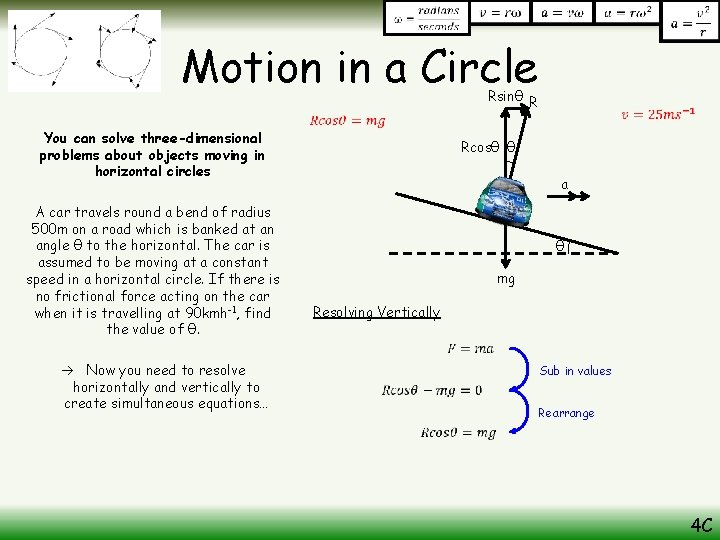
Motion in a Circle Rsinθ R You can solve three-dimensional problems about objects moving in horizontal circles A car travels round a bend of radius 500 m on a road which is banked at an angle θ to the horizontal. The car is assumed to be moving at a constant speed in a horizontal circle. If there is no frictional force acting on the car when it is travelling at 90 kmh-1, find the value of θ. Now you need to resolve horizontally and vertically to create simultaneous equations… Rcosθ θ a θ mg Resolving Vertically Sub in values Rearrange 4 C
Motion in a Circle Rsinθ R You can solve three-dimensional problems about objects moving in horizontal circles A car travels round a bend of radius 500 m on a road which is banked at an angle θ to the horizontal. The car is assumed to be moving at a constant speed in a horizontal circle. If there is no frictional force acting on the car when it is travelling at 90 kmh-1, find the value of θ. Now you need to resolve horizontally and vertically to create simultaneous equations… Rcosθ θ a θ mg Resolving Horizontally Replace terms with equivalents Sub in values Simplify 4 C
Motion in a Circle Rsinθ R You can solve three-dimensional problems about objects moving in horizontal circles A car travels round a bend of radius 500 m on a road which is banked at an angle θ to the horizontal. The car is assumed to be moving at a constant speed in a horizontal circle. If there is no frictional force acting on the car when it is travelling at 90 kmh-1, find the value of θ. Now you need to resolve horizontally and vertically to create simultaneous equations… Now we can divide one equation by the other to eliminate R… 1) 2) Rcosθ θ a θ Equation 2 ÷ equation 1 mg The left side will equal tanθ. On the right side you can divide the top and bottom by m… On the right side, multiply the top and bottom by 4 Inverse tan 4 C
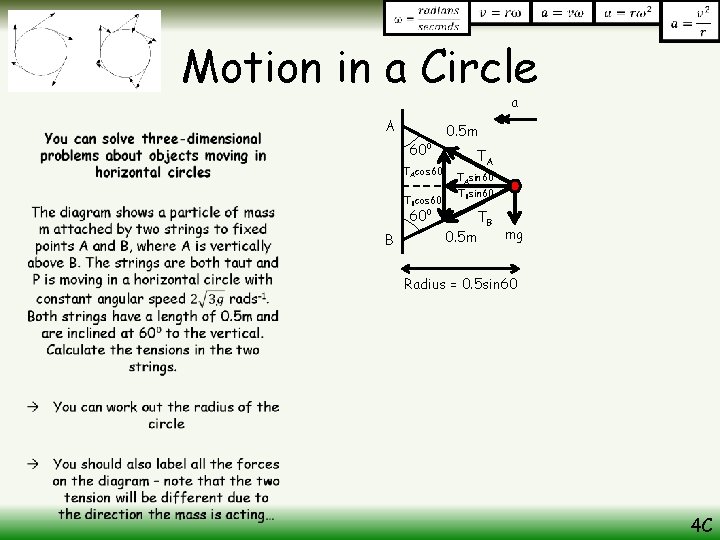
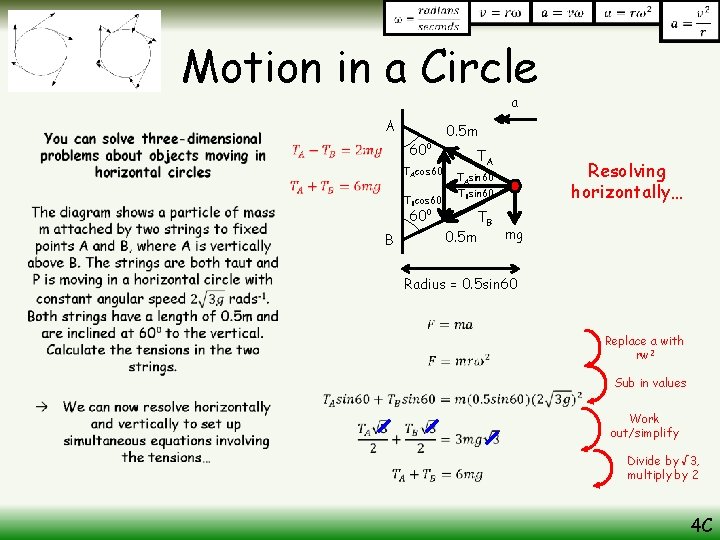
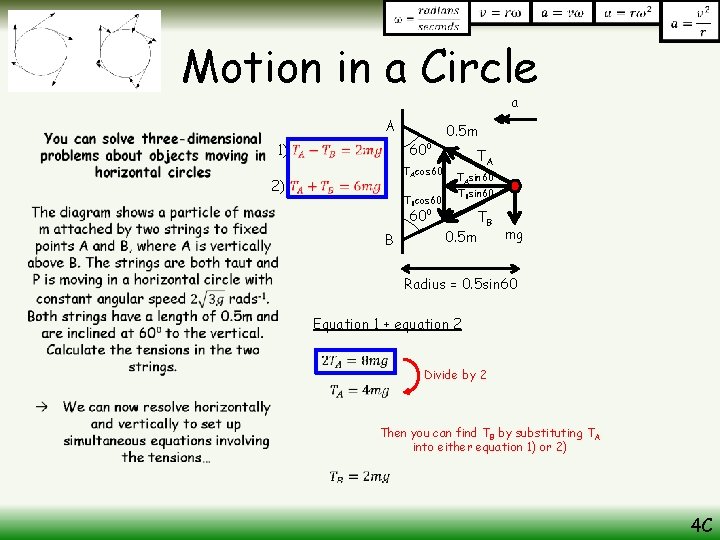
Motion in a Circle a • A 60⁰ TAcos 60 TBcos 60 0. 5 m TA TAsin 60 TBsin 60 60⁰ B 0. 5 m TB mg Radius = 0. 5 sin 60 4 C
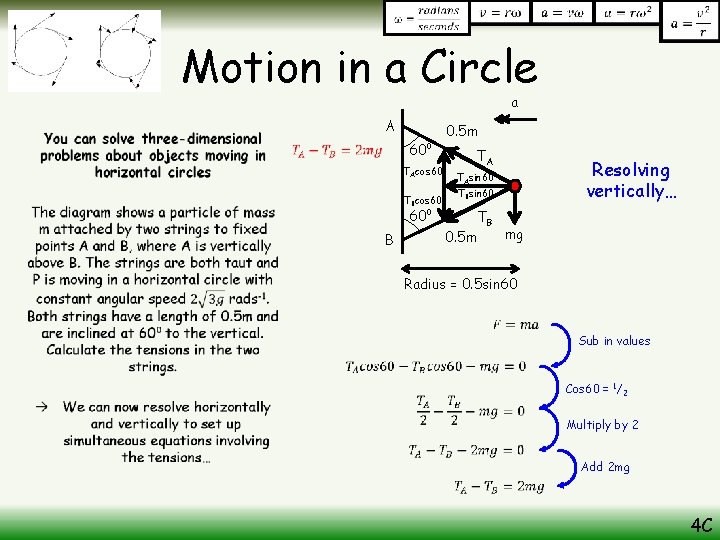
Motion in a Circle a • A 60⁰ TAcos 60 TBcos 60 0. 5 m TA TBsin 60 60⁰ B Resolving vertically… TAsin 60 0. 5 m TB mg Radius = 0. 5 sin 60 Sub in values Cos 60 = 1/2 Multiply by 2 Add 2 mg 4 C
Motion in a Circle a • A 60⁰ TAcos 60 TBcos 60 0. 5 m TA TBsin 60 60⁰ B Resolving horizontally… TAsin 60 0. 5 m TB mg Radius = 0. 5 sin 60 Replace a with rw 2 Sub in values Work out/simplify Divide by √ 3, multiply by 2 4 C
Motion in a Circle a • A 1) 60⁰ TAcos 60 2) TBcos 60 0. 5 m TA TAsin 60 TBsin 60 60⁰ B 0. 5 m TB mg Radius = 0. 5 sin 60 Equation 1 + equation 2 Divide by 2 Then you can find TB by substituting TA into either equation 1) or 2) 4 C
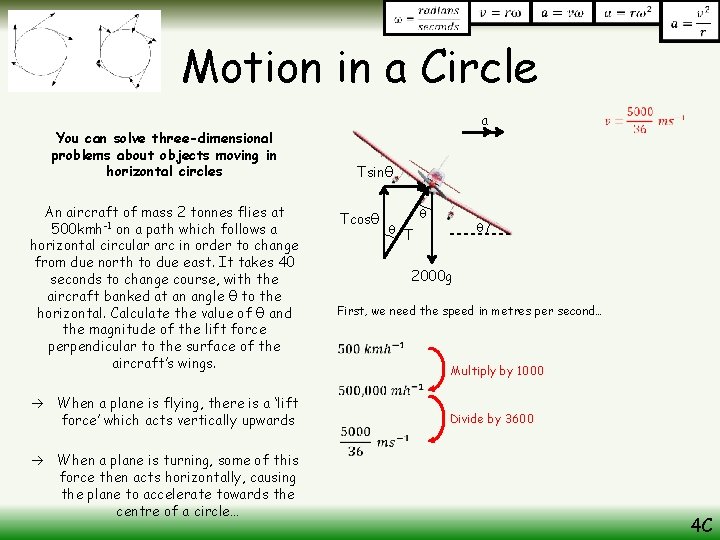
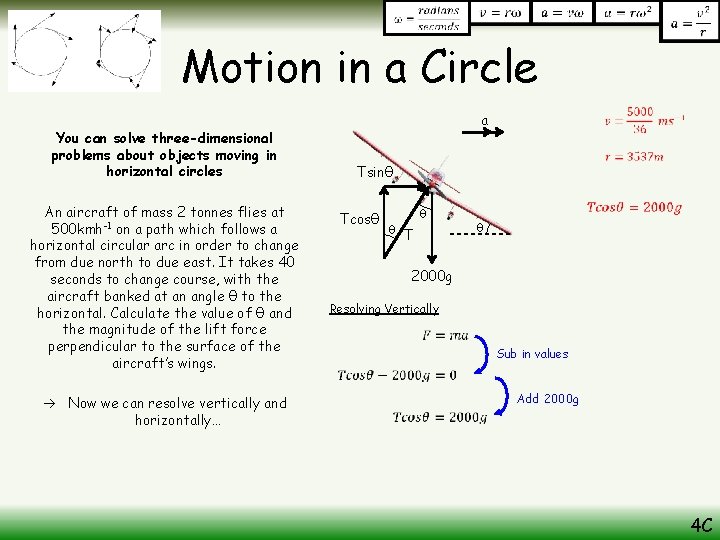
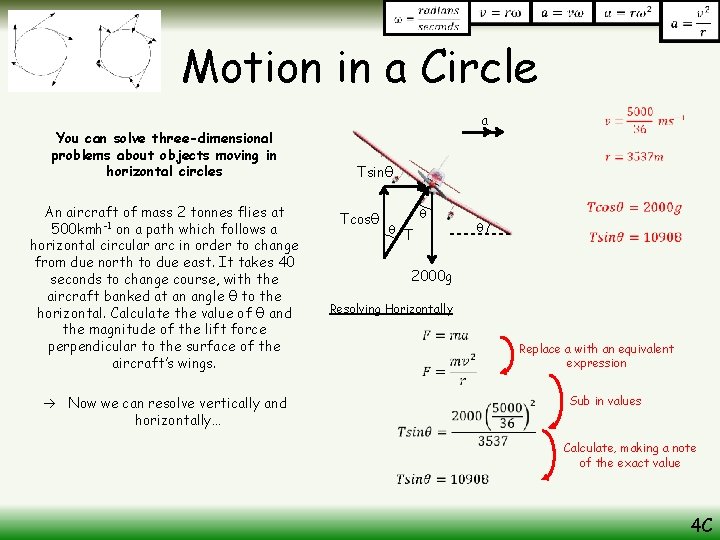
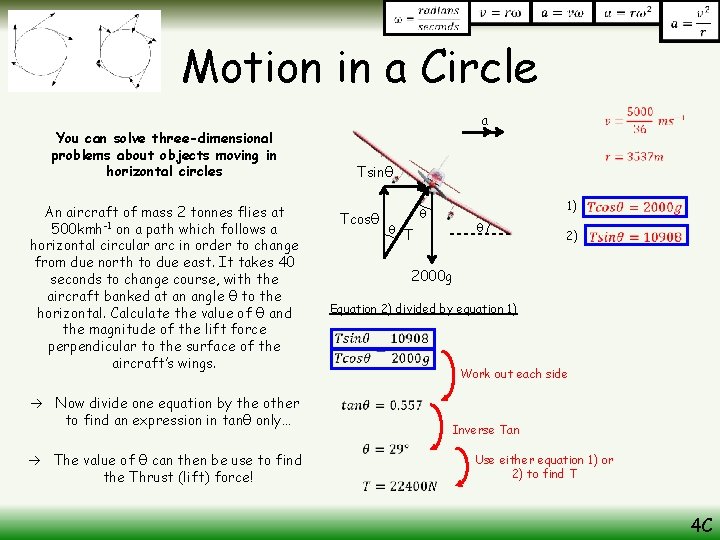
Motion in a Circle You can solve three-dimensional problems about objects moving in horizontal circles An aircraft of mass 2 tonnes flies at 500 kmh-1 on a path which follows a horizontal circular arc in order to change from due north to due east. It takes 40 seconds to change course, with the aircraft banked at an angle θ to the horizontal. Calculate the value of θ and the magnitude of the lift force perpendicular to the surface of the aircraft’s wings. When a plane is flying, there is a ‘lift force’ which acts vertically upwards When a plane is turning, some of this force then acts horizontally, causing the plane to accelerate towards the centre of a circle… a Tsinθ Tcosθ θ T 2000 g First, we need the speed in metres per second… Multiply by 1000 Divide by 3600 4 C
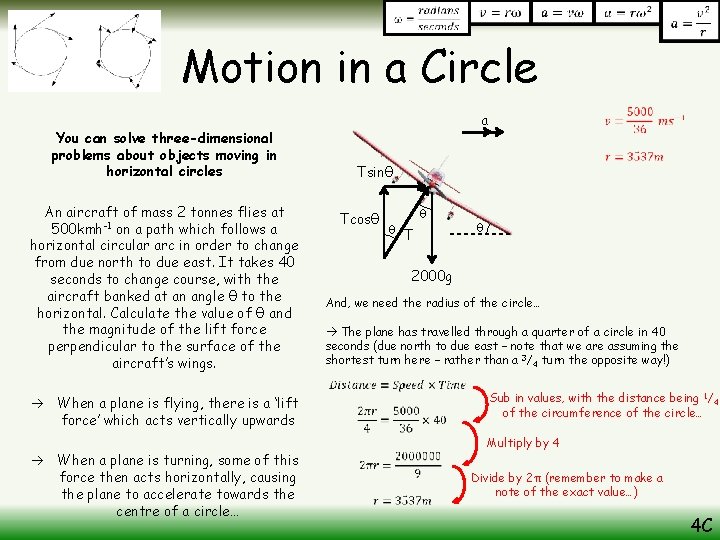
Motion in a Circle You can solve three-dimensional problems about objects moving in horizontal circles An aircraft of mass 2 tonnes flies at 500 kmh-1 on a path which follows a horizontal circular arc in order to change from due north to due east. It takes 40 seconds to change course, with the aircraft banked at an angle θ to the horizontal. Calculate the value of θ and the magnitude of the lift force perpendicular to the surface of the aircraft’s wings. When a plane is flying, there is a ‘lift force’ which acts vertically upwards When a plane is turning, some of this force then acts horizontally, causing the plane to accelerate towards the centre of a circle… a Tsinθ Tcosθ θ θ T θ 2000 g And, we need the radius of the circle… The plane has travelled through a quarter of a circle in 40 seconds (due north to due east – note that we are assuming the shortest turn here – rather than a 3/4 turn the opposite way!) Sub in values, with the distance being 1/4 of the circumference of the circle… Multiply by 4 Divide by 2π (remember to make a note of the exact value…) 4 C
Motion in a Circle You can solve three-dimensional problems about objects moving in horizontal circles An aircraft of mass 2 tonnes flies at 500 kmh-1 on a path which follows a horizontal circular arc in order to change from due north to due east. It takes 40 seconds to change course, with the aircraft banked at an angle θ to the horizontal. Calculate the value of θ and the magnitude of the lift force perpendicular to the surface of the aircraft’s wings. Now we can resolve vertically and horizontally… a Tsinθ Tcosθ θ θ T θ 2000 g Resolving Vertically Sub in values Add 2000 g 4 C
Motion in a Circle You can solve three-dimensional problems about objects moving in horizontal circles An aircraft of mass 2 tonnes flies at 500 kmh-1 on a path which follows a horizontal circular arc in order to change from due north to due east. It takes 40 seconds to change course, with the aircraft banked at an angle θ to the horizontal. Calculate the value of θ and the magnitude of the lift force perpendicular to the surface of the aircraft’s wings. Now we can resolve vertically and horizontally… a Tsinθ Tcosθ θ θ T θ 2000 g Resolving Horizontally Replace a with an equivalent expression Sub in values Calculate, making a note of the exact value 4 C
Motion in a Circle You can solve three-dimensional problems about objects moving in horizontal circles An aircraft of mass 2 tonnes flies at 500 kmh-1 on a path which follows a horizontal circular arc in order to change from due north to due east. It takes 40 seconds to change course, with the aircraft banked at an angle θ to the horizontal. Calculate the value of θ and the magnitude of the lift force perpendicular to the surface of the aircraft’s wings. Now divide one equation by the other to find an expression in tanθ only… The value of θ can then be use to find the Thrust (lift) force! a Tsinθ Tcosθ θ 1) θ θ T 2) 2000 g Equation 2) divided by equation 1) Work out each side Inverse Tan Use either equation 1) or 2) to find T 4 C
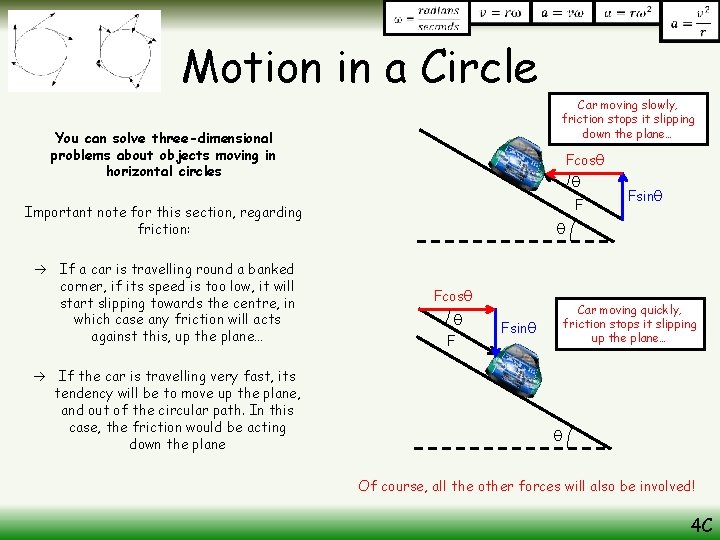
Motion in a Circle Car moving slowly, friction stops it slipping down the plane… You can solve three-dimensional problems about objects moving in horizontal circles Fcosθ θ F Important note for this section, regarding friction: If a car is travelling round a banked corner, if its speed is too low, it will start slipping towards the centre, in which case any friction will acts against this, up the plane… If the car is travelling very fast, its tendency will be to move up the plane, and out of the circular path. In this case, the friction would be acting down the plane Fsinθ θ Fcosθ θ F Car moving quickly, friction stops it slipping up the plane… Fsinθ θ Of course, all the other forces will also be involved! 4 C
Teachings for Exercise 4 D
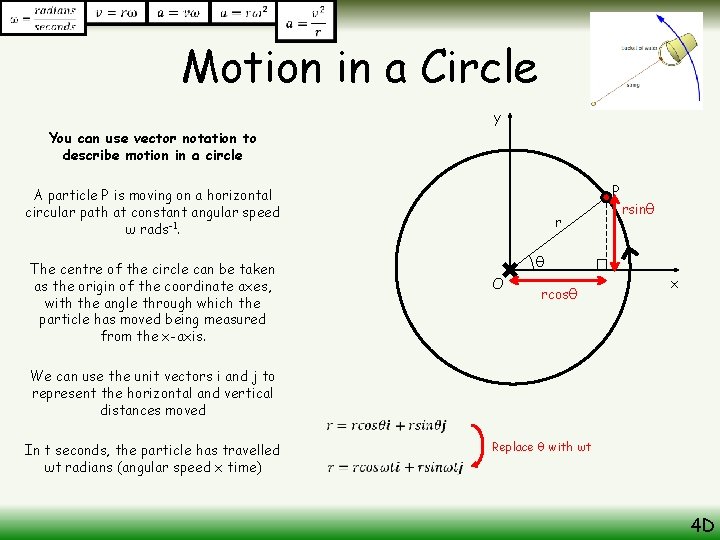
Motion in a Circle y You can use vector notation to describe motion in a circle P A particle P is moving on a horizontal circular path at constant angular speed ω rads-1. The centre of the circle can be taken as the origin of the coordinate axes, with the angle through which the particle has moved being measured from the x-axis. r rsinθ θ O rcosθ x We can use the unit vectors i and j to represent the horizontal and vertical distances moved In t seconds, the particle has travelled ωt radians (angular speed x time) Replace θ with ωt 4 D
Teachings for Exercise 4 E
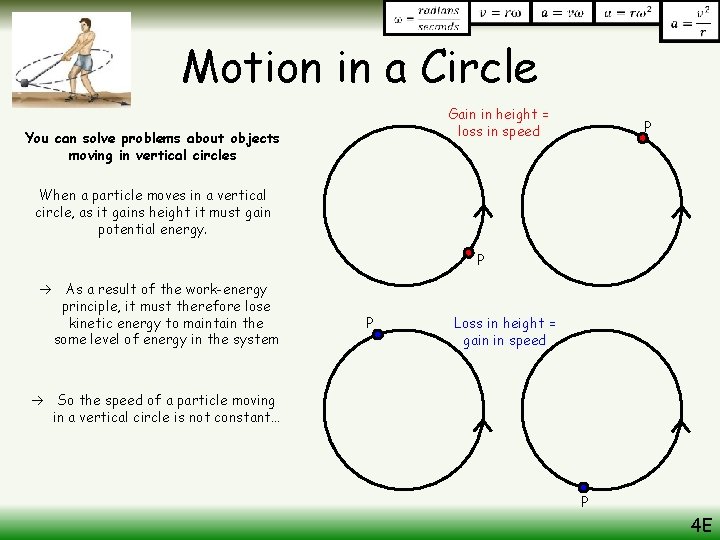
Motion in a Circle Gain in height = loss in speed You can solve problems about objects moving in vertical circles P When a particle moves in a vertical circle, as it gains height it must gain potential energy. P As a result of the work-energy principle, it must therefore lose kinetic energy to maintain the some level of energy in the system P Loss in height = gain in speed So the speed of a particle moving in a vertical circle is not constant… P 4 E
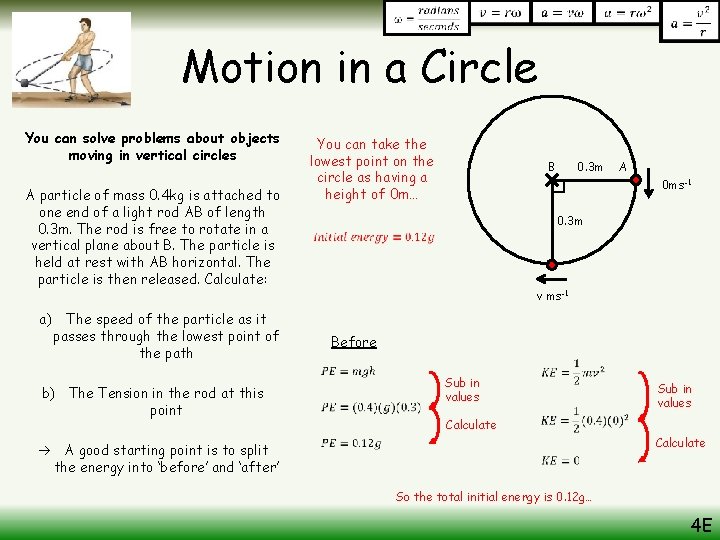
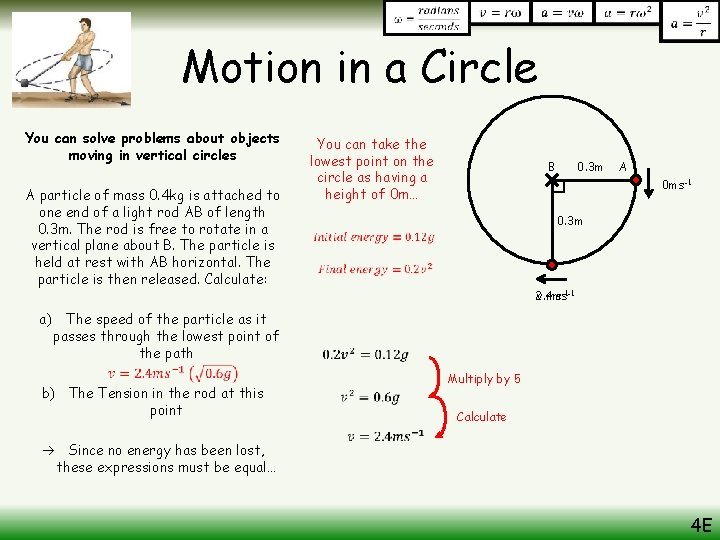
Motion in a Circle You can solve problems about objects moving in vertical circles A particle of mass 0. 4 kg is attached to one end of a light rod AB of length 0. 3 m. The rod is free to rotate in a vertical plane about B. The particle is held at rest with AB horizontal. The particle is then released. Calculate: a) The speed of the particle as it passes through the lowest point of the path b) The Tension in the rod at this point You can take the lowest point on the circle as having a height of 0 m… B 0. 3 m A 0 ms-1 0. 3 m v ms-1 Before Sub in values Calculate A good starting point is to split the energy into ‘before’ and ‘after’ So the total initial energy is 0. 12 g… 4 E
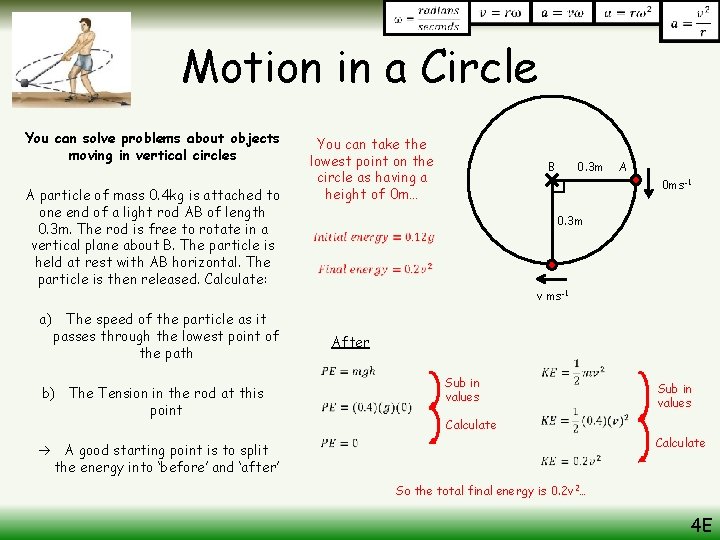
Motion in a Circle You can solve problems about objects moving in vertical circles A particle of mass 0. 4 kg is attached to one end of a light rod AB of length 0. 3 m. The rod is free to rotate in a vertical plane about B. The particle is held at rest with AB horizontal. The particle is then released. Calculate: a) The speed of the particle as it passes through the lowest point of the path b) The Tension in the rod at this point You can take the lowest point on the circle as having a height of 0 m… B 0. 3 m A 0 ms-1 0. 3 m v ms-1 After Sub in values Calculate A good starting point is to split the energy into ‘before’ and ‘after’ So the total final energy is 0. 2 v 2… 4 E
Motion in a Circle You can solve problems about objects moving in vertical circles A particle of mass 0. 4 kg is attached to one end of a light rod AB of length 0. 3 m. The rod is free to rotate in a vertical plane about B. The particle is held at rest with AB horizontal. The particle is then released. Calculate: You can take the lowest point on the circle as having a height of 0 m… B 0. 3 m A 0 ms-1 0. 3 m 2. 4 ms v ms-1 -1 a) The speed of the particle as it passes through the lowest point of the path b) The Tension in the rod at this point Multiply by 5 Calculate Since no energy has been lost, these expressions must be equal… 4 E
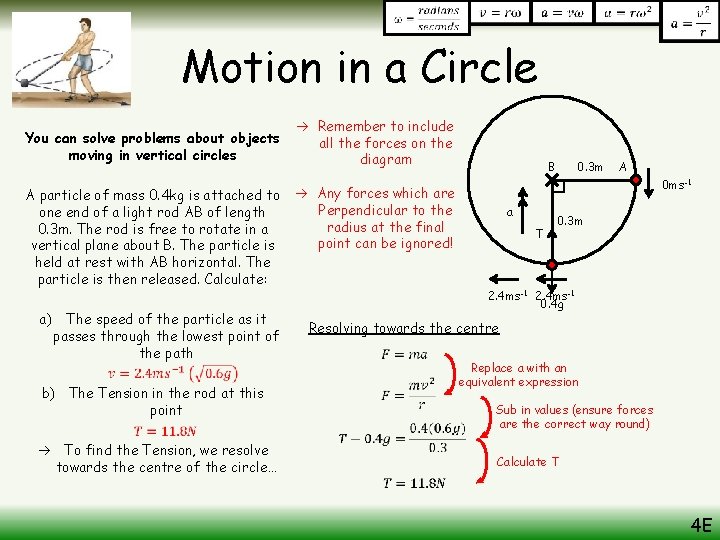
Motion in a Circle You can solve problems about objects moving in vertical circles Remember to include all the forces on the diagram A particle of mass 0. 4 kg is attached to Any forces which are Perpendicular to the one end of a light rod AB of length radius at the final 0. 3 m. The rod is free to rotate in a point can be ignored! vertical plane about B. The particle is held at rest with AB horizontal. The particle is then released. Calculate: a) The speed of the particle as it passes through the lowest point of the path b) The Tension in the rod at this point To find the Tension, we resolve towards the centre of the circle… B 0. 3 m A 0 ms-1 a T 0. 3 m 2. 4 ms-1 0. 4 g Resolving towards the centre Replace a with an equivalent expression Sub in values (ensure forces are the correct way round) Calculate T 4 E
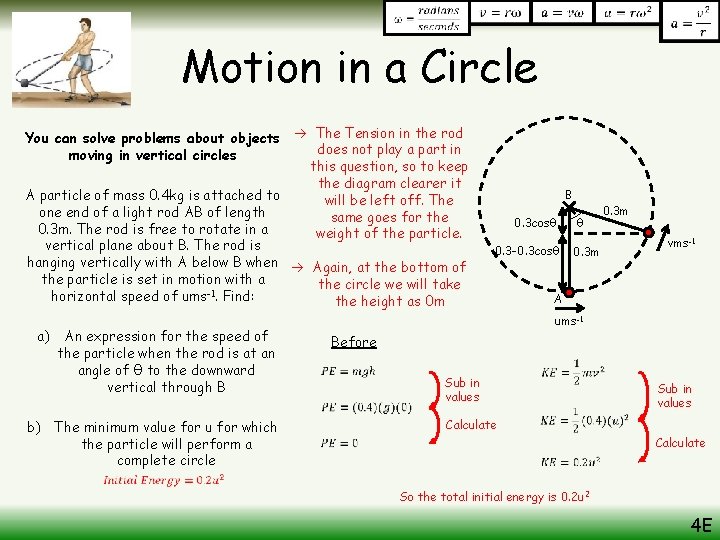
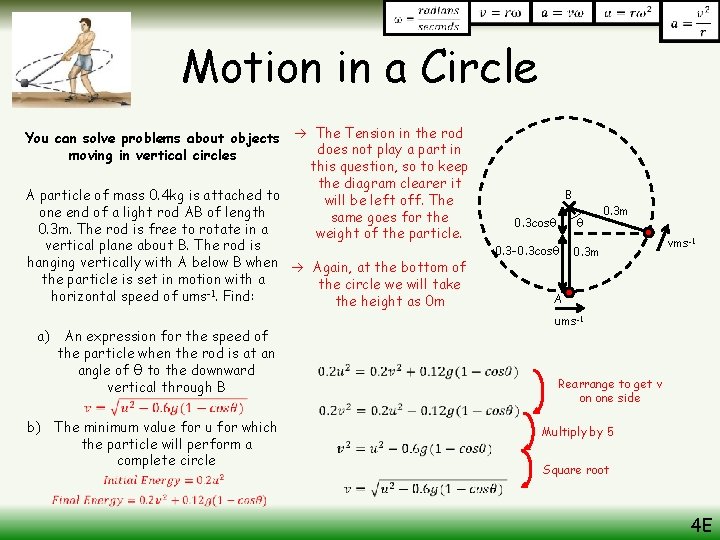
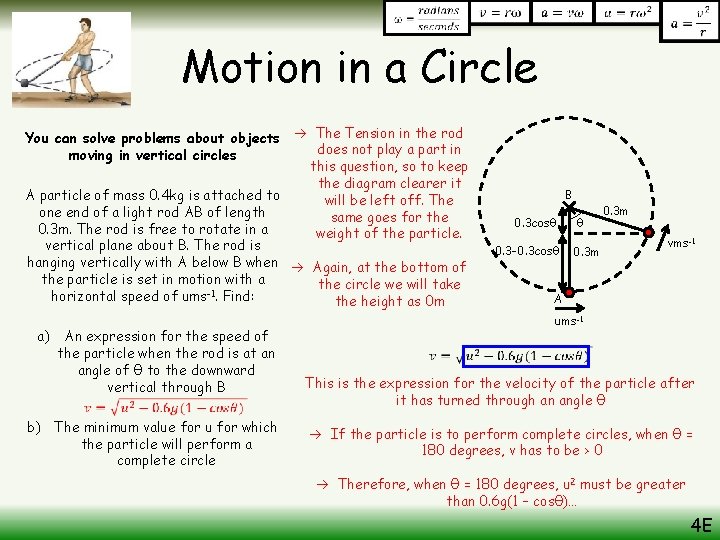
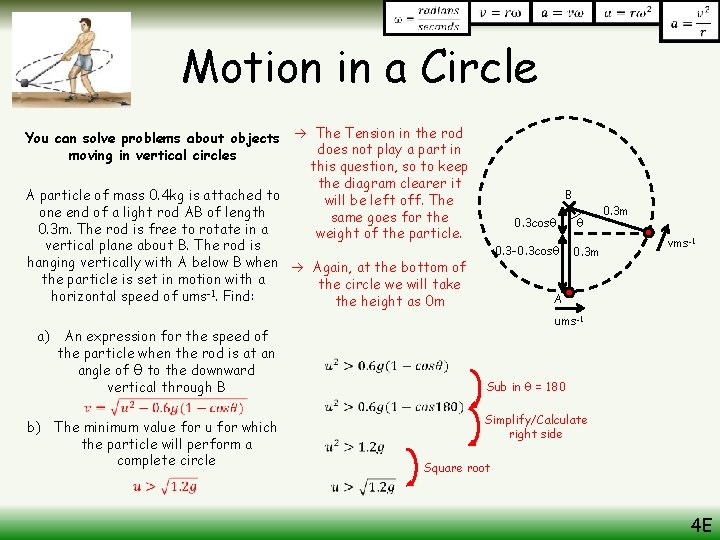
Motion in a Circle You can solve problems about objects The Tension in the rod does not play a part in moving in vertical circles this question, so to keep the diagram clearer it A particle of mass 0. 4 kg is attached to will be left off. The one end of a light rod AB of length same goes for the 0. 3 m. The rod is free to rotate in a weight of the particle. vertical plane about B. The rod is hanging vertically with A below B when Again, at the bottom of the particle is set in motion with a the circle we will take horizontal speed of ums-1. Find: the height as 0 m a) An expression for the speed of the particle when the rod is at an angle of θ to the downward vertical through B b) The minimum value for u for which the particle will perform a complete circle B 0. 3 cosθ 0. 3 -0. 3 cosθ θ 0. 3 m vms-1 A ums-1 Before Sub in values Calculate So the total initial energy is 0. 2 u 2 4 E
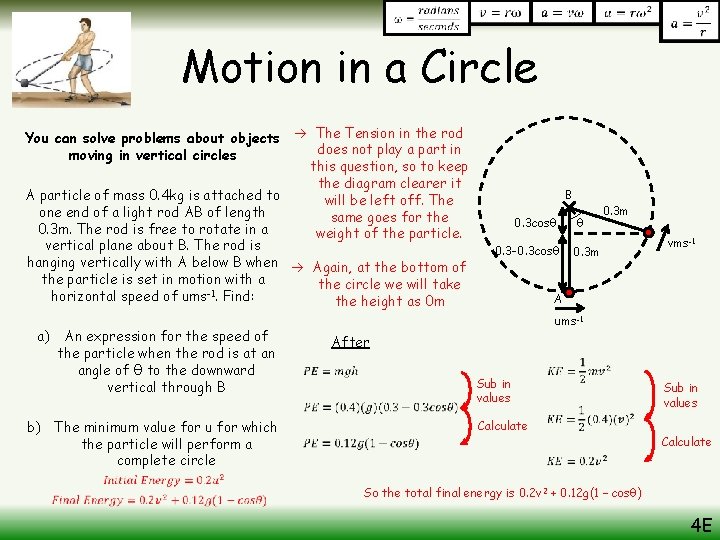
Motion in a Circle You can solve problems about objects The Tension in the rod does not play a part in moving in vertical circles this question, so to keep the diagram clearer it A particle of mass 0. 4 kg is attached to will be left off. The one end of a light rod AB of length same goes for the 0. 3 m. The rod is free to rotate in a weight of the particle. vertical plane about B. The rod is hanging vertically with A below B when Again, at the bottom of the particle is set in motion with a the circle we will take horizontal speed of ums-1. Find: the height as 0 m a) An expression for the speed of the particle when the rod is at an angle of θ to the downward vertical through B b) The minimum value for u for which the particle will perform a complete circle B 0. 3 cosθ 0. 3 -0. 3 cosθ θ 0. 3 m vms-1 A ums-1 After Sub in values Calculate So the total final energy is 0. 2 v 2 + 0. 12 g(1 – cosθ) 4 E
Motion in a Circle You can solve problems about objects The Tension in the rod does not play a part in moving in vertical circles this question, so to keep the diagram clearer it A particle of mass 0. 4 kg is attached to will be left off. The one end of a light rod AB of length same goes for the 0. 3 m. The rod is free to rotate in a weight of the particle. vertical plane about B. The rod is hanging vertically with A below B when Again, at the bottom of the particle is set in motion with a the circle we will take horizontal speed of ums-1. Find: the height as 0 m a) An expression for the speed of the particle when the rod is at an angle of θ to the downward vertical through B b) The minimum value for u for which the particle will perform a complete circle B 0. 3 cosθ θ 0. 3 -0. 3 cosθ 0. 3 m vms-1 A ums-1 Rearrange to get v on one side Multiply by 5 Square root 4 E
Motion in a Circle You can solve problems about objects The Tension in the rod does not play a part in moving in vertical circles this question, so to keep the diagram clearer it A particle of mass 0. 4 kg is attached to will be left off. The one end of a light rod AB of length same goes for the 0. 3 m. The rod is free to rotate in a weight of the particle. vertical plane about B. The rod is hanging vertically with A below B when Again, at the bottom of the particle is set in motion with a the circle we will take horizontal speed of ums-1. Find: the height as 0 m a) An expression for the speed of the particle when the rod is at an angle of θ to the downward vertical through B b) The minimum value for u for which the particle will perform a complete circle B 0. 3 cosθ 0. 3 -0. 3 cosθ θ 0. 3 m vms-1 A ums-1 This is the expression for the velocity of the particle after it has turned through an angle θ If the particle is to perform complete circles, when θ = 180 degrees, v has to be > 0 Therefore, when θ = 180 degrees, u 2 must be greater than 0. 6 g(1 – cosθ)… 4 E
Motion in a Circle You can solve problems about objects The Tension in the rod does not play a part in moving in vertical circles this question, so to keep the diagram clearer it A particle of mass 0. 4 kg is attached to will be left off. The one end of a light rod AB of length same goes for the 0. 3 m. The rod is free to rotate in a weight of the particle. vertical plane about B. The rod is hanging vertically with A below B when Again, at the bottom of the particle is set in motion with a the circle we will take horizontal speed of ums-1. Find: the height as 0 m a) An expression for the speed of the particle when the rod is at an angle of θ to the downward vertical through B b) The minimum value for u for which the particle will perform a complete circle B 0. 3 cosθ 0. 3 -0. 3 cosθ θ 0. 3 m vms-1 A ums-1 Sub in θ = 180 Simplify/Calculate right side Square root 4 E
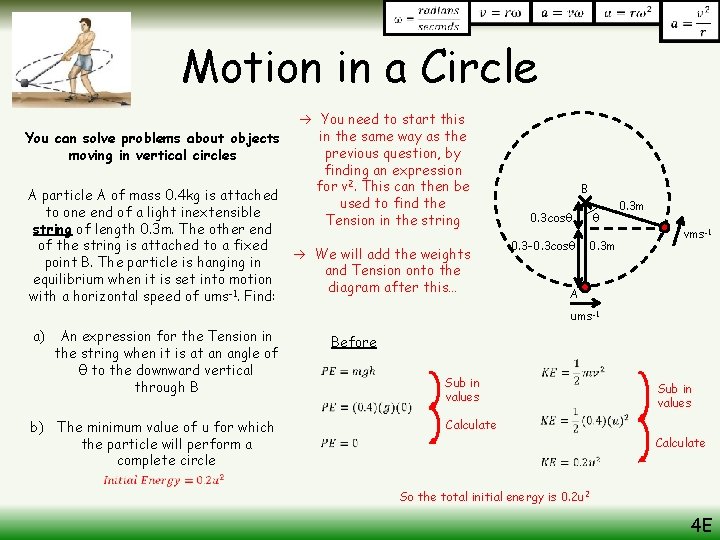
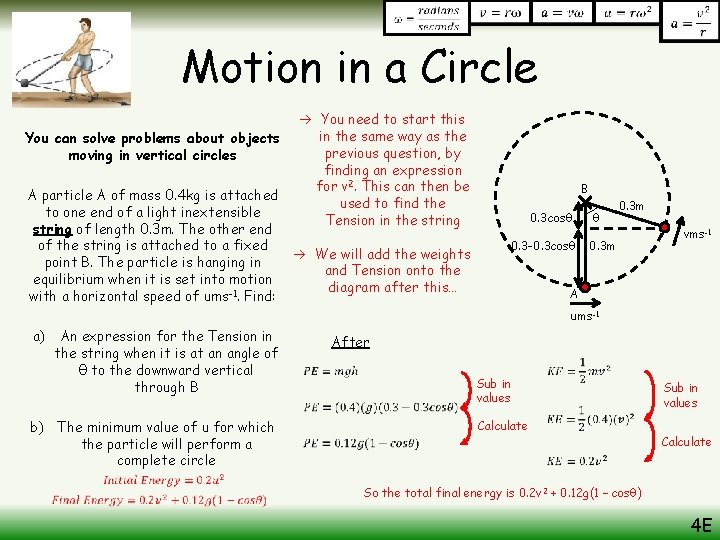
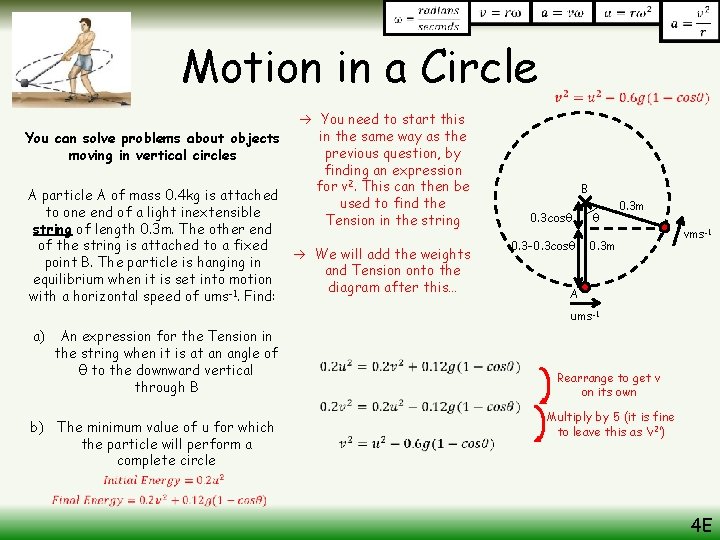
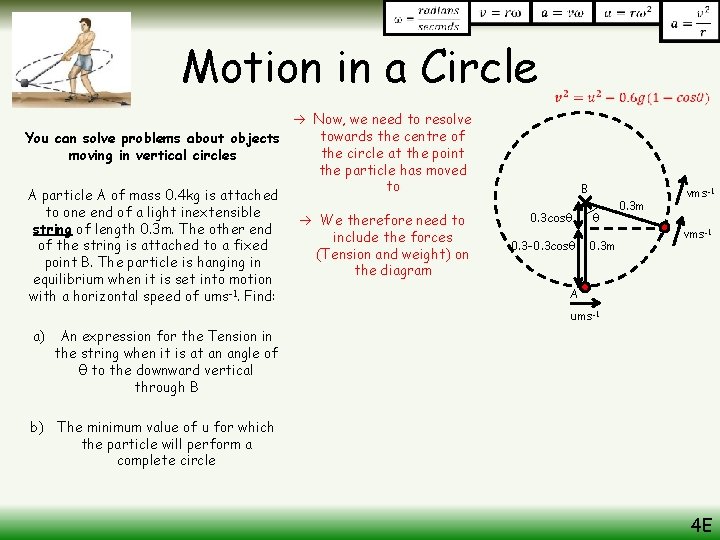
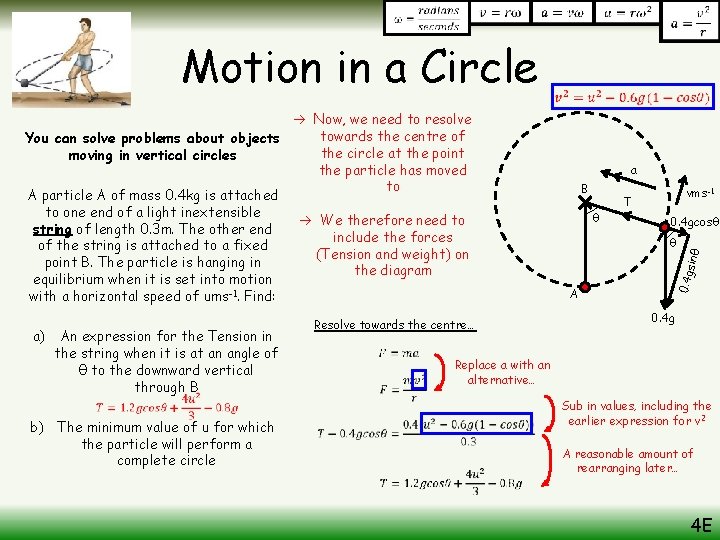
Motion in a Circle You can solve problems about objects moving in vertical circles You need to start this in the same way as the previous question, by finding an expression for v 2. This can then be used to find the Tension in the string A particle A of mass 0. 4 kg is attached to one end of a light inextensible string of length 0. 3 m. The other end of the string is attached to a fixed We will add the weights point B. The particle is hanging in and Tension onto the equilibrium when it is set into motion diagram after this… with a horizontal speed of ums-1. Find: B 0. 3 cosθ 0. 3 -0. 3 cosθ θ 0. 3 m vms-1 A ums-1 a) An expression for the Tension in the string when it is at an angle of θ to the downward vertical through B b) The minimum value of u for which the particle will perform a complete circle Before Sub in values Calculate So the total initial energy is 0. 2 u 2 4 E
Motion in a Circle You can solve problems about objects moving in vertical circles You need to start this in the same way as the previous question, by finding an expression for v 2. This can then be used to find the Tension in the string A particle A of mass 0. 4 kg is attached to one end of a light inextensible string of length 0. 3 m. The other end of the string is attached to a fixed We will add the weights point B. The particle is hanging in and Tension onto the equilibrium when it is set into motion diagram after this… with a horizontal speed of ums-1. Find: B 0. 3 cosθ 0. 3 -0. 3 cosθ θ 0. 3 m vms-1 A ums-1 a) An expression for the Tension in the string when it is at an angle of θ to the downward vertical through B b) The minimum value of u for which the particle will perform a complete circle After Sub in values Calculate So the total final energy is 0. 2 v 2 + 0. 12 g(1 – cosθ) 4 E
Motion in a Circle You can solve problems about objects moving in vertical circles You need to start this in the same way as the previous question, by finding an expression for v 2. This can then be used to find the Tension in the string A particle A of mass 0. 4 kg is attached to one end of a light inextensible string of length 0. 3 m. The other end of the string is attached to a fixed We will add the weights point B. The particle is hanging in and Tension onto the equilibrium when it is set into motion diagram after this… with a horizontal speed of ums-1. Find: B 0. 3 cosθ 0. 3 -0. 3 cosθ θ 0. 3 m vms-1 A ums-1 a) An expression for the Tension in the string when it is at an angle of θ to the downward vertical through B b) The minimum value of u for which the particle will perform a complete circle Rearrange to get v on its own Multiply by 5 (it is fine to leave this as ‘v 2’) 4 E
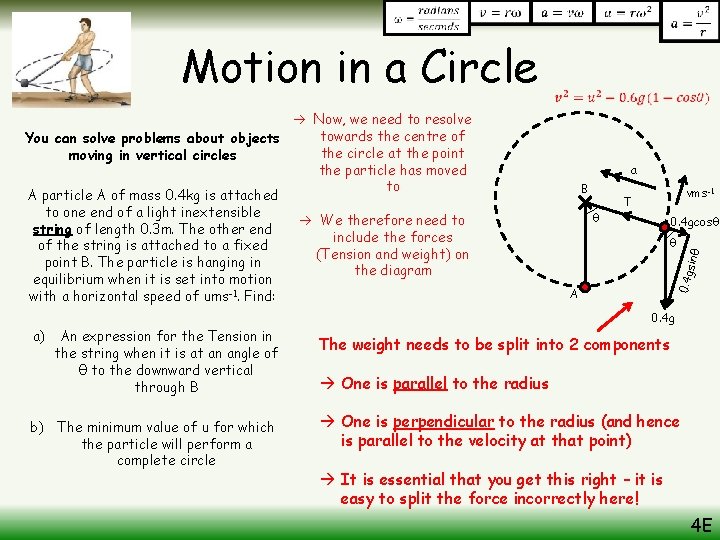
Motion in a Circle Now, we need to resolve towards the centre of You can solve problems about objects the circle at the point moving in vertical circles the particle has moved to A particle A of mass 0. 4 kg is attached to one end of a light inextensible We therefore need to string of length 0. 3 m. The other end include the forces of the string is attached to a fixed (Tension and weight) on point B. The particle is hanging in the diagram equilibrium when it is set into motion with a horizontal speed of ums-1. Find: B 0. 3 cosθ 0. 3 -0. 3 cosθ θ 0. 3 m vms-1 A ums-1 a) An expression for the Tension in the string when it is at an angle of θ to the downward vertical through B b) The minimum value of u for which the particle will perform a complete circle 4 E
Motion in a Circle a) An expression for the Tension in the string when it is at an angle of θ to the downward vertical through B b) The minimum value of u for which the particle will perform a complete circle a θ vms-1 T 0. 4 gcosθ θ sinθ B 0. 4 g Now, we need to resolve towards the centre of You can solve problems about objects the circle at the point moving in vertical circles the particle has moved to A particle A of mass 0. 4 kg is attached to one end of a light inextensible We therefore need to string of length 0. 3 m. The other end include the forces of the string is attached to a fixed (Tension and weight) on point B. The particle is hanging in the diagram equilibrium when it is set into motion with a horizontal speed of ums-1. Find: A 0. 4 g The weight needs to be split into 2 components One is parallel to the radius One is perpendicular to the radius (and hence is parallel to the velocity at that point) It is essential that you get this right – it is easy to split the force incorrectly here! 4 E
Motion in a Circle a) An expression for the Tension in the string when it is at an angle of θ to the downward vertical through B b) The minimum value of u for which the particle will perform a complete circle Resolve towards the centre… a θ vms-1 T 0. 4 gcosθ θ A sinθ B 0. 4 g Now, we need to resolve towards the centre of You can solve problems about objects the circle at the point moving in vertical circles the particle has moved to A particle A of mass 0. 4 kg is attached to one end of a light inextensible We therefore need to string of length 0. 3 m. The other end include the forces of the string is attached to a fixed (Tension and weight) on point B. The particle is hanging in the diagram equilibrium when it is set into motion with a horizontal speed of ums-1. Find: 0. 4 g Replace a with an alternative… Sub in values, including the earlier expression for v 2 A reasonable amount of rearranging later… 4 E
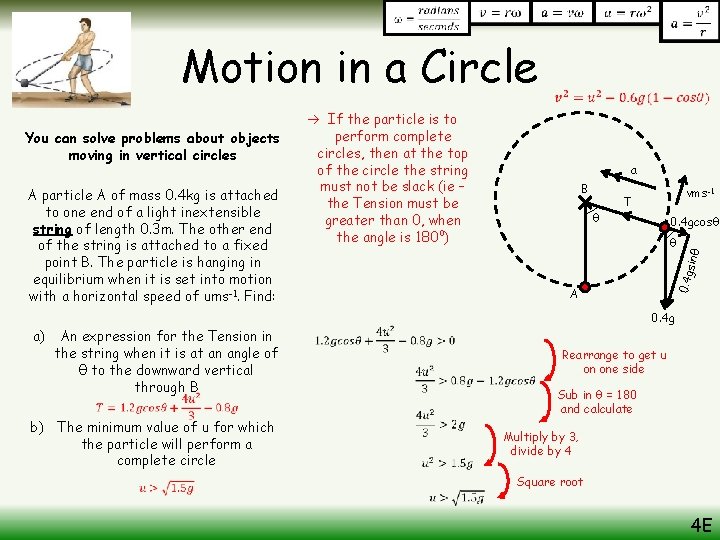
Motion in a Circle a) An expression for the Tension in the string when it is at an angle of θ to the downward vertical through B b) The minimum value of u for which the particle will perform a complete circle B θ vms-1 T 0. 4 gcosθ θ sinθ A particle A of mass 0. 4 kg is attached to one end of a light inextensible string of length 0. 3 m. The other end of the string is attached to a fixed point B. The particle is hanging in equilibrium when it is set into motion with a horizontal speed of ums-1. Find: a 0. 4 g You can solve problems about objects moving in vertical circles If the particle is to perform complete circles, then at the top of the circle the string must not be slack (ie – the Tension must be greater than 0, when the angle is 180⁰) A 0. 4 g Rearrange to get u on one side Sub in θ = 180 and calculate Multiply by 3, divide by 4 Square root 4 E
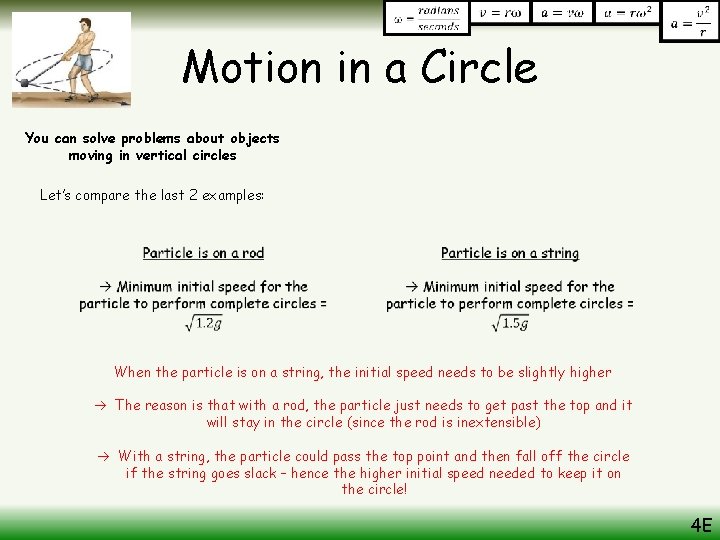
Motion in a Circle You can solve problems about objects moving in vertical circles Let’s compare the last 2 examples: When the particle is on a string, the initial speed needs to be slightly higher The reason is that with a rod, the particle just needs to get past the top and it will stay in the circle (since the rod is inextensible) With a string, the particle could pass the top point and then fall off the circle if the string goes slack – hence the higher initial speed needed to keep it on the circle! 4 E
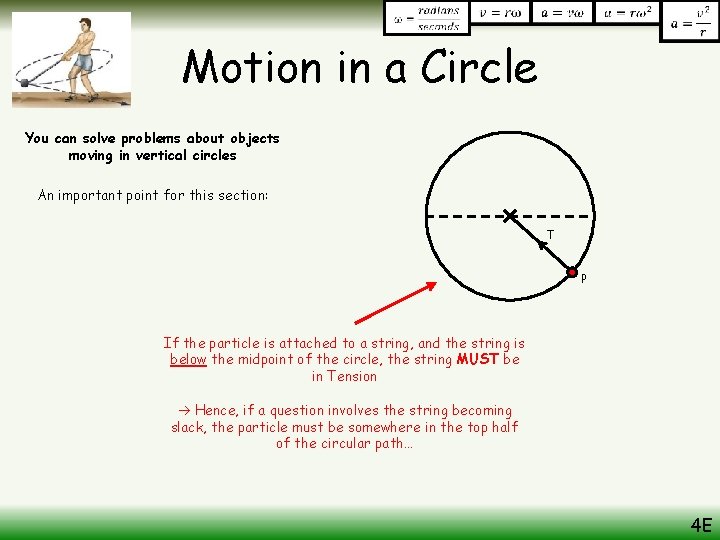
Motion in a Circle You can solve problems about objects moving in vertical circles An important point for this section: T P If the particle is attached to a string, and the string is below the midpoint of the circle, the string MUST be in Tension Hence, if a question involves the string becoming slack, the particle must be somewhere in the top half of the circular path… 4 E
Teachings for Exercise 4 F
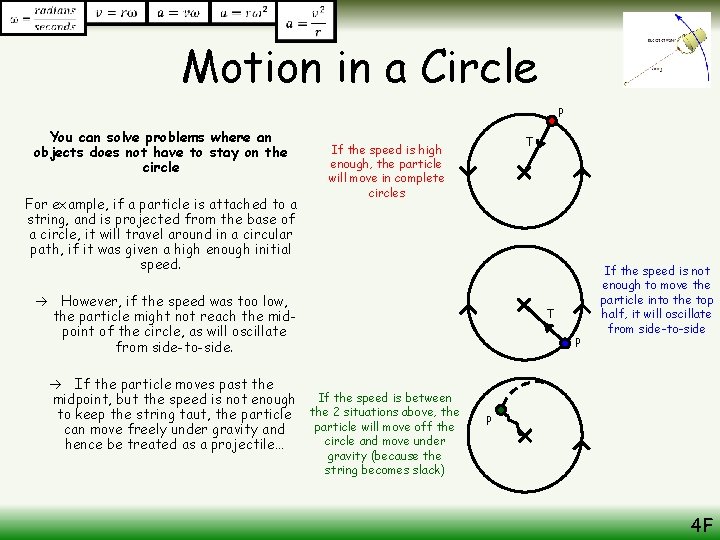
Motion in a Circle P You can solve problems where an objects does not have to stay on the circle For example, if a particle is attached to a string, and is projected from the base of a circle, it will travel around in a circular path, if it was given a high enough initial speed. T If the speed is high enough, the particle will move in complete circles However, if the speed was too low, the particle might not reach the midpoint of the circle, as will oscillate from side-to-side. T P If the particle moves past the If the speed is between midpoint, but the speed is not enough to keep the string taut, the particle the 2 situations above, the particle will move off the can move freely under gravity and circle and move under hence be treated as a projectile… If the speed is not enough to move the particle into the top half, it will oscillate from side-to-side P gravity (because the string becomes slack) 4 F
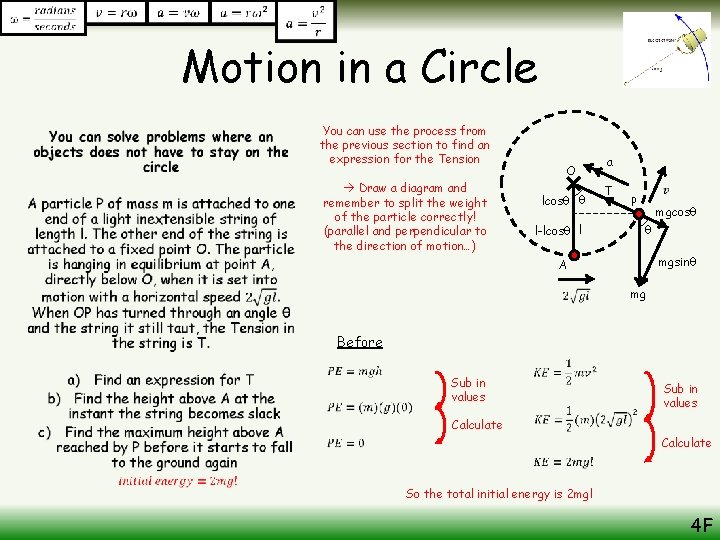
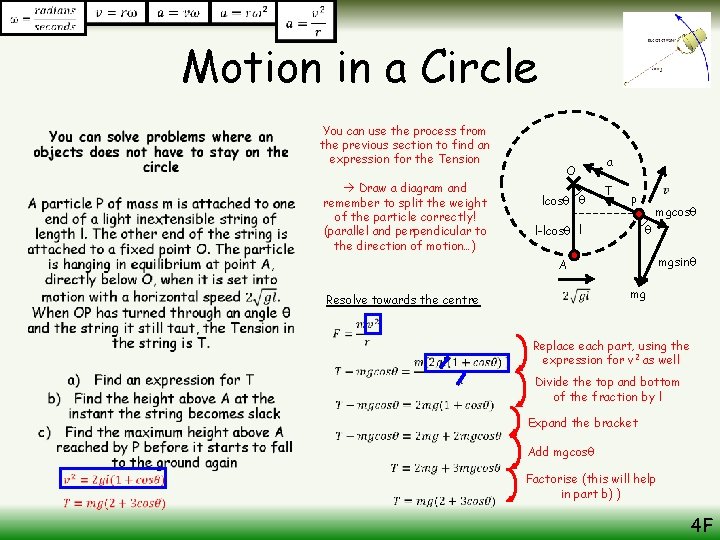
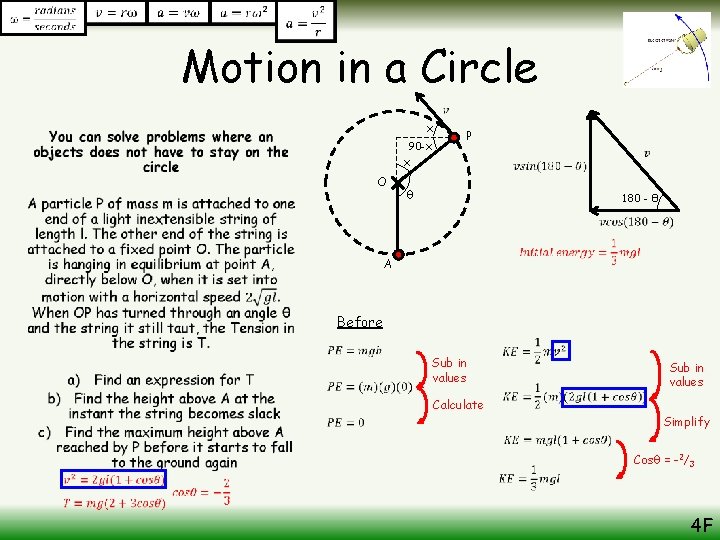
Motion in a Circle • You can use the process from the previous section to find an expression for the Tension Draw a diagram and remember to split the weight of the particle correctly! (parallel and perpendicular to the direction of motion…) O lcosθ θ l-lcosθ l a T P mgcosθ θ mgsinθ A mg Before Sub in values Calculate So the total initial energy is 2 mgl 4 F
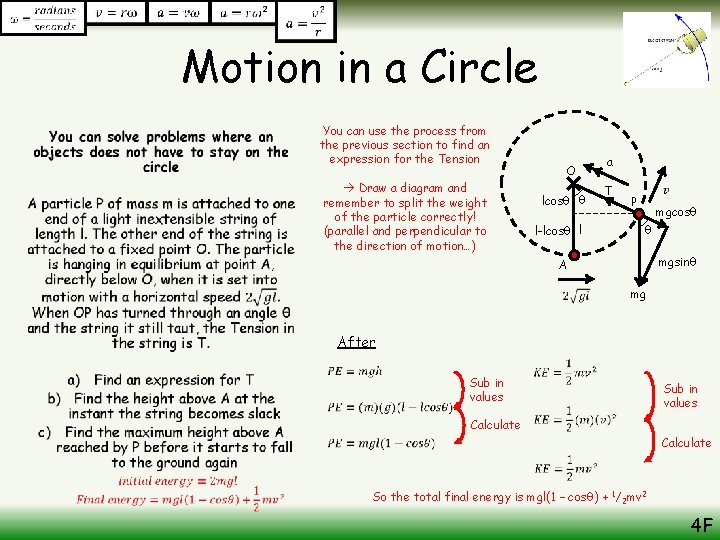
Motion in a Circle • You can use the process from the previous section to find an expression for the Tension Draw a diagram and remember to split the weight of the particle correctly! (parallel and perpendicular to the direction of motion…) O lcosθ θ l-lcosθ l a T P mgcosθ θ mgsinθ A mg After Sub in values Calculate So the total final energy is mgl(1 – cosθ) + 1/2 mv 2 4 F
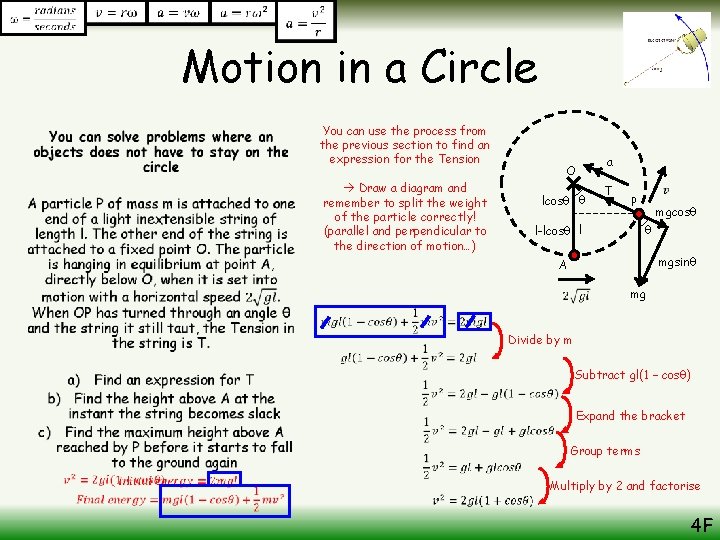
Motion in a Circle • You can use the process from the previous section to find an expression for the Tension Draw a diagram and remember to split the weight of the particle correctly! (parallel and perpendicular to the direction of motion…) O lcosθ θ a T P mgcosθ θ l-lcosθ l mgsinθ A mg Divide by m Subtract gl(1 – cosθ) Expand the bracket Group terms Multiply by 2 and factorise 4 F
Motion in a Circle • You can use the process from the previous section to find an expression for the Tension Draw a diagram and remember to split the weight of the particle correctly! (parallel and perpendicular to the direction of motion…) O lcosθ θ a T P mgcosθ θ l-lcosθ l mgsinθ A mg Resolve towards the centre Replace each part, using the expression for v 2 as well Divide the top and bottom of the fraction by l Expand the bracket Add mgcosθ Factorise (this will help in part b) ) 4 F
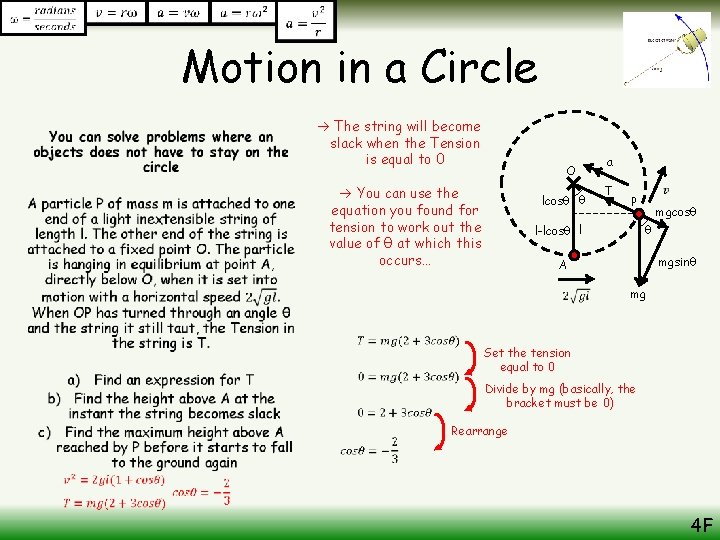
Motion in a Circle • The string will become slack when the Tension is equal to 0 O You can use the equation you found for tension to work out the value of θ at which this occurs… lcosθ θ a T P mgcosθ θ l-lcosθ l mgsinθ A mg Set the tension equal to 0 Divide by mg (basically, the bracket must be 0) Rearrange 4 F
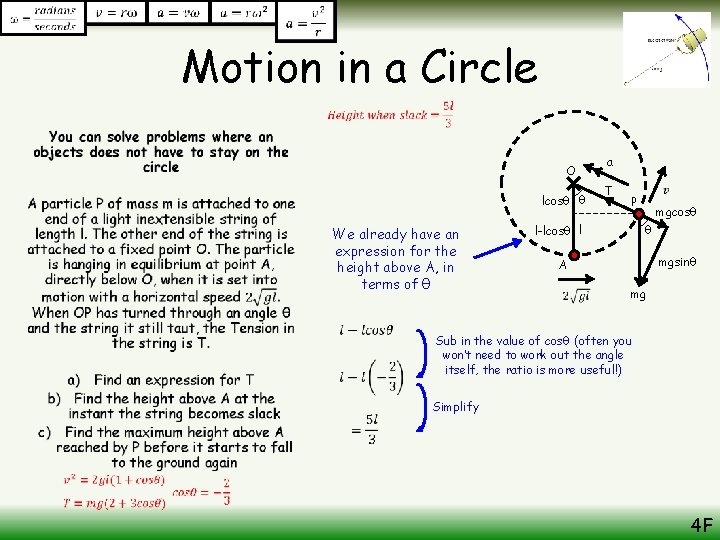
Motion in a Circle • O lcosθ θ We already have an expression for the height above A, in terms of θ a T P mgcosθ θ l-lcosθ l mgsinθ A mg Sub in the value of cosθ (often you won’t need to work out the angle itself, the ratio is more useful!) Simplify 4 F
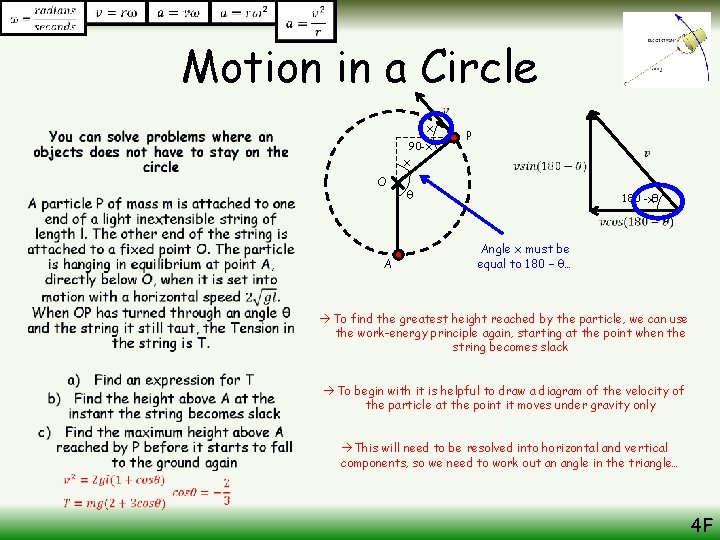
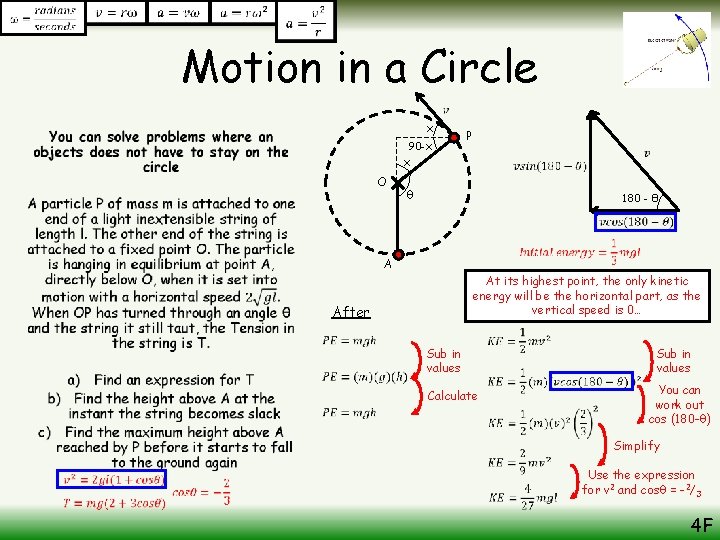
Motion in a Circle x • 90 -x x O A P θ 180 -xθ Angle x must be equal to 180 – θ… To find the greatest height reached by the particle, we can use the work-energy principle again, starting at the point when the string becomes slack To begin with it is helpful to draw a diagram of the velocity of the particle at the point it moves under gravity only This will need to be resolved into horizontal and vertical components, so we need to work out an angle in the triangle… 4 F
Motion in a Circle x • 90 -x x O P θ 180 - θ A Before Sub in values Calculate Sub in values Simplify Cosθ = -2/3 4 F
Motion in a Circle x • 90 -x x O P θ 180 - θ A At its highest point, the only kinetic energy will be the horizontal part, as the vertical speed is 0… After Sub in values Calculate Sub in values You can work out cos (180 -θ) Simplify Use the expression for v 2 and cosθ = -2/3 4 F
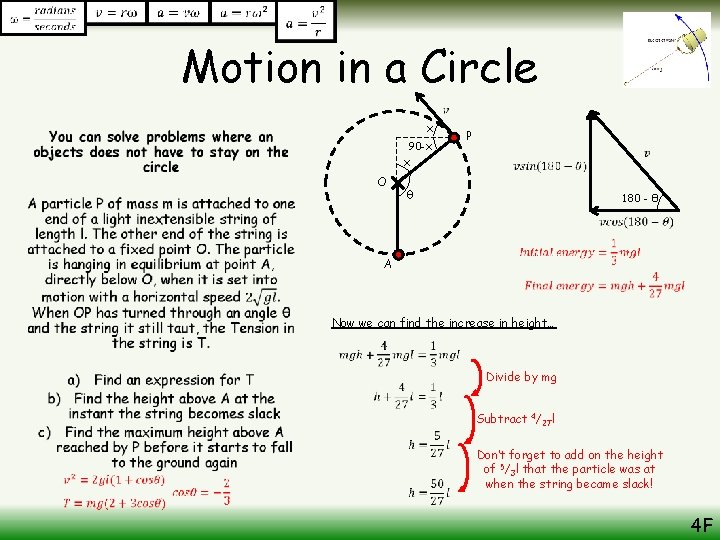
Motion in a Circle x • 90 -x x O P θ 180 - θ A Now we can find the increase in height… Divide by mg Subtract 4/27 l Don’t forget to add on the height of 5/3 l that the particle was at when the string became slack! 4 F
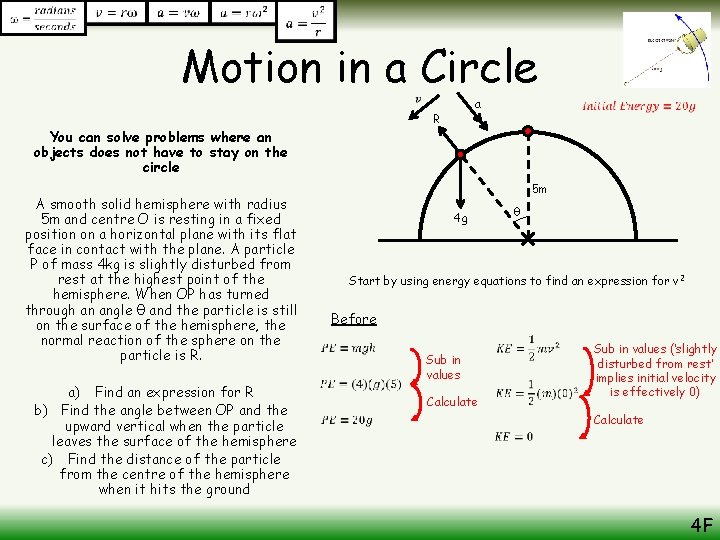
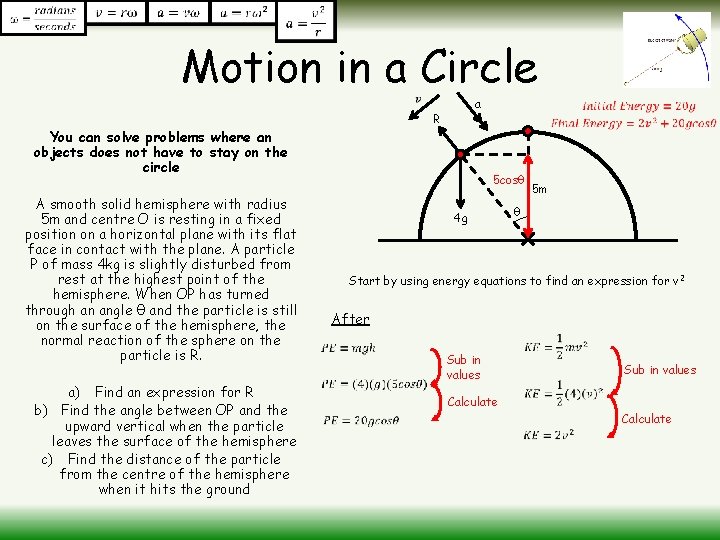
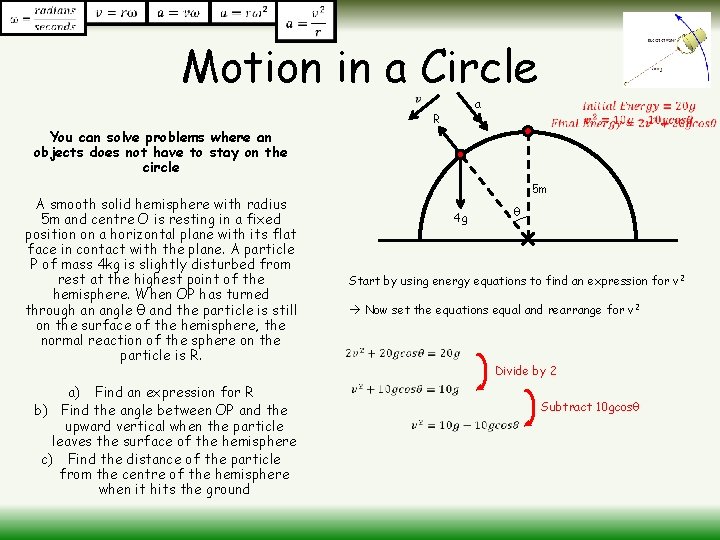
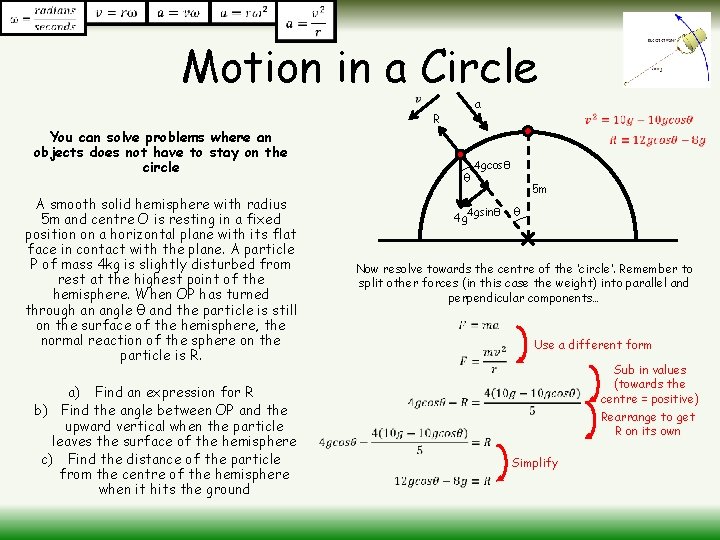
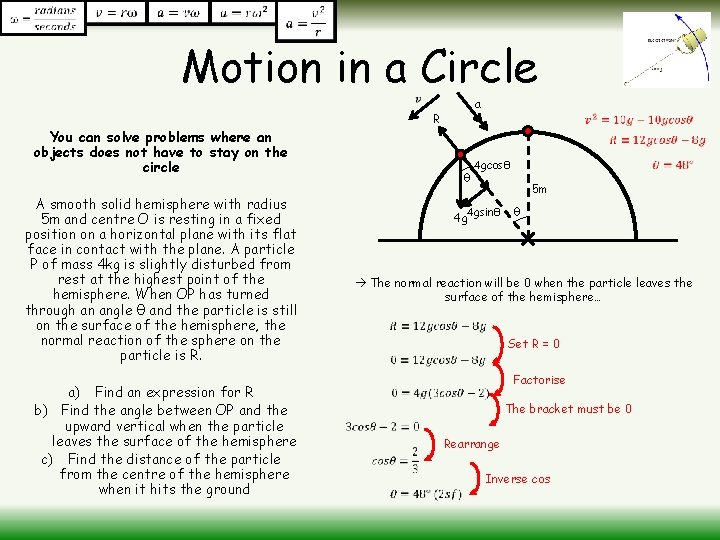
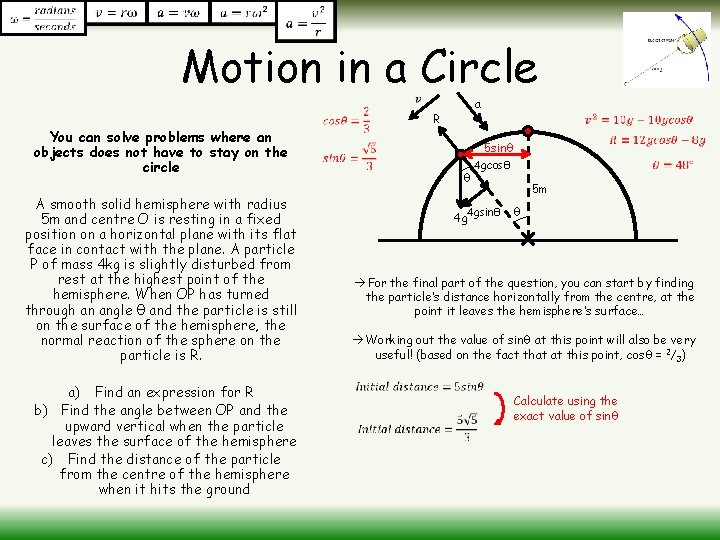
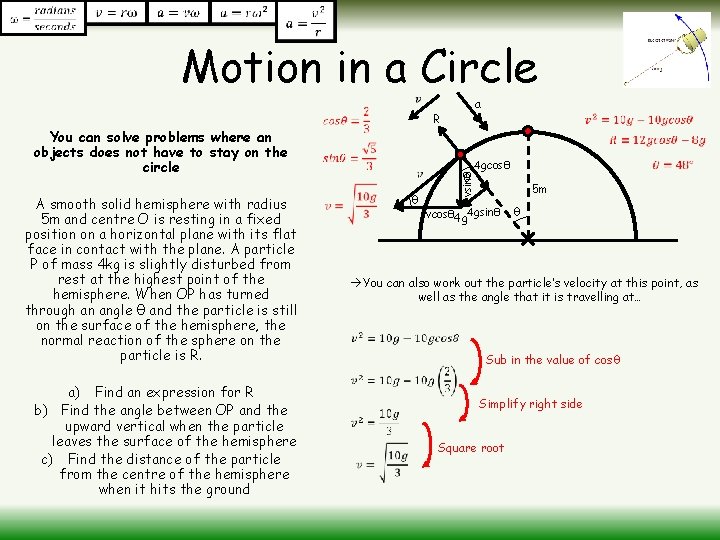
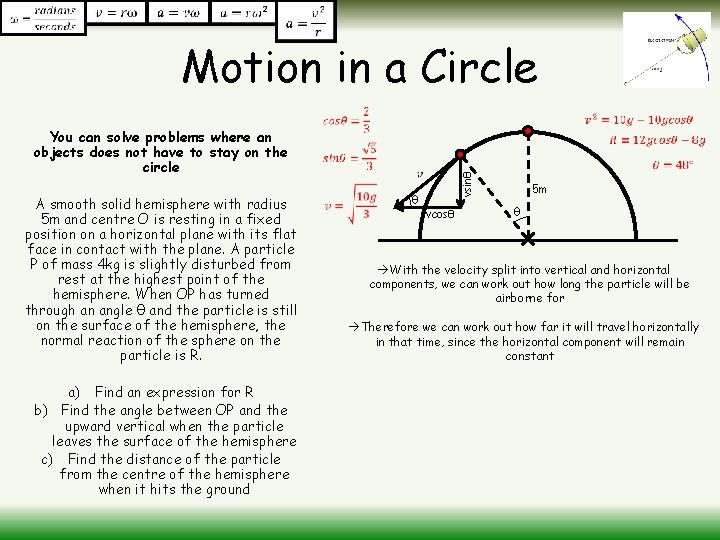
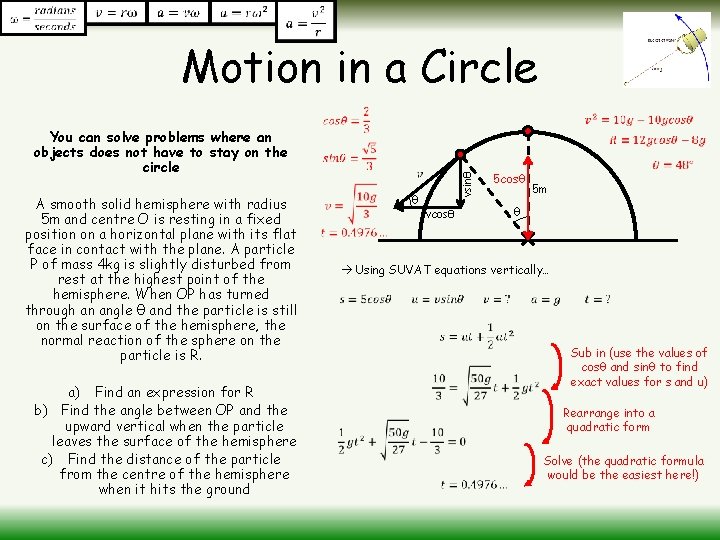
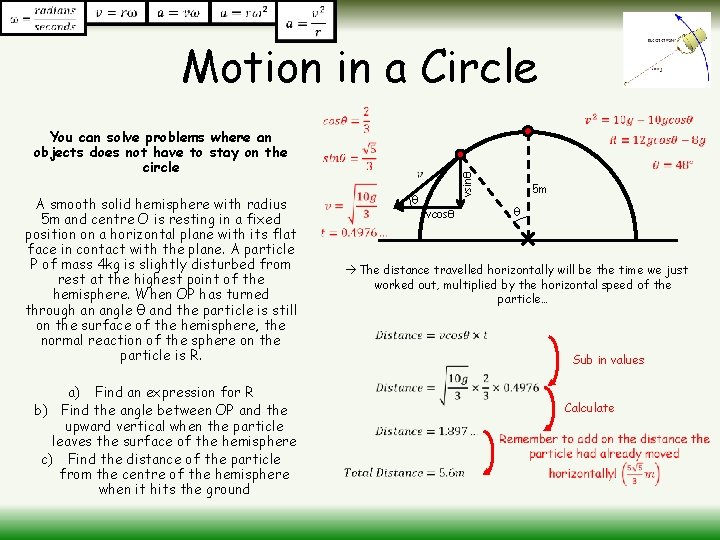
Motion in a Circle R You can solve problems where an objects does not have to stay on the circle A smooth solid hemisphere with radius 5 m and centre O is resting in a fixed position on a horizontal plane with its flat face in contact with the plane. A particle P of mass 4 kg is slightly disturbed from rest at the highest point of the hemisphere. When OP has turned through an angle θ and the particle is still on the surface of the hemisphere, the normal reaction of the sphere on the particle is R. a) Find an expression for R b) Find the angle between OP and the upward vertical when the particle leaves the surface of the hemisphere c) Find the distance of the particle from the centre of the hemisphere when it hits the ground a 5 m 4 g θ Start by using energy equations to find an expression for v 2 Before Sub in values Calculate Sub in values (‘slightly disturbed from rest’ implies initial velocity is effectively 0) Calculate 4 F
Motion in a Circle R You can solve problems where an objects does not have to stay on the circle A smooth solid hemisphere with radius 5 m and centre O is resting in a fixed position on a horizontal plane with its flat face in contact with the plane. A particle P of mass 4 kg is slightly disturbed from rest at the highest point of the hemisphere. When OP has turned through an angle θ and the particle is still on the surface of the hemisphere, the normal reaction of the sphere on the particle is R. a) Find an expression for R b) Find the angle between OP and the upward vertical when the particle leaves the surface of the hemisphere c) Find the distance of the particle from the centre of the hemisphere when it hits the ground a 5 cosθ 4 g 5 m θ Start by using energy equations to find an expression for v 2 After Sub in values Calculate
Motion in a Circle You can solve problems where an objects does not have to stay on the circle A smooth solid hemisphere with radius 5 m and centre O is resting in a fixed position on a horizontal plane with its flat face in contact with the plane. A particle P of mass 4 kg is slightly disturbed from rest at the highest point of the hemisphere. When OP has turned through an angle θ and the particle is still on the surface of the hemisphere, the normal reaction of the sphere on the particle is R. a) Find an expression for R b) Find the angle between OP and the upward vertical when the particle leaves the surface of the hemisphere c) Find the distance of the particle from the centre of the hemisphere when it hits the ground a R 5 m 4 g θ Start by using energy equations to find an expression for v 2 Now set the equations equal and rearrange for v 2 Divide by 2 Subtract 10 gcosθ
Motion in a Circle You can solve problems where an objects does not have to stay on the circle A smooth solid hemisphere with radius 5 m and centre O is resting in a fixed position on a horizontal plane with its flat face in contact with the plane. A particle P of mass 4 kg is slightly disturbed from rest at the highest point of the hemisphere. When OP has turned through an angle θ and the particle is still on the surface of the hemisphere, the normal reaction of the sphere on the particle is R. a) Find an expression for R b) Find the angle between OP and the upward vertical when the particle leaves the surface of the hemisphere c) Find the distance of the particle from the centre of the hemisphere when it hits the ground a R θ 4 gcosθ 4 gsinθ 4 g 5 m θ Now resolve towards the centre of the ‘circle’. Remember to split other forces (in this case the weight) into parallel and perpendicular components… Use a different form Sub in values (towards the centre = positive) Rearrange to get R on its own Simplify
Motion in a Circle You can solve problems where an objects does not have to stay on the circle A smooth solid hemisphere with radius 5 m and centre O is resting in a fixed position on a horizontal plane with its flat face in contact with the plane. A particle P of mass 4 kg is slightly disturbed from rest at the highest point of the hemisphere. When OP has turned through an angle θ and the particle is still on the surface of the hemisphere, the normal reaction of the sphere on the particle is R. a) Find an expression for R b) Find the angle between OP and the upward vertical when the particle leaves the surface of the hemisphere c) Find the distance of the particle from the centre of the hemisphere when it hits the ground a R θ 4 gcosθ 5 m 4 gsinθ 4 g θ The normal reaction will be 0 when the particle leaves the surface of the hemisphere… Set R = 0 Factorise The bracket must be 0 Rearrange Inverse cos
Motion in a Circle You can solve problems where an objects does not have to stay on the circle A smooth solid hemisphere with radius 5 m and centre O is resting in a fixed position on a horizontal plane with its flat face in contact with the plane. A particle P of mass 4 kg is slightly disturbed from rest at the highest point of the hemisphere. When OP has turned through an angle θ and the particle is still on the surface of the hemisphere, the normal reaction of the sphere on the particle is R. a) Find an expression for R b) Find the angle between OP and the upward vertical when the particle leaves the surface of the hemisphere c) Find the distance of the particle from the centre of the hemisphere when it hits the ground a R 5 sinθ θ 4 gcosθ 4 gsinθ 4 g 5 m θ For the final part of the question, you can start by finding the particle’s distance horizontally from the centre, at the point it leaves the hemisphere’s surface… Working out the value of sinθ at this point will also be very useful! (based on the fact that at this point, cosθ = 2/3) Calculate using the exact value of sinθ
Motion in a Circle R You can solve problems where an objects does not have to stay on the circle a) Find an expression for R b) Find the angle between OP and the upward vertical when the particle leaves the surface of the hemisphere c) Find the distance of the particle from the centre of the hemisphere when it hits the ground θ θ vsinθ A smooth solid hemisphere with radius 5 m and centre O is resting in a fixed position on a horizontal plane with its flat face in contact with the plane. A particle P of mass 4 kg is slightly disturbed from rest at the highest point of the hemisphere. When OP has turned through an angle θ and the particle is still on the surface of the hemisphere, the normal reaction of the sphere on the particle is R. a 4 gcosθ 5 m vcosθ 4 g 4 gsinθ θ You can also work out the particle’s velocity at this point, as well as the angle that it is travelling at… Sub in the value of cosθ Simplify right side Square root
Motion in a Circle A smooth solid hemisphere with radius 5 m and centre O is resting in a fixed position on a horizontal plane with its flat face in contact with the plane. A particle P of mass 4 kg is slightly disturbed from rest at the highest point of the hemisphere. When OP has turned through an angle θ and the particle is still on the surface of the hemisphere, the normal reaction of the sphere on the particle is R. a) Find an expression for R b) Find the angle between OP and the upward vertical when the particle leaves the surface of the hemisphere c) Find the distance of the particle from the centre of the hemisphere when it hits the ground θ vsinθ You can solve problems where an objects does not have to stay on the circle vcosθ 5 m θ With the velocity split into vertical and horizontal components, we can work out how long the particle will be airborne for Therefore we can work out how far it will travel horizontally in that time, since the horizontal component will remain constant
Motion in a Circle A smooth solid hemisphere with radius 5 m and centre O is resting in a fixed position on a horizontal plane with its flat face in contact with the plane. A particle P of mass 4 kg is slightly disturbed from rest at the highest point of the hemisphere. When OP has turned through an angle θ and the particle is still on the surface of the hemisphere, the normal reaction of the sphere on the particle is R. a) Find an expression for R b) Find the angle between OP and the upward vertical when the particle leaves the surface of the hemisphere c) Find the distance of the particle from the centre of the hemisphere when it hits the ground θ vsinθ You can solve problems where an objects does not have to stay on the circle vcosθ 5 m θ Using SUVAT equations vertically… Sub in (use the values of cosθ and sinθ to find exact values for s and u) Rearrange into a quadratic form Solve (the quadratic formula would be the easiest here!)
Motion in a Circle A smooth solid hemisphere with radius 5 m and centre O is resting in a fixed position on a horizontal plane with its flat face in contact with the plane. A particle P of mass 4 kg is slightly disturbed from rest at the highest point of the hemisphere. When OP has turned through an angle θ and the particle is still on the surface of the hemisphere, the normal reaction of the sphere on the particle is R. a) Find an expression for R b) Find the angle between OP and the upward vertical when the particle leaves the surface of the hemisphere c) Find the distance of the particle from the centre of the hemisphere when it hits the ground θ vsinθ You can solve problems where an objects does not have to stay on the circle vcosθ 5 m θ The distance travelled horizontally will be the time we just worked out, multiplied by the horizontal speed of the particle… Sub in values Calculate
Summary • We have learnt how to answer problems relating to motion in a circle • We have seen how to correctly split up forces, as well as use new formulae • We have also seen how to use energy equations in many different situations!