
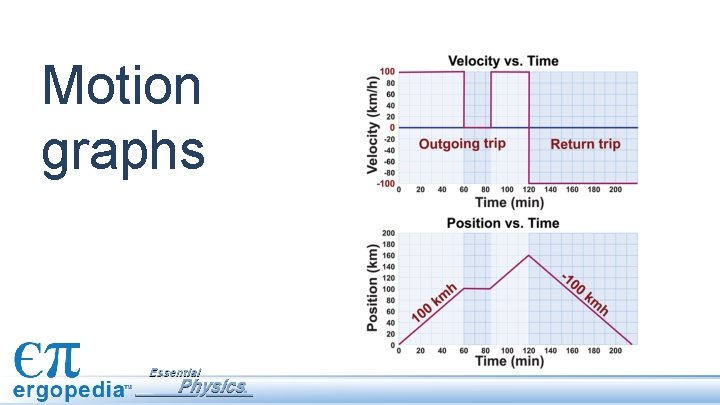
Motion graphs Graphing motion In order to understand
- Slides: 47
Motion graphs
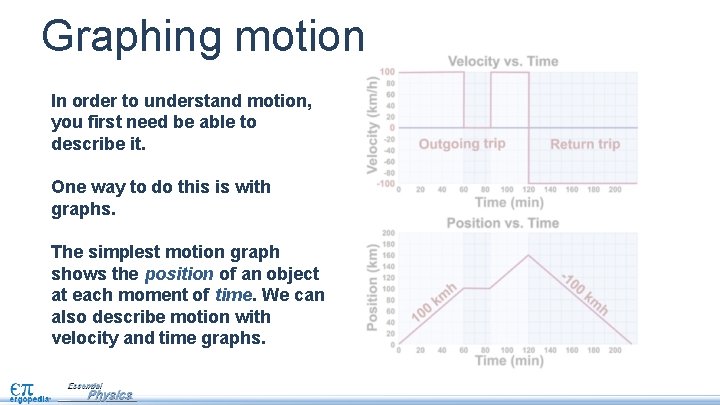
Graphing motion In order to understand motion, you first need be able to describe it. One way to do this is with graphs. The simplest motion graph shows the position of an object at each moment of time. We can also describe motion with velocity and time graphs.
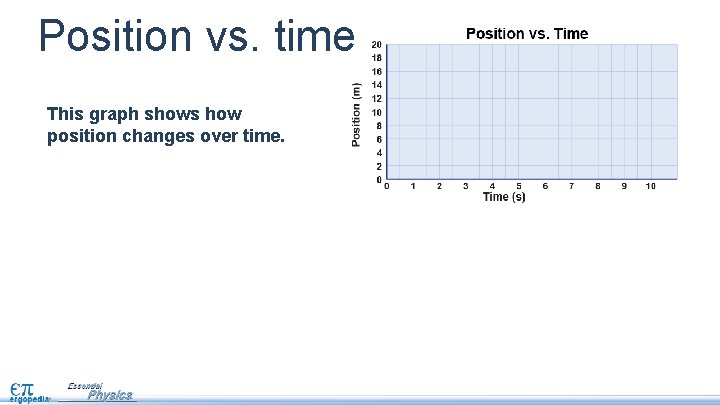
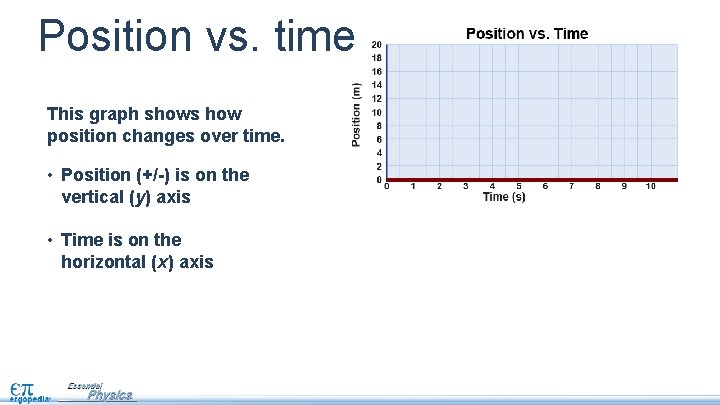
Position vs. time This graph shows how position changes over time.
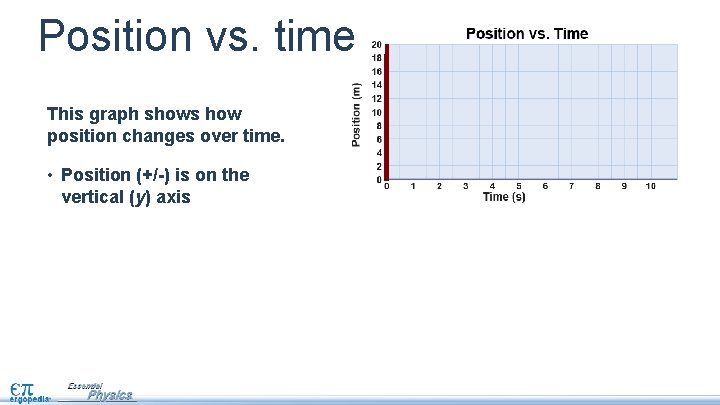
Position vs. time This graph shows how position changes over time. • Position (+/-) is on the vertical (y) axis
Position vs. time This graph shows how position changes over time. • Position (+/-) is on the vertical (y) axis • Time is on the horizontal (x) axis
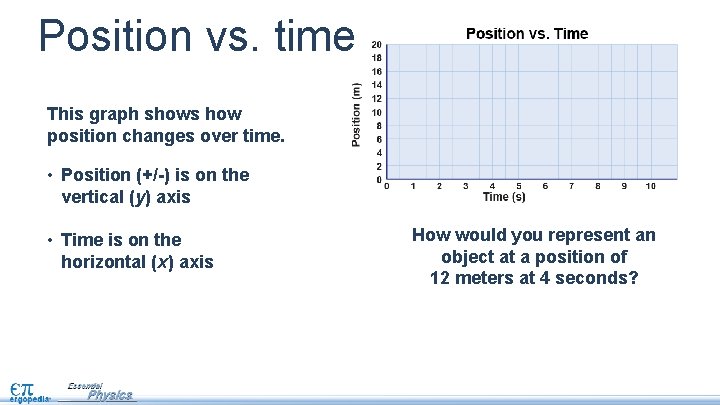
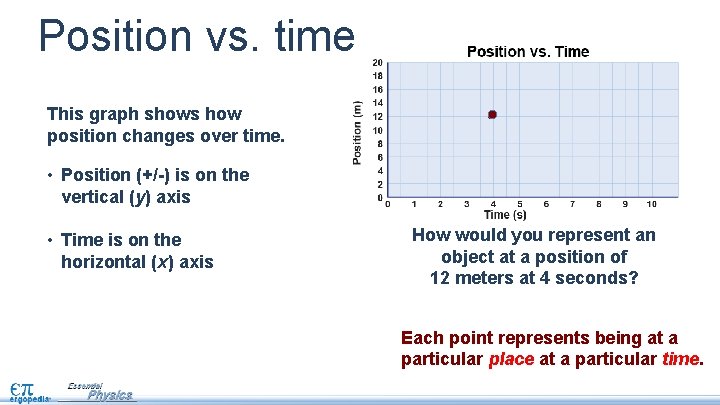
Position vs. time This graph shows how position changes over time. • Position (+/-) is on the vertical (y) axis • Time is on the horizontal (x) axis How would you represent an object at a position of 12 meters at 4 seconds?
Position vs. time This graph shows how position changes over time. • Position (+/-) is on the vertical (y) axis • Time is on the horizontal (x) axis How would you represent an object at a position of 12 meters at 4 seconds? Each point represents being at a particular place at a particular time.
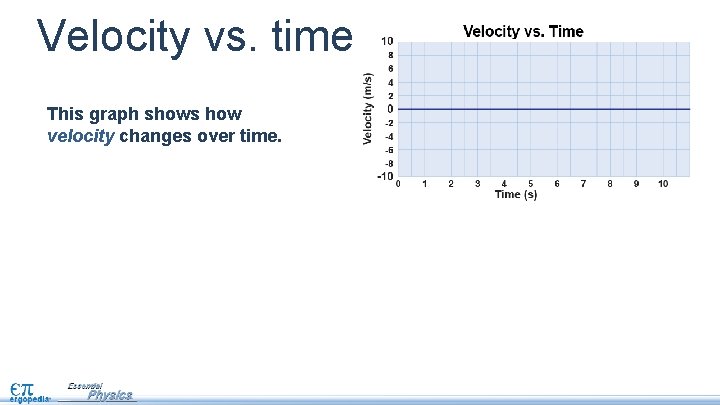
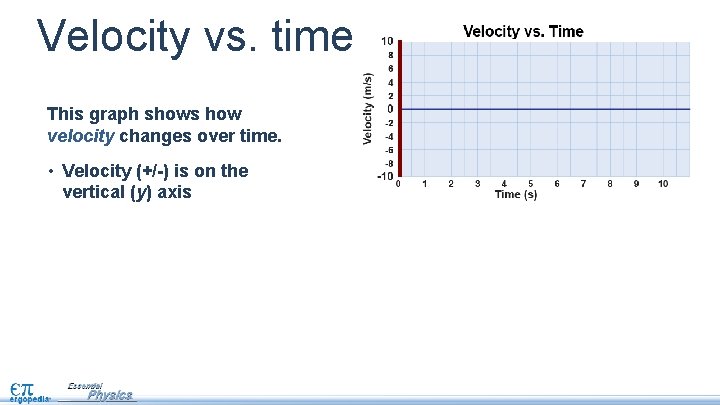
Velocity vs. time This graph shows how velocity changes over time.
Velocity vs. time This graph shows how velocity changes over time. • Velocity (+/-) is on the vertical (y) axis
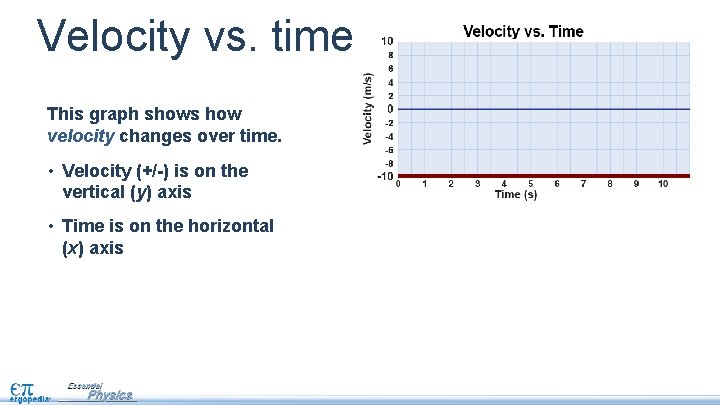
Velocity vs. time This graph shows how velocity changes over time. • Velocity (+/-) is on the vertical (y) axis • Time is on the horizontal (x) axis
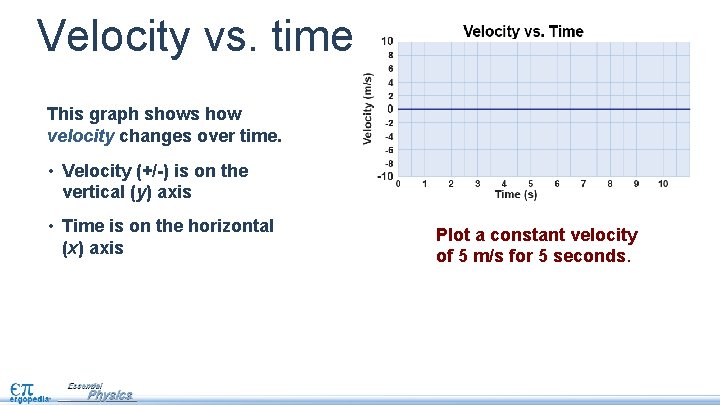
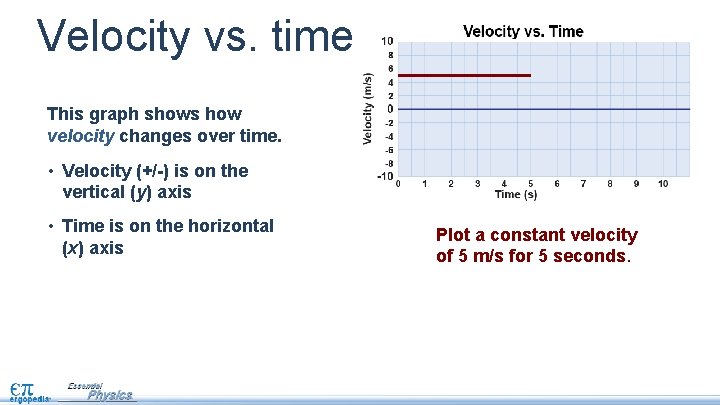
Velocity vs. time This graph shows how velocity changes over time. • Velocity (+/-) is on the vertical (y) axis • Time is on the horizontal (x) axis Plot a constant velocity of 5 m/s for 5 seconds.
Velocity vs. time This graph shows how velocity changes over time. • Velocity (+/-) is on the vertical (y) axis • Time is on the horizontal (x) axis Plot a constant velocity of 5 m/s for 5 seconds.
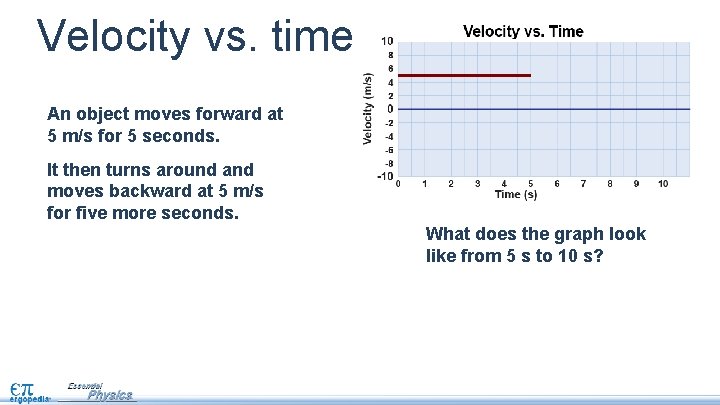
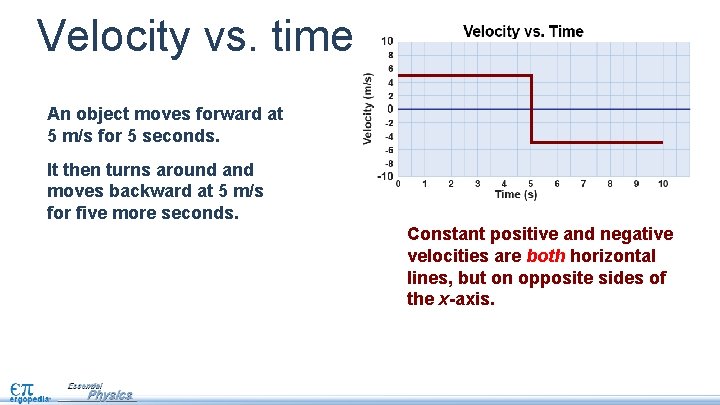
Velocity vs. time An object moves forward at 5 m/s for 5 seconds. It then turns around and moves backward at 5 m/s for five more seconds. What does the graph look like from 5 s to 10 s?
Velocity vs. time An object moves forward at 5 m/s for 5 seconds. It then turns around and moves backward at 5 m/s for five more seconds. Constant positive and negative velocities are both horizontal lines, but on opposite sides of the x-axis.
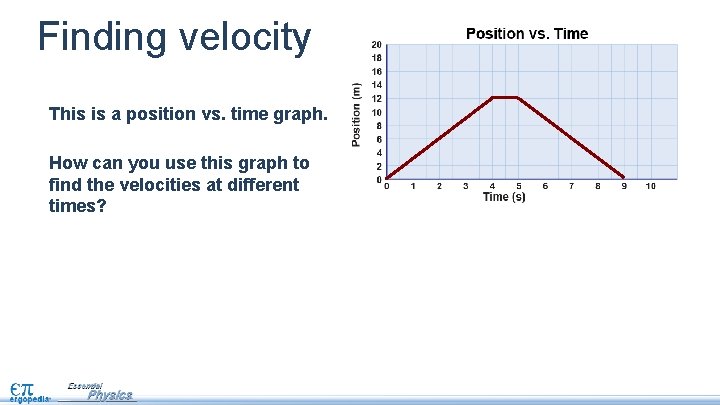
Finding velocity This is a position vs. time graph. How can you use this graph to find the velocities at different times?
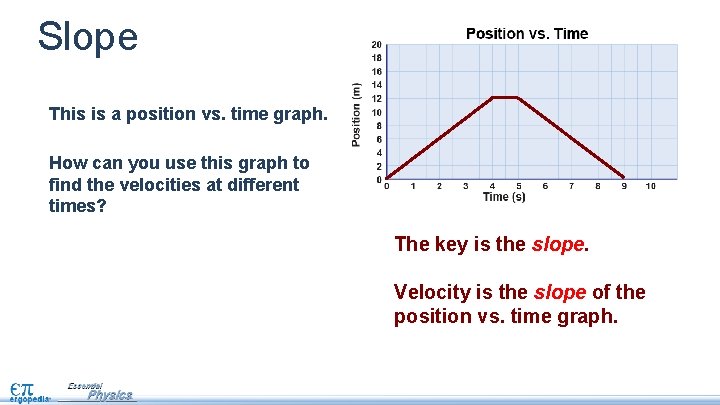
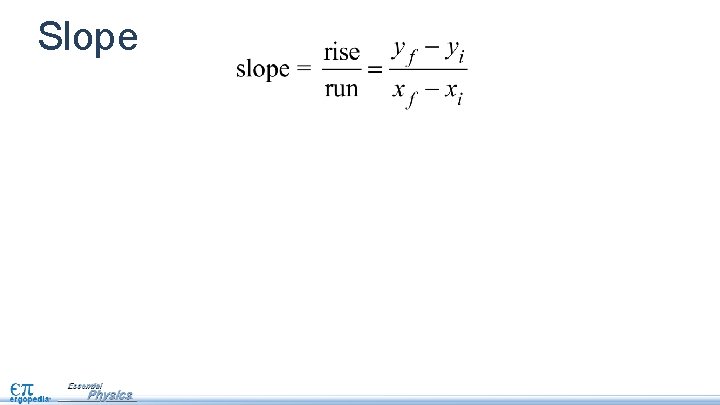
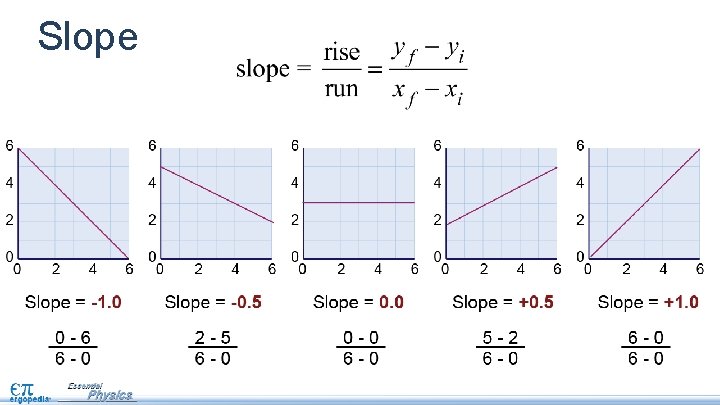
Slope This is a position vs. time graph. How can you use this graph to find the velocities at different times? The key is the slope. Velocity is the slope of the position vs. time graph.
Slope
Slope
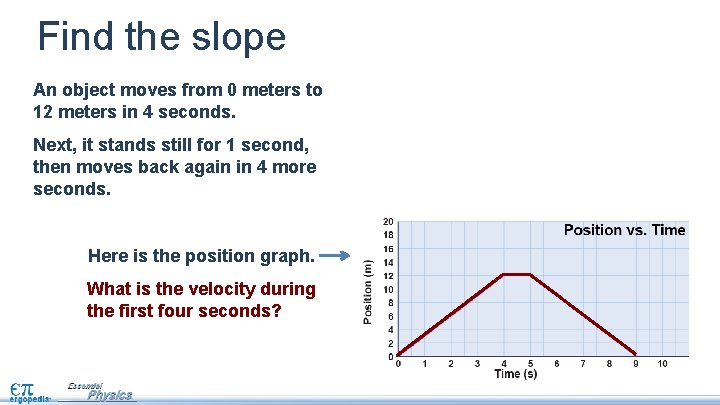
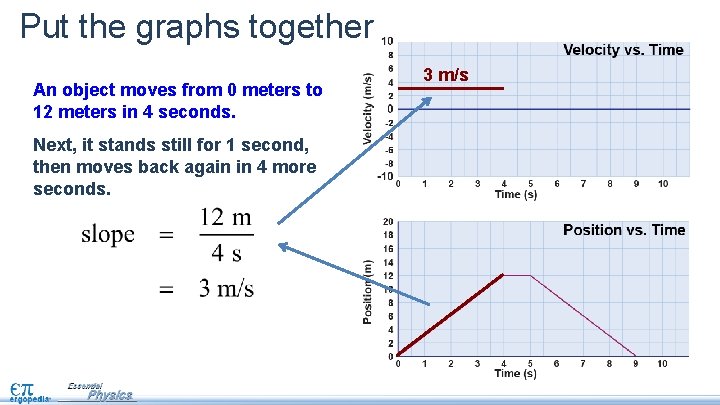
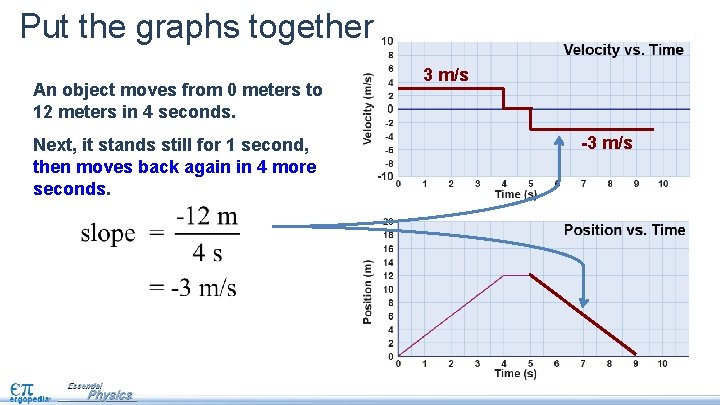
Find the slope An object moves from 0 meters to 12 meters in 4 seconds. Next, it stands still for 1 second, then moves back again in 4 more seconds. Here is the position graph. What is the velocity during the first four seconds?
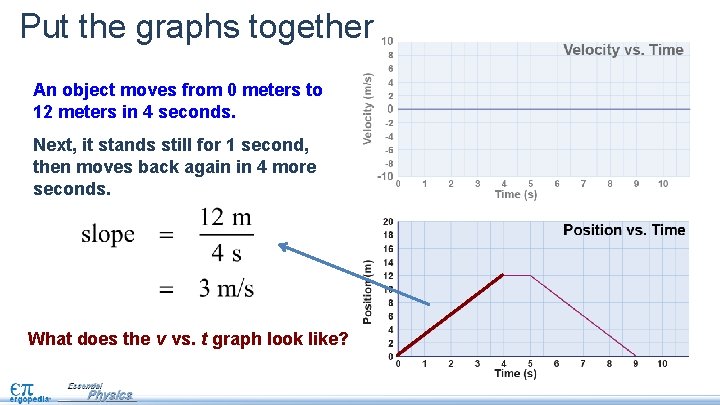
Put the graphs together An object moves from 0 meters to 12 meters in 4 seconds. Next, it stands still for 1 second, then moves back again in 4 more seconds. What does the v vs. t graph look like?
Put the graphs together An object moves from 0 meters to 12 meters in 4 seconds. Next, it stands still for 1 second, then moves back again in 4 more seconds. 3 m/s
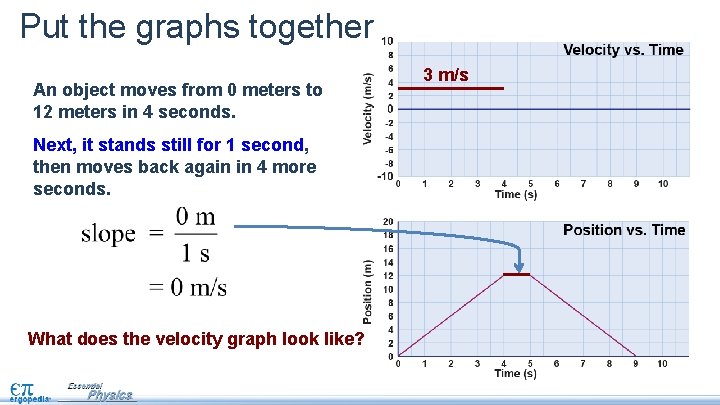
Put the graphs together An object moves from 0 meters to 12 meters in 4 seconds. Next, it stands still for 1 second, then moves back again in 4 more seconds. What does the velocity graph look like? 3 m/s
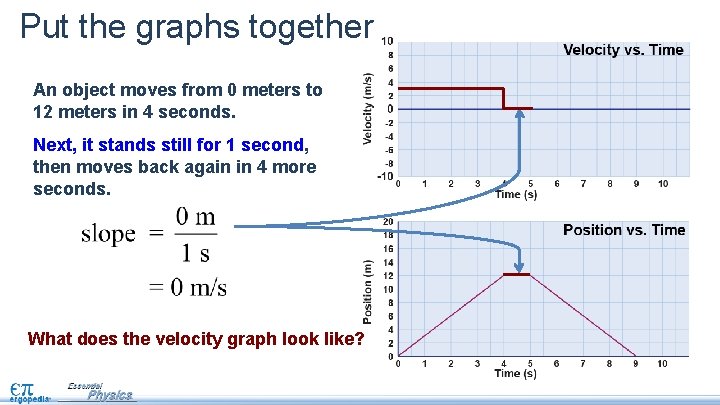
Put the graphs together An object moves from 0 meters to 12 meters in 4 seconds. Next, it stands still for 1 second, then moves back again in 4 more seconds. What does the velocity graph look like? 3 m/s
Put the graphs together An object moves from 0 meters to 12 meters in 4 seconds. Next, it stands still for 1 second, then moves back again in 4 more seconds. What does the velocity graph look like? 3 m/s
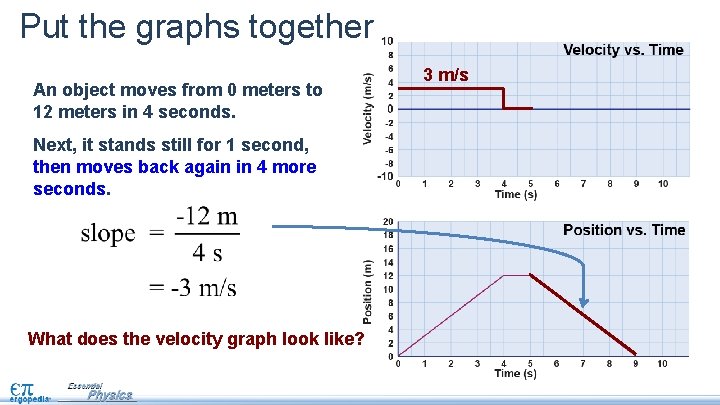
Put the graphs together An object moves from 0 meters to 12 meters in 4 seconds. Next, it stands still for 1 second, then moves back again in 4 more seconds. 3 m/s -3 m/s
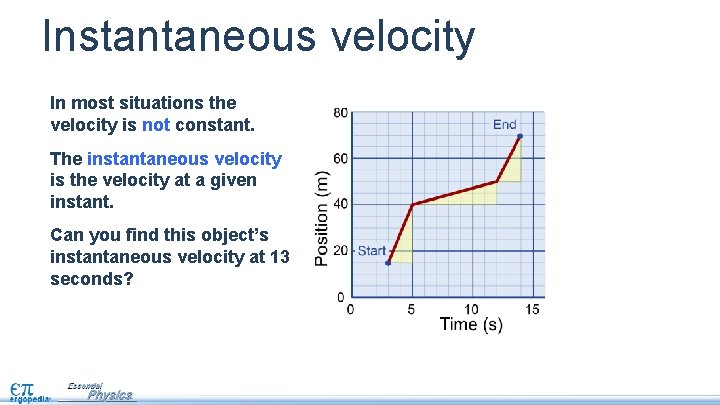
Instantaneous velocity In most situations the velocity is not constant. The instantaneous velocity is the velocity at a given instant. Can you find this object’s instantaneous velocity at 13 seconds?
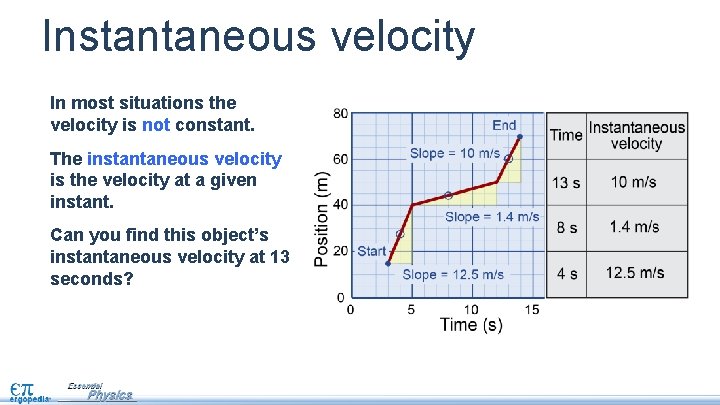
Instantaneous velocity In most situations the velocity is not constant. The instantaneous velocity is the velocity at a given instant. Can you find this object’s instantaneous velocity at 13 seconds?
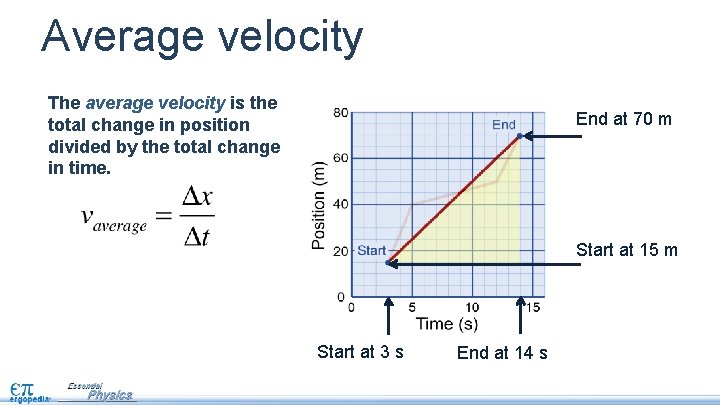
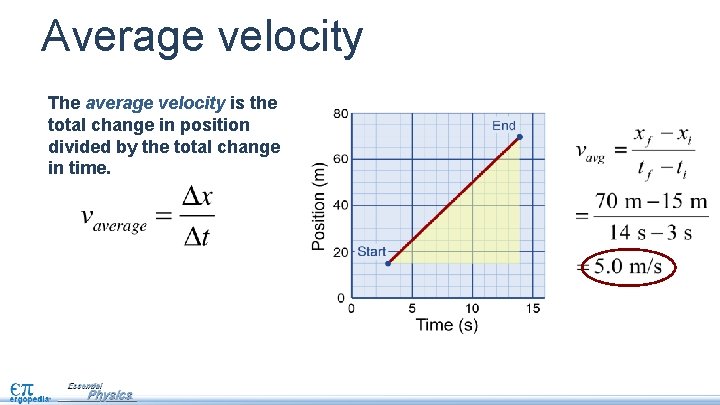
Average velocity The average velocity is the total change in position divided by the total change in time. End at 70 m Start at 15 m Start at 3 s End at 14 s
Average velocity The average velocity is the total change in position divided by the total change in time.
What about when velocity changes? What are some ways velocity can change?
What about when velocity changes? What are some ways velocity can change? Acceleration, deceleration and changes in direction.
What about when velocity changes? What are some ways velocity can change? Acceleration, deceleration and changes in direction. When accelerating, the position changes more each unit of time. While velocity changes at the same rate each unit of time. For example, 3 m/s/s, means that velocity is increasing by 3 m/s every second. Draw what this may look like:
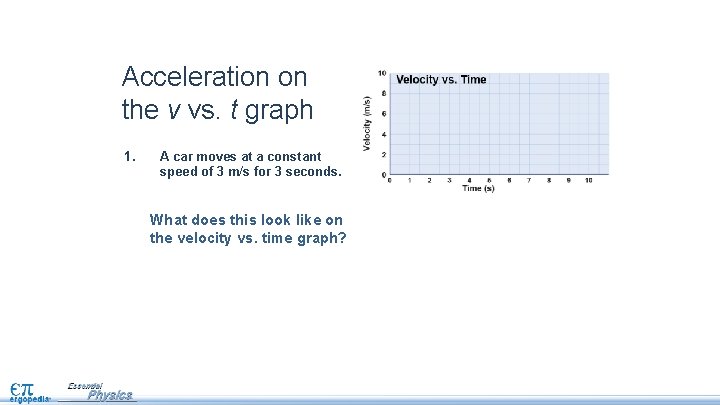
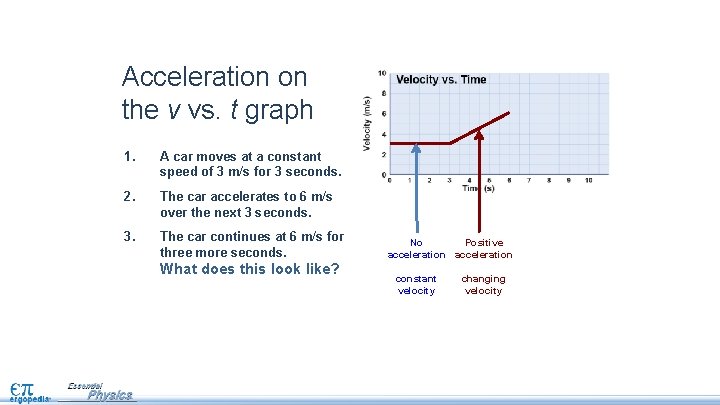
Acceleration on the v vs. t graph 1. A car moves at a constant speed of 3 m/s for 3 seconds. What does this look like on the velocity vs. time graph?
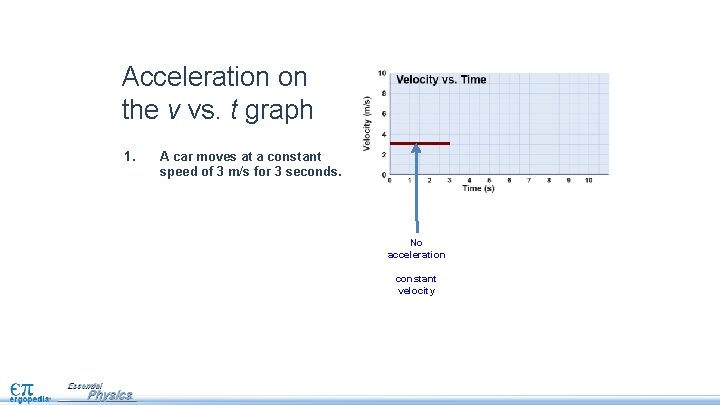
Acceleration on the v vs. t graph 1. A car moves at a constant speed of 3 m/s for 3 seconds. No acceleration constant velocity
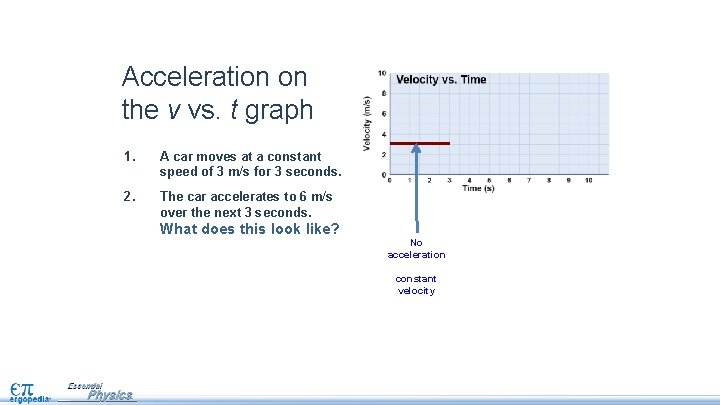
Acceleration on the v vs. t graph 1. A car moves at a constant speed of 3 m/s for 3 seconds. 2. The car accelerates to 6 m/s over the next 3 seconds. What does this look like? No acceleration constant velocity
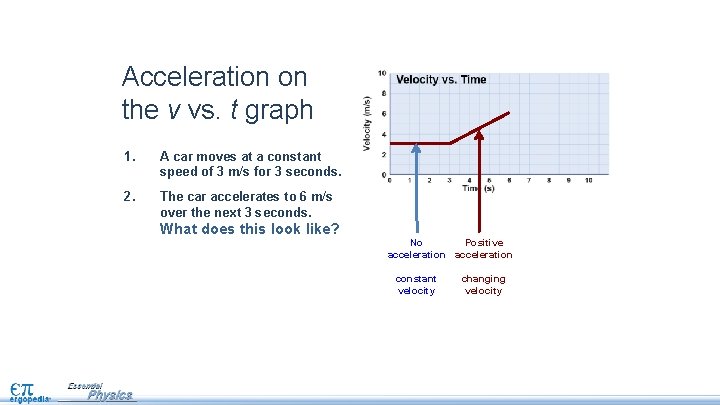
Acceleration on the v vs. t graph 1. A car moves at a constant speed of 3 m/s for 3 seconds. 2. The car accelerates to 6 m/s over the next 3 seconds. What does this look like? No Positive acceleration constant velocity changing velocity
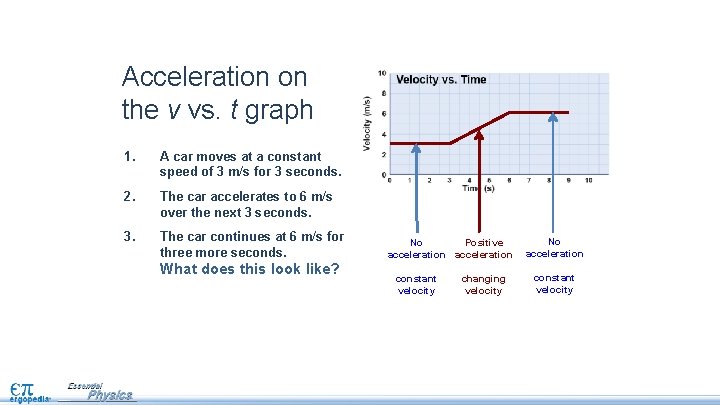
Acceleration on the v vs. t graph 1. A car moves at a constant speed of 3 m/s for 3 seconds. 2. The car accelerates to 6 m/s over the next 3 seconds. 3. The car continues at 6 m/s for three more seconds. What does this look like? No Positive acceleration constant velocity changing velocity
Acceleration on the v vs. t graph 1. A car moves at a constant speed of 3 m/s for 3 seconds. 2. The car accelerates to 6 m/s over the next 3 seconds. 3. The car continues at 6 m/s for three more seconds. What does this look like? No Positive acceleration constant velocity changing velocity No acceleration constant velocity
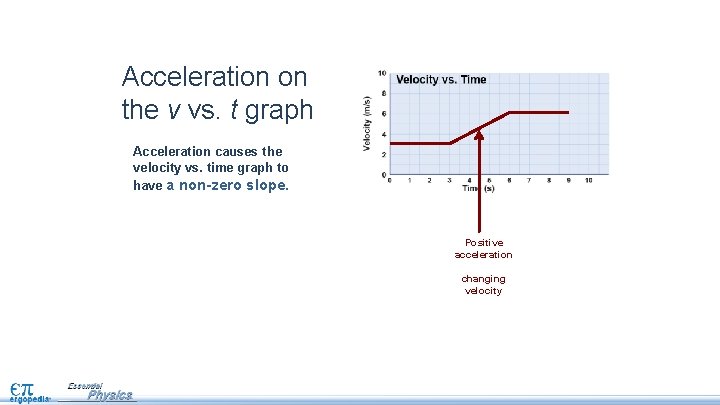
Acceleration on the v vs. t graph Acceleration causes the velocity vs. time graph to have a non-zero slope. Positive acceleration changing velocity
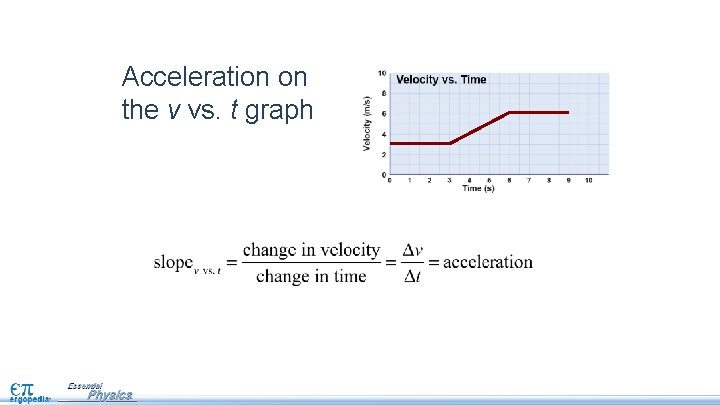
Acceleration on the v vs. t graph
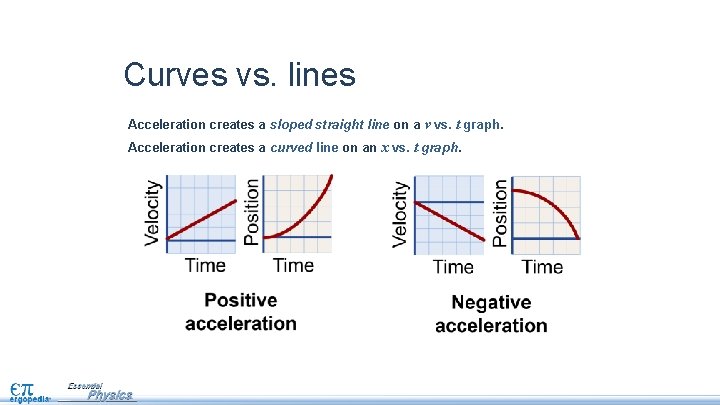
Curves vs. lines Acceleration creates a sloped straight line on a v vs. t graph. Acceleration creates a curved line on an x vs. t graph.
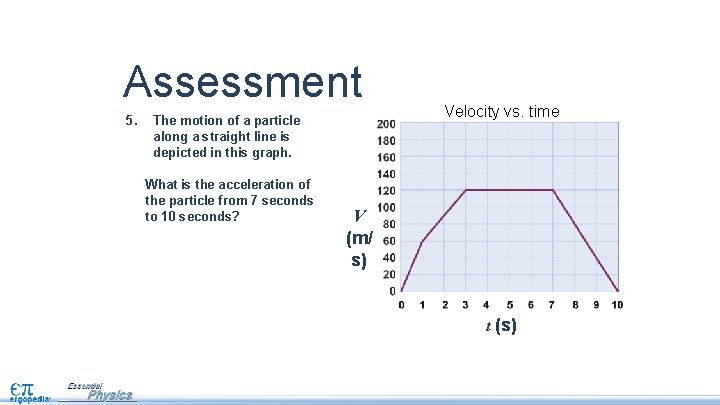
Assessment 5. The motion of a particle along a straight line is depicted in this graph. What is the acceleration of the particle from 7 seconds to 10 seconds? Velocity vs. time V (m/ s) t (s)
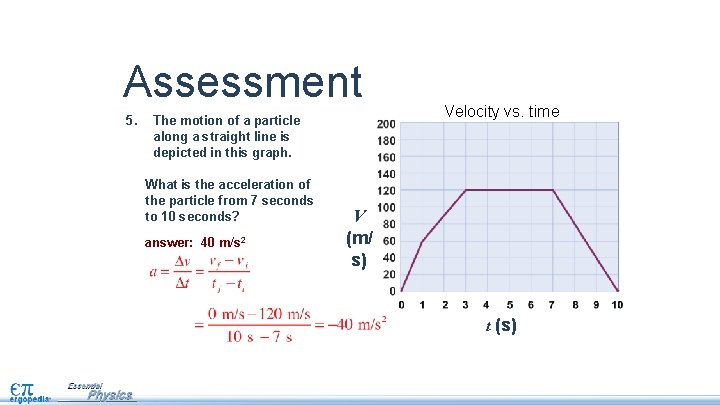
Assessment 5. The motion of a particle along a straight line is depicted in this graph. What is the acceleration of the particle from 7 seconds to 10 seconds? answer: 40 m/s 2 Velocity vs. time V (m/ s) t (s)
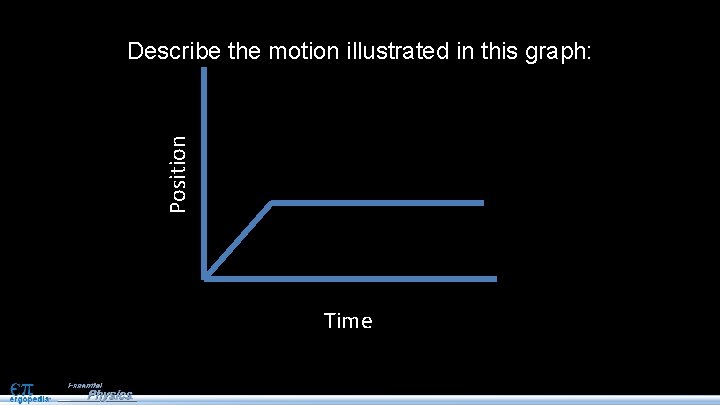
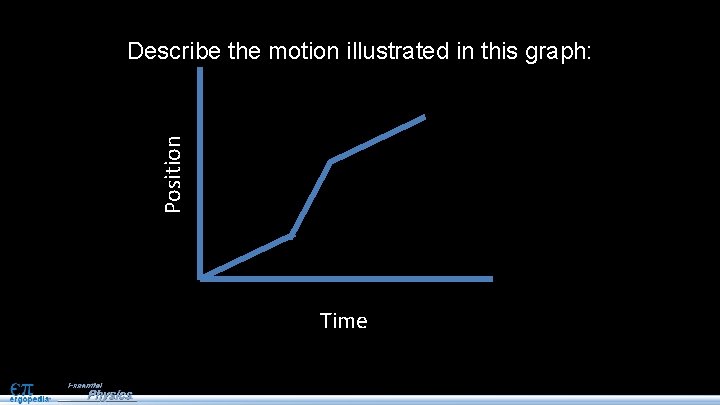
Position Describe the motion illustrated in this graph: Time
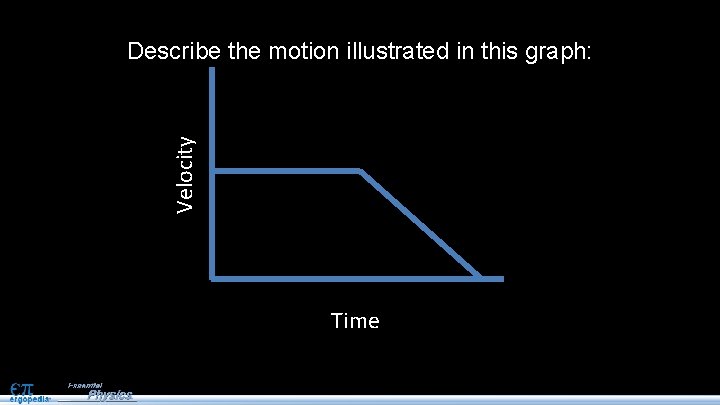
Velocity Describe the motion illustrated in this graph: Time
Position Describe the motion illustrated in this graph: Time
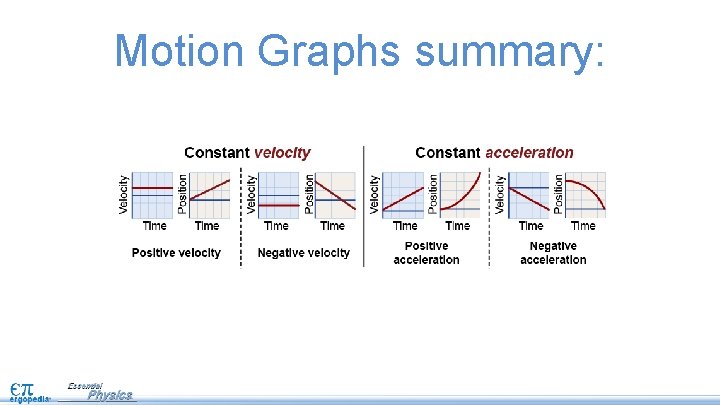
Motion Graphs summary: