
Motion Estimation Thanks to Steve Seitz Simon Baker
Motion Estimation Thanks to Steve Seitz, Simon Baker, Takeo Kanade, and anyone else who helped develop these slides. 1
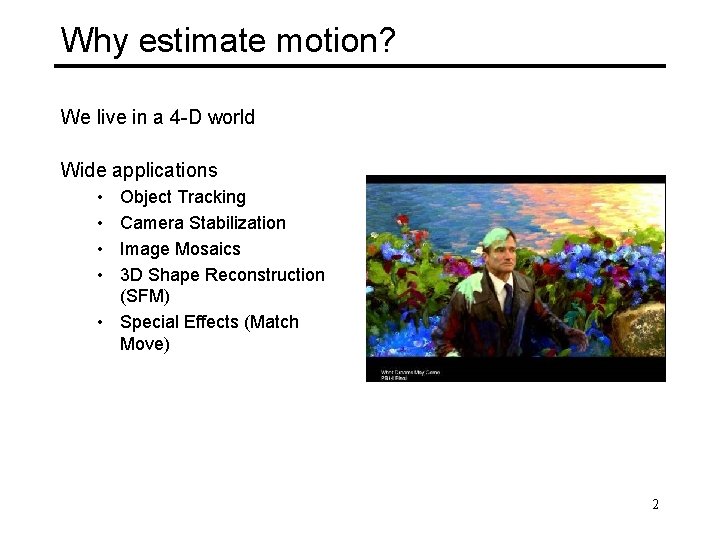
Why estimate motion? We live in a 4 -D world Wide applications • • Object Tracking Camera Stabilization Image Mosaics 3 D Shape Reconstruction (SFM) • Special Effects (Match Move) 2
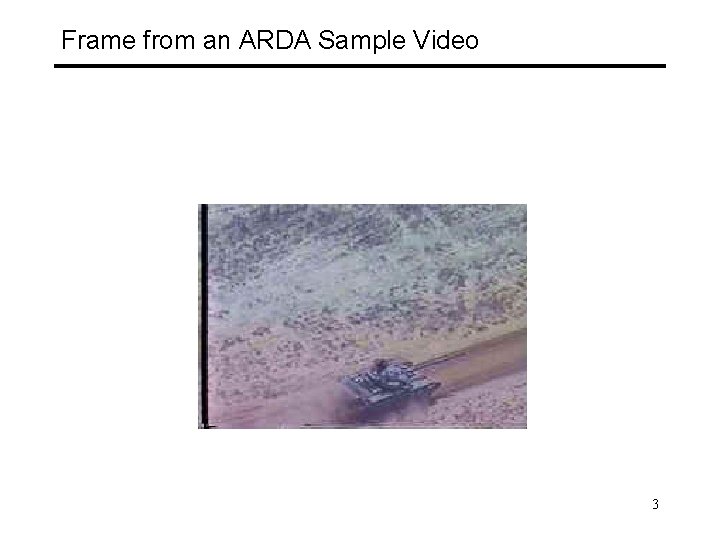
Frame from an ARDA Sample Video 3
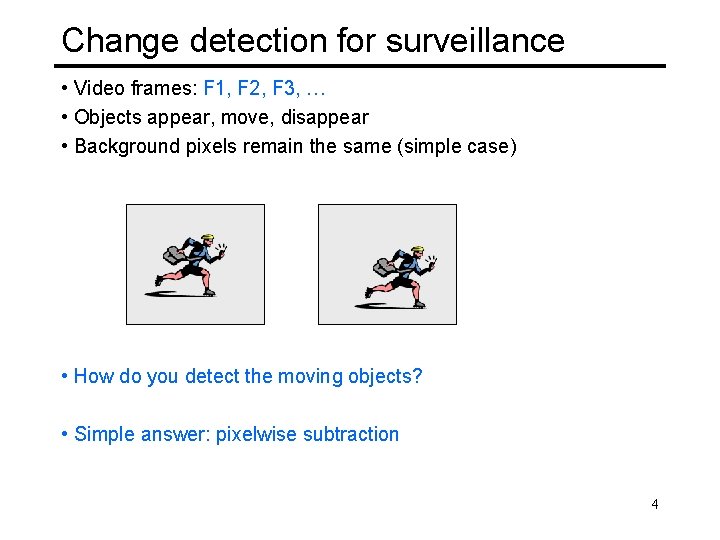
Change detection for surveillance • Video frames: F 1, F 2, F 3, … • Objects appear, move, disappear • Background pixels remain the same (simple case) • How do you detect the moving objects? • Simple answer: pixelwise subtraction 4
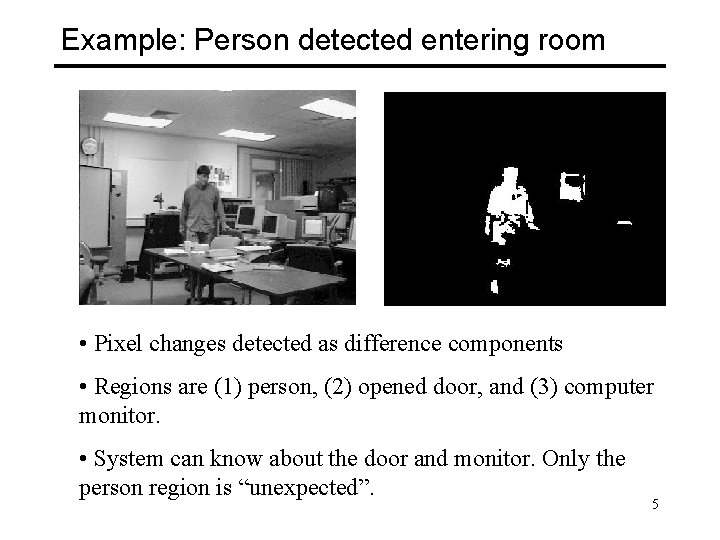
Example: Person detected entering room • Pixel changes detected as difference components • Regions are (1) person, (2) opened door, and (3) computer monitor. • System can know about the door and monitor. Only the person region is “unexpected”. 5
![Change Detection via Image Subtraction for each pixel [r, c] if (|I 1[r, c]](http://slidetodoc.com/presentation_image_h2/4e165dda8686954ee5b1d0b18e265c94/image-6.jpg "Change Detection via Image Subtraction for each pixel [r, c] if (|I 1[r, c]")
Change Detection via Image Subtraction for each pixel [r, c] if (|I 1[r, c] - I 2[r, c]| > threshold) then Iout[r, c] = 1 else Iout[r, c] = 0 Perform connected components on Iout. Remove small regions. Perform a closing with a small disk for merging close neighbors. Compute and return the bounding boxes B of each remaining region. What assumption does this make about the changes? 6
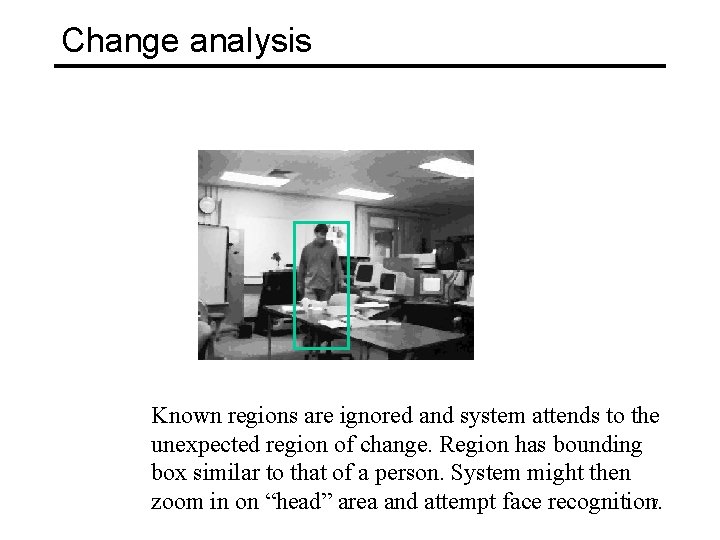
Change analysis Known regions are ignored and system attends to the unexpected region of change. Region has bounding box similar to that of a person. System might then zoom in on “head” area and attempt face recognition. 7
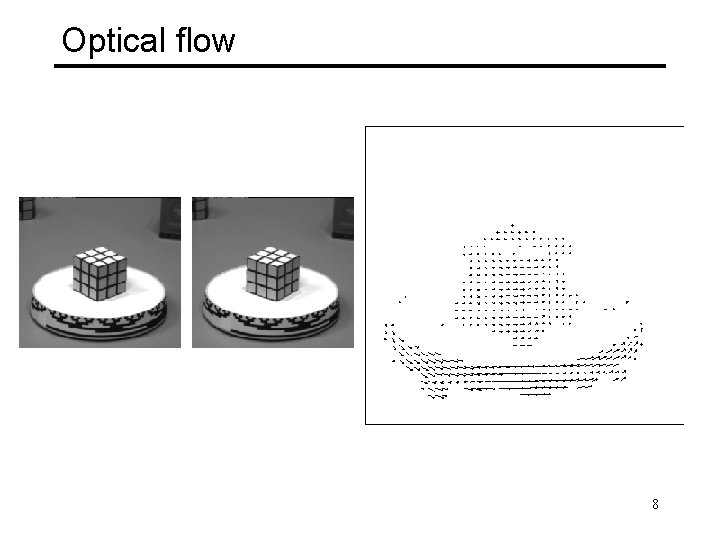
Optical flow 8
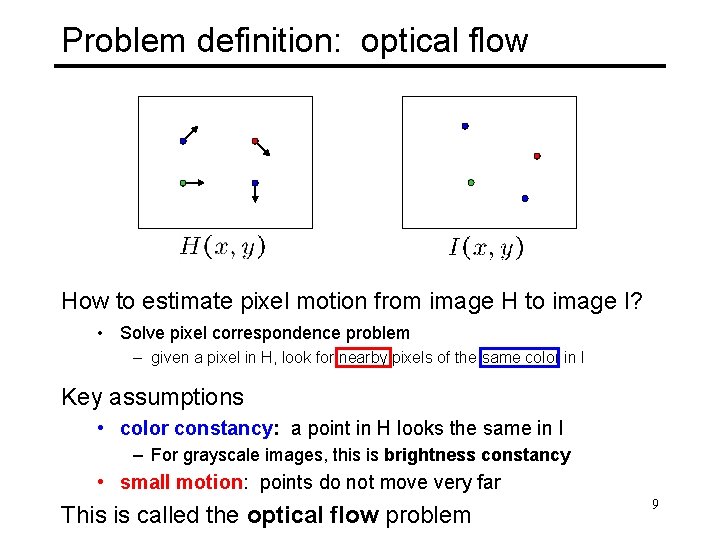
Problem definition: optical flow How to estimate pixel motion from image H to image I? • Solve pixel correspondence problem – given a pixel in H, look for nearby pixels of the same color in I Key assumptions • color constancy: a point in H looks the same in I – For grayscale images, this is brightness constancy • small motion: points do not move very far This is called the optical flow problem 9
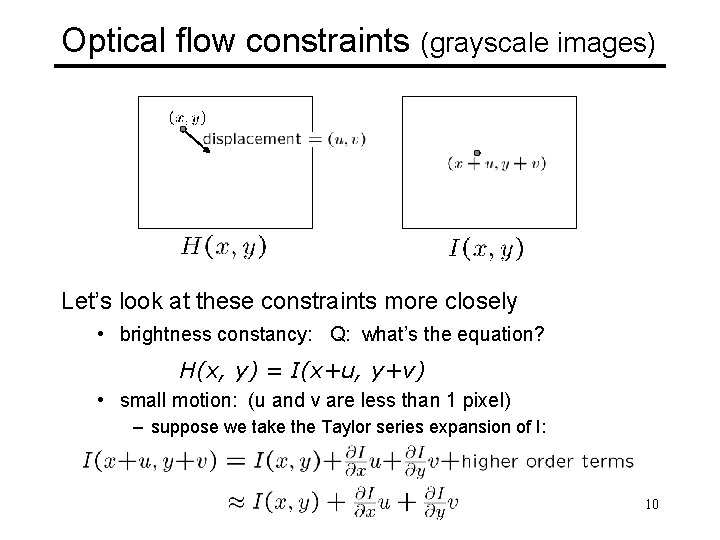
Optical flow constraints (grayscale images) Let’s look at these constraints more closely • brightness constancy: Q: what’s the equation? H(x, y) = I(x+u, y+v) • small motion: (u and v are less than 1 pixel) – suppose we take the Taylor series expansion of I: 10

Optical flow equation Combining these two equations The x-component of the gradient vector. What is It ? The time derivative of the image at (x, y) How do we calculate it? 11

Optical flow equation Q: how many unknowns and equations per pixel? 1 equation, but 2 unknowns (u and v) Intuitively, what does this constraint mean? • The component of the flow in the gradient direction is determined • The component of the flow parallel to an edge is unknown 12

Aperture problem 13

Aperture problem 14
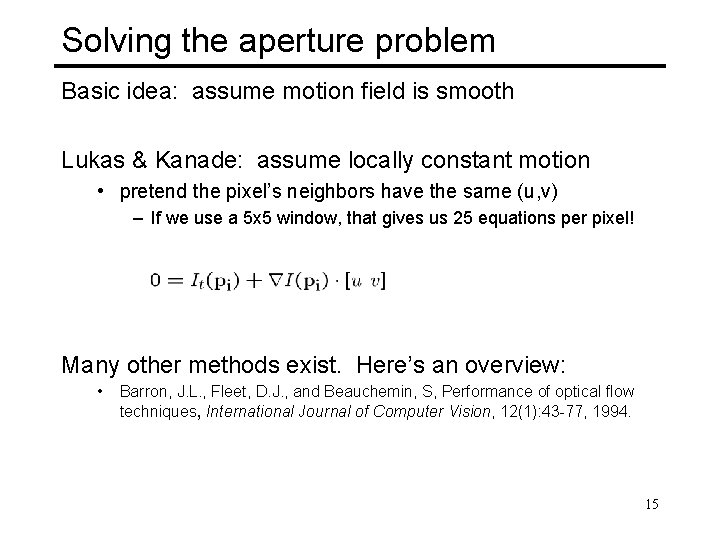
Solving the aperture problem Basic idea: assume motion field is smooth Lukas & Kanade: assume locally constant motion • pretend the pixel’s neighbors have the same (u, v) – If we use a 5 x 5 window, that gives us 25 equations per pixel! Many other methods exist. Here’s an overview: • Barron, J. L. , Fleet, D. J. , and Beauchemin, S, Performance of optical flow techniques, International Journal of Computer Vision, 12(1): 43 -77, 1994. 15
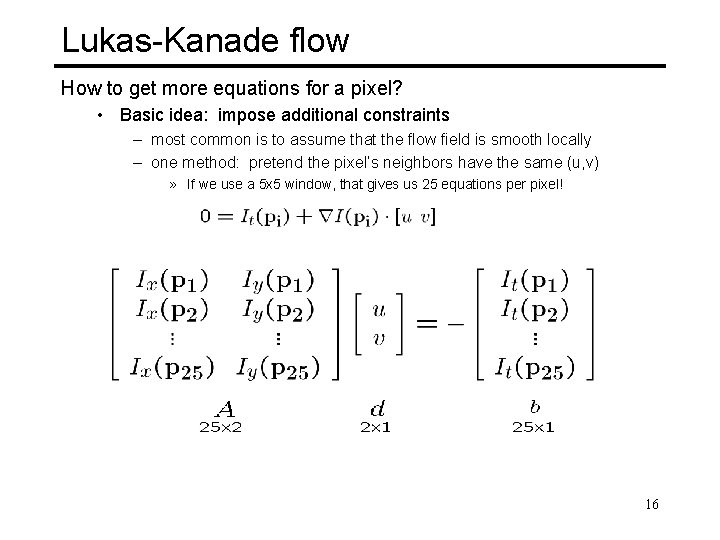
Lukas-Kanade flow How to get more equations for a pixel? • Basic idea: impose additional constraints – most common is to assume that the flow field is smooth locally – one method: pretend the pixel’s neighbors have the same (u, v) » If we use a 5 x 5 window, that gives us 25 equations per pixel! 16
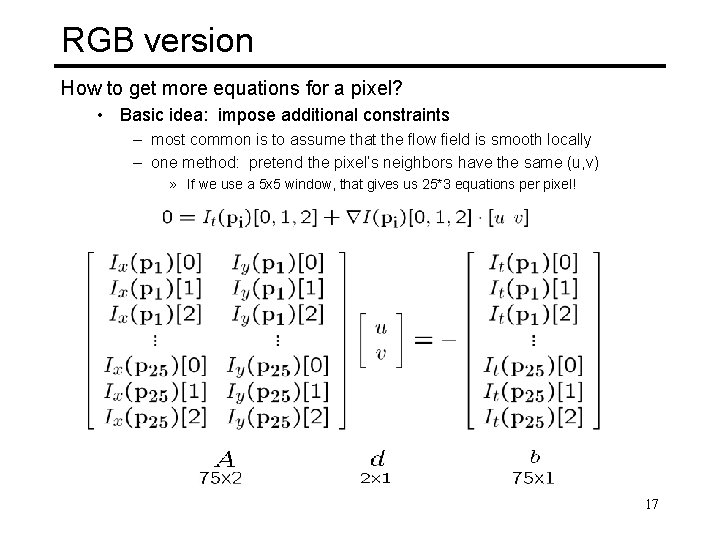
RGB version How to get more equations for a pixel? • Basic idea: impose additional constraints – most common is to assume that the flow field is smooth locally – one method: pretend the pixel’s neighbors have the same (u, v) » If we use a 5 x 5 window, that gives us 25*3 equations per pixel! 17
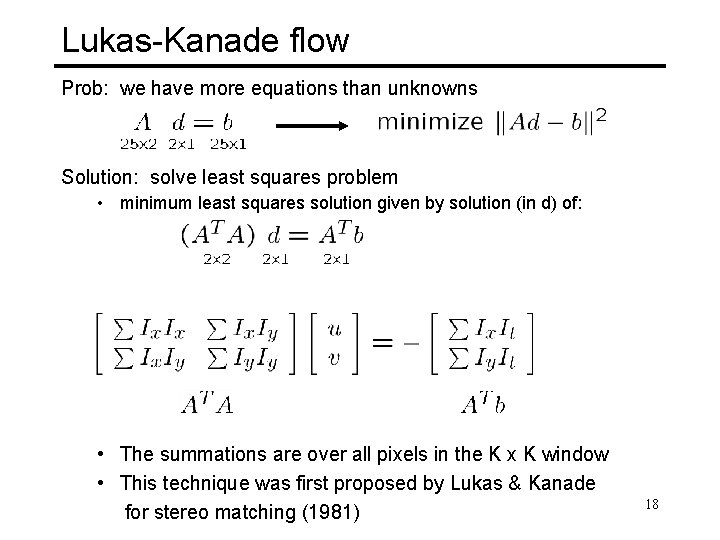
Lukas-Kanade flow Prob: we have more equations than unknowns Solution: solve least squares problem • minimum least squares solution given by solution (in d) of: • The summations are over all pixels in the K x K window • This technique was first proposed by Lukas & Kanade for stereo matching (1981) 18
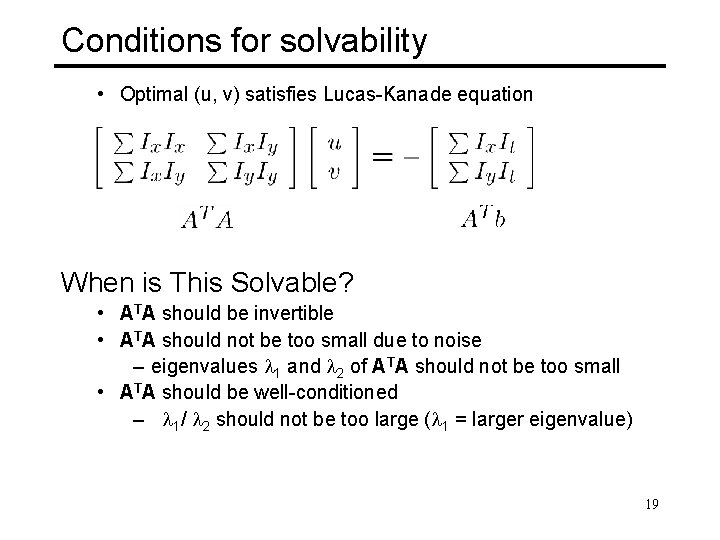
Conditions for solvability • Optimal (u, v) satisfies Lucas-Kanade equation When is This Solvable? • ATA should be invertible • ATA should not be too small due to noise – eigenvalues l 1 and l 2 of ATA should not be too small • ATA should be well-conditioned – l 1/ l 2 should not be too large (l 1 = larger eigenvalue) 19
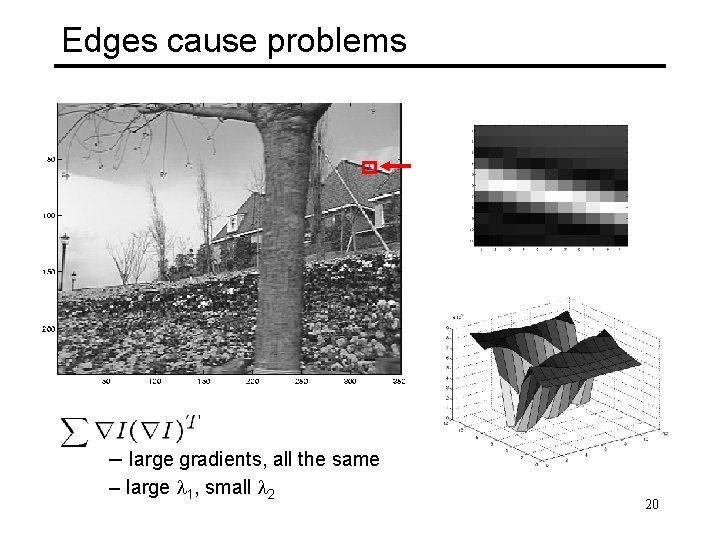
Edges cause problems – large gradients, all the same – large l 1, small l 2 20
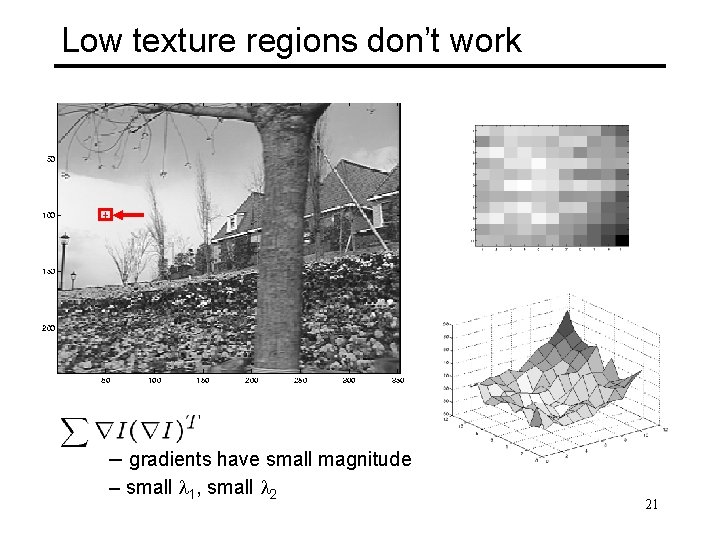
Low texture regions don’t work – gradients have small magnitude – small l 1, small l 2 21
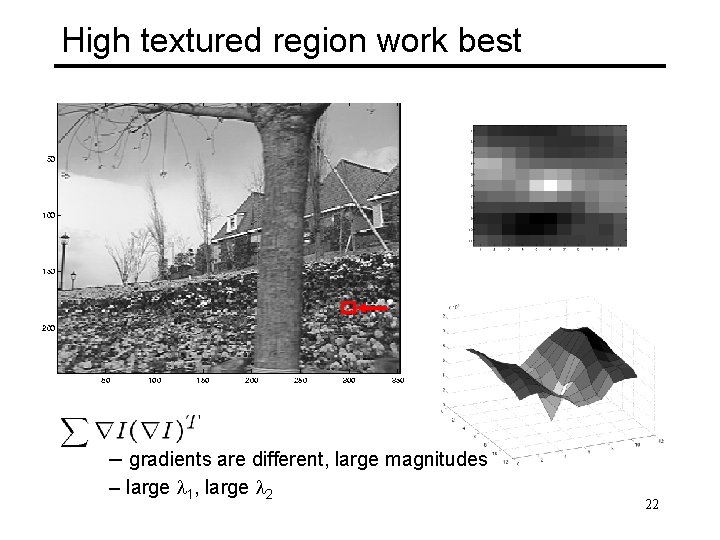
High textured region work best – gradients are different, large magnitudes – large l 1, large l 2 22
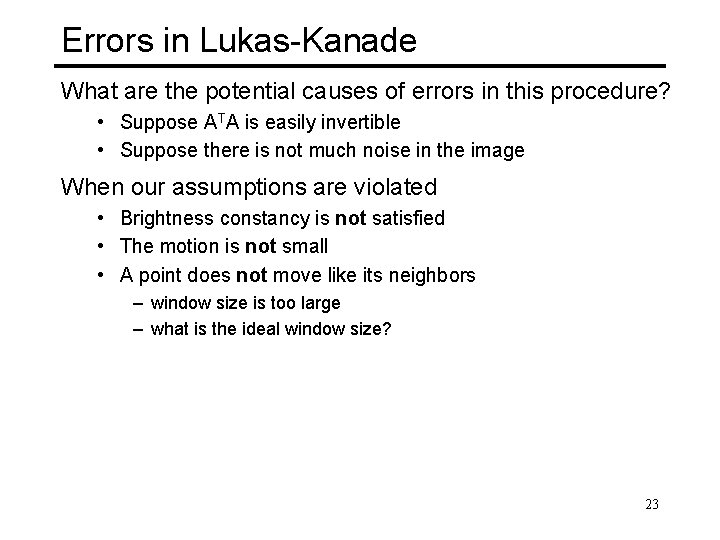
Errors in Lukas-Kanade What are the potential causes of errors in this procedure? • Suppose ATA is easily invertible • Suppose there is not much noise in the image When our assumptions are violated • Brightness constancy is not satisfied • The motion is not small • A point does not move like its neighbors – window size is too large – what is the ideal window size? 23
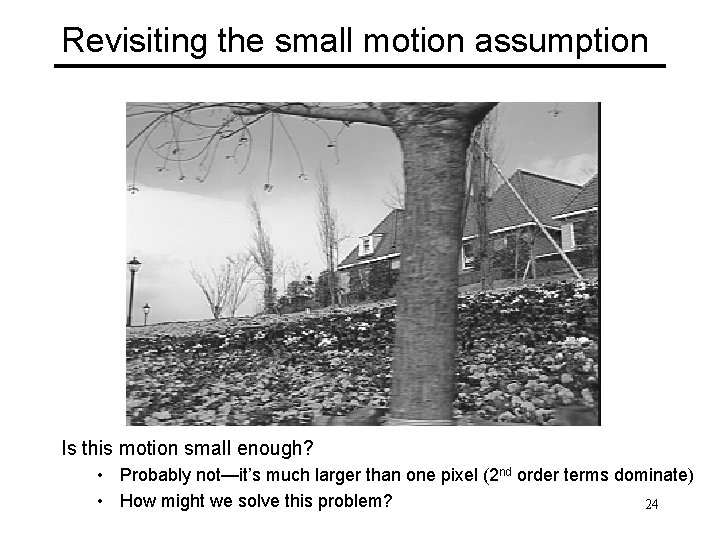
Revisiting the small motion assumption Is this motion small enough? • Probably not—it’s much larger than one pixel (2 nd order terms dominate) • How might we solve this problem? 24
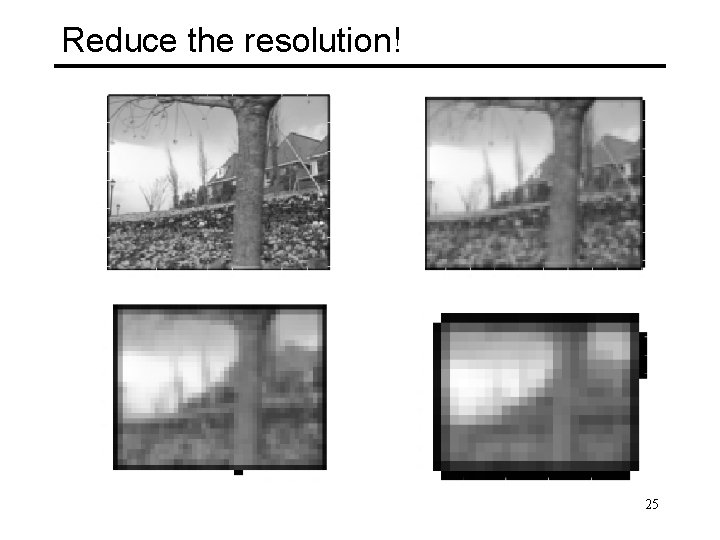
Reduce the resolution! 25
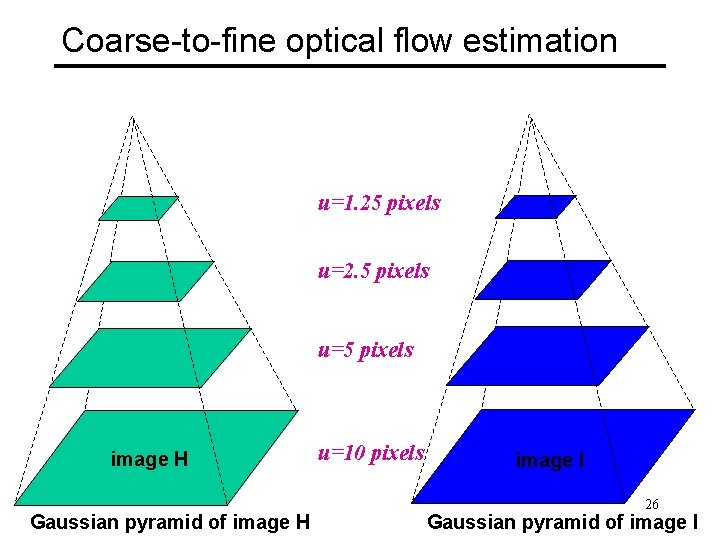
Coarse-to-fine optical flow estimation u=1. 25 pixels u=2. 5 pixels u=5 pixels image H Gaussian pyramid of image H u=10 pixels image II image 26 Gaussian pyramid of image I
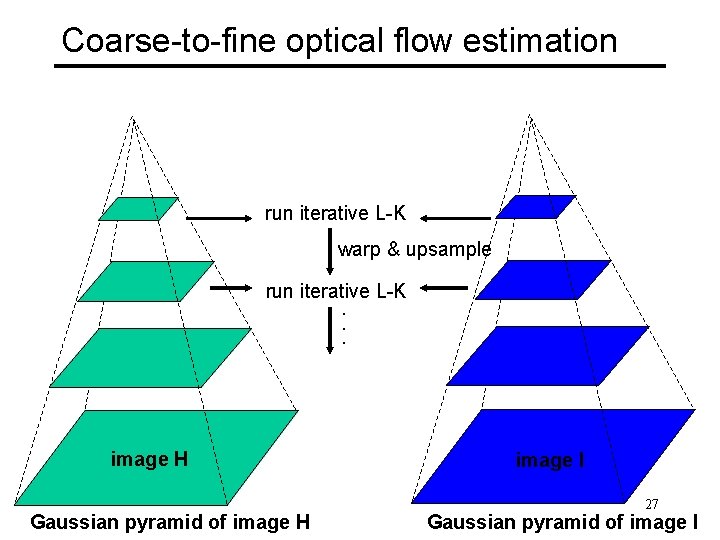
Coarse-to-fine optical flow estimation run iterative L-K warp & upsample run iterative L-K. . . image JH Gaussian pyramid of image H image II image 27 Gaussian pyramid of image I
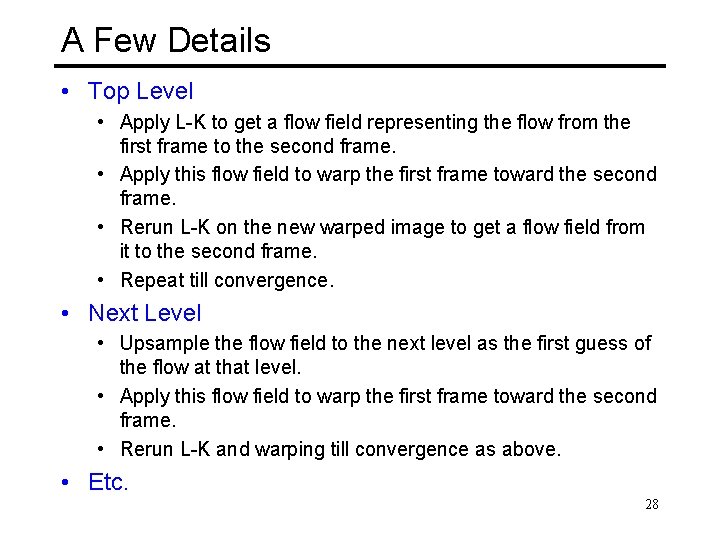
A Few Details • Top Level • Apply L-K to get a flow field representing the flow from the first frame to the second frame. • Apply this flow field to warp the first frame toward the second frame. • Rerun L-K on the new warped image to get a flow field from it to the second frame. • Repeat till convergence. • Next Level • Upsample the flow field to the next level as the first guess of the flow at that level. • Apply this flow field to warp the first frame toward the second frame. • Rerun L-K and warping till convergence as above. • Etc. 28
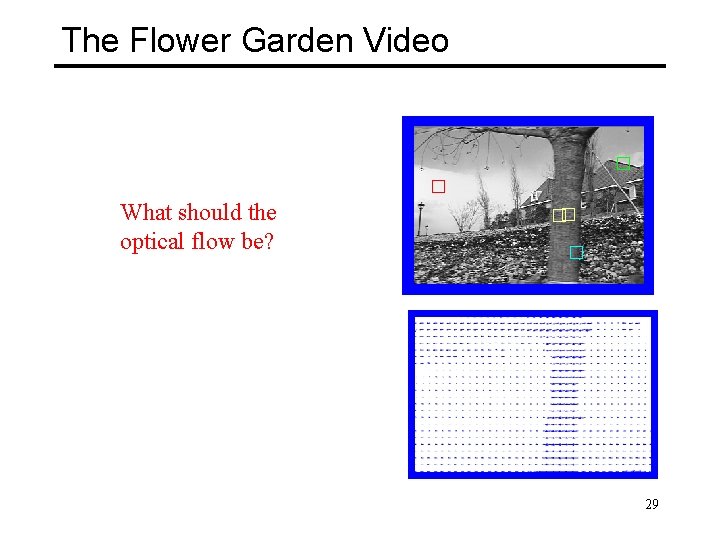
The Flower Garden Video What should the optical flow be? 29
Robust Visual Motion Analysis: Piecewise-Smooth Optical Flow Ming Ye Electrical Engineering University of Washington 30
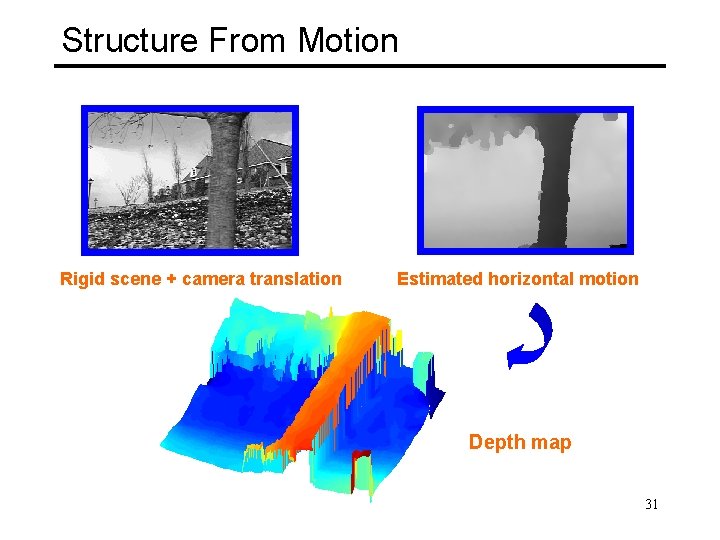
Structure From Motion Rigid scene + camera translation Estimated horizontal motion Depth map 31
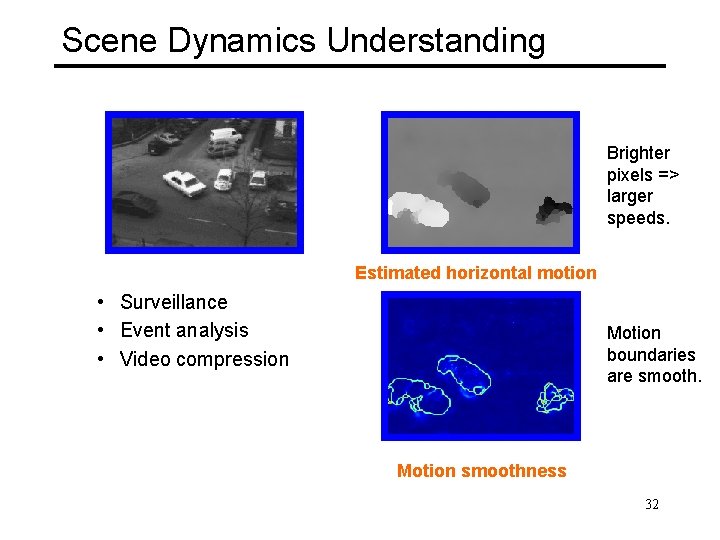
Scene Dynamics Understanding Brighter pixels => larger speeds. Estimated horizontal motion • Surveillance • Event analysis • Video compression Motion boundaries are smooth. Motion smoothness 32
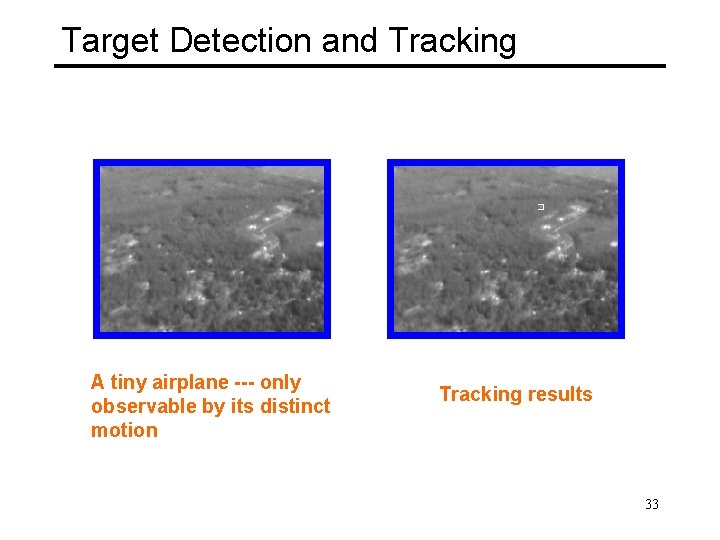
Target Detection and Tracking A tiny airplane --- only observable by its distinct motion Tracking results 33
Estimating Piecewise-Smooth Optical Flow with Global Matching and Graduated Optimization Problem Statement: Assuming only brightness conservation and piecewise-smooth motion, find the optical flow to best describe the intensity change in three frames. 34
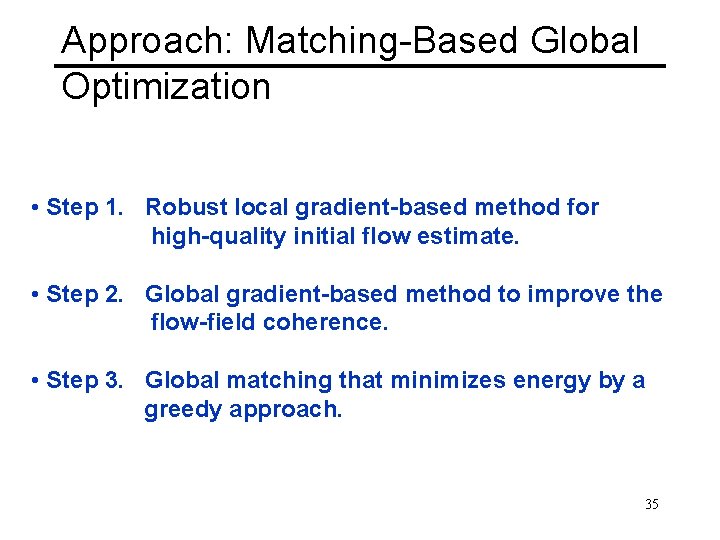
Approach: Matching-Based Global Optimization • Step 1. Robust local gradient-based method for high-quality initial flow estimate. • Step 2. Global gradient-based method to improve the flow-field coherence. • Step 3. Global matching that minimizes energy by a greedy approach. 35
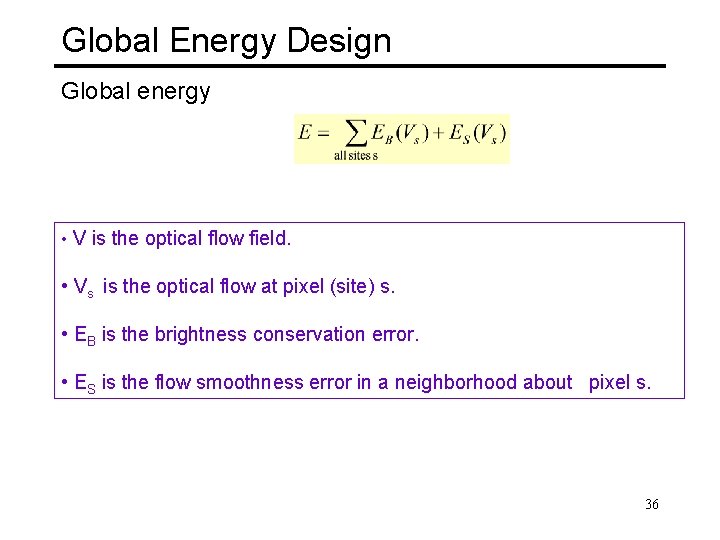
Global Energy Design Global energy • V is the optical flow field. • Vs is the optical flow at pixel (site) s. • EB is the brightness conservation error. • ES is the flow smoothness error in a neighborhood about pixel s. 36
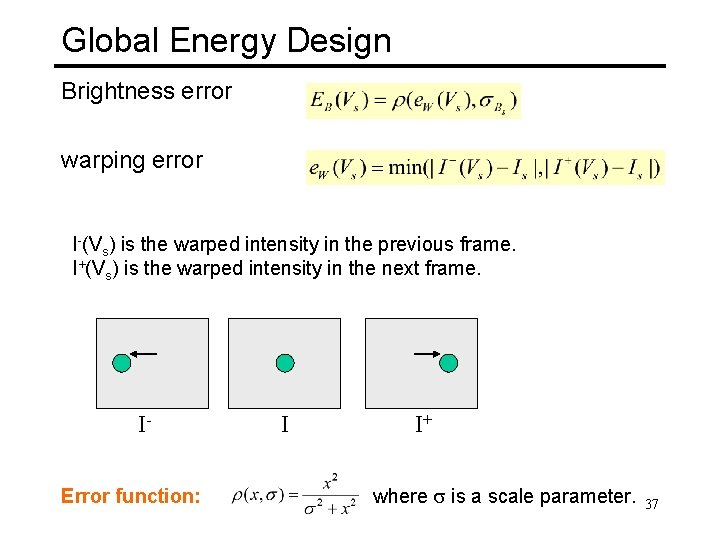
Global Energy Design Brightness error warping error I-(Vs) is the warped intensity in the previous frame. I+(Vs) is the warped intensity in the next frame. IError function: I I+ where is a scale parameter. 37
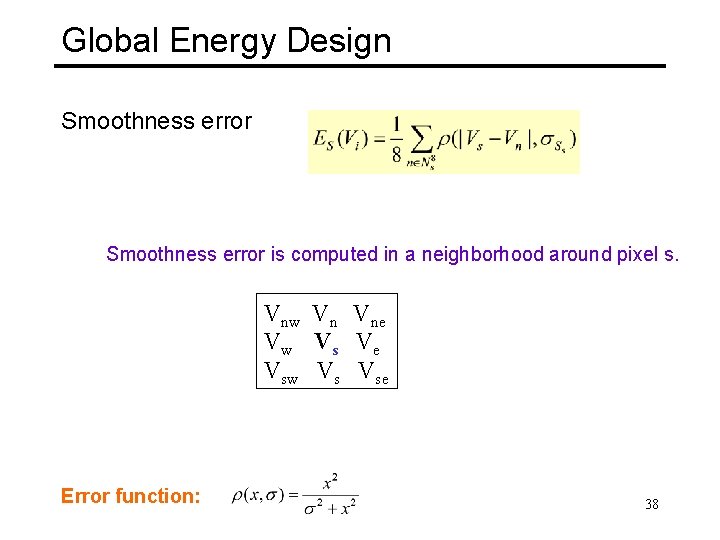
Global Energy Design Smoothness error is computed in a neighborhood around pixel s. Vnw Vn Vne Vw Vs Ve Vsw Vs Vse Error function: 38
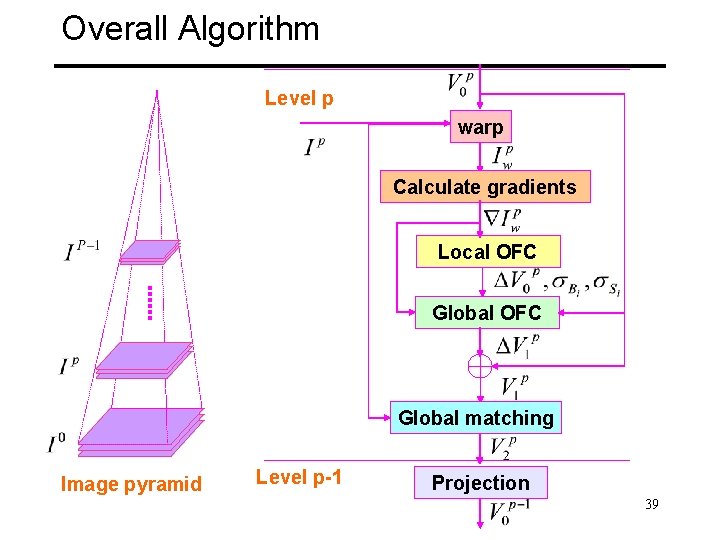
Overall Algorithm Level p warp Calculate gradients Local OFC Global matching Image pyramid Level p-1 Projection 39
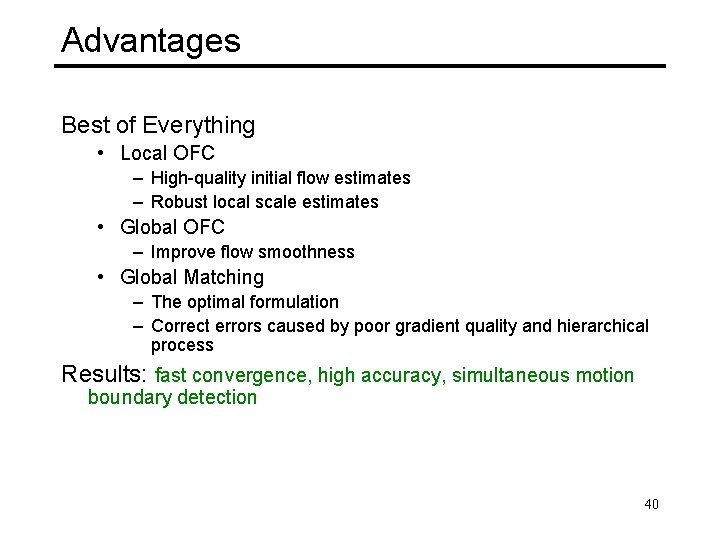
Advantages Best of Everything • Local OFC – High-quality initial flow estimates – Robust local scale estimates • Global OFC – Improve flow smoothness • Global Matching – The optimal formulation – Correct errors caused by poor gradient quality and hierarchical process Results: fast convergence, high accuracy, simultaneous motion boundary detection 40
Experiments • Experiments were run on several standard test videos. • Estimates of optical flow were made for the middle frame of every three. • The results were compared with the Black and Anandan algorithm. 41
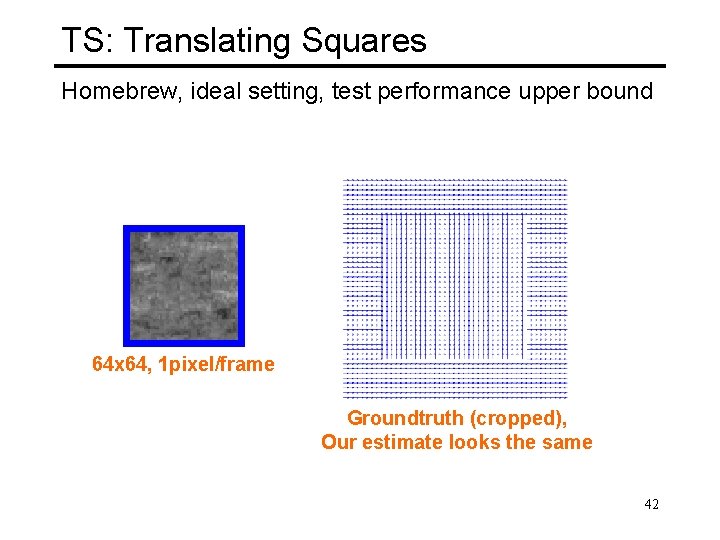
TS: Translating Squares Homebrew, ideal setting, test performance upper bound 64 x 64, 1 pixel/frame Groundtruth (cropped), Our estimate looks the same 42
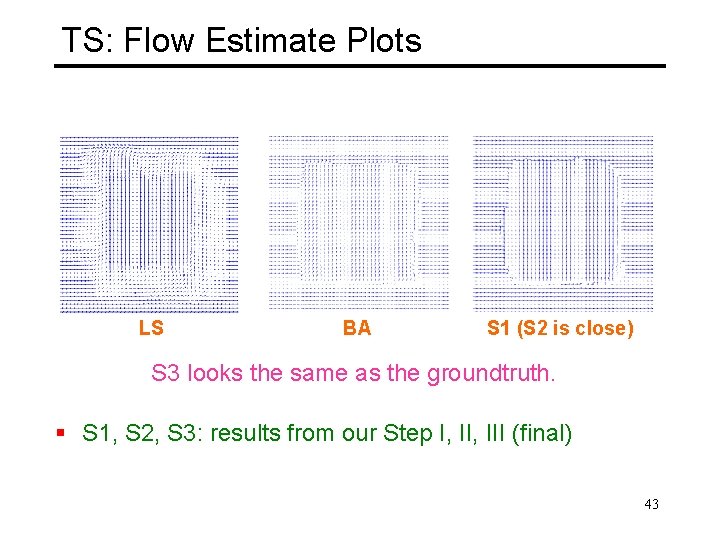
TS: Flow Estimate Plots LS BA S 1 (S 2 is close) S 3 looks the same as the groundtruth. § S 1, S 2, S 3: results from our Step I, III (final) 43
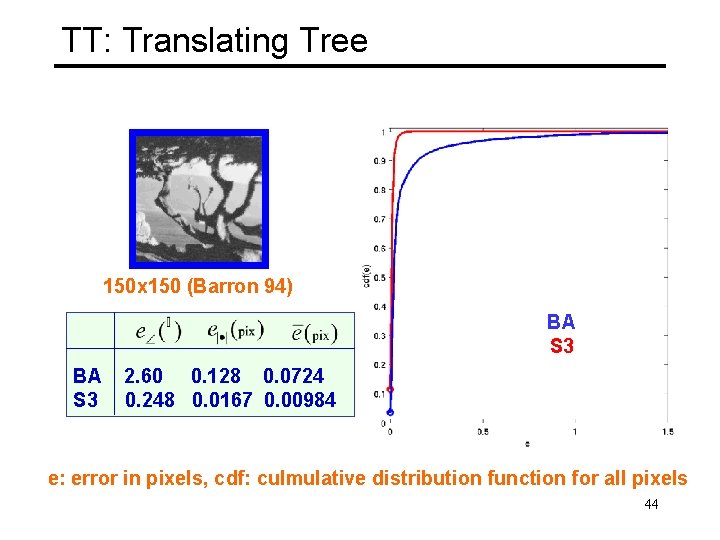
TT: Translating Tree 150 x 150 (Barron 94) BA S 3 2. 60 0. 128 0. 0724 0. 248 0. 0167 0. 00984 e: error in pixels, cdf: culmulative distribution function for all pixels 44
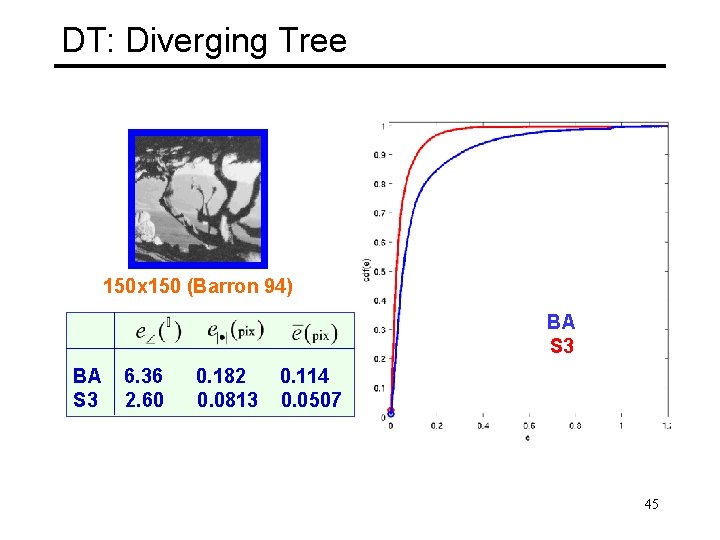
DT: Diverging Tree 150 x 150 (Barron 94) BA S 3 6. 36 2. 60 0. 182 0. 0813 0. 114 0. 0507 45
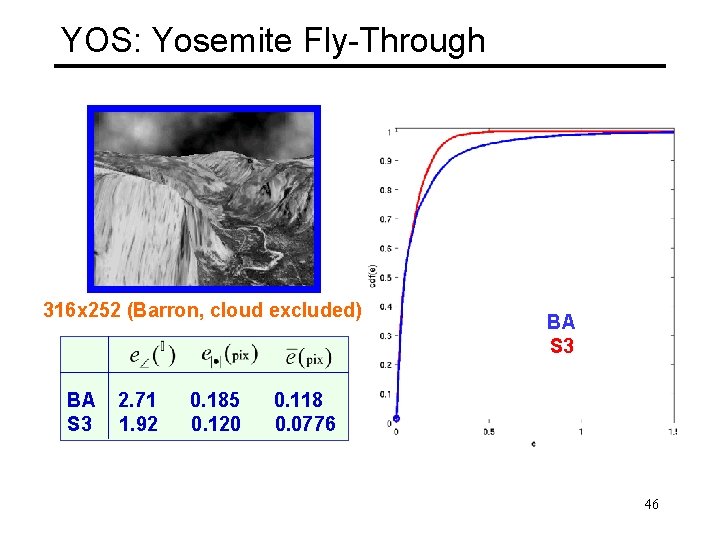
YOS: Yosemite Fly-Through 316 x 252 (Barron, cloud excluded) BA S 3 2. 71 1. 92 0. 185 0. 120 BA S 3 0. 118 0. 0776 46
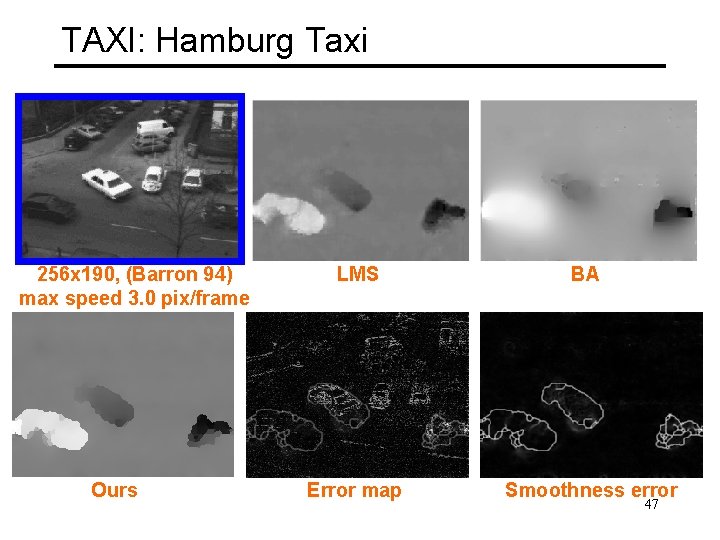
TAXI: Hamburg Taxi 256 x 190, (Barron 94) max speed 3. 0 pix/frame Ours LMS BA Error map Smoothness error 47
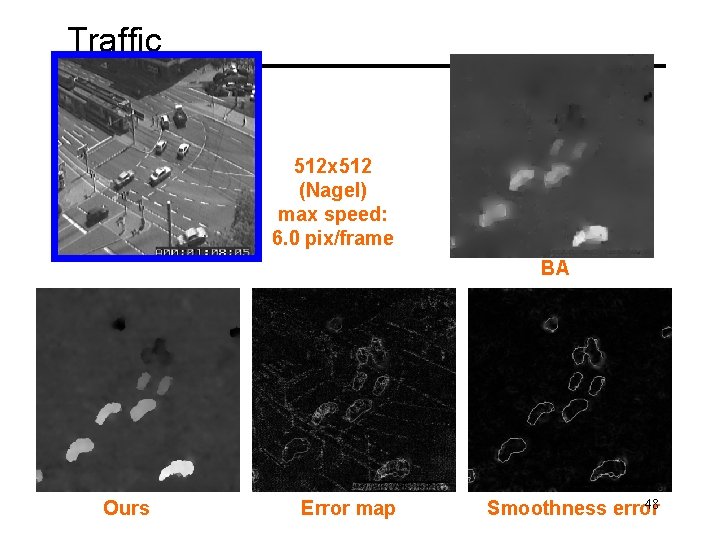
Traffic 512 x 512 (Nagel) max speed: 6. 0 pix/frame BA Ours Error map 48 Smoothness error
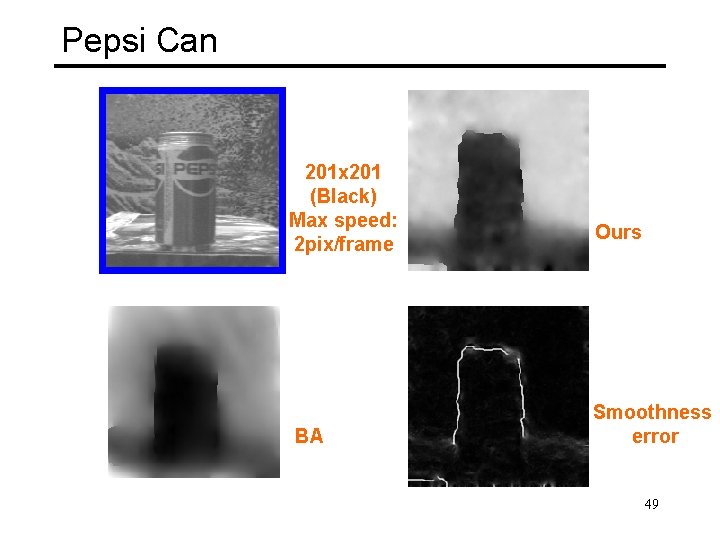
Pepsi Can 201 x 201 (Black) Max speed: 2 pix/frame BA Ours Smoothness error 49
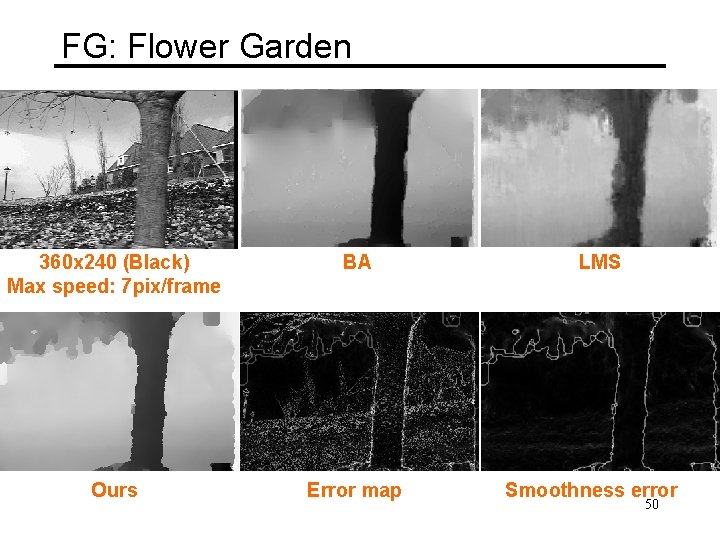
FG: Flower Garden 360 x 240 (Black) Max speed: 7 pix/frame BA Ours Error map LMS Smoothness error 50
- Slides: 50