
Motion Estimation I What affects the induced image






- Slides: 30
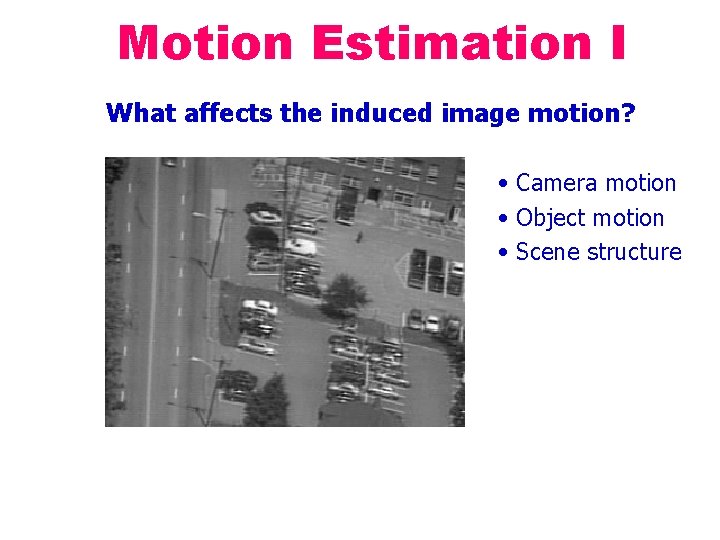
Motion Estimation I What affects the induced image motion? • Camera motion • Object motion • Scene structure
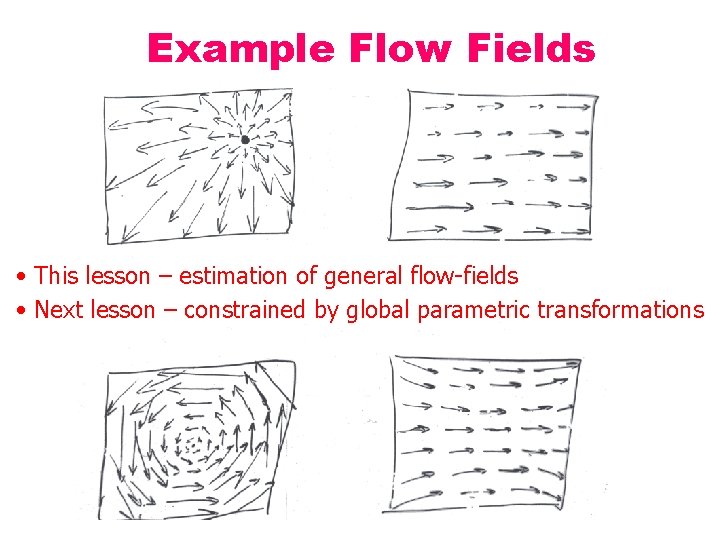
Example Flow Fields • This lesson – estimation of general flow-fields • Next lesson – constrained by global parametric transformations
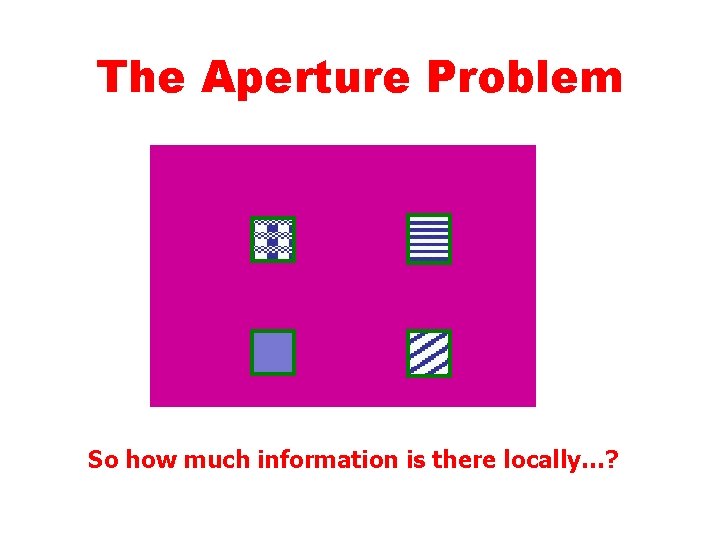
The Aperture Problem So how much information is there locally…?
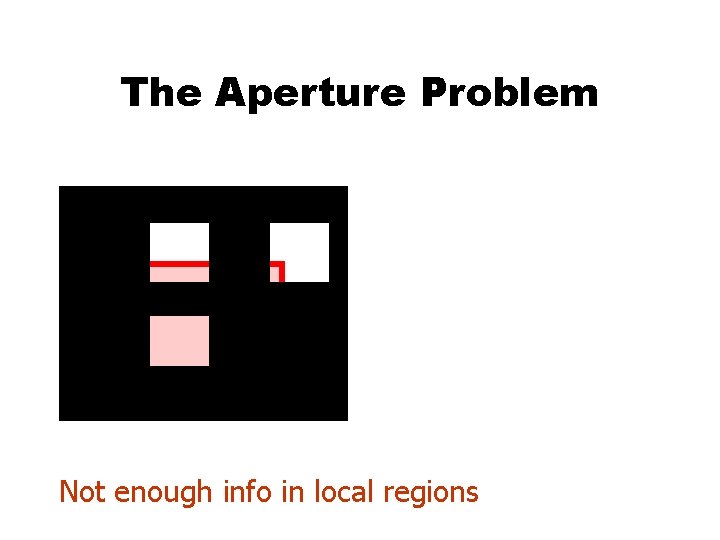
The Aperture Problem Not enough info in local regions Copyright, 1996 © Dale Carnegie & Associates, Inc.
The Aperture Problem Not enough info in local regions Copyright, 1996 © Dale Carnegie & Associates, Inc.
The Aperture Problem Copyright, 1996 © Dale Carnegie & Associates, Inc.
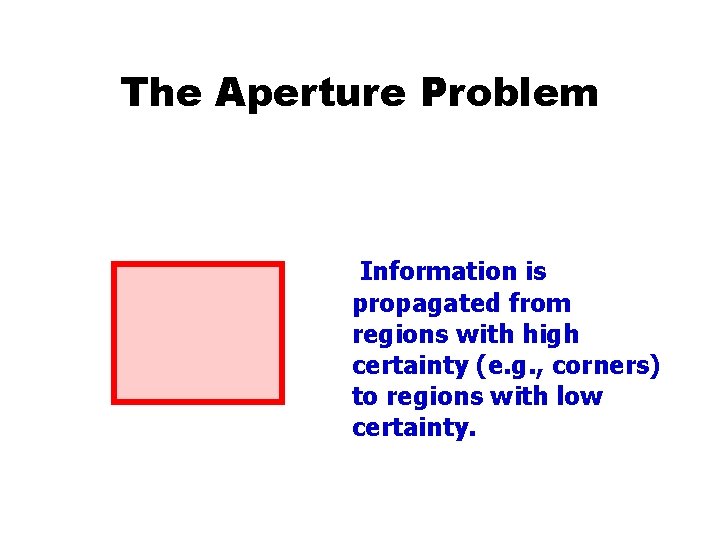
The Aperture Problem Information is propagated from regions with high certainty (e. g. , corners) to regions with low certainty. Copyright, 1996 © Dale Carnegie & Associates, Inc.
Such info propagation cause optical illusions… Illusory corners
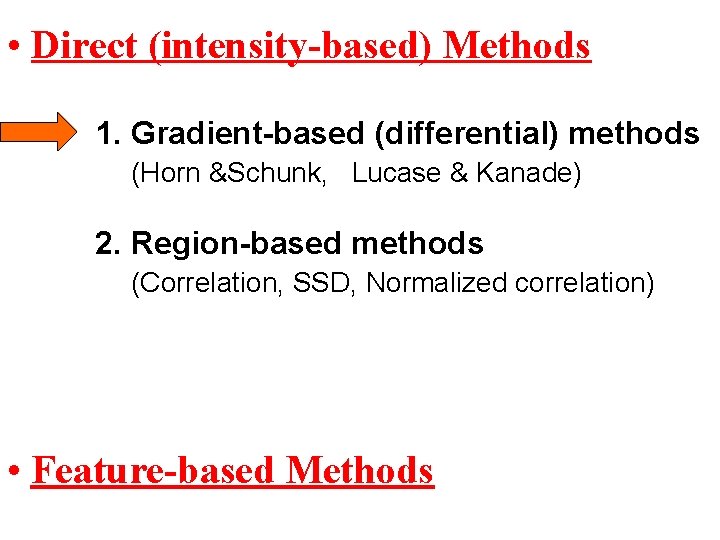
• Direct (intensity-based) Methods 1. Gradient-based (differential) methods (Horn &Schunk, Lucase & Kanade) 2. Region-based methods (Correlation, SSD, Normalized correlation) • Feature-based Methods
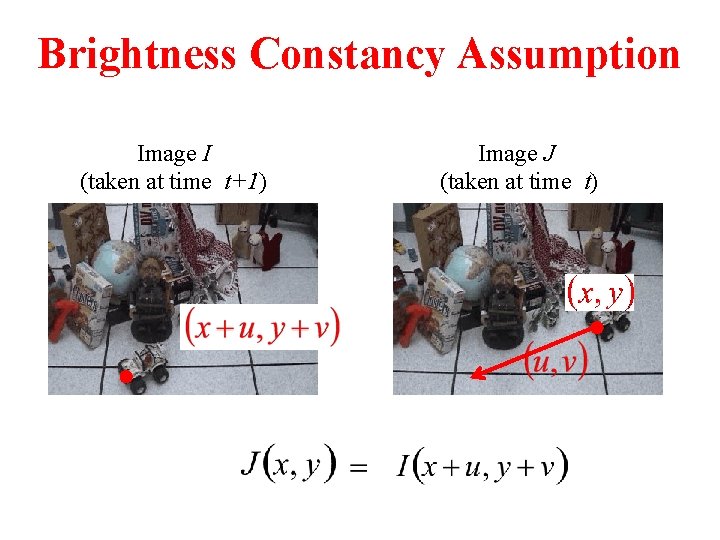
Brightness Constancy Assumption Image I (taken at time t+1) Image J (taken at time t)
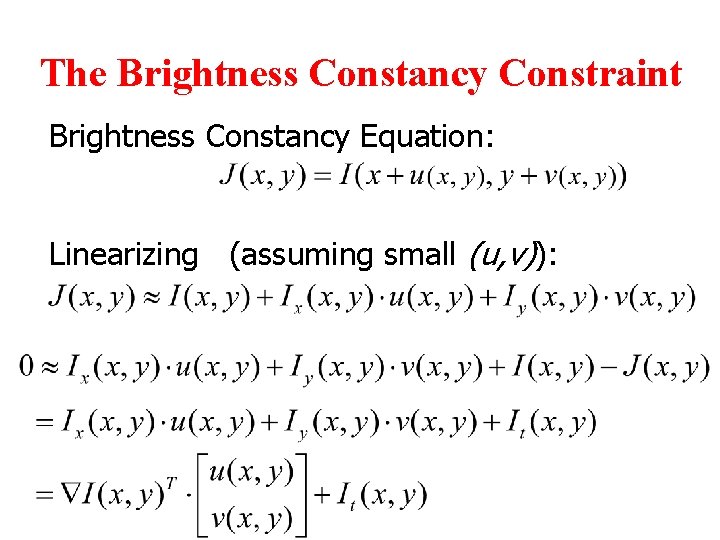
The Brightness Constancy Constraint Brightness Constancy Equation: Linearizing (assuming small (u, v)):
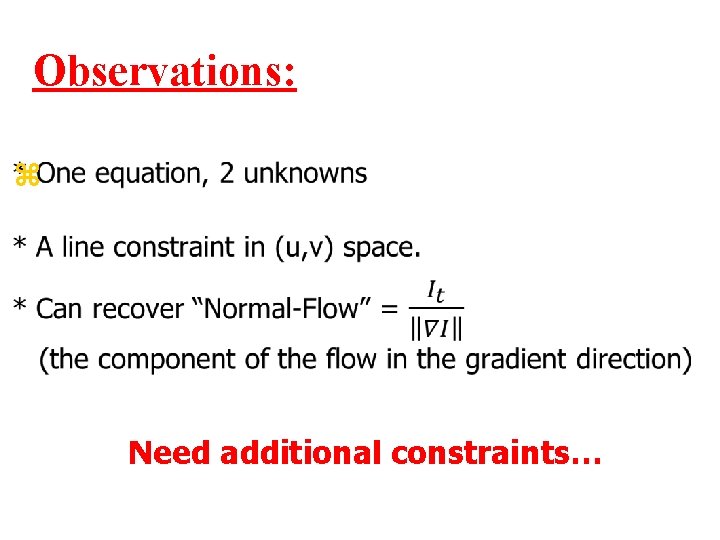
Observations: z Need additional constraints…
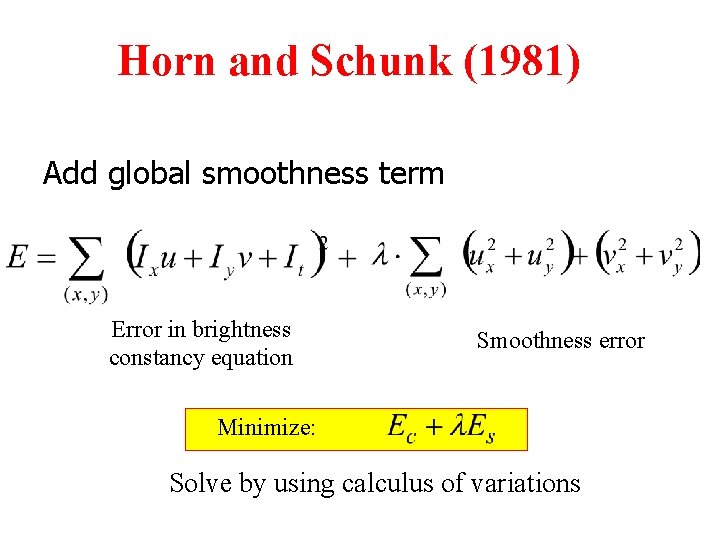
Horn and Schunk (1981) Add global smoothness term Error in brightness constancy equation Smoothness error Minimize: Solve by using calculus of variations
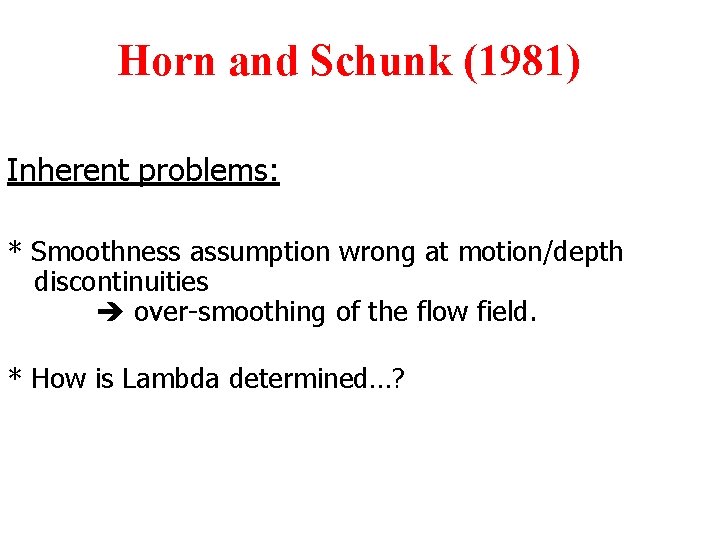
Horn and Schunk (1981) Inherent problems: * Smoothness assumption wrong at motion/depth discontinuities over-smoothing of the flow field. * How is Lambda determined…?
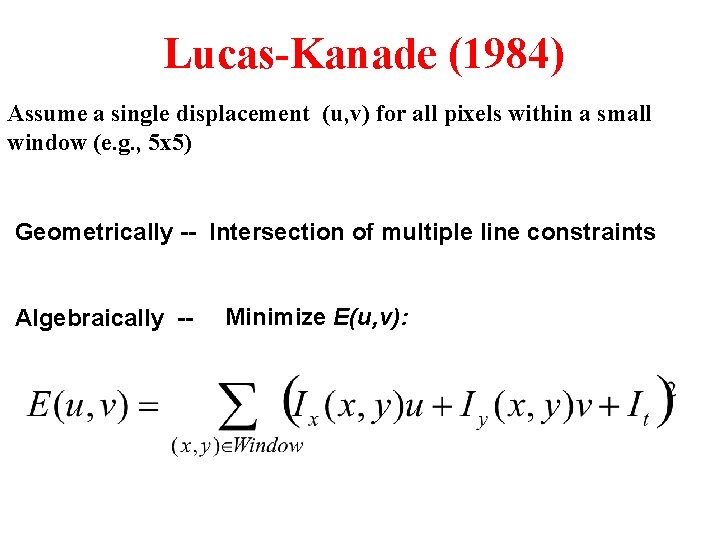
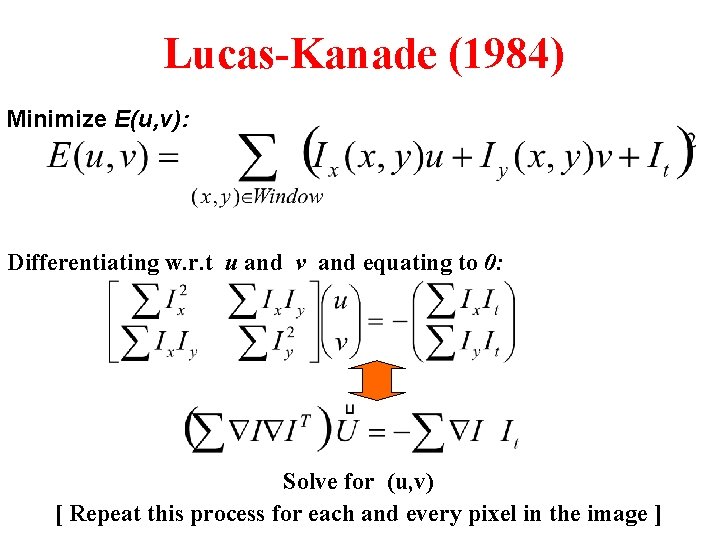
Lucas-Kanade (1984) Assume a single displacement (u, v) for all pixels within a small window (e. g. , 5 x 5) Geometrically -- Intersection of multiple line constraints Algebraically -- Minimize E(u, v):
Lucas-Kanade (1984) Minimize E(u, v): Differentiating w. r. t u and v and equating to 0: Solve for (u, v) [ Repeat this process for each and every pixel in the image ]
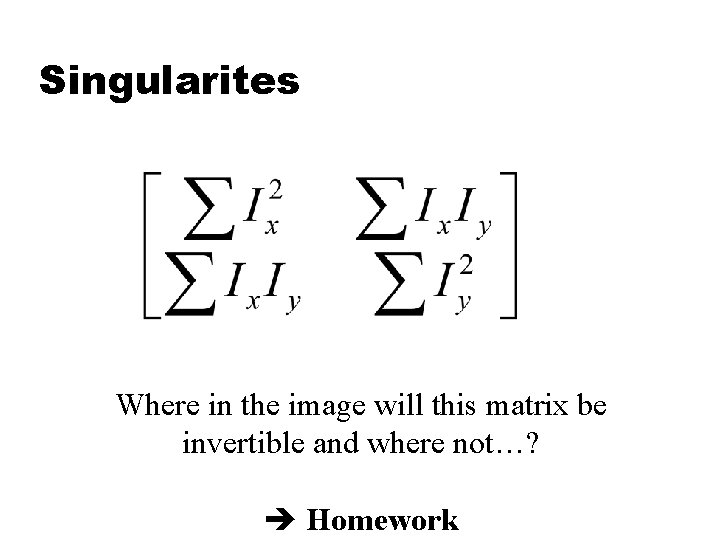
Singularites Where in the image will this matrix be invertible and where not…? Homework
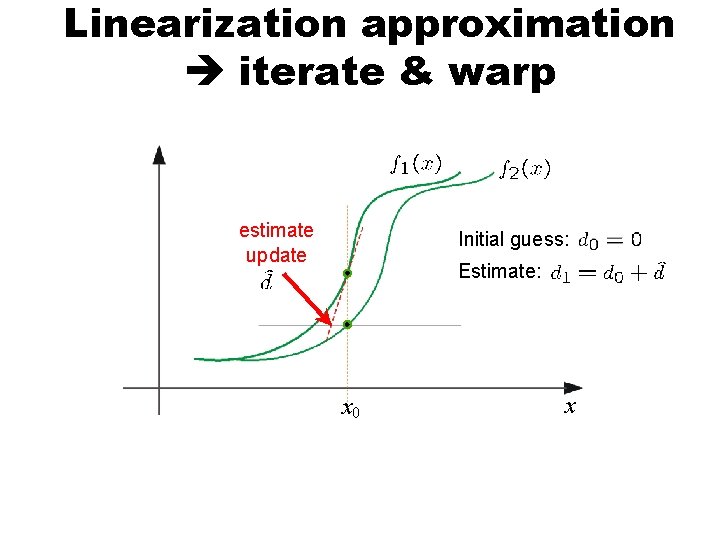
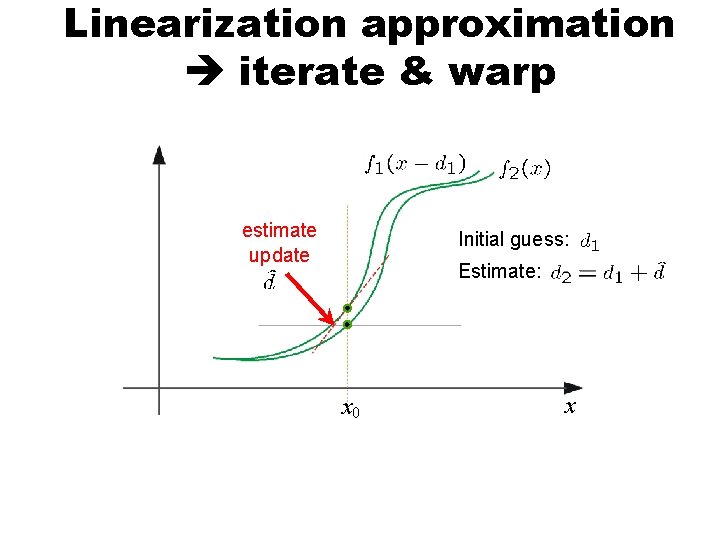
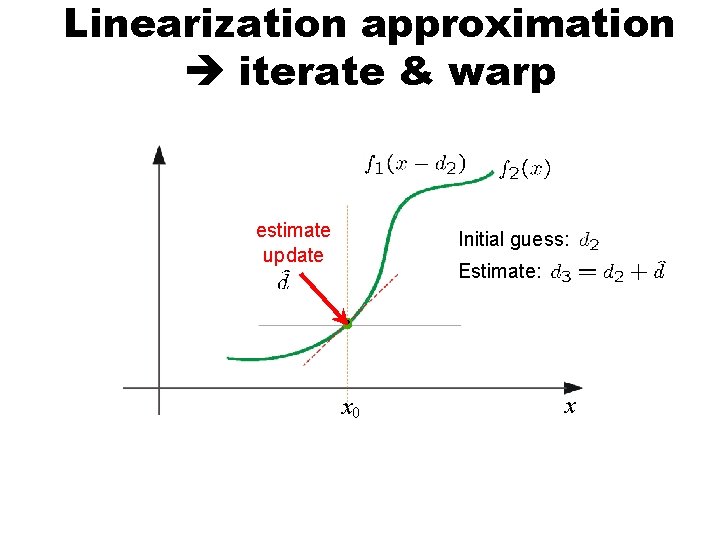
Linearization approximation iterate & warp estimate update Initial guess: Estimate: x 0 x
Linearization approximation iterate & warp estimate update Initial guess: Estimate: x 0 x
Linearization approximation iterate & warp estimate update Initial guess: Estimate: x 0 x
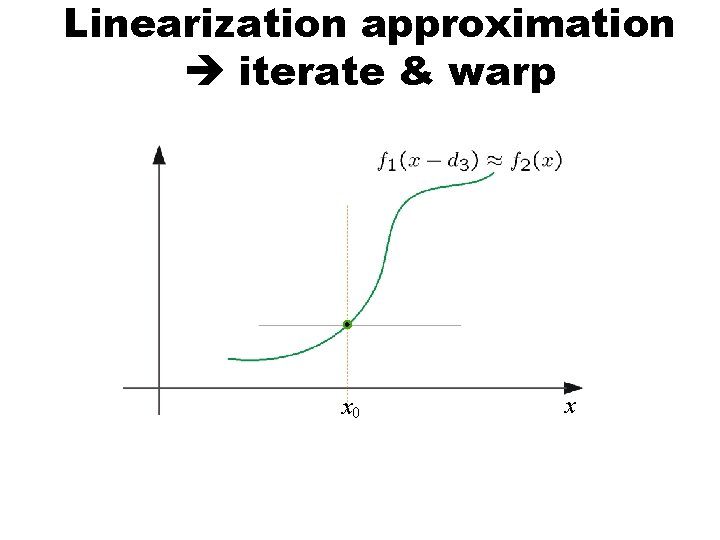
Linearization approximation iterate & warp x 0 x
Revisiting the small motion assumption Is this motion small enough? Probably not—it’s much larger than one pixel (2 nd order terms dominate) How might we solve this problem?
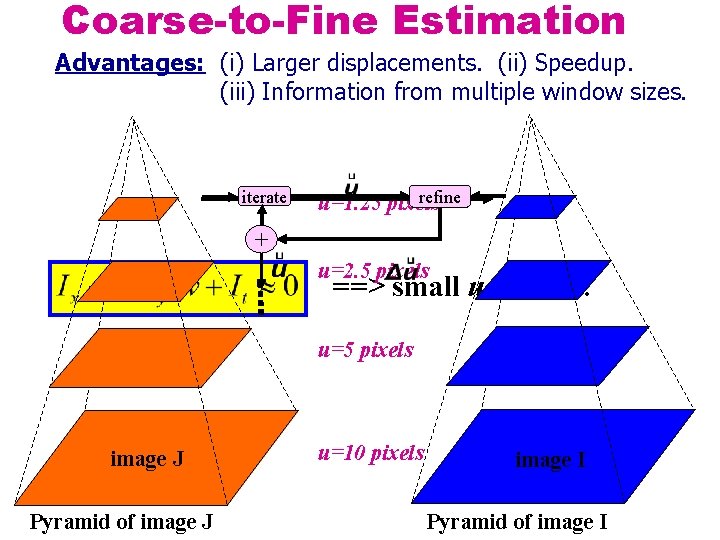
Coarse-to-Fine Estimation Advantages: (i) Larger displacements. (ii) Speedup. (iii) Information from multiple window sizes. iterate refine u=1. 25 pixels + u=2. 5 pixels ==> small u and v. . . u=5 pixels image J Pyramid of image J u=10 pixels image I Pyramid of image I
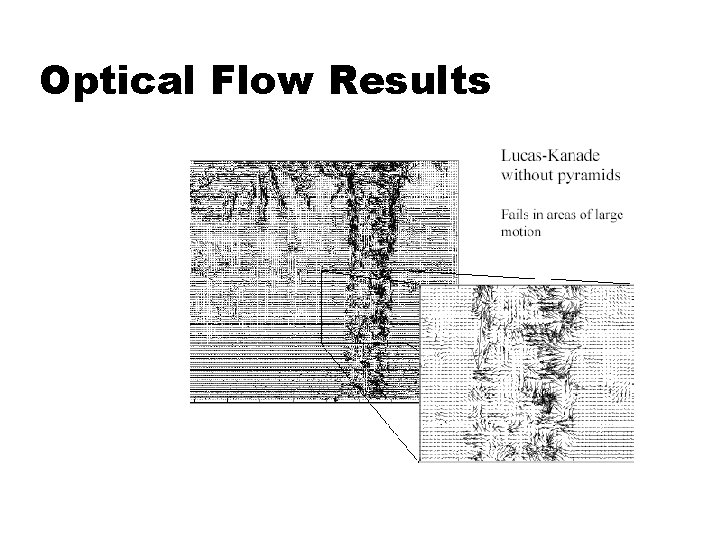
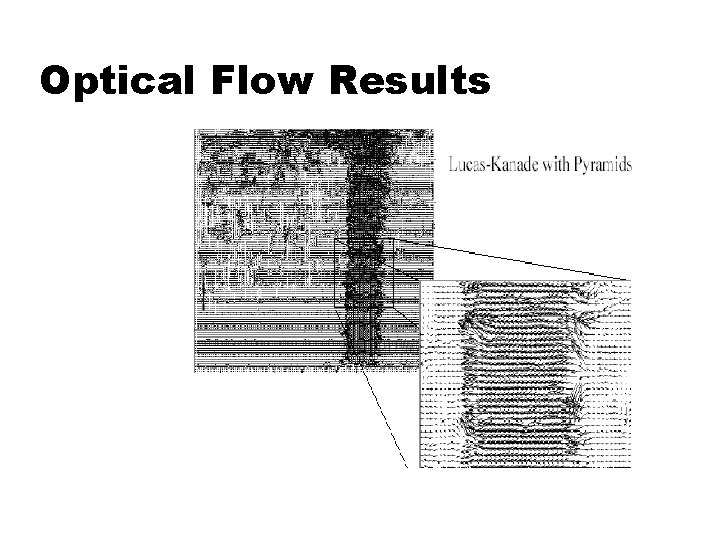
Optical Flow Results
Optical Flow Results
Lucas-Kanade (1984) Inherent problems: * Still smoothes motion discontinuities (but unlike Horn & Schunk, does not propagate error across the entire image) * Local singularities (due to the aperture problem) • Maybe increase the aperture (window) size…? • But no longer a single motion… Global parametric motion estimation – next week.
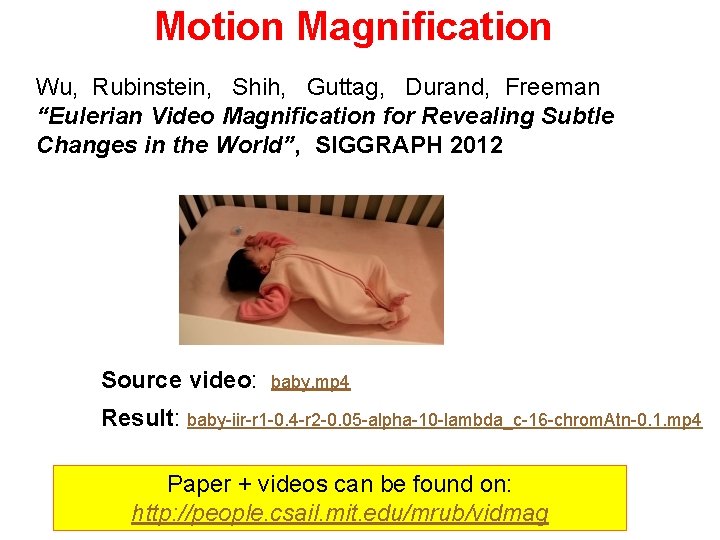
Motion Magnification Wu, Rubinstein, Shih, Guttag, Durand, Freeman “Eulerian Video Magnification for Revealing Subtle Changes in the World”, SIGGRAPH 2012 Source video: baby. mp 4 Result: baby-iir-r 1 -0. 4 -r 2 -0. 05 -alpha-10 -lambda_c-16 -chrom. Atn-0. 1. mp 4 Paper + videos can be found on: http: //people. csail. mit. edu/mrub/vidmag
Motion Magnification Could compute optical flow and magnify it But… very complicated (motions are almost invisible) Alternatively: But holds only for small u • s and v • s apply coarse to fine to generate larger motions
Motion Magnification What is equivalent to? This is equivalent to keeping the same temporal frequencies, but magnifying the amplitude (increase frequency coefficient). Can decide to do this selectively to specific temporal frequencies (e. g. , a range of frequencies of expected heart rates).
Motion Magnification Wu, Rubinstein, Shih, Guttag, Durand, Freeman “Eulerian Video Magnification for Revealing Subtle Changes in the World”, SIGGRAPH 2012 Paper + videos can be found on: http: //people. csail. mit. edu/mrub/vidmag A simplified version of this work the next programming exercise • Exercise will be posted within a few days • Meanwhile, please read SIGGRAPH’ 2012 paper