
MOTION AND SPEED Chapter 10 MOTION All matter




- Slides: 22
MOTION AND SPEED Chapter 10
MOTION • All matter in the universe is constantly in motion. • Examples: 1) Earth revolves around the sun. 2) Electrons move around the nucleus. 3) Blood circulates through your body. 4) Lava flows from a volcano.
MOTION • Motion is……. – Something that is moving or has movement • An object is in motion when it’s changing position relative to a reference point OR it’s distance from another object is changing
FRAME OF REFERENCE • A FRAME OF REFERENCE is the stationary point / area / or object that is used as a comparison. What is your frame of reference for the cheerleader and baseball player?
Most Common…. . • What are the most common frames of reference? THE SUN AND THE EARTH!
MEMORY REFRESHER!! • What SI units are used to describe length or distance? The basic SI unit of length is the meter.
Distance and Displacement • Distance is the total length of travel between a starting point and ending point. • Displacement includes the distance between a starting point and ending point AND the direction in which you travel. Distance = 40 m Displacement = 40 m east Distance = 70 m Displacement = 50 m northeast Distance = 140 m Displacement = 0
SPEED! SPEED IS: The distance an object travels in one unit of time.
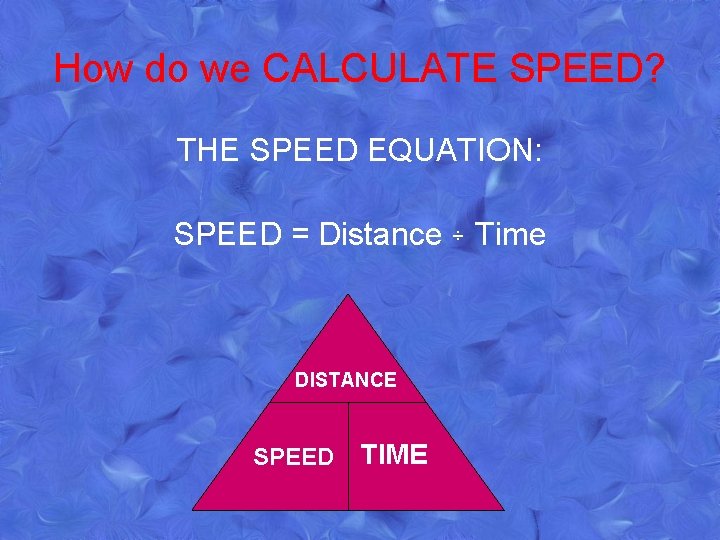
How do we CALCULATE SPEED? THE SPEED EQUATION: SPEED = Distance ÷ Time DISTANCE SPEED TIME
PRACTICE PROBLEM COMPLETE PRACTICE PROBLEMS A, B, and C on pages 2 and 3 in Packet
TWO TYPES OF SPEED There are two types of speed: Instantaneous Speed and Average Speed • Instantaneous Speed: The speed of an object at one instant of time. – Can you think of an example? • Average Speed: Found when speed is changing by dividing the total distance traveled by the total time taken. – Can you think of an example?
AVERAGE SPEED • Complete AVERAGE SPEED SAMPLE PROBLEM on Page 3 of packet!
Look at the Constant Speed graph…. • How do you know this dog is running at a “constant” speed? DISTANCE – Straight line TIME
• What’s happening in the graph? At a? At b? At c? DISTANCE Look at the Average Speed Graph a b c • A – moving TIME at a constant speed • B – not moving • C – moving at a constant speed
VELOCITY • Velocity is speed in a given direction! • What are some examples of direction? Example: A river is flowing South at 15 km / hr. Velocity = Speed + Direction Velocity = 15 km/hr + South Velocity = 15 km/hr South Complete #13 A & B Velocity Examples
Combining Velocities USE ADDITION AND SUBTRACTION Same Directions ADD the velocities. Opposite Directions SUBTRACT the velocities.
COMBINING VELOCITIES Sample problems page 5 in packet Complete #15; A, B, and C
SO, What is ACCELERATION? • Acceleration is the RATE AT WHICH VELOCITY CHANGES!! • The process of speeding up or slowing down!
Quick Review • Velocity has two components: 1) SPEED 2) DIRECTION
Acceleration Therefore, in science, acceleration refers to three things: 1) Increasing Speed 2) Decreasing Speed 3) Changing Direction
Circular Motion Is the moon accelerating? YES Explain circular motion: Circular Motion – is acceleration because you are constantly changing direction.
Circular Motion Is the ferris wheel accelerating? YES