
Motion and Scene Complexity for Streaming Video Games

- Slides: 25
Motion and Scene Complexity for Streaming Video Games Mark Claypool Computer Science Department Worcester Polytechnic Institute Worcester, Massachusetts, USA http: //www. cs. wpi. edu/~claypool/papers/game-motion/
Introduction • • • Growth: – Networks – high bandwidth to the home – Thin clients – Remote Desktop, Google Desktop – Online games Opportunity: – Heavyweight, “fat” server hosting game – Stream game as interactive video over network – Played on a lightweight, thin client Motivation: – Rendering game that requires data and specialized hardware not at client • Sony Remote Play, and On. Live – Augmented reality - physical world enhanced by thin, wearable computers (i. e. head-mounted displays) – Ease of implementation and maintenance FDG, Orlando, FL, USA 2 April 2009
Application Streams vs. Game Streams • Typical thin client applications: – Relatively casual interaction • i. e. typing or mouse clicking – Infrequent display updates • i. e. character updates or scrolling text • Computer games: – Intense interaction • i. e. avatar movement and shooting – Frequently changing displays • i. e. 360 degree panning FDG, Orlando, FL, USA 3 April 2009
Games as Streaming Video • • • High bandwidth – push limits of graphics – Need efficient compression – – – High motion needs quality scaling Low motion needs temporal scaling Getting it “right” improves perceived quality by as much as 50% Adapting traditional video to network motion and scene complexity crucial to maximize quality To stream games as video, need: 1. Standard measures of motion and scene complexity 2. Streaming game videos as benchmarks 3. Understanding how current thin tech is limited FDG, Orlando, FL, USA 4 April 2009
Outline • Introduction • Motion and Scene Complexity • Game Perspectives • Methodology • Analysis • Conclusions FDG, Orlando, FL, USA 5 (done) (next) April 2009
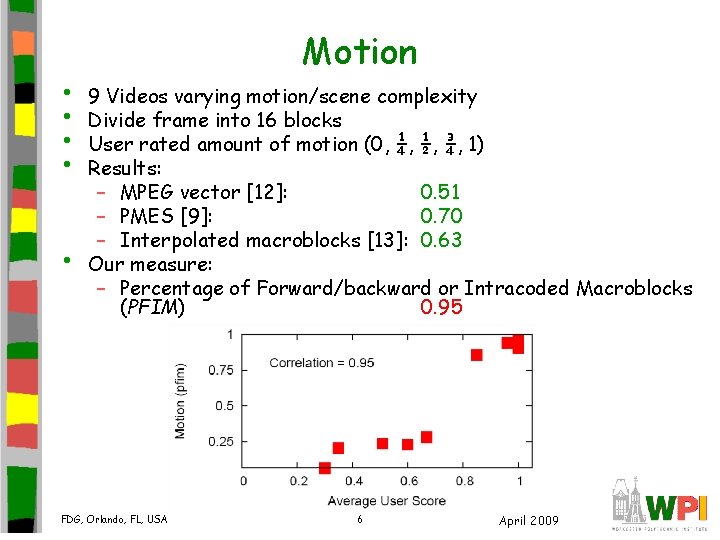
• • • Motion 9 Videos varying motion/scene complexity Divide frame into 16 blocks User rated amount of motion (0, ¼, ½, ¾, 1) Results: – MPEG vector [12]: 0. 51 – PMES [9]: 0. 70 – Interpolated macroblocks [13]: 0. 63 Our measure: – Percentage of Forward/backward or Intracoded Macroblocks (PFIM) 0. 95 FDG, Orlando, FL, USA 6 April 2009
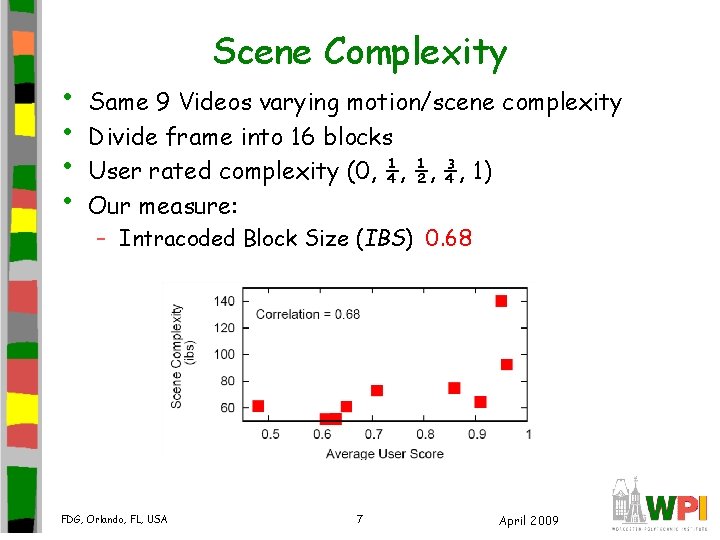
• • Scene Complexity Same 9 Videos varying motion/scene complexity Divide frame into 16 blocks User rated complexity (0, ¼, ½, ¾, 1) Our measure: – Intracoded Block Size (IBS) 0. 68 FDG, Orlando, FL, USA 7 April 2009
Outline • Introduction • Motion and Scene Complexity • Game Perspectives • Methodology • Analysis • Conclusions FDG, Orlando, FL, USA 8 (done) (next) April 2009
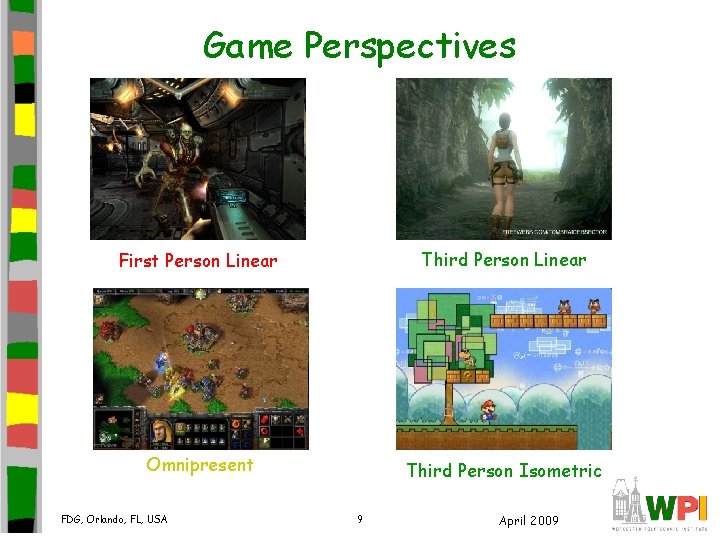
Game Perspectives First Person Linear Third Person Linear Omnipresent Third Person Isometric FDG, Orlando, FL, USA 9 April 2009
Outline • Introduction • Motion and Scene Complexity • Game Perspectives • Methodology • Analysis • Conclusions FDG, Orlando, FL, USA 10 (done) (next) April 2009
Methodology • Select Games • Record Traces • Select Videos • Analyze Data • Evaluate Thin Clients FDG, Orlando, FL, USA 11 April 2009
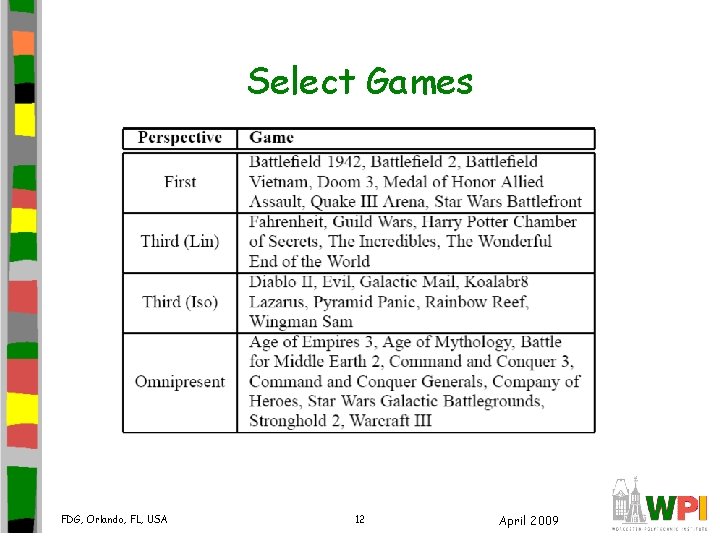
Select Games FDG, Orlando, FL, USA 12 April 2009
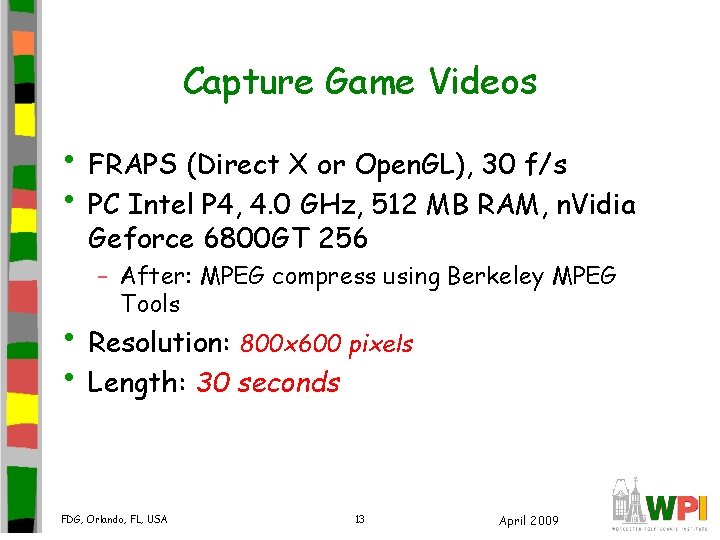
Capture Game Videos • FRAPS (Direct X or Open. GL), 30 f/s • PC Intel P 4, 4. 0 GHz, 512 MB RAM, n. Vidia Geforce 6800 GT 256 – After: MPEG compress using Berkeley MPEG Tools • Resolution: 800 x 600 pixels • Length: 30 seconds FDG, Orlando, FL, USA 13 April 2009
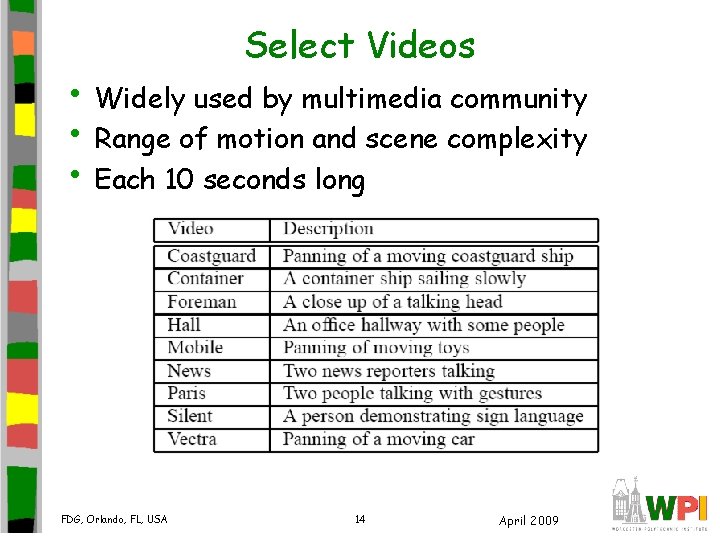
Select Videos • Widely used by multimedia community • Range of motion and scene complexity • Each 10 seconds long FDG, Orlando, FL, USA 14 April 2009
Outline • Introduction • Motion and Scene Complexity • Game Perspectives • Methodology • Analysis (done) – Motion and Scene Complexity – Thin Clients (next) • Conclusions FDG, Orlando, FL, USA 15 April 2009
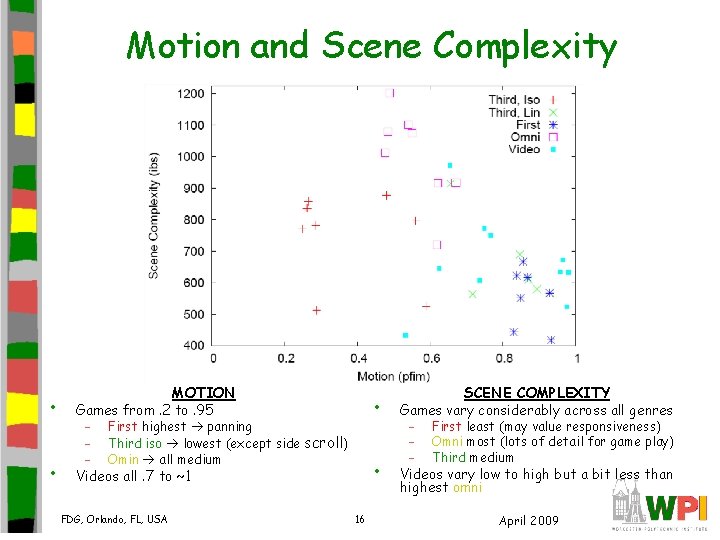
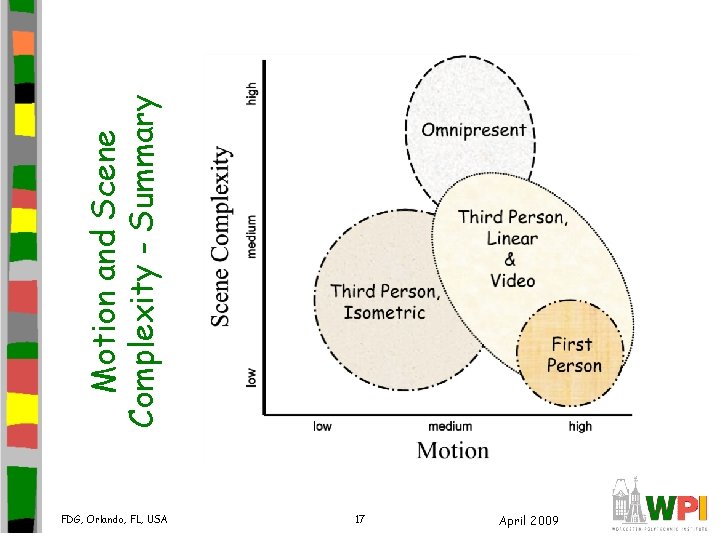
Motion and Scene Complexity • • MOTION Games from. 2 to. 95 – First highest panning – Third iso lowest (except side scroll) – Omin all medium Videos all. 7 to ~1 FDG, Orlando, FL, USA • • 16 SCENE COMPLEXITY Games vary considerably across all genres – First least (may value responsiveness) – Omni most (lots of detail for game play) – Third medium Videos vary low to high but a bit less than highest omni April 2009
FDG, Orlando, FL, USA 17 April 2009 Motion and Scene Complexity - Summary
Outline • Introduction • Motion and Scene Complexity • Game Perspectives • Methodology • Analysis (done) – Motion and Scene Complexity – Thin Clients (done) (next) • Conclusions FDG, Orlando, FL, USA 18 April 2009
Thin Client Evaluation • Brief look at performance issues with current thin -client technology – Microsoft’s Terminal Services (RDP) – No. Machine’s NX client (for Windows) – Specialized technology future work • • • Win XP laptop, Intel M 2. 26 Gh. Z, 2 GB RAM, n. Video Ge. Force GO 6400 w/64 MB Wireless, 802. 11 g Use Video. LAN VLC media player • Wireshark – Reports frame statistic – Network traces FDG, Orlando, FL, USA 19 April 2009
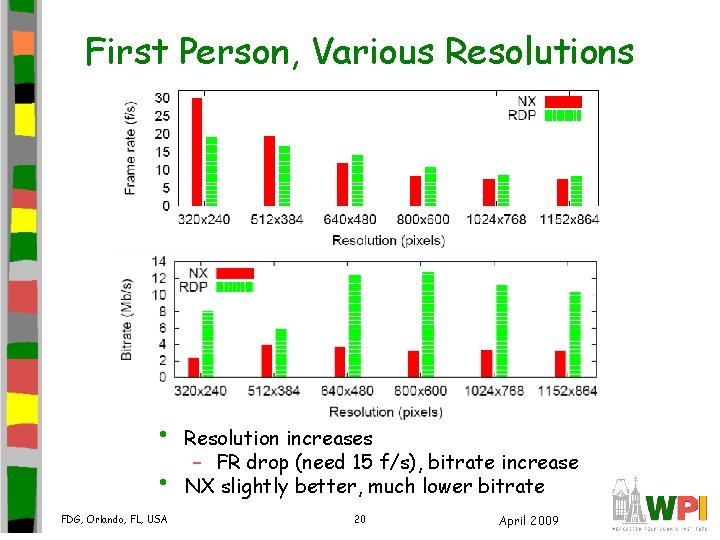
First Person, Various Resolutions • • FDG, Orlando, FL, USA Resolution increases – FR drop (need 15 f/s), bitrate increase NX slightly better, much lower bitrate 20 April 2009
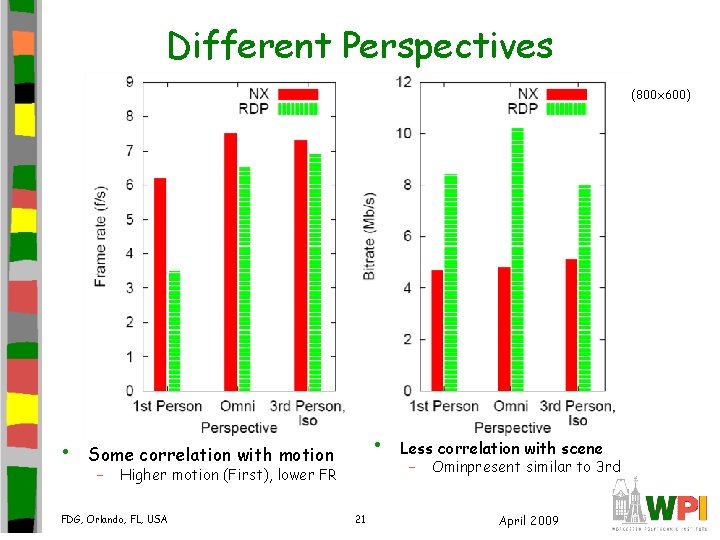
Different Perspectives (800 x 600) • • Some correlation with motion – Higher motion (First), lower FR FDG, Orlando, FL, USA 21 Less correlation with scene – Ominpresent similar to 3 rd April 2009
Contributions • Novel metrics of motion and scene complexity – IBS and PFIM • 29 game videos public benchmark –. avi and. mpg – Scripts for PFIM and IBS • Preliminary evaluation of thin clients FDG, Orlando, FL, USA 22 April 2009
Conclusions 1. Video encoding characteristics (IBS and PFIM) capture perceived motion and scene complexity 2. Motion and scene complexity vary considerably across games – Perspective impacts both – First person higher motion, while third iso least 3. Motion and scene complexity for games different than for video – Games have broader range, and omni more complex 4. Streaming video games possible, but only for low motion and low resolution – Bitrates higher than most residential broadband, but ok for LAN FDG, Orlando, FL, USA 23 April 2009
Future Work • Game-specific thin clients – Sony Remote Play – Onlive • Latency FDG, Orlando, FL, USA 24 April 2009
Motion and Scene Complexity for Streaming Video Games Mark Claypool Computer Science Department Worcester Polytechnic Institute Worcester, Massachusetts, USA http: //www. cs. wpi. edu/~claypool/papers/game-motion/