
Most commonly spoke language This interesting map comes
- Slides: 13
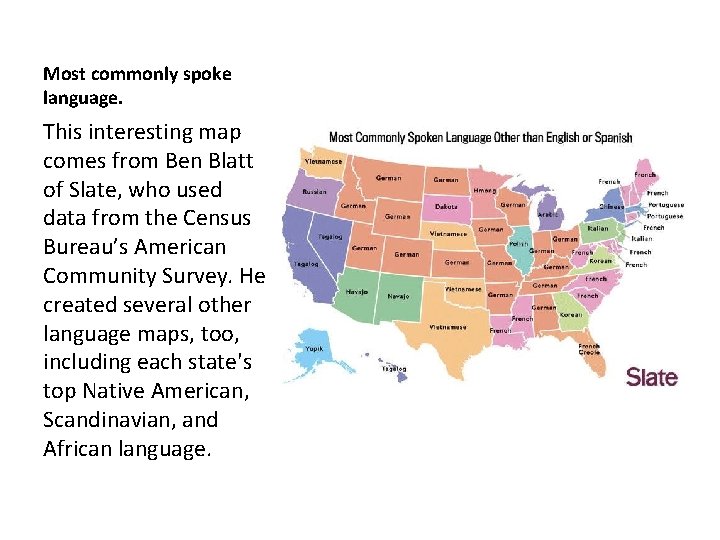
Most commonly spoke language. This interesting map comes from Ben Blatt of Slate, who used data from the Census Bureau’s American Community Survey. He created several other language maps, too, including each state's top Native American, Scandinavian, and African language.
Frage des Tages • Was bedeutet GANZ DOLL? a) Ganz toll. b) Sehr.
Objective • Students will be able to change weak verbs from present tense to the Perfekt and Imperfekt with a 70% accuracy rate. Students will be able to identify adjectives and adverbs and distinguish between the two.
Comparison of Adjectives/Adverbs • An adjective modifies a noun. An adverb modifies a verb. There are 2 levels: Comparative and Superlative fast schnell faster schneller (comparative) fastest schnellste/am schnellsten (superlative) Das schnelle Auto. (fast describes the car therefor you are modifying the noun) Das schnellere Auto. Das schnellste Auto.
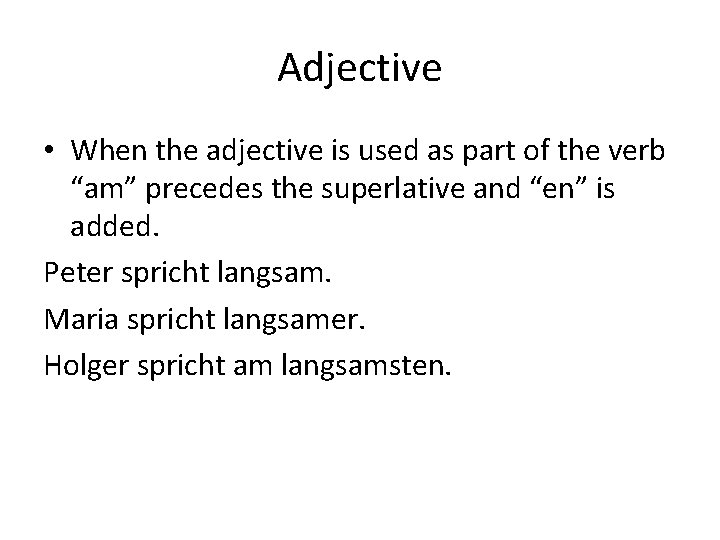
Adjective • When the adjective is used as part of the verb “am” precedes the superlative and “en” is added. Peter spricht langsam. Maria spricht langsamer. Holger spricht am langsamsten.
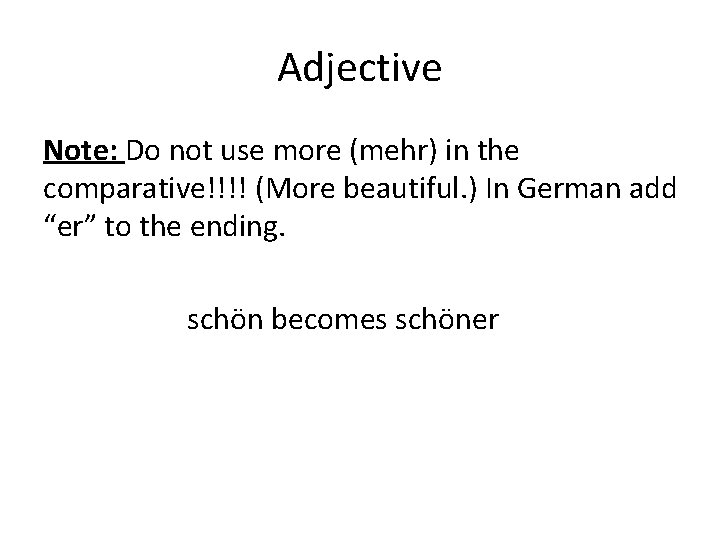
Adjective Note: Do not use more (mehr) in the comparative!!!! (More beautiful. ) In German add “er” to the ending. schön becomes schöner
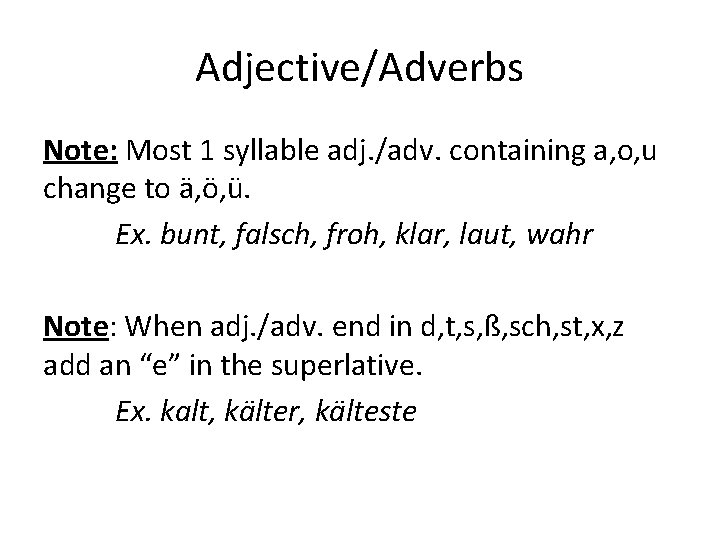
Adjective/Adverbs Note: Most 1 syllable adj. /adv. containing a, o, u change to ä, ö, ü. Ex. bunt, falsch, froh, klar, laut, wahr Note: When adj. /adv. end in d, t, s, ß, sch, st, x, z add an “e” in the superlative. Ex. kalt, kälter, kälteste
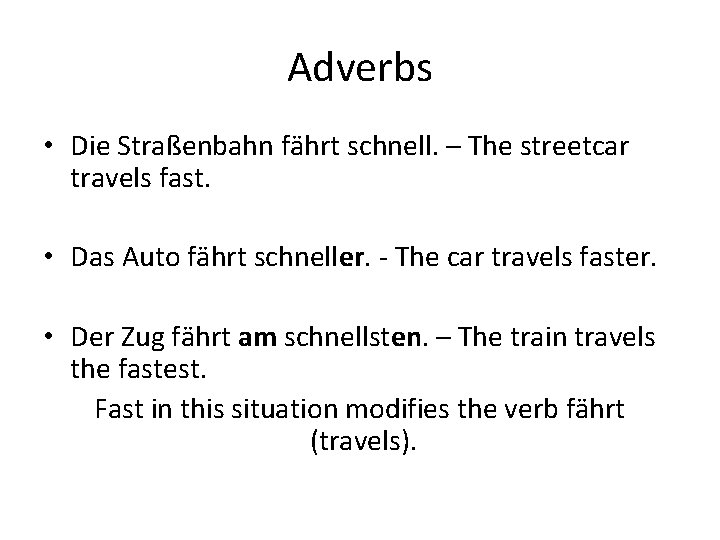
Adverbs • Die Straßenbahn fährt schnell. – The streetcar travels fast. • Das Auto fährt schneller. - The car travels faster. • Der Zug fährt am schnellsten. – The train travels the fastest. Fast in this situation modifies the verb fährt (travels).
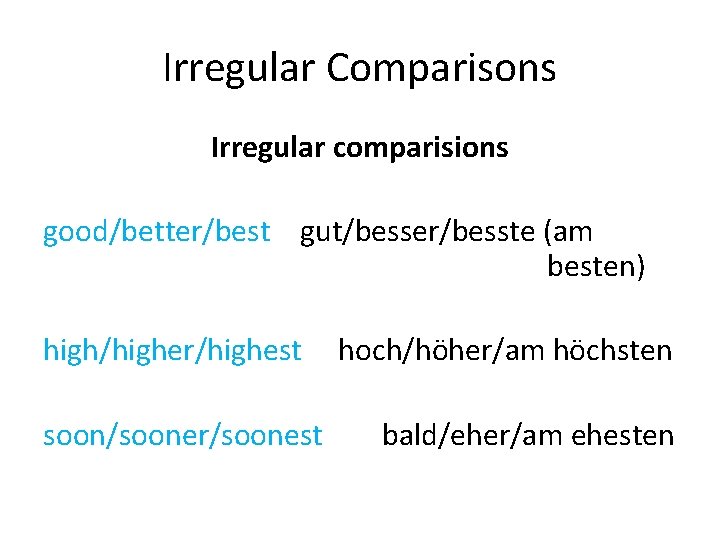
Irregular Comparisons Irregular comparisions good/better/best gut/besser/besste (am besten) high/higher/highest soon/sooner/soonest hoch/höher/am höchsten bald/eher/am ehesten
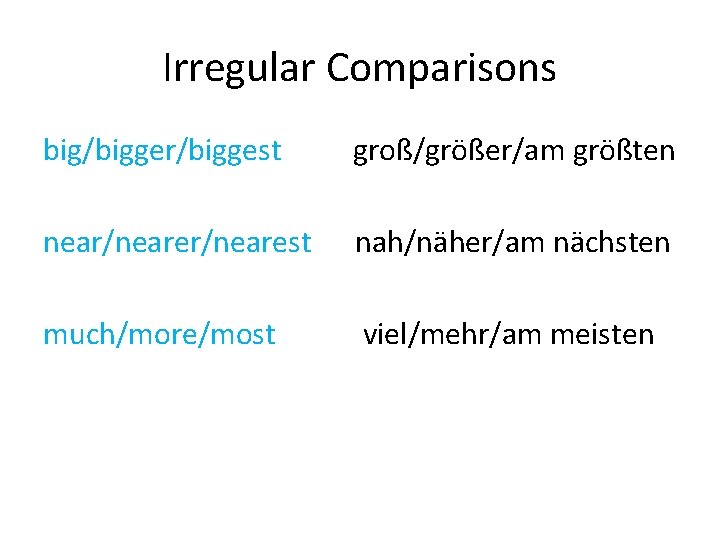
Irregular Comparisons big/bigger/biggest groß/größer/am größten near/nearest nah/näher/am nächsten much/more/most viel/mehr/am meisten
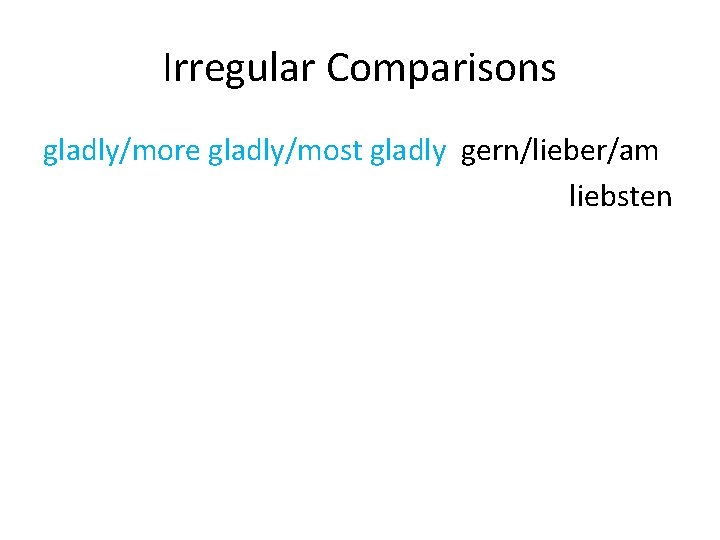
Irregular Comparisons gladly/more gladly/most gladly gern/lieber/am liebsten
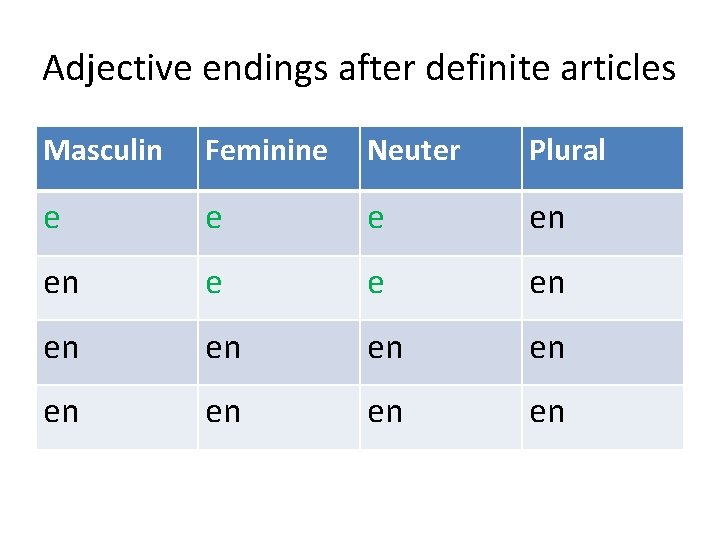
Adjective endings after definite articles Masculin Feminine Neuter Plural e en en en en en
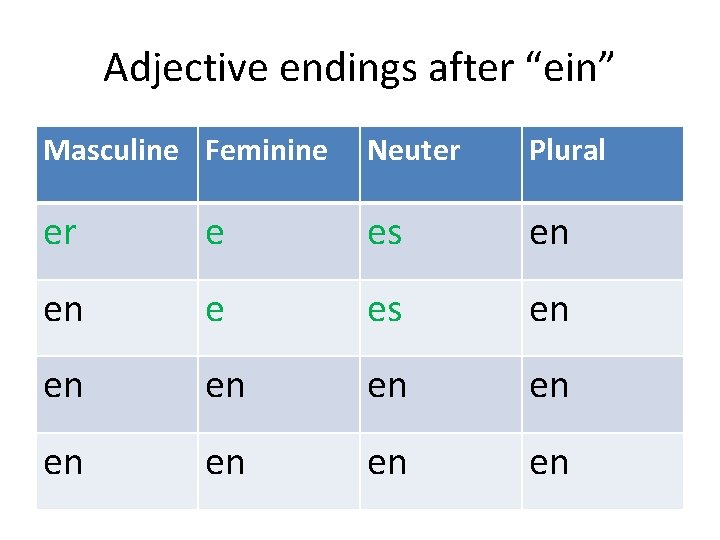
Adjective endings after “ein” Masculine Feminine Neuter Plural er e es en en en