
Mosaicking ATNF Synthesis Workshop Erwin de Blok ATNF
Mosaic(k)ing ATNF Synthesis Workshop Erwin de Blok ATNF Synthesis Workshop
Overview v. Why mosaicking? v. Different Approaches v. Mosaicking in Practice v. Mosaicking at ATCA ATNF Synthesis Workshop
Why Mosaicing? v. Source larger than primary beam: > /D o not limited by primary beam size v. Source structure at large scales: > /bmin o better uv coverage ATNF Synthesis Workshop
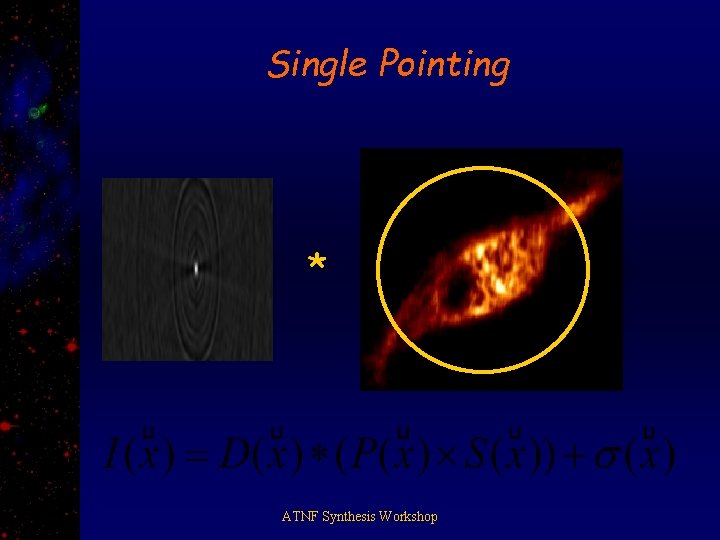
Single Pointing * ATNF Synthesis Workshop
Mosaicing: Individual Approach v Observe single pointings v Reduce them separately v “Stitch” images together v Disadvantages: o o Deconvolution non-linear (cleaning bowl) Overlap regions noisy (primary beam shape) Expensive in observing time Does not use all uv information v OK for high-res where source << field ATNF Synthesis Workshop
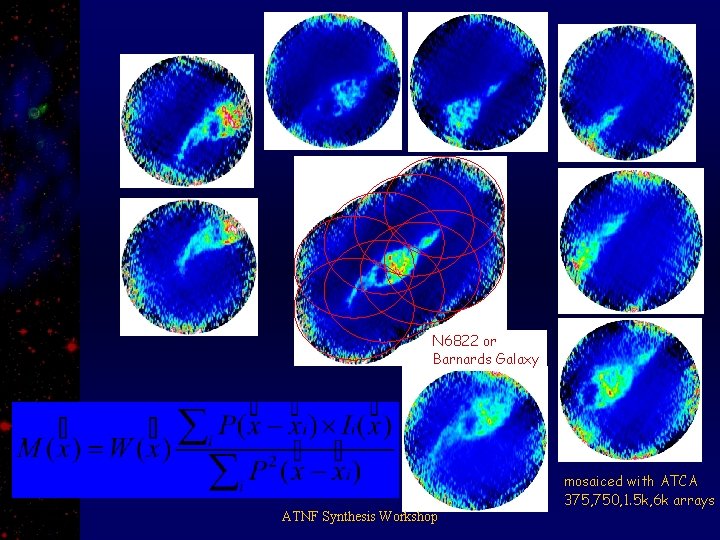
N 6822 or Barnards Galaxy mosaiced with ATCA 375, 750, 1. 5 k, 6 k arrays ATNF Synthesis Workshop
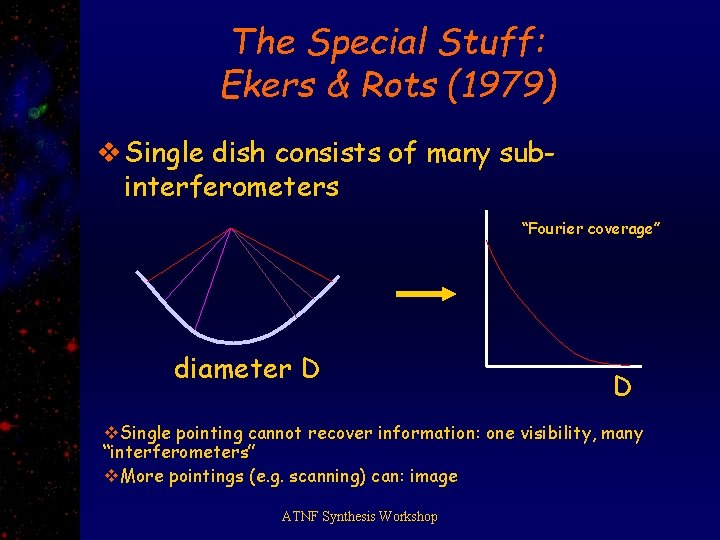
The Special Stuff: Ekers & Rots (1979) v Single dish consists of many subinterferometers “Fourier coverage” diameter D D v. Single pointing cannot recover information: one visibility, many “interferometers” v. More pointings (e. g. scanning) can: image ATNF Synthesis Workshop
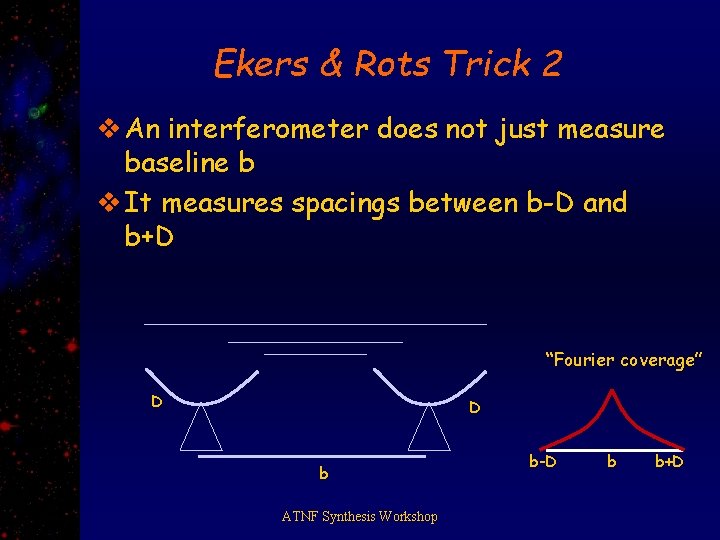
Ekers & Rots Trick 2 v An interferometer does not just measure baseline b v It measures spacings between b-D and b+D “Fourier coverage” D D b ATNF Synthesis Workshop b-D b b+D
Ekers & Rots 3 v Again, one pointing cannot recover this information (individual approach) v Many pointing together can recover this “extra” coverage (joint approach) Þ Use all uv data from all pointings simultaneously: better uv-coverage, better beam, better image ATNF Synthesis Workshop
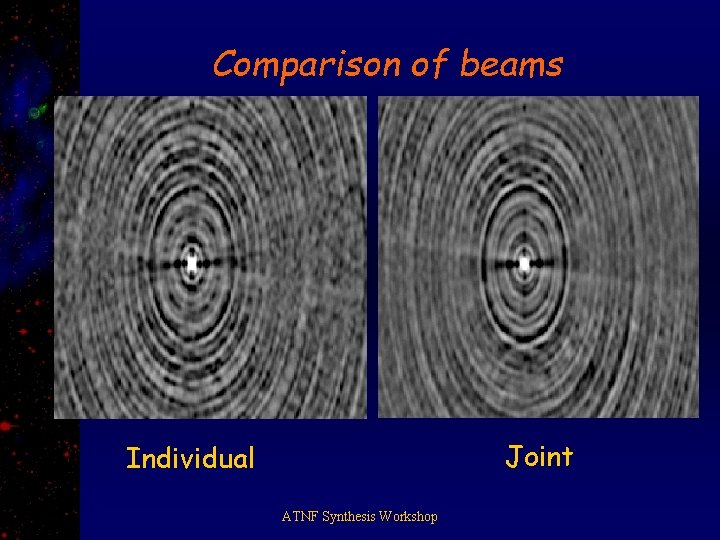
Comparison of beams Joint Individual ATNF Synthesis Workshop
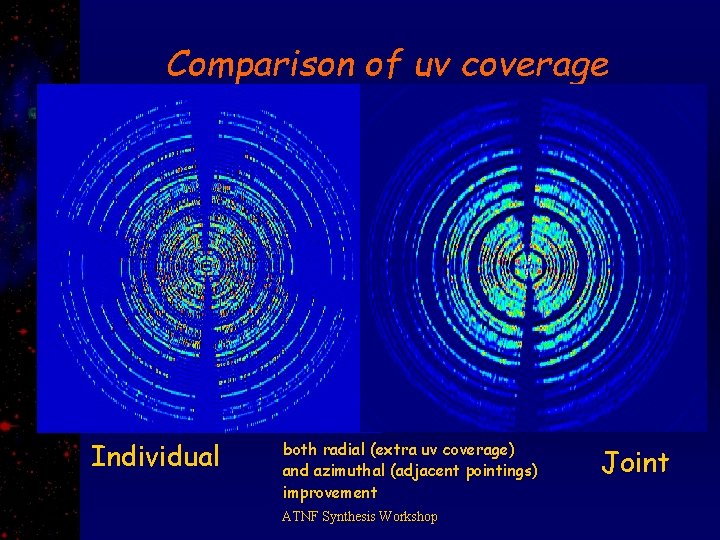
Comparison of uv coverage Individual both radial (extra uv coverage) and azimuthal (adjacent pointings) improvement ATNF Synthesis Workshop Joint
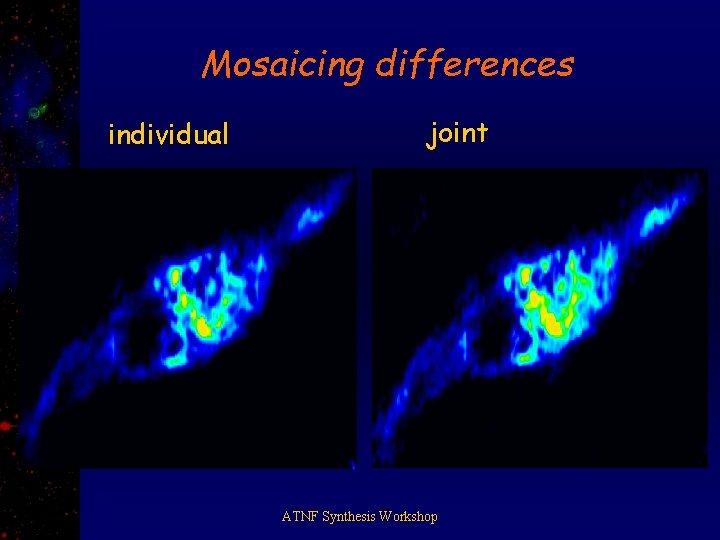
Mosaicing differences individual joint ATNF Synthesis Workshop
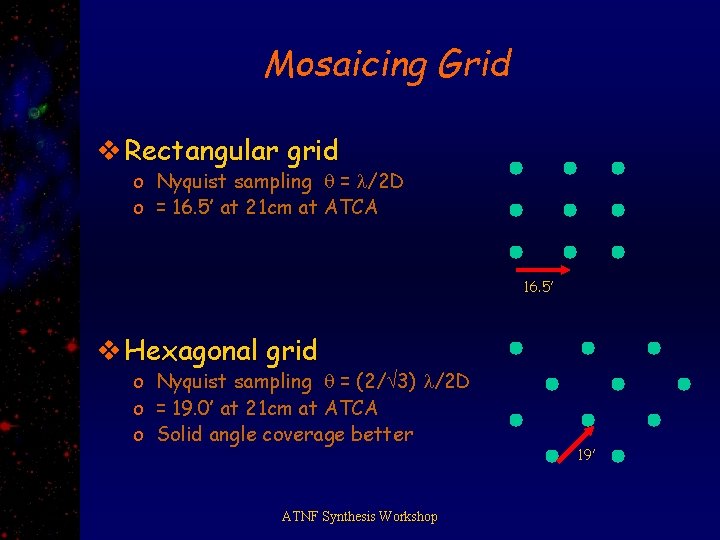
Mosaicing Grid v Rectangular grid o Nyquist sampling = /2 D o = 16. 5’ at 21 cm at ATCA 16. 5’ v Hexagonal grid o Nyquist sampling = (2/ 3) /2 D o = 19. 0’ at 21 cm at ATCA o Solid angle coverage better ATNF Synthesis Workshop 19’
Drive times v For short drives: t=2(s/a)1/2 v a=400 deg/min 2 v so for 0. 5 degree drive, t = 4. 3 sec ATNF Synthesis Workshop
Complete uv sampling v One baseline measures region in uv plane with size 2 D v At transit, time between independent points is =(86400/2 )(2 D/L) sec where D=diameter, L=longest baseline v Nyquist sampling for N pointings: dwell time is /2 N sec v E. g. 375 m: 13. 4 min. 750 m: 6. 7 min ATNF Synthesis Workshop
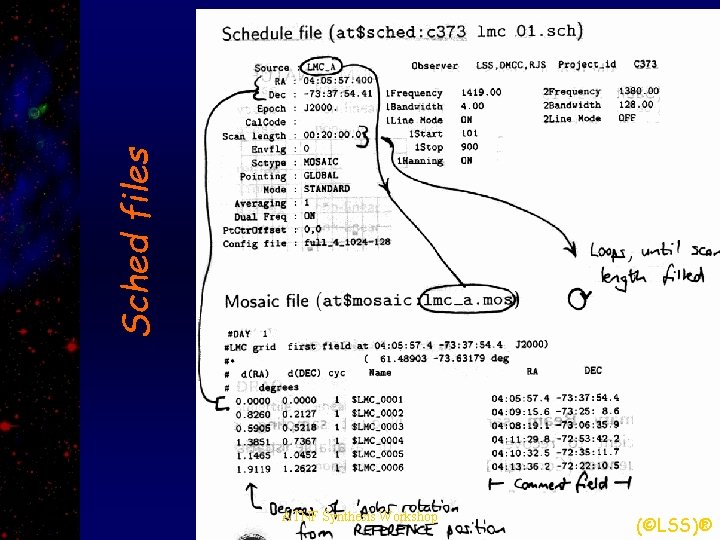
Sched files ATNF Synthesis Workshop (©LSS)®
Mosaicking with MIRIAD v Linear mosaic with LINMOS (after CLEAN/RESTOR on indiv pointings) v MIRIAD has multi-source capability: no need to split files v Making cubes: use INVERT with option=mosaic v Deconvolving: Maximum entropy MOSMEM or cleaning with MOSSDI v Restoring with RESTOR ATNF Synthesis Workshop
Other mosaicing software v Classic AIPS: o LTESS (linear) o VTESS, UTESS (non-linear) v AIPS++ o part of IMAGER tool o has MEM and clean variations o also has “mosaicwizard” ATNF Synthesis Workshop
Summary v Mosaicing is essential for widefield imaging v Mosaicing is easy v Use individual approach for high angular resolution observations where b >> D: minimize primary beam errors v Use joint approach where b D: extra uv information ATNF Synthesis Workshop
Literature v Ekers & Rots (1979), IAU Coll 49, 61 v Cornwell (1988), A&A, 202, 316 v Cornwell, Holdaway & Uson (1993), A&A, 271, 697 v Sault, Staveley-Smith, Brouw (1996), A&A Sup, 120, 375 v Holdaway (1998), ASP Conf 180, Ch. 20 v Sault & Killeen, Miriad manual, Ch. 21 ATNF Synthesis Workshop
- Slides: 20