
MOS Performance MOS significantly improves on the skill





- Slides: 47
MOS Performance • MOS significantly improves on the skill of model output. • National Weather Service verification statistics have shown a narrowing gap between human and MOS forecasts.
Cool Season Mi. Temp – 12 UTC Cycle Average Over 80 US stations
Prob. Of Precip. – Cool Season (0000/1200 UTC Cycles Combined)
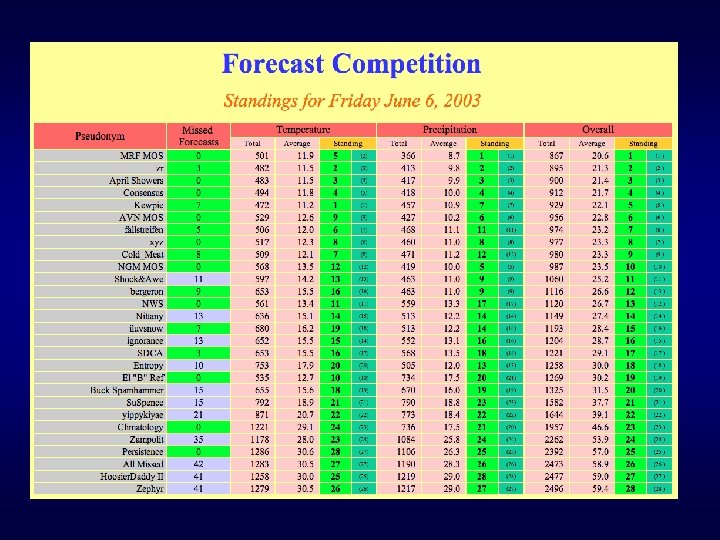
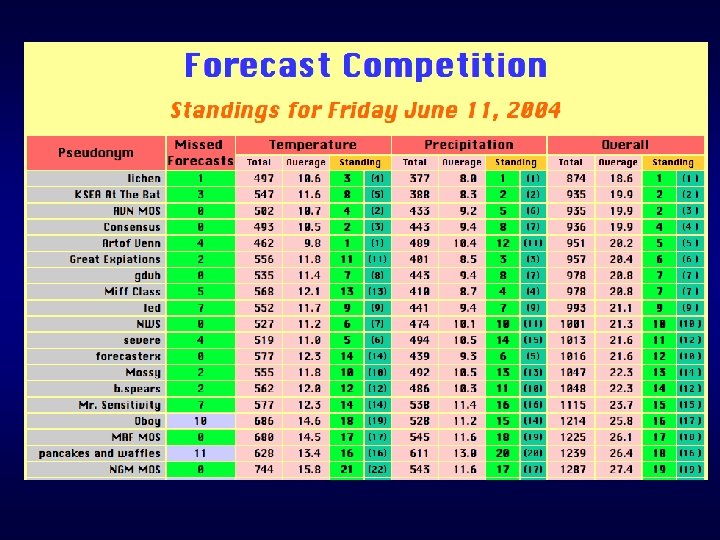
MOS Won the Department Forecast Contest in 2003 For the First Time!
Average or Composite MOS • There has been some evidence that an average or consensus MOS is even more skillful than individual MOS output. • Vislocky and Fritsch (1997), using 1990 -1992 data, found that an average of two or more MOS’s (CMOS) outperformed individual MOS’s and many human forecasters in a forecasting competition.
Some Questions • How does the current MOS performance…driven by far superior models… compare with NWS forecasters around the country. • How skillful is a composite MOS, particularly if one weights the members by past performance? • How does relative human/MOS performance vary by forecast projection, region, large one-day variation, or when conditions vary greatly from climatology? • Considering the results, what should be the role of human forecasters?
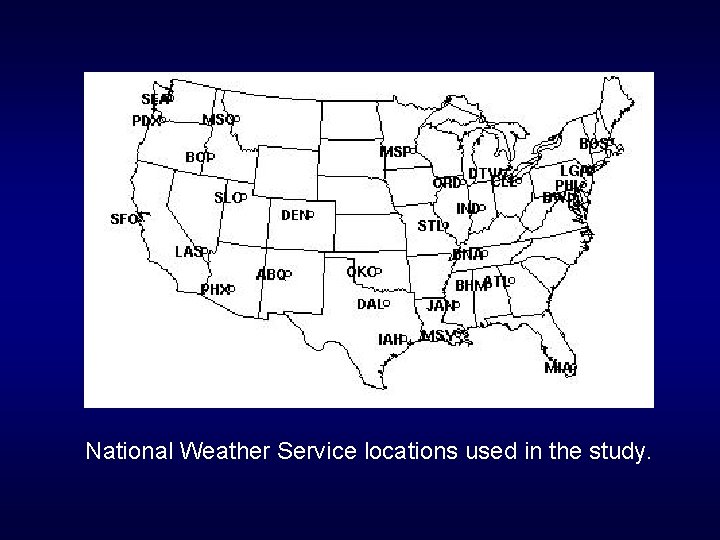
This Study • August 1 2003 – August 1 2004 (12 months). • 29 stations, all at major NWS Weather Forecast Office (WFO) sites. • Evaluated MOS predictions of maximum and minimum temperature, and probability of precipitation (POP).
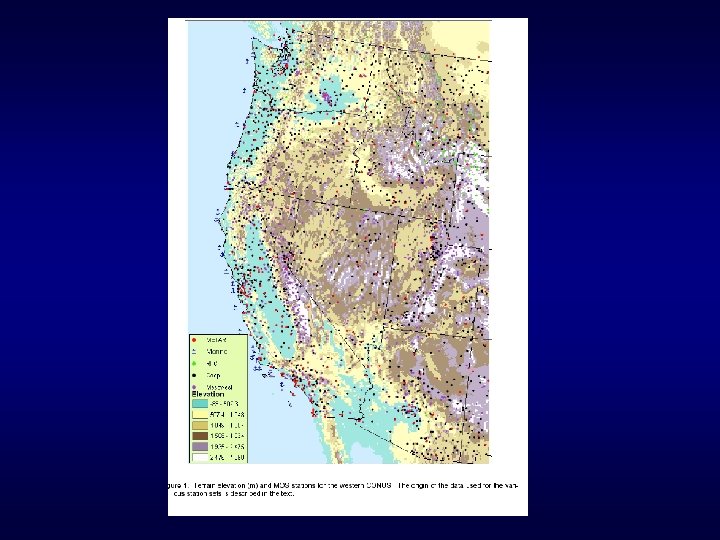
National Weather Service locations used in the study.
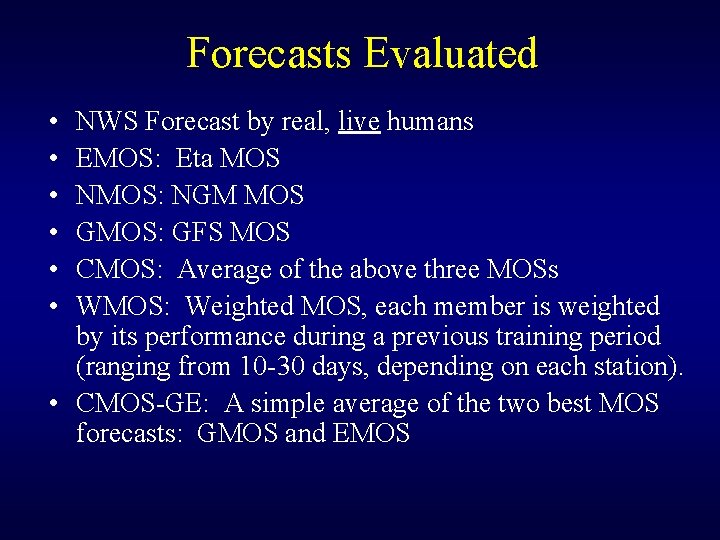
Forecasts Evaluated • • • NWS Forecast by real, live humans EMOS: Eta MOS NMOS: NGM MOS GMOS: GFS MOS CMOS: Average of the above three MOSs WMOS: Weighted MOS, each member is weighted by its performance during a previous training period (ranging from 10 -30 days, depending on each station). • CMOS-GE: A simple average of the two best MOS forecasts: GMOS and EMOS
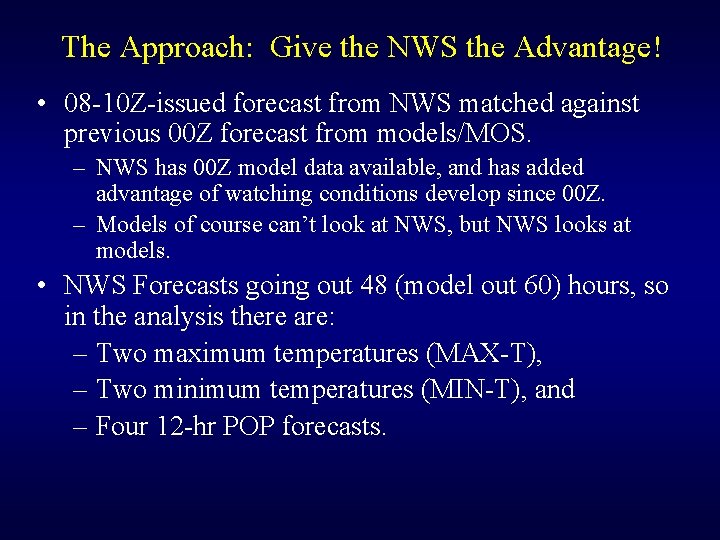
The Approach: Give the NWS the Advantage! • 08 -10 Z-issued forecast from NWS matched against previous 00 Z forecast from models/MOS. – NWS has 00 Z model data available, and has added advantage of watching conditions develop since 00 Z. – Models of course can’t look at NWS, but NWS looks at models. • NWS Forecasts going out 48 (model out 60) hours, so in the analysis there are: – Two maximum temperatures (MAX-T), – Two minimum temperatures (MIN-T), and – Four 12 -hr POP forecasts.
Temperature Comparisons
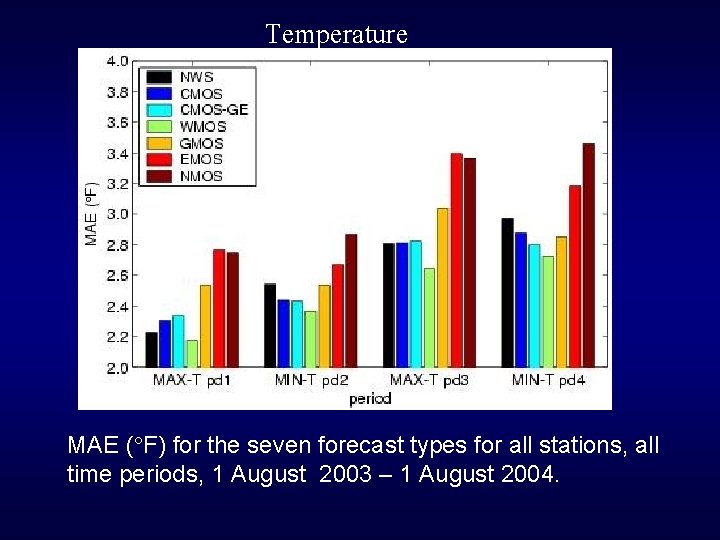
Temperature MAE ( F) for the seven forecast types for all stations, all time periods, 1 August 2003 – 1 August 2004.
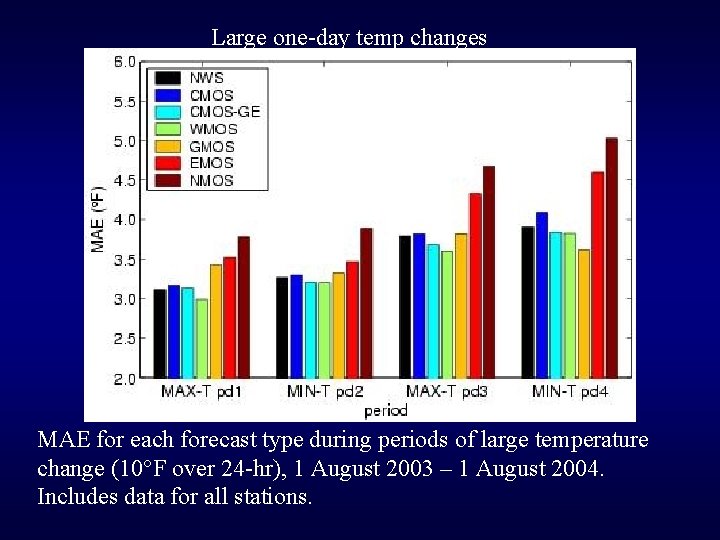
Large one-day temp changes MAE for each forecast type during periods of large temperature change (10 F over 24 -hr), 1 August 2003 – 1 August 2004. Includes data for all stations.
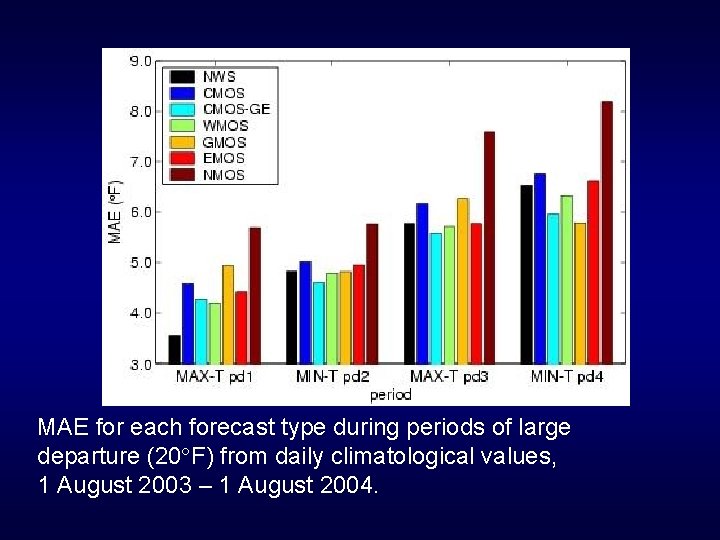
MAE for each forecast type during periods of large departure (20 F) from daily climatological values, 1 August 2003 – 1 August 2004.
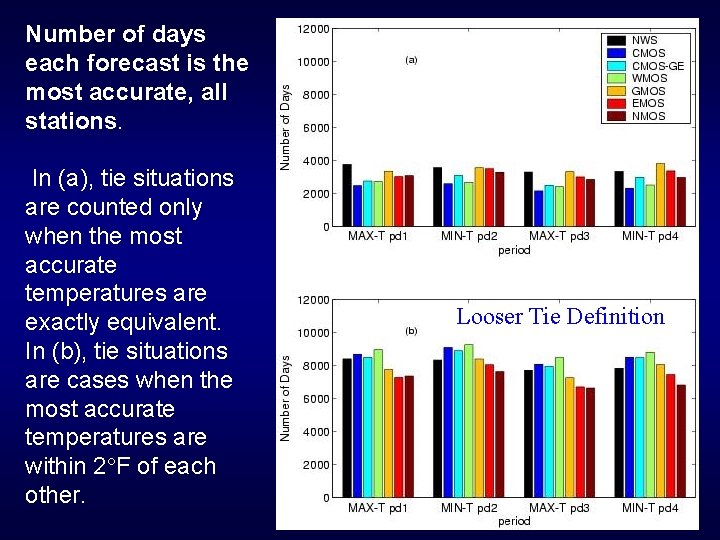
Number of days each forecast is the most accurate, all stations. In (a), tie situations are counted only when the most accurate temperatures are exactly equivalent. In (b), tie situations are cases when the most accurate temperatures are within 2 F of each other. Looser Tie Definition
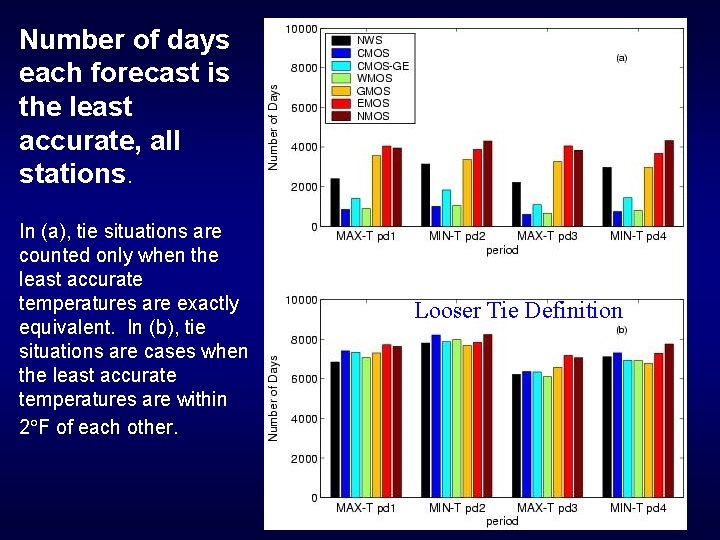
Number of days each forecast is the least accurate, all stations. In (a), tie situations are counted only when the least accurate temperatures are exactly equivalent. In (b), tie situations are cases when the least accurate temperatures are within 2 F of each other. Looser Tie Definition
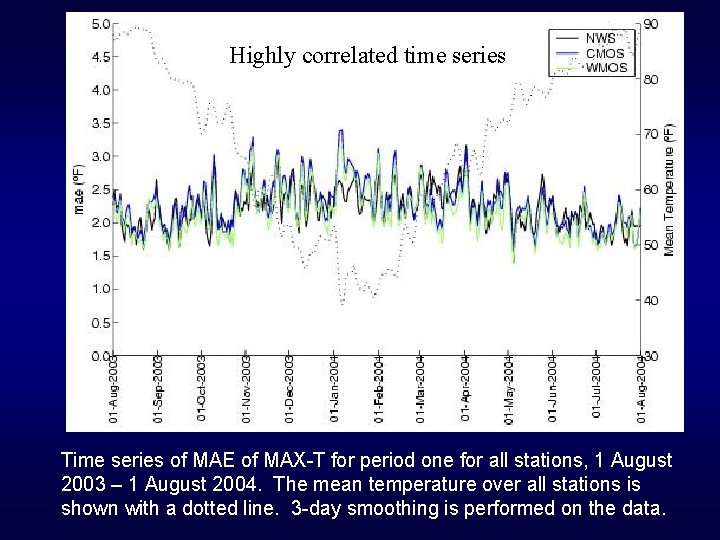
Highly correlated time series Time series of MAE of MAX-T for period one for all stations, 1 August 2003 – 1 August 2004. The mean temperature over all stations is shown with a dotted line. 3 -day smoothing is performed on the data.
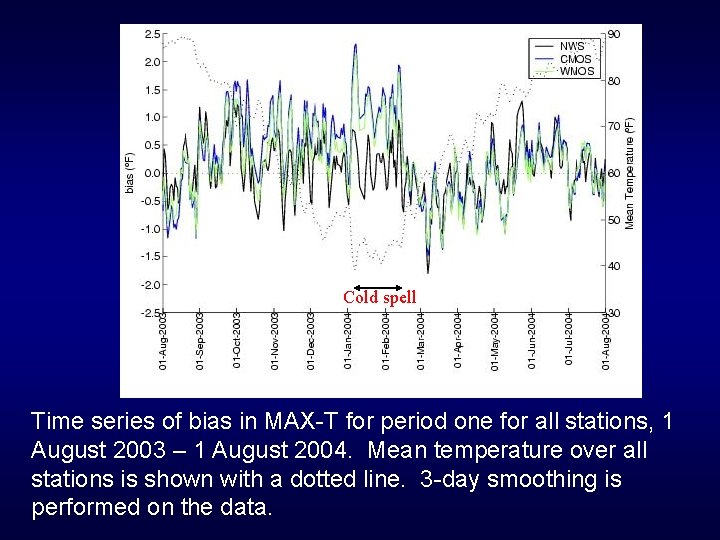
Cold spell Time series of bias in MAX-T for period one for all stations, 1 August 2003 – 1 August 2004. Mean temperature over all stations is shown with a dotted line. 3 -day smoothing is performed on the data.
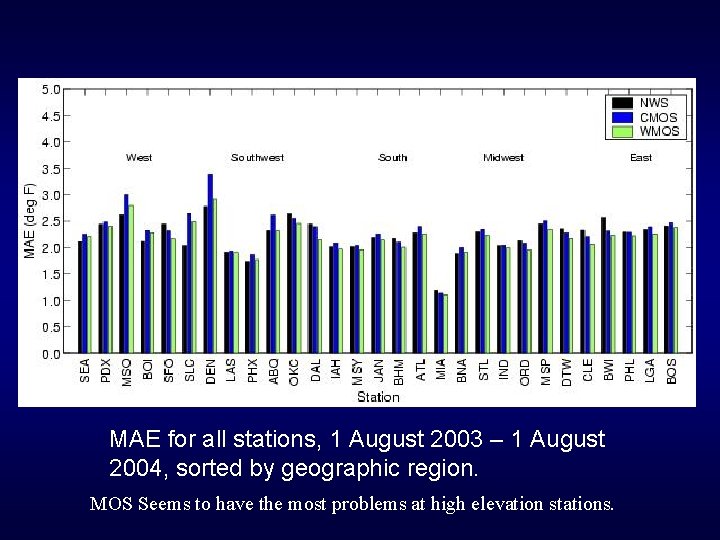
MAE for all stations, 1 August 2003 – 1 August 2004, sorted by geographic region. MOS Seems to have the most problems at high elevation stations.
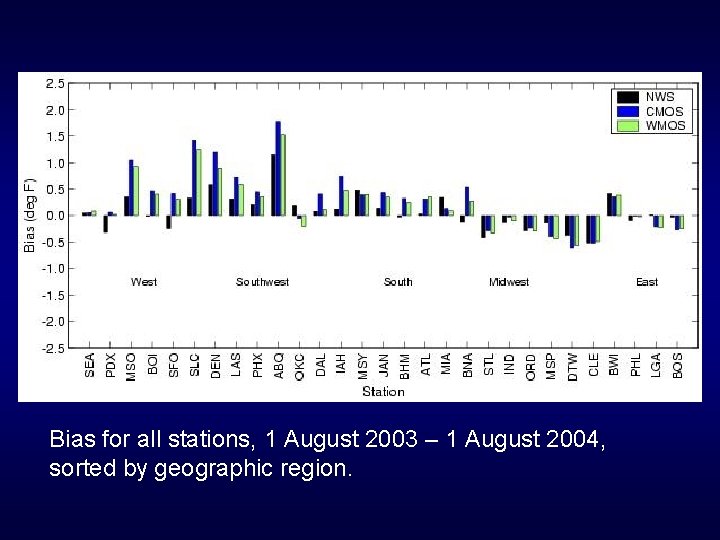
Bias for all stations, 1 August 2003 – 1 August 2004, sorted by geographic region.
Precipitation Comparisons
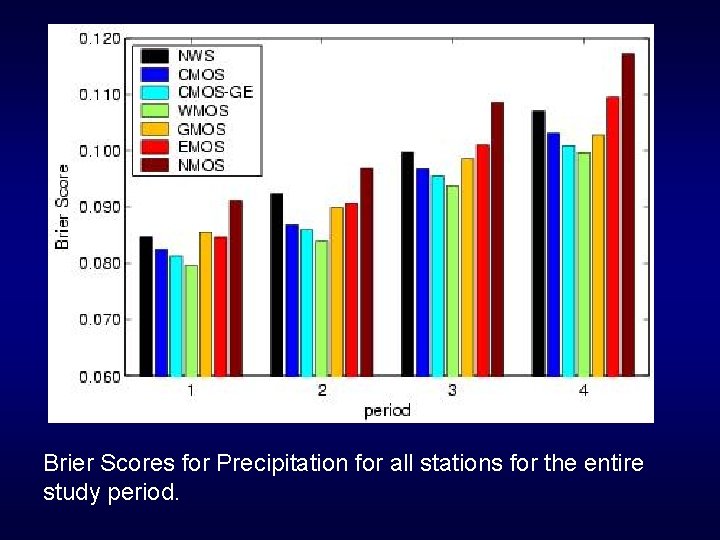
Brier Scores for Precipitation for all stations for the entire study period.
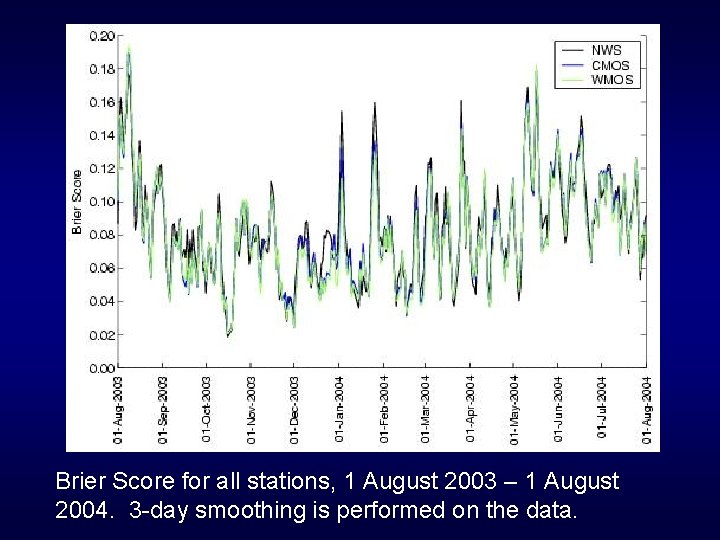
Brier Score for all stations, 1 August 2003 – 1 August 2004. 3 -day smoothing is performed on the data.
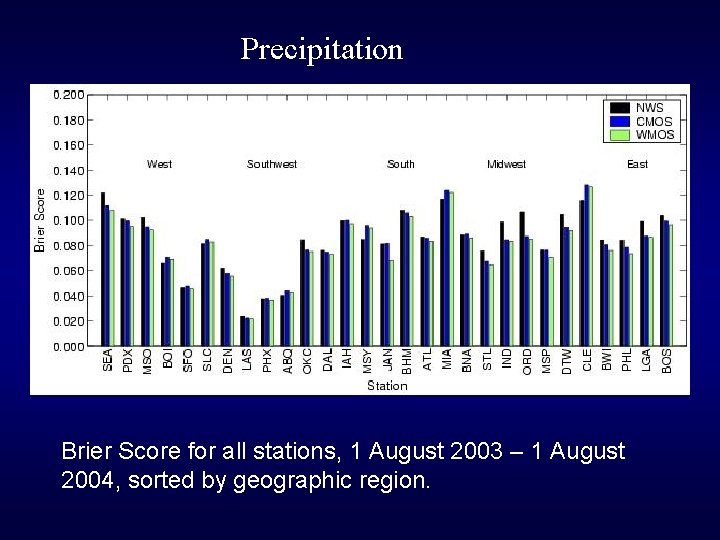
Precipitation Brier Score for all stations, 1 August 2003 – 1 August 2004, sorted by geographic region.
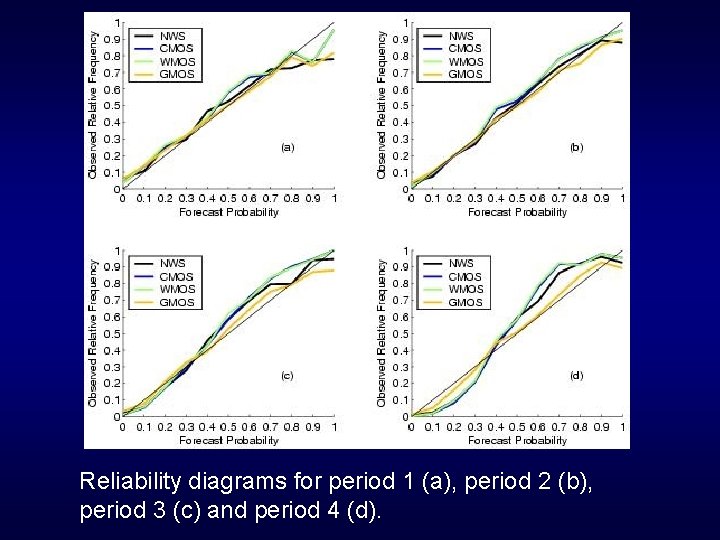
Reliability diagrams for period 1 (a), period 2 (b), period 3 (c) and period 4 (d).
NWS Main MOS site: http: //www. nws. noaa. gov/mdl/synop/products. shtml
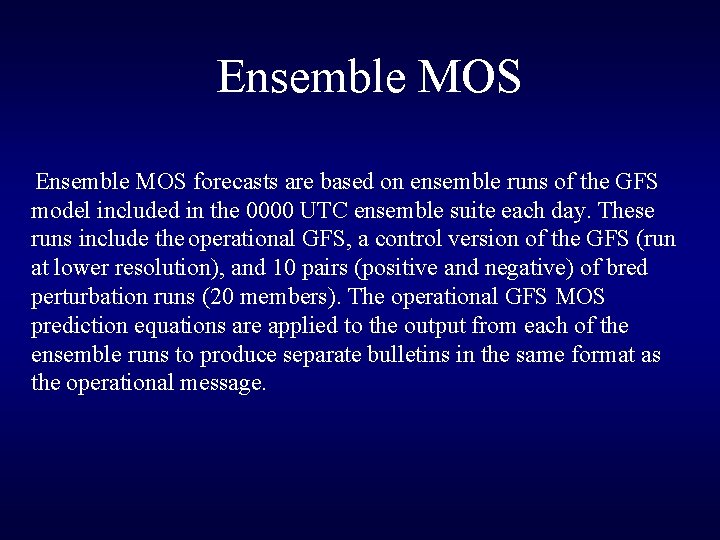
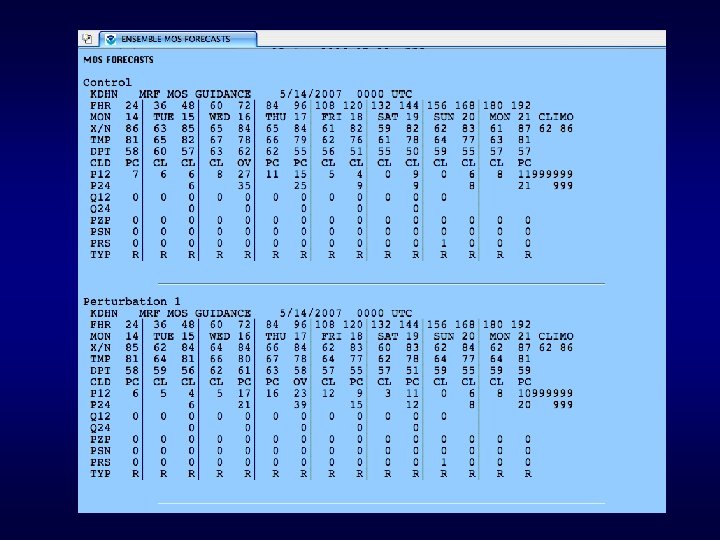
Ensemble MOS forecasts are based on ensemble runs of the GFS model included in the 0000 UTC ensemble suite each day. These runs include the. operational GFS, a control version of the GFS (run at lower resolution), and 10 pairs (positive and negative) of bred perturbation runs (20 members). The operational GFS MOS prediction equations are applied to the output from each of the ensemble runs to produce separate bulletins in the same format as the operational message.
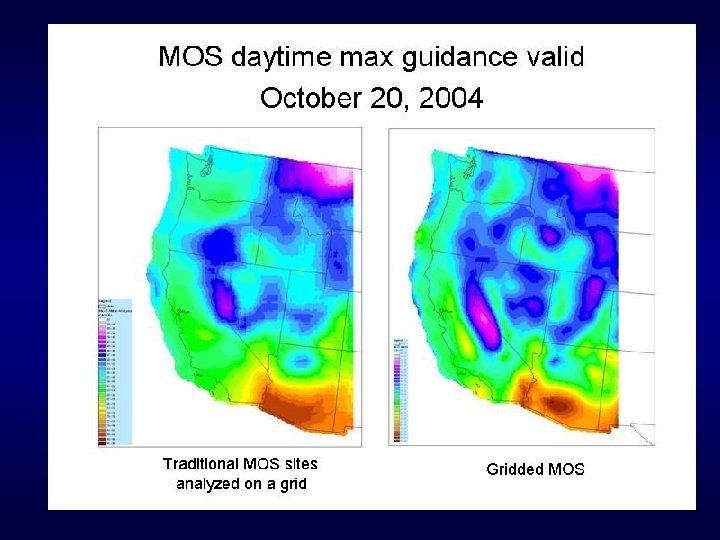
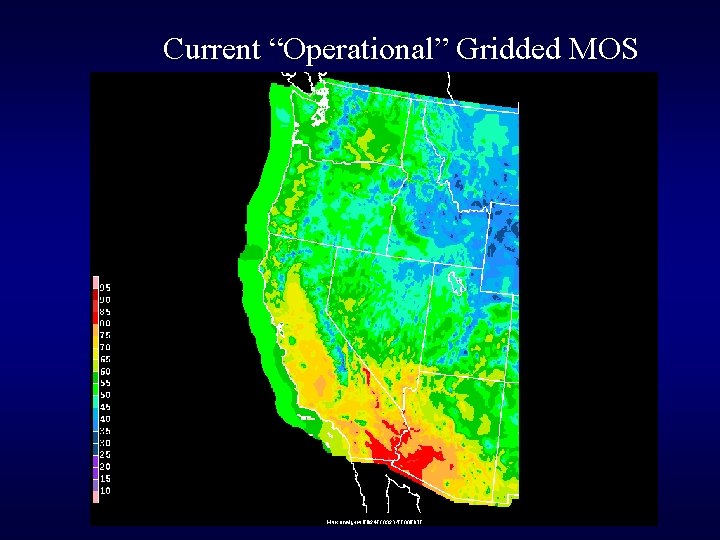
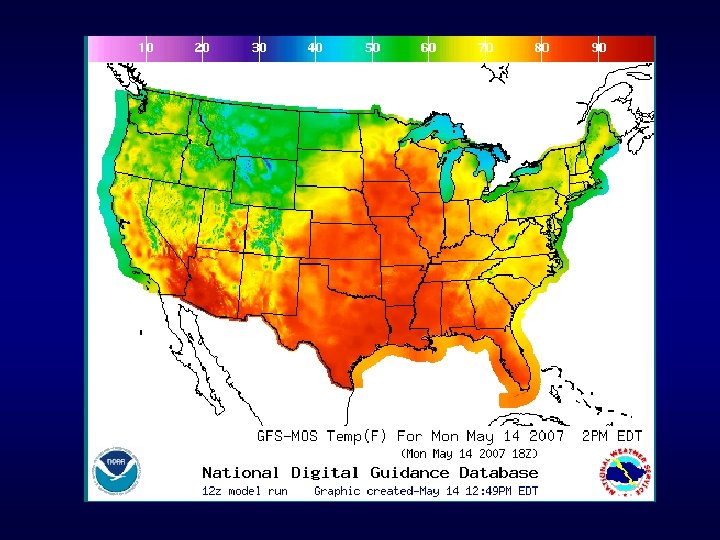
Gridded MOS • The NWS needs MOS on a grid for many reasons, including for use in their IFPS analysis/forecasting system. • The problem is that MOS is only available at station locations. • A recent project is to create Gridded MOS. • Takes MOS at individual stations and spreads it out based on proximity and height differences. Also does a topogaphic correction dependent on reasonable lapse rate.
Gridded MOS SITE http: //www. nws. noaa. gov/mdl/synop/gmos. html
Current “Operational” Gridded MOS
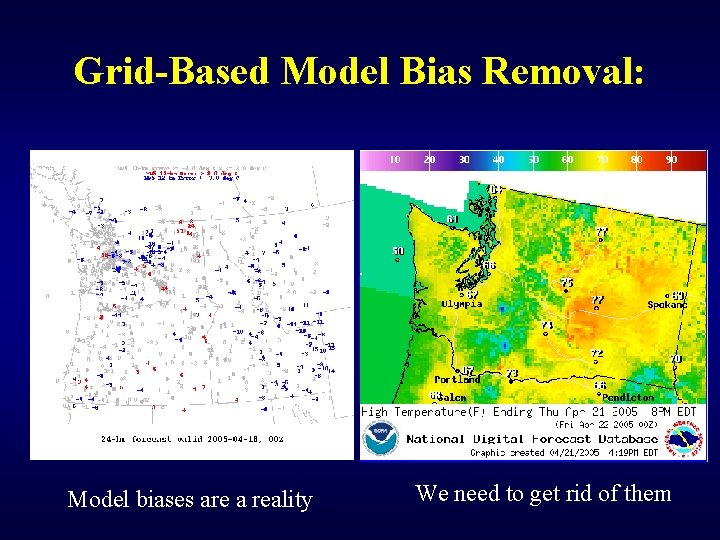
Grid-Based Model Bias Removal: Model biases are a reality We need to get rid of them
Grid-Based Bias Removal • In the past, the NWS has attempted to remove these biases only at observation locations (MOS, Perfect Prog)--exception…gridded mos recently • Removal of systemic model bias on forecast grids is needed. Why? – All models have significant systematic biases – NWS and others want to distribute graphical forecasts on a grid (IFPS) – People and applications need forecasts everywhere…not only at ASOS sites – Important post-processing step for ensembles
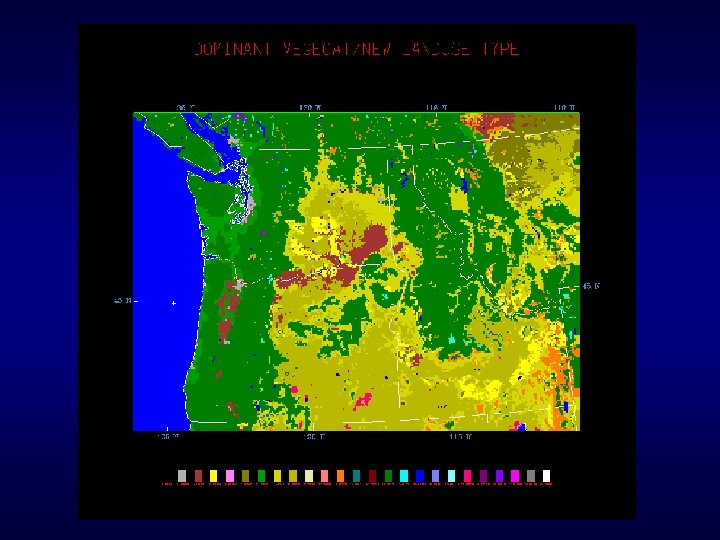
A Potential Solution: Obs-Based Grid Based Bias Removal • Based on observations, not analyses. • Base the bias removal on observation-site land use category, elevation, and proximity. Land use and elevation are the key parameters the control physical biases.
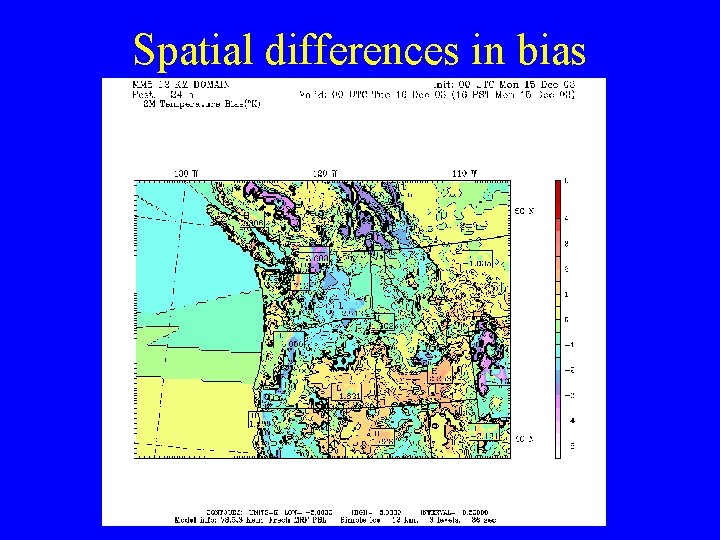
Spatial differences in bias
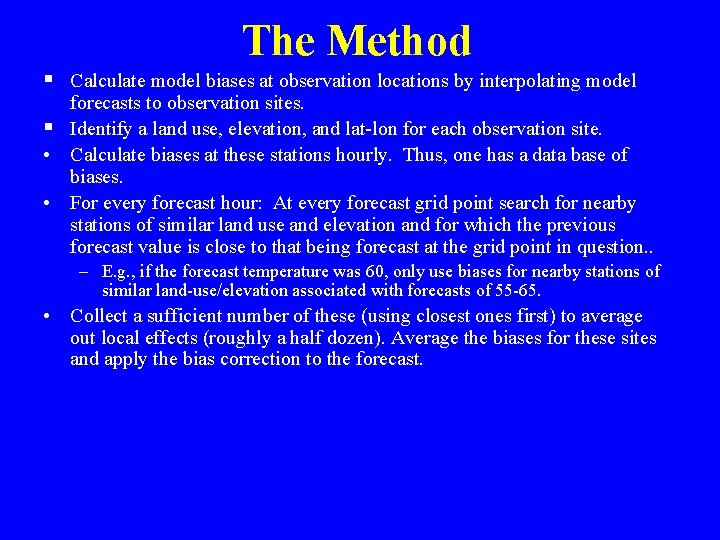
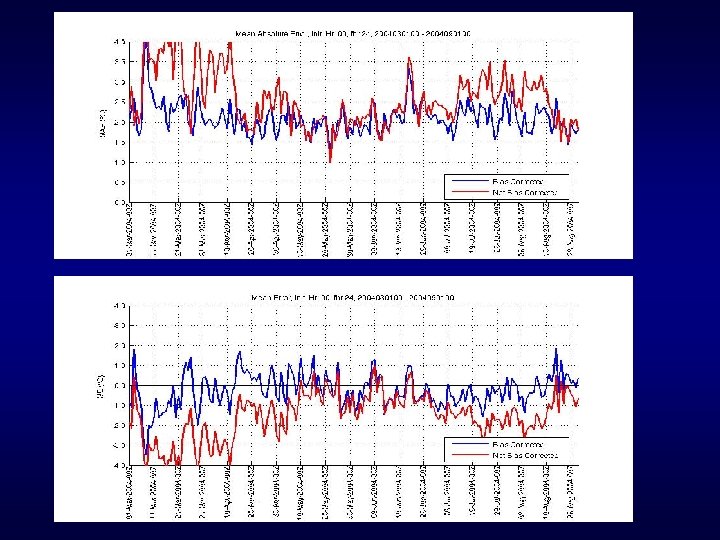
The Method § Calculate model biases at observation locations by interpolating model forecasts to observation sites. § Identify a land use, elevation, and lat-lon for each observation site. • Calculate biases at these stations hourly. Thus, one has a data base of biases. • For every forecast hour: At every forecast grid point search for nearby stations of similar land use and elevation and for which the previous forecast value is close to that being forecast at the grid point in question. . – E. g. , if the forecast temperature was 60, only use biases for nearby stations of similar land-use/elevation associated with forecasts of 55 -65. • Collect a sufficient number of these (using closest ones first) to average out local effects (roughly a half dozen). Average the biases for these sites and apply the bias correction to the forecast.
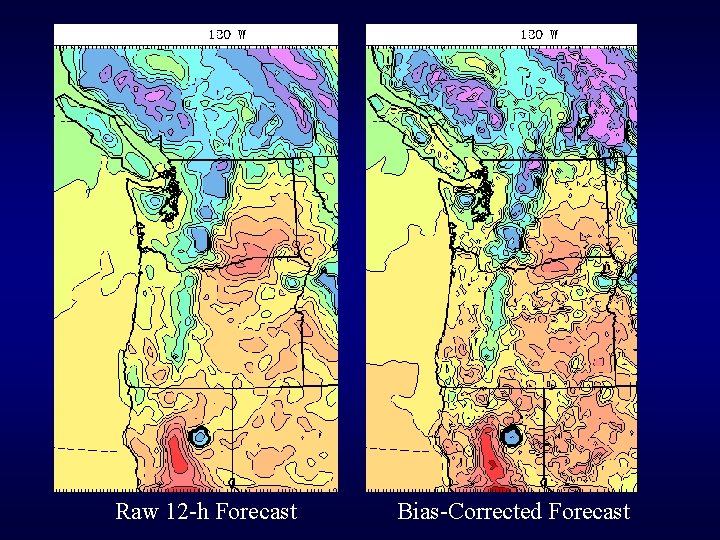
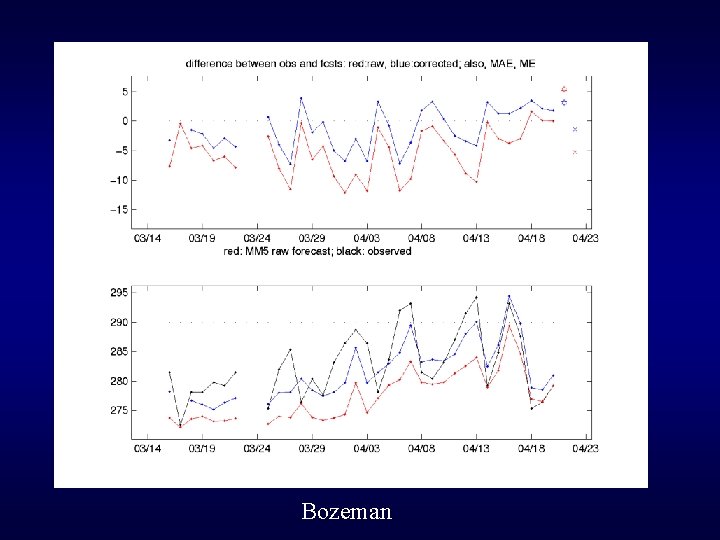
Raw 12 -h Forecast Bias-Corrected Forecast
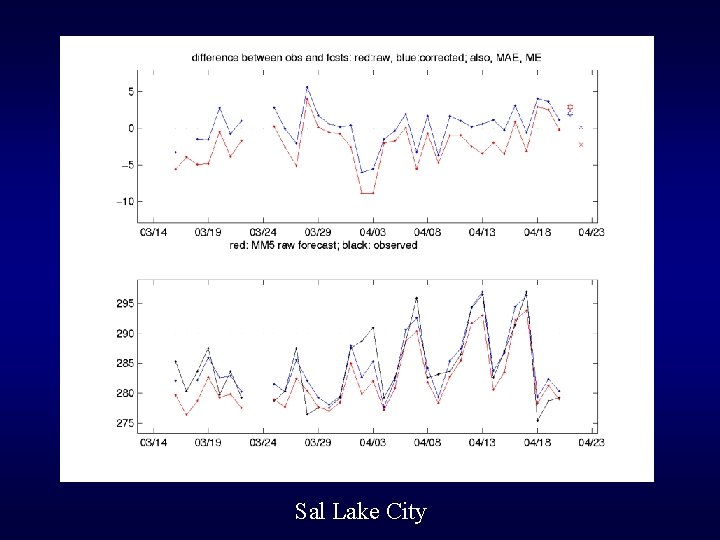
Sal Lake City
Bozeman
The End http: //www. atmos. washington. edu/~jbaars/mos_vs_nws. html