
Mortgages Which of these statements best describes what
Mortgages
Which of these statements best describes what a mortgage is? 1. A mortgage is a loan used to buy your home 2. A mortgage is an unsecured loan 3. A mortgage is a loan you do not have to pay back until you retire 2
What payments are you probably going to have to make to the landlord when you start renting? 1. Gas and water 2. Council tax 3. Deposit and one month’s rent 3
Who can repossess your home if you fail to make your monthly payments? 1. The council 2. The mortgage lender 3. The government 4
Key terms Loan to value (LTV) – This is the ratio between the amount of the mortgage and the value of the property, for example: § For a £ 90, 000 mortgage on a property worth £ 100, 000 the LTV would be 90%, so you’ll need a deposit of £ 10, 000. 5
Key terms § Early repayment charge (ERC) – If you decide to pay of a large chunk of your mortgage back, the bank can charge you. § Annual percentage rate (APR) – the standard measure of the cost of loans. It is the interest payable on what you have borrowed, plus other charges such as fees, expressed as an annual rate of charge. It also takes into account how often the interest is charged (monthly, quarterly or annually). 6
Income Tax § Not all income is taxable: your personal allowance provides an amount of tax-free income each year. § For the tax year 2014/15, the basic personal allowance (tax-free amount) is £ 10, 000. Your taxable income is the amount you earn over and above your personal allowance. § You have to pay income tax on that taxable income. 7
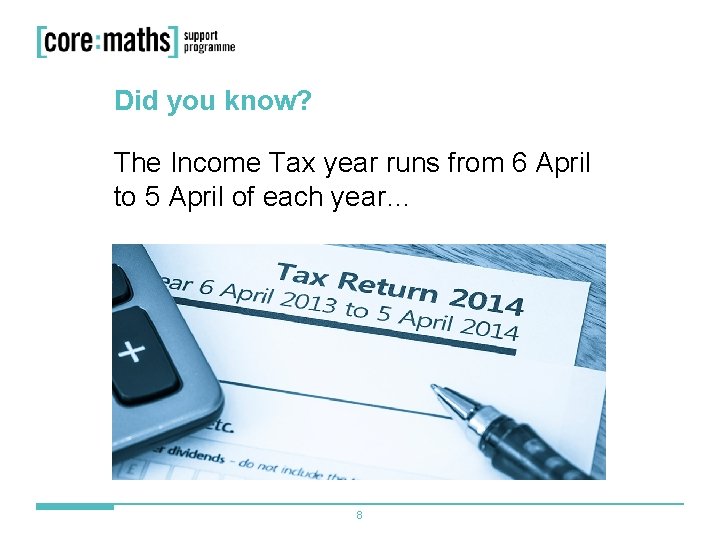
Did you know? The Income Tax year runs from 6 April to 5 April of each year… 8
PAYE (Pay As You Earn) If you're an employee, your employer deducts Income Tax from your wages throughout the year, using the tax code provided. If your circumstances change, you may be given a new tax code. HMRC will send you a PAYE Coding Notice to tell you: § What your new tax code is § The amount of tax-free income you can receive (your personal allowance, or PA) § How that has been worked out 9
PAYE (Pay As You Earn) § Pay As You Earn (PAYE) is a system of deducting the tax that an employee owes directly from their wage or salary. § Your payslip shows how much PAYE has been deducted. Your employer pays that amount to HM Revenue & Customs on your behalf. 10
Tax rates § Basic rate tax is deducted at 20% on income up to £ 40, 000 (after taking your PA into account). § Most people will have a tax-free allowance of £ 10, 000. § Higher rate: On income over £ 40, 000, tax is deducted at 40%. § Additional rate: On income over £ 150, 001, tax is deducted at 45%. 11
National Insurance You pay National Insurance contributions to build up your entitlement to certain state benefits, including the State Pension. You pay National Insurance if you’re: § 16 or over § an employee earning above £ 153 a week § self-employed making a profit over £ 5, 885 a year (unless you get an exception) The exact amount you pay depends on: § how much you earn § whether you’re employed or self-employed. 12
National Insurance You pay Class 1 National Insurance contributions. The rates are: § 12% on your yearly earnings between £ 8, 000 and £ 42, 000 § 2% on any yearly earnings over £ 42, 000 § You pay National Insurance with your tax. Your employer will take it from your wages before you get paid. If you’re a director of a limited company, you may also be your own employee and pay National Insurance Class 1 through your PAYE payroll. For more info, visit: https: //www. gov. uk/browse/tax/national-insurance 13
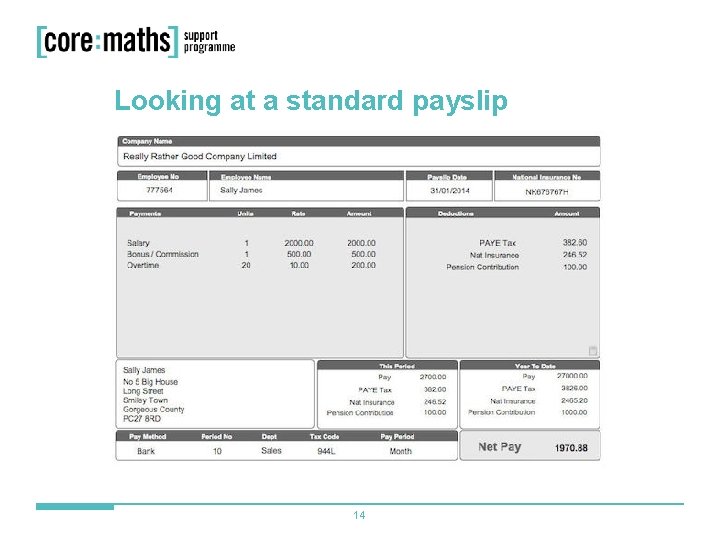
Looking at a standard payslip 14
Example Jasmine the Jewellery Designer § £ 16, 000 annual salary 15
Example Philip the (famous) Photographer § £ 65, 000 per year § Pays 3. 2% pension § How much does he take home each year? 16
Activity § Complete the worksheets calculating the net incomes for each individual. § There is a scaffolded worksheet to help with this. 17
Case studies 1. A single person in their 20 s earning £ 30, 000 a year. They are a first-time buyer with £ 6, 000 saved in the bank. 2. A young couple in their late 20 s. One of them earns £ 25, 000 the other £ 35, 000. They are first time buyers. They have £ 23, 000 saved in the bank. 3. A couple in their early 30 s with three children. One earns £ 15, 000 and the other £ 40, 000. They have £ 15, 000 in the bank saved. 18
Steps to success Look at the salaries of your case study. You need to work out how much they actually take home each month. 19
Activity § Write down all the things you have to pay for in a month. § How much do you think this comes to? 20
Activity § Work out how much you take home every month after tax, and then fill in the budget plan: http: //www. santander-products. co. uk/mortgagebudget-planner/index. php Look at how much you can afford a month on a mortgage. § https: //personal. natwest. com/personal/mortgag es/secure/how-much-can-i-borrow. html § http: //www. natwest. com/personal/mortgages/m ortgage-calculator. ashx § Research costs of houses and mortgage rates. 21
Consider this: § Although you may be able to afford the mortgage of a £ 200, 000 house, banks will only offer you a mortgage on an amount 4 x your salary. This would mean that you would need an income/joint income of £ 50, 000 to get a mortgage. § Does this mean a person earning £ 50, 000 can afford a £ 200, 000 house? 22
Does this change your situation? § Look at the houses and rates you have found so far. Are these still possible? § What amount could each case study actually apply for and be approved? – looking at the budget plan, see what can they actually afford. 23
Types of mortgages § Fixed-rate mortgages: Your repayments are fixed at a certain rate of interest for a specified time – maybe two or three years. Your monthly repayments remain the same regardless of whether interest rates go up or down. § Tracker mortgages: You pay an agreed percentage above the Bank of England’s base rate. As the base rate goes up and down, so will your mortgage repayments. § Interest-only mortgages are another type of mortgage where your monthly repayments cover the interest only – not the capital – of your home loan. You will usually be required to have a long-term investment fund put in place to pay back the original loan by an agreed future date. 24
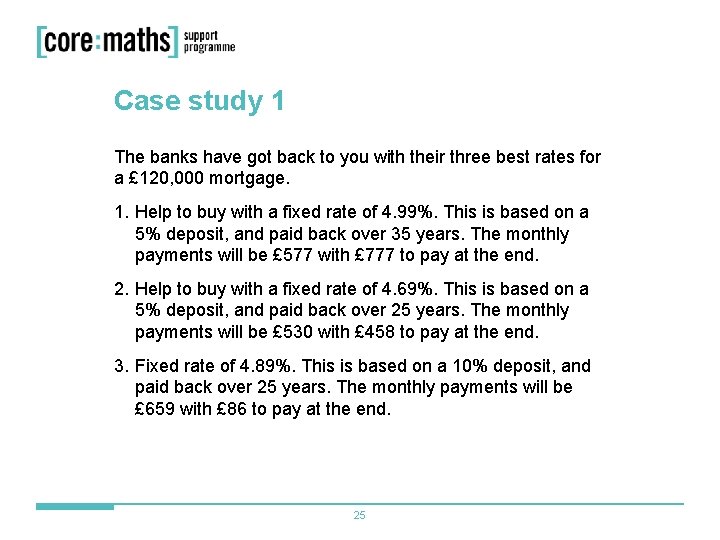
Case study 1 The banks have got back to you with their three best rates for a £ 120, 000 mortgage. 1. Help to buy with a fixed rate of 4. 99%. This is based on a 5% deposit, and paid back over 35 years. The monthly payments will be £ 577 with £ 777 to pay at the end. 2. Help to buy with a fixed rate of 4. 69%. This is based on a 5% deposit, and paid back over 25 years. The monthly payments will be £ 530 with £ 458 to pay at the end. 3. Fixed rate of 4. 89%. This is based on a 10% deposit, and paid back over 25 years. The monthly payments will be £ 659 with £ 86 to pay at the end. 25
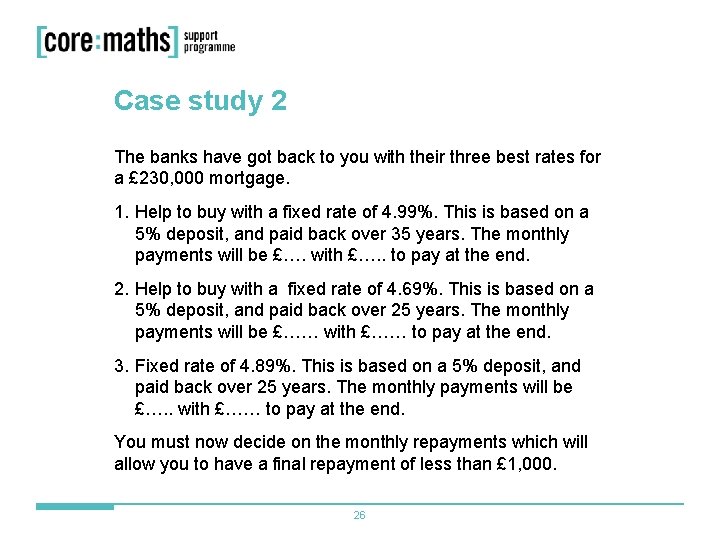
Case study 2 The banks have got back to you with their three best rates for a £ 230, 000 mortgage. 1. Help to buy with a fixed rate of 4. 99%. This is based on a 5% deposit, and paid back over 35 years. The monthly payments will be £…. with £…. . to pay at the end. 2. Help to buy with a fixed rate of 4. 69%. This is based on a 5% deposit, and paid back over 25 years. The monthly payments will be £…… with £…… to pay at the end. 3. Fixed rate of 4. 89%. This is based on a 5% deposit, and paid back over 25 years. The monthly payments will be £…. . with £…… to pay at the end. You must now decide on the monthly repayments which will allow you to have a final repayment of less than £ 1, 000. 26
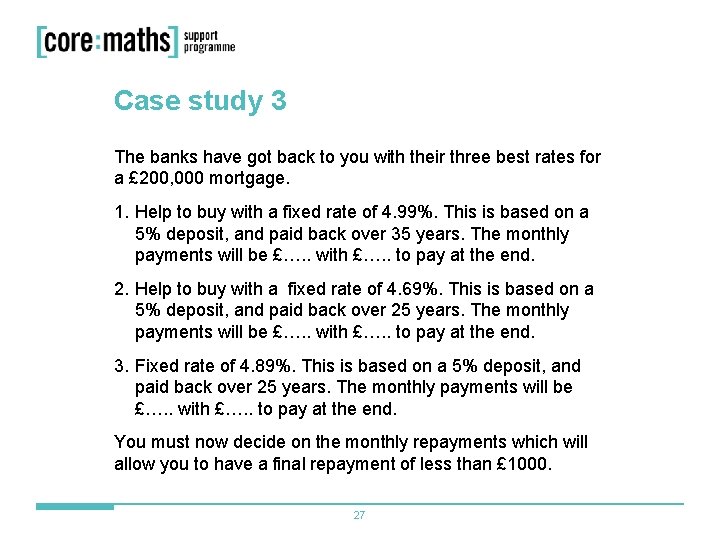
Case study 3 The banks have got back to you with their three best rates for a £ 200, 000 mortgage. 1. Help to buy with a fixed rate of 4. 99%. This is based on a 5% deposit, and paid back over 35 years. The monthly payments will be £…. . with £…. . to pay at the end. 2. Help to buy with a fixed rate of 4. 69%. This is based on a 5% deposit, and paid back over 25 years. The monthly payments will be £…. . with £…. . to pay at the end. 3. Fixed rate of 4. 89%. This is based on a 5% deposit, and paid back over 25 years. The monthly payments will be £…. . with £…. . to pay at the end. You must now decide on the monthly repayments which will allow you to have a final repayment of less than £ 1000. 27
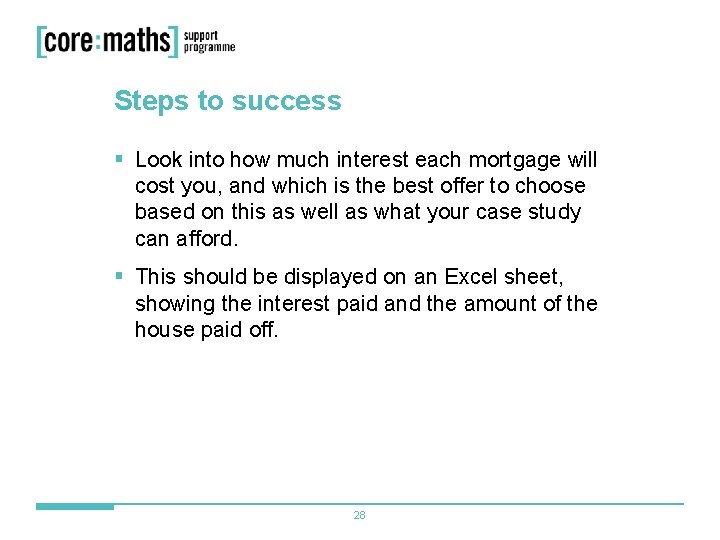
Steps to success § Look into how much interest each mortgage will cost you, and which is the best offer to choose based on this as well as what your case study can afford. § This should be displayed on an Excel sheet, showing the interest paid and the amount of the house paid off. 28
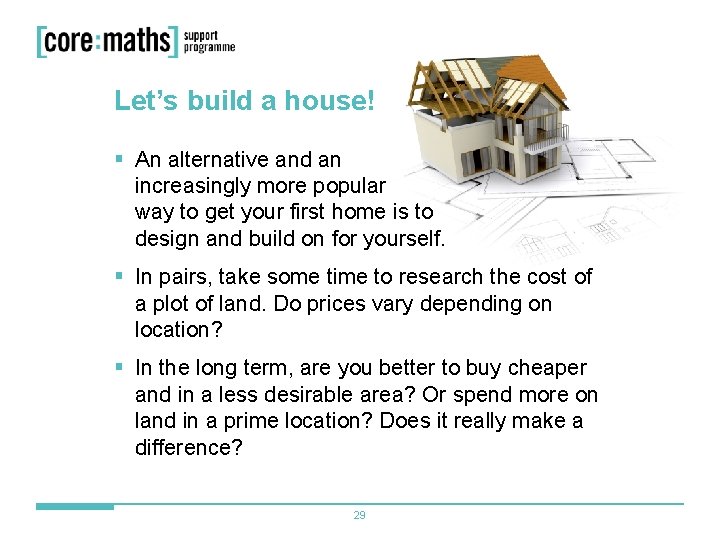
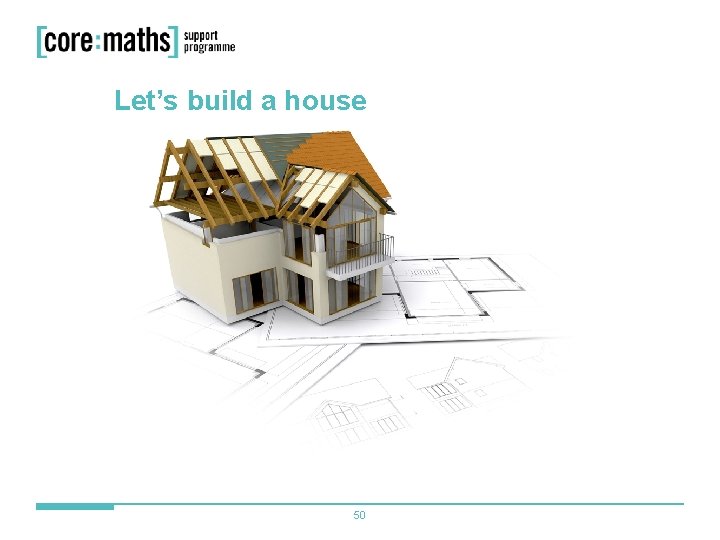
Let’s build a house! § An alternative and an increasingly more popular way to get your first home is to design and build on for yourself. § In pairs, take some time to research the cost of a plot of land. Do prices vary depending on location? § In the long term, are you better to buy cheaper and in a less desirable area? Or spend more on land in a prime location? Does it really make a difference? 29
Applying for the money § Now you know the cost of building your house, you are going to need to get the money from somewhere. § Let’s go back to our three favourite banks and see how their interest rates have changed. 30
Remember, when applying for a loan there are four important things to think about: § The amount of money you require § The interest rates you are offered § How much you can afford each month § How much time you will need to pay it back 31
Mantander § They can lend you the whole £ 200, 000. § Interest is 5% a month over 40 years. § The minimum payback each month is £ 964. § The bank will only accept the minimum amount each month and no more. § You need to make a final payment of £ 600 in the last month. 32
Nat. East § They can lend you the whole £ 200, 000. § Interest is 7% each month over 30 years. § The minimum payback each month is £ 1330. § The bank will only accept the minimum amount each month, no more. § You will need to make a final payment of £ 738 in the last month. 33
Floyds TSB § They can lend you the whole £ 200, 000. § Interest is 6% over 35 years. § The minimum payback each month is £ 1140. § The bank will only accept the minimum amount each month, no more. § You will need to make a final payment of £ 540 in the last month. 34
Steps to success Step 1: Create an Excel sheet with the figures for each bank over the years. Step 2: Look at the total interest paid for each bank and decide which is the best deal. Step 3: Display all three banks’ data on one graph to compare. Step 4: Choose which is the best bank and say why. Step 5: Display your balance over time in a graph 35
Maths warm-up § Activity networks § Gantt diagrams § Scheduling 36
Scheduling 37
Gantt diagrams and schedules We need to schedule both the tasks and the workers to finish the job in the minimum time. 38
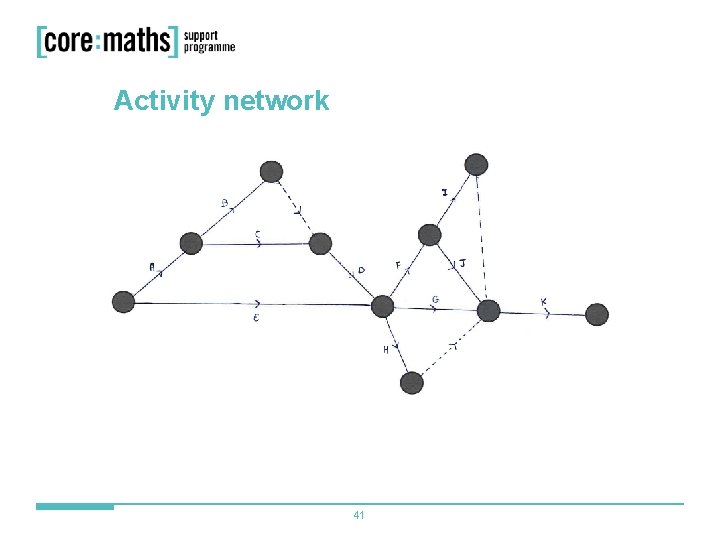
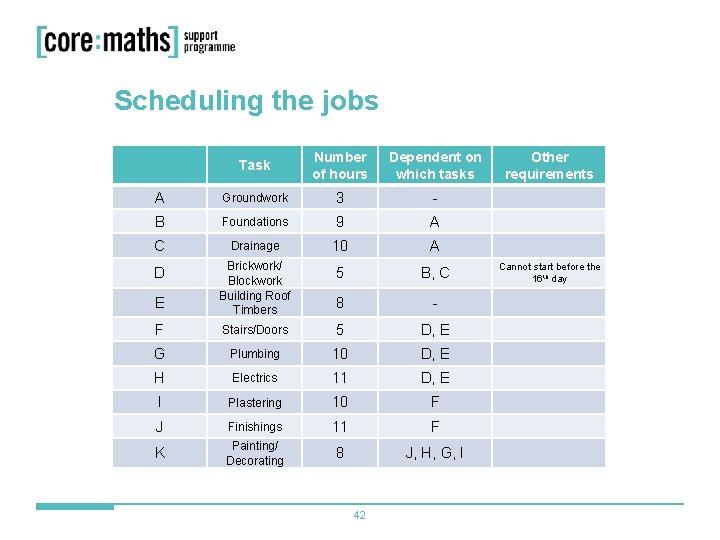
Scheduling the tasks The following jobs need to be completed, each job requires a different amount of time and certain jobs have been scheduled for certain times. Certain tasks cannot begin until other tasks have been completed. 39
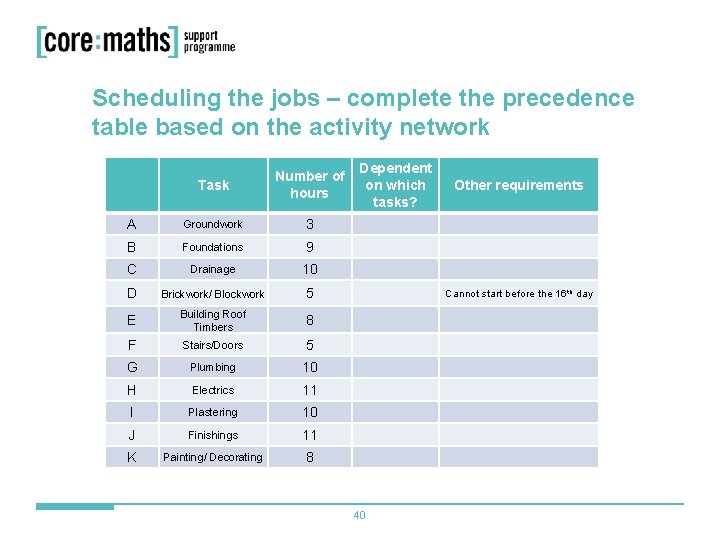
Scheduling the jobs – complete the precedence table based on the activity network Task Number of hours A Groundwork 3 B Foundations 9 C Drainage 10 D Brickwork/ Blockwork 5 E Building Roof Timbers 8 F Stairs/Doors 5 G Plumbing 10 H Electrics 11 I Plastering 10 J Finishings 11 K Painting/ Decorating 8 Dependent on which tasks? Other requirements Cannot start before the 16 th day 40
Activity network 41
Scheduling the jobs Task Number of hours Dependent on which tasks A Groundwork 3 - B Foundations 9 A C Drainage 10 A D 5 B, C E Brickwork/ Blockwork Building Roof Timbers 8 - F Stairs/Doors 5 D, E G Plumbing 10 D, E H Electrics 11 D, E I Plastering 10 F J Finishings 11 F K Painting/ Decorating 8 J, H, G, I 42 Other requirements Cannot start before the 16 th day
Activity networks § Complete the activity network for the early and late times for each activity. § Calculate the float times for each activity and state which activities are critical. 43
Gantt diagrams Complete a cascade diagram for your tasks, making sure to show the float times of each activity. 44
Scheduling the workers We have the following workers at our disposal: § 3 labourers § 2 skilled builders § 2 bricklayers § 1 carpenter § 1 plumber § 1 electrician § 1 plasterer At all times a skilled worker (red) must have a labourer at their disposal. 45
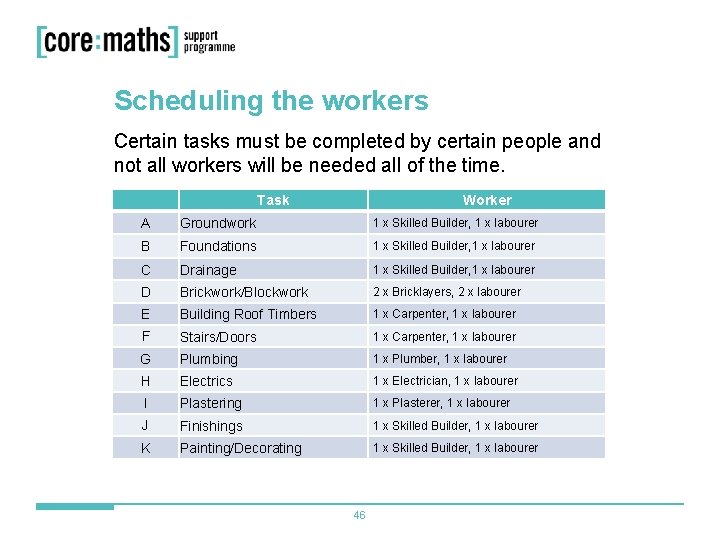
Scheduling the workers Certain tasks must be completed by certain people and not all workers will be needed all of the time. Task Worker A Groundwork 1 x Skilled Builder, 1 x labourer B Foundations 1 x Skilled Builder, 1 x labourer C Drainage 1 x Skilled Builder, 1 x labourer D Brickwork/Blockwork 2 x Bricklayers, 2 x labourer E Building Roof Timbers 1 x Carpenter, 1 x labourer F Stairs/Doors 1 x Carpenter, 1 x labourer G Plumbing 1 x Plumber, 1 x labourer H Electrics 1 x Electrician, 1 x labourer I Plastering 1 x Plasterer, 1 x labourer J Finishings 1 x Skilled Builder, 1 x labourer K Painting/Decorating 1 x Skilled Builder, 1 x labourer 46
Scheduling the workers § Create a scheduling diagram for all your workers. § All tasks should be completed by day 44. § Begin by planning your critical activities. § You only have three labourers so no more than three tasks can be completed at any one time. 47
Designing your garden § The house is complete and now it is just you: you now have to renovate the garden. § Draw a Gantt diagram for the activities and state what is the minimum time in which you could complete all the tasks, if you completed every activity on time. § If activities G and H were delayed by two hours, what would be the new minimum time to complete the project? 48
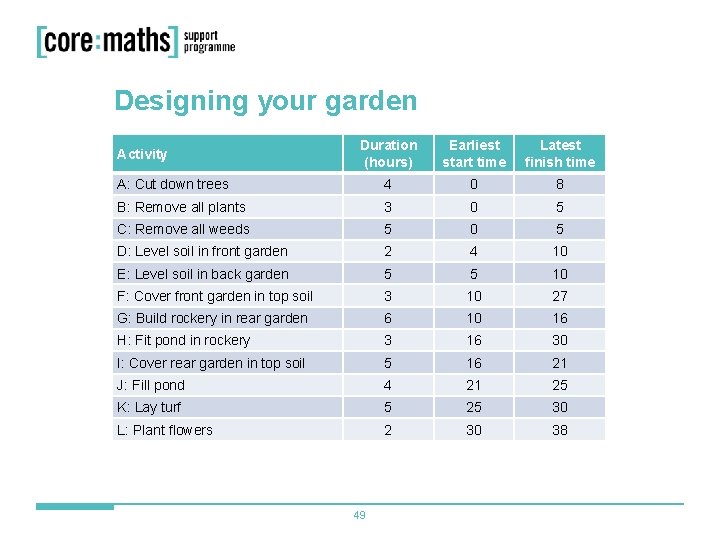
Designing your garden Duration (hours) Earliest start time Latest finish time A: Cut down trees 4 0 8 B: Remove all plants 3 0 5 C: Remove all weeds 5 0 5 D: Level soil in front garden 2 4 10 E: Level soil in back garden 5 5 10 F: Cover front garden in top soil 3 10 27 G: Build rockery in rear garden 6 10 16 H: Fit pond in rockery 3 16 30 I: Cover rear garden in top soil 5 16 21 J: Fill pond 4 21 25 K: Lay turf 5 25 30 L: Plant flowers 2 30 38 Activity 49
Let’s build a house 50
Building a house What do we need to know? Budget House size Resources Workforce needed Time http: //www. homebuilding. co. uk/advice/costs/building-house-under-%C 2%A 3150000 51
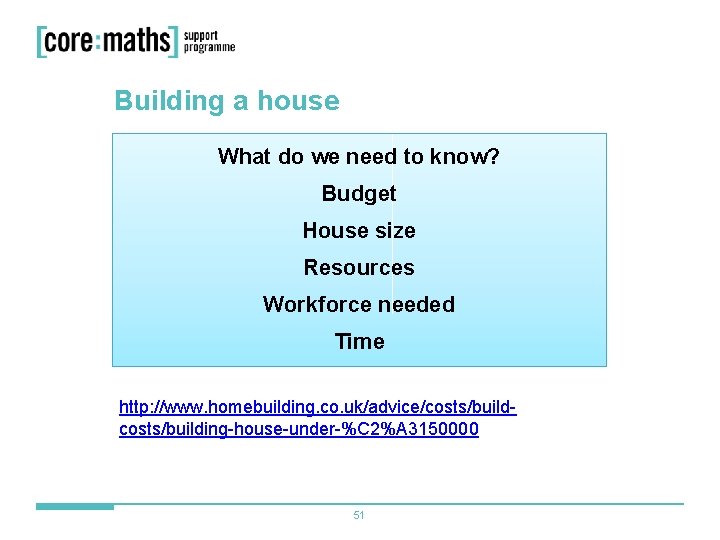
Building a house What do we need to know and how much do we need? § Budget – What does a four-bedroom house cost? § House size – What area of ground is needed? § Resources – Bricks, blocks, cement, sand, wood, tools and fittings (nails) § Workforce needed – Ground workers, bricklayers, skilled workers, electricians, plumbers, carpenters, plasterers and labourers § Time it will take to build 52
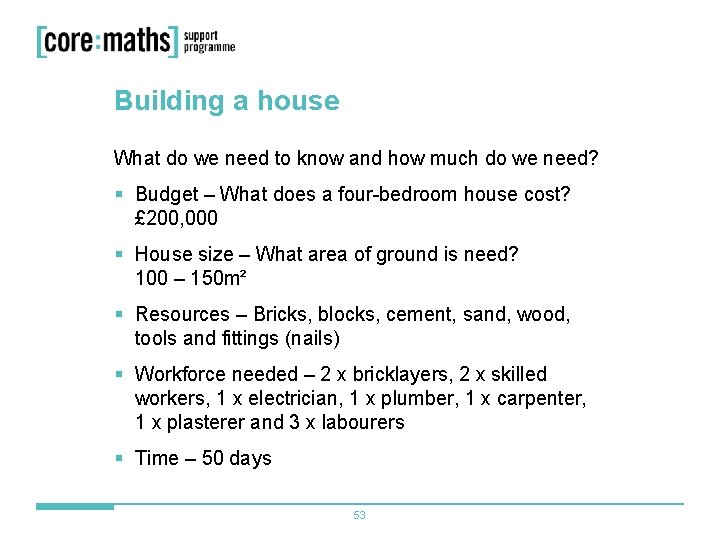
Building a house What do we need to know and how much do we need? § Budget – What does a four-bedroom house cost? £ 200, 000 § House size – What area of ground is need? 100 – 150 m² § Resources – Bricks, blocks, cement, sand, wood, tools and fittings (nails) § Workforce needed – 2 x bricklayers, 2 x skilled workers, 1 x electrician, 1 x plumber, 1 x carpenter, 1 x plasterer and 3 x labourers § Time – 50 days 53
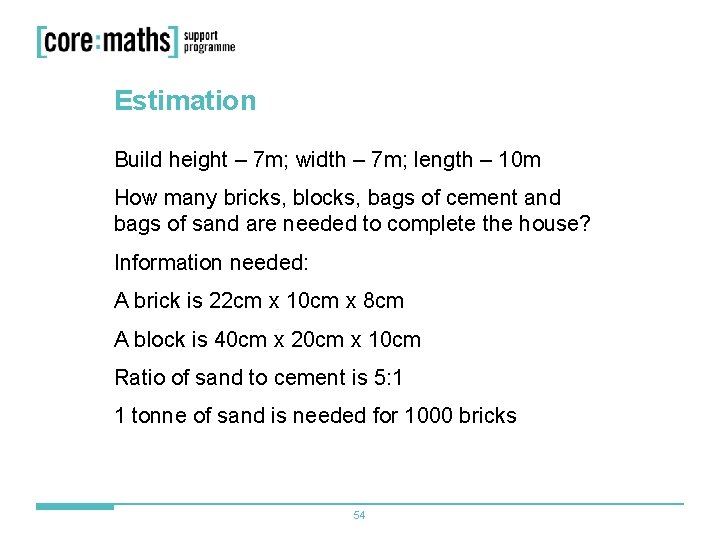
Estimation Build height – 7 m; width – 7 m; length – 10 m How many bricks, blocks, bags of cement and bags of sand are needed to complete the house? Information needed: A brick is 22 cm x 10 cm x 8 cm A block is 40 cm x 20 cm x 10 cm Ratio of sand to cement is 5: 1 1 tonne of sand is needed for 1000 bricks 54
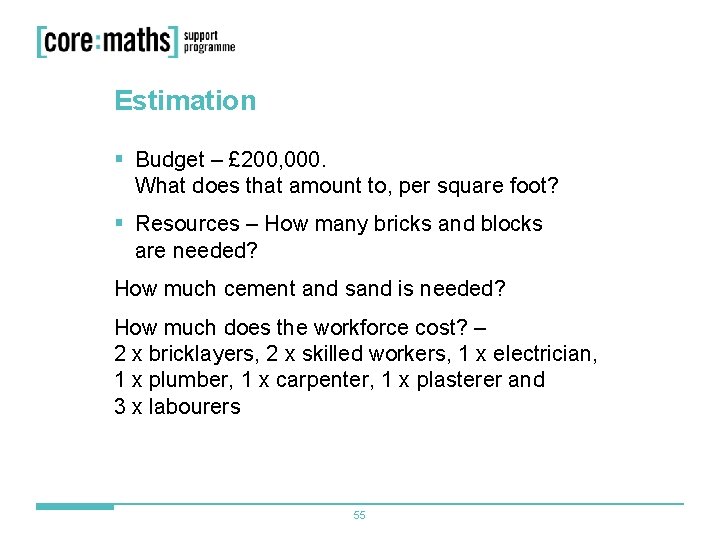
Estimation § Budget – £ 200, 000. What does that amount to, per square foot? § Resources – How many bricks and blocks are needed? How much cement and sand is needed? How much does the workforce cost? – 2 x bricklayers, 2 x skilled workers, 1 x electrician, 1 x plumber, 1 x carpenter, 1 x plasterer and 3 x labourers 55
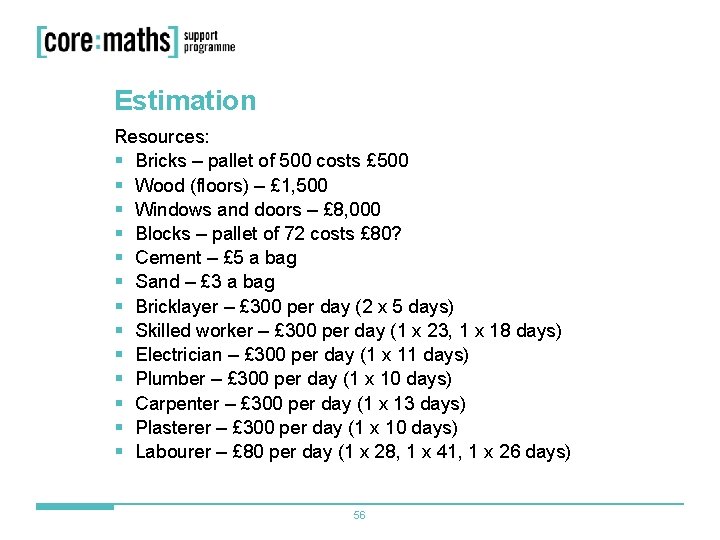
Estimation Resources: § Bricks – pallet of 500 costs £ 500 § Wood (floors) – £ 1, 500 § Windows and doors – £ 8, 000 § Blocks – pallet of 72 costs £ 80? § Cement – £ 5 a bag § Sand – £ 3 a bag § Bricklayer – £ 300 per day (2 x 5 days) § Skilled worker – £ 300 per day (1 x 23, 1 x 18 days) § Electrician – £ 300 per day (1 x 11 days) § Plumber – £ 300 per day (1 x 10 days) § Carpenter – £ 300 per day (1 x 13 days) § Plasterer – £ 300 per day (1 x 10 days) § Labourer – £ 80 per day (1 x 28, 1 x 41, 1 x 26 days) 56
Estimation § Create a finance spreadsheet for all of the costings. § This must be split into labour and materials. 57
Core Maths Support Programme 60 Queens Road Reading RG 1 4 BS E-mail cmsp@cfbt. com Call 0118 902 1243
- Slides: 58