
Mortality measurescrude specific summary the life table Recall
Mortality measures-crude, specific, & summary (the life table)
Recall lesson about rates: crude, age-specific, summary stats èCrude death rate: conceals a lot because mortality varies greatly by age èAge-specific death rates: asdr = deaths agex/pop. at risk agex (for specific period and place) èSummary statistic-->the life table: life expectancy: mean years expected to live from age x under current mortality conditions
The Life Table: demographic fossil or “most useful tool” èLaid out by John Graunt in 1662, when data and ability to calculate were scarce commodities èThe life table was designed to both “show the work”, how death rates by age are used to compute all stats of the table, and to “show the results”. èNotion can be extended beyond mortality
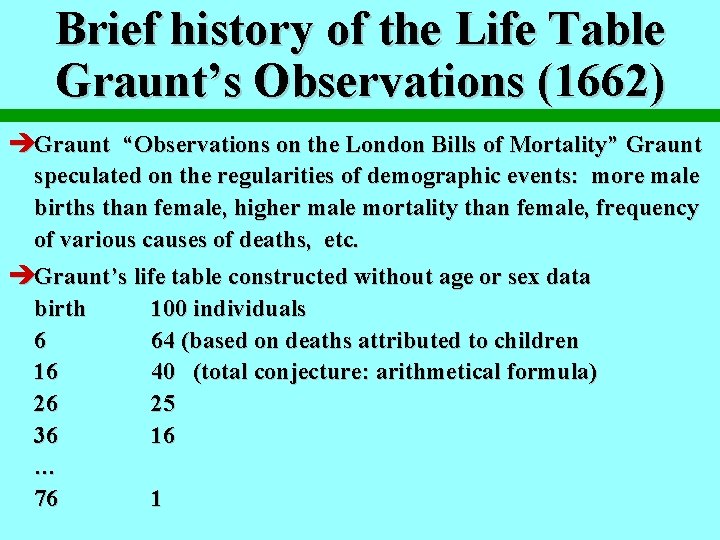
Brief history of the Life Table Graunt’s Observations (1662) èGraunt “Observations on the London Bills of Mortality” Graunt speculated on the regularities of demographic events: more male births than female, higher male mortality than female, frequency of various causes of deaths, etc. èGraunt’s life table constructed without age or sex data birth 6 16 26 36 … 76 100 individuals 64 (based on deaths attributed to children 40 (total conjecture: arithmetical formula) 25 16 1
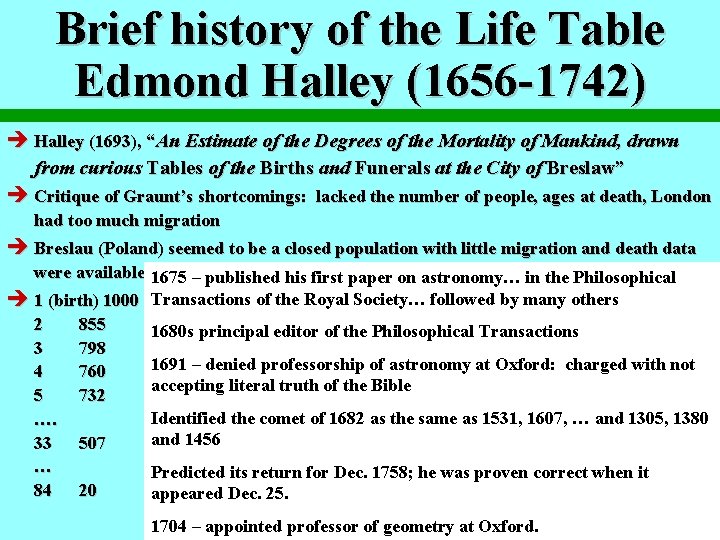
Brief history of the Life Table Edmond Halley (1656 -1742) è Halley (1693), “An Estimate of the Degrees of the Mortality of Mankind, drawn from curious Tables of the Births and Funerals at the City of Breslaw” è Critique of Graunt’s shortcomings: lacked the number of people, ages at death, London had too much migration è Breslau (Poland) seemed to be a closed population with little migration and death data were available by age– (individual years) 1675 published his first paper on astronomy… in the Philosophical Transactions of the Royal Society… followed by many others è 1 (birth) 1000 individuals 2 855 1680 s principal editor of the Philosophical Transactions 3 798 1691 – denied professorship of astronomy at Oxford: charged with not 4 760 accepting literal truth of the Bible 5 732 Identified the comet of 1682 as the same as 1531, 1607, … and 1305, 1380 …. and 1456 33 507 … Predicted its return for Dec. 1758; he was proven correct when it 84 20 appeared Dec. 25. 1704 – appointed professor of geometry at Oxford.
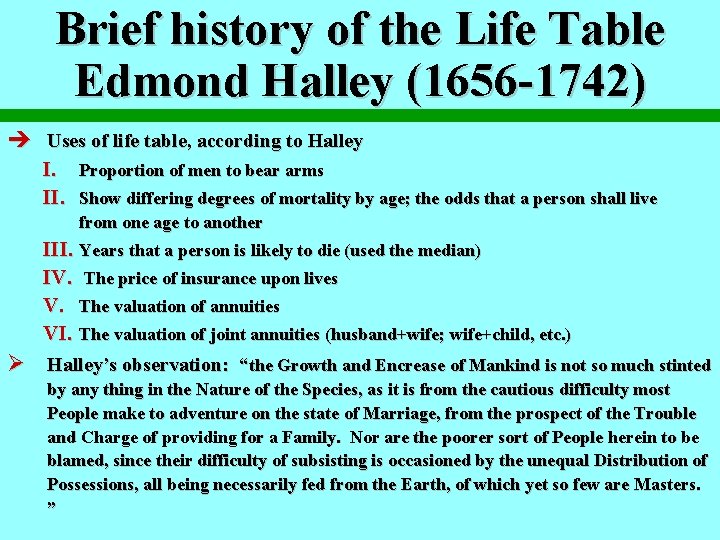
Brief history of the Life Table Edmond Halley (1656 -1742) è Uses of life table, according to Halley I. Proportion of men to bear arms II. Show differing degrees of mortality by age; the odds that a person shall live from one age to another III. Years that a person is likely to die (used the median) IV. The price of insurance upon lives V. The valuation of annuities VI. The valuation of joint annuities (husband+wife; wife+child, etc. ) Ø Halley’s observation: “the Growth and Encrease of Mankind is not so much stinted by any thing in the Nature of the Species, as it is from the cautious difficulty most People make to adventure on the state of Marriage, from the prospect of the Trouble and Charge of providing for a Family. Nor are the poorer sort of People herein to be blamed, since their difficulty of subsisting is occasioned by the unequal Distribution of Possessions, all being necessarily fed from the Earth, of which yet so few are Masters. ”
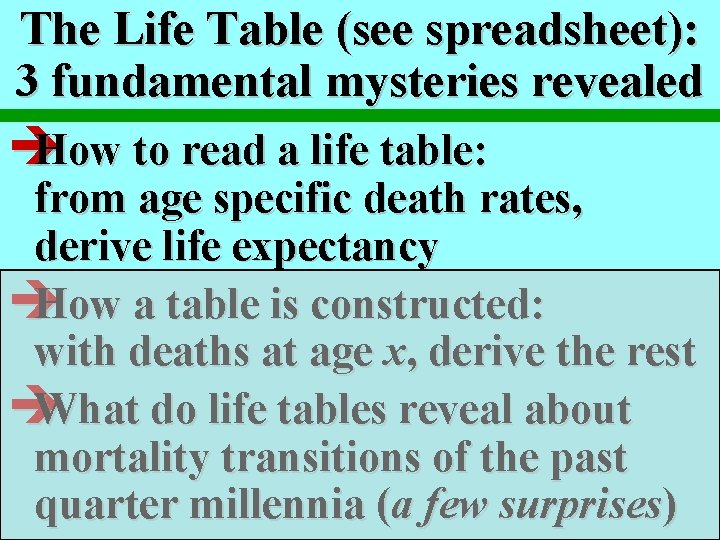
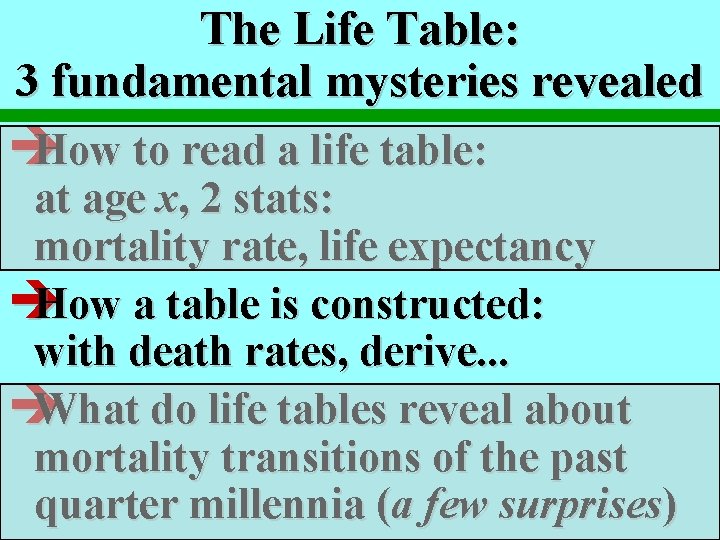
The Life Table (see spreadsheet): 3 fundamental mysteries revealed è How to read a life table: from age specific death rates, derive life expectancy è How a table is constructed: with deaths at age x, derive the rest è What do life tables reveal about mortality transitions of the past quarter millennia (a few surprises)

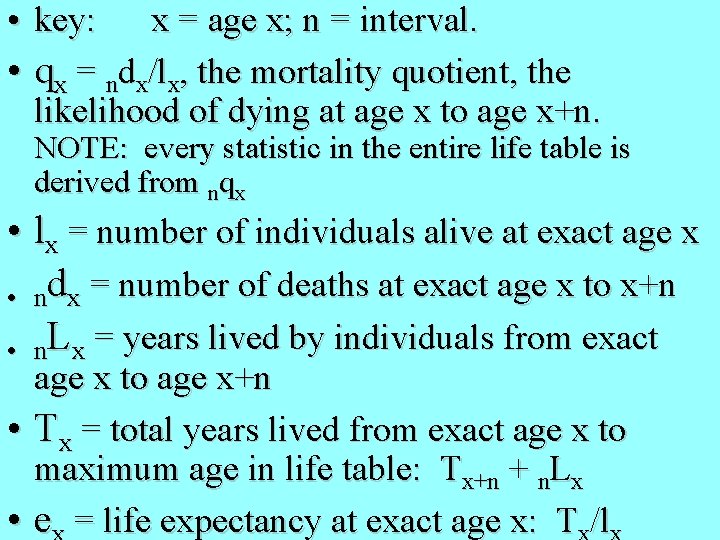
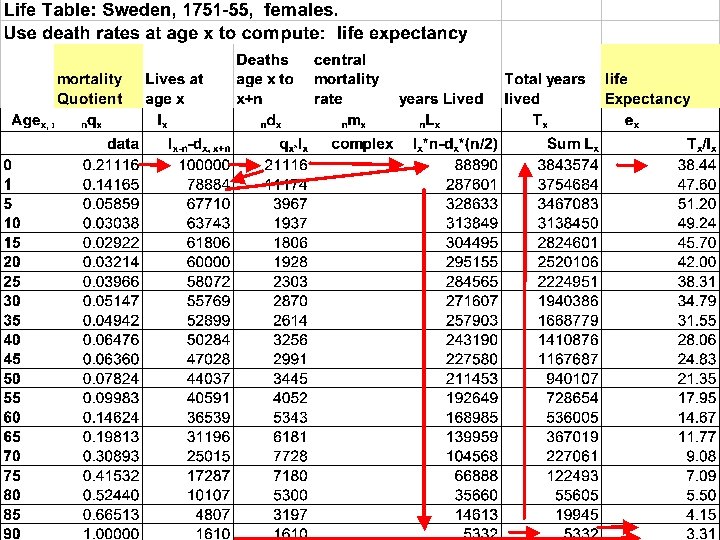
• key: x = age x; n = interval. • qx = ndx/lx, the mortality quotient, the likelihood of dying at age x to age x+n. NOTE: every statistic in the entire life table is derived from nqx • lx = number of individuals alive at exact age x • ndx = number of deaths at exact age x to x+n • n. Lx = years lived by individuals from exact age x to age x+n • Tx = total years lived from exact age x to maximum age in life table: Tx+n + n. Lx • e = life expectancy at exact age x: T /l
The Life Table: 3 fundamental mysteries revealed è How to read a life table: at age x, 2 stats: mortality rate, life expectancy è How a table is constructed: with death rates, derive. . . è What do life tables reveal about mortality transitions of the past quarter millennia (a few surprises)
The Life Table: 3 fundamental mysteries revealed è How to read a life table: at age x, 2 stats: mortality rate, life expectancy è How a table is constructed: with deaths at age x, derive the rest è What do life tables reveal about mortality transitions of the past quarter millennia (a few surprises)
Life table mortality probabilities and life expectancies in historical perspective: The case of Sweden, 1751 -1999
Changing demographic patterns of dying: Sweden, 1751 -1996 èIndicator: nqx, or mortality quotient ègraphics of nqx by: l age (0, 1, 5. . . 85+), l sex and l time (1751, 1851, 1996 -9)
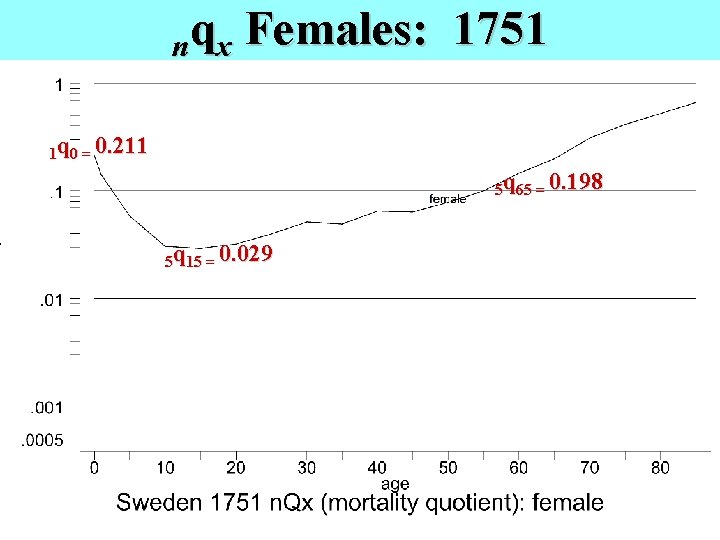
nq x Females: 1751 1 q 0 = 0. 211 5 q 65 = 0. 198 5 q 15 = 0. 029
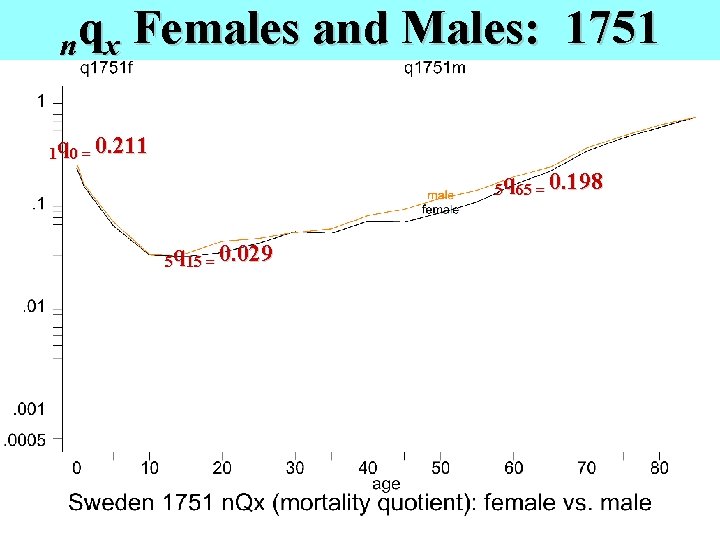
nq x Females and Males: 1751 1 q 0 = 0. 211 5 q 65 = 0. 198 5 q 15 = 0. 029
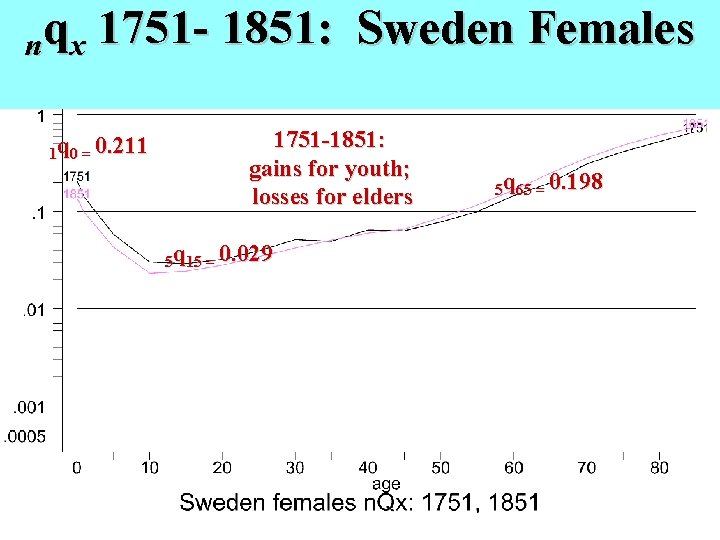
nq x 1751 - 1851: Sweden Females 1 q 0 = 0. 211 1751 -1851: gains for youth; losses for elders 5 q 15 = 0. 029 5 q 65 = 0. 198
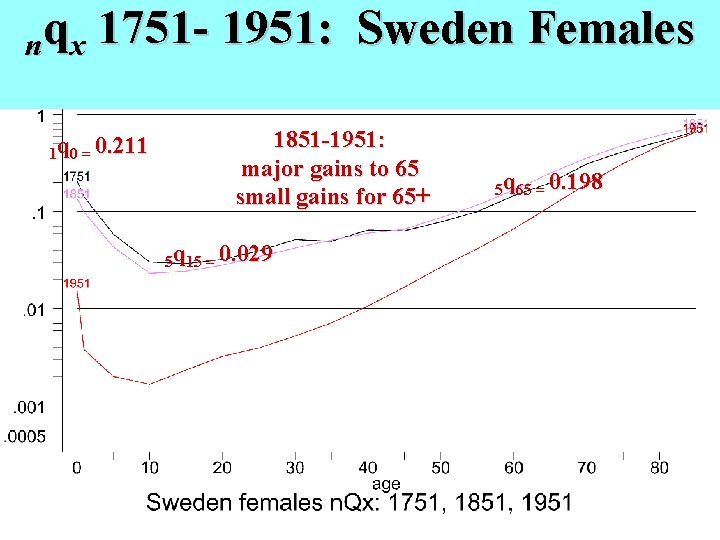
nq x 1751 - 1951: Sweden Females 1 q 0 = 0. 211 1851 -1951: major gains to 65 small gains for 65+ 5 q 15 = 0. 029 5 q 65 = 0. 198
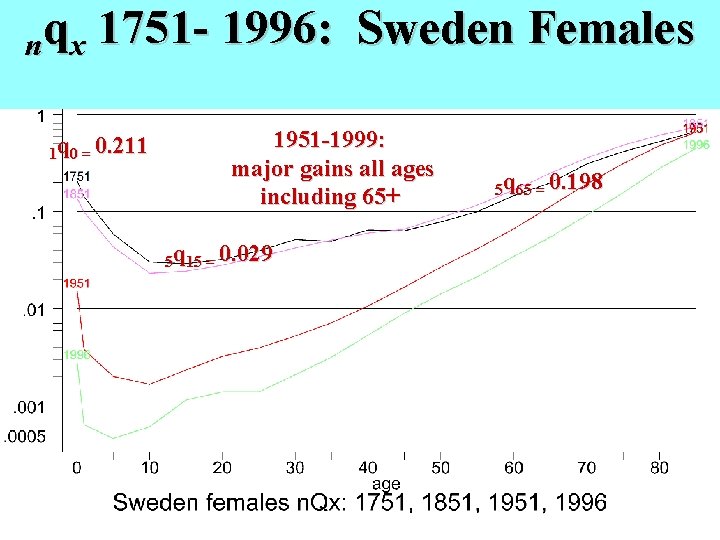
nq x 1751 - 1996: Sweden Females 1 q 0 = 0. 211 1951 -1999: major gains all ages including 65+ 5 q 15 = 0. 029 5 q 65 = 0. 198
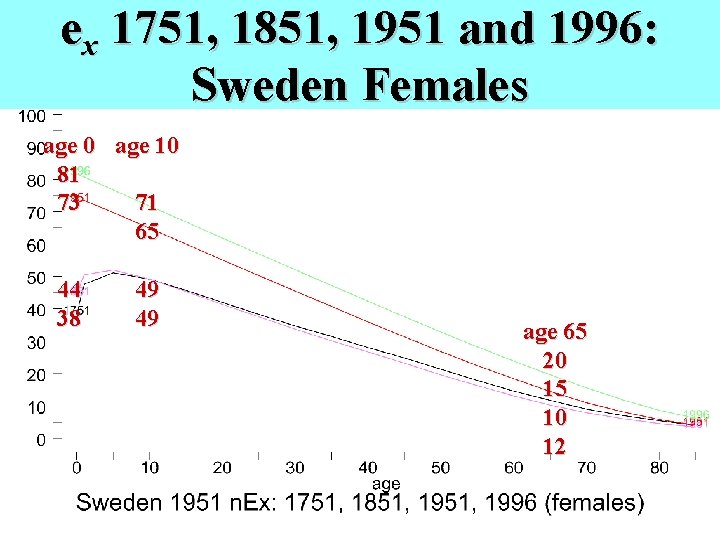
ex 1751, 1851, 1951 and 1996: Sweden Females age 0 age 10 81 73 71 65 44 38 49 49 age 65 20 15 10 12
Life expectancy and the mortality transition èFirst improvements: infant mortality; 1751 -1851: e 0 increases 6 years; e 65 decreases 2 years èSecond, 1851 -1951: infant and child mortality, e 0 increases 29 and e 10 16 years; e 65 increases 5 years èLast, 1951 -: e 0 increases 8 years; e 10 increases 6; e 65 increases 5 years.
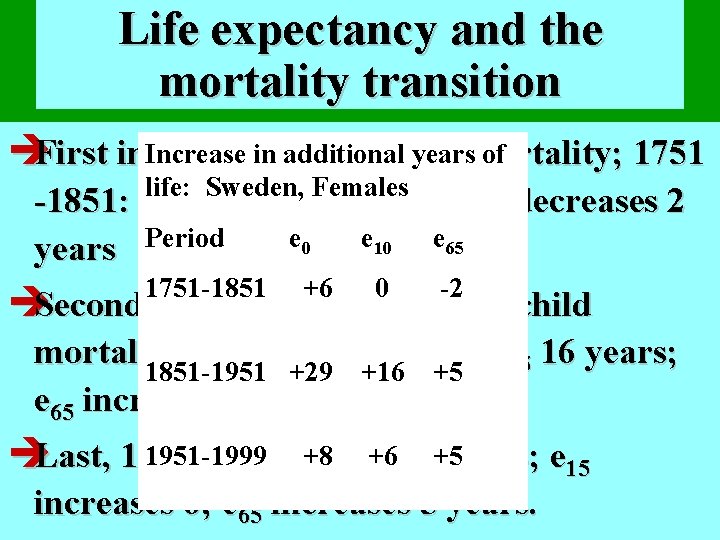
Life expectancy and the mortality transition Increase in additional yearsmortality; of èFirst improvements: infant 1751 life: Sweden, Females -1851: e 0 increases 6 years; e 65 decreases 2 e 0 e 10 e 65 years Period 1751 -1851 +6 0 -2 èSecond, 1851 -1951: infant and child mortality, e increases 29 and e 16 years; 0 15 1851 -1951 +29 +16 +5 e 65 increases 5 years 1951 -1999 +8 +6 8+5 èLast, 1951 -: e 0 increases years; e 15 increases 6; e 65 increases 5 years.
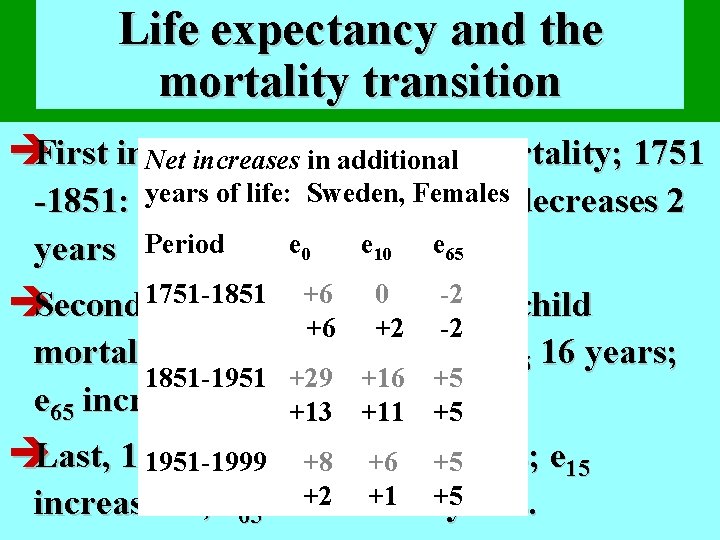
Life expectancy and the mortality transition èFirst improvements: infant mortality; 1751 Net increases in additional of life: Sweden, Females -1851: years e 0 increases 6 years; e 65 decreases 2 e 0 e 10 e 65 years Period +6 infant 0 -2 èSecond, 1751 -1851 -1951: and child +6 +2 -2 mortality, e 0 increases 29 and e 15 16 years; 1851 -1951 +29 +16 +5 e 65 increases 5 years +13 +11 +5 èLast, 1951 -: e 0 increases years; e 15 1951 -1999 +8 +6 8+5 +2 +1 5+5 increases 6; e 65 increases years.
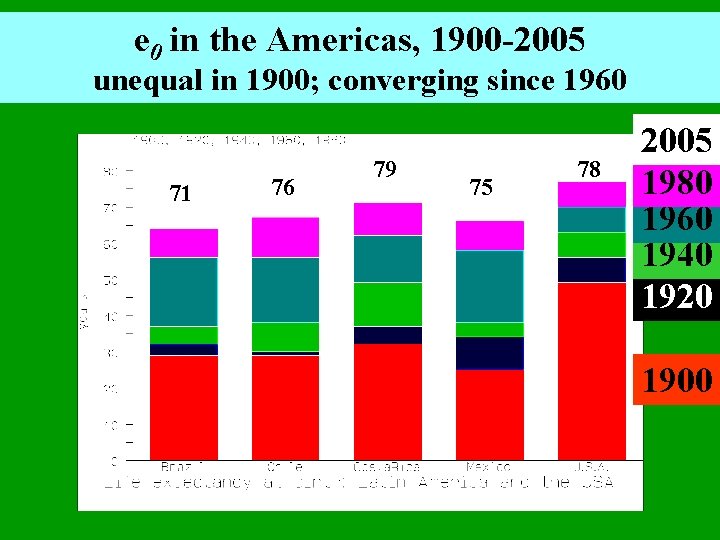
e 0 in the Americas, 1900 -2005 unequal in 1900; converging since 1960 71 76 79 75 78 2005 1980 1960 1940 1920 1900
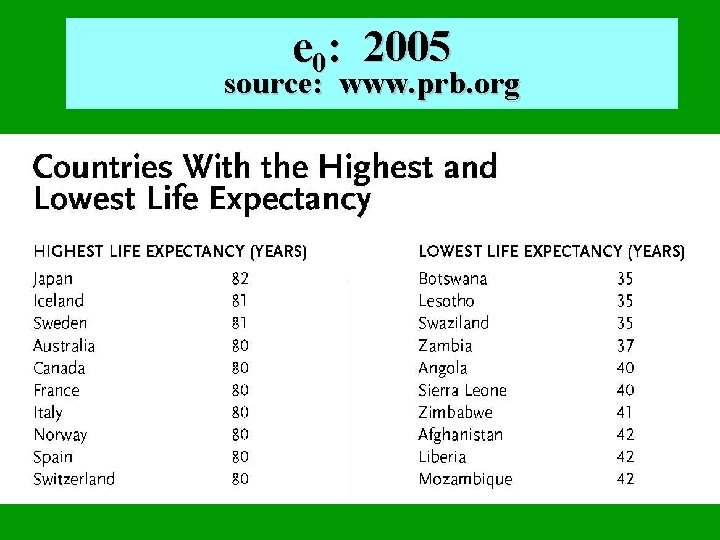
e 0: 2005 source: www. prb. org
End
- Slides: 26