
Mortality improvements in the next decade Discussion hosted

- Slides: 50
Mortality improvements in the next decade Discussion hosted by SIAS and the CMI Mortality Projections Committee 11 April 2017 Staple Inn Hall, London The views expressed in this presentation are those of the presenters and not necessarily those of their employers, the CMI or the Staple Inn Actuarial Society.
CMI • Wholly owned by Institute and Faculty of Actuaries • Independent executive and management Funded by subscription but free for academics and non-commercial research Mission To produce high-quality impartial analysis, standard tables and models of mortality and morbidity for long-term insurance products and pension scheme liabilities on behalf of subscribers and, in doing so, to further actuarial understanding. Our vision is to be regarded across the world as setting the benchmark for the quality, depth and breadth of analysis of industry-wide insurance company and pension scheme experience studies 11 April 2017 SIAS/CMI meeting – Mortality improvements in the next decade 2
Agenda 10 mins Introduction / scene setting 30 -40 mins Panel presentations with 5 to 10 mins per speaker Speaker Role Employer Richard Willets Expert Longevity Consultant Just Stephen Courquin Head of UK Actuarial Research RGA Re Steven Baxter Head of Longevity Innovation & Research Hymans Robertson Stuart Mc. Donald Head of Longevity Lloyds Banking Group 30 -40 mins Comments and questions from the floor 5 mins 11 April 2017 Wrap up / close SIAS/CMI meeting – Mortality improvements in the next decade 3
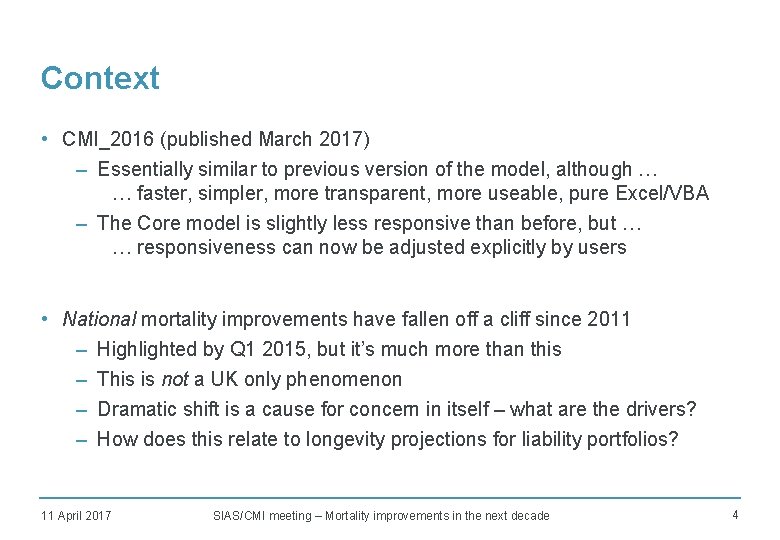
Context • CMI_2016 (published March 2017) – Essentially similar to previous version of the model, although … … faster, simpler, more transparent, more useable, pure Excel/VBA – The Core model is slightly less responsive than before, but … … responsiveness can now be adjusted explicitly by users • National mortality improvements have fallen off a cliff since 2011 – Highlighted by Q 1 2015, but it’s much more than this – This is not a UK only phenomenon – Dramatic shift is a cause for concern in itself – what are the drivers? – How does this relate to longevity projections for liability portfolios? 11 April 2017 SIAS/CMI meeting – Mortality improvements in the next decade 4
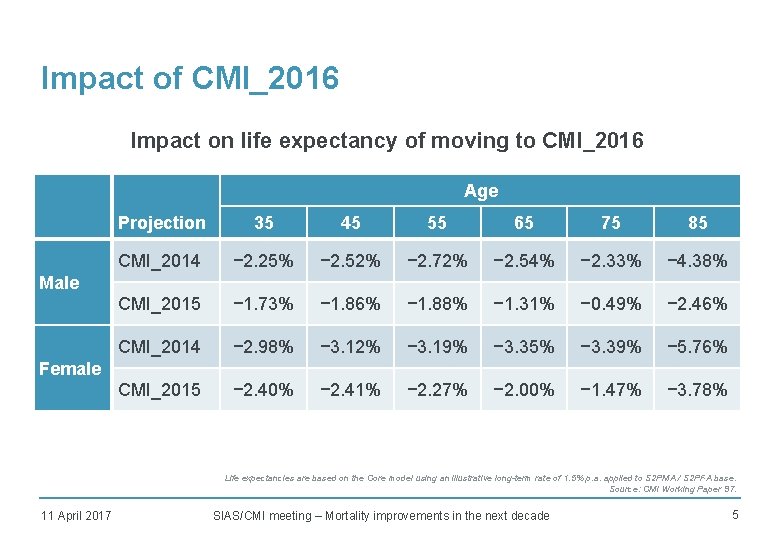
Impact of CMI_2016 Impact on life expectancy of moving to CMI_2016 Age Projection 35 45 55 65 75 85 CMI_2014 − 2. 25% − 2. 52% − 2. 72% − 2. 54% − 2. 33% − 4. 38% CMI_2015 − 1. 73% − 1. 86% − 1. 88% − 1. 31% − 0. 49% − 2. 46% CMI_2014 − 2. 98% − 3. 12% − 3. 19% − 3. 35% − 3. 39% − 5. 76% CMI_2015 − 2. 40% − 2. 41% − 2. 27% − 2. 00% − 1. 47% − 3. 78% Male Female Life expectancies are based on the Core model using an illustrative long-term rate of 1. 5% p. a. applied to S 2 PMA / S 2 PFA base. Source: CMI Working Paper 97. 11 April 2017 SIAS/CMI meeting – Mortality improvements in the next decade 5
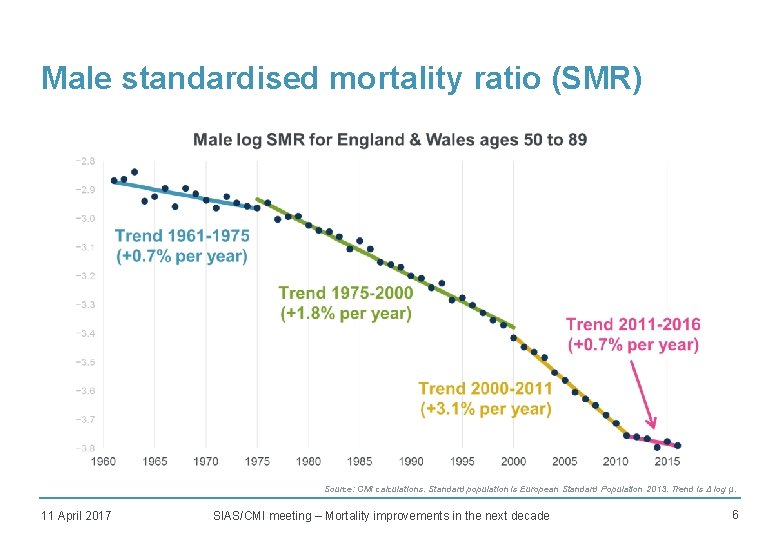
Male standardised mortality ratio (SMR) Source: CMI calculations. Standard population is European Standard Population 2013. Trend is Δ log μ. 11 April 2017 SIAS/CMI meeting – Mortality improvements in the next decade 6
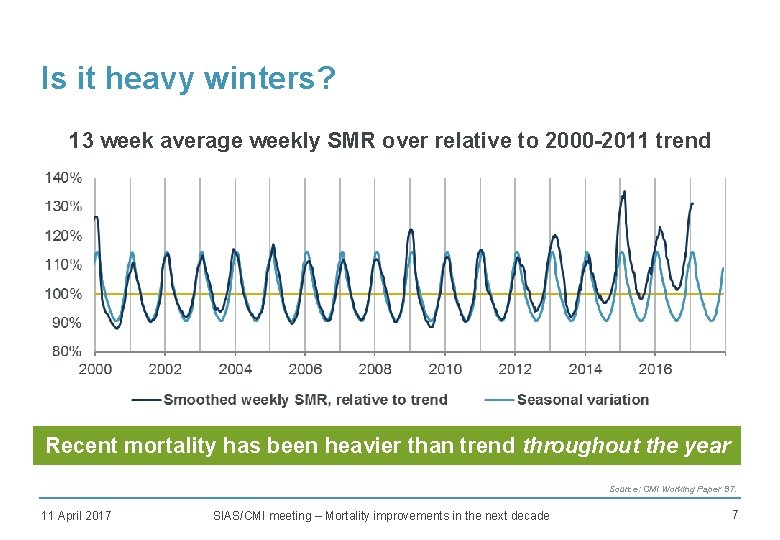
Is it heavy winters? 13 week average weekly SMR over relative to 2000 -2011 trend Recent mortality has been heavier than trend throughout the year Source: CMI Working Paper 97. 11 April 2017 SIAS/CMI meeting – Mortality improvements in the next decade 7
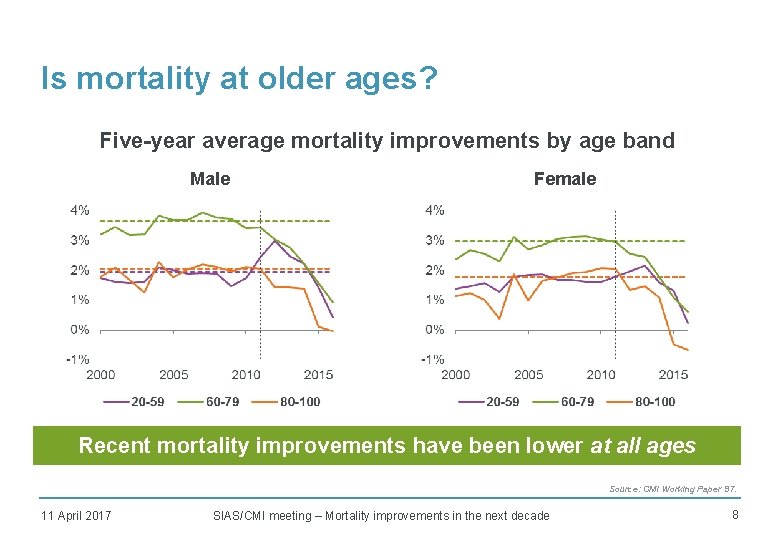
Is mortality at older ages? Five-year average mortality improvements by age band Male Female Recent mortality improvements have been lower at all ages Source: CMI Working Paper 97. 11 April 2017 SIAS/CMI meeting – Mortality improvements in the next decade 8
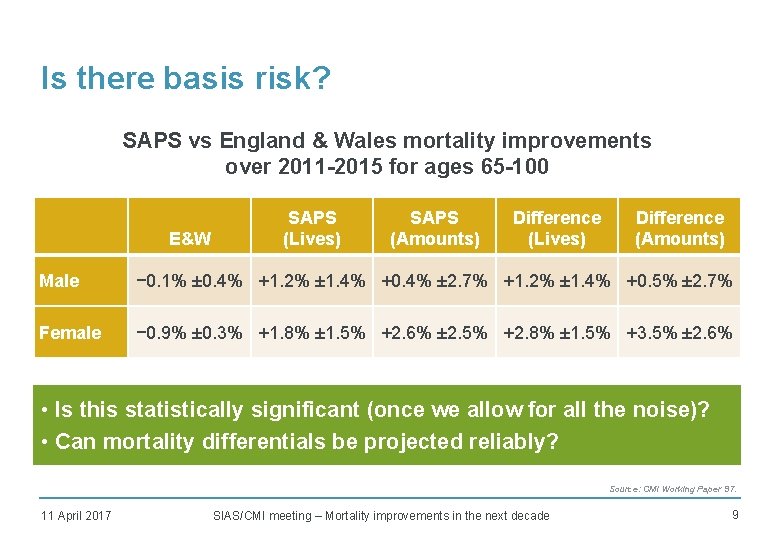
Is there basis risk? SAPS vs England & Wales mortality improvements over 2011 -2015 for ages 65 -100 E&W SAPS (Lives) SAPS (Amounts) Difference (Lives) Difference (Amounts) Male − 0. 1% ± 0. 4% +1. 2% ± 1. 4% +0. 4% ± 2. 7% +1. 2% ± 1. 4% +0. 5% ± 2. 7% Female − 0. 9% ± 0. 3% +1. 8% ± 1. 5% +2. 6% ± 2. 5% +2. 8% ± 1. 5% +3. 5% ± 2. 6% • Is this statistically significant (once we allow for all the noise)? • Can mortality differentials be projected reliably? Source: CMI Working Paper 97. 11 April 2017 SIAS/CMI meeting – Mortality improvements in the next decade 9
Key questions 1. Is the recent fall in national mortality improvements a blip or persistent? 2. How do we value specific portfolios? 11 April 2017 SIAS/CMI meeting – Mortality improvements in the next decade 10
Richard Willets Expert Longevity Consultant Just 11 April 2017 SIAS/CMI meeting – Mortality improvements in the next decade 11
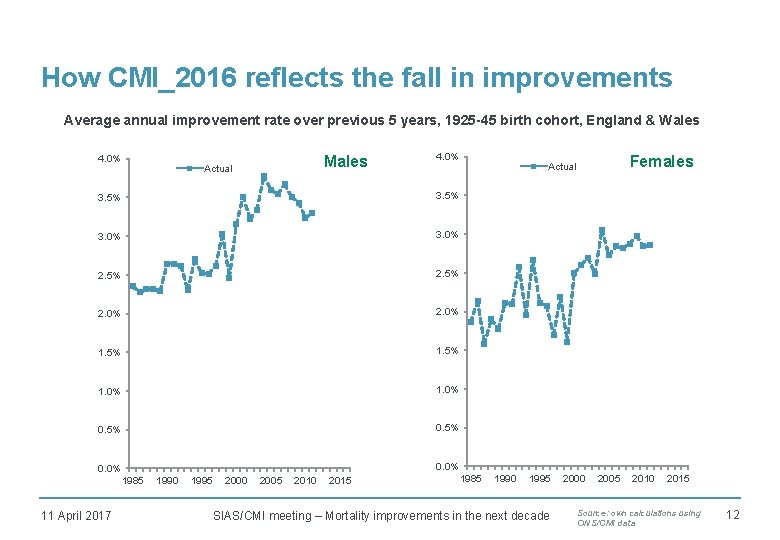
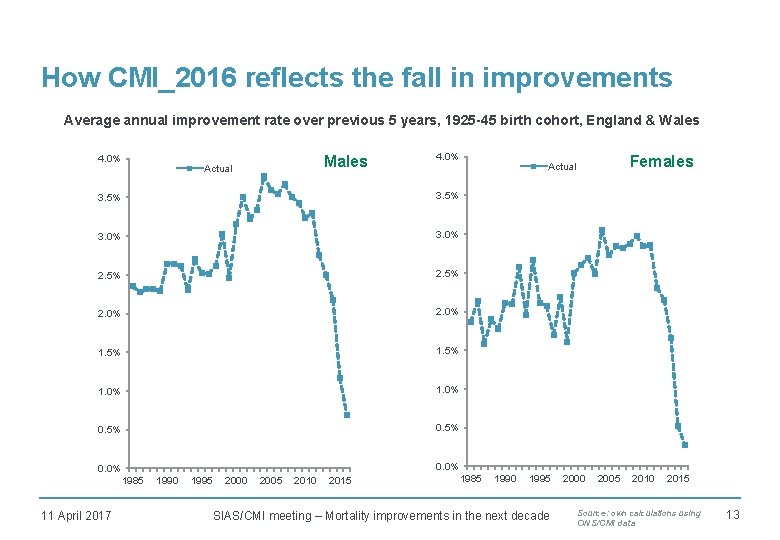
How CMI_2016 reflects the fall in improvements Average annual improvement rate over previous 5 years, 1925 -45 birth cohort, England & Wales 4. 0% Males Actual 4. 0% 3. 5% 3. 0% 2. 5% 2. 0% 1. 5% 1. 0% 0. 5% 0. 0% 1985 11 April 2017 Females Actual 1990 1995 2000 2005 2010 2015 1985 1990 1995 SIAS/CMI meeting – Mortality improvements in the next decade 2000 2005 2010 2015 Source: own calculations using ONS/CMI data 12
How CMI_2016 reflects the fall in improvements Average annual improvement rate over previous 5 years, 1925 -45 birth cohort, England & Wales 4. 0% Males Actual 4. 0% 3. 5% 3. 0% 2. 5% 2. 0% 1. 5% 1. 0% 0. 5% 0. 0% 1985 11 April 2017 Females Actual 1990 1995 2000 2005 2010 2015 1985 1990 1995 SIAS/CMI meeting – Mortality improvements in the next decade 2000 2005 2010 2015 Source: own calculations using ONS/CMI data 13
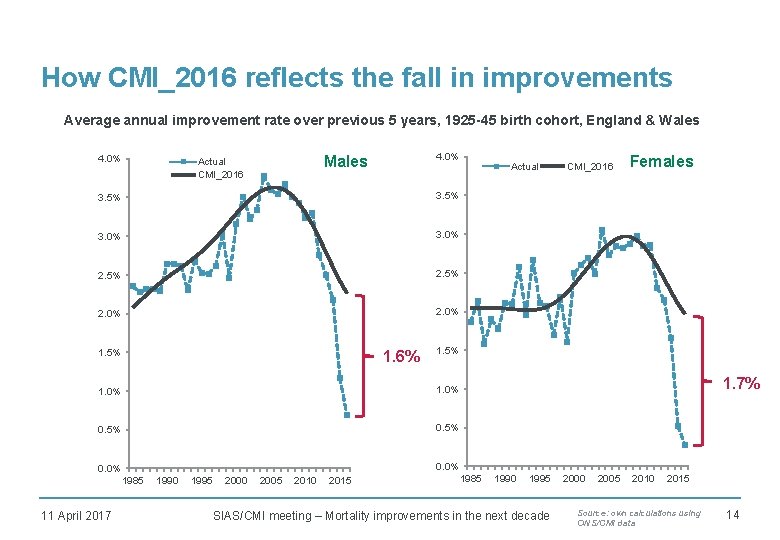
How CMI_2016 reflects the fall in improvements Average annual improvement rate over previous 5 years, 1925 -45 birth cohort, England & Wales 4. 0% Males Actual CMI_2016 3. 5% 3. 0% 2. 5% 2. 0% 1. 5% 1. 6% CMI_2016 Females 1. 5% 1. 0% 0. 5% 1. 7% 0. 0% 1985 11 April 2017 Actual 1990 1995 2000 2005 2010 2015 1985 1990 1995 SIAS/CMI meeting – Mortality improvements in the next decade 2000 2005 2010 2015 Source: own calculations using ONS/CMI data 14
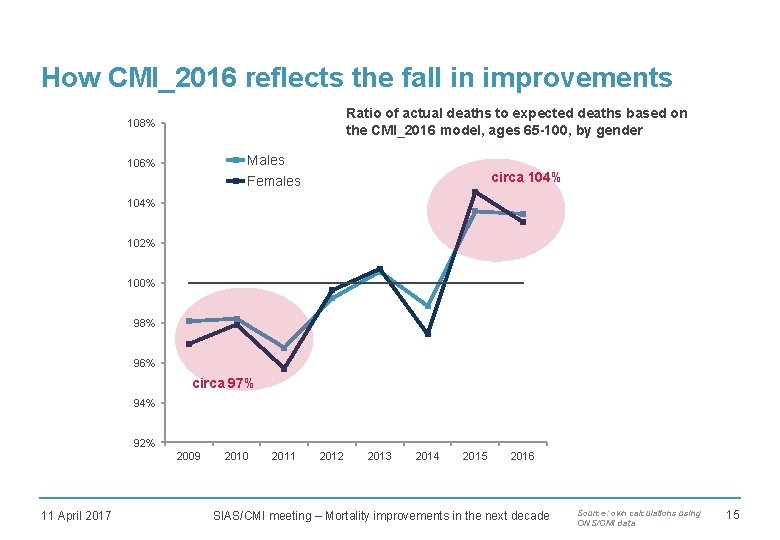
How CMI_2016 reflects the fall in improvements Ratio of actual deaths to expected deaths based on the CMI_2016 model, ages 65 -100, by gender 108% Males 106% circa 104% Females 104% 102% 100% 98% 96% circa 97% 94% 92% 2009 11 April 2017 2010 2011 2012 2013 2014 2015 2016 SIAS/CMI meeting – Mortality improvements in the next decade Source: own calculations using ONS/CMI data 15
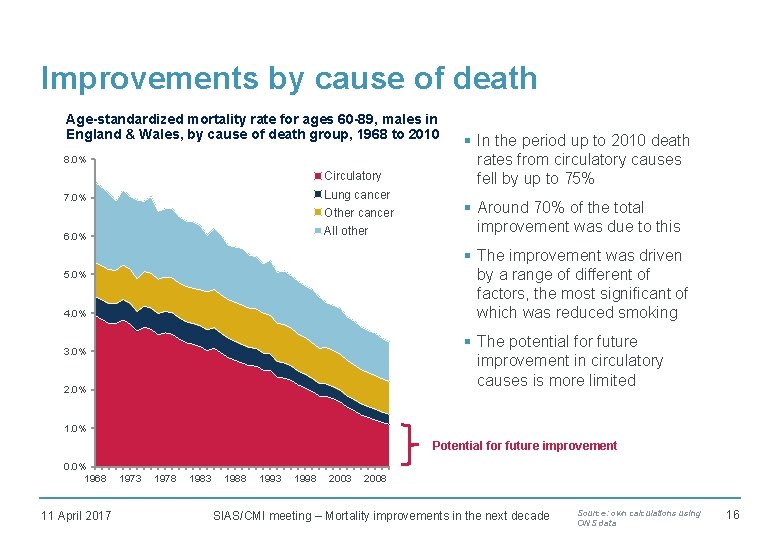
Improvements by cause of death Age-standardized mortality rate for ages 60 -89, males in England & Wales, by cause of death group, 1968 to 2010 8. 0% Circulatory Lung cancer 7. 0% Other cancer All other 6. 0% § In the period up to 2010 death rates from circulatory causes fell by up to 75% § Around 70% of the total improvement was due to this § The improvement was driven by a range of different of factors, the most significant of which was reduced smoking 5. 0% 4. 0% § The potential for future improvement in circulatory causes is more limited 3. 0% 2. 0% 1. 0% Potential for future improvement 0. 0% 1968 11 April 2017 1973 1978 1983 1988 1993 1998 2003 2008 SIAS/CMI meeting – Mortality improvements in the next decade Source: own calculations using ONS data 16
Improvements by cause of death 3. 5% Average annual rate of improvement for ages 60 -89, males in England & Wales, decomposed by cause of death group, 1968 to 2015 Total = 2. 9% 3. 0% Total = 3. 0% Circulatory Lung cancer 2. 5% Other cancer 1. 5% All other Total = 1. 7% 2. 0% Total = 1. 1% 1. 0% 0. 5% 0. 0% -0. 5% -1. 0% 1968 -1983 11 April 2017 1984 -1992 1993 -2000 2001 -2010 2011 -15 SIAS/CMI meeting – Mortality improvements in the next decade Source: own calculations using ONS data 17
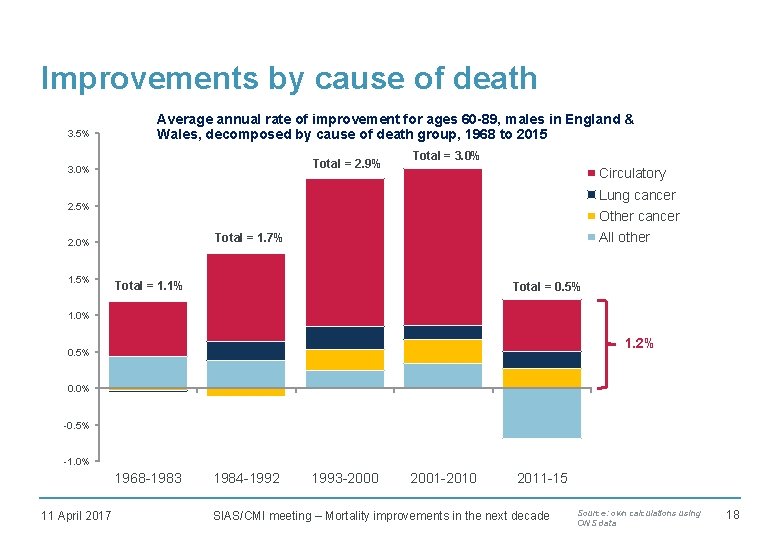
Improvements by cause of death 3. 5% Average annual rate of improvement for ages 60 -89, males in England & Wales, decomposed by cause of death group, 1968 to 2015 Total = 2. 9% 3. 0% Total = 3. 0% Circulatory Lung cancer 2. 5% Other cancer 1. 5% All other Total = 1. 7% 2. 0% Total = 1. 1% Total = 0. 5% 1. 0% 1. 2% 0. 5% 0. 0% -0. 5% -1. 0% 1968 -1983 11 April 2017 1984 -1992 1993 -2000 2001 -2010 2011 -15 SIAS/CMI meeting – Mortality improvements in the next decade Source: own calculations using ONS data 18
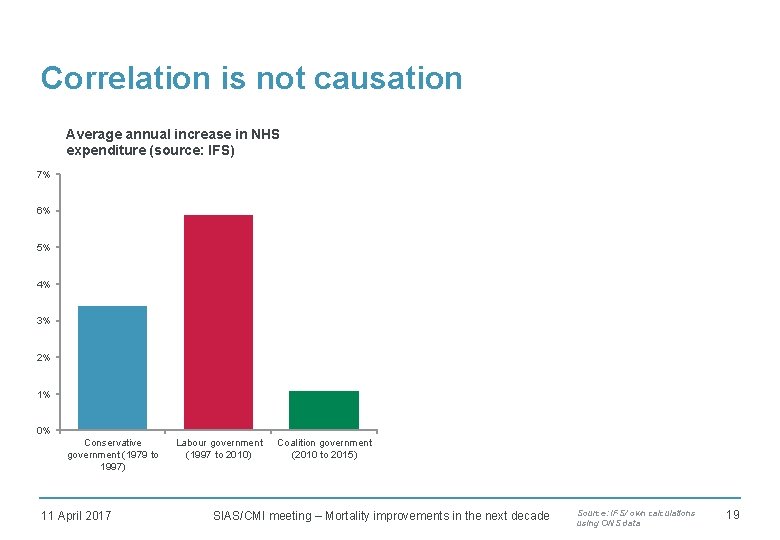
Correlation is not causation Average annual increase in NHS expenditure (source: IFS) 7% 6% 5% 4% 3% 2% 1% 0% Conservative government (1979 to 1997) 11 April 2017 Labour government (1997 to 2010) Coalition government (2010 to 2015) SIAS/CMI meeting – Mortality improvements in the next decade Source: IFS/ own calculations using ONS data 19
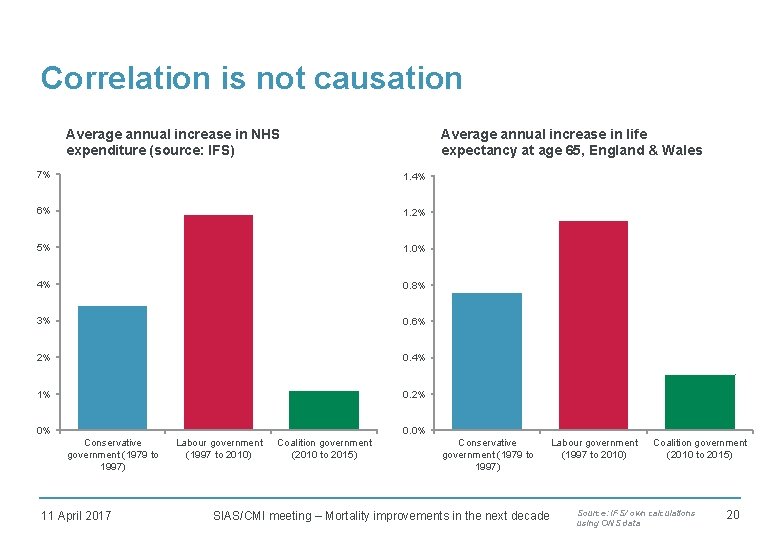
Correlation is not causation Average annual increase in NHS expenditure (source: IFS) Average annual increase in life expectancy at age 65, England & Wales 7% 1. 4% 6% 1. 2% 5% 1. 0% 4% 0. 8% 3% 0. 6% 2% 0. 4% 1% 0. 2% 0. 0% 0% Conservative government (1979 to 1997) 11 April 2017 Labour government (1997 to 2010) Coalition government (2010 to 2015) Conservative government (1979 to 1997) SIAS/CMI meeting – Mortality improvements in the next decade Labour government (1997 to 2010) Coalition government (2010 to 2015) Source: IFS/ own calculations using ONS data 20
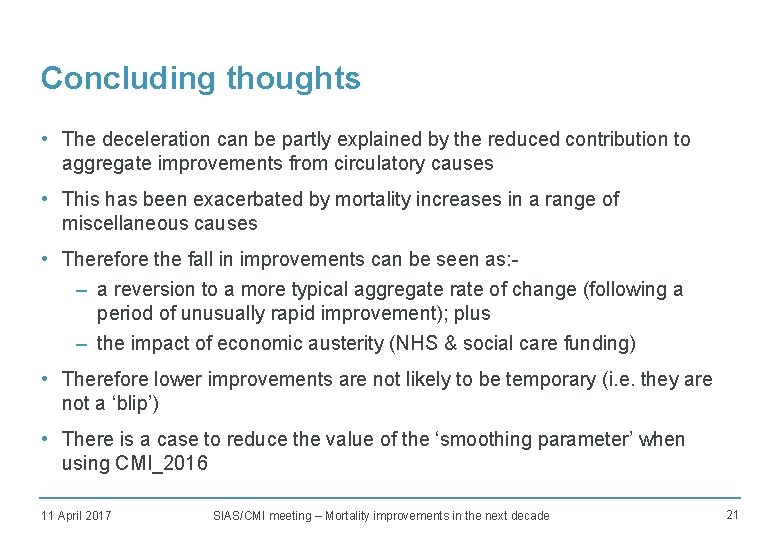
Concluding thoughts • The deceleration can be partly explained by the reduced contribution to aggregate improvements from circulatory causes • This has been exacerbated by mortality increases in a range of miscellaneous causes • Therefore the fall in improvements can be seen as: – a reversion to a more typical aggregate rate of change (following a period of unusually rapid improvement); plus – the impact of economic austerity (NHS & social care funding) • Therefore lower improvements are not likely to be temporary (i. e. they are not a ‘blip’) • There is a case to reduce the value of the ‘smoothing parameter’ when using CMI_2016 11 April 2017 SIAS/CMI meeting – Mortality improvements in the next decade 21
Stephen Courquin Head of UK Actuarial Research RGA Re 11 April 2017 SIAS/CMI meeting – Mortality improvements in the next decade 22
Discussion points • Trends by socioeconomic group • International comparisons 11 April 2017 SIAS/CMI meeting – Mortality improvements in the next decade 23
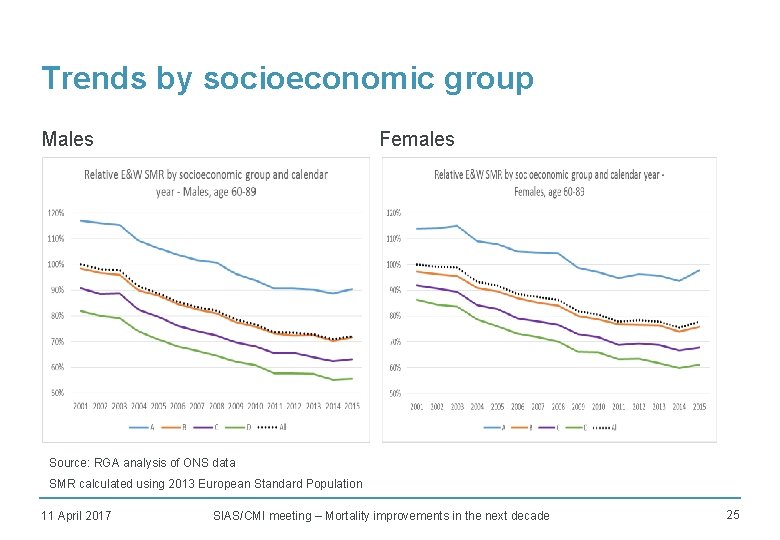
Trends by socioeconomic group • Financial liabilities in pension schemes and insurance companies will tend to be skewed towards the higher socioeconomic groups • Investigated trends by socioeconomic group in England & Wales using population data between 2001 and 2015 • Exposure & death data split by: – Single age (0 -89) – Gender – Lower super output area (LSOA) – Approx 35, 000 in E&W • Mapped each LSOA to various indices linked to socioeconomic status • Results shown are based on splitting data into four groups of increasing affluence (A – lower SEG, D – higher SEG) 11 April 2017 SIAS/CMI meeting – Mortality improvements in the next decade 24
Trends by socioeconomic group Males Females Source: RGA analysis of ONS data SMR calculated using 2013 European Standard Population 11 April 2017 SIAS/CMI meeting – Mortality improvements in the next decade 25
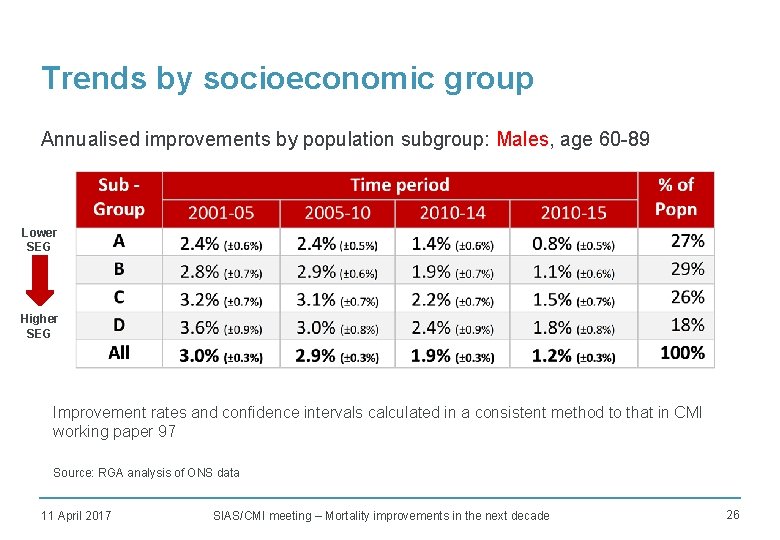
Trends by socioeconomic group Annualised improvements by population subgroup: Males, age 60 -89 Lower SEG Higher SEG Improvement rates and confidence intervals calculated in a consistent method to that in CMI working paper 97 Source: RGA analysis of ONS data 11 April 2017 SIAS/CMI meeting – Mortality improvements in the next decade 26
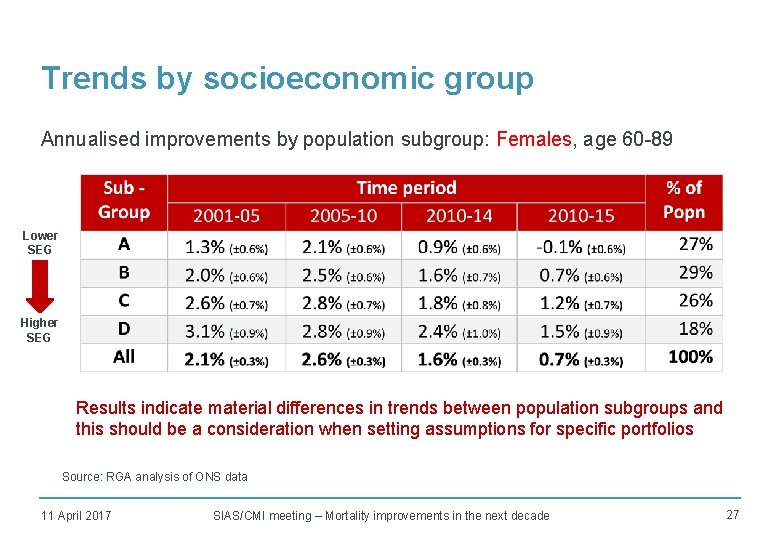
Trends by socioeconomic group Annualised improvements by population subgroup: Females, age 60 -89 Lower SEG Higher SEG Results indicate material differences in trends between population subgroups and this should be a consideration when setting assumptions for specific portfolios Source: RGA analysis of ONS data 11 April 2017 SIAS/CMI meeting – Mortality improvements in the next decade 27
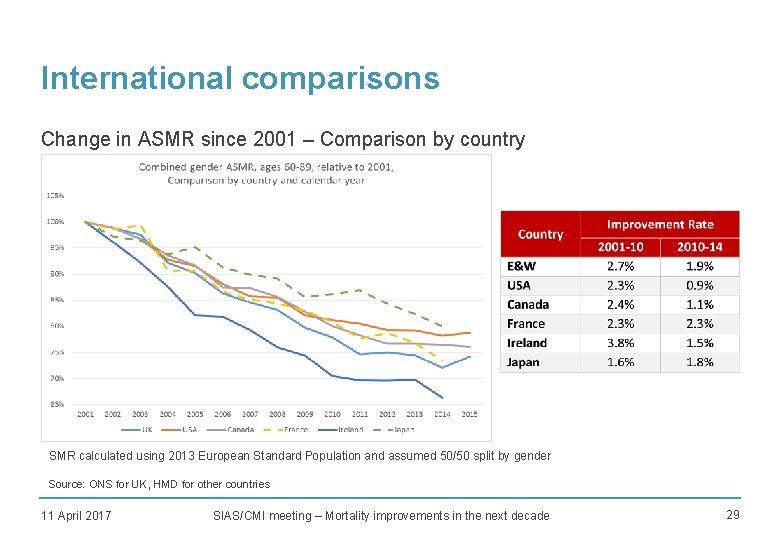
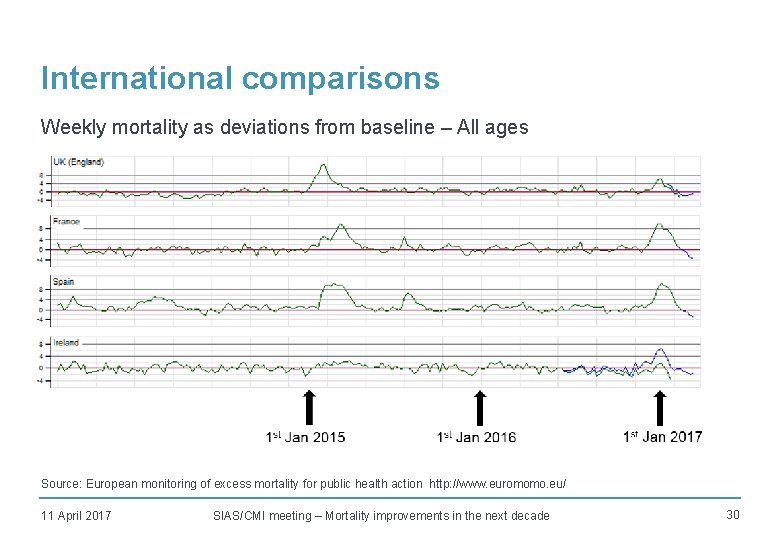
International comparisons • Are other countries in Europe and across the world also experiencing similar changes in trends? • Understanding what has happened elsewhere may provide insight into the recent UK trends and their future path 11 April 2017 SIAS/CMI meeting – Mortality improvements in the next decade 28
International comparisons Change in ASMR since 2001 – Comparison by country SMR calculated using 2013 European Standard Population and assumed 50/50 split by gender Source: ONS for UK, HMD for other countries 11 April 2017 SIAS/CMI meeting – Mortality improvements in the next decade 29
International comparisons Weekly mortality as deviations from baseline – All ages Source: European monitoring of excess mortality for public health action http: //www. euromomo. eu/ 11 April 2017 SIAS/CMI meeting – Mortality improvements in the next decade 30
Steven Baxter Head of Longevity Innovation & Research Hymans Robertson 11 April 2017 SIAS/CMI meeting – Mortality improvements in the next decade 31
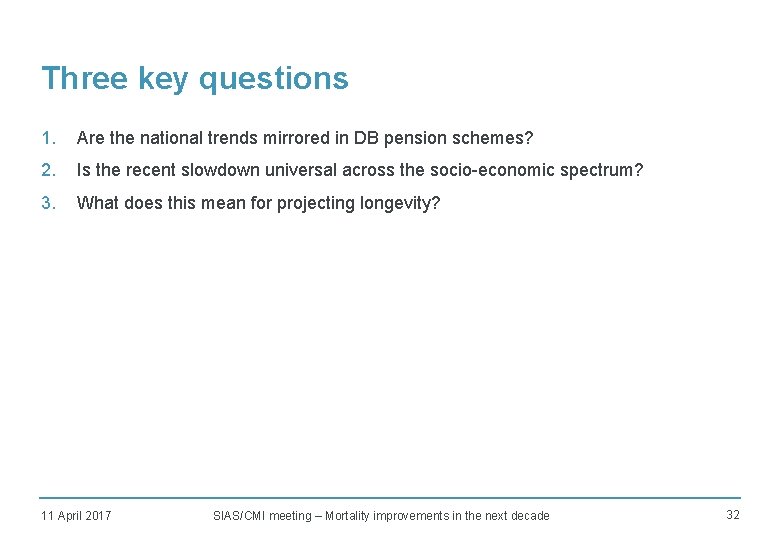
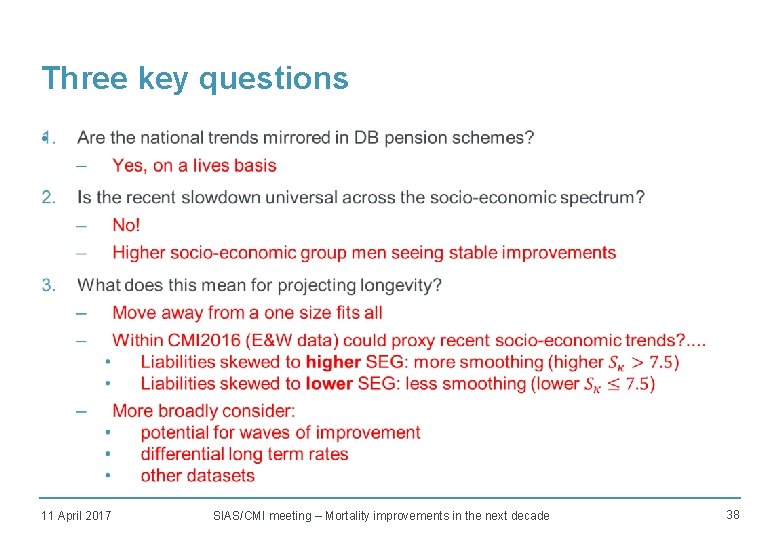
Three key questions 1. Are the national trends mirrored in DB pension schemes? 2. Is the recent slowdown universal across the socio-economic spectrum? 3. What does this mean for projecting longevity? 11 April 2017 SIAS/CMI meeting – Mortality improvements in the next decade 32
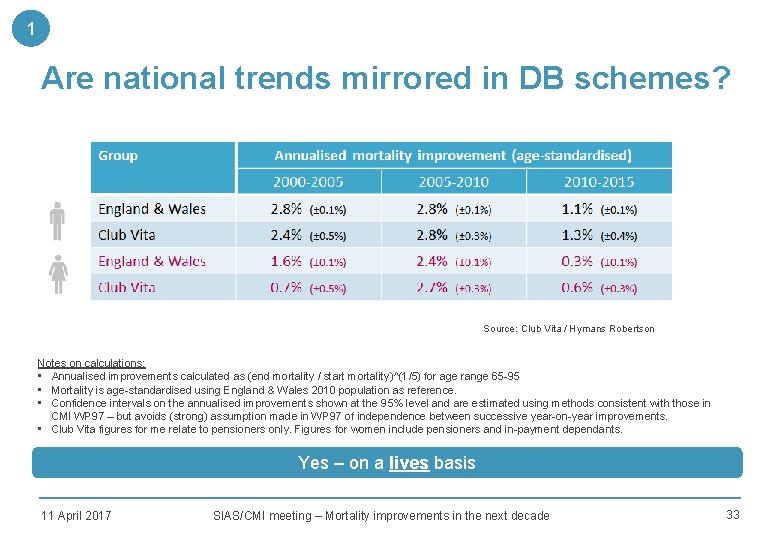
1 Are national trends mirrored in DB schemes? Source: Club Vita / Hymans Robertson Notes on calculations: • Annualised improvements calculated as (end mortality / start mortality)^(1/5) for age range 65 -95 • Mortality is age-standardised using England & Wales 2010 population as reference. • Confidence intervals on the annualised improvements shown at the 95% level and are estimated using methods consistent with those in CMI WP 97 – but avoids (strong) assumption made in WP 97 of independence between successive year-on-year improvements. • Club Vita figures for me relate to pensioners only. Figures for women include pensioners and in-payment dependants. Yes – on a lives basis 11 April 2017 SIAS/CMI meeting – Mortality improvements in the next decade 33
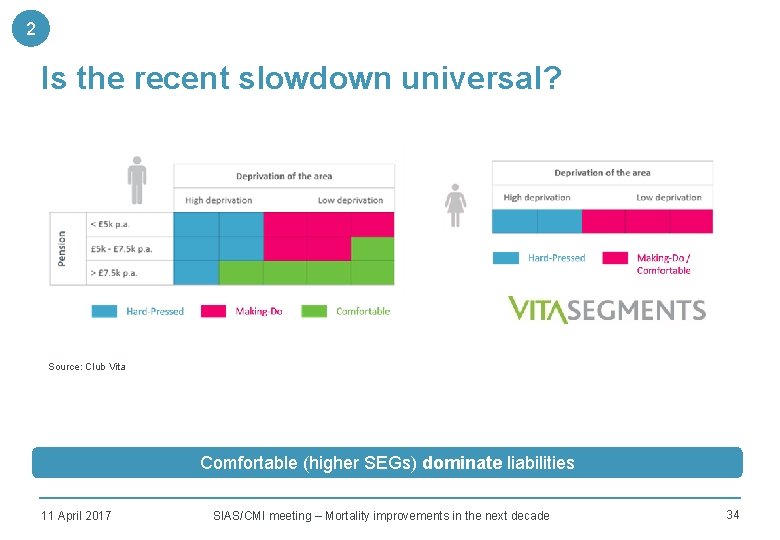
2 Is the recent slowdown universal? Source: Club Vita Comfortable (higher SEGs) dominate liabilities 11 April 2017 SIAS/CMI meeting – Mortality improvements in the next decade 34
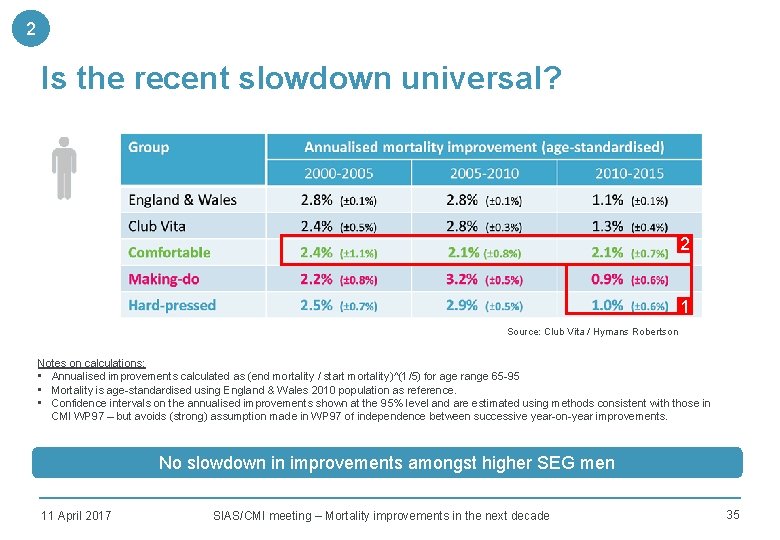
2 Is the recent slowdown universal? 2 1 Source: Club Vita / Hymans Robertson Notes on calculations: • Annualised improvements calculated as (end mortality / start mortality)^(1/5) for age range 65 -95 • Mortality is age-standardised using England & Wales 2010 population as reference. • Confidence intervals on the annualised improvements shown at the 95% level and are estimated using methods consistent with those in CMI WP 97 – but avoids (strong) assumption made in WP 97 of independence between successive year-on-year improvements. No slowdown in improvements amongst higher SEG men 11 April 2017 SIAS/CMI meeting – Mortality improvements in the next decade 35
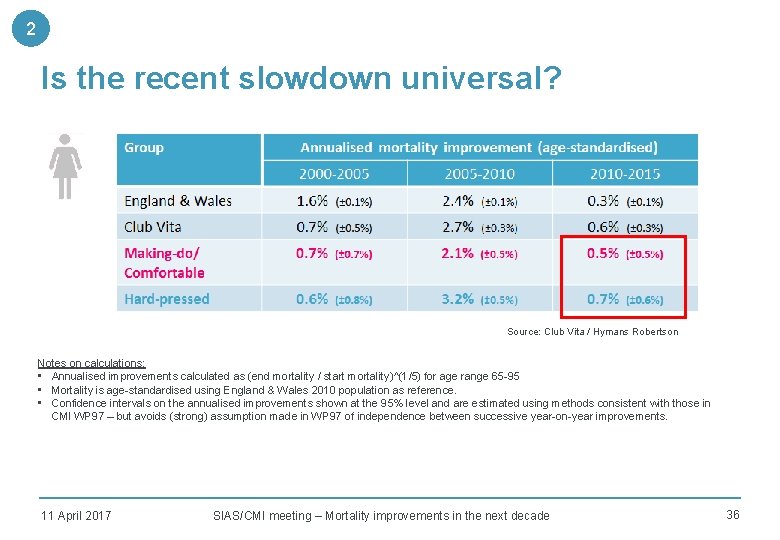
2 Is the recent slowdown universal? Source: Club Vita / Hymans Robertson Notes on calculations: • Annualised improvements calculated as (end mortality / start mortality)^(1/5) for age range 65 -95 • Mortality is age-standardised using England & Wales 2010 population as reference. • Confidence intervals on the annualised improvements shown at the 95% level and are estimated using methods consistent with those in CMI WP 97 – but avoids (strong) assumption made in WP 97 of independence between successive year-on-year improvements. 11 April 2017 SIAS/CMI meeting – Mortality improvements in the next decade 36
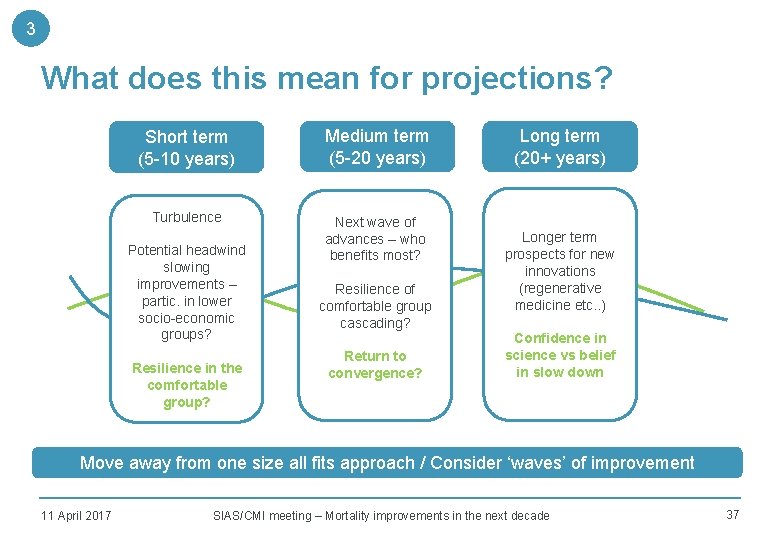
3 What does this mean for projections? Short term (5 -10 years) Medium term (5 -20 years) Turbulence Next wave of advances – who benefits most? Potential headwind slowing improvements – partic. in lower socio-economic groups? Resilience in the comfortable group? Resilience of comfortable group cascading? Return to convergence? Long term (20+ years) Longer term prospects for new innovations (regenerative medicine etc. . ) Confidence in science vs belief in slow down Move away from one size all fits approach / Consider ‘waves’ of improvement 11 April 2017 SIAS/CMI meeting – Mortality improvements in the next decade 37
Three key questions • 11 April 2017 SIAS/CMI meeting – Mortality improvements in the next decade 38
Stuart Mc. Donald Head of Longevity Lloyds Banking Group 11 April 2017 SIAS/CMI meeting – Mortality improvements in the next decade 39
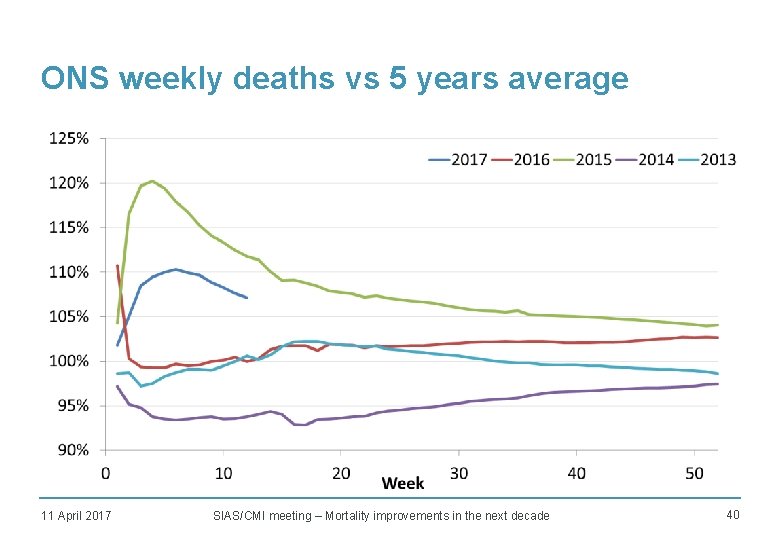
ONS weekly deaths vs 5 years average • TBC 11 April 2017 SIAS/CMI meeting – Mortality improvements in the next decade 40
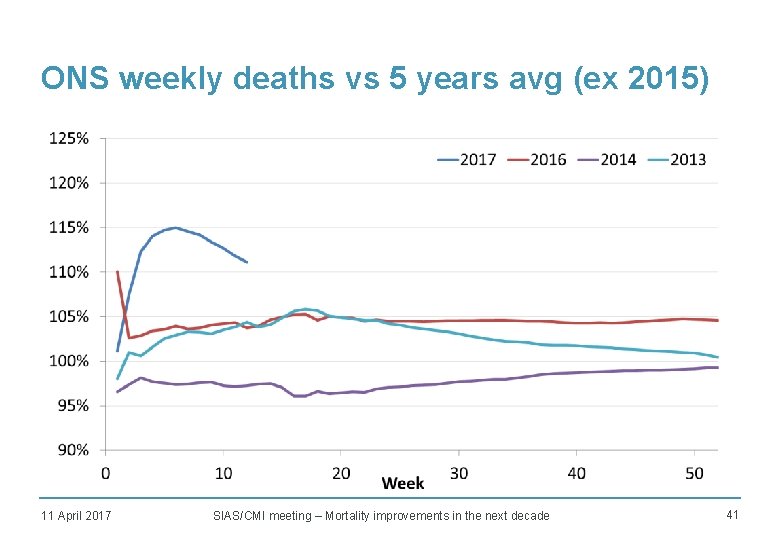
ONS weekly deaths vs 5 years avg (ex 2015) • TBC 11 April 2017 SIAS/CMI meeting – Mortality improvements in the next decade 41
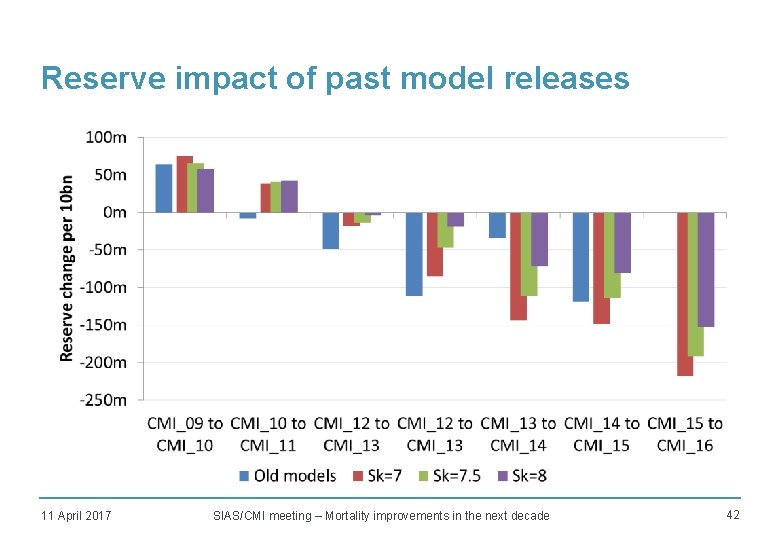
Reserve impact of past model releases • TBC 11 April 2017 SIAS/CMI meeting – Mortality improvements in the next decade 42
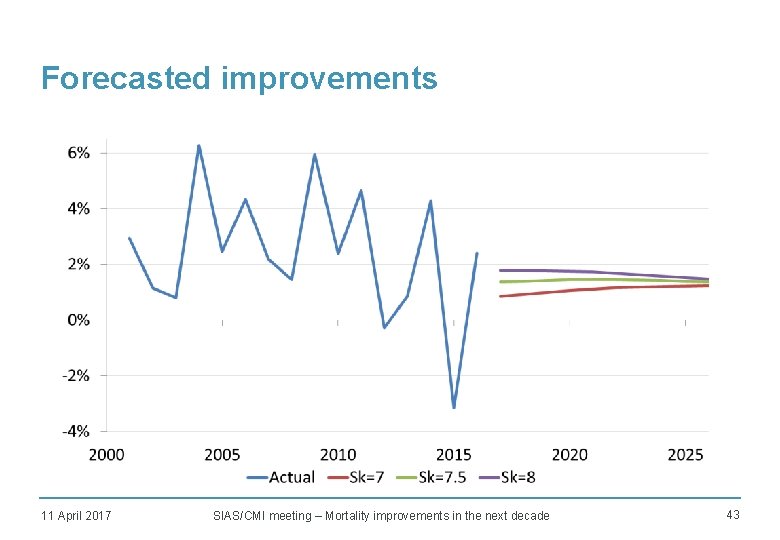
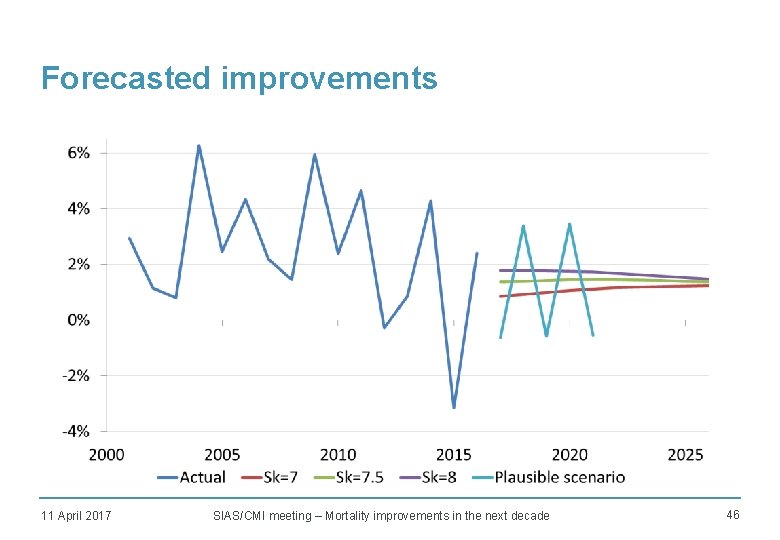
Forecasted improvements • TBC 11 April 2017 SIAS/CMI meeting – Mortality improvements in the next decade 43
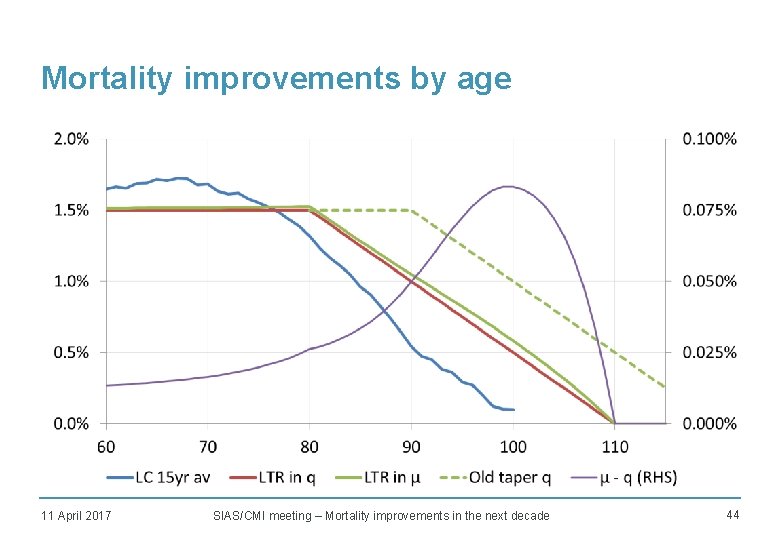
Mortality improvements by age • TBC 11 April 2017 SIAS/CMI meeting – Mortality improvements in the next decade 44
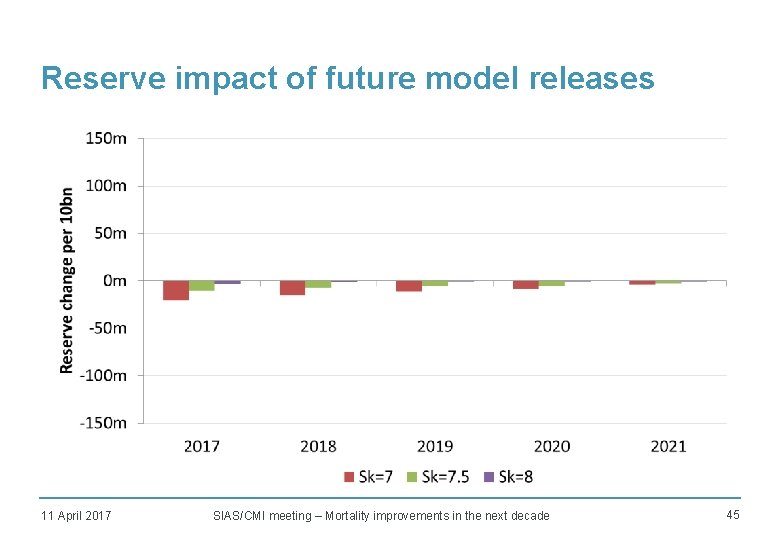
Reserve impact of future model releases • TBC 11 April 2017 SIAS/CMI meeting – Mortality improvements in the next decade 45
Forecasted improvements • TBC 11 April 2017 SIAS/CMI meeting – Mortality improvements in the next decade 46
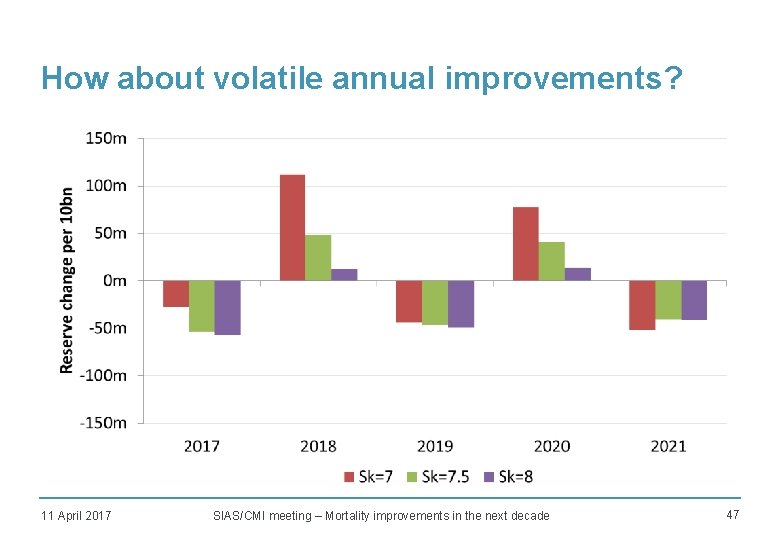
How about volatile annual improvements? • TBC 11 April 2017 SIAS/CMI meeting – Mortality improvements in the next decade 47
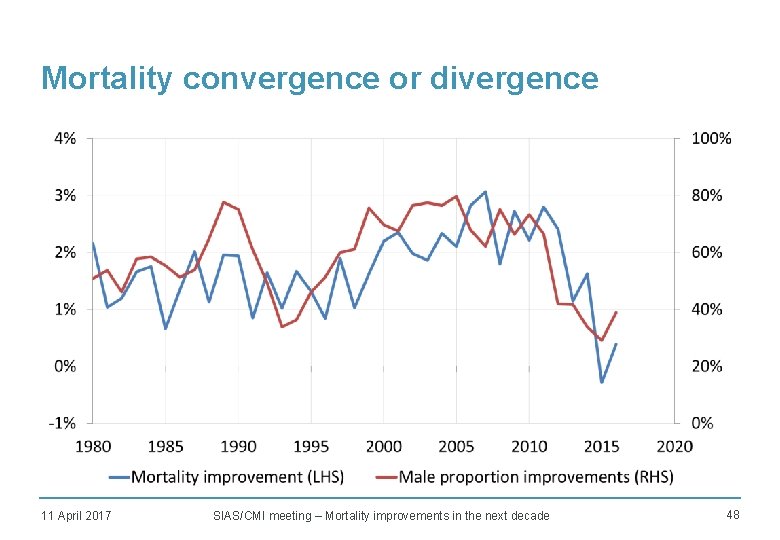
Mortality convergence or divergence • TBC 11 April 2017 SIAS/CMI meeting – Mortality improvements in the next decade 48
Discussion 1. Is the recent fall in national mortality improvements a blip or persistent? 2. How do we value specific portfolios? 11 April 2017 SIAS/CMI meeting – Mortality improvements in the next decade 49
Continuous Mortality Investigation Limited Registered in England & Wales (Company number: 8373631) Registered Office: 7 th floor, Holborn Gate, 326 -330 High Holborn, London, WC 1 V 7 PP Correspondence address: Cheapside House, 138 Cheapside, London, EC 2 V 6 BW, United Kingdom Email: info@cmilimited. co. uk Tel: +44 20 7776 3820 Website: www. cmilimited. co. uk (redirects to www. actuaries. org. uk) Continuous Mortality Investigation Limited (‘the CMI’) is wholly owned by the Institute and Faculty of Actuaries. Disclaimer: This document has been prepared by and/or on behalf of Continuous Mortality Investigation Limited (CMI). This document does not constitute advice and should not be relied upon as such. While care has been taken to ensure that it is accurate, up-to-date and useful, CMI will not accept any legal liability in relation to its contents. © Continuous Mortality Investigation Limited 11 April 2017