
Mortality by Dr Kumar Satyendra Yadav Assistant Professor
Mortality by Dr. Kumar Satyendra Yadav Assistant Professor Department of Statistics Patna University Patna
Mortality An important component of demographic phenomenon. It shows the depletion of population in a given area in the absence of migration.
• Relevance of mortality and in health programme One of the important objectives of the a health progamme is to improve the health of population. Consider RCH programme in which health of both mother and child is to be improved by reaching and delivery of quality health care service. Mortality is an indicator of health status. The most common indicator of health status is the expectancy of life which is very much affected by the level of mortality. The concept of mortality indicators are discussed in the following slides.
• Improving health situation implies at least reducing infant and child mortality and maternal deaths. • This calls for understanding basic measures of mortality among the machineries of RCH programme implementation and evaluation.

Measures of Mortality
Crude Death Rate (CDR) No. of deaths per 1, 000 population in a given year Advantages ü A summary measure used most often for the population. It is the total number of deaths in a particular year per 1000 population. ü Short and easy to understand ü Not much difficulty in getting data for calculation Disadvantage Ø Not a comparable figure between populations Ø Does not consider the effect of age distribution and their experience of mortality. Hence Crude by name itself
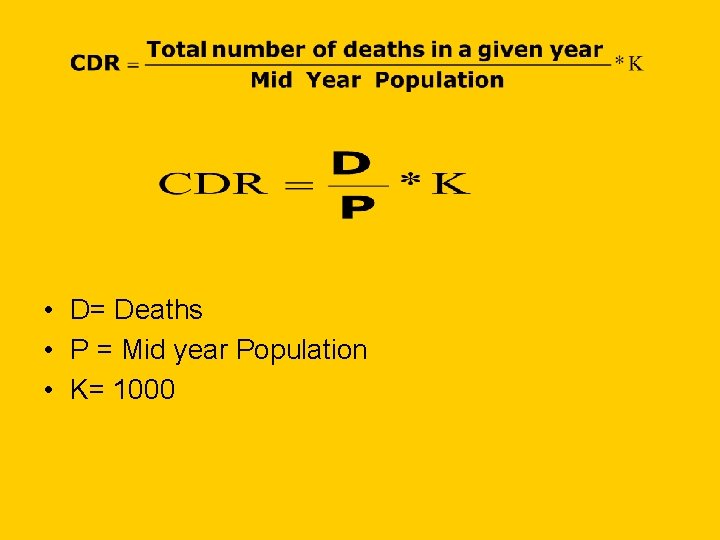
• D= Deaths • P = Mid year Population • K= 1000
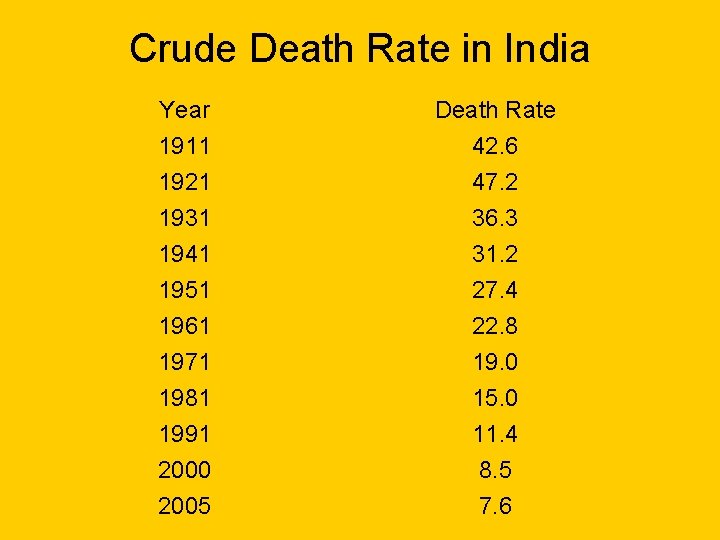
Crude Death Rate in India Year 1911 1921 1931 Death Rate 42. 6 47. 2 36. 3 1941 1951 1961 1971 1981 1991 2000 2005 31. 2 27. 4 22. 8 19. 0 15. 0 11. 4 8. 5 7. 6
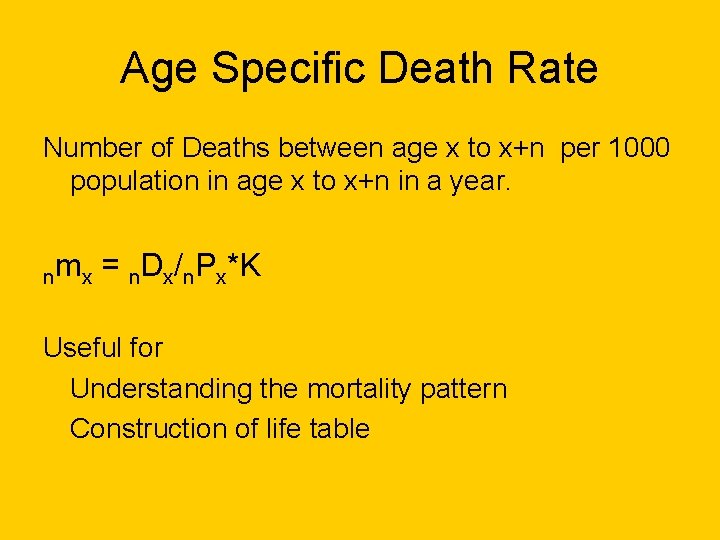
Age Specific Death Rate Number of Deaths between age x to x+n per 1000 population in age x to x+n in a year. n mx = n. Dx/n. Px*K Useful for Understanding the mortality pattern Construction of life table
• ASDR can be applied to both male and female • Same logic can be extended for cause specific death also
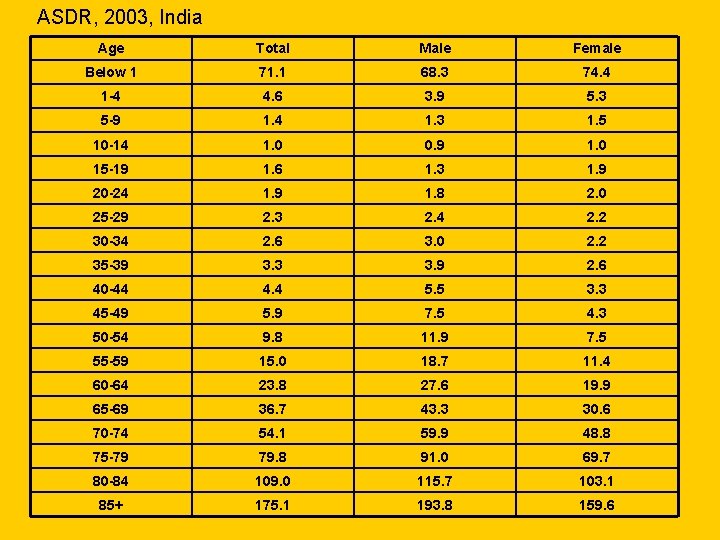
ASDR, 2003, India Age Total Male Female Below 1 71. 1 68. 3 74. 4 1 -4 4. 6 3. 9 5. 3 5 -9 1. 4 1. 3 1. 5 10 -14 1. 0 0. 9 1. 0 15 -19 1. 6 1. 3 1. 9 20 -24 1. 9 1. 8 2. 0 25 -29 2. 3 2. 4 2. 2 30 -34 2. 6 3. 0 2. 2 35 -39 3. 3 3. 9 2. 6 40 -44 4. 4 5. 5 3. 3 45 -49 5. 9 7. 5 4. 3 50 -54 9. 8 11. 9 7. 5 55 -59 15. 0 18. 7 11. 4 60 -64 23. 8 27. 6 19. 9 65 -69 36. 7 43. 3 30. 6 70 -74 54. 1 59. 9 48. 8 75 -79 79. 8 91. 0 69. 7 80 -84 109. 0 115. 7 103. 1 85+ 175. 1 193. 8 159. 6
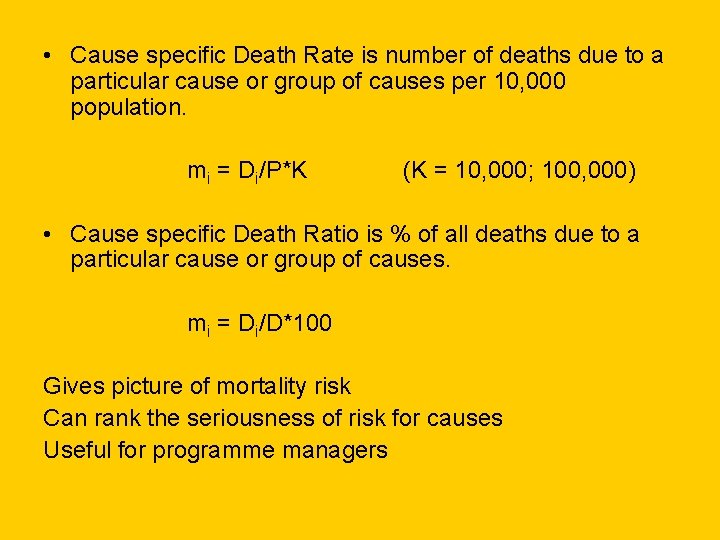
• Cause specific Death Rate is number of deaths due to a particular cause or group of causes per 10, 000 population. mi = Di/P*K (K = 10, 000; 100, 000) • Cause specific Death Ratio is % of all deaths due to a particular cause or group of causes. mi = Di/D*100 Gives picture of mortality risk Can rank the seriousness of risk for causes Useful for programme managers
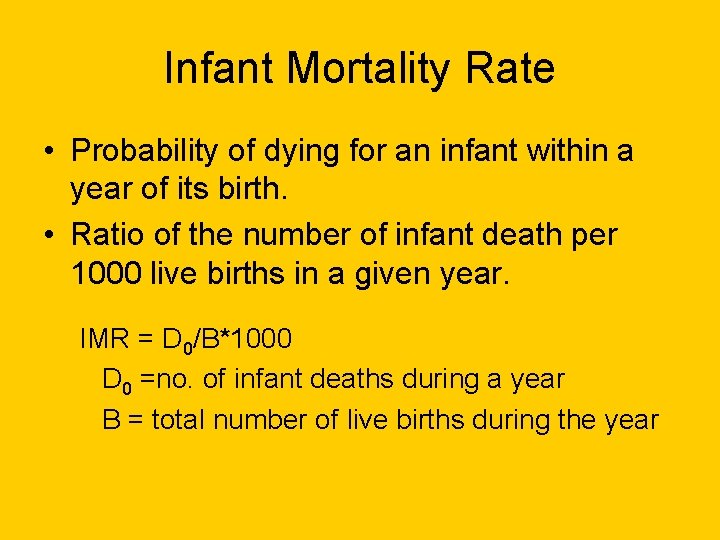
Infant Mortality Rate • Probability of dying for an infant within a year of its birth. • Ratio of the number of infant death per 1000 live births in a given year. IMR = D 0/B*1000 D 0 =no. of infant deaths during a year B = total number of live births during the year
Some issues of IMR • Conventional method of calculation of IMR considers all the infant deaths occurring in a year while the denominator is births in that year. • Some of infants may not be from the same births occurring in the same year i. e. , from the previous births. • An adjustment can be made.
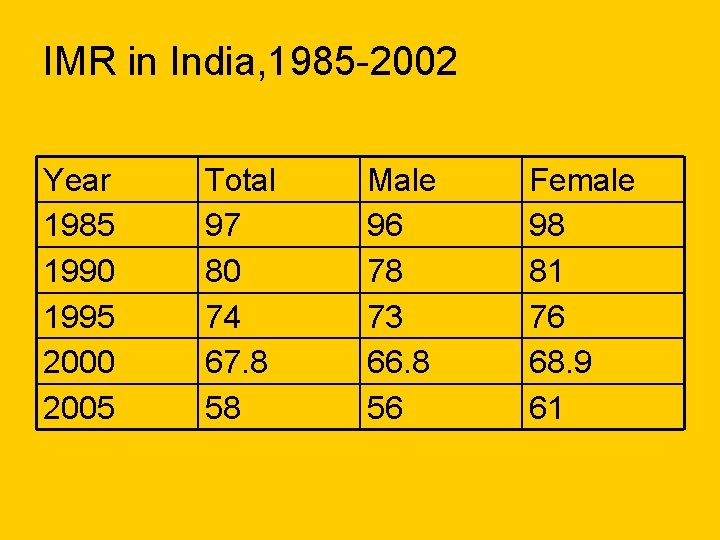
IMR in India, 1985 -2002 Year 1985 1990 1995 2000 2005 Total 97 80 74 67. 8 58 Male 96 78 73 66. 8 56 Female 98 81 76 68. 9 61
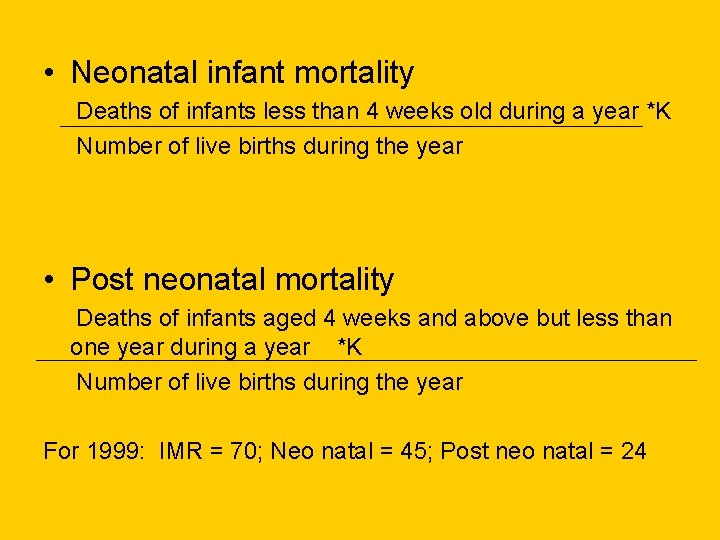
• Neonatal infant mortality Deaths of infants less than 4 weeks old during a year *K Number of live births during the year • Post neonatal mortality Deaths of infants aged 4 weeks and above but less than one year during a year *K Number of live births during the year For 1999: IMR = 70; Neo natal = 45; Post neo natal = 24
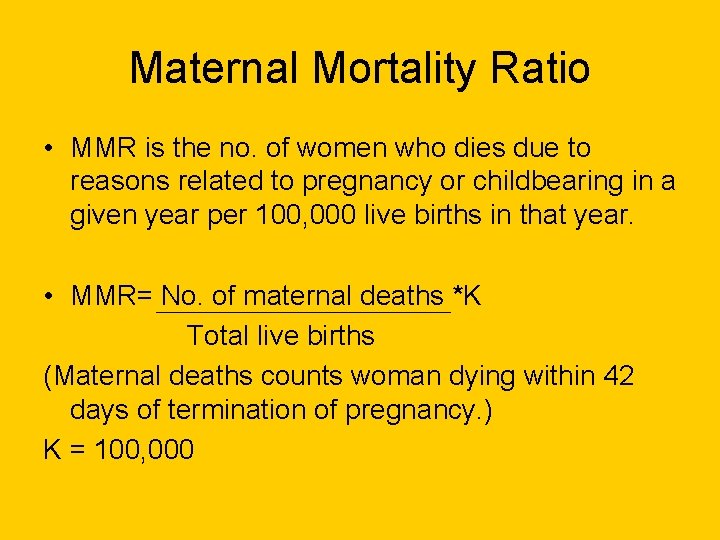
Maternal Mortality Ratio • MMR is the no. of women who dies due to reasons related to pregnancy or childbearing in a given year per 100, 000 live births in that year. • MMR= No. of maternal deaths *K Total live births (Maternal deaths counts woman dying within 42 days of termination of pregnancy. ) K = 100, 000
- Slides: 17