
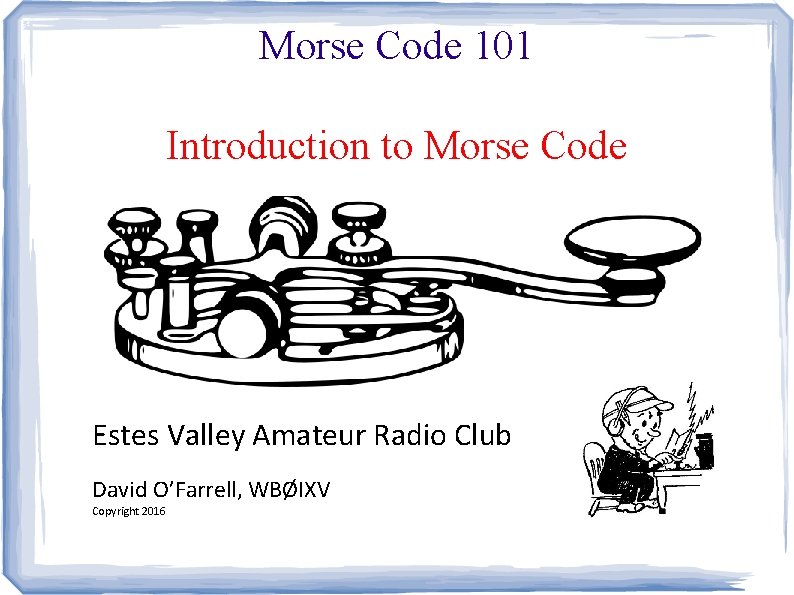
Morse Code 101 Introduction to Morse Code Estes
- Slides: 75
Morse Code 101 Introduction to Morse Code Estes Valley Amateur Radio Club David O’Farrell, WBØIXV Copyright 2016
● First It's MORSE CODE – NOT MORRIS CODE – Morris is a cat
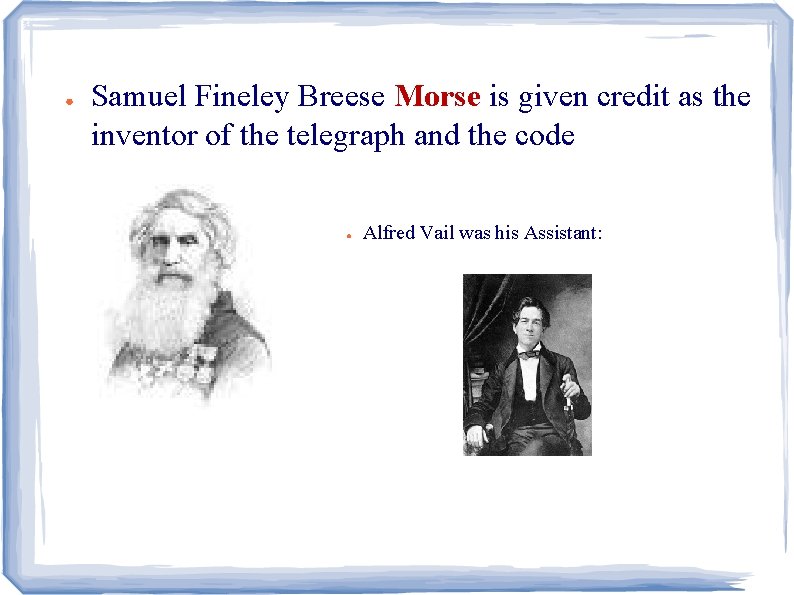
● Samuel Fineley Breese Morse is given credit as the inventor of the telegraph and the code ● Alfred Vail was his Assistant:
What we will cover ● Learning Morse Code ● Sending Morse Code ● A ‘standard’ QSO ● Some Misc items
● My Amateur Radio History – First Licensed as a Novice in 1964, when I was 15 years old – KN 7 YXO ● – That required a 5 wpm code test I upgraded to General Class in 1965 - WA 7 COH ● That required a 13 wpm code test from the FCC
● There actually two Morse codes! – American Morse – International (Continental) Morse code
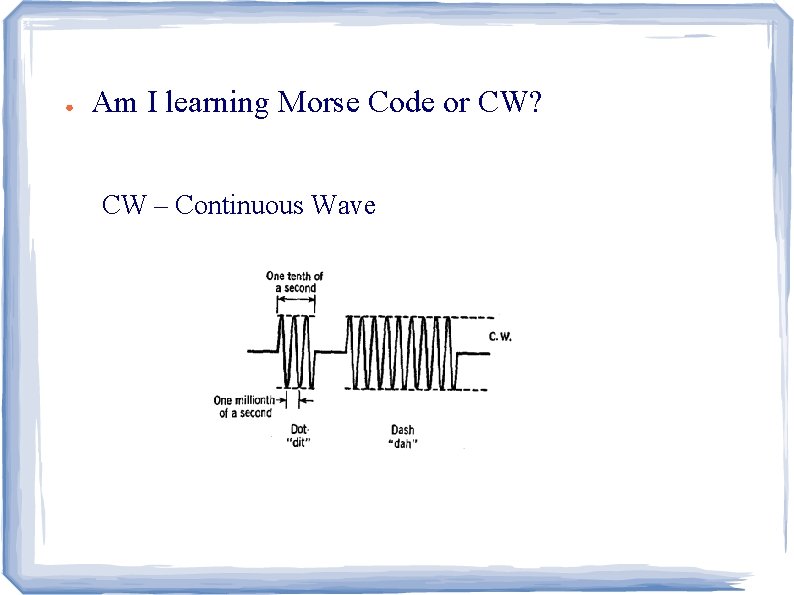
● Am I learning Morse Code or CW? CW – Continuous Wave
● Why Morse Code? – Why not Phone? Effective ● Efficient ● Universal ● Simple! ●
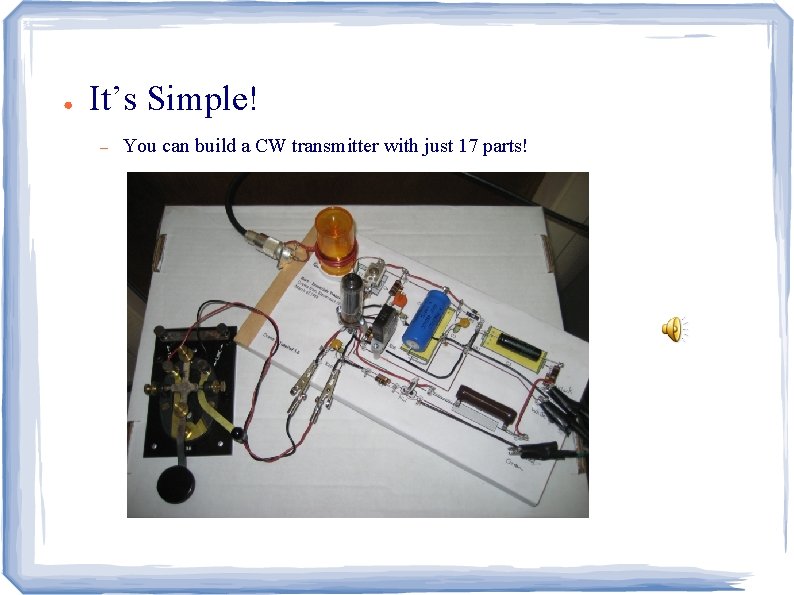
● It’s Simple! – You can build a CW transmitter with just 17 parts!
● Why else use Morse Code? – More Frequencies – Low profile or Stealth operation – Backpacking and Hiking – It’s FUN – Hearing Impairments – You will be special!
● Learning the code – The Right way ● – Learning by sound from the start The Wrong way ● Learning visually by memorizing a code table
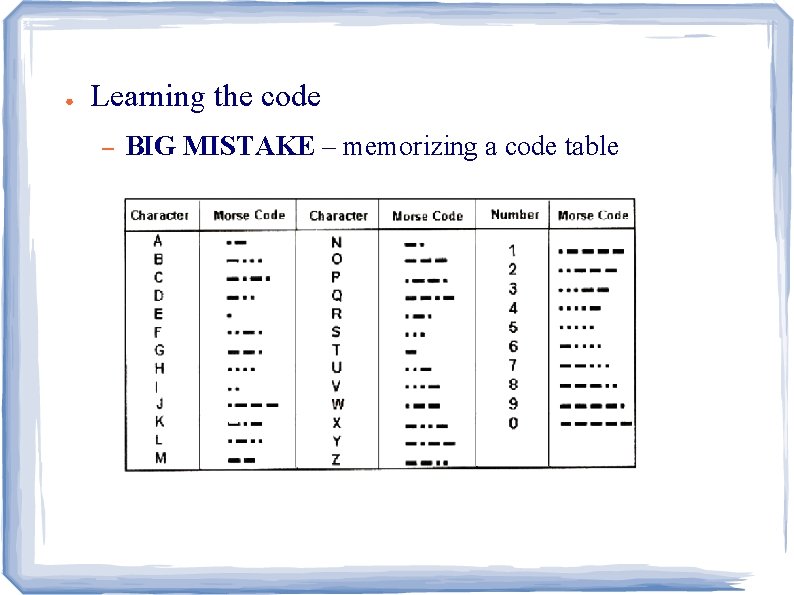
● Learning the code – BIG MISTAKE – memorizing a code table
● Best Way to Learn – Aurally (dits & dahs) – ● ● Learn it by SOUND NEVER Dots and Dashes and visually Practice both sending and receiving at the same time.
● Methods: – Recordings – Computer programs – On the air code practice
● What do you need to learn? – The Alphabet (A to Z) – The numbers (0 to 9) – Punctuation. , / ? = – Prosigns ● – AR, AS, SK, CL, K, KN, error …… Only 48 symbols!
● What order to learn them in? – It really doesn’t matter
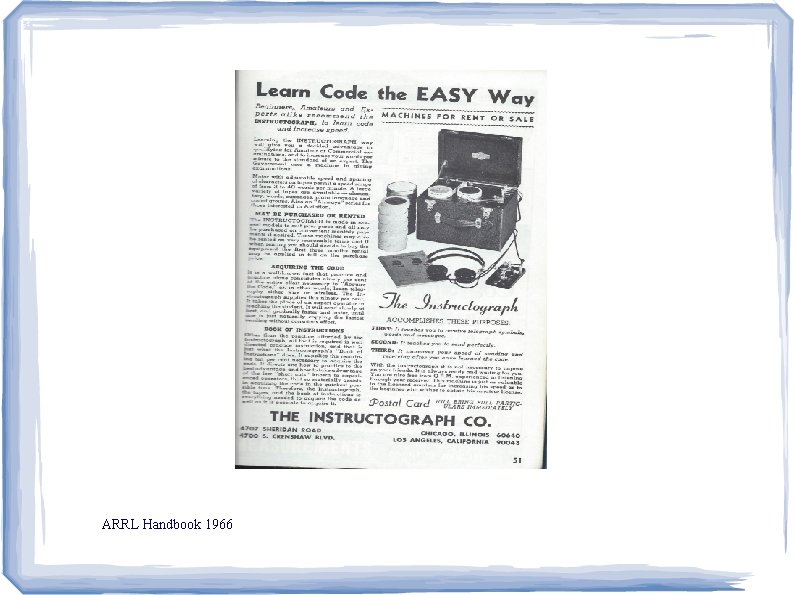
ARRL Handbook 1966
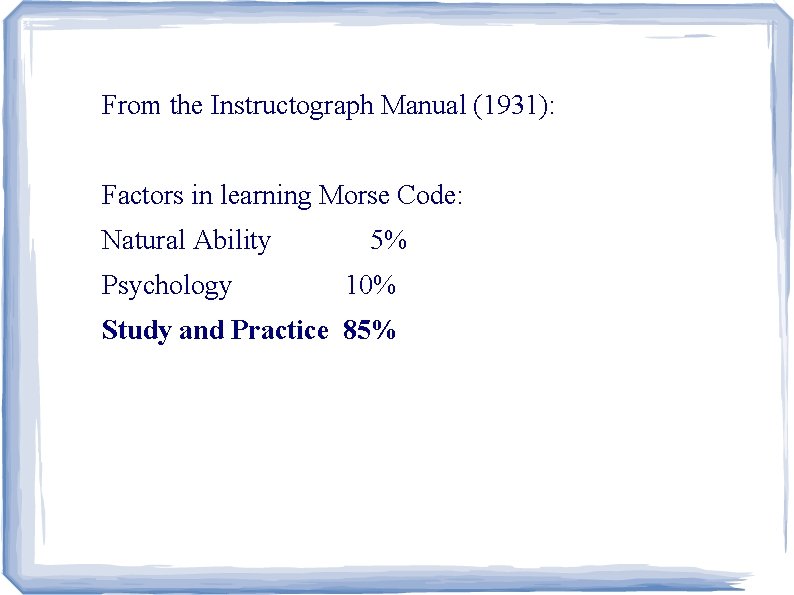
From the Instructograph Manual (1931): Factors in learning Morse Code: Natural Ability Psychology 5% 10% Study and Practice 85%
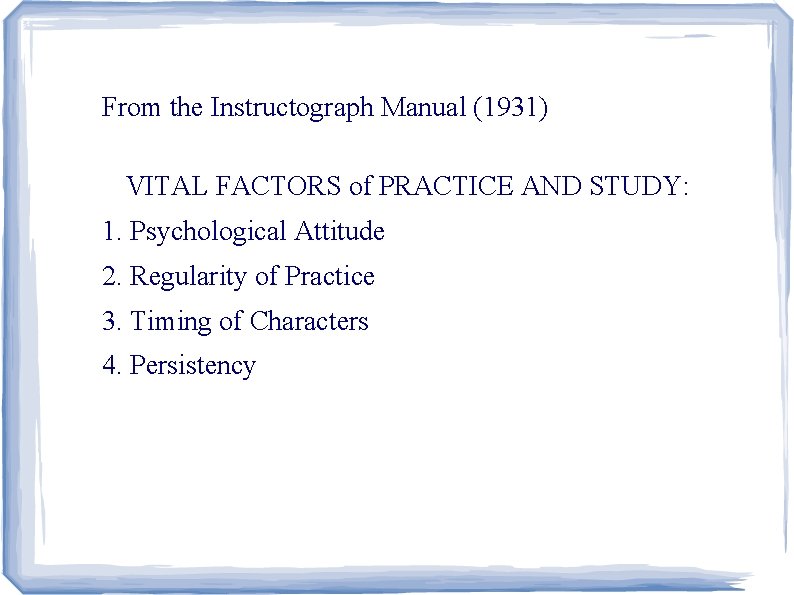
From the Instructograph Manual (1931) VITAL FACTORS of PRACTICE AND STUDY: 1. Psychological Attitude 2. Regularity of Practice 3. Timing of Characters 4. Persistency
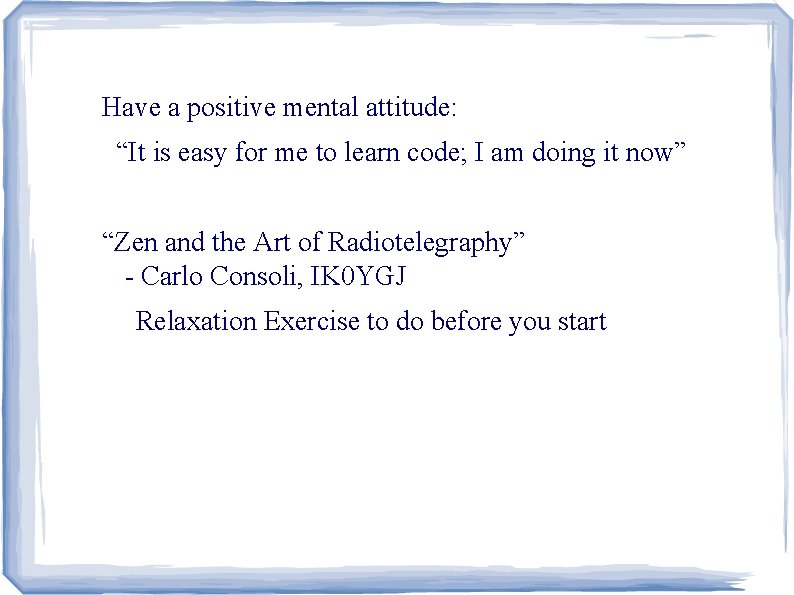
Have a positive mental attitude: “It is easy for me to learn code; I am doing it now” “Zen and the Art of Radiotelegraphy” - Carlo Consoli, IK 0 YGJ Relaxation Exercise to do before you start
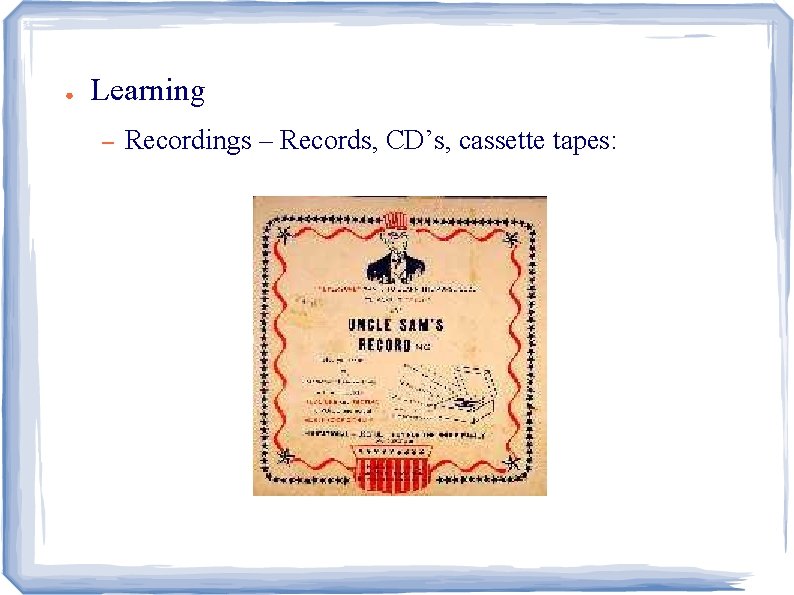
● Learning – Recordings – Records, CD’s, cassette tapes:
● Learning – Recordings – CD’s, MP 3 files ● K 7 QO’s Fists Code Course (50 free today!) ● ARRL ● W 5 YI ● VIS Amateur Supply – KB 6 MT – High Speed QSO training
● Learning – – Computer programs ● G 4 FON (Koch method) ● Just Learn Morse There’s an App for that!
● Learning – On the Air – W 1 AW code practice ● Slow code at 5, 7 -1/2, 10, 13, 15 wpm ● Fast code at 35, 30, 25, 20, 15, 13, 10 wpm ● Also available as mp 3 download
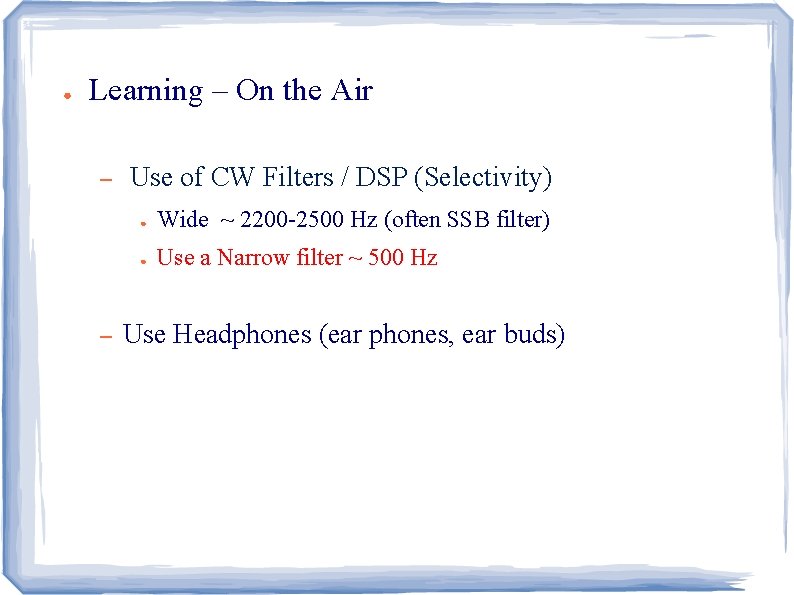
● Learning – On the Air – – Use of CW Filters / DSP (Selectivity) ● Wide ~ 2200 -2500 Hz (often SSB filter) ● Use a Narrow filter ~ 500 Hz Use Headphones (ear phones, ear buds)
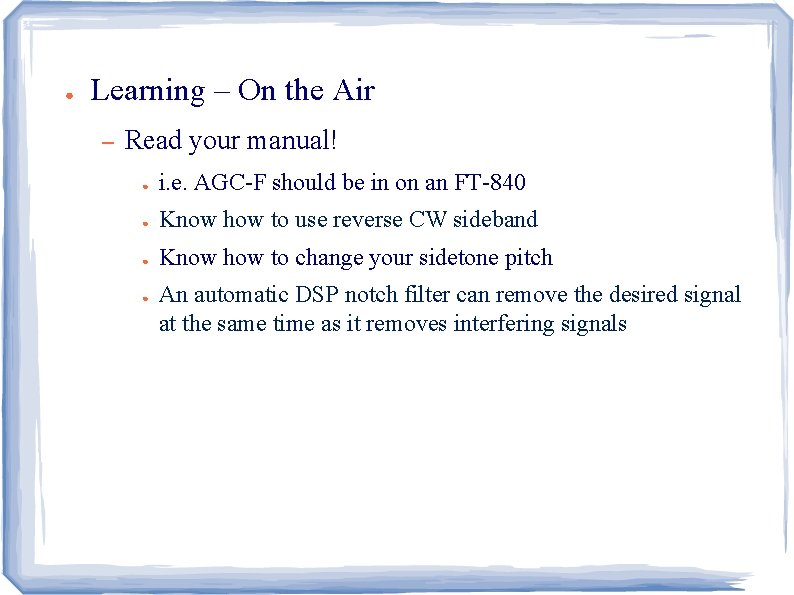
● Learning – On the Air – Read your manual! ● i. e. AGC-F should be in on an FT-840 ● Know how to use reverse CW sideband ● Know how to change your sidetone pitch ● An automatic DSP notch filter can remove the desired signal at the same time as it removes interfering signals
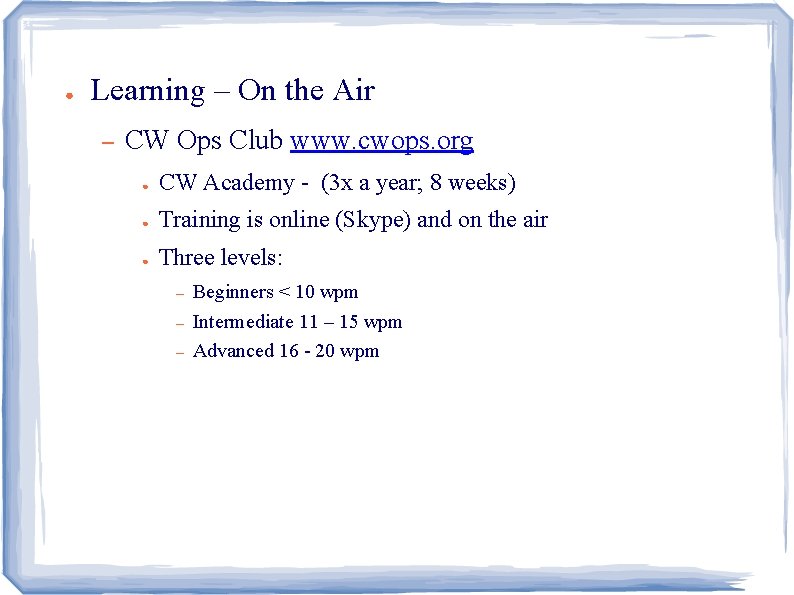
● Learning – On the Air – CW Ops Club www. cwops. org ● CW Academy - (3 x a year; 8 weeks) ● Training is online (Skype) and on the air ● Three levels: – – – Beginners < 10 wpm Intermediate 11 – 15 wpm Advanced 16 - 20 wpm
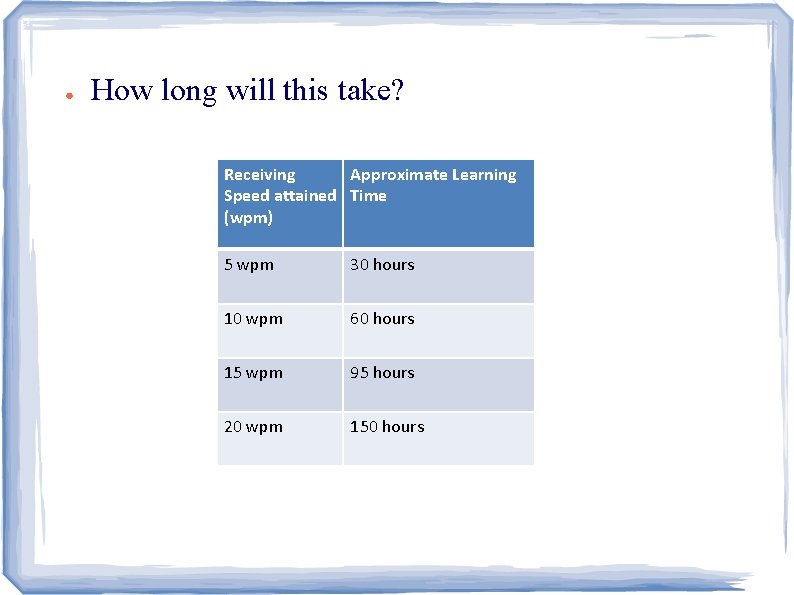
● How long will this take? Receiving Approximate Learning Speed attained Time (wpm) 5 wpm 30 hours 10 wpm 60 hours 15 wpm 95 hours 20 wpm 150 hours
● Best to do daily short practice sessions – No more than thirty minutes daily – Two fifteen minute sessions daily best ● More frequent practice sessions are better ● Repetition, Repetition ● Writing in script is 50% faster than printing ● If you miss a letter, let it go. Leave a space. – Otherwise you will miss the next 4 or 5 characters.
● Your goal is instance recognition. ● RELAX! Take a deep breath. ● If you are missing letters, struggling, etc. – ● ● Take a break! This is a hobby, not a job! If you hit a plateau, just keep practicing. – Some days you won’t copy as fast as you previously did – But at few days later you will be through the plateau Remember, we are amateurs, not professionals!
– Copying code is a sub-conscious mental process. – There really isn’t a way to ‘learn sub-consciously’, other than practice.
● Farnsworth method (aka Farnsworth spacing) – The letters are sent at a higher wpm, ● – But the space between them is longer to make the overall speed slower. Always use the Farnsworth method, or you will need to learn the code 3 or 4 times!
● ● ● Koch Method Traditionally, Morse code has been taught by struggling through all the codes at a slow speed and then (slowly) progressing toward higher speeds. Koch's method was invented by German psychologist Ludwig Koch in the 1930 s. Koch's method, on the other hand, dictates that you should start learning at the desired speed - but you start with only two characters. Each session is five minutes long, and whenever you get 90% or more correct, you add another character. G 4 FON & Just Learn Morse utilizes Koch's method for teaching Morse code.
TIPS You May Hear From Hams: • You have to push yourself hard. • Don’t push yourself too hard, you’ll burn out. • Use Code CD’s. • Don’t use code CD’s, use a computer program • Listen to CD’s in the car • Don’t listen to CD’s in the car, it’s dangerous!
TIPS You May Hear From Hams: • Never look at a chart when you practice. • Look at the chart to help you remember • Learn the code in groups of related sounds • Learn the most frequently used letters first • Try to copy code off the air • Don’t try to copy code off the air
BEST TIPS on learning: So different methods work for different people. Try different ones to see what you like. Sometimes a change in approach helps create variety.
BEST TIPS on learning: Give extra attention to P, Y, J, Z, X, Q, and L They are not so frequently used as the rest of the alphabet.
Printing or Writing copy? You can print your copy up to about 10 wpm; Handwriting work up to about 30 wpm, Then use a keyboard or typewriter (Mill) for higher speeds.
Your Plan of Attack! 1. Start with the CD 2. If you wish, use a computer program 3. Then move to on the air copying
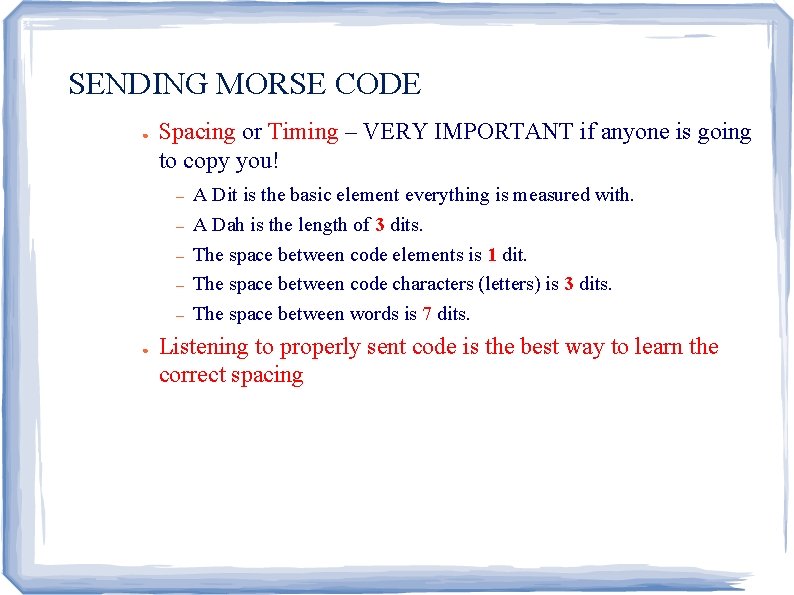
SENDING MORSE CODE ● Spacing or Timing – VERY IMPORTANT if anyone is going to copy you! – – – ● A Dit is the basic element everything is measured with. A Dah is the length of 3 dits. The space between code elements is 1 dit. The space between code characters (letters) is 3 dits. The space between words is 7 dits. Listening to properly sent code is the best way to learn the correct spacing
Terms ● FIST – Your distinctive rhythm when sending with a straight key. ● LID – A poor operator – has a POOR FIST, and poor operating procedures. ● Ham – Ham fisted? Due to poor sending?
● Learning to Send Morse Code – Code Practice Oscillator (CPO) – Straight key or – ● Paddle Forget trying to use a ‘bug’, or a semi-automatic key at this point.
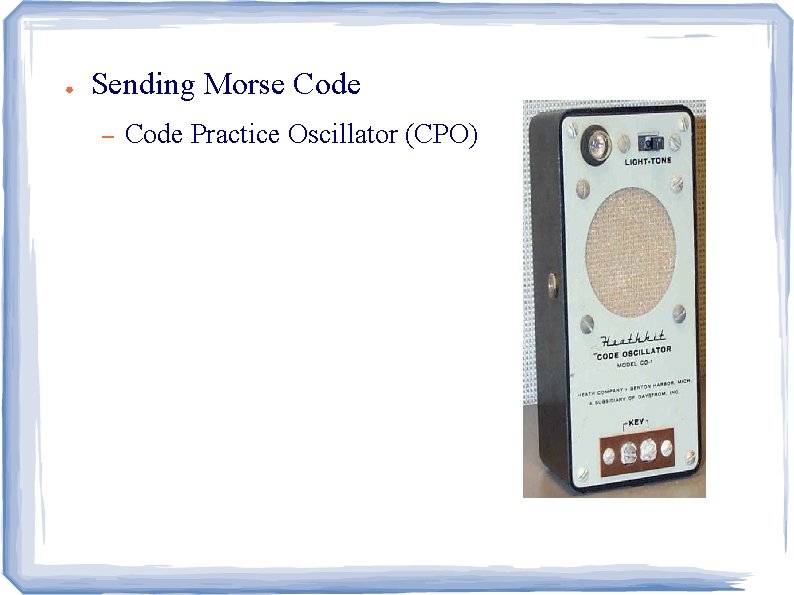
● Sending Morse Code – Code Practice Oscillator (CPO)
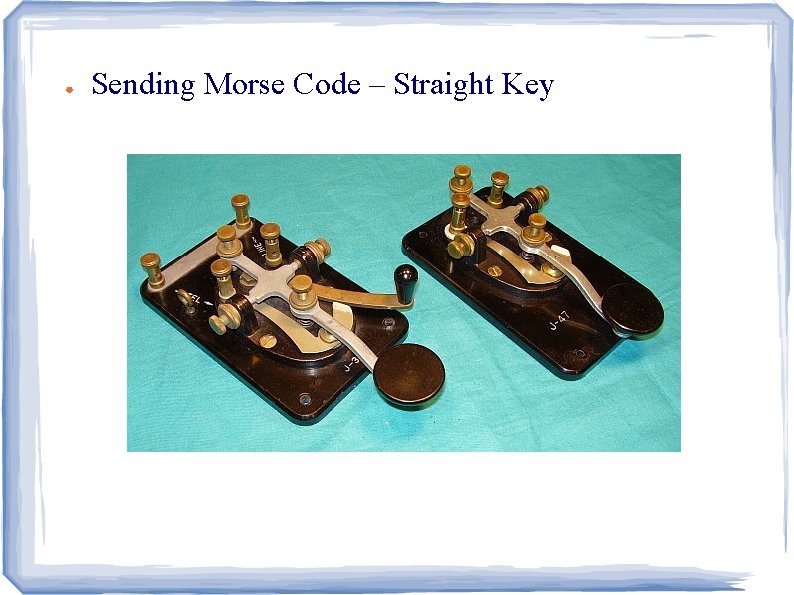
● Sending Morse Code – Straight Key
– Your goal is Accuracy, Beauty, Speed. ● – Just in that order The motto of the FISTS telegraph club is ● “Accuracy transcends Speed”
– Practice sending using Panagrams ● ● The quick brown fox jumps over the lazy dog. (35 letters) While making deep excavations we found some quaint bronze jewelry. (56 letters)
● Adjusting and using a Straight Key – Spacing – Spring tension – Sit upright with your arm inline with the key – The knob should be about 18 inches from the table edge – Use a relaxed grip
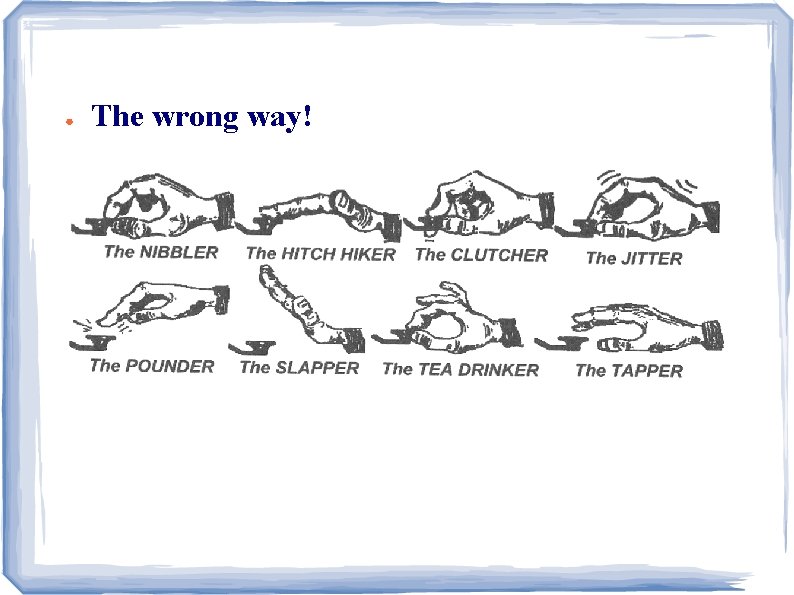
● The wrong way!
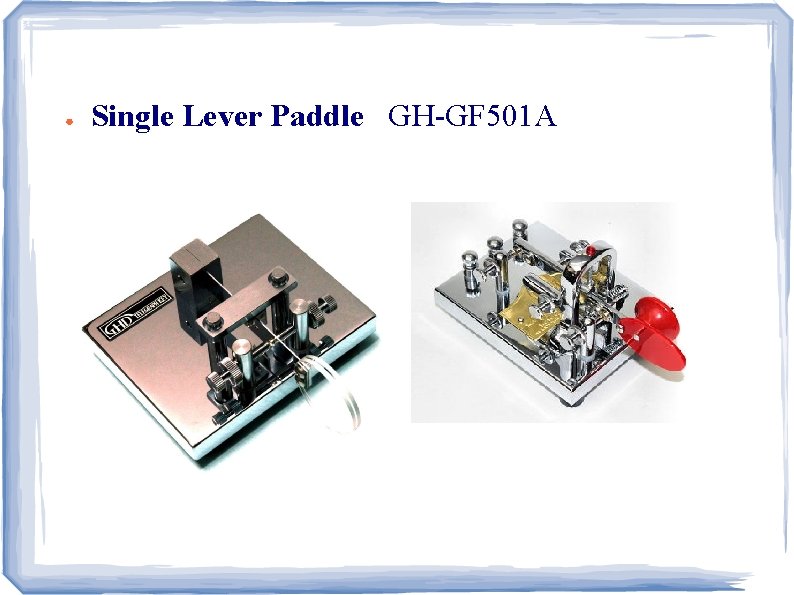
● Single Lever Paddle GH-GF 501 A ●
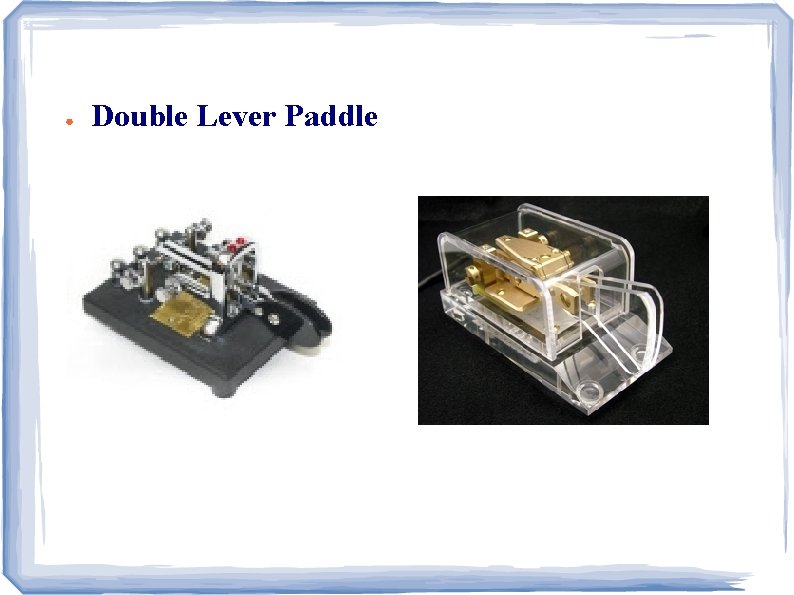
● Double Lever Paddle
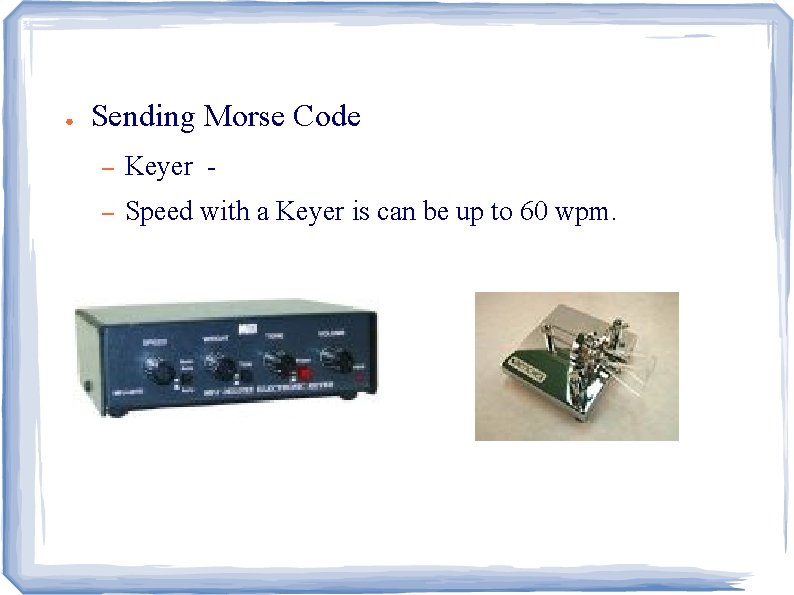
● Sending Morse Code – Keyer - – Speed with a Keyer is can be up to 60 wpm.
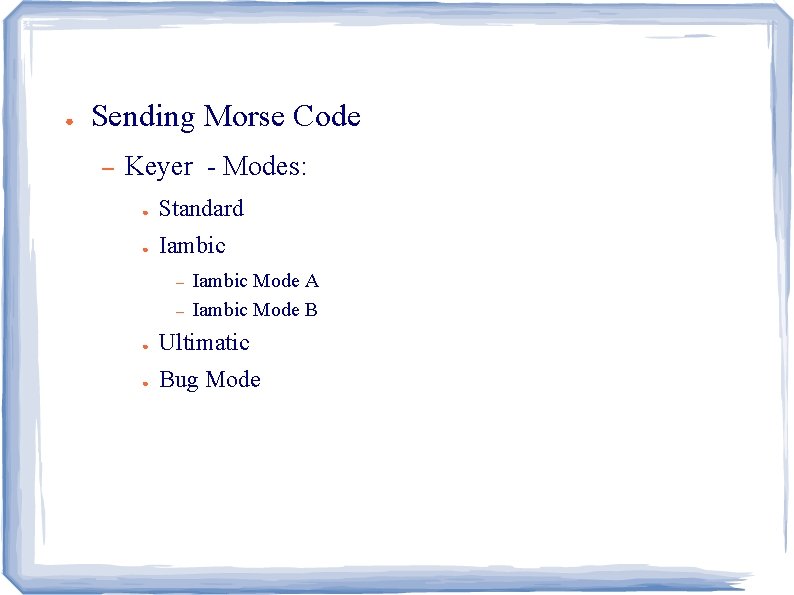
● Sending Morse Code – Keyer - Modes: ● Standard ● Iambic – – Iambic Mode A Iambic Mode B ● Ultimatic ● Bug Mode
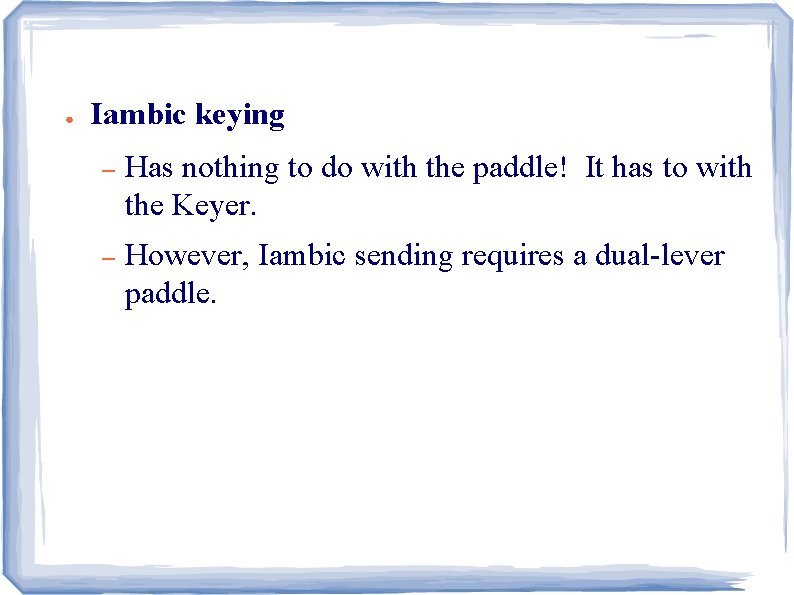
● Iambic keying – Has nothing to do with the paddle! It has to with the Keyer. – However, Iambic sending requires a dual-lever paddle.
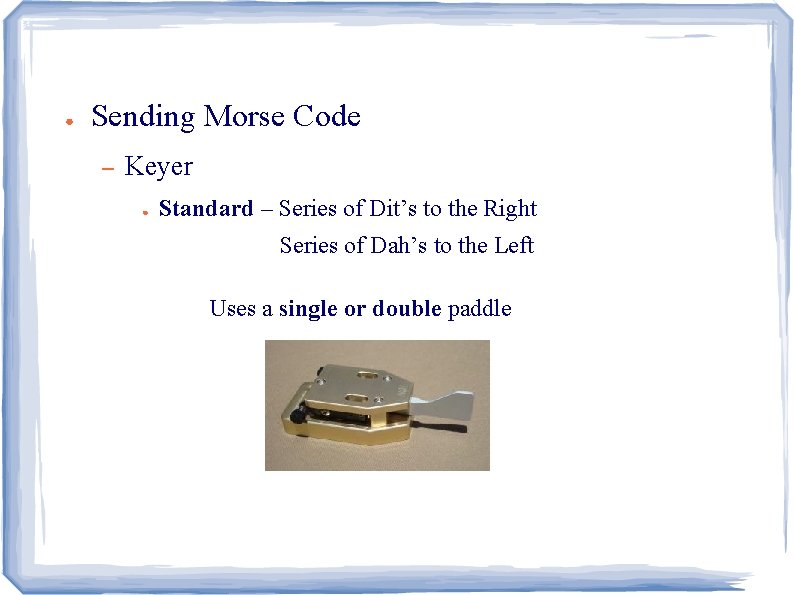
● Sending Morse Code – Keyer ● Standard – Series of Dit’s to the Right Series of Dah’s to the Left Uses a single or double paddle
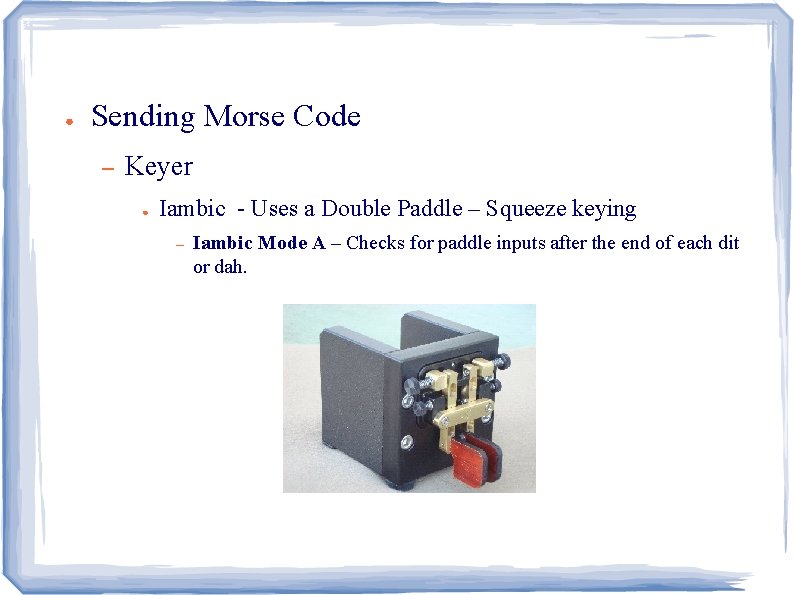
● Sending Morse Code – Keyer ● Iambic - Uses a Double Paddle – Squeeze keying – Iambic Mode A – Checks for paddle inputs after the end of each dit or dah.
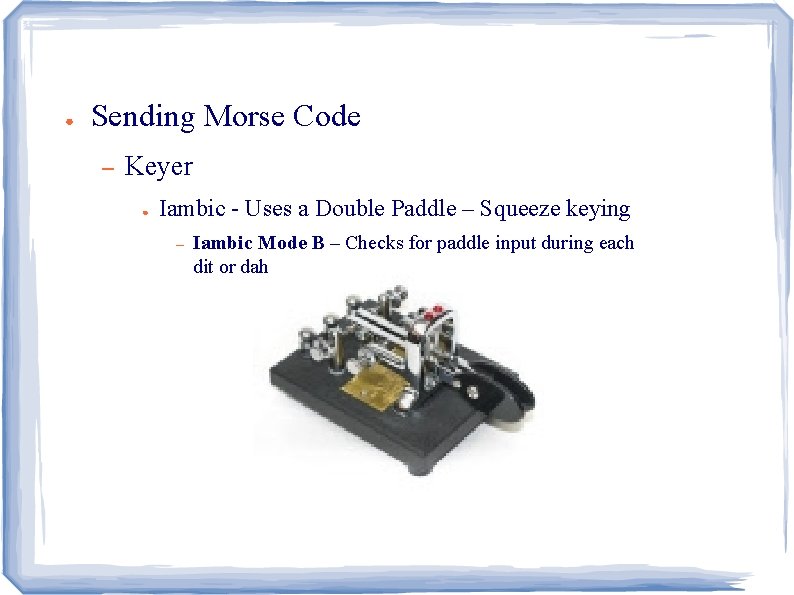
● Sending Morse Code – Keyer ● Iambic - Uses a Double Paddle – Squeeze keying – Iambic Mode B – Checks for paddle input during each dit or dah
● Sending Morse Code – Keyer ● Ultimatic – Will send dits and dahs according to the last paddle to be pressed.
– Now that you can send and receive, let’s get on the air! ● Side Tone from your Transceiver ● ZERO BEAT aka SPOTTING ● RIT – Receiver Incremental Tuning
● Q Signals – – To speed up the QSO; – To overcome language differences
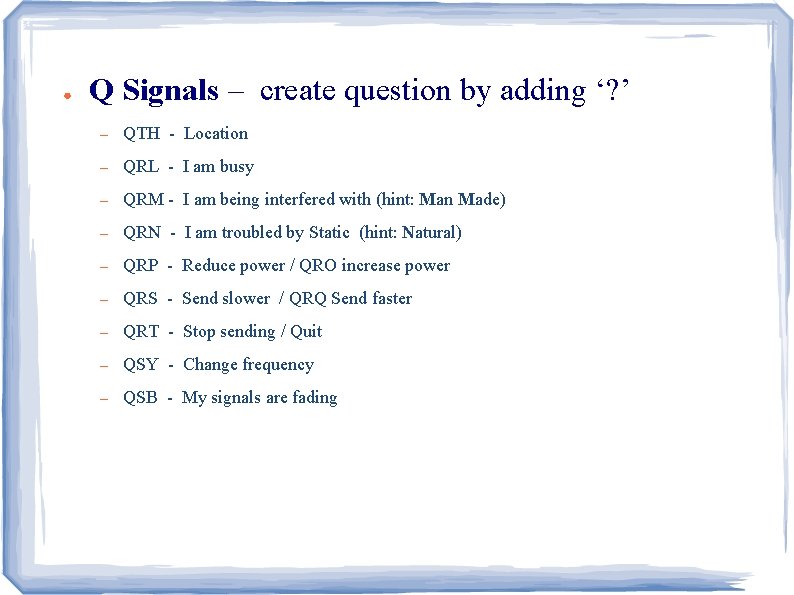
● Q Signals – create question by adding ‘? ’ – QTH - Location – QRL - I am busy – QRM - I am being interfered with (hint: Man Made) – QRN - I am troubled by Static (hint: Natural) – QRP - Reduce power / QRO increase power – QRS - Send slower / QRQ Send faster – QRT - Stop sending / Quit – QSY - Change frequency – QSB - My signals are fading
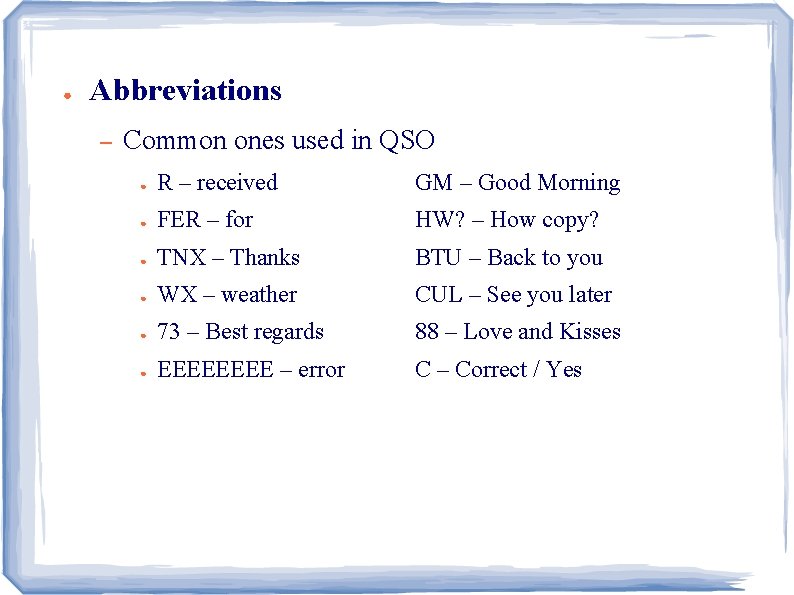
● Abbreviations – Common ones used in QSO ● R – received GM – Good Morning ● FER – for HW? – How copy? ● TNX – Thanks BTU – Back to you ● WX – weather CUL – See you later ● 73 – Best regards 88 – Love and Kisses ● EEEE – error C – Correct / Yes
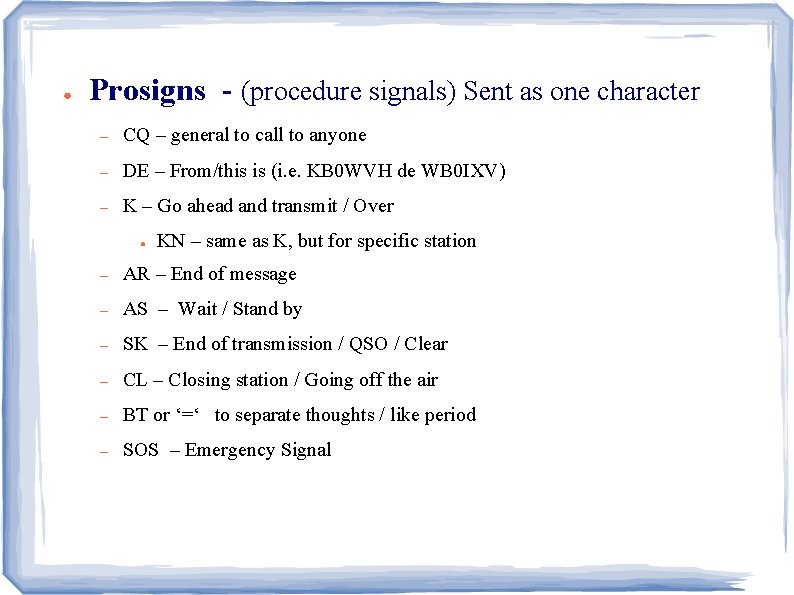
● Prosigns - (procedure signals) Sent as one character – CQ – general to call to anyone – DE – From/this is (i. e. KB 0 WVH de WB 0 IXV) – K – Go ahead and transmit / Over ● KN – same as K, but for specific station – AR – End of message – AS – Wait / Stand by – SK – End of transmission / QSO / Clear – CL – Closing station / Going off the air – BT or ‘=‘ to separate thoughts / like period – SOS – Emergency Signal
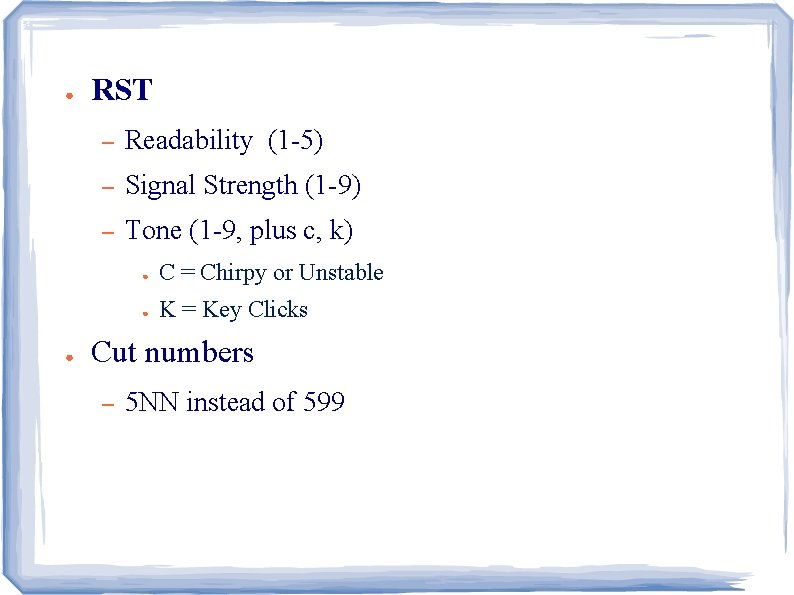
● ● RST – Readability (1 -5) – Signal Strength (1 -9) – Tone (1 -9, plus c, k) ● C = Chirpy or Unstable ● K = Key Clicks Cut numbers – 5 NN instead of 599
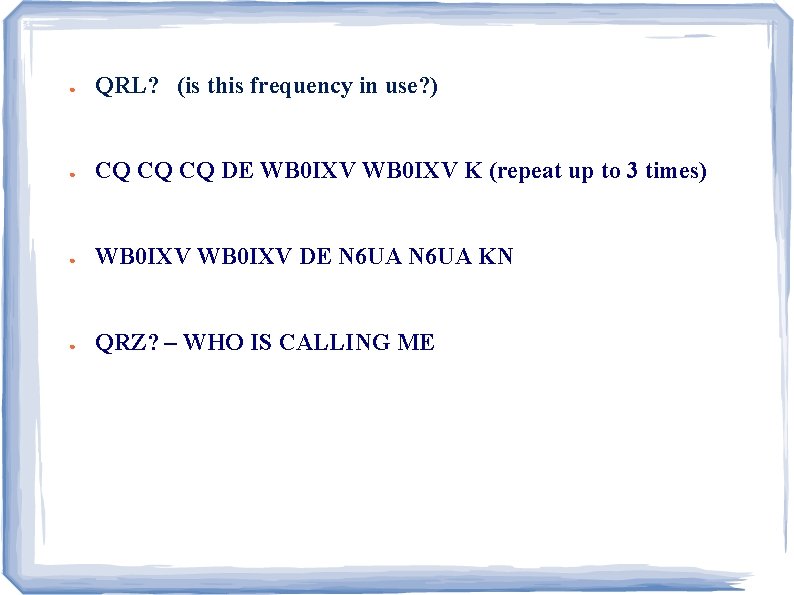
● QRL? (is this frequency in use? ) ● CQ CQ CQ DE WB 0 IXV K (repeat up to 3 times) ● WB 0 IXV DE N 6 UA KN ● QRZ? – WHO IS CALLING ME
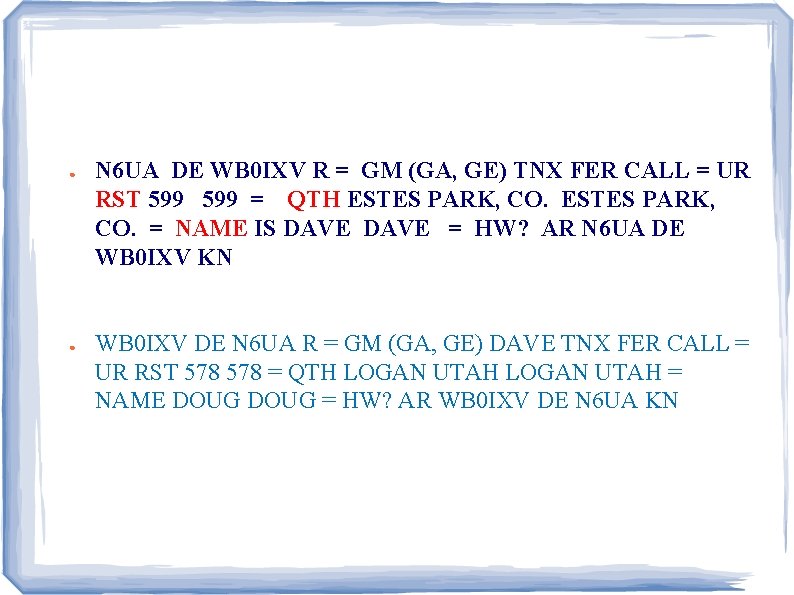
● ● N 6 UA DE WB 0 IXV R = GM (GA, GE) TNX FER CALL = UR RST 599 = QTH ESTES PARK, CO. = NAME IS DAVE = HW? AR N 6 UA DE WB 0 IXV KN WB 0 IXV DE N 6 UA R = GM (GA, GE) DAVE TNX FER CALL = UR RST 578 = QTH LOGAN UTAH = NAME DOUG = HW? AR WB 0 IXV DE N 6 UA KN
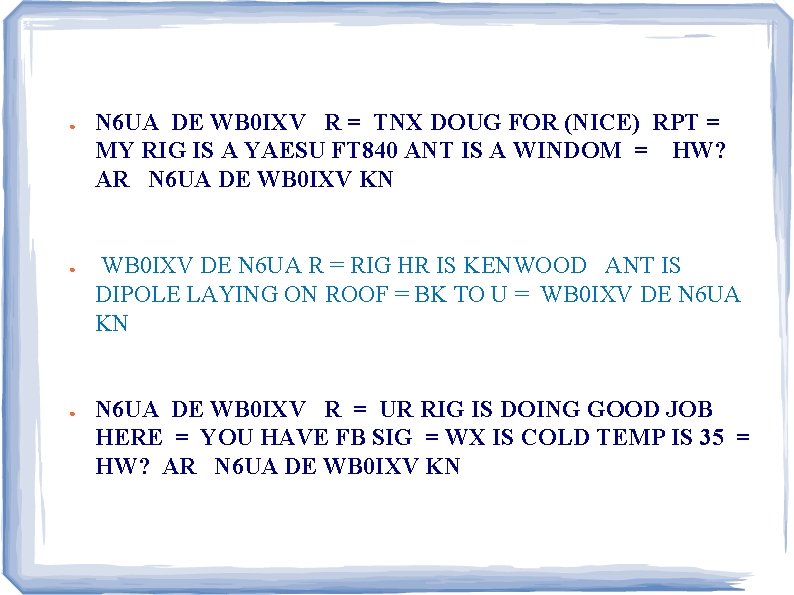
● ● ● N 6 UA DE WB 0 IXV R = TNX DOUG FOR (NICE) RPT = MY RIG IS A YAESU FT 840 ANT IS A WINDOM = HW? AR N 6 UA DE WB 0 IXV KN WB 0 IXV DE N 6 UA R = RIG HR IS KENWOOD ANT IS DIPOLE LAYING ON ROOF = BK TO U = WB 0 IXV DE N 6 UA KN N 6 UA DE WB 0 IXV R = UR RIG IS DOING GOOD JOB HERE = YOU HAVE FB SIG = WX IS COLD TEMP IS 35 = HW? AR N 6 UA DE WB 0 IXV KN
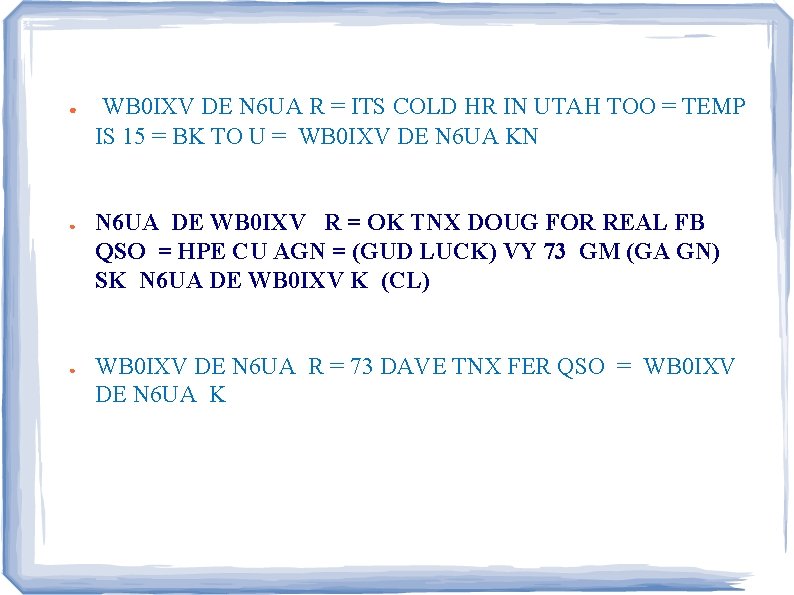
● ● ● WB 0 IXV DE N 6 UA R = ITS COLD HR IN UTAH TOO = TEMP IS 15 = BK TO U = WB 0 IXV DE N 6 UA KN N 6 UA DE WB 0 IXV R = OK TNX DOUG FOR REAL FB QSO = HPE CU AGN = (GUD LUCK) VY 73 GM (GA GN) SK N 6 UA DE WB 0 IXV K (CL) WB 0 IXV DE N 6 UA R = 73 DAVE TNX FER QSO = WB 0 IXV DE N 6 UA K
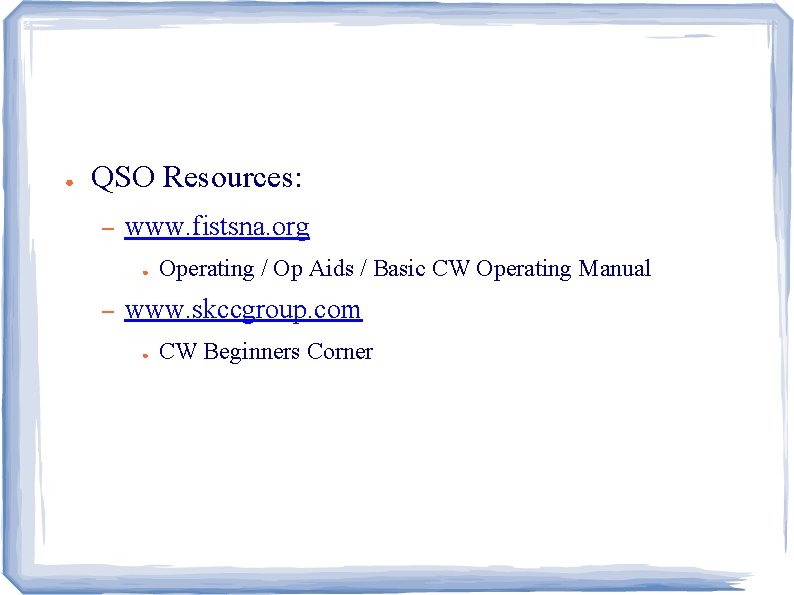
● QSO Resources: – www. fistsna. org ● – Operating / Op Aids / Basic CW Operating Manual www. skccgroup. com ● CW Beginners Corner
● QSK - Full Break In
IMPORTANT: – Only send as fast as you can receive! – Only send as fast as the other operator is sending – Ask them to slow down, QRS 10 PSE, if needed! – When selecting an operating frequency, separate yourself 150 to 500 Hz from other stations.
Groups with slow speed (QRS) code operators: FISTS – The International Morse Preservation Society 7. 028, 7. 048, 7. 118 10. 118, 14. 058, 21. 185, and others SKCC – Straight Key Century Club 7. 055, 7. 120, 10. 120, 14. 050, 21. 050, and others
Contesting CQ TEST
DX’ing ● ● Working Split Don’t work too close to the band edge.
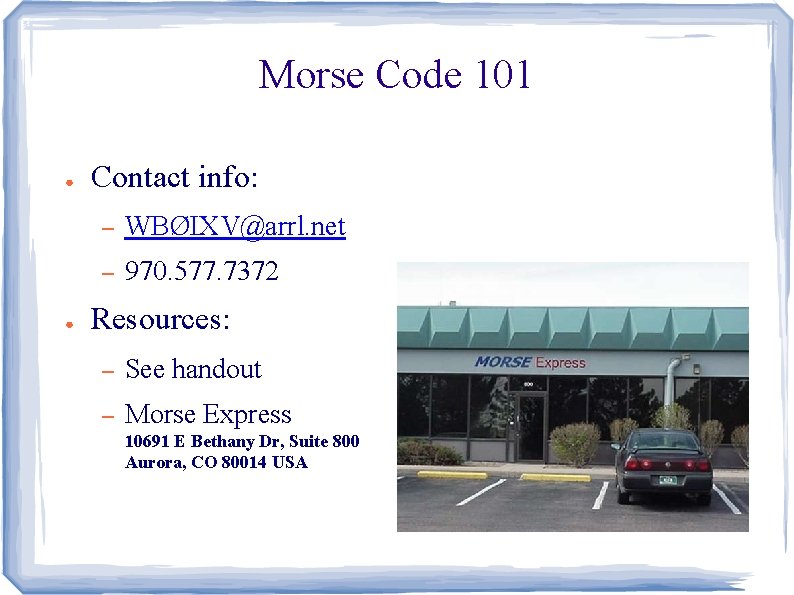
Morse Code 101 ● ● Contact info: – WBØIXV@arrl. net – 970. 577. 7372 Resources: – See handout – Morse Express 10691 E Bethany Dr, Suite 800 Aurora, CO 80014 USA