
Morphophonology Bipasha Patgiri Assistant Professor Program for Linguistics
Morphophonology Bipasha Patgiri Assistant Professor, (Program for Linguistics) EFL Department, TU
Introduction to Sub-fields of Linguistics • Phonetics: Study of sounds and their physical properties: Articulatory, Acoustic and Auditory • Phonology: Study of linguistically significant sound patterns. • Morphology: Study of word-formation processes. • Syntax: Study of sentence structure.
Sub-fields of Linguistics (cont. . ) • Semantics: Study of meaning of linguistic expression. • Pragmatics: Study of contextual meaning of linguistic expressions. • Discourse analysis: Study of language in texts. • Semiotics: Study of signs and sign processes.
Computational Linguistics • It refers to the study of linguistic issues in a way that is 'computationally responsible', i. e. , taking careful note of computational consideration of algorithmic specification and computational complexity, so that the linguistic theories devised can be shown to exhibit certain desirable computational properties implementations. • It is an interdisciplinary field dealing with the statistical or rule-based modelling of natural language from a computational perspective.
Some Interfaces of Linguistic Sub-fields • Phonetics and phonology are interrelated and both focus on the sounds used in human language. • Morphophonology: It deals with the phonetic alternations of phonemes/morphemes across morpheme boundary. • Morphosyntax: It deals with morphological alternations due to sentence formation.
Morphophonology • It deals with the phonetic alternations of morphemes across morpheme boundary. • It is also termed as morphophonemics. • A morphophonemic rule has the form of a phonological rule, but is restricted to a particular morphological environment. • Morphophonemic variation occur at morpheme boundaries • And it involves sounds that are associated with separate phonemes.
Morphophonology • A word’s pronunciation can be sensitive to morphological factors. For example, in English, ‘electric’ /elektrik/ (the final sound is a voiceless velar stop) but when added with an /-ity/ suffix, ‘electricity’ /elektrisity/ (the /k/ changes to /s/, a voiceless alveolar fricative)
What is a Phoneme? • Phoneme is the smallest unit of sound. • Phonemes combine together to form morpheme or word. • For example, in English, the word ‘psychology’ is transcribed as /saikələʤi/ • And it consists of 9 phonemes. • Mind that, the spelling contains 10 symbols. • Spelling and pronunciation may not match in a language.
What is a Phoneme? • Phoneme is the smallest unit of sound. • Phonemes combine together to form morpheme or word. • Find out how many phonemes are in the word ‘Ptolemy’ and ‘Christmas’
What is a Morpheme? • Morpheme is the minimal meaningful unit of word. • Morphemes combine to form words. • For example, in English, the word ‘disestablishment’ consists of 3 morphemes: dis-, establish and –ment • Out of these, only ‘establish’ can stand on its own. Rest, cannot.
What is a Morpheme? • Morpheme is the minimal meaningful unit of word. • Morphemes combine to form words. • Find out the number of morphemes in ‘incapability’ and ‘antilogarithm’.
Morphonology of English Plural Suffix • The selection of the correct form of the English plural suffix and the other involving plurals in which the final consonant of the root changes (as in thief-thieves).
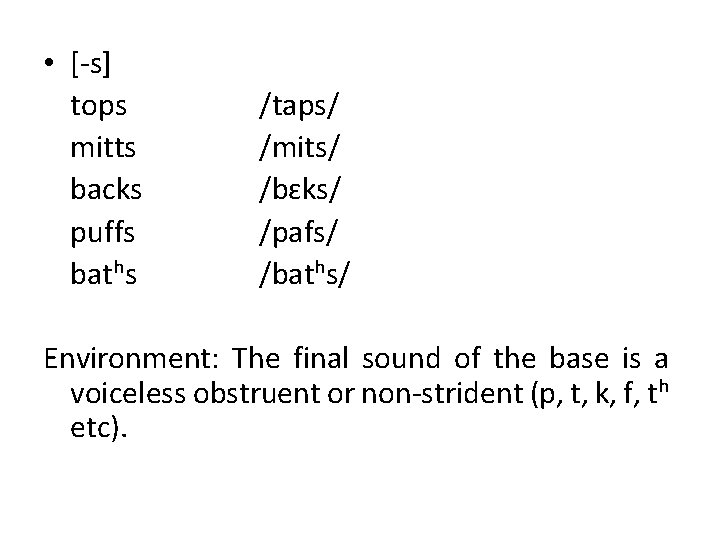
• [-s] tops mitts backs puffs batʰs /taps/ /mits/ /bɛks/ /pafs/ /batʰs/ Environment: The final sound of the base is a voiceless obstruent or non-strident (p, t, k, f, tʰ etc).
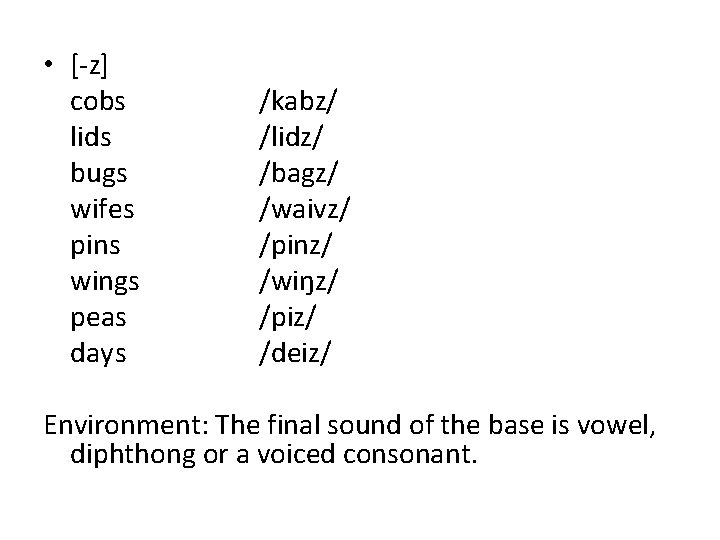
• [-z] cobs lids bugs wifes pins wings peas days /kabz/ /lidz/ /bagz/ /waivz/ /pinz/ /wiŋz/ /piz/ /deiz/ Environment: The final sound of the base is vowel, diphthong or a voiced consonant.
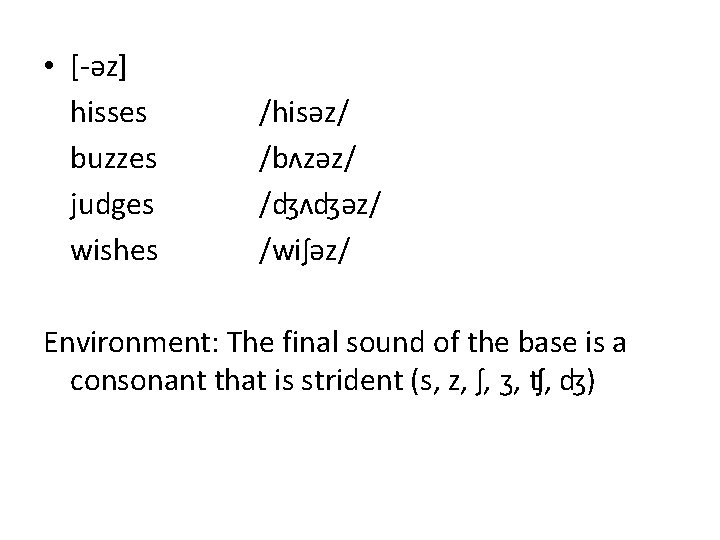
• [-əz] hisses buzzes judges wishes /hisəz/ /bʌzəz/ /ʤʌʤəz/ /wiʃəz/ Environment: The final sound of the base is a consonant that is strident (s, z, ʃ, ʒ, ʧ, ʤ)
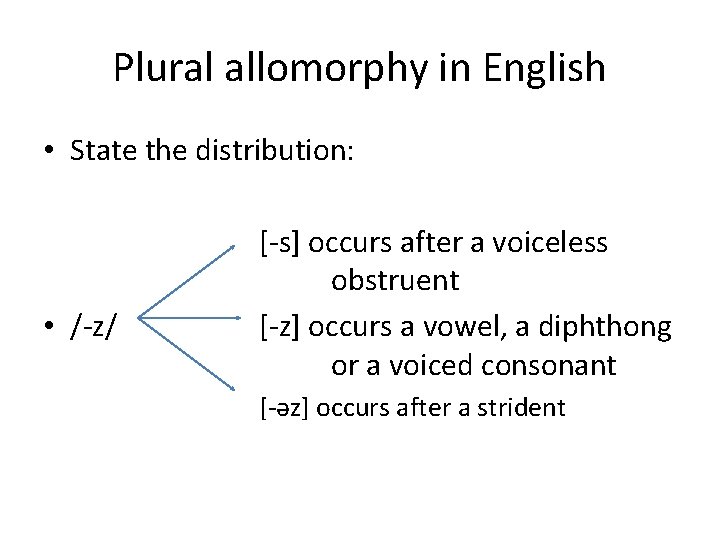
Plural allomorphy in English • State the distribution: • /-z/ [-s] occurs after a voiceless obstruent [-z] occurs a vowel, a diphthong or a voiced consonant [-əz] occurs after a strident
Plural allomorphy in English • The choice of plural allomorph is determined by the final sound of the base word. • The underlying form is the one which happens to be at the widest distribution. • This process, in terms of phonological terminology, is called assimilation. The neighbouring segments assimilates to certain feature to become similar.
Morphophonlogical rule • Definition: A morphophonemic rule has the form of a phonological rule, but is restricted to a particular morphological environment. • Discussion: Morphophonemic rules are sensitive to their environment, unlike phonological rules. Whenever morphological information is required to specify the environment for an allophonic rule, the rule is morphophonemic.
English negative prefixation • The negative prefix /in-/ has the following allomorphs: /in-/ + respective = irrespective /in-/ + literate = illiterate
Counter Examples • These rules are morphophonemic and not phonological. Because, if they were so, the prefixes /un-/ and /non-/ would also exhibit this pattern in the same way. But it is not so as • /un-/ + romantic = unromantic • /un-/ + limited = unlimited • /non-/ + resident = non-resident • /non-/ + lethal = nonlethal
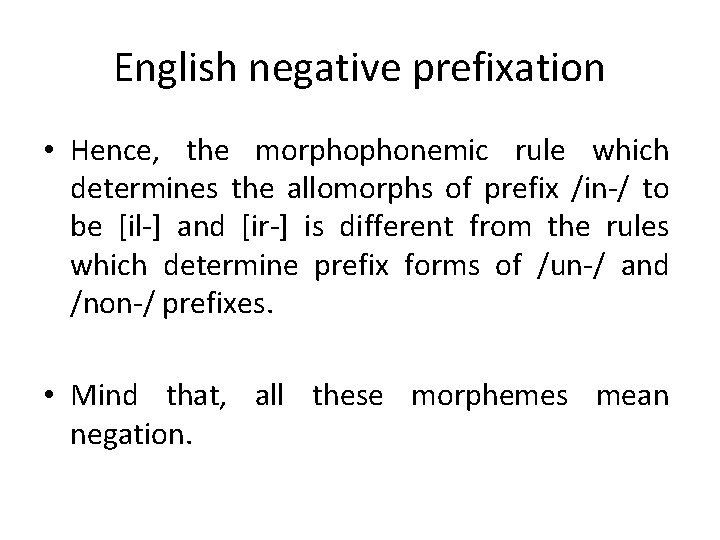
English negative prefixation • Hence, the morphophonemic rule which determines the allomorphs of prefix /in-/ to be [il-] and [ir-] is different from the rules which determine prefix forms of /un-/ and /non-/ prefixes. • Mind that, all these morphemes mean negation.
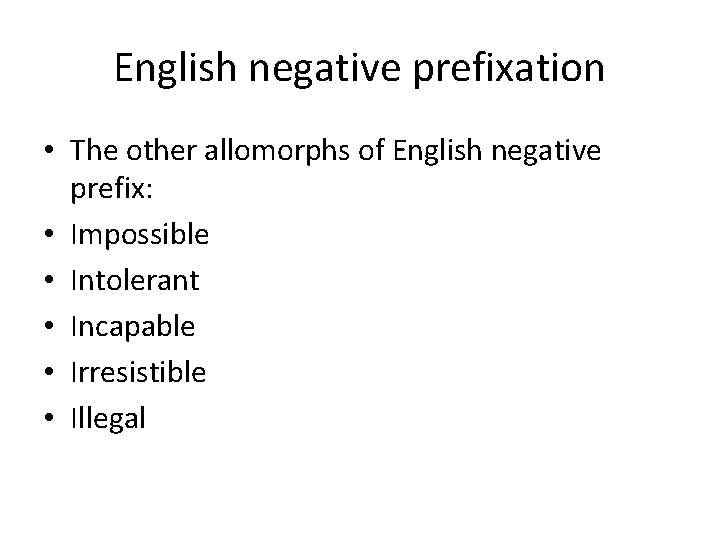
English negative prefixation • The other allomorphs of English negative prefix: • Impossible • Intolerant • Incapable • Irresistible • Illegal
English negative prefixation • More examples:
English negative prefixation • State the distribution:
English negative prefixation • State the rule:
- Slides: 25