
Morphology The Study of the Internal Structure of
![Prefixes u Karok [pasip] “Shoot!” [nipasip] “I shoot” [/upasip] “She/he shoots” u {pasip} u](https://slidetodoc.com/presentation_image_h2/5b2f5d03746a3e21eaf6bcc822f99d0d/image-9.jpg "Prefixes u Karok [pasip] “Shoot!” [nipasip] “I shoot” [/upasip] “She/he shoots” u {pasip} u")
![Suffixes u Mende [p. El. E] [p. El. Ei] [m. Em. Ei] “house” “the](https://slidetodoc.com/presentation_image_h2/5b2f5d03746a3e21eaf6bcc822f99d0d/image-11.jpg "Suffixes u Mende [p. El. E] [p. El. Ei] [m. Em. Ei] “house” “the")
![Infix u Bontoc [fikas] “strong” [fumikas] “she is becoming strong” [fusul] “enemy” [fumusal] “she](https://slidetodoc.com/presentation_image_h2/5b2f5d03746a3e21eaf6bcc822f99d0d/image-13.jpg "Infix u Bontoc [fikas] “strong” [fumikas] “she is becoming strong” [fusul] “enemy” [fumusal] “she")
- Slides: 14
Morphology The Study of the Internal Structure of Words
What Is Morphology? u Many words can be broken down into smaller units u Morphology is the study of word formation u Morphologists identify different classes of morphemes, and study the patterns that occur in the combination of morphemes v. E. G. : {re-} only comes before verbs
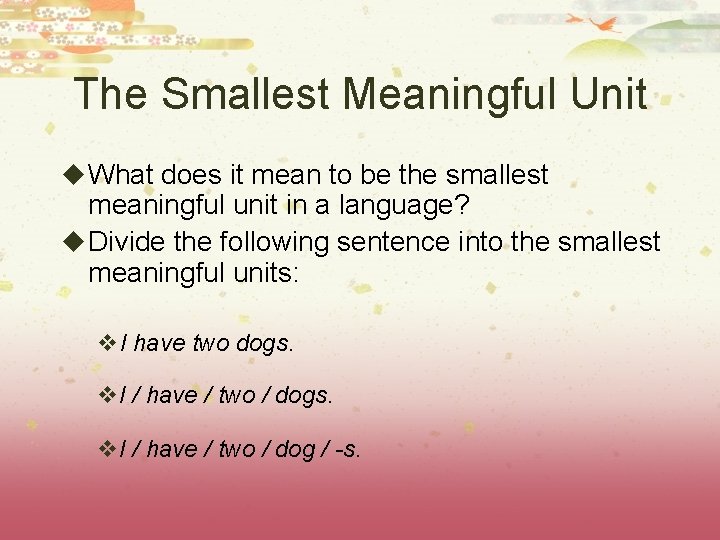
The Smallest Meaningful Unit u What does it mean to be the smallest meaningful unit in a language? u Divide the following sentence into the smallest meaningful units: v. I have two dogs. v. I / have / two / dog / -s.
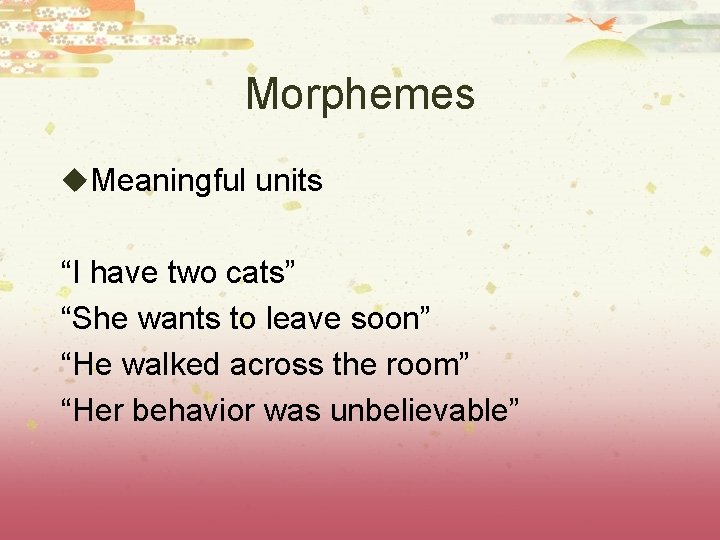
Morphemes u. Meaningful units “I have two cats” “She wants to leave soon” “He walked across the room” “Her behavior was unbelievable”
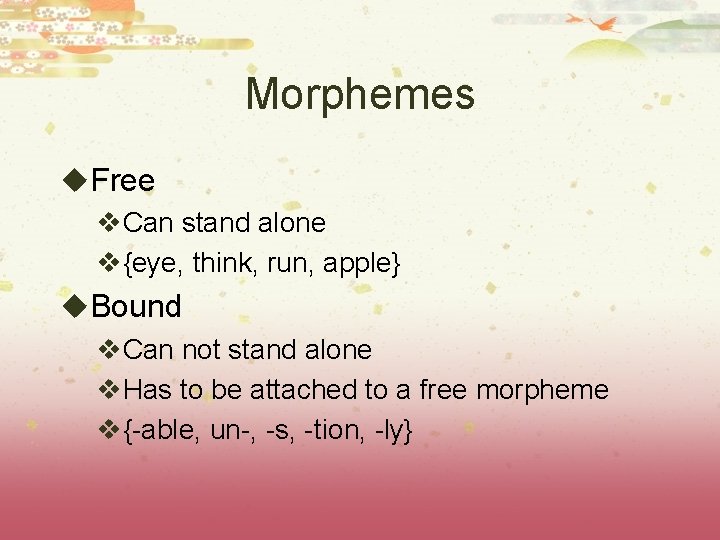
Morphemes u. Free v. Can stand alone v{eye, think, run, apple} u. Bound v. Can not stand alone v. Has to be attached to a free morpheme v{-able, un-, -s, -tion, -ly}
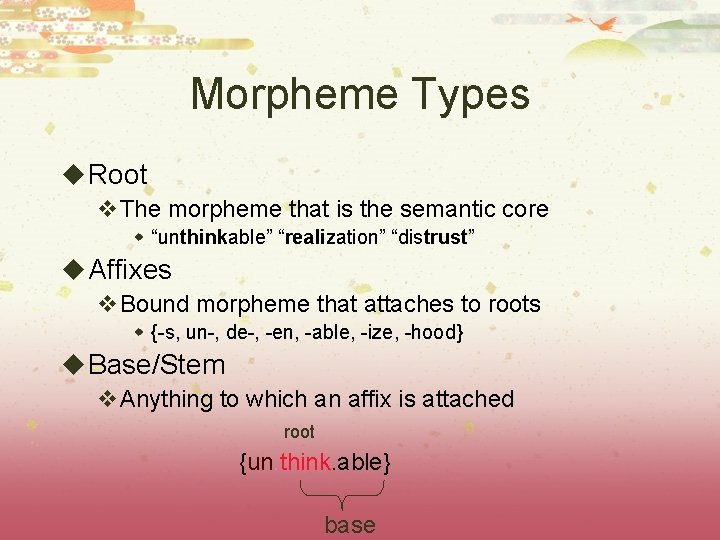
Morpheme Types u Root v. The morpheme that is the semantic core w “unthinkable” “realization” “distrust” u Affixes v. Bound morpheme that attaches to roots w {-s, un-, de-, -en, -able, -ize, -hood} u Base/Stem v. Anything to which an affix is attached root {un. think. able} base
Affixes u. The most common way to build new words v. Prefix v. Suffix v. Infix v. Affix
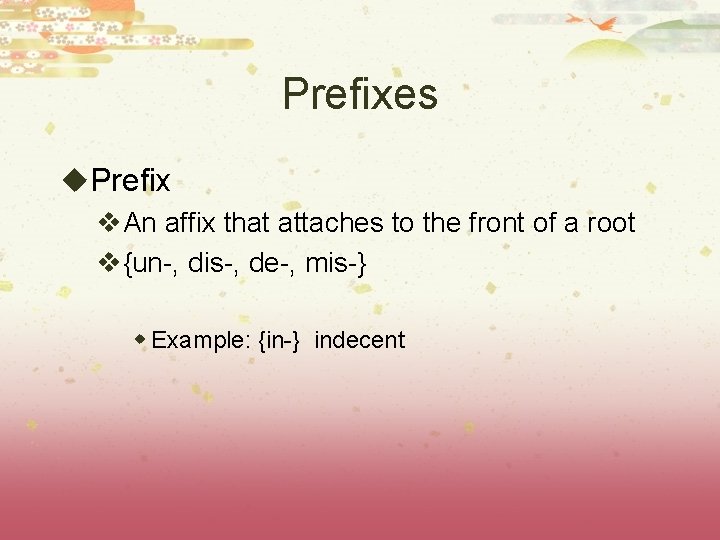
Prefixes u. Prefix v. An affix that attaches to the front of a root v{un-, dis-, de-, mis-} w Example: {in-} indecent
Prefixes u Karok [pasip] “Shoot!” [nipasip] “I shoot” [/upasip] “She/he shoots” u {pasip} u {ni-} u {/u-} “shoot “ 1 st person singular” “ 3 rd person singular” (Karok is a Hokan language of California. The language has been in decline, but some young people are working to keep their ancestral language alive. )
Suffixes u. Suffix v. An affix that attaches to the end of a root v{-able, -ing, -ed, -s} v. Most common affix w Example: {-ful} careful
Suffixes u Mende [p. El. E] [p. El. Ei] [m. Em. Ei] “house” “the house” “glass” “the glass” u {-i} “the” (Mende, Bandi, and Loko belong to the southwestern group of Mende and are spoken in Sierra Leone/Liberia, northeastern Liberia, and north-central Sierra Leone, respectively. )
Infix u. Infix v. An affix that attaches within the root v. No ‘standard’ English example, though examples exist in slang: w ‘abso-darn-lutely’ w ‘un-freaking-likely’
Infix u Bontoc [fikas] “strong” [fumikas] “she is becoming strong” [fusul] “enemy” [fumusal] “she is becoming an enemy” u {-um-} “becoming”
Affix u. Affix v. General term to cover all the previous terms v. Affixes can attach to other affixes w boy. ish. ness w dis. en. tangle