
Morphology I III IV Basic concepts and terms
Morphology I. III. IV. Basic concepts and terms Derivational processes Inflection Problems in morphological description V. Interaction between morphology and phonology VI. Collocations
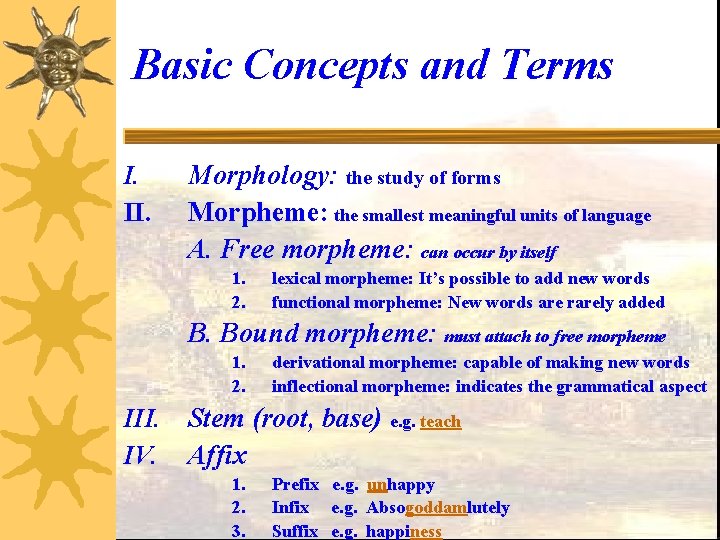
Basic Concepts and Terms I. II. Morphology: the study of forms Morpheme: the smallest meaningful units of language A. Free morpheme: can occur by itself 1. 2. lexical morpheme: It’s possible to add new words functional morpheme: New words are rarely added B. Bound morpheme: must attach to free morpheme 1. 2. derivational morpheme: capable of making new words inflectional morpheme: indicates the grammatical aspect III. Stem (root, base) e. g. teach IV. Affix 1. 2. 3. Prefix e. g. unhappy Infix e. g. Absogoddamlutely Suffix e. g. happiness
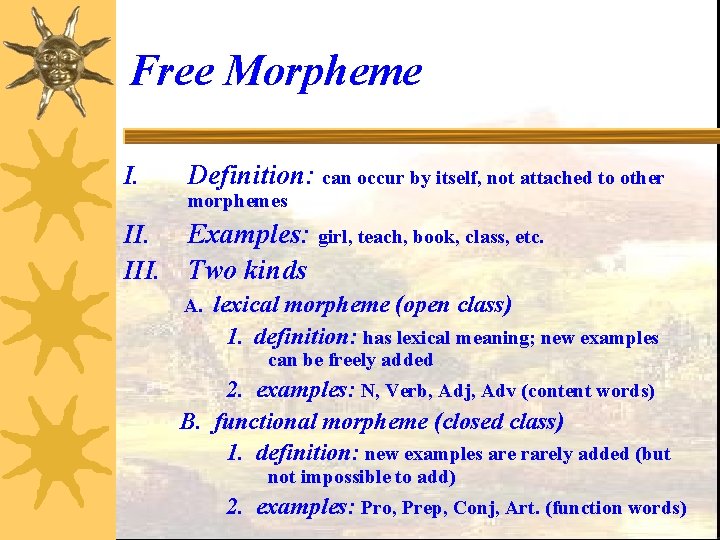
Free Morpheme I. Definition: can occur by itself, not attached to other morphemes II. Examples: girl, teach, book, class, etc. III. Two kinds A. lexical morpheme (open class) 1. definition: has lexical meaning; new examples can be freely added 2. examples: N, Verb, Adj, Adv (content words) B. functional morpheme (closed class) 1. definition: new examples are rarely added (but not impossible to add) 2. examples: Pro, Prep, Conj, Art. (function words)

Bound Morpheme I. Derivational morpheme A. may change syntactic class B. to form new words C. examples: -able, un-, re-, etc. II. Inflectional morpheme A. Different forms of the same word B. Not change syntactic class C. Only 8 kinds in English: -’s, -s (plural nouns), -ing, ed/-en, -est, -er, -s (S-V agreement)

II. Derivational Processes: a method to get new words A. B. C. D. E. F. G. H. I. J. K. L. Derivation (Derivational affixation) Compounding: combine two or more morphemes to form new words Reduplication: full or partial repetition of a morpheme Blending: parts of the words that are combined are deleted Clipping: part of a word has been clipped off Acronyms: abbreviate a longer term by taking the initial letters Back formation: A word (usually a noun) is reduced to form another word of a different type (usually a verb) Extension of word formation rules: Part of a word is treated as a morpheme though it’s not Functional shift (Conversion): A change in the part of speech Proper names Common words Onomatopoeia: words imitate sounds in nature Borrowing: The taking over of words from other languages

III. Inflection; Function words Definition: adds some grammatical functions related to Syntax, but does not create new words. A list of Function words in English (see Nash 65) All the inflectional morphemes in English are suffixes. Basic word structure in English: (DER) Base (DER) (INFL) e. g. . . Plant er s im Polite

IV. Problems in Morphological Description: For example: Noun ADJ Law (English) Legal (Old Norse) due to historical influence Mouth (English) Oral (Latin) The above examples aren’t suitable for people to analyze by using morphological rules More examples: Sheep (plural form) Read (past tense)
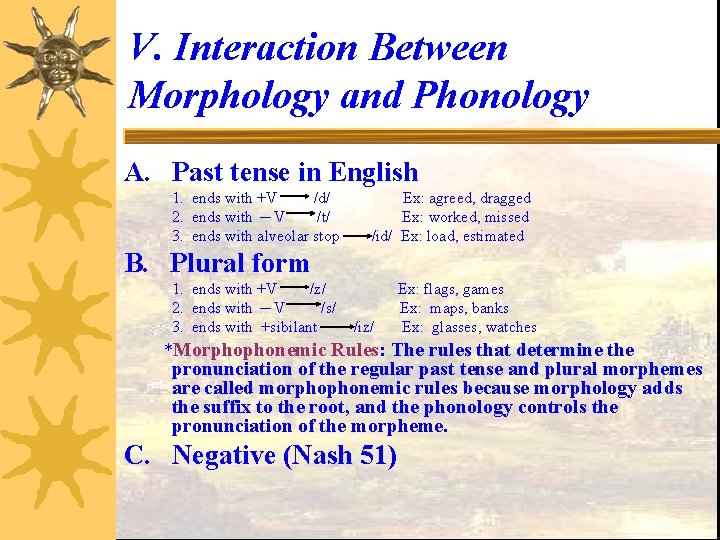
V. Interaction Between Morphology and Phonology A. Past tense in English 1. ends with +V /d/ 2. ends with -V /t/ 3. ends with alveolar stop Ex: agreed, dragged Ex: worked, missed /id/ Ex: load, estimated B. Plural form 1. ends with +V /z/ 2. ends with -V /s/ 3. ends with +sibilant /iz/ Ex: flags, games Ex: maps, banks Ex: glasses, watches *Morphophonemic Rules: The rules that determine the pronunciation of the regular past tense and plural morphemes are called morphophonemic rules because morphology adds the suffix to the root, and the phonology controls the pronunciation of the morpheme. C. Negative (Nash 51)
VI. Collocation Definition: There are combinations of words which are stored together as whole units in the brain, sometimes like big words. A speaker calls up the units as a whole form from memory, just as he calls up individual words. Examples: Salt and Pepper Knife and Fork Bread and Butter Do business Do harm Make a mistake
- Slides: 9