
Morphology based glossing of Estonian and Leipzig glossing
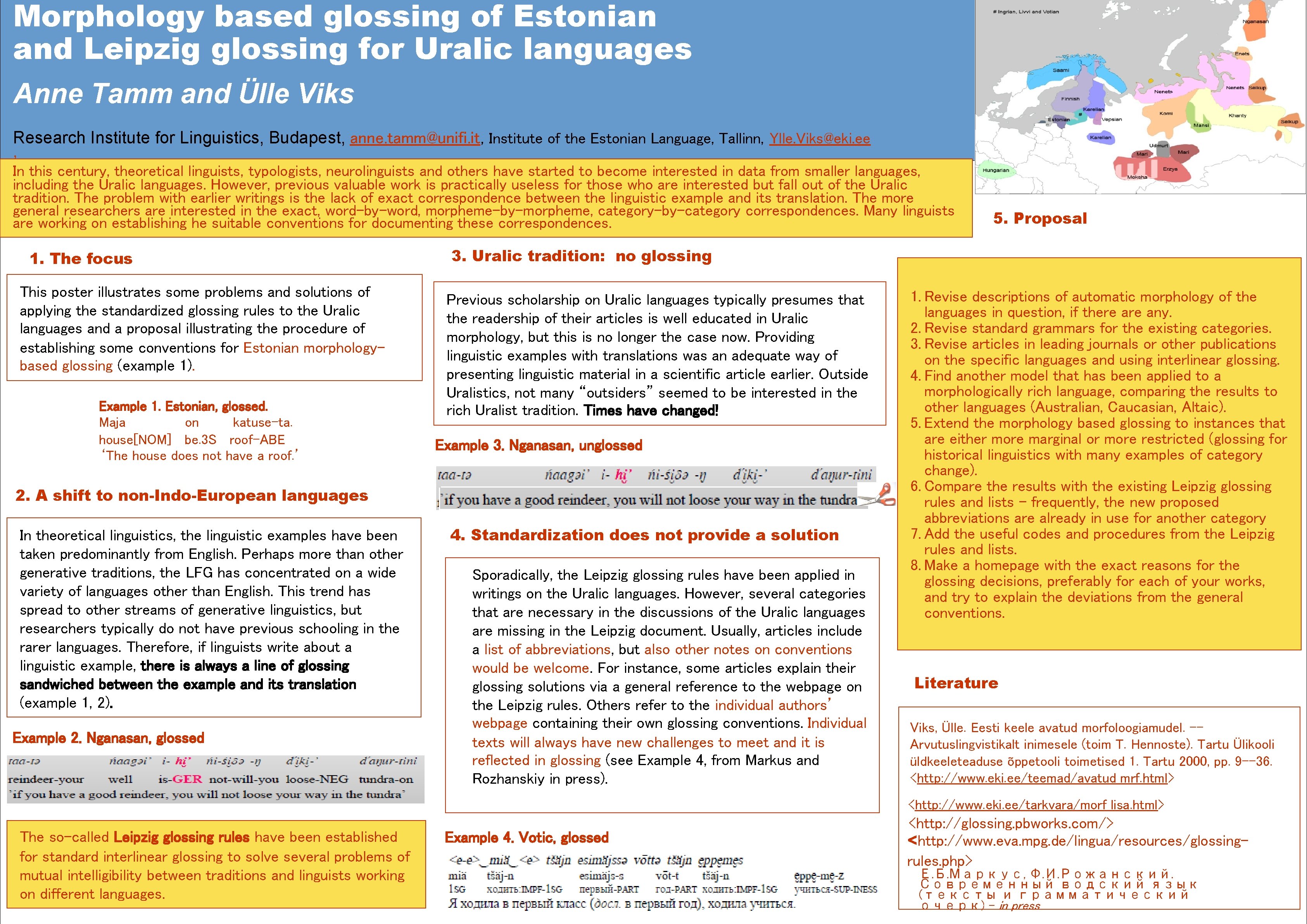
Morphology based glossing of Estonian and Leipzig glossing for Uralic languages Anne Tamm and Ülle Viks Research Institute for Linguistics, Budapest, anne. tamm@unifi. it, Institute of the Estonian Language, Tallinn, Ylle. Viks@eki. ee , In this century, theoretical linguists, typologists, neurolinguists and others have started to become interested in data from smaller languages, including the Uralic languages. However, previous valuable work is practically useless for those who are interested but fall out of the Uralic tradition. The problem with earlier writings is the lack of exact correspondence between the linguistic example and its translation. The more general researchers are interested in the exact, word-by-word, morpheme-by-morpheme, category-by-category correspondences. Many linguists are working on establishing he suitable conventions for documenting these correspondences. 1. The focus This poster illustrates some problems and solutions of applying the standardized glossing rules to the Uralic languages and a proposal illustrating the procedure of establishing some conventions for Estonian morphologybased glossing (example 1). Example 1. Estonian, glossed. Maja on katuse-ta. house[NOM] be. 3 S roof-ABE ‘The house does not have a roof. ’ 3. Uralic tradition: no glossing Previous scholarship on Uralic languages typically presumes that the readership of their articles is well educated in Uralic morphology, but this is no longer the case now. Providing linguistic examples with translations was an adequate way of presenting linguistic material in a scientific article earlier. Outside Uralistics, not many “outsiders” seemed to be interested in the rich Uralist tradition. Times have changed! Example 3. Nganasan, unglossed 2. A shift to non-Indo-European languages In theoretical linguistics, the linguistic examples have been taken predominantly from English. Perhaps more than other generative traditions, the LFG has concentrated on a wide variety of languages other than English. This trend has spread to other streams of generative linguistics, but researchers typically do not have previous schooling in the rarer languages. Therefore, if linguists write about a linguistic example, there is always a line of glossing sandwiched between the example and its translation (example 1, 2). Example 2. Nganasan, glossed 5. Proposal 4. Standardization does not provide a solution Sporadically, the Leipzig glossing rules have been applied in writings on the Uralic languages. However, several categories that are necessary in the discussions of the Uralic languages are missing in the Leipzig document. Usually, articles include a list of abbreviations, but also other notes on conventions would be welcome. For instance, some articles explain their glossing solutions via a general reference to the webpage on the Leipzig rules. Others refer to the individual authors’ webpage containing their own glossing conventions. Individual texts will always have new challenges to meet and it is reflected in glossing (see Example 4, from Markus and Rozhanskiy in press). 1. Revise descriptions of automatic morphology of the languages in question, if there any. 2. Revise standard grammars for the existing categories. 3. Revise articles in leading journals or other publications on the specific languages and using interlinear glossing. 4. Find another model that has been applied to a morphologically rich language, comparing the results to other languages (Australian, Caucasian, Altaic). 5. Extend the morphology based glossing to instances that are either more marginal or more restricted (glossing for historical linguistics with many examples of category change). 6. Compare the results with the existing Leipzig glossing rules and lists – frequently, the new proposed abbreviations are already in use for another category 7. Add the useful codes and procedures from the Leipzig rules and lists. 8. Make a homepage with the exact reasons for the glossing decisions, preferably for each of your works, and try to explain the deviations from the general conventions. Literature Viks, Ülle. Eesti keele avatud morfoloogiamudel. -Arvutuslingvistikalt inimesele (toim T. Hennoste). Tartu Ülikooli üldkeeleteaduse õppetooli toimetised 1. Tartu 2000, pp. 9 --36. <http: //www. eki. ee/teemad/avatud_mrf. html> <http: //www. eki. ee/tarkvara/morf_lisa. html> The so-called Leipzig glossing rules have been established for standard interlinear glossing to solve several problems of mutual intelligibility between traditions and linguists working on different languages. Example 4. Votic, glossed <http: //glossing. pbworks. com/> <http: //www. eva. mpg. de/lingua/resources/glossingrules. php> Е. Б. Маркус, Ф. И. Рожанский. Современный водский язык (тексты и грамматический очерк) – in press

2
- Slides: 2