
Morphological study of Insect Mechanoreceptors to develop Artificial



- Slides: 17
Morphological study of Insect Mechanoreceptors to develop Artificial Bio-inspired mechanosensors Shashikanth Chakilam *1 , Dan Ting Li 2 , Zhang chuan xi 2 , Rimvydas Gaidys 1 , Audronė Lupeikienė 3 1. Faculty of Mechanical Engineering, Kaunas university of Technology, Kaunas, Lithuania 2. Institute of Insect Science, Zhejiang University, Hangzhou 310058, China 3. Institute of Mathematics and Informatics, Vilnius University, Vilnius, Lithuania 1 7 th International Electronic Conference on Sensors and Application
OUTLINE 2 Objective Introduction Physiology of Insect Mechanoreceptors Working or Functioning of Mechanoreceptors Materials and Methods Results and Discussion Proposed Model Conclusion
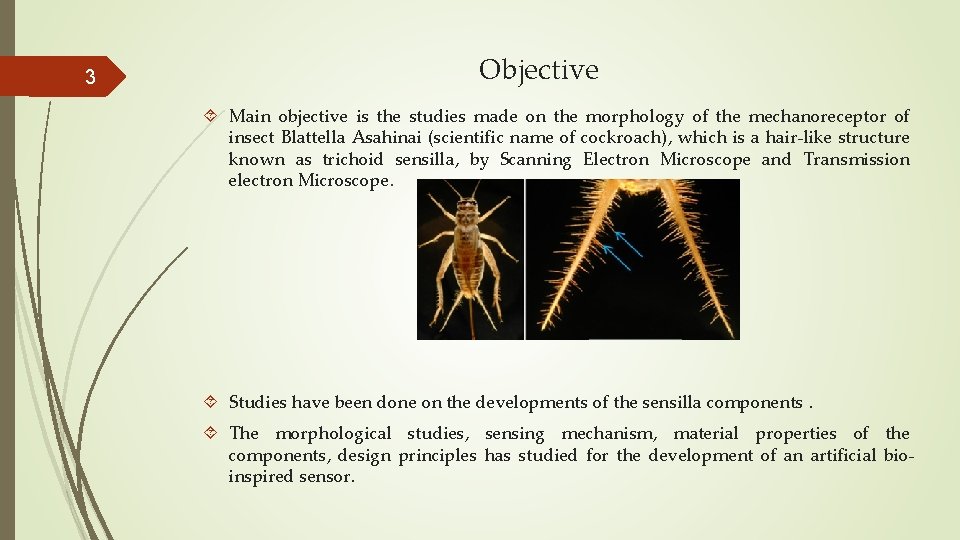
3 Objective Main objective is the studies made on the morphology of the mechanoreceptor of insect Blattella Asahinai (scientific name of cockroach), which is a hair-like structure known as trichoid sensilla, by Scanning Electron Microscope and Transmission electron Microscope. Studies have been done on the developments of the sensilla components. The morphological studies, sensing mechanism, material properties of the components, design principles has studied for the development of an artificial bioinspired sensor.
4 Introduction For the development of any technology, Nature is one of the best inspiration. Insects are the best templets for development of the smaller bio- inspired sensors because of their multiple sensors which are located on the outer surface of hard shell bodies , to sense the environmental stimulus. This makes insects particularly amenable to comparative architectural and hierarchical studies and bio-inspiration. The neural and physiological mechanisms of single sensors or entire sensor systems have been well studied over a century. Here we are considering one of the best systems of mechanosensory in insects, the hair flow sensing system of Arthropods and their bio-inspired micro-mechanical systems.
5 PHYSIOLOGY & MORPHOLOGY tb: tubular body; osl: outer sensillum lymph space; jm: joint or socket membrane; to: tormogen cell tr: trichogen cell; sc: sensory cell ; th: thecogen cell ; bl: basal lamina; hl: hemolymph id; gl: glia; ss: socket septum; ep: epidermis Figures taken from Keil and Steiner (1991) paper.
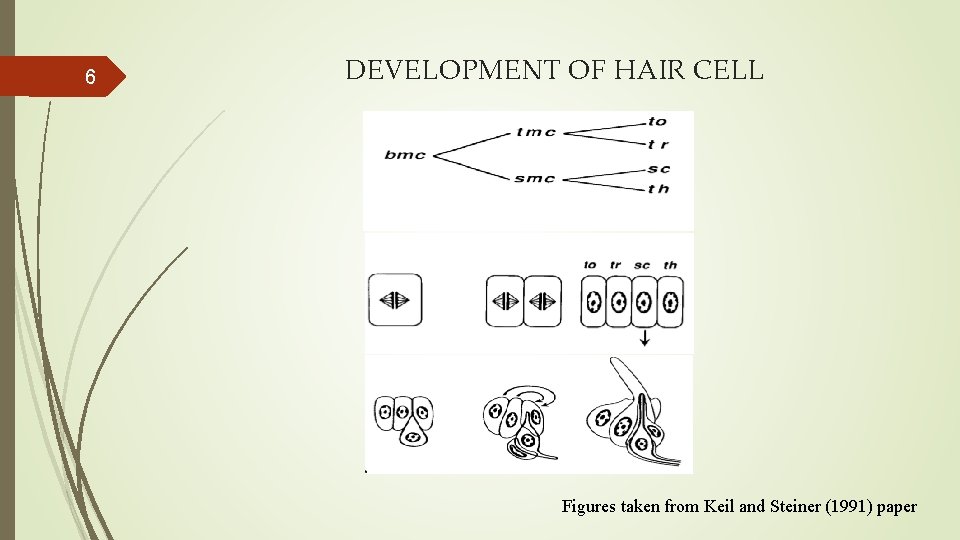
6 DEVELOPMENT OF HAIR CELL Figures taken from Keil and Steiner (1991) paper
7 FUNCTIONING (when flow is on hair) In the functioning of the insect mechanoreceptors 2 processes are been involved 1. COUPLING(distortion of tip of dendrite) 2. TRANSDUCTION(production of receptor potential)
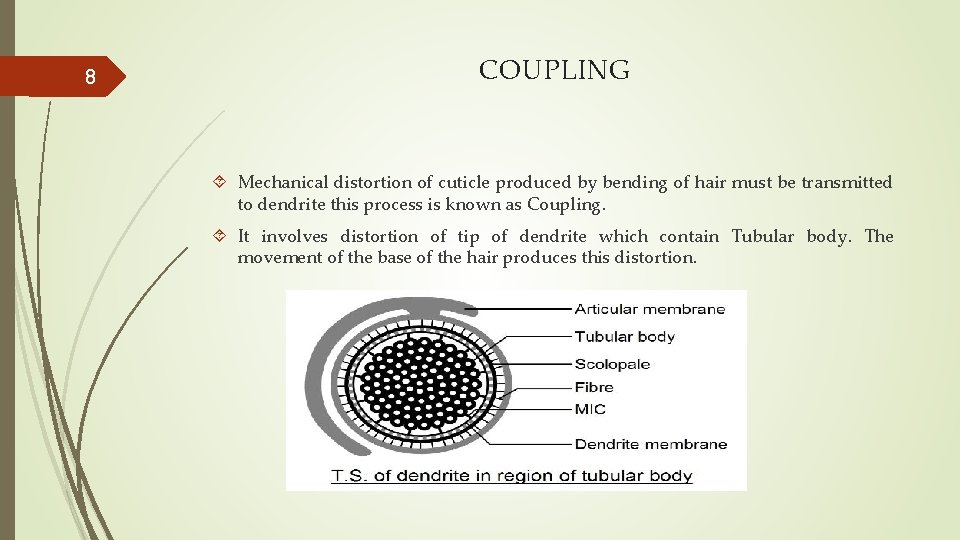
8 COUPLING Mechanical distortion of cuticle produced by bending of hair must be transmitted to dendrite this process is known as Coupling. It involves distortion of tip of dendrite which contain Tubular body. The movement of the base of the hair produces this distortion.
9 TRANSDUCTION This process involves in the deformation of dendrite and production of receptor potential. Receptor potential is the potential difference produced by the activation of sensory receptors. i. e. in insects, plasma membrane of neurons contains stretch activated ion channels, in which the inward movement of these ions occurs. It is generally a depolarizing event resulting from inward current flow. Tubular body plays an important role in this process, very small distortion is enough e. g. 5 nm to produce receptor potential.
Materials and Methods 10 Insects The Blattella Asahinai insects are collected from the bank of Musi River in Hyderabad, India and are preserved in the laboratory of Biological Regional Centre of Zoological survey of India, Hyderabad, India. Sample preparation The selected cockroach is anesthetized by keeping it on an ice block for about a minute. The antennal segments are separated from the surface of body using scissors and are kept in 1 NKOH which helps to dissolve the unwanted soft tissues and the washed with 60% ethanol at room temperature for about 5 minutes. These samples are dried well by placing them over filter paper and kept under the SEM to find the structures
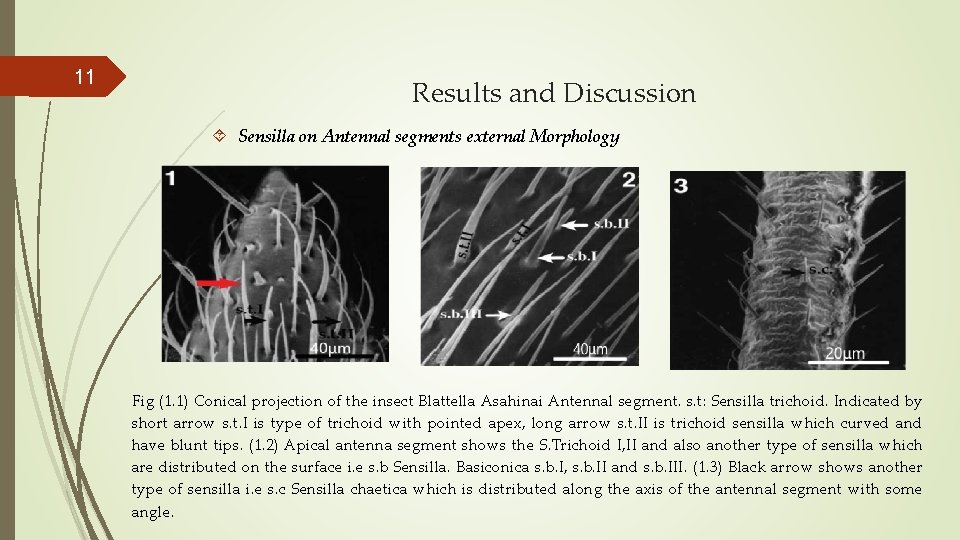
11 Results and Discussion Sensilla on Antennal segments external Morphology Fig (1. 1) Conical projection of the insect Blattella Asahinai Antennal segment. s. t: Sensilla trichoid. Indicated by short arrow s. t. I is type of trichoid with pointed apex, long arrow s. t. II is trichoid sensilla which curved and have blunt tips. (1. 2) Apical antenna segment shows the S. Trichoid I, II and also another type of sensilla which are distributed on the surface i. e s. b Sensilla. Basiconica s. b. I, s. b. II and s. b. III. (1. 3) Black arrow shows another type of sensilla i. e s. c Sensilla chaetica which is distributed along the axis of the antennal segment with some angle.
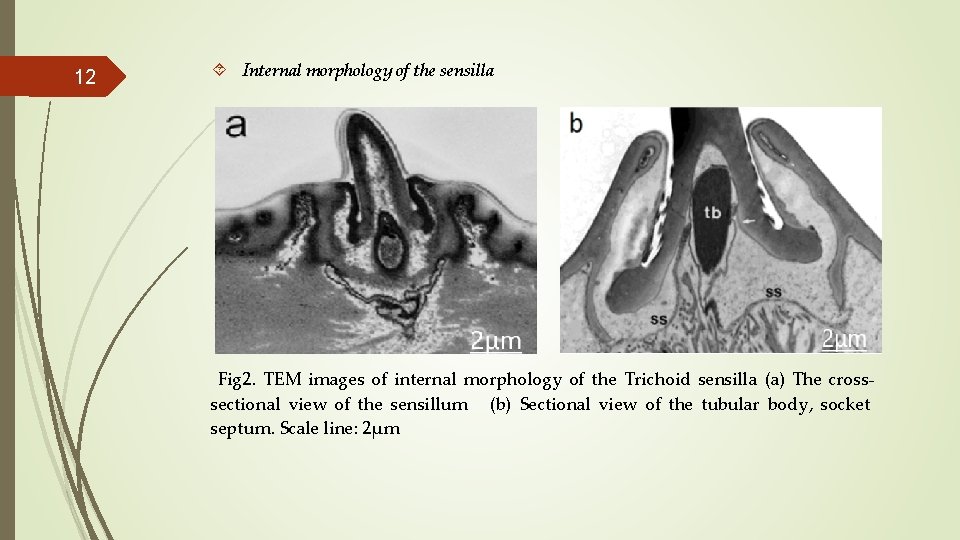
12 Internal morphology of the sensilla Fig 2. TEM images of internal morphology of the Trichoid sensilla (a) The crosssectional view of the sensillum (b) Sectional view of the tubular body, socket septum. Scale line: 2µm
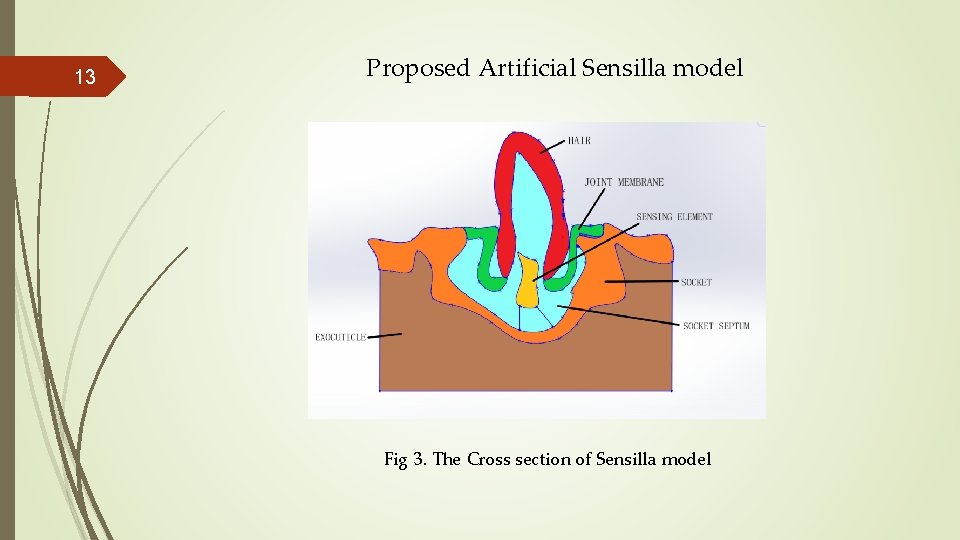
13 Proposed Artificial Sensilla model Fig 3. The Cross section of Sensilla model
14 Design of artificial mechanosensors The dimensions of the sensilla were measured using the SEM and TEM and found that the long axis of the socket is about 5+0. 5µm, the short axis of the socket is about 4+0. 5µm, the length of the hair is 15+2µm, diameter is 900+150 nm, the dendrite cross-section is round, and its diameter is about 600 nm, the tubular body inside this dendrite is about the length of 850 nm and the diameter is of 500 nm and microtubules are of 50 nm each in diameter which is tightly packed in the tubular body. The material of the hair is keratin which is a protein nanofiber containing sulfur. The mechanical properties of the hair are Density of 1100 kg/m 3, Low elastic modulus is 6 Gpa, High elastic modulus is 9 Gpa, Poisons ratio is 0. 38. Joint membrane and socket are the viscoelastic materials that have the young’s modulus of 50 Mpa, Poisson’s ratio is of 0. 4. Suspension fibers are fibrous materials which are elastic in nature. The dendrite is covered with dendrite sheath, and tubular body containing microtubules are the sensing elements which are of piezoelectric material.
15 Conclusion & Future work The morphology and physiology of sensilla of Blattella Asahinai the and its functioning are studied when an external stimulus act on it. The model of the bio-inspired artificial mechanosensor is proposed. The mathematical model and simulation studies on designed artificial hair sensor flow and tactile parameters will be made in the future.
16 References 1. A. George. ; Béla A. L. Nagy. Morphology, distribution, and ultrastructural differences of sensilla trichodea and basiconica on the antennae of the oriental fruit moth, Grapholitha molesta (Busck) (Lepidoptera: Tortricidae). International Journal of Insect Morphology and Embryology 1984, Volume 13, Issue 2, 157 -170. https: //doi. org/10. 1016/0020 -7322(84)90023 -0 2. Shimozawa, T. ; Kanou, M. The aerodynamics and sensory physiology of range fractionation in the cereal filiform sensilla of the cricket Gryllus bimaculatus. J. Comp. Physiol. 1984, 155, 495– 505. https: //doi. org/10. 1007/BF 00611914 3. S. Dey. ; R. N. Hooroo. ; D. Wankhar. Scanning electron microscopic studies of the external morphology of sensilla on the legs of a butterfly, Graphium sarpedon (Lepidoptera—Papillionidae. Micron 1995, 26, 367 -376. https: //doi. org/10. 1016/0968 -4328(95)00013 -5 4. M Dijkstra. ; J J van Baar. ; R J Wiegerink. ; T S J Lammerink. ; J H de Boer. ; G J M Krijnen. Artificial sensory hairs based on the flow sensitive receptor hairs of crickets. J. Micromech. Microeng 2005, 15, S 132–S 138. 5. Dagamseh, A. M. K. Estimation of squeeze film damping in artificial hair-sensor towards the detection-limit of crickets’ hairs. Microsyst Technol 2014, 20, 963– 970. https: //doi. org/10. 1007/s 00542 -014 -2099 -6 6. Krijnen G. J. M. ; Droogendijk H. ; Dagamseh A. M. K. ; Jaganatharaja R. K. ; Casas J. Crickets as Bio-Inspiration for MEMS-Based Flow-Sensing. In: Bleckmann H. , Mogdans J. , Coombs S. (eds) Flow Sensing in Air and Water. Springer, Berlin, Heidelberg, 2014, pp 459 -488. https: //doi. org/10. 1007/9783 -642 -41446 -6_17 7. G. J. M. Krijnen. ; T. Lammerink. ; R. Wiegerink. Learning from crickets: artificial hair-sensor array developments. SENSORS, 2010 IEEE, Kona, HI, 2010, 2218 -2223. 8. G. Krijnen. ; T. Lammerink. ; R. Wiegerink. ; J. Casas. Cricket Inspired Flow-Sensor Arrays. SENSORS, 2007 IEEE, Atlanta, GA, 2007, pp. 539 -546, doi: 10. 1109/ICSENS. 2007. 4388455. 9. Droogendijk, H. ; Casas, J. ; Steinmann, T. ; & Krijnen, G. J. Performance assessment of bio-inspired systems: flow sensing MEMS hairs. Bioinspiration & biomimetics, 2014, 10(1), 016001. 10. Droogendijk, H. (2014). Bio-inspired MEMS flow and inertial sensors. Enschede: University of Twente. https: //doi. org/10. 3990/1. 9789036535984
17