
MORPHOLOGICAL STRUCTURE OF ENGLISH WORDS Morphemes and Words
- Slides: 30
MORPHOLOGICAL STRUCTURE OF ENGLISH WORDS
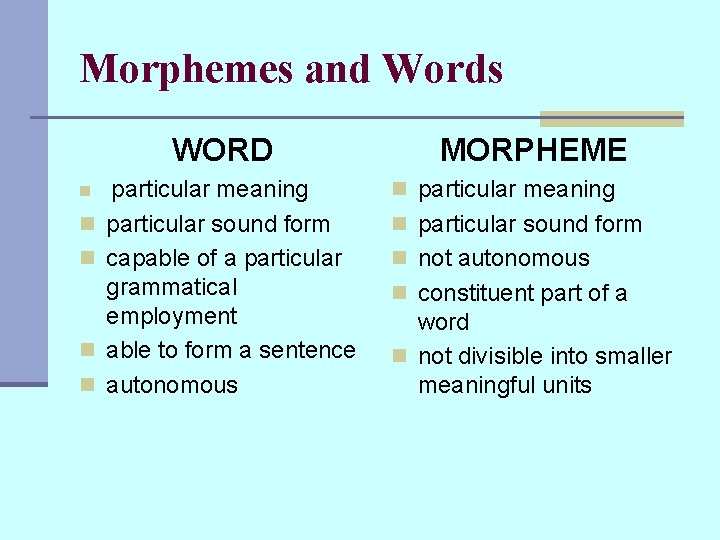
Morphemes and Words WORD n n n particular meaning particular sound form capable of a particular grammatical employment able to form a sentence autonomous MORPHEME n particular meaning n particular sound form n not autonomous n constituent part of a word n not divisible into smaller meaningful units
MORPHEME is the smallest meaningful language unit
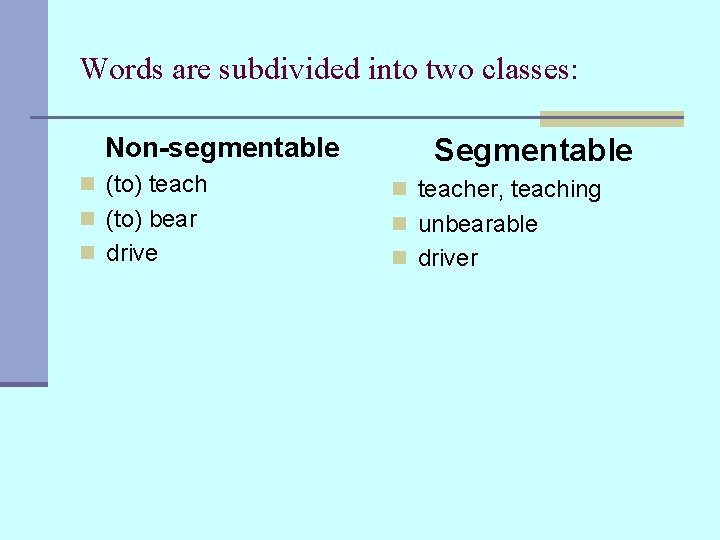
Words are subdivided into two classes: Non-segmentable Segmentable n (to) teach n teacher, teaching n (to) bear n unbearable n driver
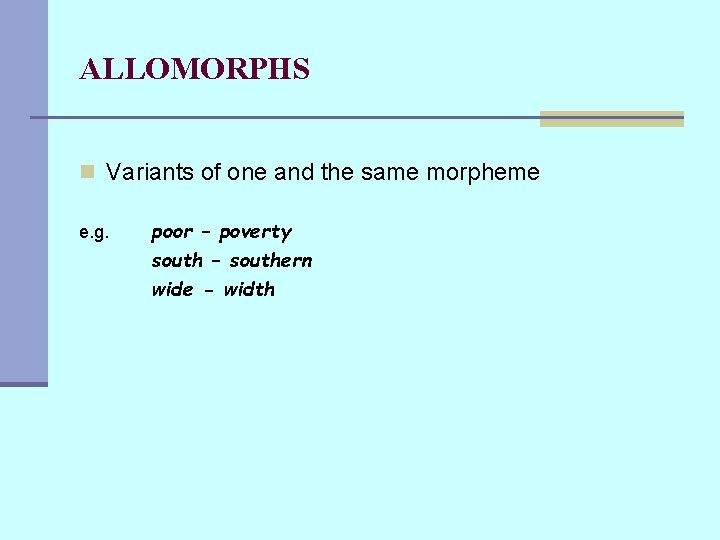
ALLOMORPHS n Variants of one and the same morpheme e. g. poor – poverty south – southern wide - width
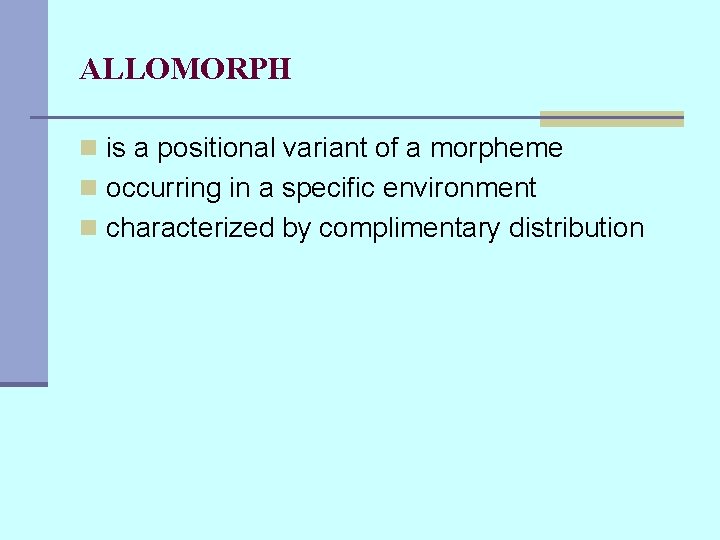
ALLOMORPH n is a positional variant of a morpheme n occurring in a specific environment n characterized by complimentary distribution
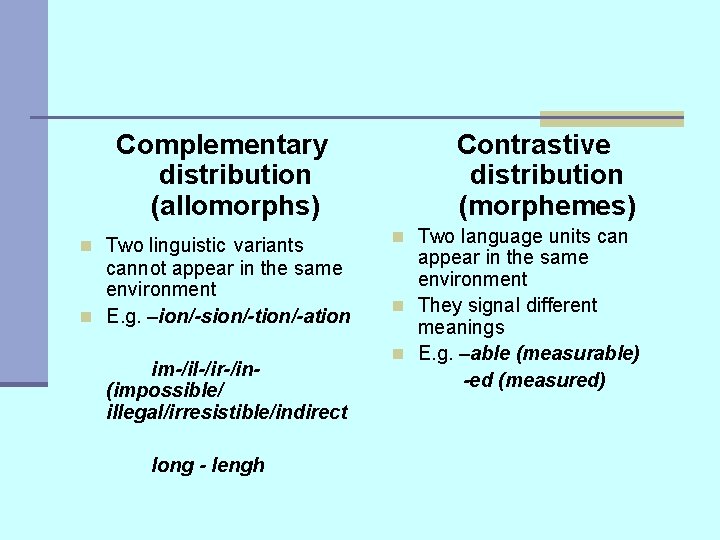
Complementary distribution (allomorphs) n Two linguistic variants cannot appear in the same environment n E. g. –ion/-sion/-tion/-ation im-/il-/ir-/in(impossible/ illegal/irresistible/indirect long - lengh Contrastive distribution (morphemes) n Two language units can appear in the same environment n They signal different meanings n E. g. –able (measurable) -ed (measured)
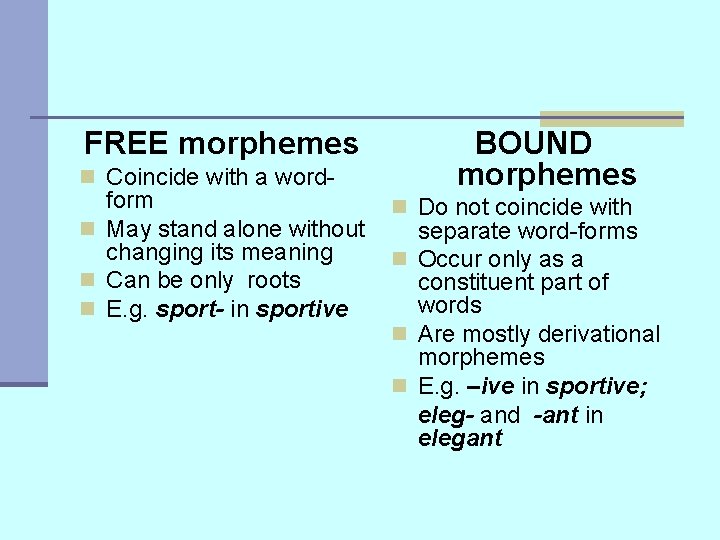
FREE morphemes n Coincide with a word- form n May stand alone without changing its meaning n Can be only roots n E. g. sport- in sportive BOUND morphemes n Do not coincide with separate word-forms n Occur only as a constituent part of words n Are mostly derivational morphemes n E. g. –ive in sportive; eleg- and -ant in elegant
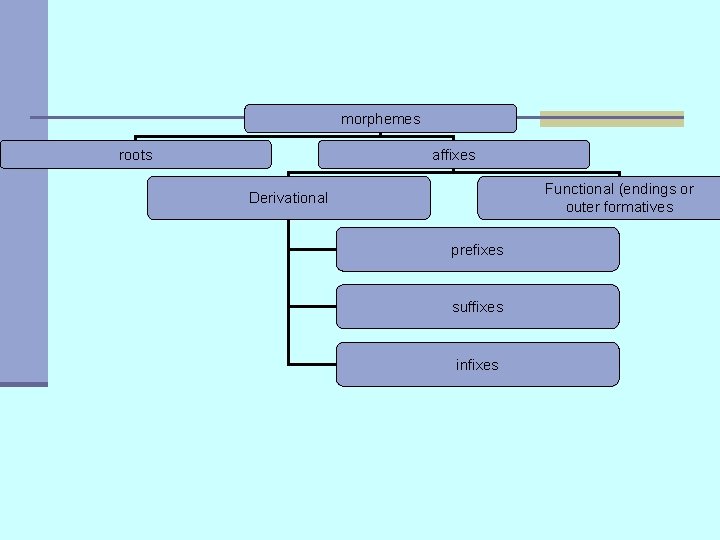
morphemes roots affixes Functional (endings or outer formatives Derivational prefixes suffixes infixes
A ROOT MORPHEME n is a lexical center of a word n has an individual lexical meaning common to a set of semantically related words (word-family) e. g. to write, writer, writing
A ROOT MORPHEME does not possess a part-of-speech meaning e. g. cold water, to water flowers n is often homonymous to words e. g. find, bear, land, man n is an ultimate constituent at a morphological level of analysis n
A STEM n is what remains of a word when a derivational or functional affix is removed from the word e. g. hearty, heart - hearts
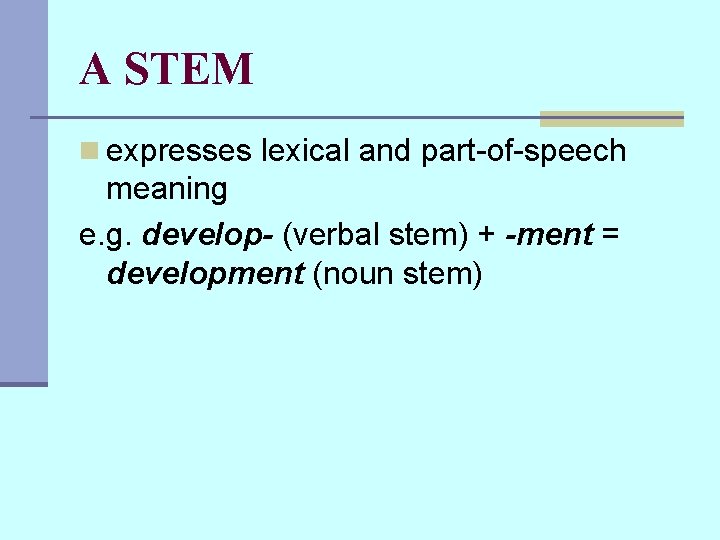
A STEM n expresses lexical and part-of-speech meaning e. g. develop- (verbal stem) + -ment = development (noun stem)
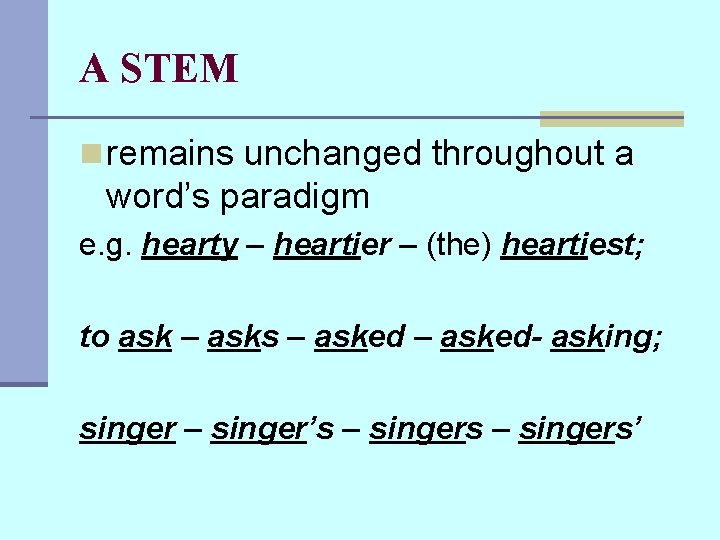
A STEM n remains unchanged throughout a word’s paradigm e. g. hearty – heartier – (the) heartiest; to ask – asks – asked- asking; singer – singer’s – singers’
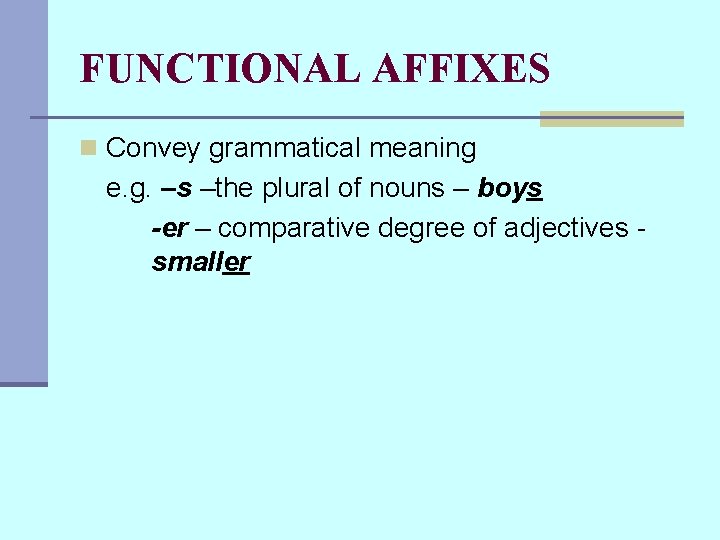
FUNCTIONAL AFFIXES n Convey grammatical meaning e. g. –s –the plural of nouns – boys -er – comparative degree of adjectives smaller
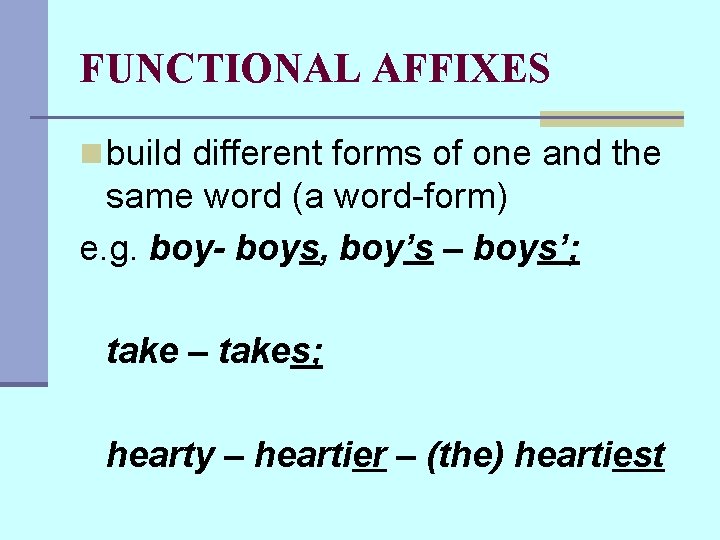
FUNCTIONAL AFFIXES n build different forms of one and the same word (a word-form) e. g. boy- boys, boy’s – boys’; take – takes; hearty – heartier – (the) heartiest
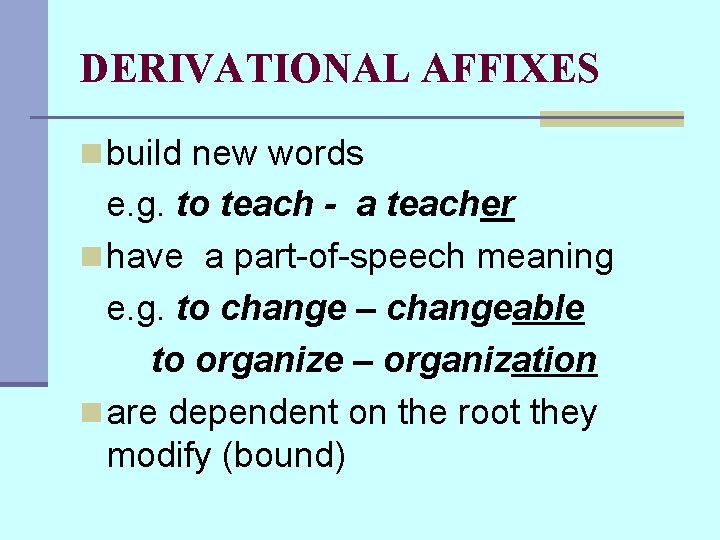
DERIVATIONAL AFFIXES n build new words e. g. to teach - a teacher n have a part-of-speech meaning e. g. to change – changeable to organize – organization n are dependent on the root they modify (bound)
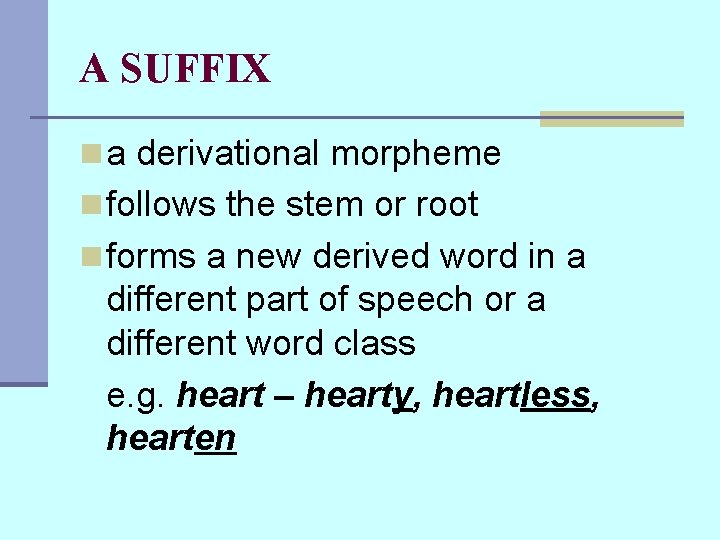
A SUFFIX n a derivational morpheme n follows the stem or root n forms a new derived word in a different part of speech or a different word class e. g. heart – hearty, heartless, hearten
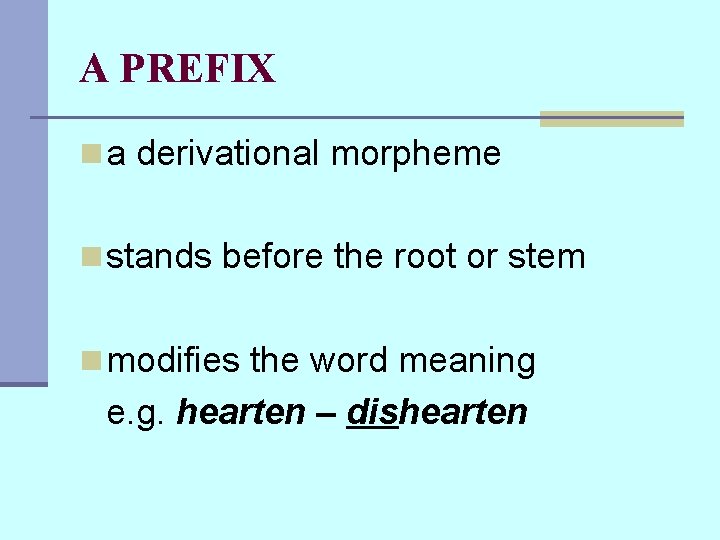
A PREFIX n a derivational morpheme n stands before the root or stem n modifies the word meaning e. g. hearten – dishearten
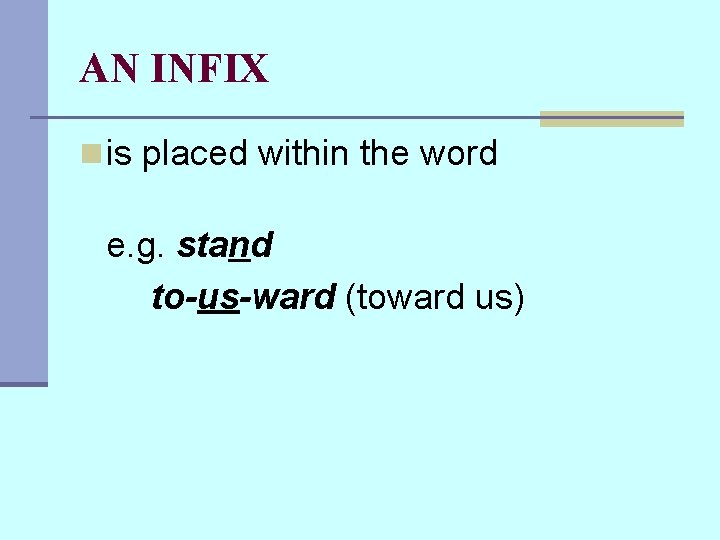
AN INFIX n is placed within the word e. g. stand to-us-ward (toward us)
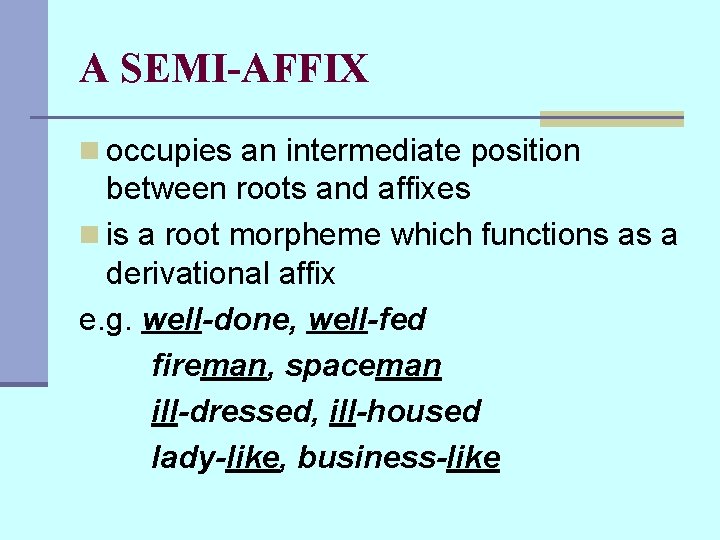
A SEMI-AFFIX n occupies an intermediate position between roots and affixes n is a root morpheme which functions as a derivational affix e. g. well-done, well-fed fireman, spaceman ill-dressed, ill-housed lady-like, business-like
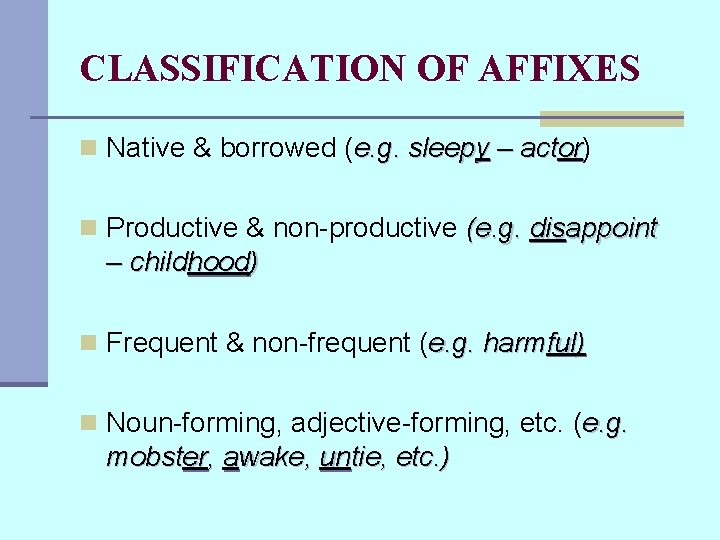
CLASSIFICATION OF AFFIXES n Native & borrowed (e. g. sleepy – actor) or n Productive & non-productive (e. g. disappoint – childhood) n Frequent & non-frequent (e. g. harmful) n Noun-forming, adjective-forming, etc. (e. g. mobster, awake, untie, etc. )
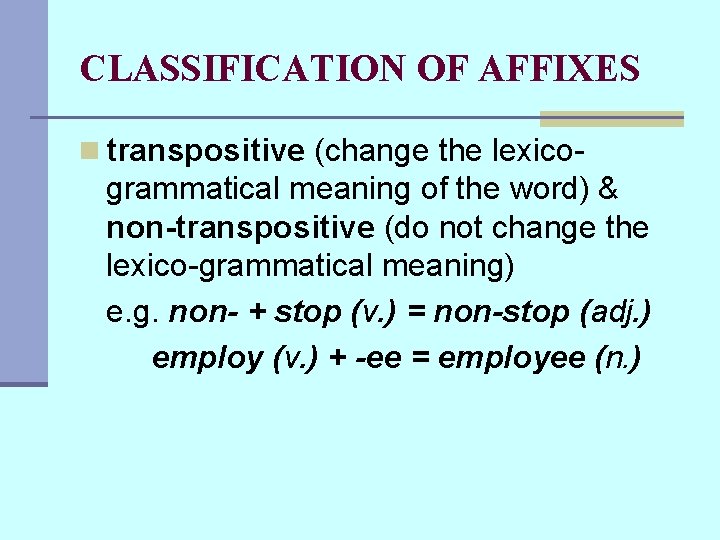
CLASSIFICATION OF AFFIXES n transpositive (change the lexico- grammatical meaning of the word) & non-transpositive (do not change the lexico-grammatical meaning) e. g. non- + stop (v. ) = non-stop (adj. ) employ (v. ) + -ee = employee (n. )
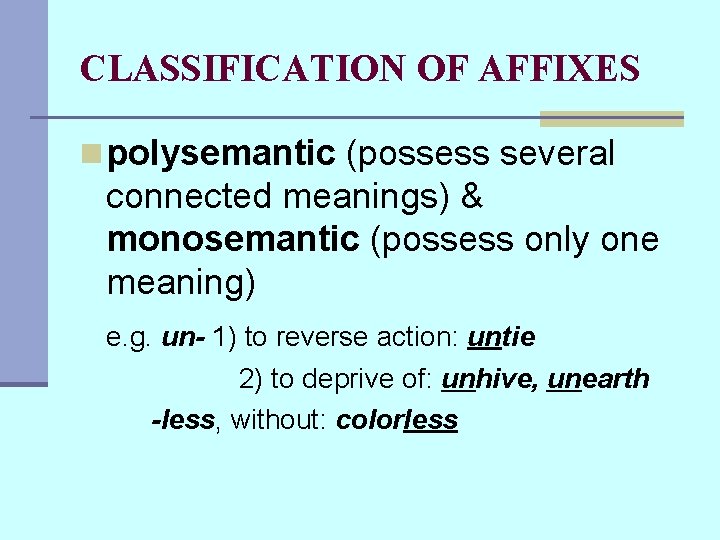
CLASSIFICATION OF AFFIXES n polysemantic (possess several connected meanings) & monosemantic (possess only one meaning) e. g. un- 1) to reverse action: untie 2) to deprive of: unhive, unearth -less, without: colorless
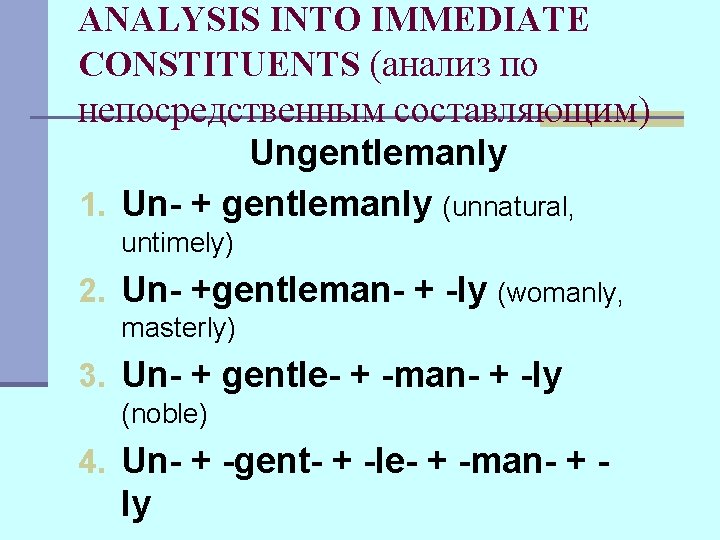
ANALYSIS INTO IMMEDIATE CONSTITUENTS (анализ по непосредственным составляющим) Ungentlemanly 1. Un- + gentlemanly (unnatural, untimely) 2. Un- +gentleman- + -ly (womanly, masterly) 3. Un- + gentle- + -man- + -ly (noble) 4. Un- + -gent- + -le- + -man- + - ly
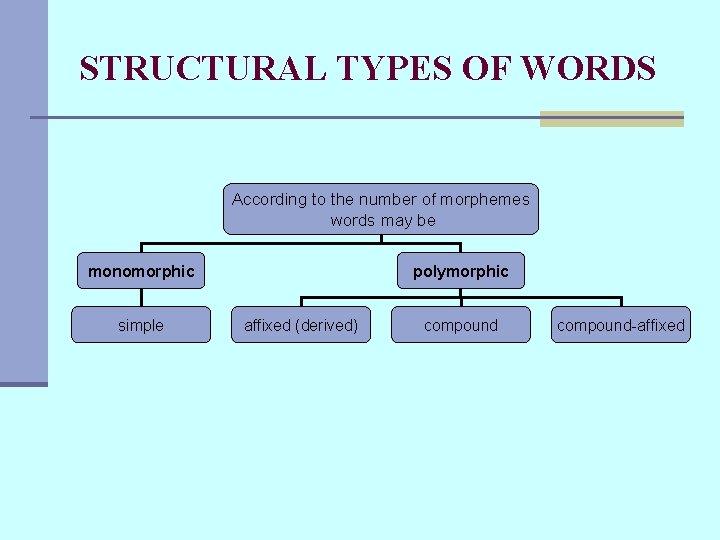
STRUCTURAL TYPES OF WORDS According to the number of morphemes words may be monomorphic simple polymorphic affixed (derived) compound-affixed
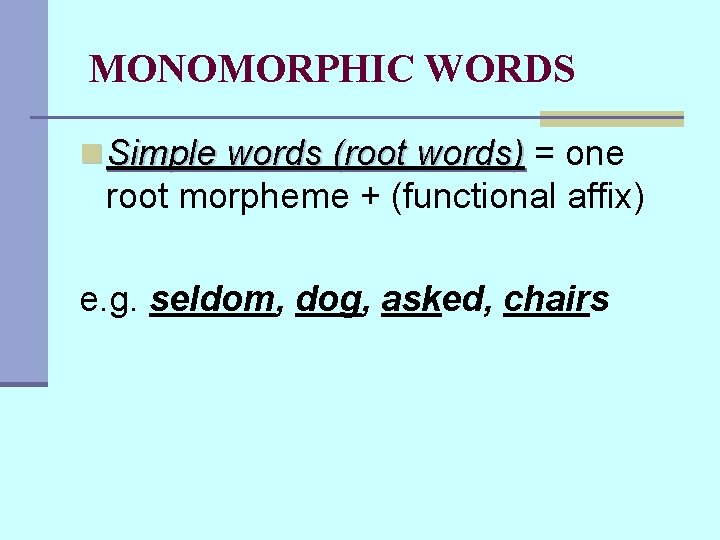
MONOMORPHIC WORDS n Simple words (root words) = one root morpheme + (functional affix) e. g. seldom, dog, asked, chairs
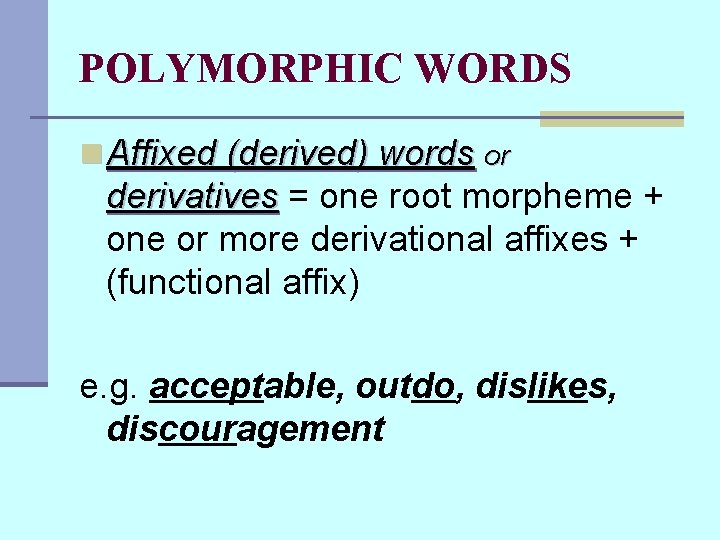
POLYMORPHIC WORDS n Affixed (derived) words or derivatives = one root morpheme + one or more derivational affixes + (functional affix) e. g. acceptable, outdo, dislikes, discouragement
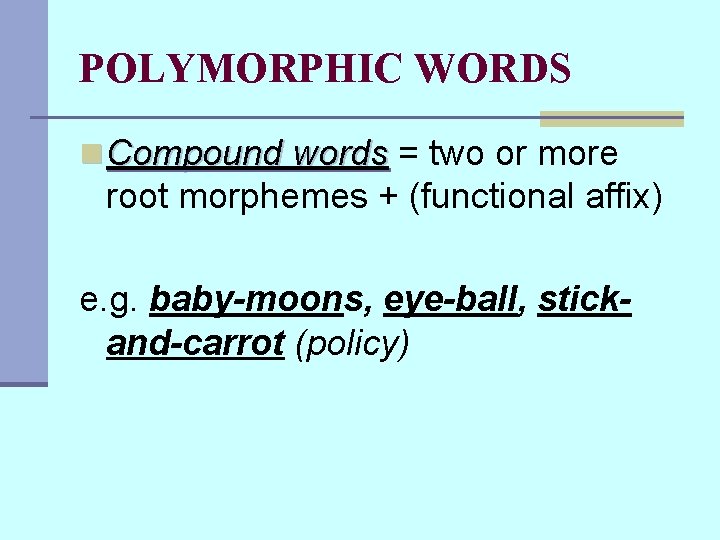
POLYMORPHIC WORDS n Compound words = two or more root morphemes + (functional affix) e. g. baby-moons, eye-ball, stickand-carrot (policy)
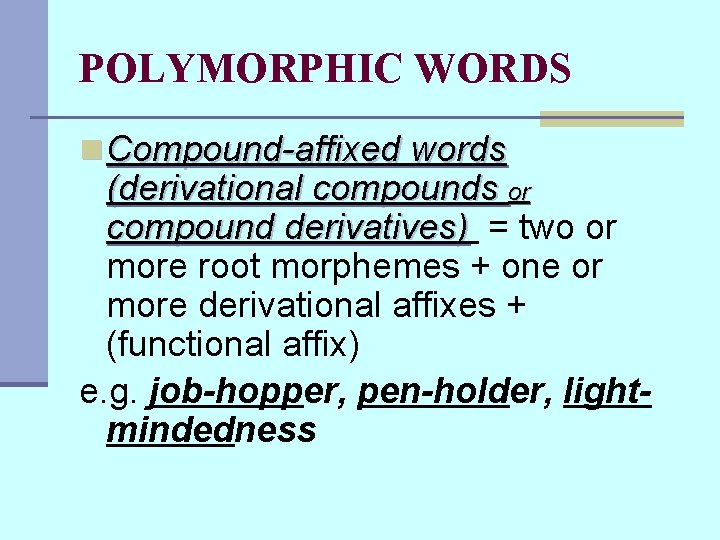
POLYMORPHIC WORDS n Compound-affixed words (derivational compounds or compound derivatives) = two or more root morphemes + one or more derivational affixes + (functional affix) e. g. job-hopper, pen-holder, lightmindedness