
MORPHOLOGICAL FEATURES OF FAMILY APOGONIDAE SCIAENIDAE and SPARIDAE

- Slides: 24
MORPHOLOGICAL FEATURES OF FAMILY APOGONIDAE, SCIAENIDAE and SPARIDAE SUZETTE B. BARCOMA
MORPHOLOGICAL FEATURES OF FAMILY APOGONIDAE
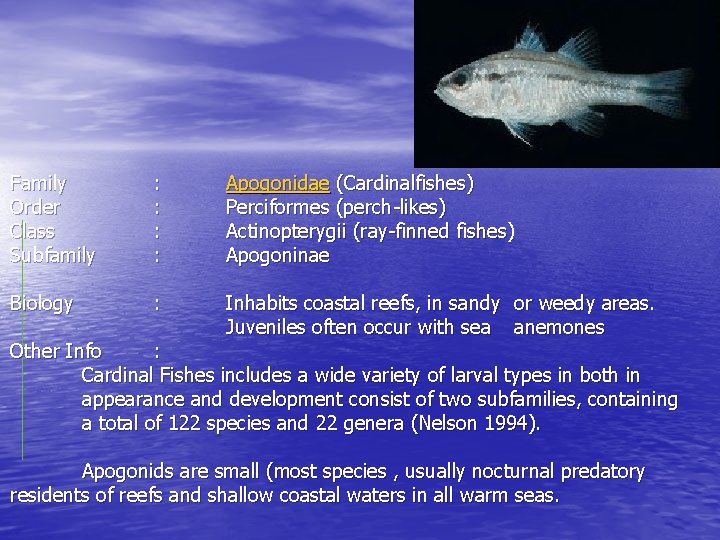
Family Order Class Subfamily : : : : Apogonidae (Cardinalfishes) Perciformes (perch-likes) Actinopterygii (ray-finned fishes) Apogoninae Biology : Inhabits coastal reefs, in sandy or weedy areas. Juveniles often occur with sea anemones Other Info : Cardinal Fishes includes a wide variety of larval types in both in appearance and development consist of two subfamilies, containing a total of 122 species and 22 genera (Nelson 1994). Apogonids are small (most species , usually nocturnal predatory residents of reefs and shallow coastal waters in all warm seas.
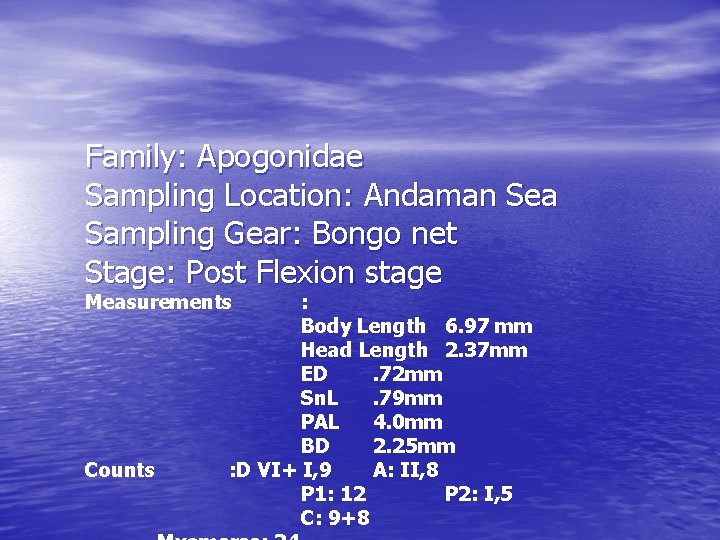
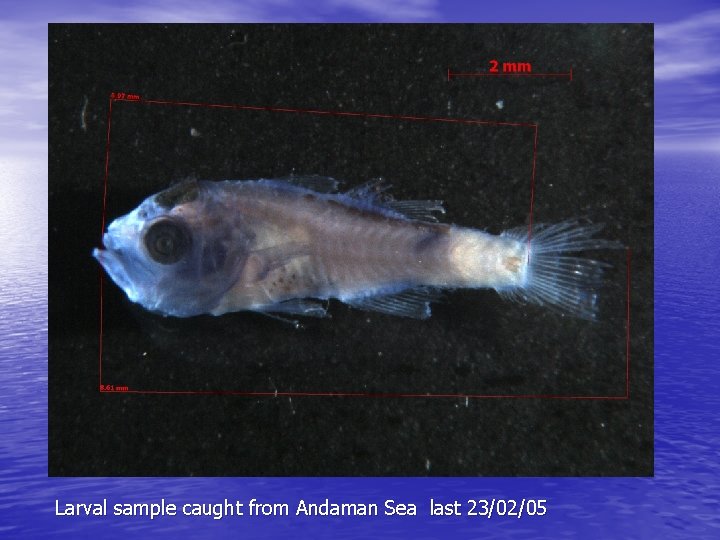
Family: Apogonidae Sampling Location: Andaman Sea Sampling Gear: Bongo net Stage: Post Flexion stage Measurements Counts : Body Length 6. 97 mm Head Length 2. 37 mm ED. 72 mm Sn. L. 79 mm PAL 4. 0 mm BD 2. 25 mm : D VI+ I, 9 A: II, 8 P 1: 12 P 2: I, 5 C: 9+8
Larval sample caught from Andaman Sea last 23/02/05
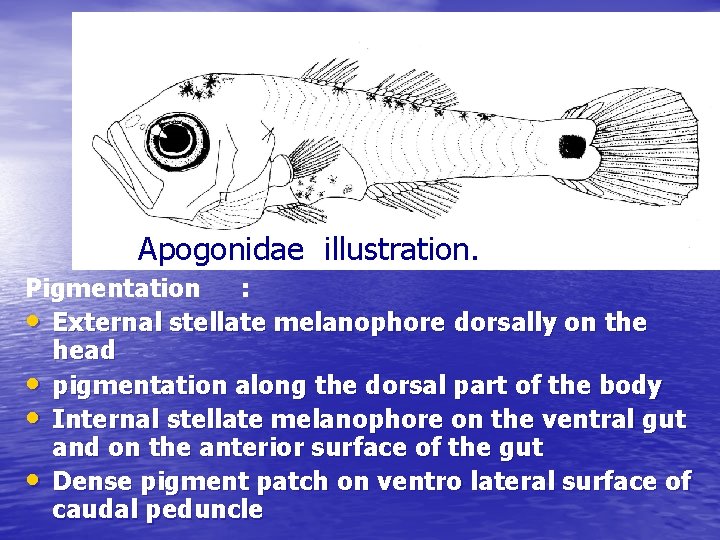
Apogonidae illustration. Pigmentation : • External stellate melanophore dorsally on the head • pigmentation along the dorsal part of the body • Internal stellate melanophore on the ventral gut and on the anterior surface of the gut • Dense pigment patch on ventro lateral surface of caudal peduncle
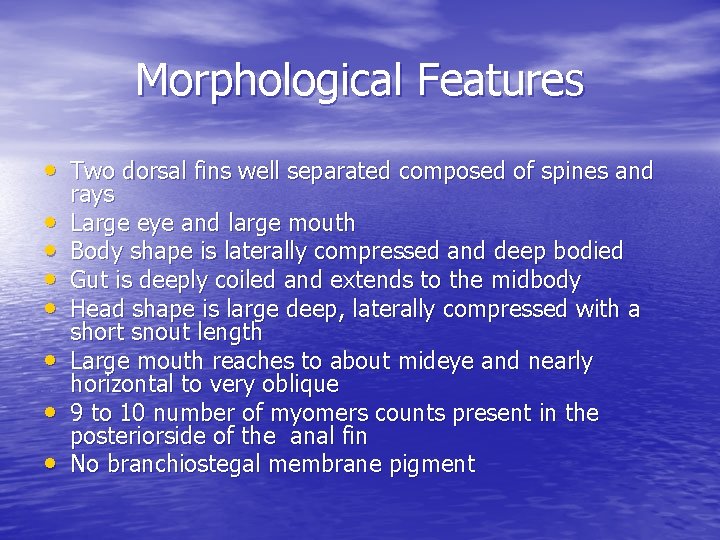
Morphological Features • Two dorsal fins well separated composed of spines and • • rays Large eye and large mouth Body shape is laterally compressed and deep bodied Gut is deeply coiled and extends to the midbody Head shape is large deep, laterally compressed with a short snout length Large mouth reaches to about mideye and nearly horizontal to very oblique 9 to 10 number of myomers counts present in the posteriorside of the anal fin No branchiostegal membrane pigment
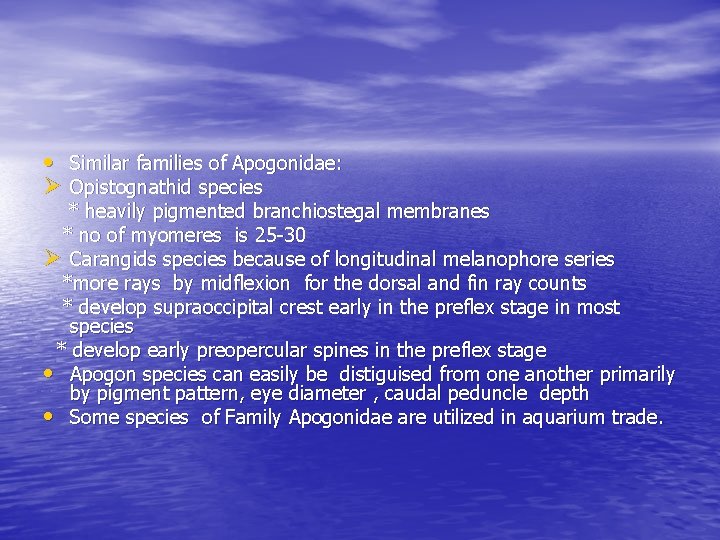
• Similar families of Apogonidae: Ø Opistognathid species * heavily pigmented branchiostegal membranes * no of myomeres is 25 -30 Ø Carangids species because of longitudinal melanophore series *more rays by midflexion for the dorsal and fin ray counts * develop supraoccipital crest early in the preflex stage in most species * develop early preopercular spines in the preflex stage • Apogon species can easily be distiguised from one another primarily by pigment pattern, eye diameter , caudal peduncle depth • Some species of Family Apogonidae are utilized in aquarium trade.
ØAdditional similar familes: Øambassids, berycids, carangids, serranids lactariids, kyposids, lethrinids, leptobramids etc, üProminent , anteriorly –located gas bladder, (can be observe during the day only)a typical myomere count of 24 and 2 dorsal fins. ü can’t be confused with gobiid interms of fins dev’t generally have a longer coiled gut ØAcropomatids,
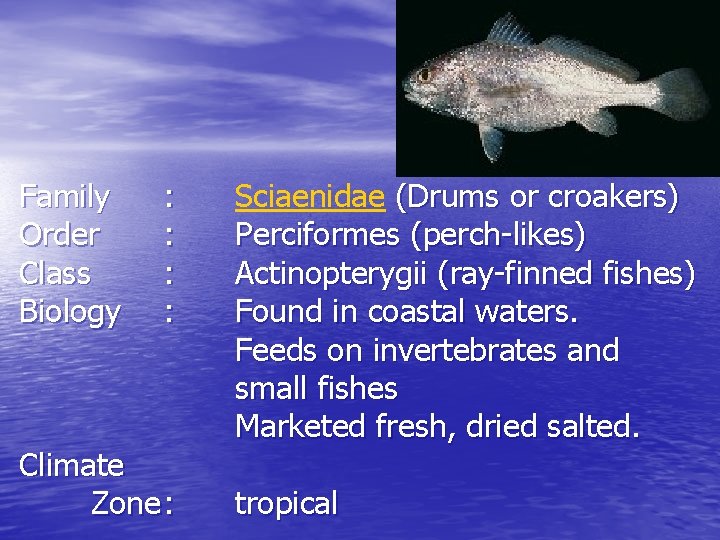
Family Order Class Biology : : : : Climate Zone : Sciaenidae (Drums or croakers) Perciformes (perch-likes) Actinopterygii (ray-finned fishes) Found in coastal waters. Feeds on invertebrates and small fishes Marketed fresh, dried salted. tropical
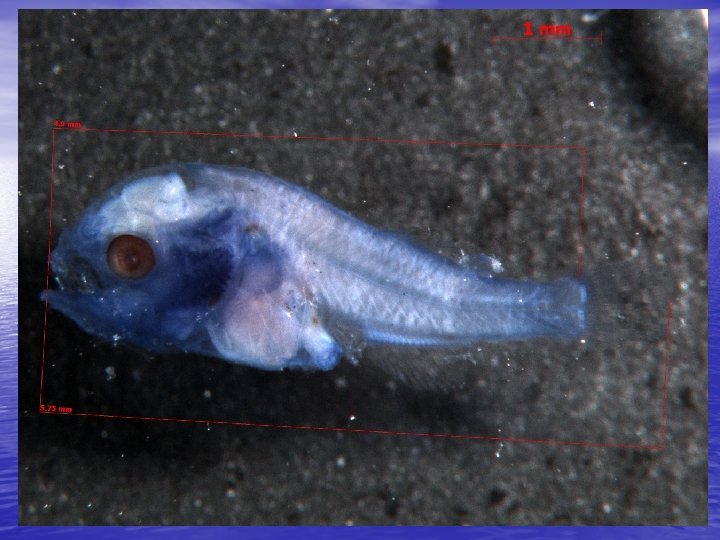
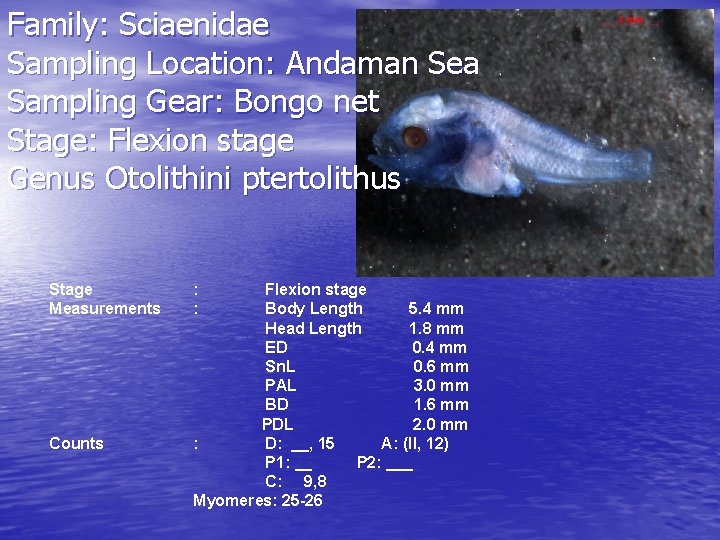
Family: Sciaenidae Sampling Location: Andaman Sea Sampling Gear: Bongo net Stage: Flexion stage Genus Otolithini ptertolithus Stage Measurements Counts : : Flexion stage Body Length 5. 4 mm Head Length 1. 8 mm ED 0. 4 mm Sn. L 0. 6 mm PAL 3. 0 mm BD 1. 6 mm PDL 2. 0 mm : D: __, 15 A: (II, 12) P 1: __ P 2: ___ C: 9, 8 Myomeres: 25 -26
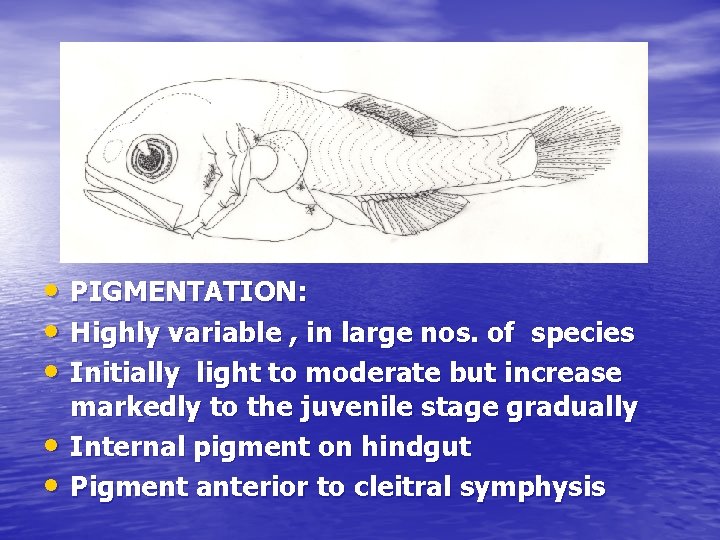
• PIGMENTATION: • Highly variable , in large nos. of species • Initially light to moderate but increase • • markedly to the juvenile stage gradually Internal pigment on hindgut Pigment anterior to cleitral symphysis
• MORPHOLOGICAL FEATURES: • Robust body • Triangular gut, weak spination • Distinct characteristics along dorsal fins and short anal fins • Absence of barbels at tip of lower jaw • Shape of caudal fin is round
• SIMILAR FAMILIES: • Stromateidae, Gerreids, Haemulids and Sparids. etc • Gerridae- distinct melanophores on dorsal midline posterior to 2 nd • • dorsal fins, slimmer bodied , fin rays counts differ and usually exhibit greater space b/w succesive fin rays Haemulidae bases of 2 nd dorsal and anal fins are equal, slim bodied, w/ less deeening on the pectoral region, head spines is very weak, usual weak to preopercle, pigment prominent on posterior midline Stromateidae- early stages high myomere counts less than 30, no gap b/w anus n anal fin origin and nos. of anal and 2 nd dorsal about equal
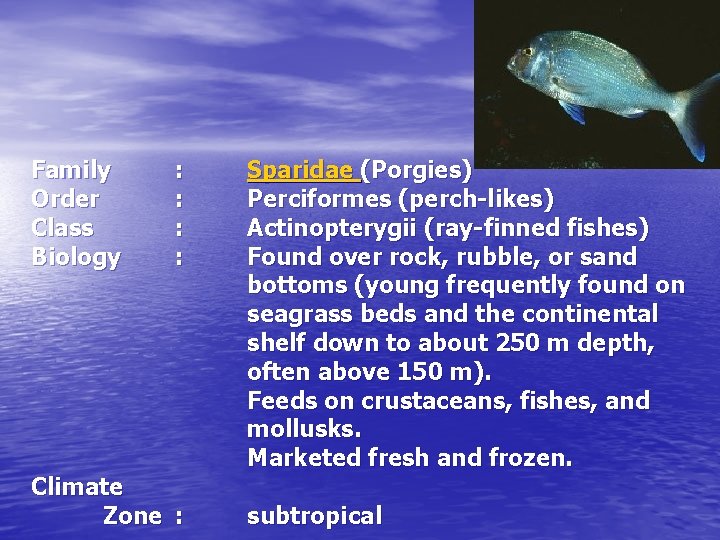
Family Order Class Biology : : Climate Zone : Sparidae (Porgies) Perciformes (perch-likes) Actinopterygii (ray-finned fishes) Found over rock, rubble, or sand bottoms (young frequently found on seagrass beds and the continental shelf down to about 250 m depth, often above 150 m). Feeds on crustaceans, fishes, and mollusks. Marketed fresh and frozen. subtropical
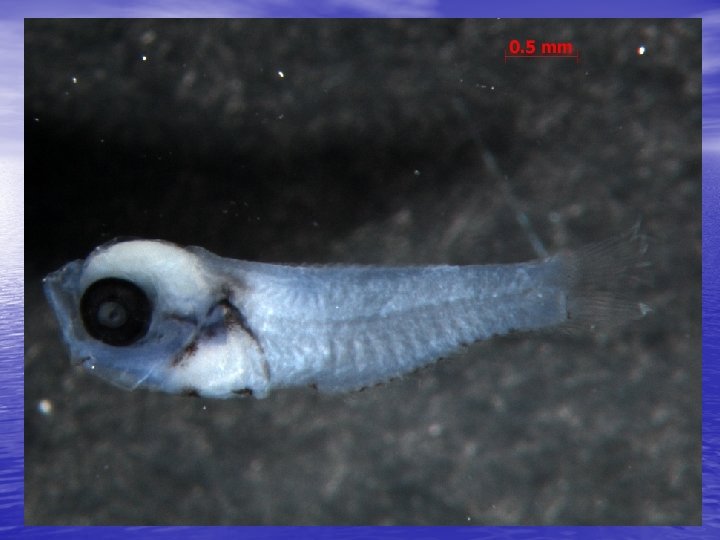
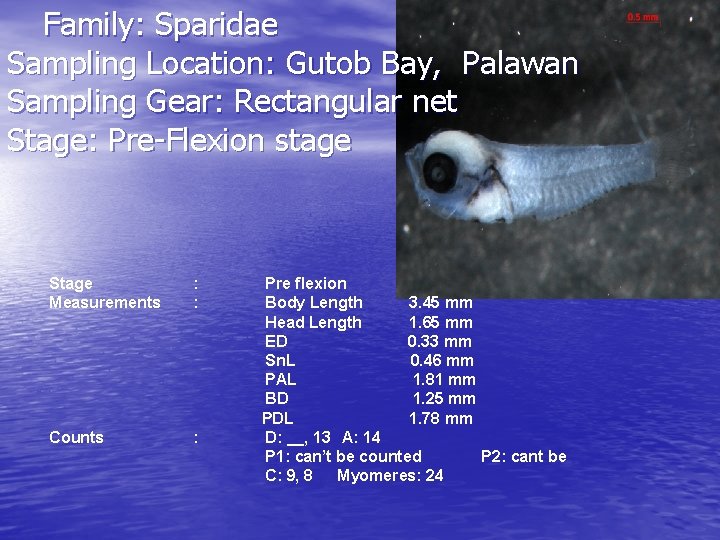
Family: Sparidae Sampling Location: Gutob Bay, Palawan Sampling Gear: Rectangular net Stage: Pre-Flexion stage Stage Measurements : : Counts : Pre flexion Body Length 3. 45 mm Head Length 1. 65 mm ED 0. 33 mm Sn. L 0. 46 mm PAL 1. 81 mm BD 1. 25 mm PDL 1. 78 mm D: __, 13 A: 14 P 1: can’t be counted P 2: cant be C: 9, 8 Myomeres: 24
• PIGMENTATION: • Melanophore along the base of caudal fin • external melanophore series along pigmented ventral finbase • Internal pigment on hindgut and stellate pigment over anterior surface of gut • Internal melanophore on the midbrain • Includes 1 to 2 spots anterior to the anus
• • • Morphological Features: Sparids are compressed Position of mouth is subterminal Body shape is moderately deep bodied Head is Large A supra occipital crest Caudal fin formation is truncate Forked Caudal fin Continous dorsal fin Coiled gut
• mouth small barely reaching anterior edge of the eye • Body depth to anus increases • Preopercular weak spine • Weak head spination • Later larva have series of unevenly spaced melanophores along venter beginning over gut &extending on notochord tip • Pre anus length is about 45 to 50% of the BL. * about equal no of finrays in D 2 & A fins in D 2
• Similar families:
üSparids are moderately large , deep compressed , carnivorous fishes üSupport major commercial and recreational fisheries.