
Morphological Computation Connecting Brain Body and Environment 2015

Morphological Computation – Connecting Brain, Body, and Environment 2015 -11 -20 presenter : Kyung-Wha Park Dong-Hyun Kwak Biointelligence Laboratory Seoul National University

Introduction What is morphological computation? n Morphology 형태학 n n n Artificial intelligence and Biorobotics n n n 생물의 형태, 구조, 발생 따위를 연구하는 학문. Hardware in robotics : robot arms, actuators etc Work out the principles underlying intelligent behavior Enable us to n Understand natural forms of intelligence n Design and build intelligent systems Traditionally. . n n n Only focus on the control or the neural system, the brain, itself Given morphology and then programmed, to do certain tasks. Separation between hardware and software. 2

Introduction What is morphological computation? n Centered Notion : “Embodiment” n n A complete organism that interacts with the real world The idea that intelligence always requires a body? Relation between physical and information (neural, control) process Morphological computation n When morphology or materials take over some of the functions in brain Morphology embodiment Brain (the control) Real world 3

Introduction What is morphological computation? n Information self-structuring n n Proper morphology and exploitation of intrinsic dynamics, facilitate the induction of information structure Information structure induced in the sensory data, facilitating perception and learning n It can’t be understood by looking at internal brain only. n How the brain is embedded into the physical system? How the organism interacts with the real world? About connecting body, brain and environment. n © 2012 -2014, SNU CSE Biointelligence Lab. , http: //bi. snu. ac. kr 4

Case Studies Exploitation of Sensory Morphology n Eyebot: n n n Non-homogeneous arrangement of the facets compensates Motion parallax facilitating neural processing. Objects on the side travel faster across the visual field “morphological computation” Information self-structuring : n Sensory stimulation is only induced, moving in a particular way Artificial evolution on real robots n Proper morphological arrangement n Keeping lateral distance to an obstacle can be solved by proper morphological arrangement : Frontally more dense than laterally n Without changing anything inside the neural controller 5
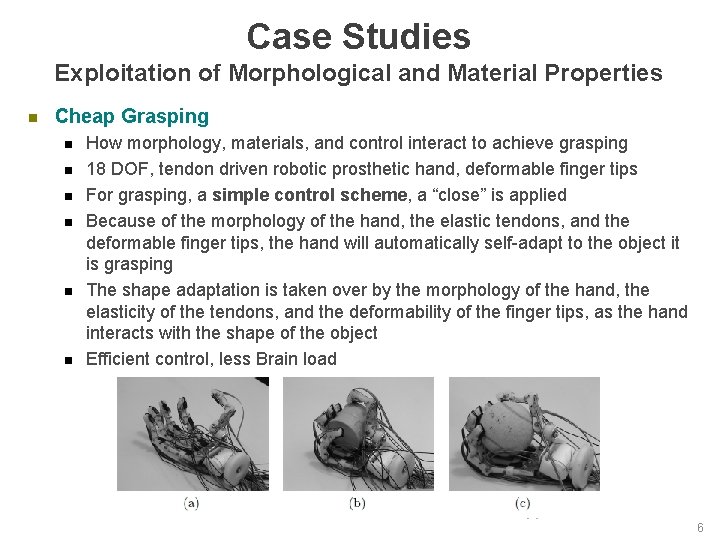
Case Studies Exploitation of Morphological and Material Properties n Cheap Grasping n n n How morphology, materials, and control interact to achieve grasping 18 DOF, tendon driven robotic prosthetic hand, deformable finger tips For grasping, a simple control scheme, a “close” is applied Because of the morphology of the hand, the elastic tendons, and the deformable finger tips, the hand will automatically self-adapt to the object it is grasping The shape adaptation is taken over by the morphology of the hand, the elasticity of the tendons, and the deformability of the finger tips, as the hand interacts with the shape of the object Efficient control, less Brain load 6

Case Studies Exploitation of Morphological and Material Properties n Physical Dynamics n n n Swinging arm and hand movement : controlling looks complex, but it’s simple Proper morphology and exploitation of intrinsic dynamics, facilitate the induction of information structure Information Self-structuring n n n Proper morphology and exploitation of intrinsic dynamics, facilitate the induction of information structure Cross-modal associations can be formed between the visual, the haptic, etc If the hand is swinging from the right side towards the center. . n through sensory-motor coordinated behaviors such as seeing, reaching, and grasping, sensory stimulation is not only induced but it also tends to contain information structure 7

Case Studies Managing Complex Bodies: Adaptation through Morphological Changes n The Fin Ray Effect: n n Two ribs interconnected by elastic connective tissue Bends towards the direction of an external force Provide an equal distribution of pressure in a dynamic system “Aqua ray robot” by Festo [21]. n Resembles a manta ray n Has a minimum setup with only three motors n Although each motor is just driven back and forth, n With “fin ray effect” provides the “Aqua ray” robot with a perfect and cheap way to bend the wings and exploit the fluid dynamics Brain (the control) + morphology 8

Case Studies Managing Complex Bodies: Adaptation through Morphological Changes n Exploiting Self-adaptation: Cockroaches Climbing over Obstacles: n n n Cockroaches cannot move fast over uneven terrain, but they can negotiate obstacles that exceed their body height Complex bodies. one thoracic ganglion at each segment. 250 neurons Face obstacle n The brain, rather than changing the movement pattern by evoking a different neural circuit, “re-configures” the shoulder joint n Appropriately altered joint morphology n But local neural circuits continue doing the same thing “Brain outsourcing” Advantages of controlling through morphological computation n Can be solved efficiently with few neurons n Freeing it from unnecessary control tasks n Inherent stability of the local feedback circuits n Designing controllers by exploiting mechanical change and feedback 9

Exploitation of Dynamics n n n Inspired from passive dynamic walkers, we will show 3 kinds of robots-”Stumpy, Puppy, Crazy Bird”. And through these, we can know how materials and dynamics are applied into robots. Passive Dynamic Walkers n n n Without actuator nor motor, this can walk down the incline. This kind of walking is very energy efficient – the energy is supplied by gravity only. Ecological niche (the environment in which the robot is capable of operating) is extremely narrow: it only consists of inclines of certain angles. https: //youtu. be/Ad. K 7 op. Xqoro? t=23 s 10

Exploitation of Dynamics n Stumpy n n The walking and hopping robot. 압축공기를 이용한 actuator 가 장착되어, 평지에서도 걸 을 수 있게 디자인 됨. Lower body is made of an inverted “T” mounted on wide springy feet. The upper body is an upright “T” connected to the lower body by a rotary joint, the “waist” joint. 11
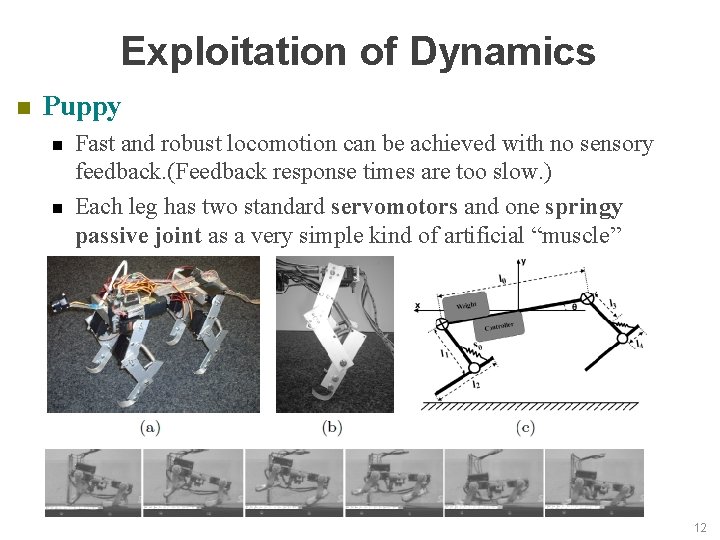
Exploitation of Dynamics n Puppy n n Fast and robust locomotion can be achieved with no sensory feedback. (Feedback response times are too slow. ) Each leg has two standard servomotors and one springy passive joint as a very simple kind of artificial “muscle” 12
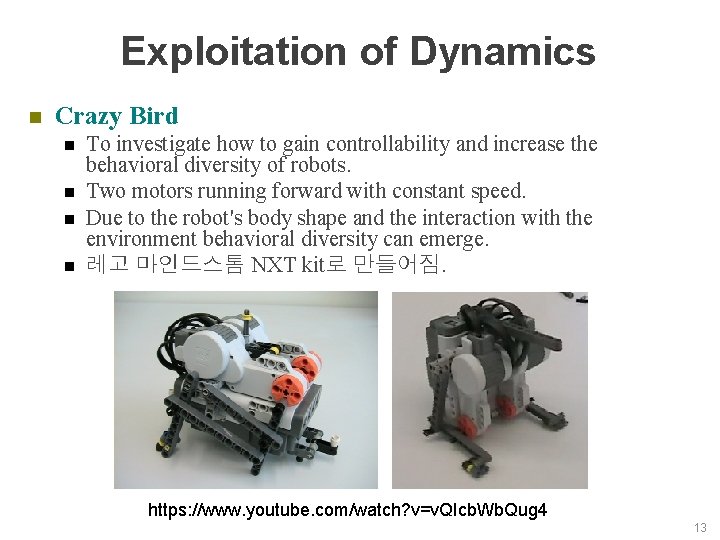
Exploitation of Dynamics n Crazy Bird n n To investigate how to gain controllability and increase the behavioral diversity of robots. Two motors running forward with constant speed. Due to the robot's body shape and the interaction with the environment behavioral diversity can emerge. 레고 마인드스톰 NXT kit로 만들어짐. https: //www. youtube. com/watch? v=v. QIcb. Wb. Qug 4 13
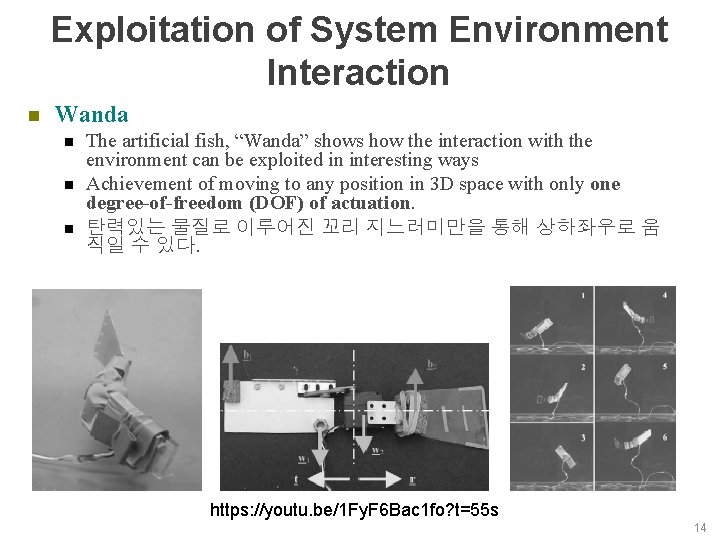
Exploitation of System Environment Interaction n Wanda n n n The artificial fish, “Wanda” shows how the interaction with the environment can be exploited in interesting ways Achievement of moving to any position in 3 D space with only one degree-of-freedom (DOF) of actuation. 탄력있는 물질로 이루어진 꼬리 지느러미만을 통해 상하좌우로 움 직일 수 있다. https: //youtu. be/1 Fy. F 6 Bac 1 fo? t=55 s 14
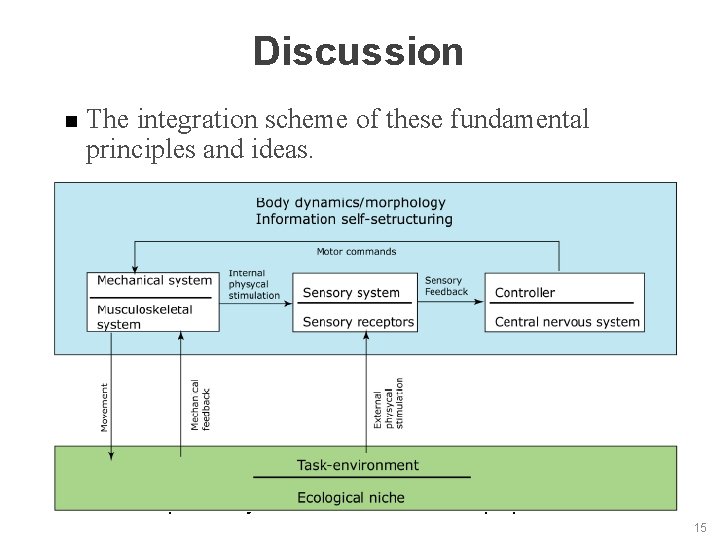
Discussion n The integration scheme of these fundamental principles and ideas. https: //www. youtube. com/watch? v=Ad. K 7 op. Xqoro 15
- Slides: 16