
Morphological Characteristics of River Systems What is a


- Slides: 27
Morphological Characteristics of River Systems
What is a river? • any natural stream of water that flows in a channel with defined banks • Significant in early human settlements • Significance to trade, agriculture and industry
Why rivers/ streams are important • Streams carry most of the water that goes from the land to the sea, and thus are an important part of the water cycle • Streams carry billions of tons of sediment to lower elevations, and thus are one of the main transporting mediums in the production of sedimentary rocks • Streams carry dissolved ions, the products of chemical weathering, into the oceans and thus make the sea salty • Streams are a major part of the erosional process, working in conjunction with weathering and mass wasting. Much of the surface landscape is controlled by stream erosion • Streams are a major source of water, waste disposal, and transportation for the world's human population. Most population centers are located next to streams • When stream channels fill with water the excess flows onto the land as a flood. Floods are a common natural disaster
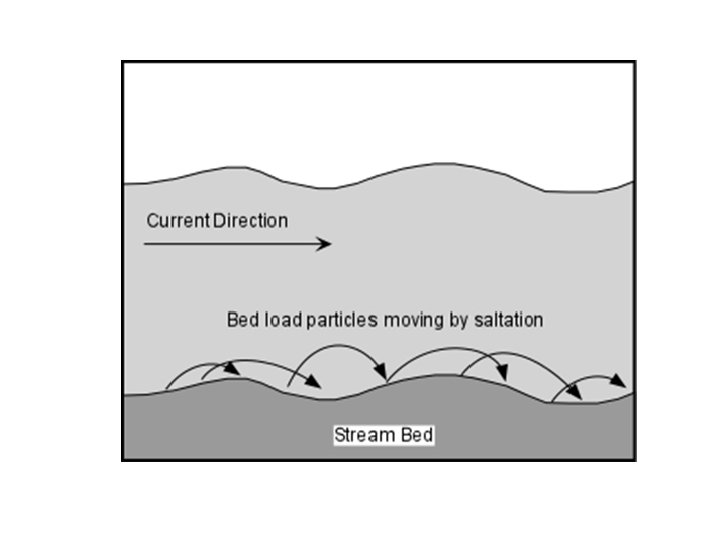
Sediment transport and deposition in rivers • The rock particles and dissolved ions carried by the stream are called the stream's load • Three components – Suspended load – Particles that are carried along with the water, size of the particles depend on density of them and velocity of water – Bed load - Coarser and denser particles that remain on the bed of the stream – Dissolved load - Ions that have been introduced into the water by chemical weathering of rocks
Stream characteristics • Stream Competence – Maximum size of particles carried by the stream • Stream Capacity – Maximum load carried by the river • Competence and capacity increases with increasing discharge • Directional flow
Stream Characteristics • In the downstream direction; – Discharge increases because water is added to the stream from tributary streams and groundwater – As discharge increases, the width, depth, and average velocity of the stream increase – The gradient of the stream, will decrease – Bed load particle size decreases
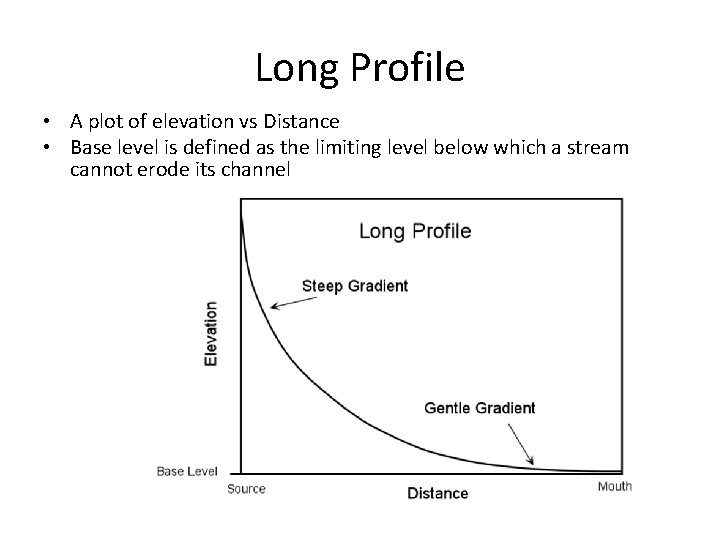
Long Profile • A plot of elevation vs Distance • Base level is defined as the limiting level below which a stream cannot erode its channel
Environmental Problems Associated with River Use • Commercial navigation – modifications to river course – increasing depth – drop of water table in the surrounding • Canalization – locks and navigation dams – affect on riverine ecosystem • Water pollution – due to agriculture, industry and other activities
Distribution of Rivers in Nature • Comparison of large rivers in the world – based on – Size of the drainage area – Length of the main stem – Mean discharge • five longest rivers in the world are the Nile, the Amazon, the Yangtze, the Mississippi–Missouri– Red Rock, and the Yenisey–Baikal–Selenga • Amazone is the world’s principal river
River Basin Characteristics • To make comparisons, to identify the effect of geology, climate, vegetation, topography etc. • Measurements – Stream order – Bifurcation ratio – Drainage density – Stream order correlations – Basin order correlations – Channel patterns – Drainage patterns
Channel Patterns
Drainage Patterns • Distinctive patterns are acquired by stream networks in consequence of adjustment to geologic structure
Dendritic drainage patterns are most common. They develop on a land surface where the underlying rock is of uniform resistance to erosion. Radial drainage patterns develop surrounding areas of high topography where elevation drops from a central high area to surrounding low areas – Sri Lanka’s drainage network
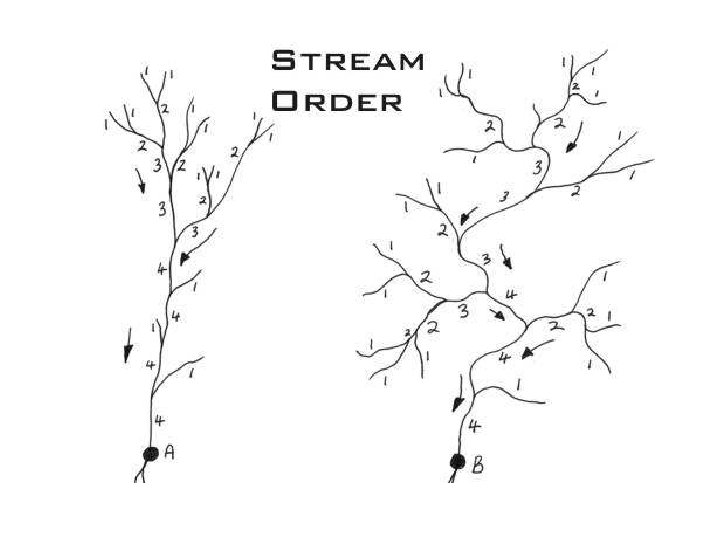
Horton’s Low of Drainage Composition • Great advances in the analysis of drainage nets were made by Robert E. Horton, an American hydraulic engineer who developed the fundamental concept of stream order • An unbranched headstream is designated as a first-order stream • Two unbranched headstreams unite to form a second-order stream • two second-order streams unite to form a thirdorder stream, and so on
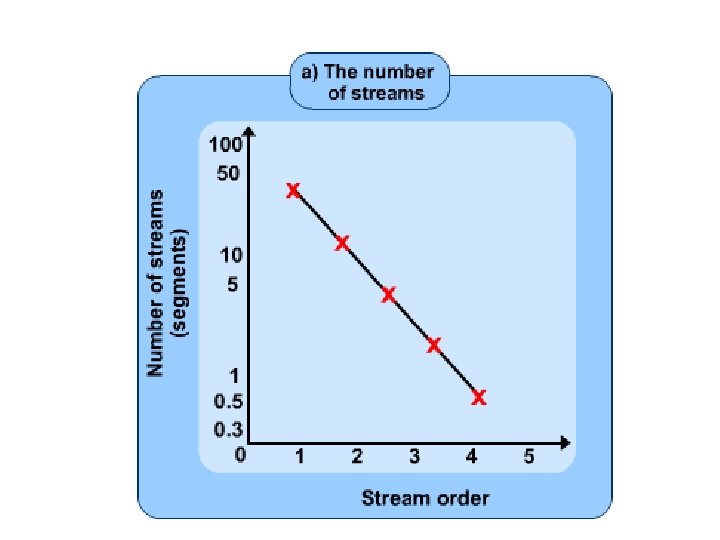
Horton’s Low of Drainage Composition • Stream number is the total number of streams of a given order for a given drainage basin • The bifurcation ratio is the ratio of the number of streams in a given order to the number in the next higher order • By definition, the value of this ratio cannot fall below 2. 0, but it can rise higher, since streams greater than first order can receive low-order tributaries without being promoted up the hierarchy.
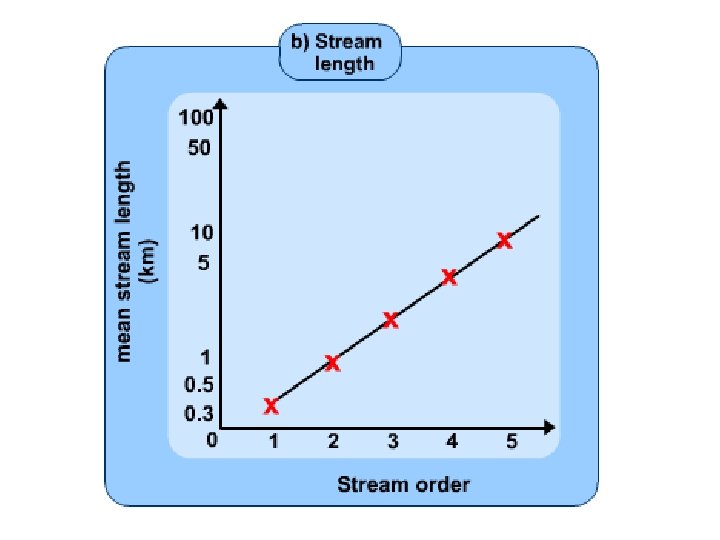
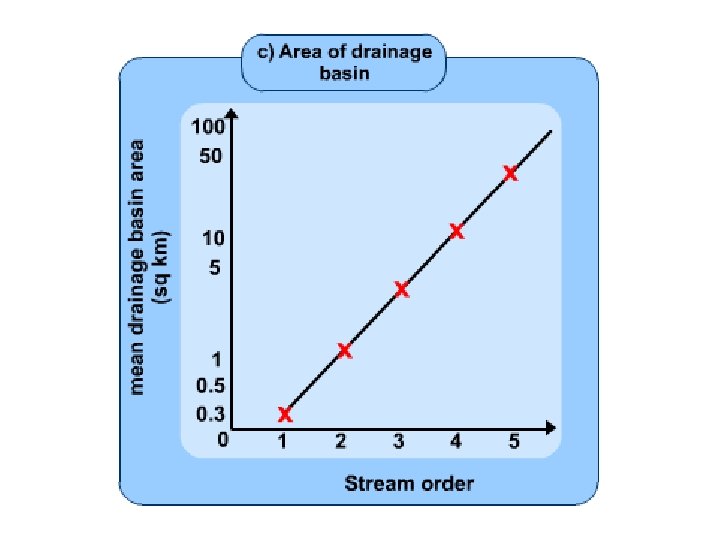
• Although the number system given here, and nowadays in common use, differs from Horton’s original in the treatment of trunk streams, Horton’s laws of drainage composition still hold, namely: – Law of stream numbers: the numbers of streams of different orders in a given drainage basin tend closely to approximate an inverse geometric series in which the first term is unity and the ratio is the bifurcation ratio. – Law of stream lengths: the average lengths of streams of each of the different orders in a drainage basin tend closely to approximate a direct geometric series in which the first term is the average length of streams of the first order. – Low of drainage area
Morphometry of Drainage Networks • Making measurements using drainage networks
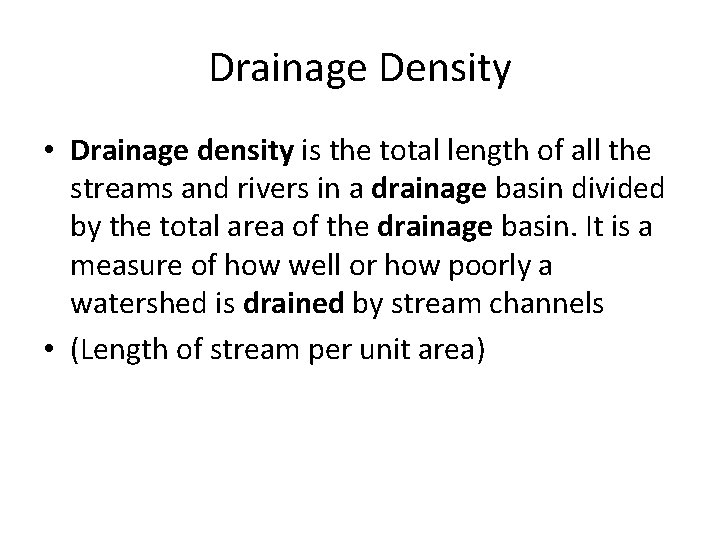
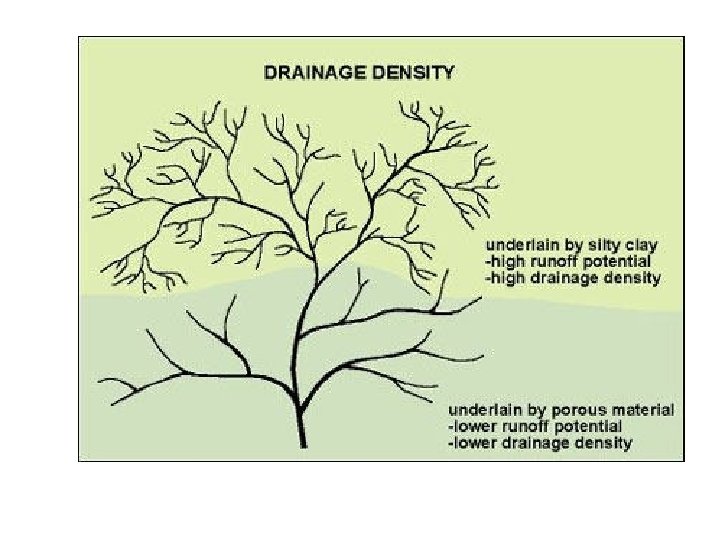
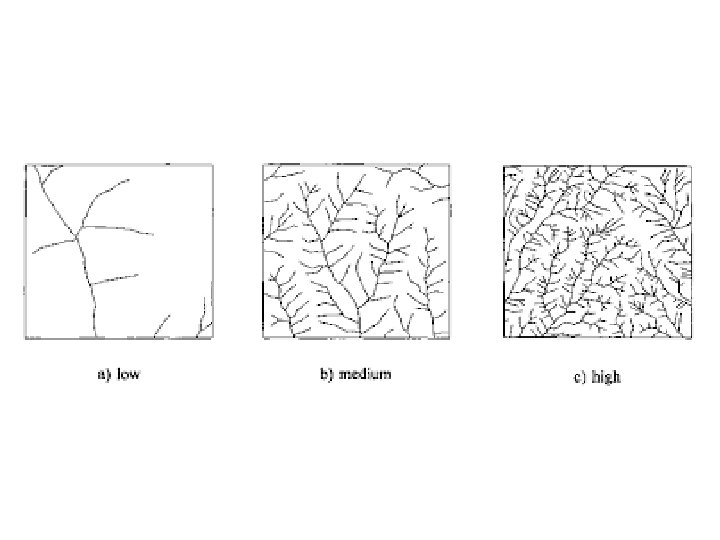
Drainage Density • Drainage density is the total length of all the streams and rivers in a drainage basin divided by the total area of the drainage basin. It is a measure of how well or how poorly a watershed is drained by stream channels • (Length of stream per unit area)
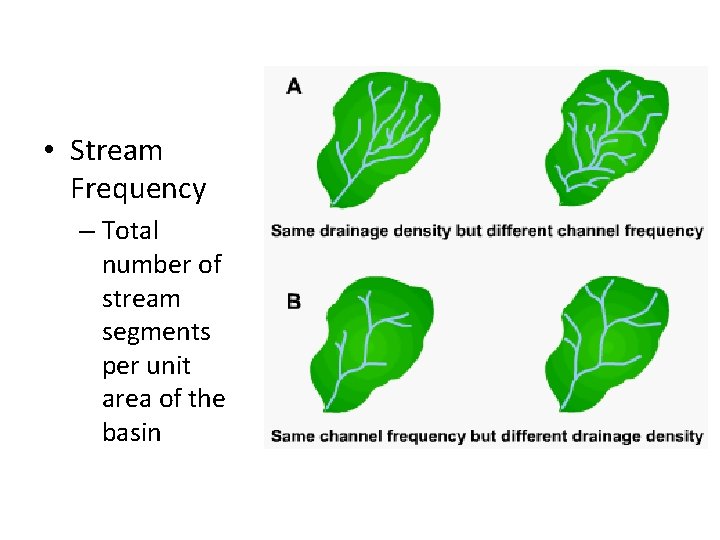
• Stream Frequency – Total number of stream segments per unit area of the basin
Drainage Texture • The total number of stream segments of all order in a basin (�� N) perimeter of the basin (P) • Drainage texture is dependent on the underlying lithology, infiltration capacity and relief aspect of the terrain • Smith (1950) has classified drainage texture into 5 different classes viz, very coarse (<2), coarse (2 to 4), moderate (4 to 6), fine (6 to 8) and very fine (>8)