
Morning Glory Disc Anomaly Discovered in an African



- Slides: 12
Morning Glory Disc Anomaly Discovered in an African American Preterm Infant Jason Sorell, DO Suzie Nemmers MD Robert Ridout, MD , Sarah Lentz-Kapua, MD The views expressed in this poster are those of the authors and do not reflect the official policy or position of the Department of the Army, Department of Defense of the U. S. Government.
Purpose/Objective n To report a case of morning glory disc anomaly (MGDA) in a premature African American male infant
Background n “MGDA is a congenital abnormality, funnelshaped excavation of the posterior fundus that incorporates the optic disk”. 5 n MGDA may result when incomplete neuroectodermal development leads to an abnormal closure of the embryonic fissure.
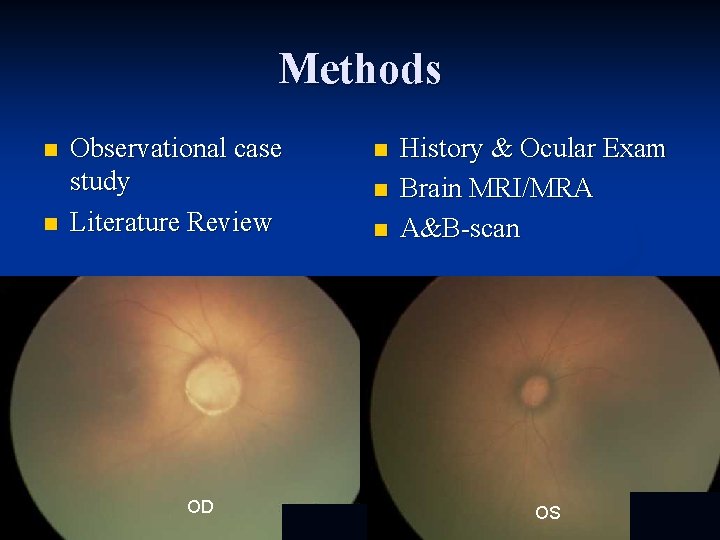
Methods n n Observational case study Literature Review OD OD n n n History & Ocular Exam Brain MRI/MRA A&B-scan OS OS
Literature Review n MGDA is rare in African Americans 3, 4 and more common in females than males (2: 1). 3, 4, 5 n MGDA is almost always unilateral and typically presents in early childhood as amblyopia and strabismus. 2, 3, 4, 5 n n Kushner successfully treated patients with functional amblyopia secondary to structural optic nerve abnormalities. 6 Non-rhegmatogenous retinal detachments reported in 25 -38% of MGDA 5
Associated Systemic Anomalies 1, 5, 11 n “In a retrospective observational case series, 9 of 20 patients (45%) with MGDA had identifiable cerebrovascular anomalies …. Three required revascularization procedures and three were diagnosed with Moyamoya disease”. 1 n Panhypopituitarism n Basal encephalocele n Absent corpus callosum n cleft lip/palate, hypertelorism
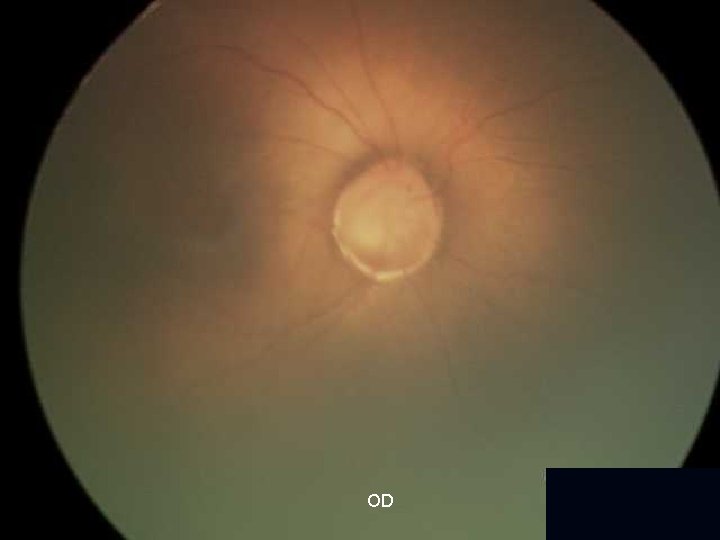
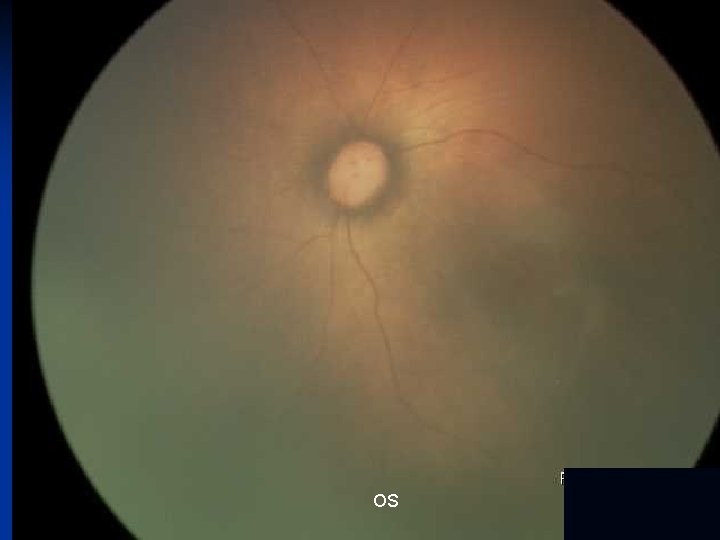
Results n n A premature African American male born at 28 weeks gestation was found to have MGD of OD & stage 1 ROP, zone II in OU on fundus exam during ROP screening. He also had microphthalmia of OD. Birth wt = 1110 g n n No craniofacial abnormalities Va=RTL OU; No RAPD Ttp=17 OU External ocular exam & anterior segment unremarkable except cornea diameter of OD < OS (7 x 7 mm & 9. 5 x 9. 5 mm respectively)
OD
OS
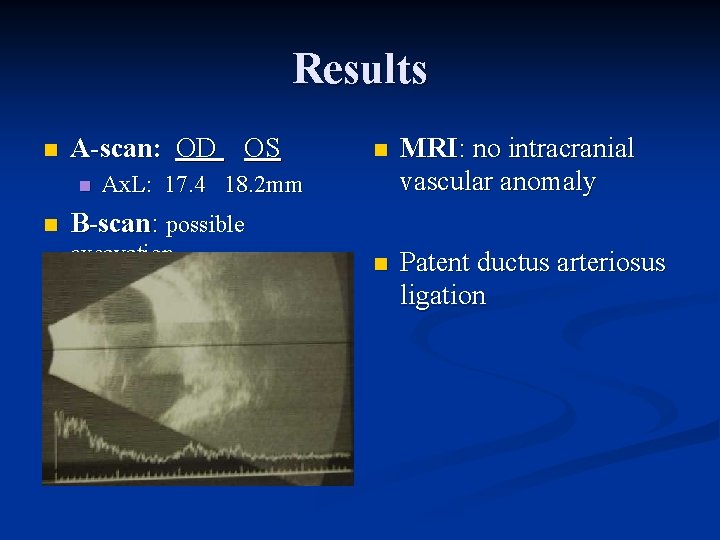
Results n A-scan: OD OS n n n MRI: no intracranial vascular anomaly n Patent ductus arteriosus ligation Ax. L: 17. 4 18. 2 mm B-scan: possible excavation
Conclusions n MGDA can occur in African Americans. n Children with MGDA should undergo MRI/MRA or CT angiography to detect associated vascular and structural brain anomalies. 1 n A growth evaluation is recommended to detect possible panhypopituitarism. 11 n A trial of occlusion therapy for functional amblyopia is warranted. 5, 6 n Closely follow for possible retinal detachment. 7, 8, 9, 10
Bibliography n n n 1. Lenhart P, Lambert S, Newman N, et al. Intravascular anomalies in patients with morning glory disc anomaly. Am J Ophthalmol. 2006 Oct; 142(4): 644 -50. 2. Kindler P. Morning glory syndrome an unusual optic disc anomaly. Am J Ophthalmol 1970; 69: 376. 3. Steinkuller P. The morning glory disk anomaly: case report and literature review. J Pediatr Ophthalmol Strabismus 1980; 17: 81 -87. 4. Pollock S; The morning glory disc anomaly: contractile movement, classification, and embryogenesis. Doc Ophthalmol 1987; 65: 439 -460. 5. Brodsky, MC. Congenital optic disk anomalies. Surv of Ophthalmol 1994; 39: 89 -112. 6. Kushner BJ: Functional amblyopia associated with abnormalities of the opitc nerve. Arch Ophthalmol 102: 683 -85, 1985 7. Haik BG, Greenstein SH, Smith ME, et al: Retinal detachment in the morning glory syndrome. Ophthalmology 91: 1638 -47, 1984. 8. Akiyama K, Azuma N, Hida T, Uemura Y. Retinal detachment in morning glory syndrome. Ophthalmic surgery. 1984; 15: 841 -83. 9. Chang S, et al. Treatment of total retinal detachment in morning glory syndrome. Am J Ophthalmol 1984; 97: 596 -600. 10. Fricken, MA, Dhungel, R. Retinal detachment in the morning glory syndrome. Retina 1984; 4: 97 -99 11. Eustis HS, Sanders MR, Zimmerman T: Morning Glory Syndrome in Children. Arch Ophthalmol 112: 204 -207, 1994