
Morgan Stanley Ka Him Ng Kevin Yu Eric

- Slides: 116
Morgan Stanley Ka Him Ng Kevin Yu Eric Long Ming Chu
Agenda 1. 2. 3. Company overview Risk management activities Recommendation
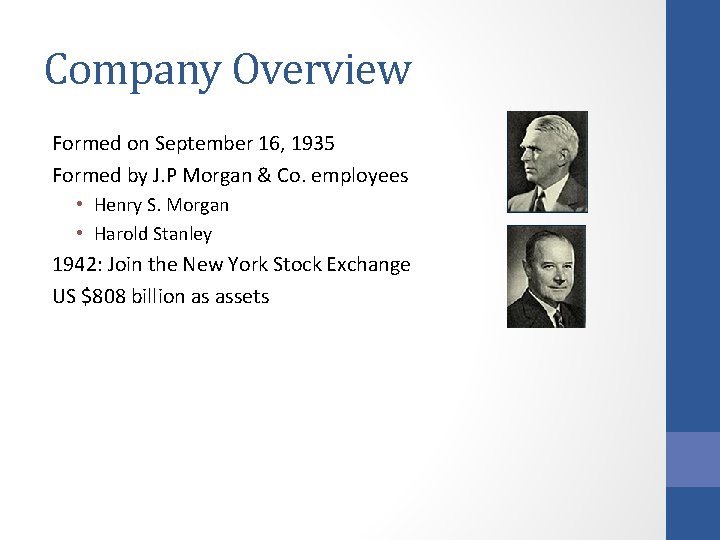
Company Overview Formed on September 16, 1935 Formed by J. P Morgan & Co. employees • Henry S. Morgan • Harold Stanley 1942: Join the New York Stock Exchange US $808 billion as assets
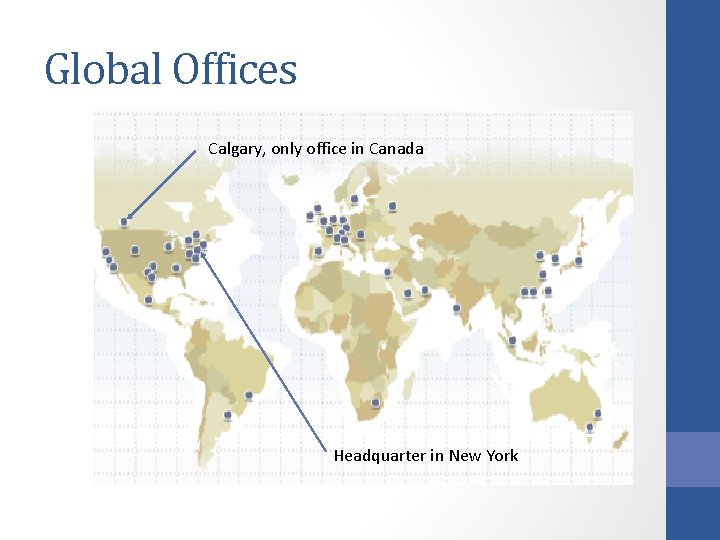
Global Offices Calgary, only office in Canada Headquarter in New York
Industry • • Global Financial Services Institutional Asset Management Retail Asset Management Investment Banking
Competitors • • • Citigroup JP Morgan Goldman Sachs Merrill Lynch UBS
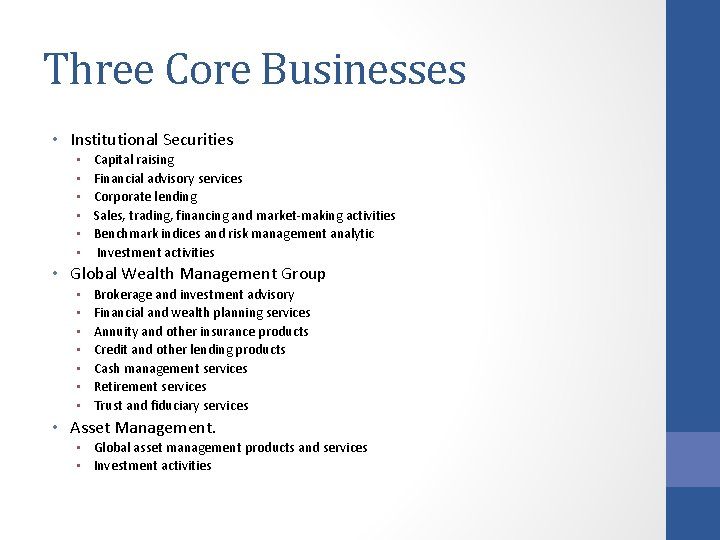
Three Core Businesses • Institutional Securities • • • Capital raising Financial advisory services Corporate lending Sales, trading, financing and market-making activities Benchmark indices and risk management analytic Investment activities • Global Wealth Management Group • • Brokerage and investment advisory Financial and wealth planning services Annuity and other insurance products Credit and other lending products Cash management services Retirement services Trust and fiduciary services • Asset Management. • Global asset management products and services • Investment activities
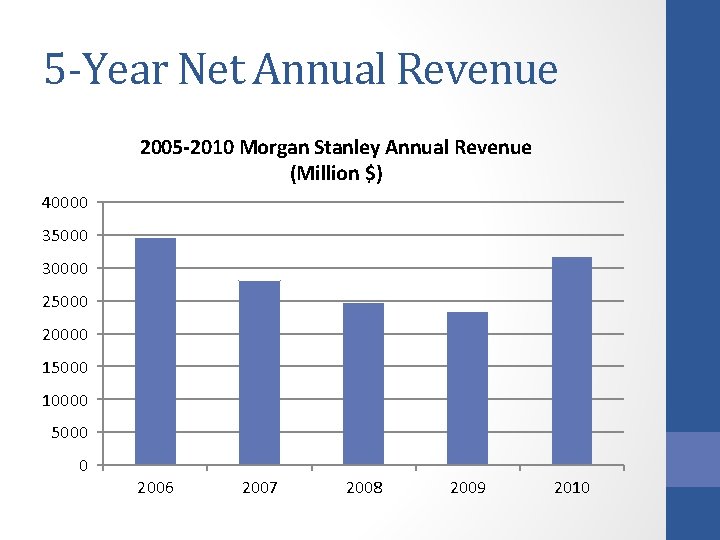
5 -Year Net Annual Revenue 2005 -2010 Morgan Stanley Annual Revenue (Million $) 40000 35000 30000 25000 20000 15000 10000 5000 0 2006 2007 2008 2009 2010
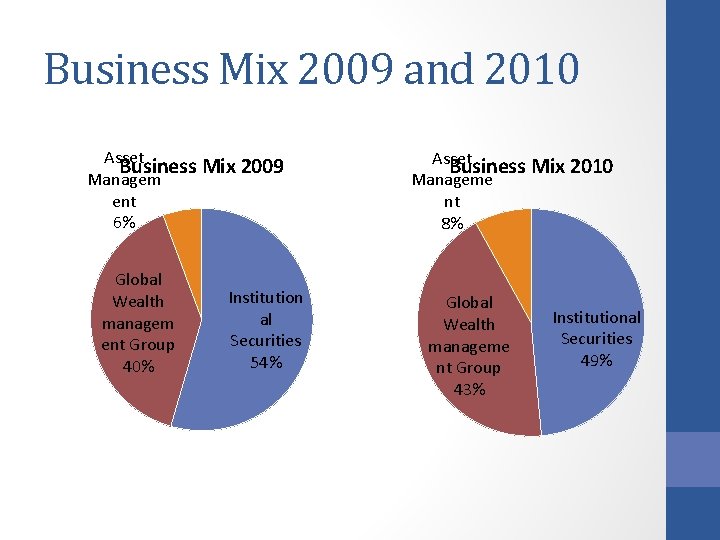
Business Mix 2009 and 2010 Asset Business Mix 2009 Managem ent 6% Global Wealth managem ent Group 40% Institution al Securities 54% Asset Business Mix 2010 Manageme nt 8% Global Wealth manageme nt Group 43% Institutional Securities 49%
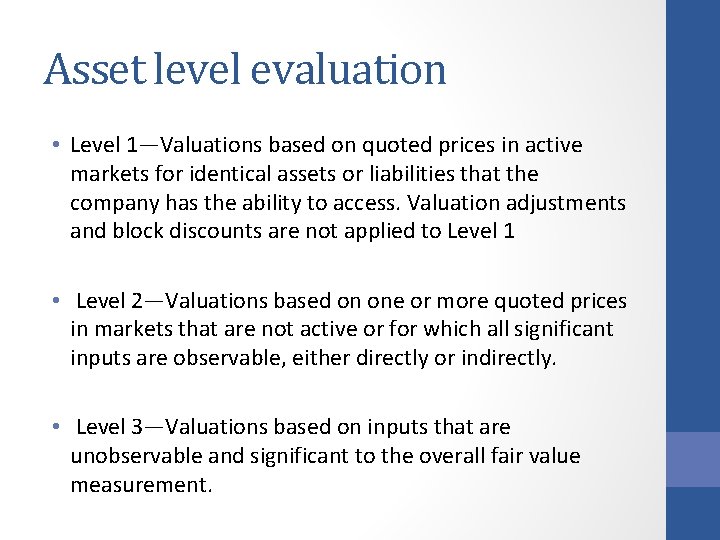
Asset level evaluation • Level 1—Valuations based on quoted prices in active markets for identical assets or liabilities that the company has the ability to access. Valuation adjustments and block discounts are not applied to Level 1 • Level 2—Valuations based on one or more quoted prices in markets that are not active or for which all significant inputs are observable, either directly or indirectly. • Level 3—Valuations based on inputs that are unobservable and significant to the overall fair value measurement.
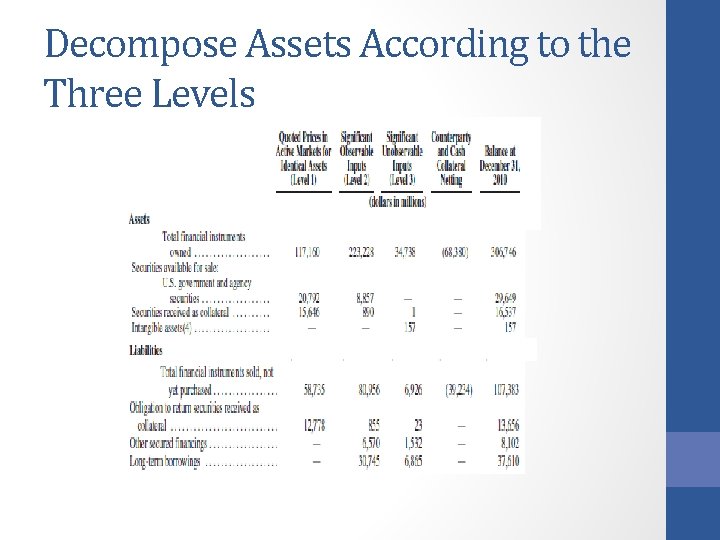
Decompose Assets According to the Three Levels
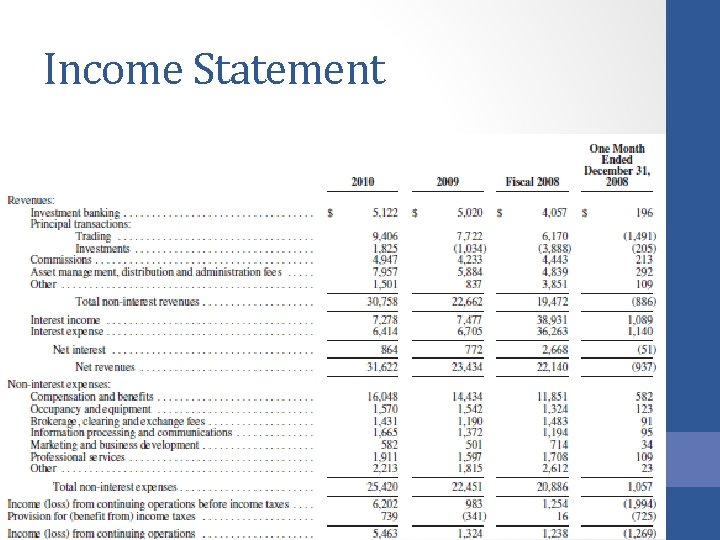
Income Statement
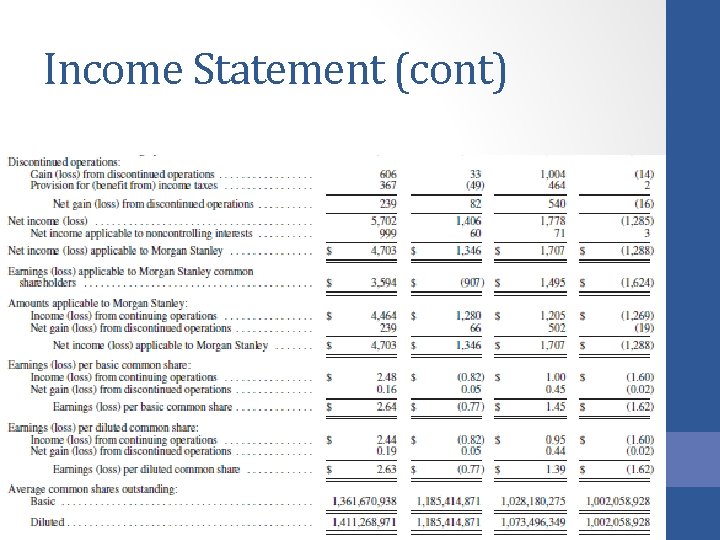
Income Statement (cont)
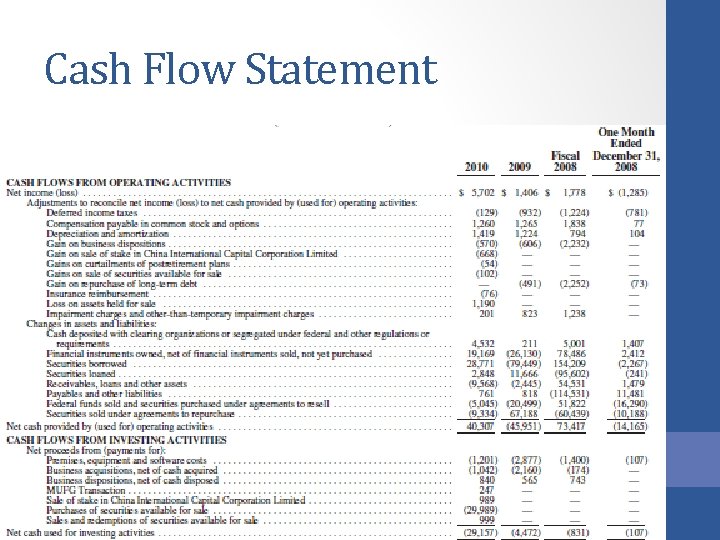
Cash Flow Statement
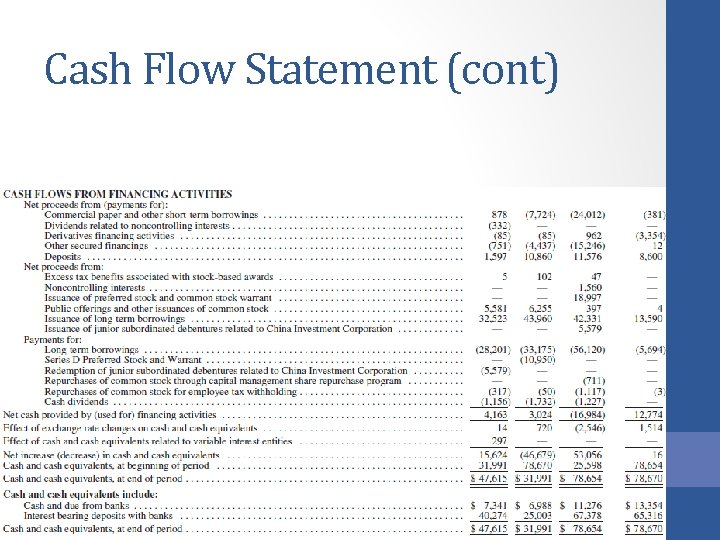
Cash Flow Statement (cont)
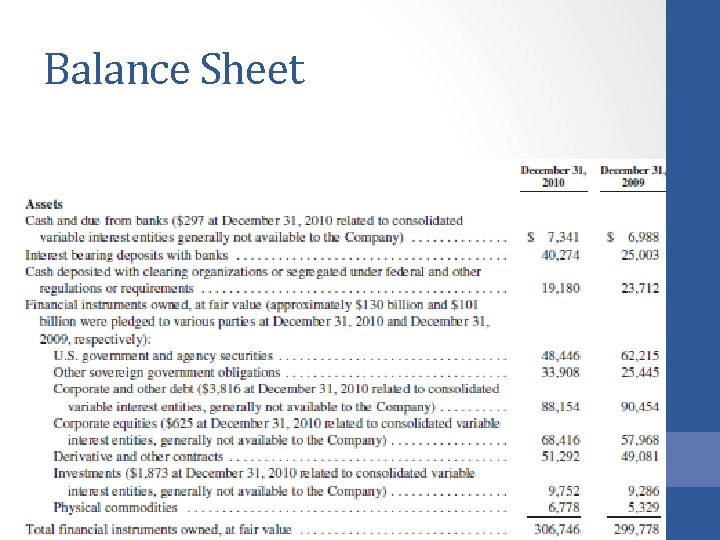
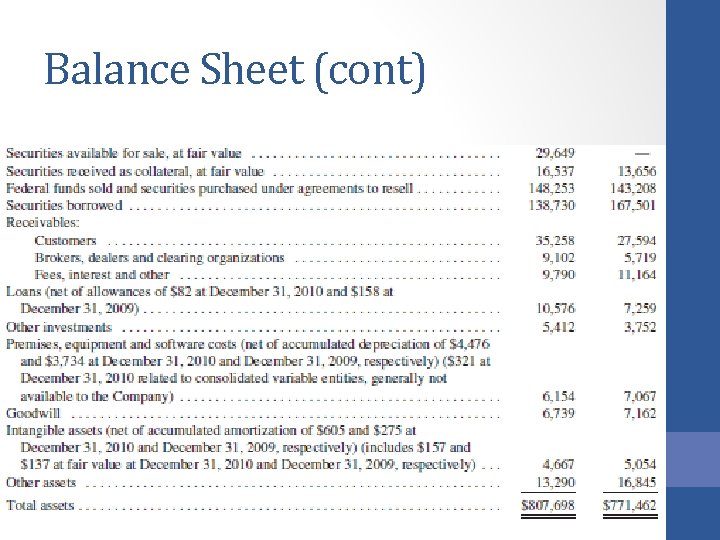
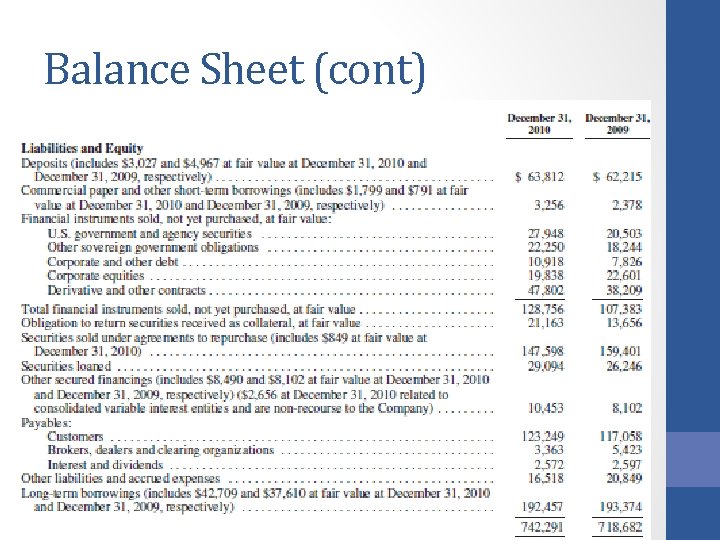
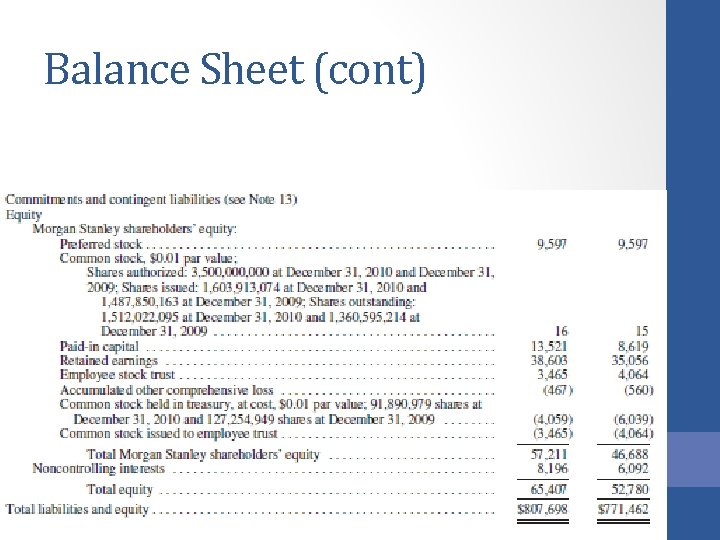
Balance Sheet
Balance Sheet (cont)
Balance Sheet (cont)
Balance Sheet (cont)
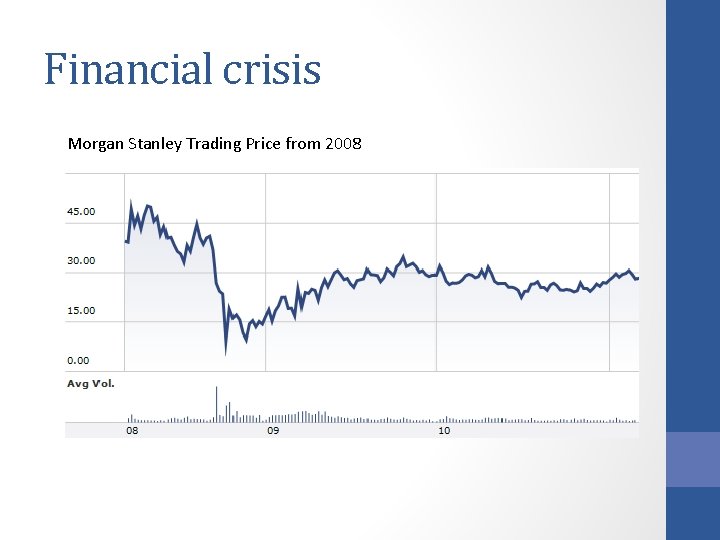
Financial crisis Morgan Stanley Trading Price from 2008
Financial Crisis (cont) • Converted to bank holding company • Regulated by the Federal Reserve • No longer a securities firm • Invested by Mitsubishi UFJ Financial Group • Brought Smith Barney from Citigroup • Joint venture with Citigroup • No. 1 in customer service among full-service brokerage firms
Future Considerations • • Protection from market volatility Build up reputation Focus on technological development Investors’ confidence Inflation Competitors Legal requirements
Risk management philosophy • • • Comprehensiveness Independence Accountability Defined risk tolerance Transparency.
Types of risks Operational risk • Risk of losses arising from insufficient controls on people, resources, and processes and external factors such as compliance risk Legal/Regulatory risk • Risk of losses in fines, penalties, damages resulting from noncompliance and legal actions Credit risk • Risk of default from borrowers
Types of Risk Liquidity and funding risk • Risk of difficulty in accessing capital markets, inability to liquidate assets in a timely manner, and threats to going concern in satisfying financial obligations Market risk • Risk of losses arising from changes in market prices, rates, volatility, and correlations
Types of Risks Competitive environment risk • Risks from competition International risk • Risks of losses from global operation Acquisition risk • Risk of losses from acquisitions, minority stakes, forming joint ventures, and strategic alliances
Liquidity and Funding Risk of being unable to finance operations due to loss of access to capital markets, difficulty liquidating assets, or failing to meet financial obligations without experiencing significant business disruption
Liquidity and Funding Risk Liquidity is essential and external sources finance a significant portion of operations • Affected by inability to raise funds in the long/short-term debt/equity capital markets or inability to access secured lending markets • Caused by: • Disruption of the financial markets • Negative views about the financial services industry • Negative perception of long or short term financial prospects • Large trading losses, downgraded or negative watch by rating agencies, decline in business activity, action by regulators, employee misconduct or illegal activity, and other reasons • Would have to liquidate assets to meet maturing liabilities and may have to sell at a discount
Liquidity and Funding Risk Borrowing Costs and access to debt capital markets depend on credit ratings • Factors that determine credit ratings: • • • Level and quality of earnings Capital adequacy Liquidity Risk appetite and management Asset quality Business mix and actual and perceived level of government support • Debt ratings can impact trading revenues • Post additional collateral in event of credit ratings downgrade
Liquidity and Funding Risk Depends on payments from subsidiaries • Regulations may prevent transfer of funds either to or from subsidiaries • Inability to access these funds may make it difficult to meet obligations • Regulations may also prevent dividend distribution or stock repurchase
Liquidity and Funding Risk • Volatility in the global market and economic conditions have affected ability to raise funds in the long/short-term debt/equity capital markets and secured lending markets • Cost and availability of funding have been affected by illiquid credit markets and wider credit spreads in the past and may do so in the future
Market Risk • Risk that a change in the level of one or more market prices, rates, indices, implied volatilities, correlations or other market factors will result in a loss
Market Risk Results of operations may be affected by market fluctuations and by global economic conditions • Factors affecting results: • Political and economic conditions • Effects of global equity, fixed income, and credit markets • Corporate and mortgage lending, and commercial real estate investments • Current, pending, and future legislation and regulation • Level and volatility of equity, fixed income, commodity prices, interest rates, currency values, and other market indices • Cost and availability of credit and capital and credit ratings • Performance of acquisitions, JV’s and strategic alliances • Reputation, inflation, natural disasters, war and terrorism • Actions by competitors and technological changes
Market Risk • Fluctuations affect the results of Institutional Securities business segments caused by factors mentioned above and global market activity • During unfavourable market conditions, the level of individual investor participation as well as level of client assets may decrease impacting the results of the Global Wealth Management Group business segment • Fluctuations in global market activity could impact flow of investment capital into or from the Asset Management business segment
Market Risk Writedowns of financial instruments and other losses caused by volatile and illiquid market conditions • Valuation of certain securities is difficult • Sales may not realize fair value due to demand liquidity in the market at the time of sale • These factors could require further writedowns in the value of securities portfolio • Under severe market conditions, hedging and other risk management strategies may not be as effective at mitigating losses as they are in more normal conditions • Severe market conditions are hard to predict and may result in substantial losses if they occur again
Market Risk Holding large and concentrated positions expose Morgan Stanley to losses • Substantial amounts of capital are committed to marketmaking, investing, block trading, underwriting and lending businesses which results in large positions in securities of, or making large loans to, a particular issuer(s) in a particular industry, country, or region
Market Risk Significant losses have been, and may continue to be incurred in the real estate sector • A number of principal positions have been acquired and financed by Morgan Stanley for their own account, investment vehicles by affiliates, separate accounts managed by affiliates, and major participants in commercial and residential real estate markets. • Originate loans on commercial and residential real estate • Securitize and trade in a wide range of real estate related products
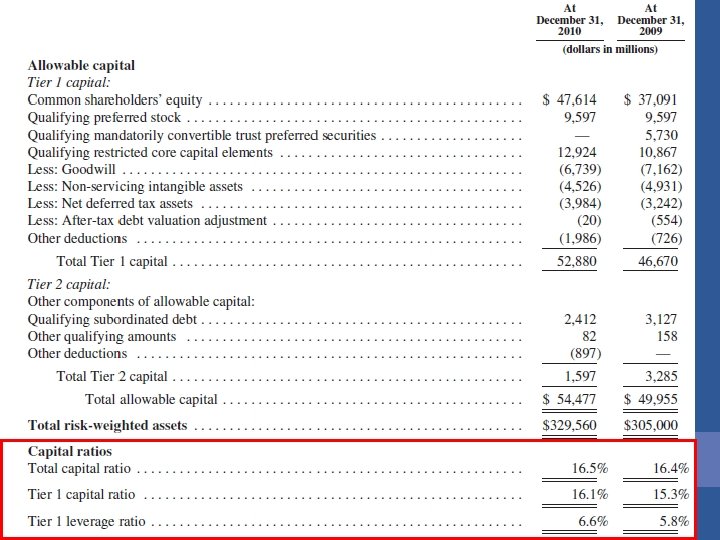
Risk Management: Liquidity and Capital Resources • Senior management establishes liquidity and capital policies and reviews performance relative to policies, monitors the availability of alternative sources of financing, and oversees the liquidity and interest rate and currency sensitivity of the Company’s asset and liability position • The liquidity and funding risk management helps mitigate the risk that the company may not have access to adequate financing • The principal elements of the company’s liquidity and funding risk management framework are the Contingency Funding Plan (CFP) and the Global Liquidity Reserve • Uses Tier 1 common ratio and the balance sheet leverage ratio as indicators of capital adequacy
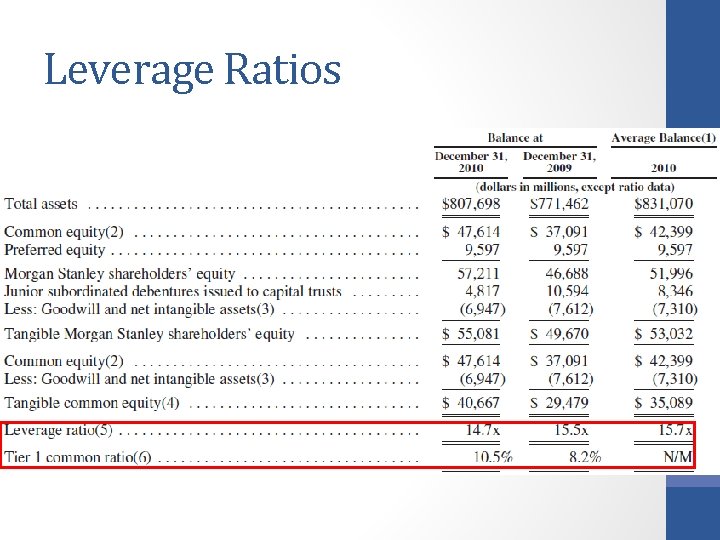
Leverage Ratios
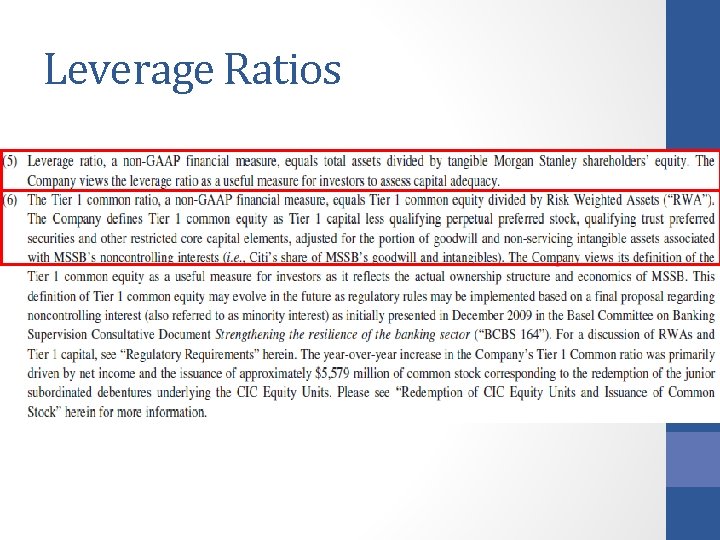
Leverage Ratios
Capital Ratio
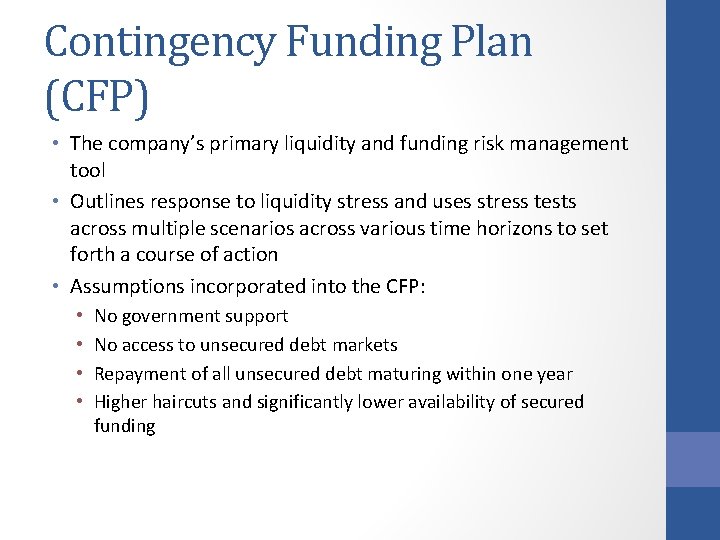
Contingency Funding Plan (CFP) • The company’s primary liquidity and funding risk management tool • Outlines response to liquidity stress and uses stress tests across multiple scenarios across various time horizons to set forth a course of action • Assumptions incorporated into the CFP: • • No government support No access to unsecured debt markets Repayment of all unsecured debt maturing within one year Higher haircuts and significantly lower availability of secured funding
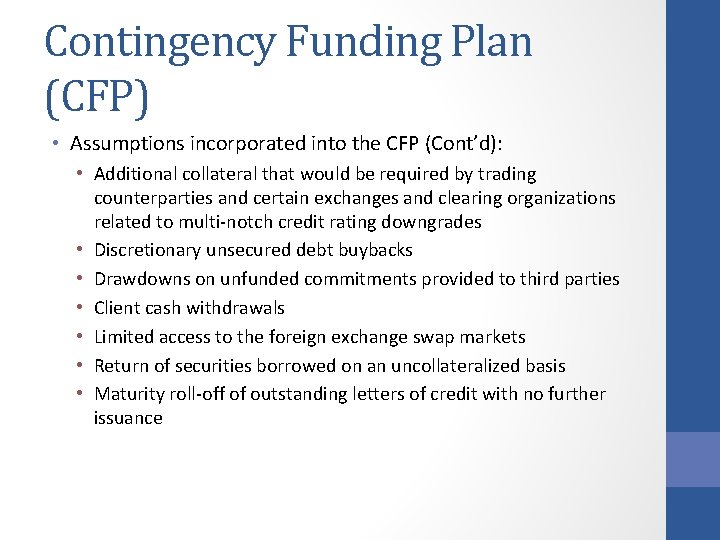
Contingency Funding Plan (CFP) • Assumptions incorporated into the CFP (Cont’d): • Additional collateral that would be required by trading counterparties and certain exchanges and clearing organizations related to multi-notch credit rating downgrades • Discretionary unsecured debt buybacks • Drawdowns on unfunded commitments provided to third parties • Client cash withdrawals • Limited access to the foreign exchange swap markets • Return of securities borrowed on an uncollateralized basis • Maturity roll-off of outstanding letters of credit with no further issuance
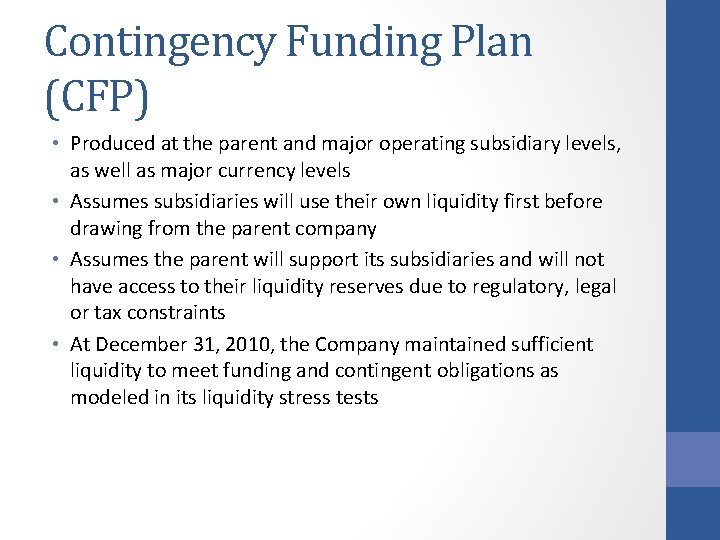
Contingency Funding Plan (CFP) • Produced at the parent and major operating subsidiary levels, as well as major currency levels • Assumes subsidiaries will use their own liquidity first before drawing from the parent company • Assumes the parent will support its subsidiaries and will not have access to their liquidity reserves due to regulatory, legal or tax constraints • At December 31, 2010, the Company maintained sufficient liquidity to meet funding and contingent obligations as modeled in its liquidity stress tests
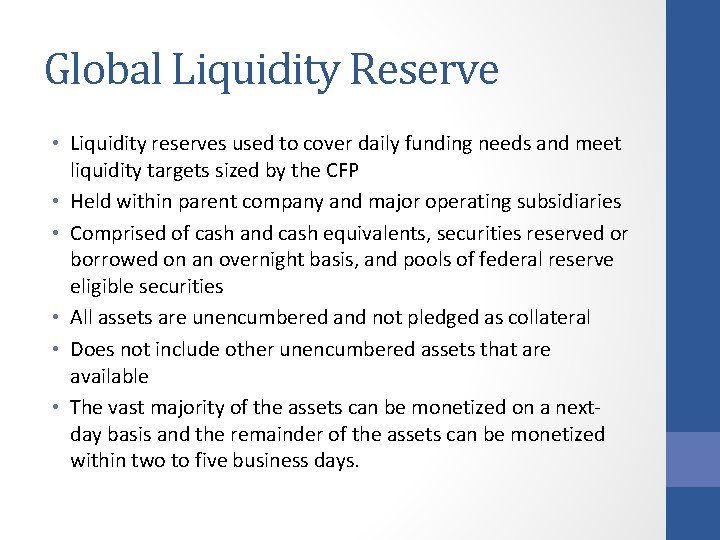
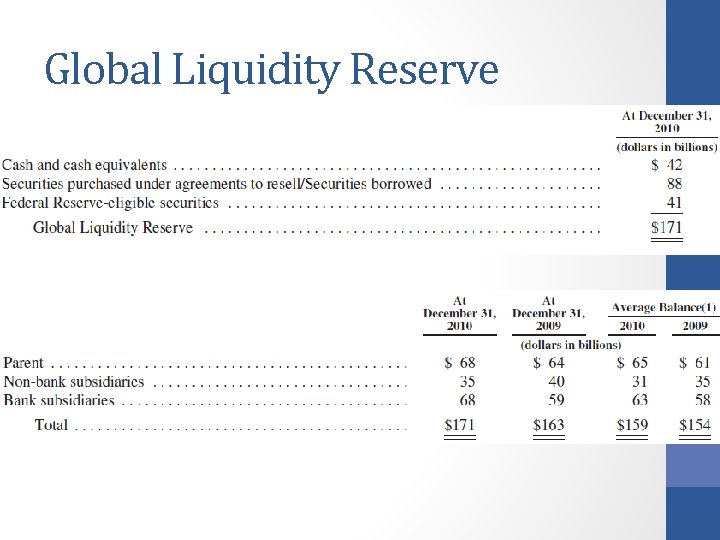
Global Liquidity Reserve • Liquidity reserves used to cover daily funding needs and meet liquidity targets sized by the CFP • Held within parent company and major operating subsidiaries • Comprised of cash and cash equivalents, securities reserved or borrowed on an overnight basis, and pools of federal reserve eligible securities • All assets are unencumbered and not pledged as collateral • Does not include other unencumbered assets that are available • The vast majority of the assets can be monetized on a nextday basis and the remainder of the assets can be monetized within two to five business days.
Global Liquidity Reserve
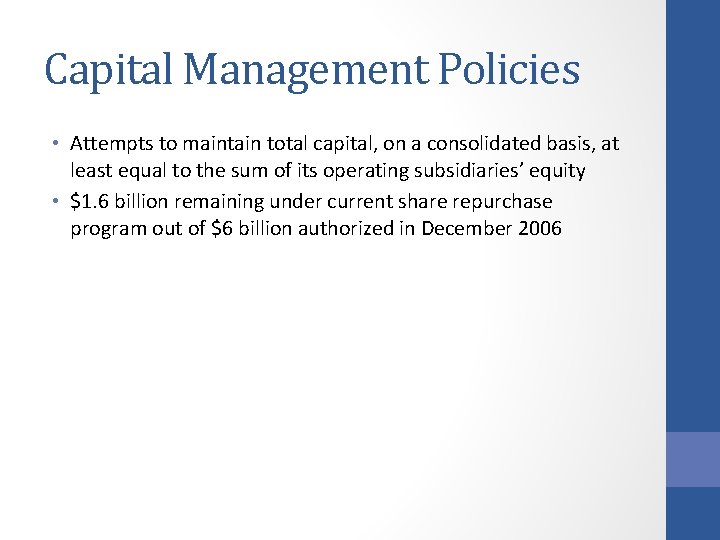
Capital Management Policies • Attempts to maintain total capital, on a consolidated basis, at least equal to the sum of its operating subsidiaries’ equity • $1. 6 billion remaining under current share repurchase program out of $6 billion authorized in December 2006
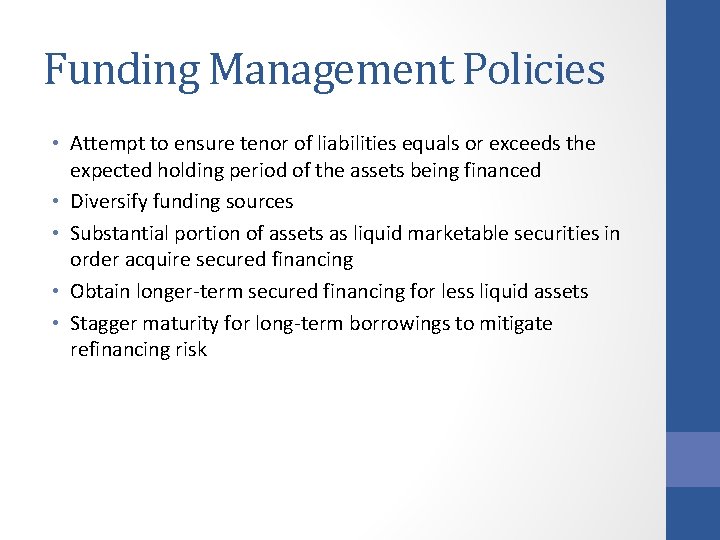
Funding Management Policies • Attempt to ensure tenor of liabilities equals or exceeds the expected holding period of the assets being financed • Diversify funding sources • Substantial portion of assets as liquid marketable securities in order acquire secured financing • Obtain longer-term secured financing for less liquid assets • Stagger maturity for long-term borrowings to mitigate refinancing risk
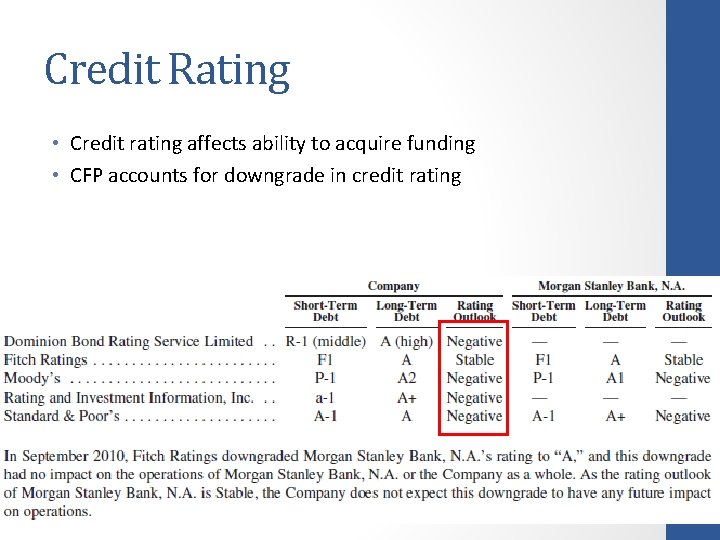
Credit Rating • Credit rating affects ability to acquire funding • CFP accounts for downgrade in credit rating
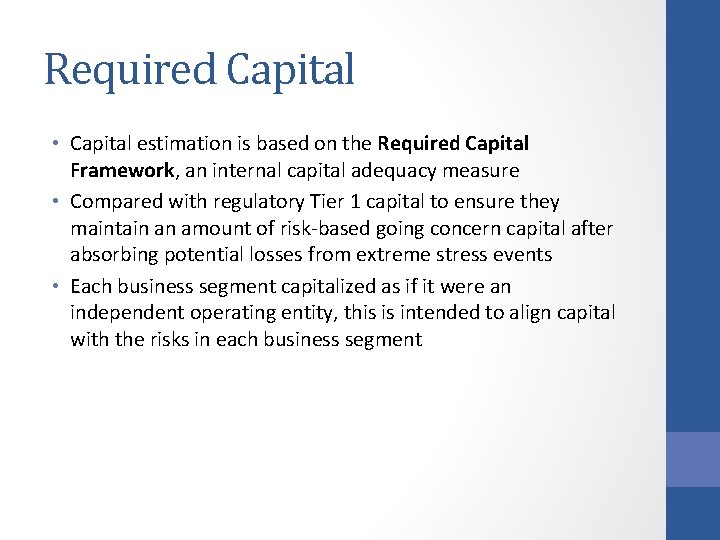
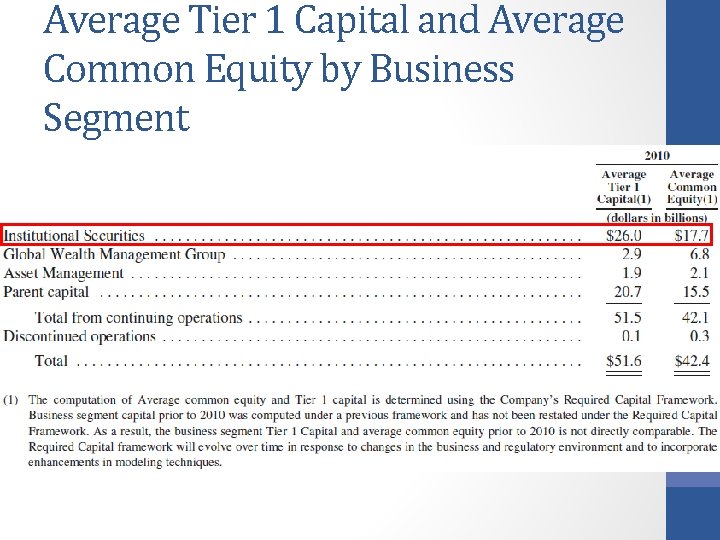
Required Capital • Capital estimation is based on the Required Capital Framework, an internal capital adequacy measure • Compared with regulatory Tier 1 capital to ensure they maintain an amount of risk-based going concern capital after absorbing potential losses from extreme stress events • Each business segment capitalized as if it were an independent operating entity, this is intended to align capital with the risks in each business segment
Average Tier 1 Capital and Average Common Equity by Business Segment
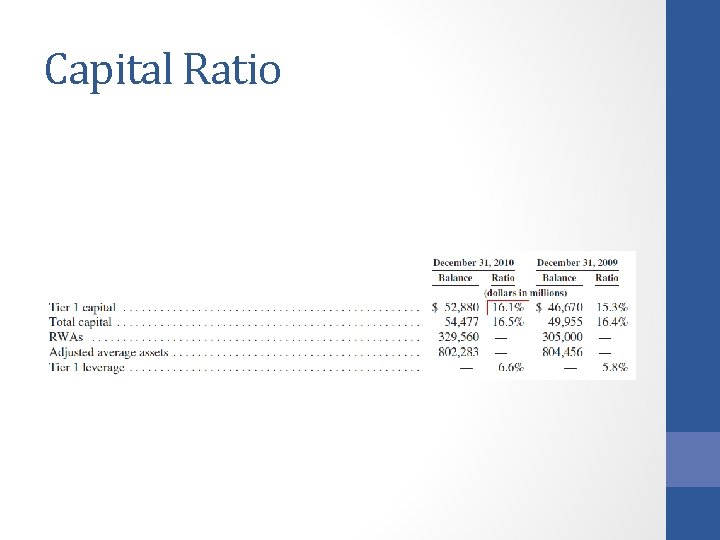
Regulatory Requirements • Subject to regulation and oversight of the Federal Reserve which establishes capital requirements • Capital ratios and Risk Weighted Assets calculated in accordance with capital adequacy standards • Risks are calculated under Basel I and Basel II simultaneously as of July 2010 • At December 31, 2010, the Company was in compliance with Basel I capital requirements with ratios of Tier 1 capital to RWAs of 16. 1% and total capital to RWAs of 16. 5% (6% and 10% being well-capitalized for regulatory purposes, respectively)
Basel II • The First Pillar: Minimum Capital Requirements • Maintain three major risks: Credit Risk, Operational Risk, Market Risk • Minimum Capital Requirement: (risk weighted) 8% • The Second Pillar: Supervisory Review • Assist the first pillar with regulatory responses • Deals with liquidity risk and other risks • The Third Pillar: Market Discipline • Market disclosure
Basel III • Implementation of Basel II may be impacted by development of Basel III • New capital standards that raise the quality of capital, strengthen counterparty credit risk capital requirements and introduces a leverage ratio as a supplemental measure to the risk-based ratio • New capital conservation buffer which imposes a common equity requirement above the new minimum that can be depleted under stress
Effects of Inflation and Changes in FX Rates • The Company’s assets are largely liquid in nature and are not significantly affected by inflation • Inflation may increase expenses which may adversely affect profitability • Business conducted in other currencies can affect the value of non-U. S. dollar net assets, revenues and expenses • Strategies to reduce impact of FX rate fluctuations include financing of non-U. S. dollar assets with direct or swap-based borrowings in the same currency and the use of currency forward contracts or the spot market in various hedging transactions related to net assets, revenues, expenses or cash flows
Risk Management: Market Risk • Institutional Securities business segment generates the substantial majority of Company’s Value at Risk (Va. R) for market risk exposure • Global Wealth Management Group incurs trading related market risk • Asset Management incurs principally non-trading market risk
Market Risk Department Responsibilities: • Ensuring transparency of material market risk • Monitoring compliance with established limits • Escalating risk concentrations to appropriate senior management How responsibilities are carried out: • Monitor risk against limits on aggregate risk exposures • Perform risk analyses • Report risk summaries • Monitor risk through various measures • Va. R • Position sensitivity • Routine stress testing
Primary Market Risk Exposures • Exposure to interest rates, equity prices, foreign exchange rates and commodity prices—and the associated implied volatilities and spreads—related to the global markets in which it conducts its trading activities
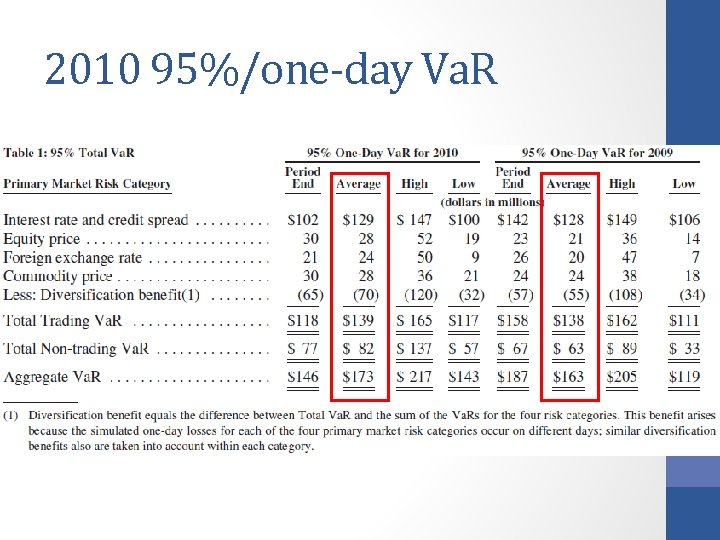
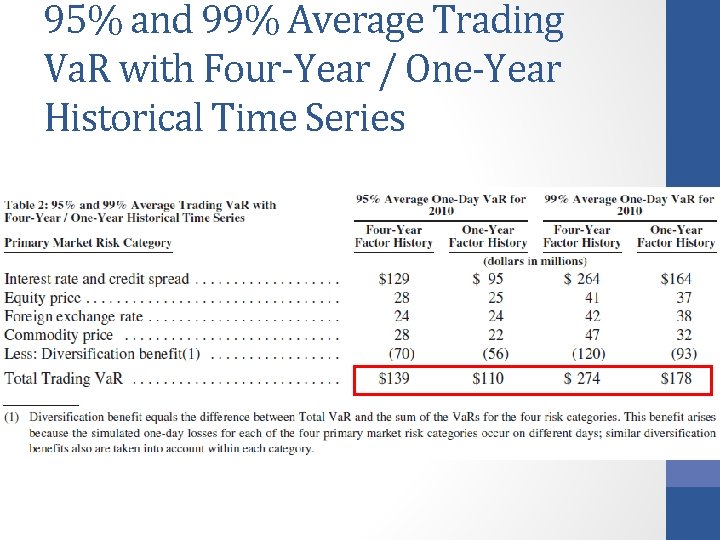
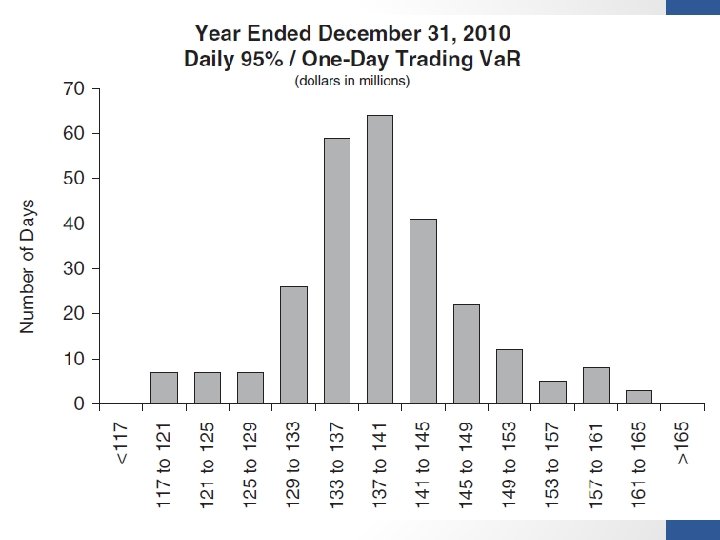
Value at Risk (Va. R) • Used to measure, monitor and review market risk exposures of its trading portfolios • Va. R estimated by using a model based on historical simulation for major market risk factors and Monte Carlo simulation for namespecific risk in corporate shares, bonds, loans and related derivatives • Historical simulation involves constructing a distribution of hypothetical daily changes in the value of trading portfolios based on two sets of inputs • Historical observation of daily changes in key market indices or other market risk factors • Information on the sensitivity of the portfolio values to these market risk factor changes • The company’s Va. R model uses four years of historical data to measure it’s 95%/one-day Va. R which corresponds to the unrealized loss in portfolio value that would have been exceeded with a frequency of 5% or 5 times in every 100 trading days if the portfolio were held constant for one day
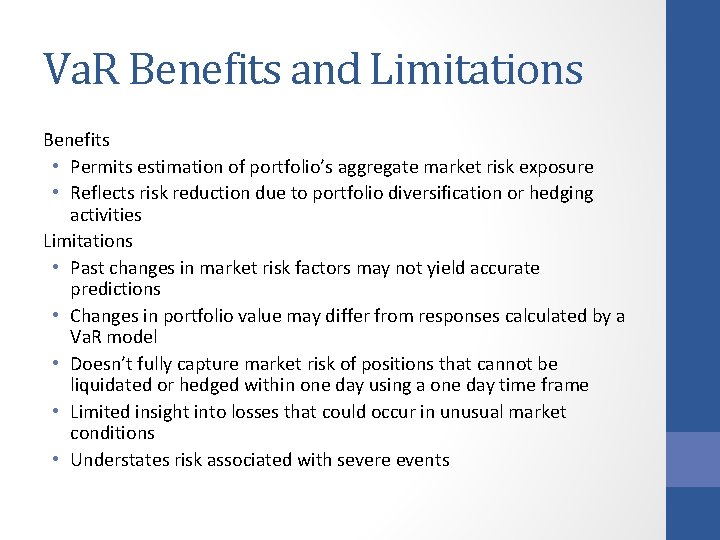
Va. R Benefits and Limitations Benefits • Permits estimation of portfolio’s aggregate market risk exposure • Reflects risk reduction due to portfolio diversification or hedging activities Limitations • Past changes in market risk factors may not yield accurate predictions • Changes in portfolio value may differ from responses calculated by a Va. R model • Doesn’t fully capture market risk of positions that cannot be liquidated or hedged within one day using a one day time frame • Limited insight into losses that could occur in unusual market conditions • Understates risk associated with severe events
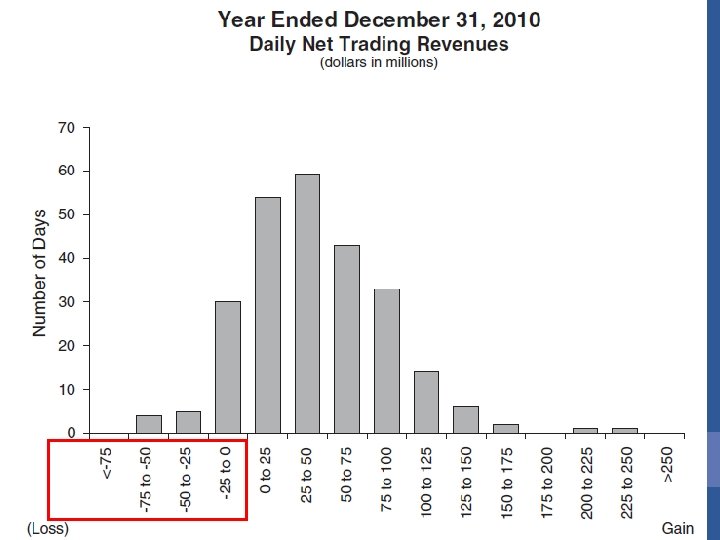
2010 95%/one-day Va. R
95% and 99% Average Trading Va. R with Four-Year / One-Year Historical Time Series
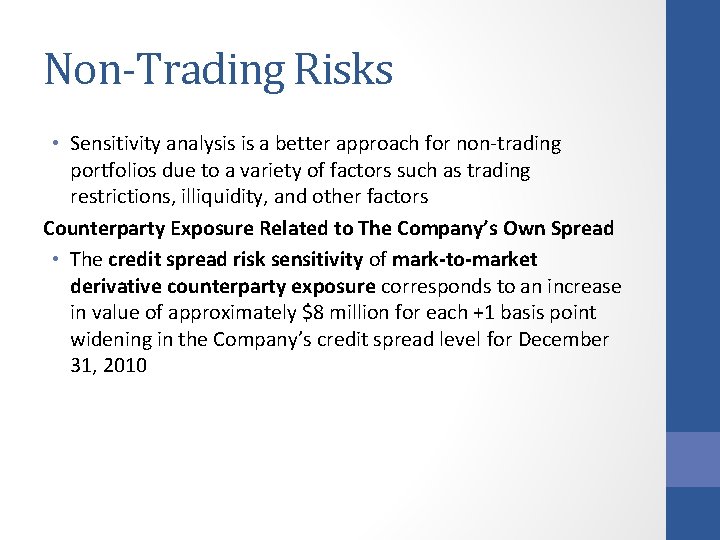
Non-Trading Risks • Sensitivity analysis is a better approach for non-trading portfolios due to a variety of factors such as trading restrictions, illiquidity, and other factors Counterparty Exposure Related to The Company’s Own Spread • The credit spread risk sensitivity of mark-to-market derivative counterparty exposure corresponds to an increase in value of approximately $8 million for each +1 basis point widening in the Company’s credit spread level for December 31, 2010
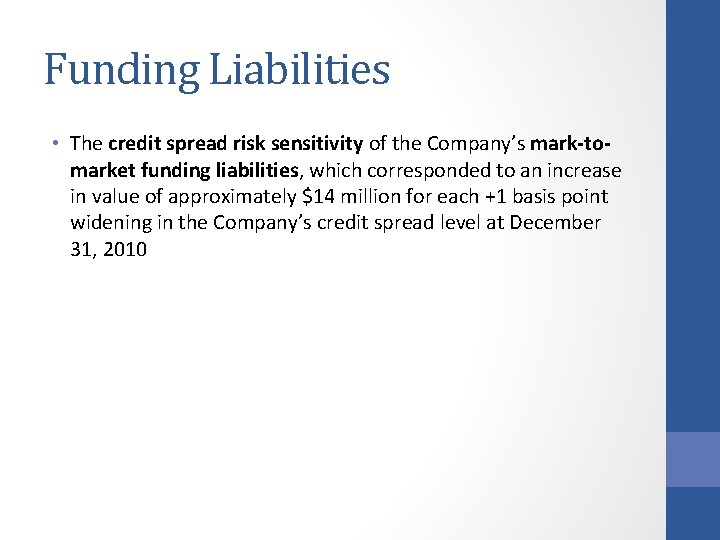
Funding Liabilities • The credit spread risk sensitivity of the Company’s mark-tomarket funding liabilities, which corresponded to an increase in value of approximately $14 million for each +1 basis point widening in the Company’s credit spread level at December 31, 2010
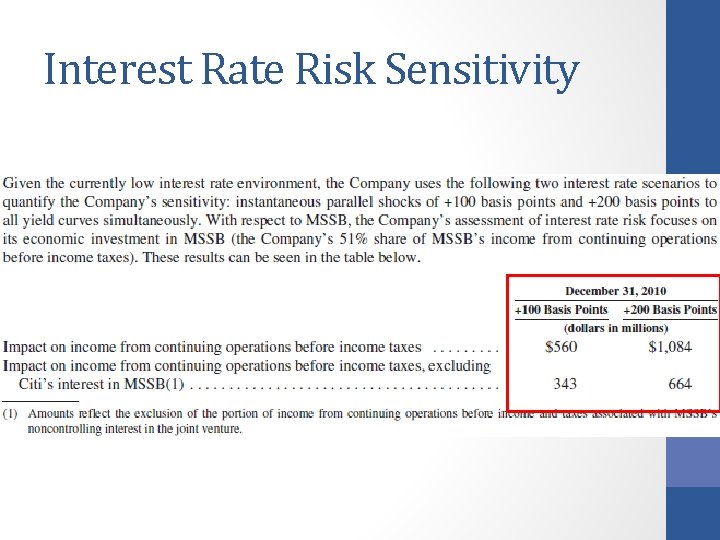
Interest Rate Risk Sensitivity
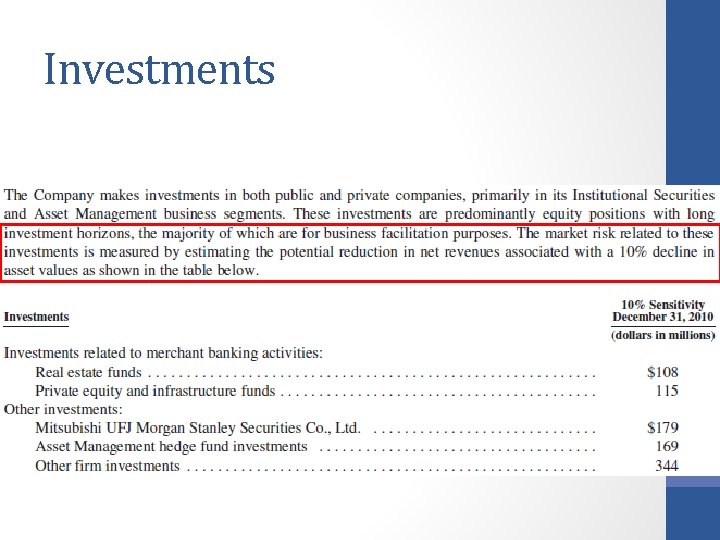
Investments
Derivative Instruments and Hedging Activities • Derivative Instruments are used for trading, foreign currency exposure management and asset and liability management • Risk mitigation strategies include diversification of risk exposure and hedging • Risk is managed on a company-wide basis, worldwide trading division level and on an individual product basis
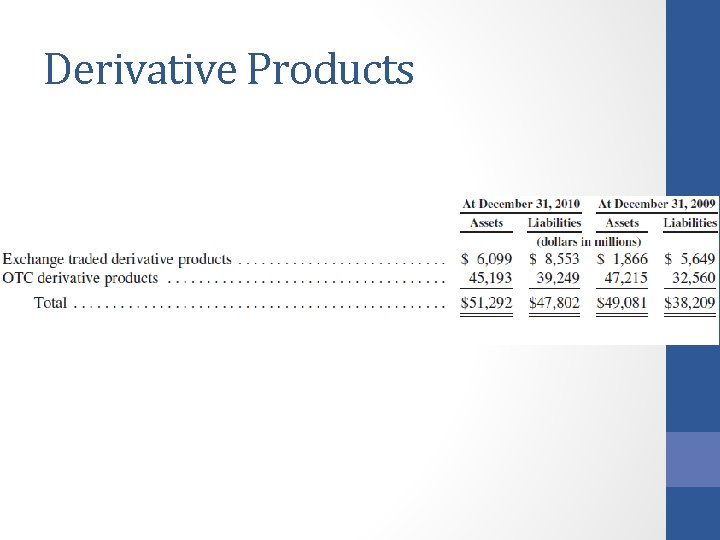
Derivative Products
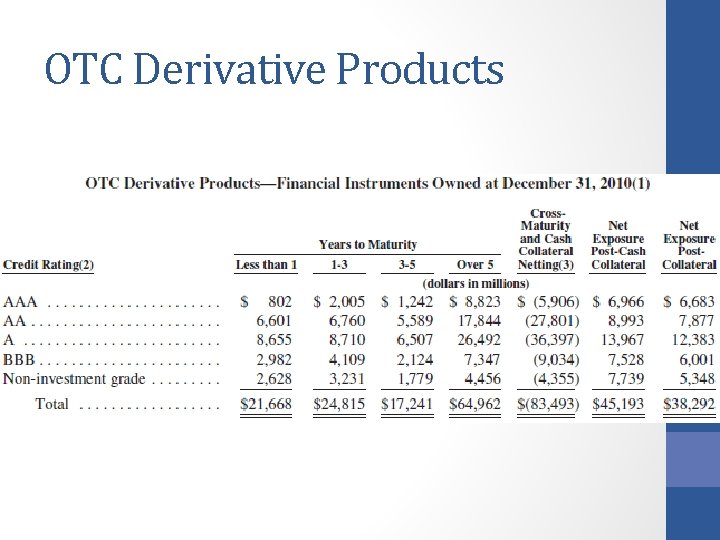
OTC Derivative Products
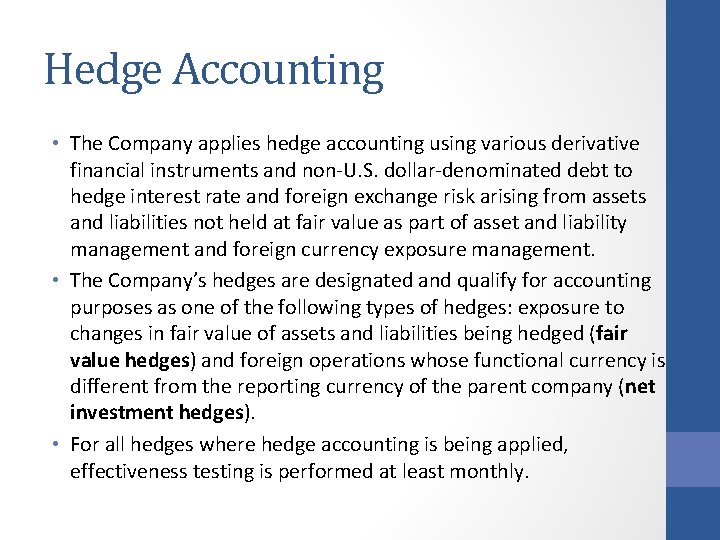
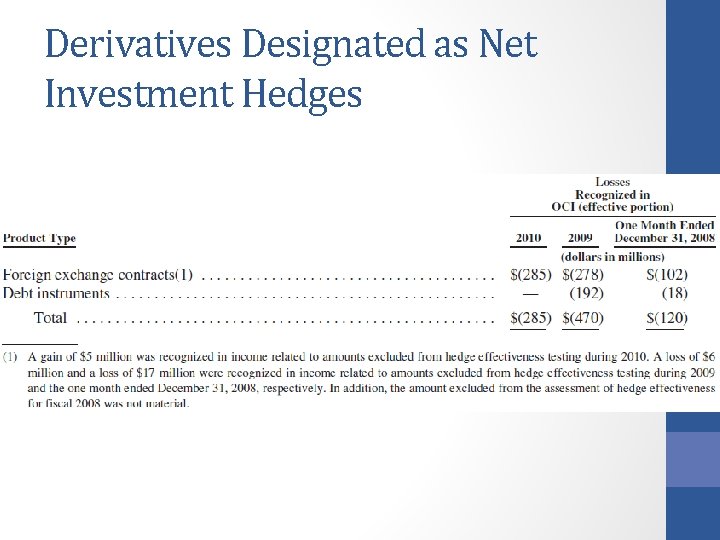
Hedge Accounting • The Company applies hedge accounting using various derivative financial instruments and non-U. S. dollar-denominated debt to hedge interest rate and foreign exchange risk arising from assets and liabilities not held at fair value as part of asset and liability management and foreign currency exposure management. • The Company’s hedges are designated and qualify for accounting purposes as one of the following types of hedges: exposure to changes in fair value of assets and liabilities being hedged (fair value hedges) and foreign operations whose functional currency is different from the reporting currency of the parent company (net investment hedges). • For all hedges where hedge accounting is being applied, effectiveness testing is performed at least monthly.
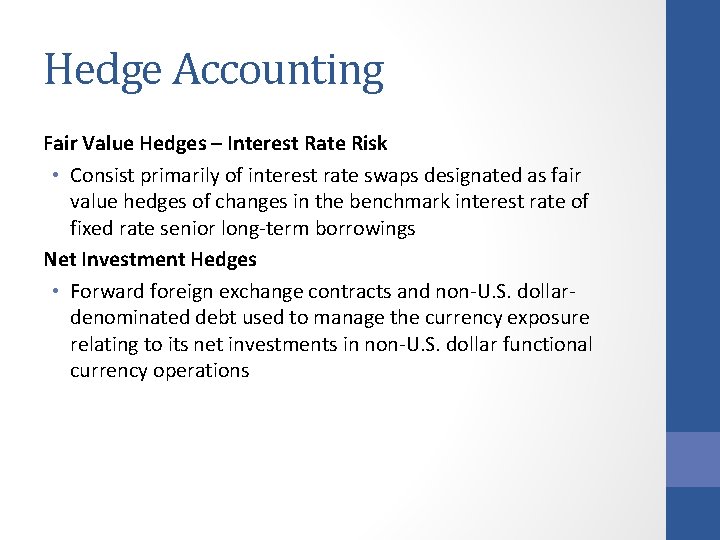
Hedge Accounting Fair Value Hedges – Interest Rate Risk • Consist primarily of interest rate swaps designated as fair value hedges of changes in the benchmark interest rate of fixed rate senior long-term borrowings Net Investment Hedges • Forward foreign exchange contracts and non-U. S. dollardenominated debt used to manage the currency exposure relating to its net investments in non-U. S. dollar functional currency operations
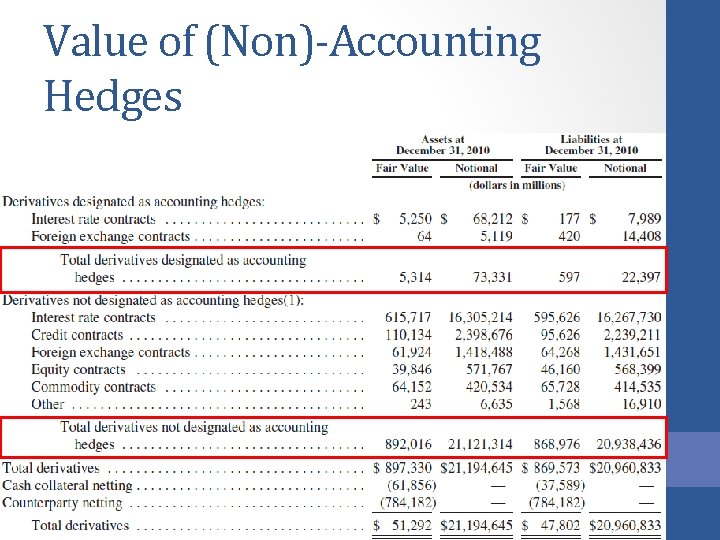
Value of (Non)-Accounting Hedges
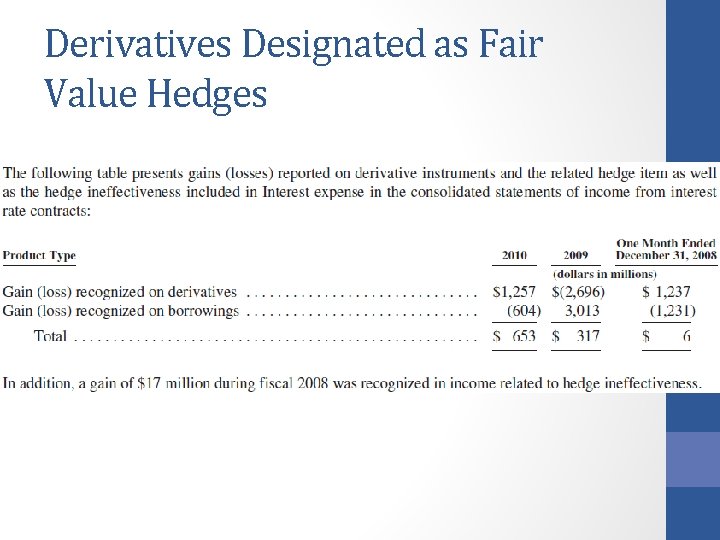
Derivatives Designated as Fair Value Hedges
Derivatives Designated as Net Investment Hedges
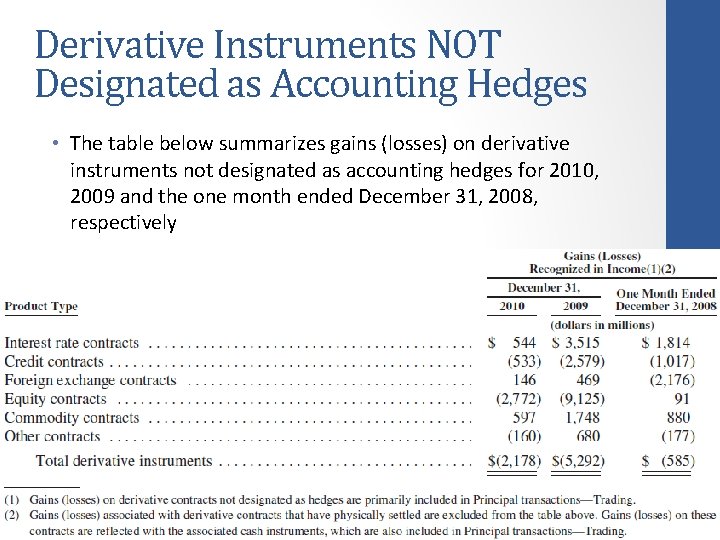
Derivative Instruments NOT Designated as Accounting Hedges • The table below summarizes gains (losses) on derivative instruments not designated as accounting hedges for 2010, 2009 and the one month ended December 31, 2008, respectively
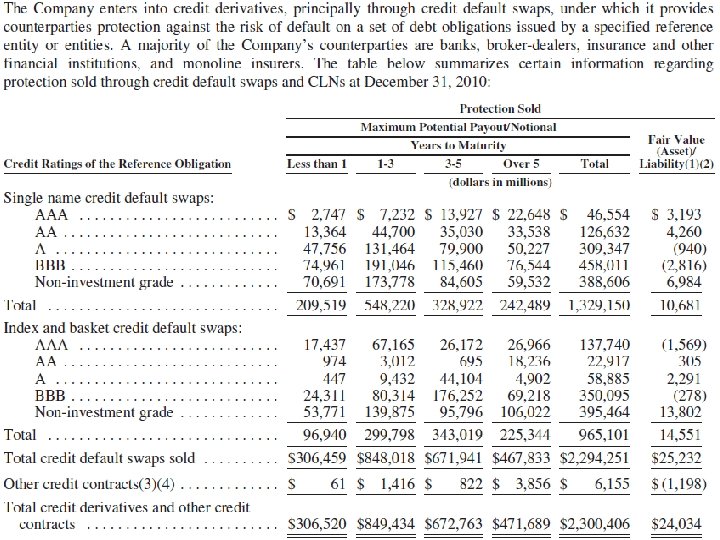
Credit Derivatives and Other Credit Contracts
Credit Risk • Refers to the risk of loss arising from borrower or counterparty default when a borrower, counterparty or obligor does not meet it’s obligation
Credit Risk • • • third parties indebted to us not perform obligation incur through Institutional Securities business segment incur in traded securities and loan pools incur in Global Wealth Management Group business segment continued difficult economic conditions may further negative impart clients and firm’s current credit exposures
Credit Risk Institutional Securities business segment • entering into swap or other derivative contract which counterparties have obligations to make payment • extending credit to clients through various lending commitments • providing short or long-term funding secured by physical or financial collateral whose value may at times be insufficient to fully cover the loan repayment amount • Posting margin or collateral to clearing houses, clearing agencies, exchanges, banks, securities firms and other financial counterparties
Credit Risk Institutional Securities Activities • Corporate Lending • Relationship-driven • expand business relationships • Event-driven • activities associated event or transaction such as support client merger or recapitalization • Securitizations • extend funding to clients through lending commitments secured by assets • Provide for over-collateralization
Credit Risk Institutional Securities Activities (cont) • Derivative Contracts • Represent future commitments to swap interest payment streams, exchange currencies on specific terms at specified future days • Morgan Stanley as a dealer of OTC derivatives
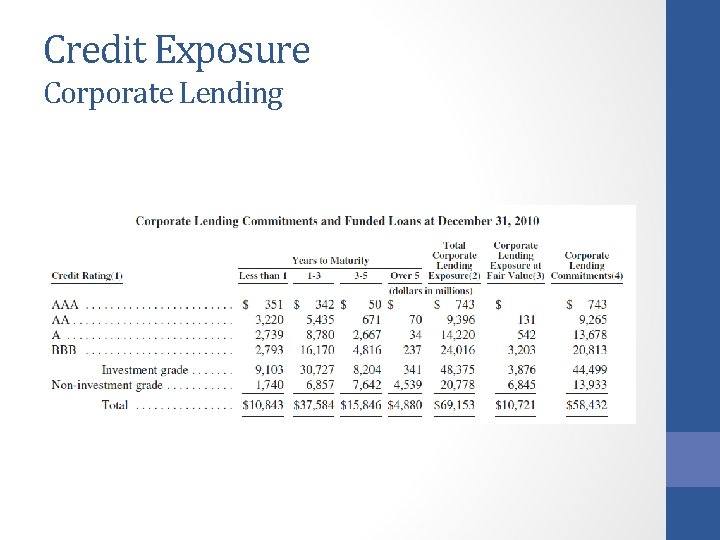
Credit Exposure Corporate Lending
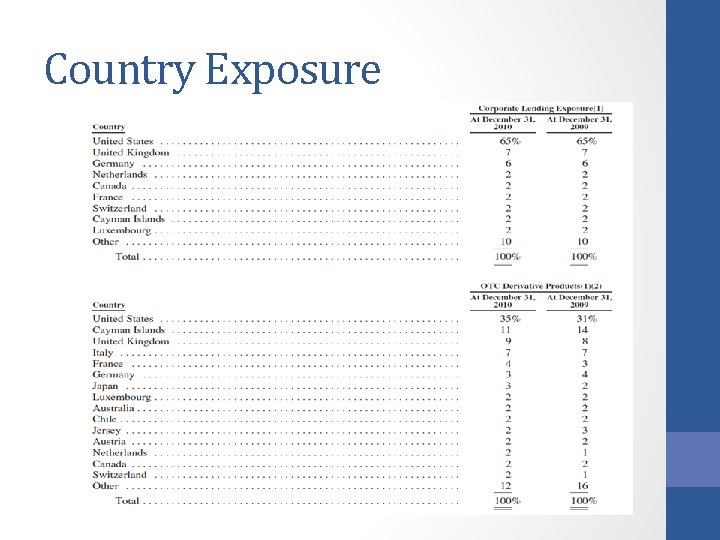
Country Exposure
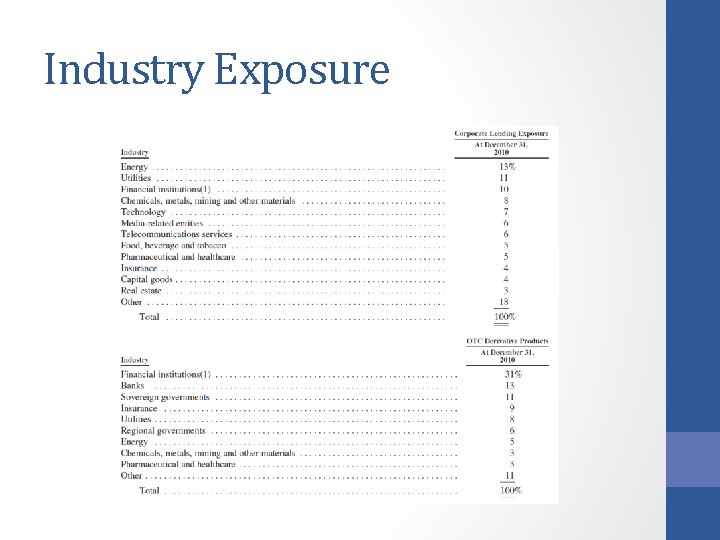
Industry Exposure
Credit Risk Management • Credit Risk Management Department • Credit Limits Framework
Analyzing Credit Risk • Credit Risk Management Department • Ensure lending transactions and derivative exposure analyzed • Review Creditworthiness of counterparties and borrowers regularly • Actively monitor and manage credit exposure • Assigns obligor credit ratings to counterparties and borrowers • Evaluate relative position of particular obligation in borrower’s capital structure and recovery prospects
Risk Mitigation • Through management of key risks elements such as size, financial covenants and collateral • Sell, assign or sub-participate funded loans to other financial institutions • Enter master netting agreements and collateral arrangements with counterparties to offset obligations, request collateral or liquidate collateral
Credit Risk Global Wealth Management Group business segment • Lending to individual investors, margin and non-purpose loans collateralized by securities, residential mortgage loans and home equity lines of credit
Credit Risk Global Wealth Management Group Activities • Margin lending • monitors margin levels, establishes credit limits • reviews amount of margin loans, intended purpose and degree of leverage • Non-purpose securities-based lending (Consumer lending) • allows clients borrow money against the value of qualifying securities for purposes other than trading or refinancing margin debt • establishes approved lines and advance rates against qualifying securities
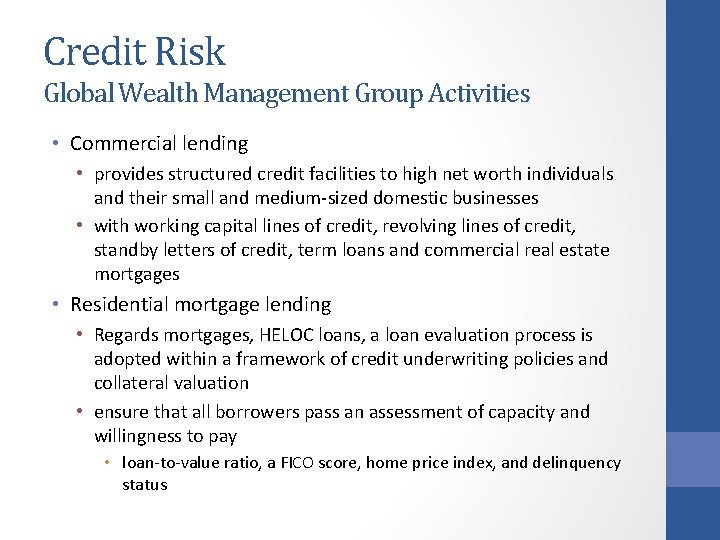
Credit Risk Global Wealth Management Group Activities • Commercial lending • provides structured credit facilities to high net worth individuals and their small and medium-sized domestic businesses • with working capital lines of credit, revolving lines of credit, standby letters of credit, term loans and commercial real estate mortgages • Residential mortgage lending • Regards mortgages, HELOC loans, a loan evaluation process is adopted within a framework of credit underwriting policies and collateral valuation • ensure that all borrowers pass an assessment of capacity and willingness to pay • loan-to-value ratio, a FICO score, home price index, and delinquency status
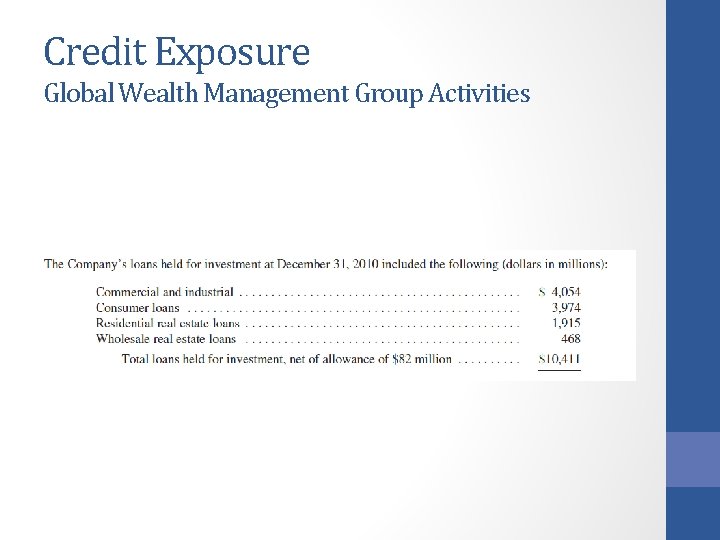
Credit Exposure Global Wealth Management Group Activities
Credit Risk Default risk • firm as a clearing member firm • responsible for the defaults or misconduct of customers • although regular review, may arise from event or circumstance that difficult to detect or foresee
Credit Risk Systemic risk • Defaults by another large financial institution could adversely affect financial market generally • commercial soundness of financial institution closely interrelated as a result of credit, trading, clearing and other relationships between the institutions • concerns, default or threatened default by, one institution could lead to significant market-wide liquidity and credit problems, losses or defaults by other institutions
Operational Risk • refers to the risk of financial or other loss, or damage to a firm’s reputation, resulting from inadequate or failed internal processes, people, resources, systems or from other internal or external events
Operational Risk • incur across full scope of business activities: • revenue-generating activities (sales & trading) • support functions (information technology and trade processing) • other strategic decisions (integration of MSSB or other joint ventures, acquisition or strategic alliances
Operational Risk • dependent on ability to process, on a daily basis, large number of transactions across numerous and diverse markets in many currencies • perform function required to operate different businesses either by ourselves or through agreement with third parties
Operational Risk • rely on ability of employees, internal systems and systems at technology centers operated by third parties to process high volume of transactions • rely on secure processing, storage and transmission of confidential and other information in computer systems
Operating Risk Management • Operational risk Oversight Committee • Chaired by CRO, provides oversight of operational risk • Operational risk manager • Monitors, measures, analyzes and reports on operational risk • Independent of business segments • Business Manager • Maintain processes and controls designed to manage operational risk
Operating Risk Management • Business Continuity Management • Contingency planning to ensure continuity of operations in case of disaster • External vendors • Risk managed through service level, contractual agreements, service and quality reviews
Operational risk Legal and Regulatory Risk • Legal and compliance risk includes the risk of exposure to fines, penalties, judgments, damages and/or settlements in connection with regulatory or legal actions as a result of noncompliance with applicable legal or regulatory requirements or litigation • contractual and commercial risk such as the risk that a counterparty’s performance obligations will be unenforceable.
Operational risk Legal and Regulatory Risk • Extensive regulations • subject to extensive regulation by U. S. federal and state regulatory agencies and securities exchanges in major markets • risk of investigations and proceedings by governmental and selfregulatory agencies in countries conducting business • Dodd-Frank Act • Present SEC with information related to securities laws violations leads to successful enforcement action • Subject to significantly revised and expanded regulation and supervision, to new activities limitations, to a systemic risk regime which impose high capital and liquidity requirement
Operational risk Legal and Regulatory Risk • substantial litigation and regulatory investigations – damage reputation and legal liability • governmental fiscal and monetary policies • Actions directly impact our cost of funds for lending • commodities activities • Engage in production, usage, transportation in metals , agricultural, energy product, etc. • Subject to related extensive regulation, potential catastrophic events and environmental risks and regulation which expose to cost and liability • failure to address conflicts of interest • Potential conflicts give rise to litigation or enforcement actions
Legal Risk Management • Legal and Compliance Division • “Develops various procedures addressing issues such as regulatory capital requirements, sales and trading practices, new products, potential conflicts of interest, structured transactions, use and safekeeping of customer funds and securities, credit granting, money laundering, privacy and recordkeeping”
Competitive environment risk • compete with commercial banks, brokerage firms, insurance companies, sponsors of mutual funds, hedge funds, energy companies, etc. • Pricing pressure • Automated trading markets increased pressure on trading commissions • Pressure in obtaining quality employees
International Risk • Subject to numerous political, economic, legal, operational, franchise and other risks • In many countries, the laws and regulations applicable to the securities and financial services industries are uncertain and evolving, difficult to determine exact requirements of local laws • Various emerging market countries have experienced severe political, economic and financial disruptions, including significant devaluations of their currencies, capital and currency exchange controls, high rates of inflation and low or negative growth rates. Crime and corruption also existed is these countries
Acquisition and Joint Venture Risk • unable to fully capture the expected value from acquisitions, joint ventures, minority stakes and strategic alliances • need to combine accounting and data processing systems and management controls and to integrate relationships with clients, trading counterparties and business partners • conflicts or disagreements between Morgan Stanley and its joint venture partners
Compensation Practices • Compensation practices are subject to oversight by the Federal Reserve • The Company is subject to the compensation-related provisions of the Dodd-Frank Act • In June 2010, the Federal Reserve and other federal regulators issued final guidance in accordance with compensation principles and standards designed to encourage sound compensation practices established by the Financial Stability Board
Compensation Objectives and Strategy • Attract and Retain Top Talent. The Company competes for talent globally with commercial banks, brokerage firms, hedge funds and other companies offering financial services. Long-term incentive awards encourage executives not to leave the Company for a competitor • Deliver Pay-for-Performance. Executive compensation program emphasizes variable incentive compensation that is linked to Company and individual performance • Align Executive Compensation with Shareholders’ Interests. The Company delivers a significant portion of long-term incentive compensation in equity to align employee interests to increased shareholder value • Evaluate Risk-taking and Compensation Arrangements. The CMDS Committee works with the Company’s Chief Risk Officer and the CMDS Committee’s independent consultant to help ensure that the structure and design of compensation arrangements do not encourage unnecessary and excessive risk-taking
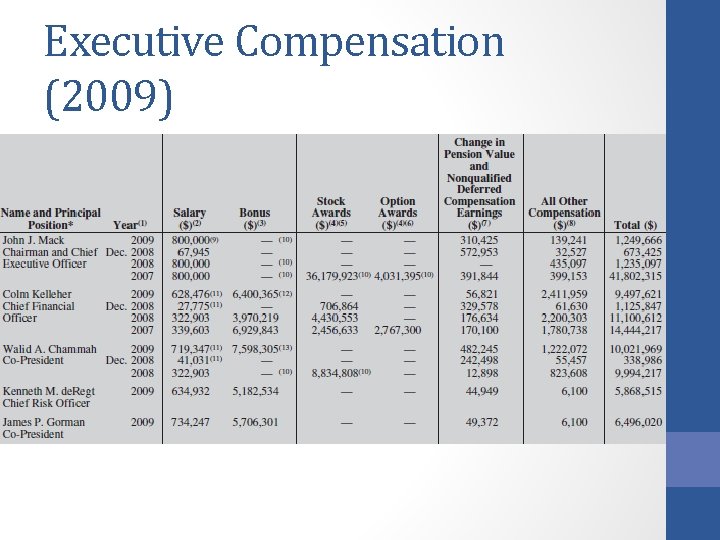
Executive Compensation (2009)
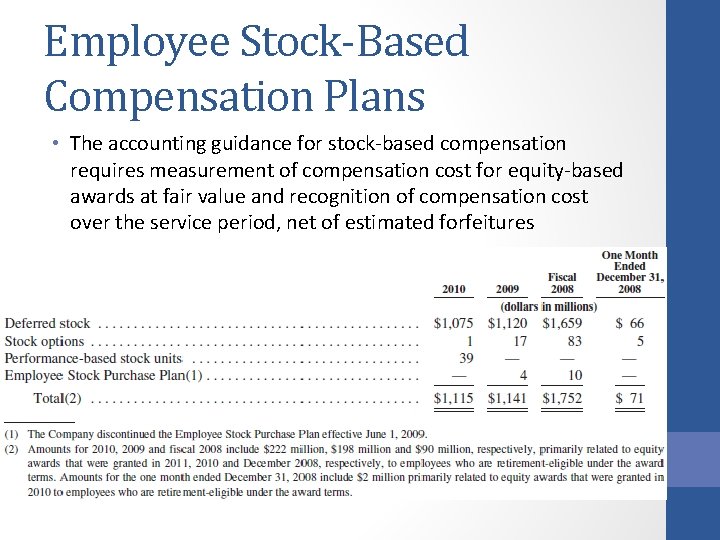
Employee Stock-Based Compensation Plans • The accounting guidance for stock-based compensation requires measurement of compensation cost for equity-based awards at fair value and recognition of compensation cost over the service period, net of estimated forfeitures
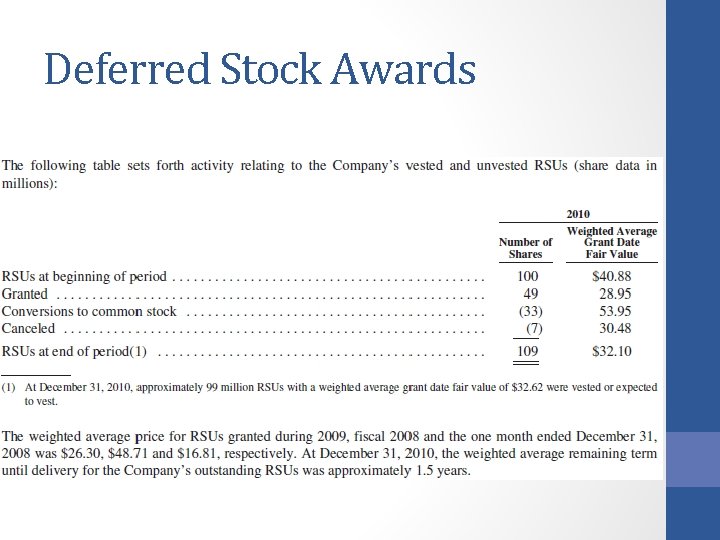
Deferred Stock Awards
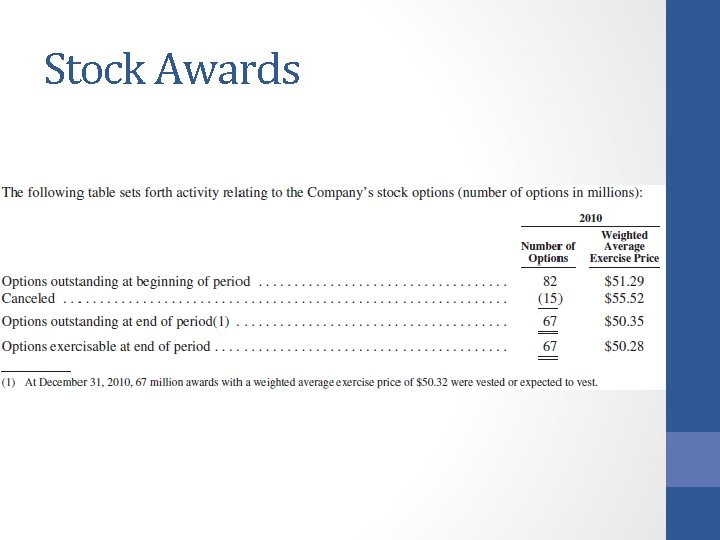
Stock Awards
Thank You!