
More Women Role Models in STEM Susan La
- Slides: 8
More Women Role Models in STEM
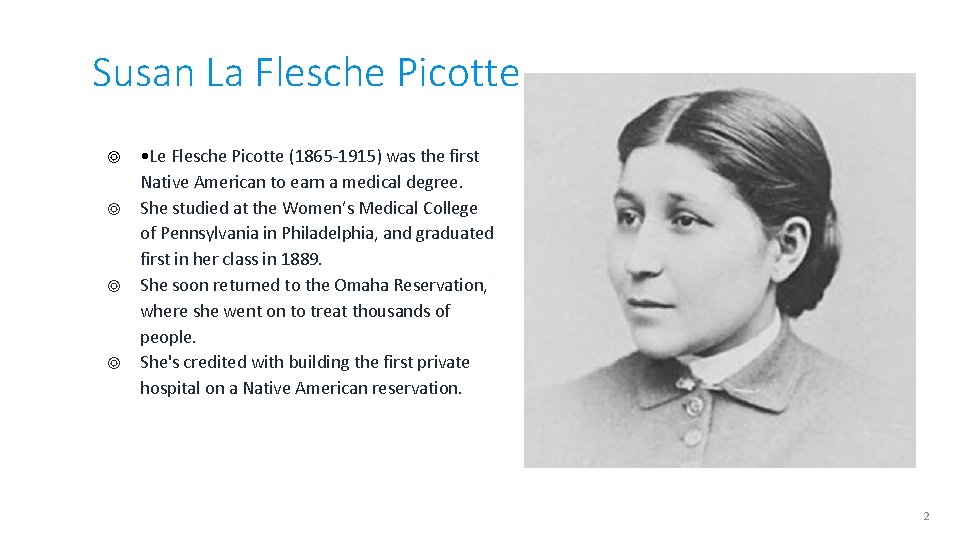
Susan La Flesche Picotte ◎ ◎ • Le Flesche Picotte (1865 -1915) was the first Native American to earn a medical degree. She studied at the Women’s Medical College of Pennsylvania in Philadelphia, and graduated first in her class in 1889. She soon returned to the Omaha Reservation, where she went on to treat thousands of people. She's credited with building the first private hospital on a Native American reservation. 2
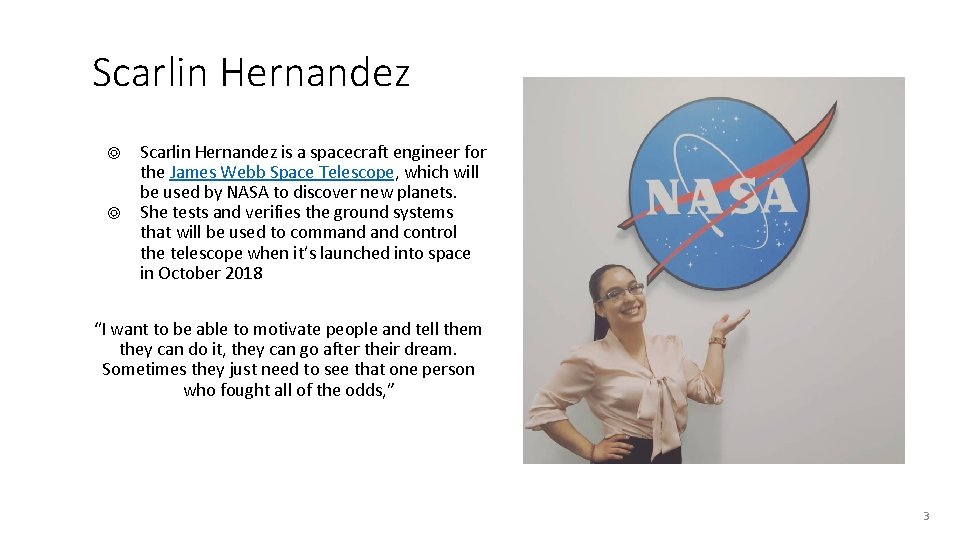
Scarlin Hernandez ◎ ◎ Scarlin Hernandez is a spacecraft engineer for the James Webb Space Telescope, which will be used by NASA to discover new planets. She tests and verifies the ground systems that will be used to command control the telescope when it’s launched into space in October 2018 “I want to be able to motivate people and tell them they can do it, they can go after their dream. Sometimes they just need to see that one person who fought all of the odds, ” 3
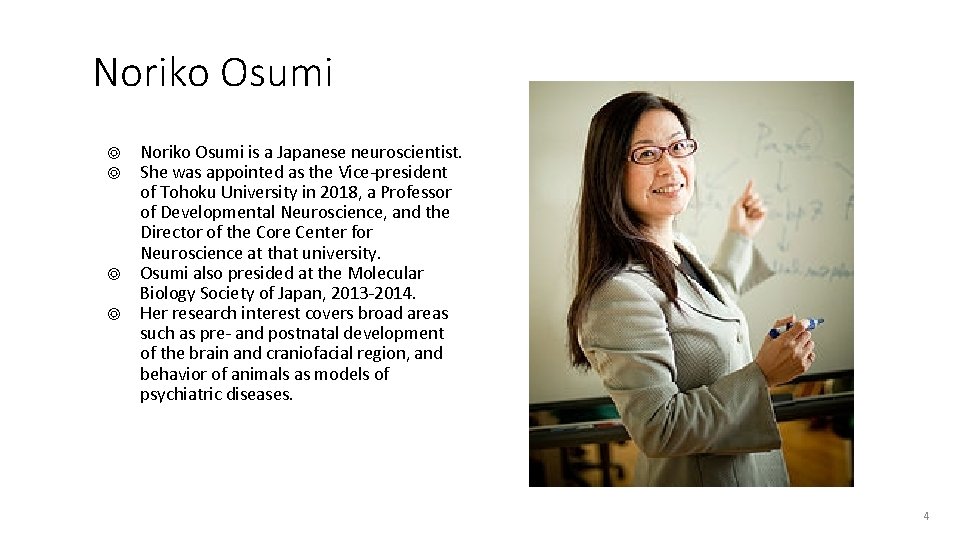
Noriko Osumi ◎ ◎ Noriko Osumi is a Japanese neuroscientist. She was appointed as the Vice-president of Tohoku University in 2018, a Professor of Developmental Neuroscience, and the Director of the Core Center for Neuroscience at that university. Osumi also presided at the Molecular Biology Society of Japan, 2013 -2014. Her research interest covers broad areas such as pre- and postnatal development of the brain and craniofacial region, and behavior of animals as models of psychiatric diseases. 4
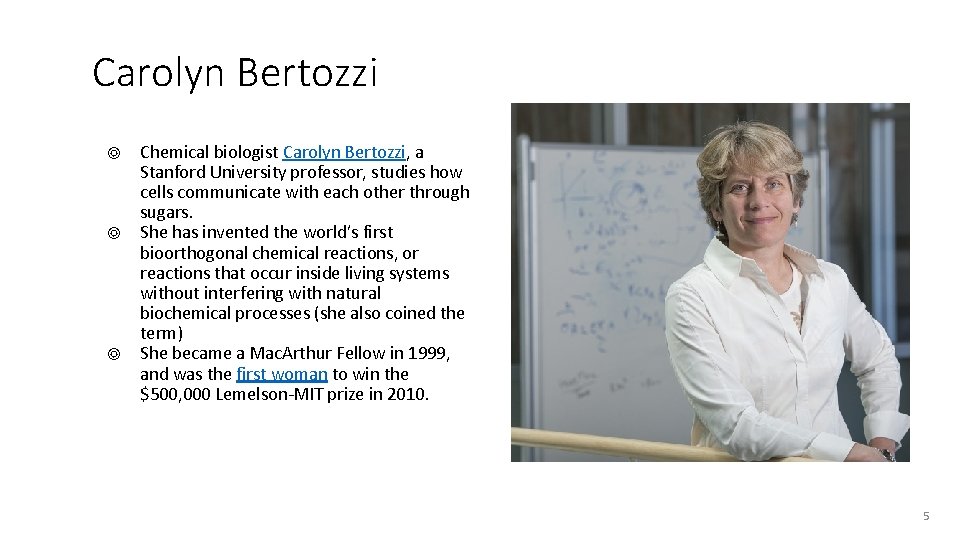
Carolyn Bertozzi ◎ ◎ ◎ Chemical biologist Carolyn Bertozzi, a Stanford University professor, studies how cells communicate with each other through sugars. She has invented the world’s first bioorthogonal chemical reactions, or reactions that occur inside living systems without interfering with natural biochemical processes (she also coined the term) She became a Mac. Arthur Fellow in 1999, and was the first woman to win the $500, 000 Lemelson-MIT prize in 2010. 5
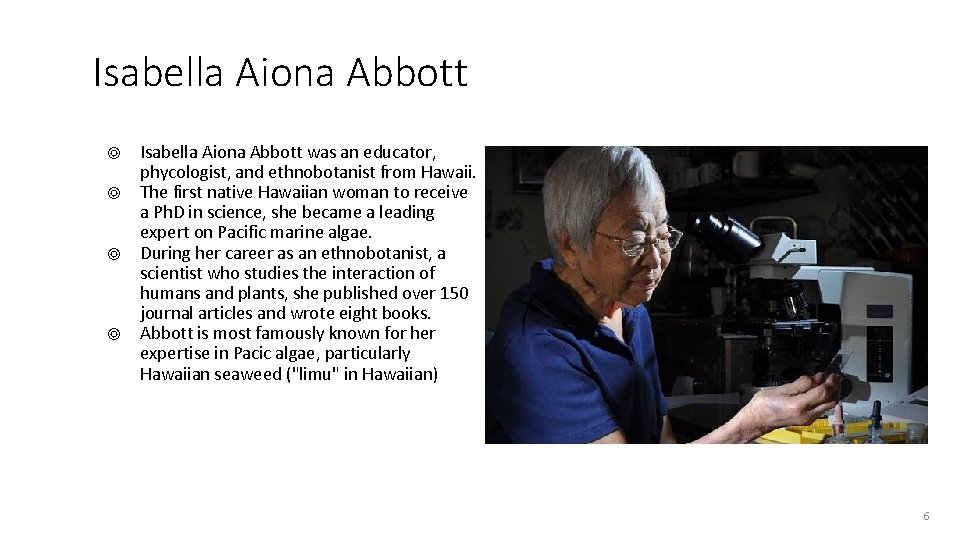
Isabella Aiona Abbott ◎ ◎ Isabella Aiona Abbott was an educator, phycologist, and ethnobotanist from Hawaii. The first native Hawaiian woman to receive a Ph. D in science, she became a leading expert on Pacific marine algae. During her career as an ethnobotanist, a scientist who studies the interaction of humans and plants, she published over 150 journal articles and wrote eight books. Abbott is most famously known for her expertise in Pacic algae, particularly Hawaiian seaweed ("limu" in Hawaiian) 6
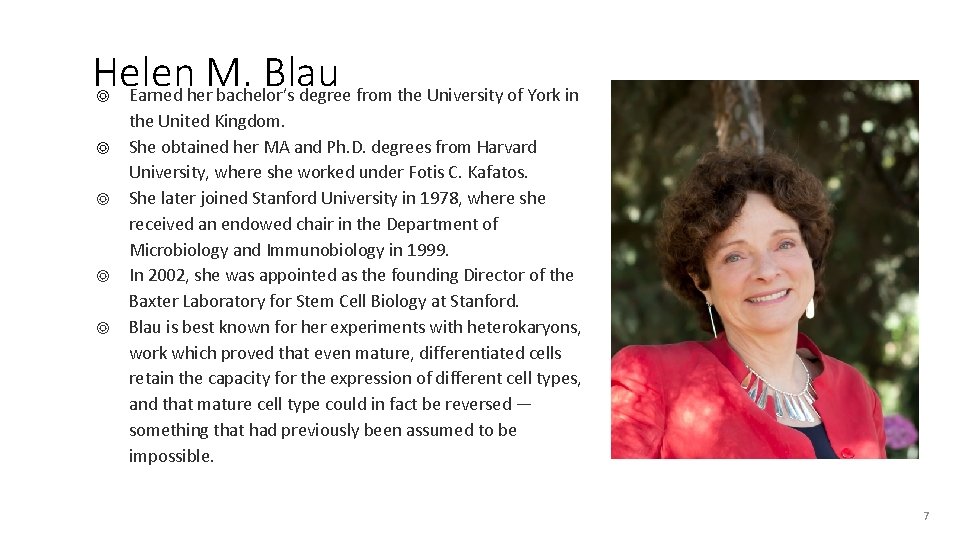
Helen M. Blau Earned her bachelor’s degree from the University of York in ◎ ◎ ◎ the United Kingdom. She obtained her MA and Ph. D. degrees from Harvard University, where she worked under Fotis C. Kafatos. She later joined Stanford University in 1978, where she received an endowed chair in the Department of Microbiology and Immunobiology in 1999. In 2002, she was appointed as the founding Director of the Baxter Laboratory for Stem Cell Biology at Stanford. Blau is best known for her experiments with heterokaryons, work which proved that even mature, differentiated cells retain the capacity for the expression of different cell types, and that mature cell type could in fact be reversed — something that had previously been assumed to be impossible. 7
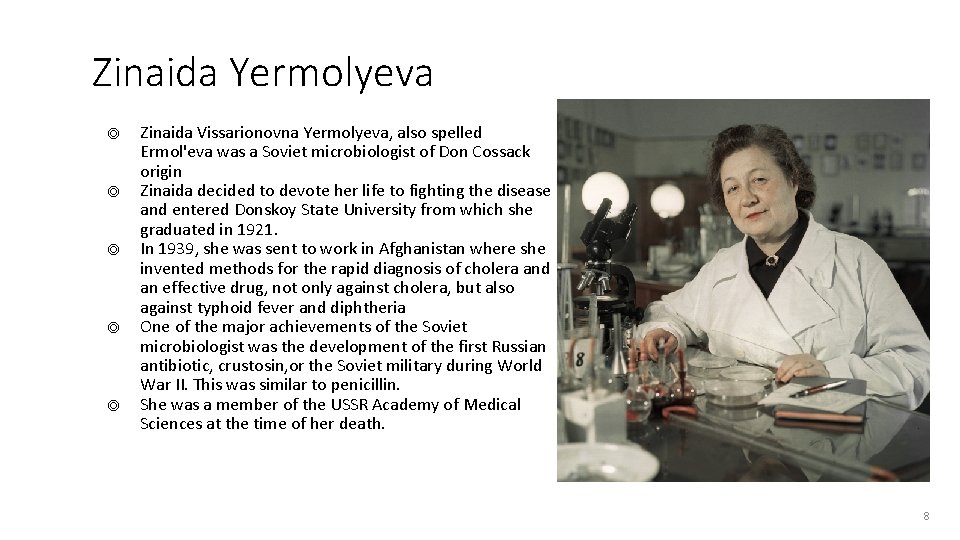
Zinaida Yermolyeva ◎ ◎ ◎ Zinaida Vissarionovna Yermolyeva, also spelled Ermol'eva was a Soviet microbiologist of Don Cossack origin Zinaida decided to devote her life to fighting the disease and entered Donskoy State University from which she graduated in 1921. In 1939, she was sent to work in Afghanistan where she invented methods for the rapid diagnosis of cholera and an effective drug, not only against cholera, but also against typhoid fever and diphtheria One of the major achievements of the Soviet microbiologist was the development of the first Russian antibiotic, crustosin, or the Soviet military during World War II. This was similar to penicillin. She was a member of the USSR Academy of Medical Sciences at the time of her death. 8