
More than I Can Handle God Gives Me










- Slides: 26
More than I Can Handle God Gives Me 4 Reasons 2 Cor 1: 8, 9 Edward April 3, 2016
Ever Been Here? You’re Not Sure How Much Longer You Can Hang On… …in the Middle of a Trial …Desperately Needing Encouragement Then Someone Makes This Statement… “You know, God will never give you more than you can handle. ” And You Wonder, “What is the Matter with Me Then? ” 4 Reasons God DOES… …Give Us More Than We Can Handle
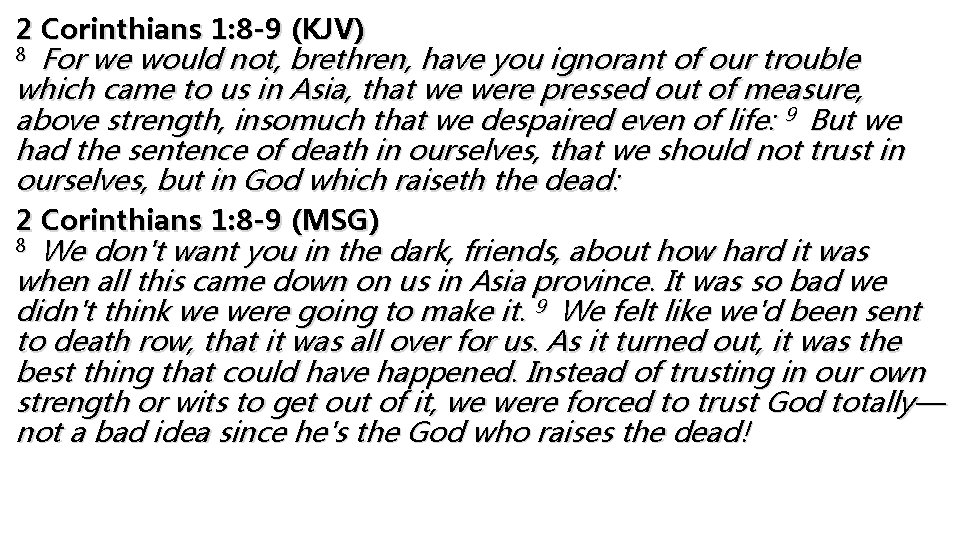
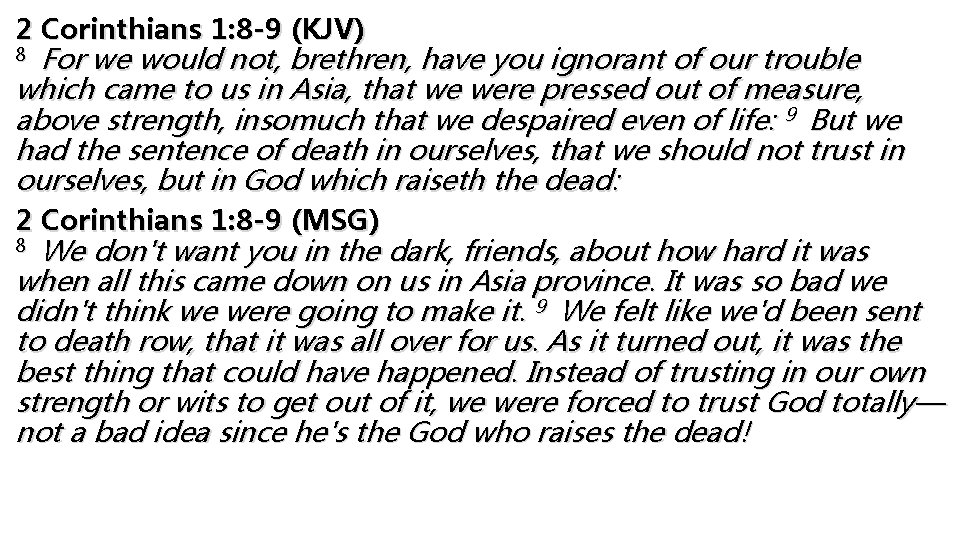
2 Corinthians 1: 8 -9 (MSG) 8 We don't want you in the dark, friends, about how hard it was when all this came down on us in Asia province. It was so bad we didn't think we were going to make it. 9 We felt like we'd been sent to death row, that it was all over for us. As it turned out, it was the best thing that could have happened. Instead of trusting in our own strength or wits to get out of it, we were forced to trust God totally— not a bad idea since he's the God who raises the dead! 2 Corinthians 12: 9 -10 9 And He has said to me, "My grace is sufficient for you, for power is perfected in weakness. " Most gladly, therefore, I will rather boast about my weaknesses, that the power of Christ may dwell in me. 10 Therefore I am well content with weaknesses, with insults, with distresses, with persecutions, with difficulties, for Christ's sake; for when I am weak, then I am strong. NASB
#1 - Our Faith Needs to Grow When We First Met Jesus We Learned Some Basics • We are Born Sinners –Rom 3: 23 • We Cannot Get Into Heaven With Our Sin –Rom 6: 23 • Jesus Came and Died For Our Sins (Perfect Sacrifice) –Rom 5: 8 God Calls Us to Repent/ Accept Salvation • Be Born of the Spirit thru Faith • Mature in Our Faith One of the Best Ways to Grow Our Faith is Through Trials
#1 - Our Faith Needs to Grow So, the Trials Started Coming… • Just Like David Who One Day Fought Goliath o He Didn’t Start With Goliath o He Fought a Lion and a Bear David’s Faith Grew Till He Could Stand Before the Giant Philistine James 1: 2 -4 (MSG) 2 Consider it a sheer gift, friends, when tests and challenges come at you from all sides. 3 You know that under pressure, your faith-life is forced into the open and shows its true colors. 4 So don't try to get out of anything prematurely. Let it do its work so you become
#2 - Our Self-Reliance Needs to Die We Live In a World Which Encourages Us to Be Our Own Person When We Fall, We’re Told to Pull Ourselves Up By Our Bootstraps. • But This Is Contrary to What We Learn in Scripture. Proverbs 3: 5 -6, 5 Trust in the LORD with all thine heart; / lean not unto thine own understanding. 6 In all thy ways acknowledge him/ he shall direct thy paths. • We Are Encouraged to Lean On God… …Not On Our Own Understanding • He’s the One Who Will Make Our Paths Straight. • We’re to Lean On Him, Not On Our Own Abilities.
#2 - Our Self-Reliance Needs to Die God is Making It Clear That We are Not Self-Sufficient. • So maybe we need to stop seeing the trials/ adversity in our lives as a burden, as an indication that God doesn’t love us. • Maybe we need to start seeing them as proof that God indeed loves us very much—so much so that He will not let us try to rely on our own strength, but continue to show us that we must rely on Him to endure suffering and persevere until the end. Philippians 4: 13 (KJV) 13 I can do all things through Christ which strengtheneth me Philippians 4: 13 (MSG) 13 Whatever I have, wherever I am, I can make it through anything in the One who makes me who I am
#3 - We Need to Learn about God’s Character Trials Teach Us God is Faithful No Matter Who Loves You, God’s His Love is the Greatest • God has Promised He Will Never Leave You. Heb 13: 5 -6 (MSG) 5 Don't be obsessed with getting more material things. Be relaxed with what you have. Since God assured us, "I'll never let you down, never walk off and leave you, " 6 we can boldly quote, God is there, ready to help; I'm fearless no matter what. Who or what can get to me? • He’s in it for the Whole Game • God is Patient / Long-suffering • So He Doesn’t Care How Long the Trial Is… …He’s Staying
#4 - God Will Get the Glory Whether You’re Aware of It or Not, Others Watch You • If You Claim to be a Christ Follower, They are Watching Closely • There’s Something Different About Those who know God Up Close When We Go Through the Difficult, God Gives Us Strength to Do It • People Notice that Difference and It Makes Them Wonder Why • Sometimes They May Even Ask You Why You Are Different • And God Gets the Glory
#4 - God Will Get the Glory The Night Before the Cross Jesus Cried Out in the Garden, “My soul is overwhelmed with sorrow to the point of death” (Matt 26: 38). Jesus Told His Father, “This is too much for me!” • But it wasn’t passed. Jesus Went Through All of It Because of God’s Love… And God Received the Glory. • When You Are With Someone Who Is Struggling - Don’t Tell Them God Will Never Give Them More Than They Can Handle • If It Were True, We Wouldn’t Need God At All
#4 - God Will Get the Glory We Need to Remember God Does Not Think Like Us Isaiah 55: 9 (NKJV) "For as the heavens are higher than the earth, So are My ways higher than your ways, And My thoughts than your thoughts” Matthew 5: 16 (KJV) Let your light so shine before men, that they may see your good works, and glorify your Father which is in heaven. 16
End of Sermon
• The point to see is that God allowed Paul to suffer some terrible trouble. And note the intensity of the trouble: "we were pressed [weighed down, crushed by a very heavy weight]". . . • • out of measure. • • above strength. • • we despaired even for our life. • • we had the sentence of death in ourselves (sensed he was going to die). • Why does God allow His dear servant to go through such suffering, especially when he is such a great servant, a servant who labors so faithfully for God? There are two primary reasons. • 1. Note that God is called the "God which raises the dead. " The one thing that man must learn is that he cannot save himself; he cannot raise himself up from the dead. Only God can save man and raise him up and give him eternal life. Suffering teaches man that he is helpless to save himself. If he wishes to be saved, he must trust God. Therefore, suffering teaches man that he is not self-sufficient. He must have the presence and help of God if he wishes to conquer the sufferings of this world—the sufferings that eventually end in the suffering of death. • 2. God allows suffering to teach a daily trust for deliverance. Note: Paul says that God continued to deliver him through the trials of life and that he continued to trust God to deliver him. The point is that we must trust God daily, trust Him to deliver us from daily sufferings. • • "There hath no temptation taken you but such as is common to man: but God is faithful, who will not suffer you to be tempted above that ye are able; but will with the temptation also make a way to escape, that ye may be able to bear it" (1 Cor. 10: 13). • "Who delivered us from so great a death, and doth deliver: in whom we trust that he will yet deliver us" (2 Cor. 1: 10). • "And the Lord shall deliver me from every evil work, and will preserve me unto his heavenly kingdom: to whom be glory for ever and ever" (2 Tim. 4: 18). • "And deliver them, who through fear of death were all their lifetime subject to bondage" (Hebrews 2: 15). • "The Lord knoweth how to deliver the godly out of temptation, and to reserve the unjust unto the day of judgment to be punished" (2 Peter 2: 9). • "Be not afraid of their faces: for I am with thee to deliver thee, saith the Lord" (Jeremiah 1: 8). • "He delivereth and rescueth, and he worketh signs and wonders in heaven and in earth, who hath delivered Daniel from the power of the lions" (Daniel 6: 27).
• Remember What God Does for You (2 Cor. 1: 4 a, 8 -11) • He permits the trials to come. There are ten basic words for suffering in the Greek language, and Paul used five of them in this letter. The most frequently used word is thlipsis, which means "narrow, confined, under pressure, " and in this letter is translated affliction (2 Cor. 2: 4; 4: 17), tribulation (2 Cor. 1: 4), and trouble (2 Cor. 1: 4, 8). Paul felt hemmed in by difficult circumstances, and the only way he could look was up. • In 2 Corinthians 1: 5 -6, Paul used the word pathema, "suffering, " which was also used for the sufferings of our Saviour (1 Peter 1: 11; 5: 1). There are some sufferings that we endure simply because we are human and subject to pain; but there are other sufferings that come because we are God's people and want to serve Him. • We must never think that trouble is an accident. For the believer, everything is a divine appointment. There are only three possible outlooks a person can take when it comes to the trials of life. If our trials are the products of "fate" or "chance, " then our only recourse is to give up. Nobody can control fate or chance. If we have to control everything ourselves, then the situation is equally as hopeless. But if God is in control, and we trust Him, then we can overcome circumstances with His help. • God encourages us in all our tribulations by teaching us from His Word that it is He who permits trials to come. • He is in control of trials (v. 8). "We were under great pressure, far beyond our ability to endure, so that we despaired even of life" (NIV). Paul was weighed down like a beast of burden with a load too heavy to bear. But God knew just how much Paul could take and He kept the situation in control. • We do not know what the specific "trouble" was, but it was great enough to make Paul think he was going to die. Whether it was peril from his many enemies (see Acts 19: 21 ff; 1 Cor. 15: 30 -32), serious illness, or special satanic attack, we do not know; but we do know that God controlled the circumstances and protected His servant. When God puts His children into the furnace, He keeps His hand on thermostat and His eye on thermometer (1 Cor. 10: 13; 1 Peter 1: 6 -7). Paul may have despaired of life, but God did not despair of Paul. • God enables us to bear our trials (v. 9). The first thing He must do is show us how weak we are in ourselves. Paul was a gifted and experienced servant of God, who had been through many different kinds of trials (see 2 Cor. 4: 8 -12; 11: 23 ff). Surely all of this experience would be sufficient for him to face these new difficulties and overcome them. • But God wants us to trust Him—not our gifts or abilities, our experience, or our "spiritual reserves. " Just about the time we feel self-confident and able to meet the enemy, we fail miserably. "For when I am weak, then am I strong" (2 Cor. 12: 10). • When you and I die to self, then God's resurrection power can go to work. It was when Abraham and Sarah were as good as dead physically that God's resurrection power enabled them to have the promised son (Rom. 4: 16 -25). However, "dying to self" does not mean idle complacency, doing nothing and expecting God to do everything. You can be sure that Paul prayed, searched the Scriptures, consulted with his associates, and trusted God to work. The God who raises the dead is sufficient for any difficulty of life! He is able, but we must be available. • Paul did not deny the way he felt, nor does God want us to deny our emotions. "We were troubled on every side; without were fightings, within were fears" (2 Cor. 7: 5). The phrase "sentence of death" in 2 Corinthians 1: 9 could refer to an official verdict, perhaps an order for Paul's arrest and execution. Keep in mind that the unbelieving Jews hounded Paul's trail and wanted to eliminate him (Acts 20: 19). "Perils by my own countrymen" must not be overlooked in the list of dangers (2 Cor. 11: 26). • God delivers us from our trials (v. 10). Paul saw God's hand of deliverance whether he looked back, around, or ahead. The word Paul used means "to help out of distress, to save and protect. " God does not always deliver us immediately, nor in the same way. James was beheaded, yet Peter was delivered from prison (Acts 12). Both were delivered, but in different ways. Sometimes God delivers us from our trials, and at other times He delivers us in our trials. • God's deliverance was in response to Paul's faith, as well as to the faith of praying people in Corinth (2 Cor. 1: 11). "This poor man cried, and the Lord heard him, and saved him out of all his troubles" (Ps. 34: 6). • God is glorified through our trials (v. 11). When Paul reported what God had done for him, a great chorus of praise and thanksgiving went up from the saints to the throne of God. The highest service you and I can render on earth is to bring glory to God, and sometimes that service involves suffering. "The gift bestowed" refers to Paul's deliverance from death, a wonderful gift indeed! • Paul was never ashamed to ask Christians to pray for him. In at least seven of his letters, he mentioned his great need for prayer support (Rom. 15: 30 -32; Eph. 6: 18 -19; Phil. 1: 19; Col. 4: 3; 1 Thes. 5: 25; 2 Thes. 3: 1; Phile. 22). Paul and the believers in Corinth were helping each other (2 Cor. 1: 11, 24). • A missionary friend told me about the miraculous deliverance of his daughter from what was diagnosed as a fatal disease. At the very time the girl was so ill, several friends in the United States were praying for the family; and God answered prayer and healed the girl. The greatest help we can give to God's servants is "helping together by prayer. " • The word sunupourgeō translated "helping together" is used only here in the Greek New Testament and is composed of three words: with, under, work. It is a picture of laborers under the burden, working together to get the job accomplished. It is encouraging to know that the Holy Spirit also assists us in our praying and helps to carry the load (Rom. 8: 26). • God works out His purposes in the trials of life, if we yield to Him, trust Him, and obey what He tells us to do. Difficulties can increase our faith and strengthen our prayer lives. Difficulties can draw us closer to other Christians as they share the burdens with us. Difficulties can be used to glorify God. So, when you find yourself in the trials of life, remember what God is to you and what God does for you
The night before Jesus was executed, He cried out in the garden, “My soul is overwhelmed with sorrow to the point of death” (Matthew 26: 38). Jesus told His father, “This is too much for me!” We see this kind of thing in the Psalms, too. The Psalmists ball their fists in rage, and shout at God, “Why have you forsaken me? ” (Psalm 22) In their sadness they say, “darkness is my closest friend” (Psalm 88).
• 2 Corinthians 1: 8 -9 (Phillips NT) 8 We should like you, our brothers, to know something of what we went through in Asia. At that time we were completely overwhelmed, the burden was more than we could bear, in fact we told ourselves that this was the end. Yet we believe now that we had this experience of coming to the end of our tether that we might learn to trust, not in ourselves, but in God who can raise the dead.
2 Corinthians 1: 8 -9 (KJV) For we would not, brethren, have you ignorant of our trouble which came to us in Asia, that we were pressed out of measure, above strength, insomuch that we despaired even of life: 9 But we had the sentence of death in ourselves, that we should not trust in ourselves, but in God which raiseth the dead: 8 2 Corinthians 1: 8 -9 (MSG) 8 We don't want you in the dark, friends, about how hard it was when all this came down on us in Asia province. It was so bad we didn't think we were going to make it. 9 We felt like we'd been sent to death row, that it was all over for us. As it turned out, it was the best thing that could have happened. Instead of trusting in our own strength or wits to get out of it, we were forced to trust God totally— not a bad idea since he's the God who raises the dead!
2 Corinthians 1: 8 -9 (KJV) For we would not, brethren, have you ignorant of our trouble which came to us in Asia, that we were pressed out of measure, above strength, insomuch that we despaired even of life: 9 But we had the sentence of death in ourselves, that we should not trust in ourselves, but in God which raiseth the dead: 8 2 Corinthians 1: 8 -9 (MSG) 8 We don't want you in the dark, friends, about how hard it was when all this came down on us in Asia province. It was so bad we didn't think we were going to make it. 9 We felt like we'd been sent to death row, that it was all over for us. As it turned out, it was the best thing that could have happened. Instead of trusting in our own strength or wits to get out of it, we were forced to trust God totally— not a bad idea since he's the God who raises the dead!
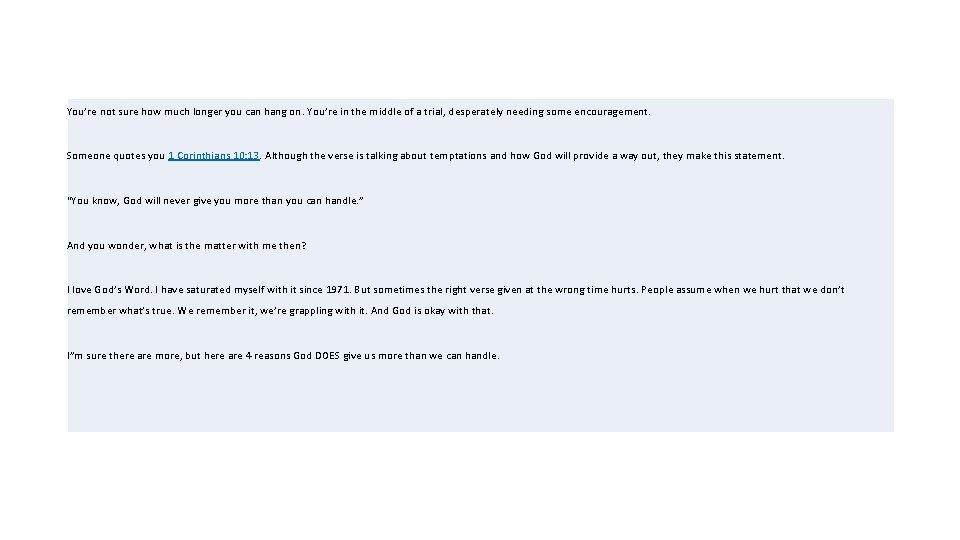
You’re not sure how much longer you can hang on. You’re in the middle of a trial, desperately needing some encouragement. Someone quotes you 1 Corinthians 10: 13. Although the verse is talking about temptations and how God will provide a way out, they make this statement. “You know, God will never give you more than you can handle. ” And you wonder, what is the matter with me then? I love God’s Word. I have saturated myself with it since 1971. But sometimes the right verse given at the wrong time hurts. People assume when we hurt that we don’t remember what’s true. We remember it, we’re grappling with it. And God is okay with that. I”m sure there are more, but here are 4 reasons God DOES give us more than we can handle.
#1 - Our Faith Needs to Grow When we were first introduced to Jesus we learned some basics. We are born sinners. We cannot get into heaven with our sin. Jesus came and died for our sins, shedding his perfect blood. Everything we know about God we’ve had to learn. And little by little we learned how to trust him. Our baby faith needed to mature. And one of the best ways to grow our faith is through trials. So, the trials started coming. Just like David who one day fought Goliath. He didn’t start with Goliath. No. God showed David he would be there with him when he fought a lion and one day a bear. Then David’s faith grew till he could stand before the giant Philistine, confident that the same God who helped him fight the lion and the bear would be with him as he faced Goliath.
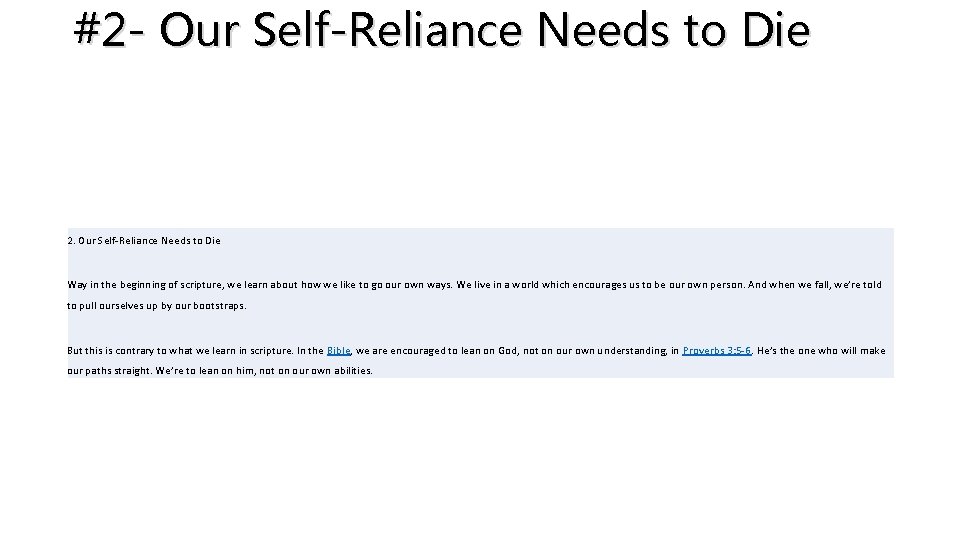
#2 - Our Self-Reliance Needs to Die 2. Our Self-Reliance Needs to Die Way in the beginning of scripture, we learn about how we like to go our own ways. We live in a world which encourages us to be our own person. And when we fall, we’re told to pull ourselves up by our bootstraps. But this is contrary to what we learn in scripture. In the Bible, we are encouraged to lean on God, not on our own understanding, in Proverbs 3: 5 -6. He’s the one who will make our paths straight. We’re to lean on him, not on our own abilities.
#3 - We Need to Learn about God’s Character 3. We Need to Learn about God’s Character Trials teach us God is faithful. No matter who knows and loves you, no one who loves you more than God does. His love is the greatest love there is. And even though you may have others in your life who will be there for you, God has promised he will never leave you. He’s in it for the whole game. God is patient and long-suffering. So he doesn’t care how long the trial is, he’s staying.
#4 - God Will Get the Glory 4. God Will Get the Glory Whether you’re aware of it or not, others watch you. And if you claim to be a Christ follower, they are watching you closely. There’s something different about those who know God personally. When we go through difficult things, God gives us the strength to do it. People notice that difference and it makes them wonder why. Sometimes they may even ask you why you are different. And God gets the glory. Jesus was in the garden of Gethsemane and he was facing death. He asked God if it were possible that the cup would be passed. That he wouldn’t have to go to the cross. But it wasn’t passed. Jesus went through all of it because of God’s love. And God received the glory. When you are with someone who is struggling. Be with them, but don’t tell them God will never give them more than they can handle. If it were true, we wouldn’t need God at all. And we do. Every single day. We need to remember God does not think like us. He tells us this in Isaiah 55: 9. Once God gave me this poem to remind me, he and I don’t think the same.