
More Statics Physics 1425 Lecture 24 Michael Fowler
- Slides: 13
More Statics Physics 1425 Lecture 24 Michael Fowler, UVa
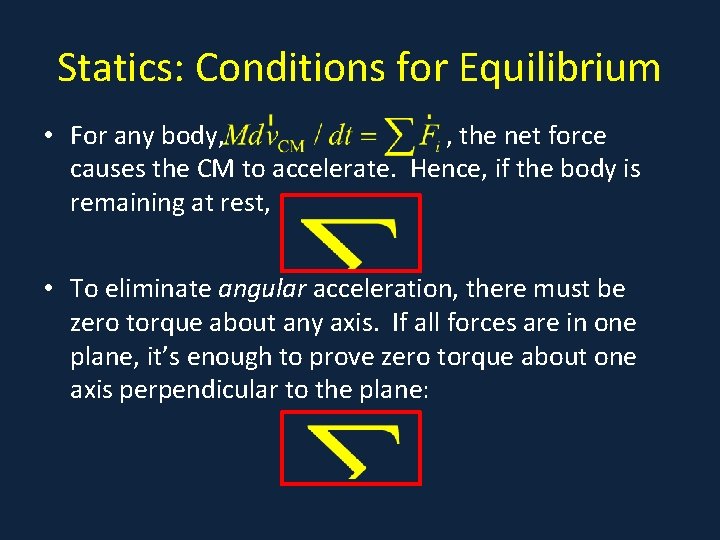
Statics: Conditions for Equilibrium • For any body, , the net force causes the CM to accelerate. Hence, if the body is remaining at rest, • To eliminate angular acceleration, there must be zero torque about any axis. If all forces are in one plane, it’s enough to prove zero torque about one axis perpendicular to the plane:
Free Body Diagrams • To apply Newton’s Laws to find how a body moves, we must focus on that body alone and add all the (vector) forces acting on it. • The diagram showing all the forces on one body (or even part of a body) is called a “free body diagram”—we’ve “freed” the body from the rest of the system, representing everything else just by the forces on this body. • The net (total) force then goes into .
Tips about Torques • In statics, the net torque of the forces on a body is zero about any point: choose a point one (or more) forces already pass through! • The torque at the origin of a force acting at the point has magnitude r. F�, where F�is the component of the applied force perpendicular to the line from the origin.
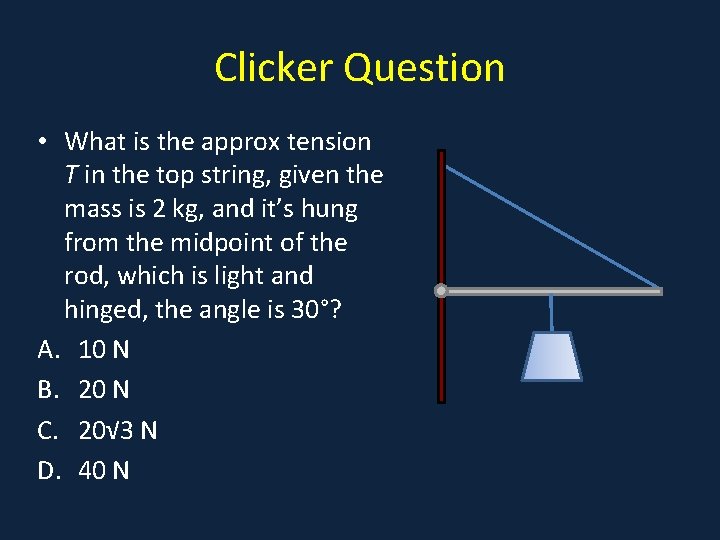
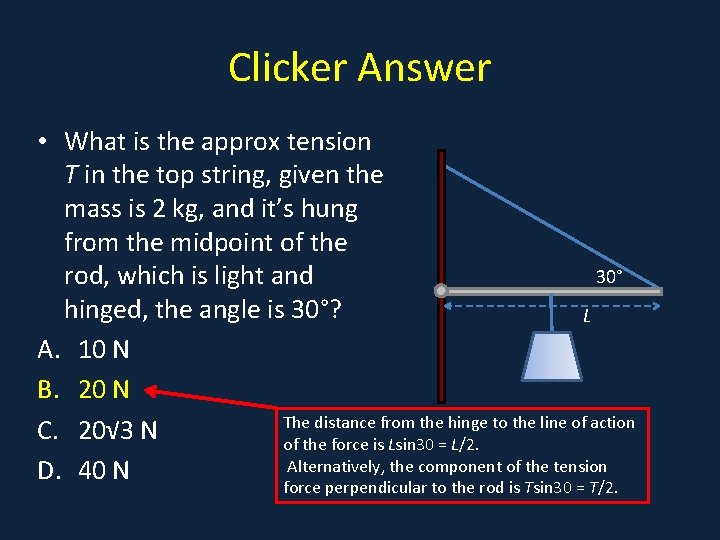
Clicker Question • What is the approx tension • a T in the top string, given the mass is 2 kg, and it’s hung from the midpoint of the rod, which is light and hinged, the angle is 30°? A. 10 N B. 20 N C. 20√ 3 N D. 40 N
Clicker Answer • What is the approx tension • a T in the top string, given the mass is 2 kg, and it’s hung from the midpoint of the 30° rod, which is light and hinged, the angle is 30°? L A. 10 N B. 20 N The distance from the hinge to the line of action C. 20√ 3 N of the force is Lsin 30 = L/2. Alternatively, the component of the tension D. 40 N force perpendicular to the rod is Tsin 30 = T/2.
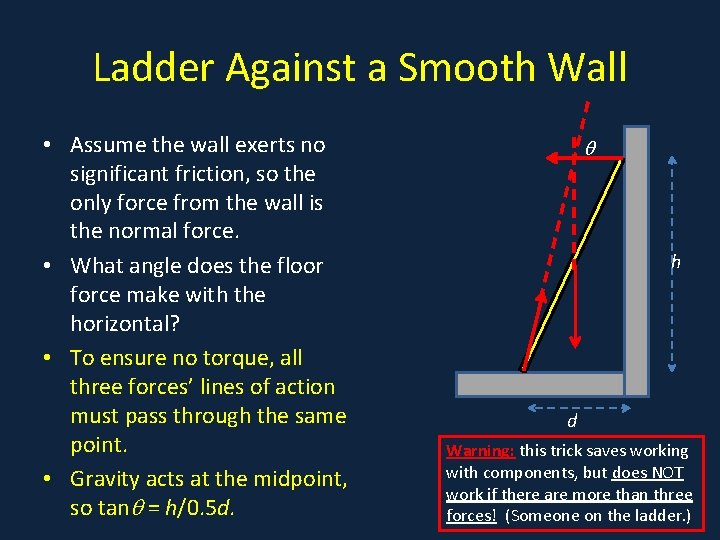
Ladder Against a Smooth Wall • Assume the wall exerts no significant friction, so the only force from the wall is the normal force. • What angle does the floor force make with the horizontal? • To ensure no torque, all three forces’ lines of action must pass through the same point. • Gravity acts at the midpoint, so tan = h/0. 5 d. • x h d Warning: this trick saves working with components, but does NOT work if there are more than three forces! (Someone on the ladder. )
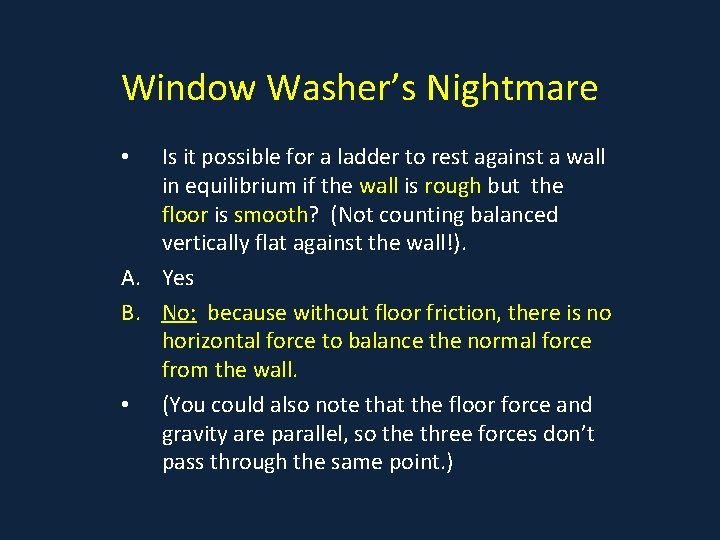
Window Washer’s Nightmare? • Is it possible for a ladder to rest against a wall in equilibrium if the wall is rough but the floor is smooth? (Not counting balanced vertically flat against the wall!). A. Yes B. No
Window Washer’s Nightmare Is it possible for a ladder to rest against a wall in equilibrium if the wall is rough but the floor is smooth? (Not counting balanced vertically flat against the wall!). A. Yes B. No: because without floor friction, there is no horizontal force to balance the normal force from the wall. • (You could also note that the floor force and gravity are parallel, so the three forces don’t pass through the same point. ) •
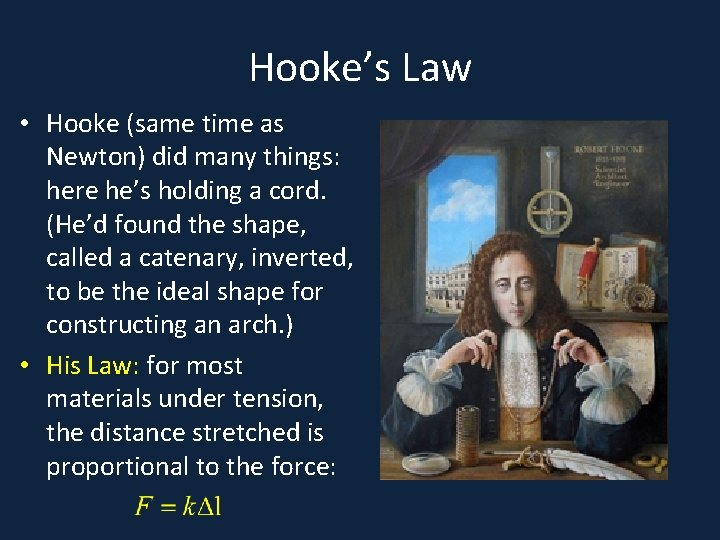
Hooke’s Law • Hooke (same time as Newton) did many things: here he’s holding a cord. (He’d found the shape, called a catenary, inverted, to be the ideal shape for constructing an arch. ) • His Law: for most materials under tension, the distance stretched is proportional to the force:
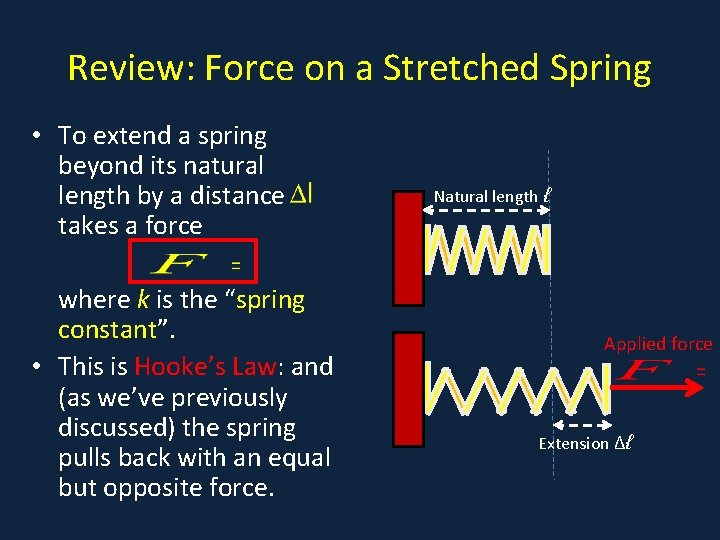
Review: Force on a Stretched Spring • To extend a spring beyond its natural length by a distance takes a force where k is the “spring constant”. • This is Hooke’s Law: and (as we’ve previously discussed) the spring pulls back with an equal but opposite force. • A Natural length ℓ Applied force Extension Δℓ
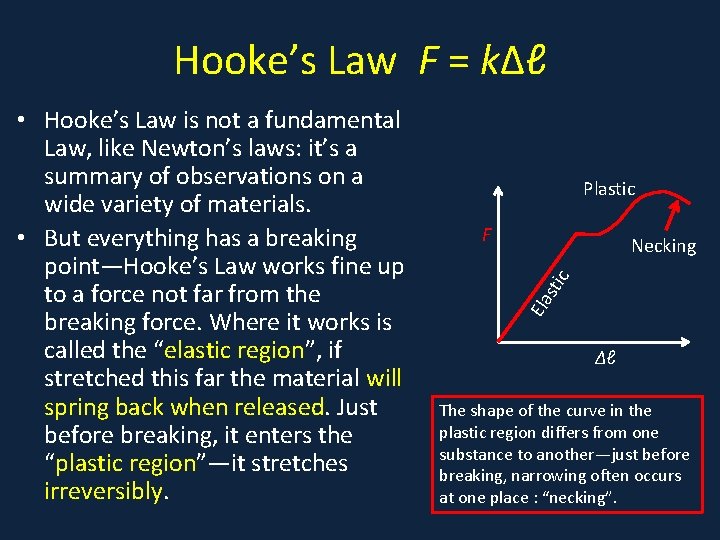
Hooke’s Law F = kΔℓ • vshape Plastic F sti c Necking Ela • Hooke’s Law is not a fundamental Law, like Newton’s laws: it’s a summary of observations on a wide variety of materials. • But everything has a breaking point—Hooke’s Law works fine up to a force not far from the breaking force. Where it works is called the “elastic region”, if stretched this far the material will spring back when released. Just before breaking, it enters the “plastic region”—it stretches irreversibly. Δℓ The shape of the curve in the plastic region differs from one substance to another—just before breaking, narrowing often occurs at one place : “necking”.
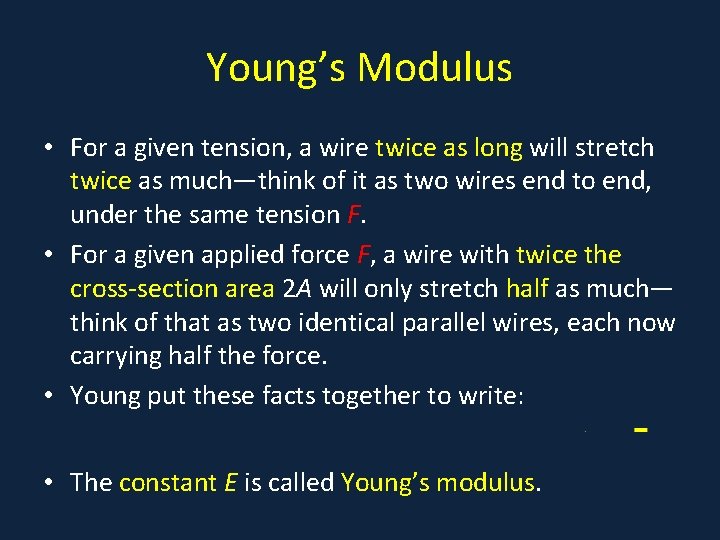
Young’s Modulus • For a given tension, a wire twice as long will stretch twice as much—think of it as two wires end to end, under the same tension F. • For a given applied force F, a wire with twice the cross-section area 2 A will only stretch half as much— think of that as two identical parallel wires, each now carrying half the force. • Young put these facts together to write: • The constant E is called Young’s modulus.