
More on Repeated Measures Designs MODULE 18 EXPERIMENTAL

- Slides: 6
More on Repeated Measures Designs MODULE 18 EXPERIMENTAL PSYCHOLOGY GUIDED-INQUIRY LEARNING Module 18: More on Repeated Measures Designs © 2017, Dr. A. Geliebter & Dr. B. Rumain, Touro College & University System
MOTIVATION In a now famous study, Dr. Judith Kearns studied two groups of children: Australian Aborigine children and white Australian children. The children were 6 to 17 years old. She wanted to compare them on visual spatial memory because of a hunch that she had: The Australian Aborigine children spend a lot of time outdoors and should be better at visual memory. White Australian children spend a lot of time in school where they learn categorization and verbal skills. So, they should do better when they can apply those skills and worse when they can’t.
From: https: //www. youtube. com/watch? v=o 7_IY 0 puuo 4
INFORMATION Abstract Visual spatial memory was investigated in Australian Aboriginal children of desert origin. The investigation arose from an environmental pressures hypothesis relating particular skills to survival requirements in a particular habitat, and follows one of a series of suggestions made by R. B. Lockard (American Psychologist, 1971, 26, 168– 179) for research in the related field of comparative psychology. Aboriginal children, from 6 to 17 years, performed at significantly higher levels than white Australian children on the tasks. Item type did not affect scores of Aboriginal children, while for white Australian children familiar items were easier than less familiar, which, if potentially nameable, were easier than items unable to be differentiated by name. These indications of strategy difference between the groups were supported by overt differences in task behavior. Aboriginal children appeared to use visual strategies, while most white Australian children probably attempted verbal strategies. Extent of traditional orientation of their group of origin had little effect on the scores of Aboriginal children, who were superior performers whether they came from traditional or nontraditional backgrounds.
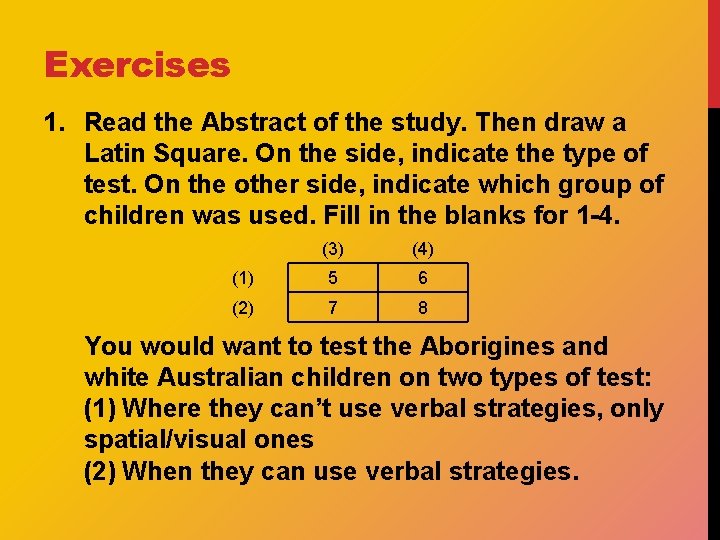
Exercises 1. Read the Abstract of the study. Then draw a Latin Square. On the side, indicate the type of test. On the other side, indicate which group of children was used. Fill in the blanks for 1 -4. (3) (4) (1) 5 6 (2) 7 8 You would want to test the Aborigines and white Australian children on two types of test: (1) Where they can’t use verbal strategies, only spatial/visual ones (2) When they can use verbal strategies.
Exercises (continued) 2. Fill in what the groups are in 5 -8. 3. What do the “repeated measures” refer to here? 4. Why do we want to use such a design here?