
More on Divide and Conquer The divideandconquer design

![low mid high • Subproblem: Find a maximum subarray of A[low. . high]. In](https://slidetodoc.com/presentation_image_h/1da4eee1a9b8cf735078b64fe8347dde/image-18.jpg "low mid high • Subproblem: Find a maximum subarray of A[low. . high]. In")
![FIND-MAXIMUM-SUBARRAY(A, low, high) if high == low return (low, high, A[low]) // base case:](https://slidetodoc.com/presentation_image_h/1da4eee1a9b8cf735078b64fe8347dde/image-20.jpg "FIND-MAXIMUM-SUBARRAY(A, low, high) if high == low return (low, high, A[low]) // base case:")
- Slides: 31
More on Divide and Conquer
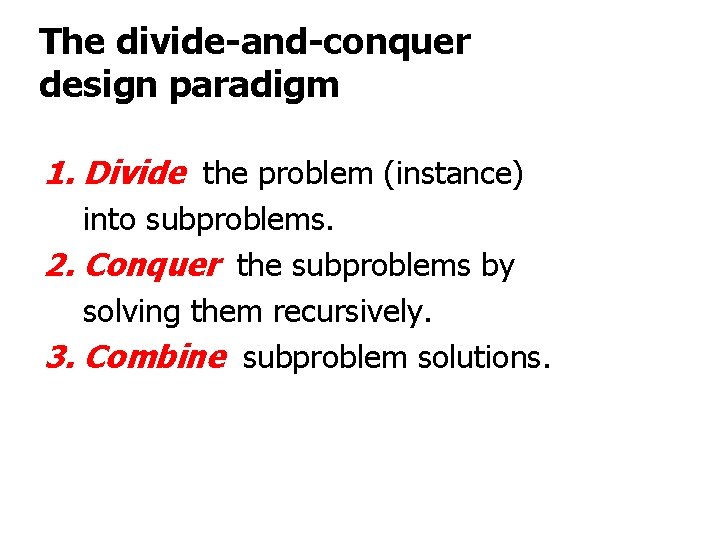
The divide-and-conquer design paradigm 1. Divide the problem (instance) into subproblems. 2. Conquer the subproblems by solving them recursively. 3. Combine subproblem solutions.
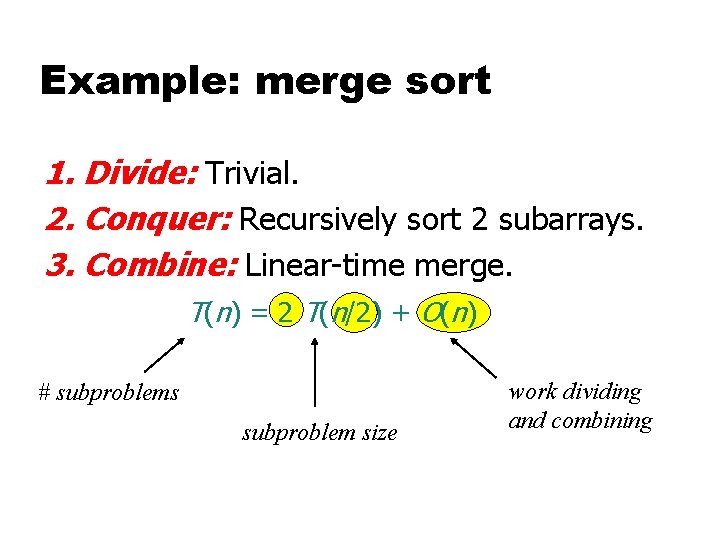
Example: merge sort 1. Divide: Trivial. 2. Conquer: Recursively sort 2 subarrays. 3. Combine: Linear-time merge. T(n) = 2 T(n/2) + O(n) # subproblems subproblem size work dividing and combining
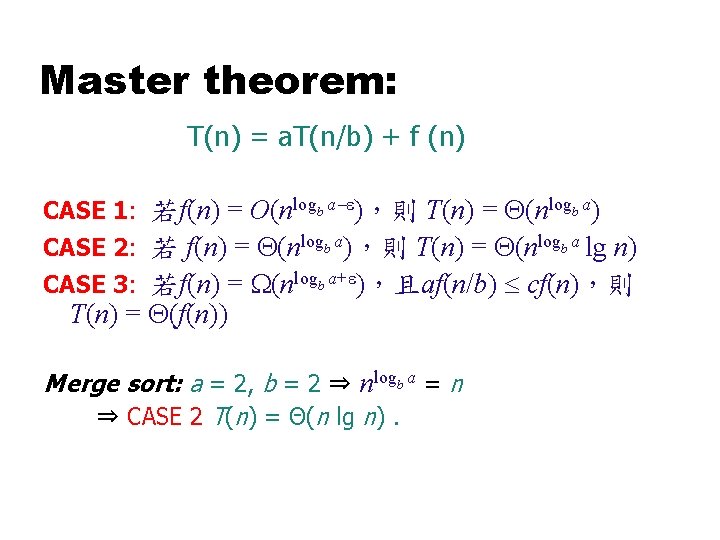
Master theorem: T(n) = a. T(n/b) + f (n) CASE 1: 若f(n) = O(nlogb a ),則 T(n) = (nlogb a) CASE 2: 若 f(n) = (nlogb a),則 T(n) = (nlogb a lg n) CASE 3: 若f(n) = (nlogb a+ ),且af(n/b) cf(n),則 T(n) = (f(n)) Merge sort: a = 2, b = 2 ⇒ nlogb a = n ⇒ CASE 2 T(n) = Θ(n lg n).
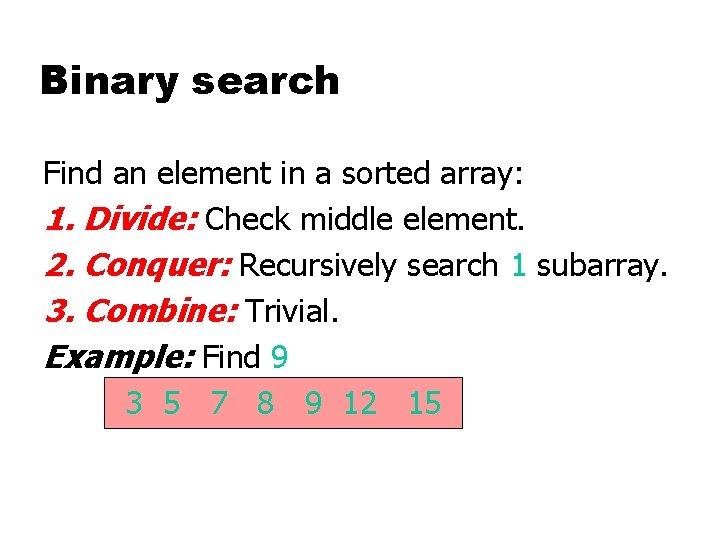
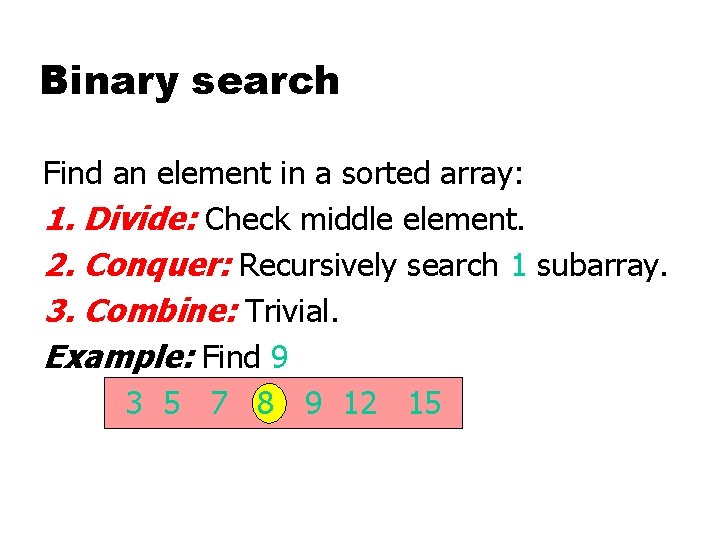
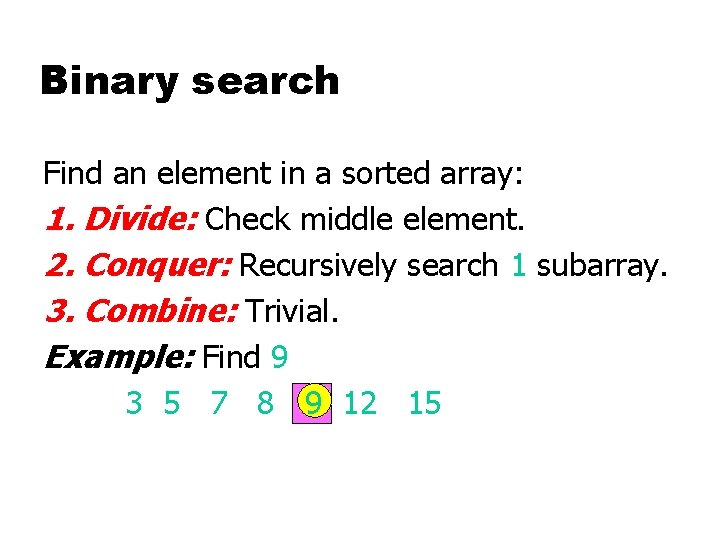
Binary search Find an element in a sorted array: 1. Divide: Check middle element. 2. Conquer: Recursively search 1 subarray. 3. Combine: Trivial. Example: Find 9 3 5 7 8 9 12 15
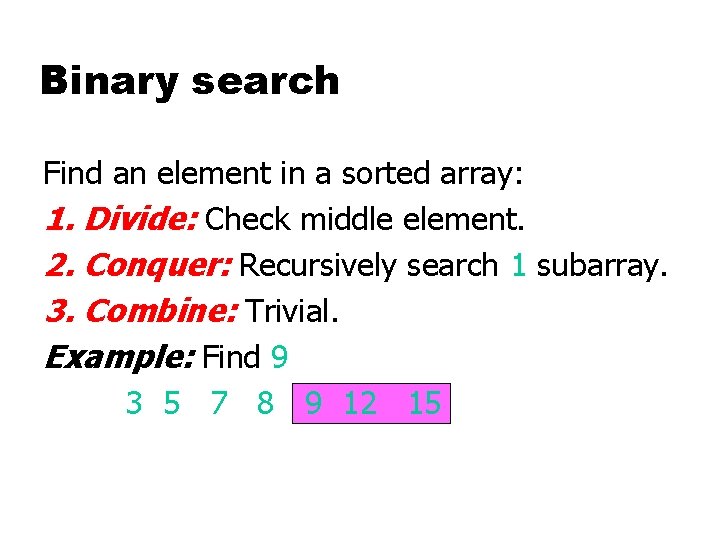
Binary search Find an element in a sorted array: 1. Divide: Check middle element. 2. Conquer: Recursively search 1 subarray. 3. Combine: Trivial. Example: Find 9 3 5 7 8 9 12 15
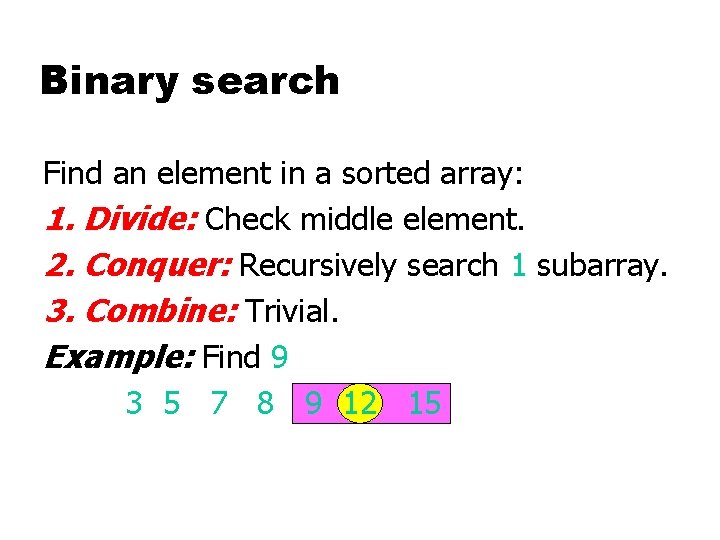
Binary search Find an element in a sorted array: 1. Divide: Check middle element. 2. Conquer: Recursively search 1 subarray. 3. Combine: Trivial. Example: Find 9 3 5 7 8 9 12 15
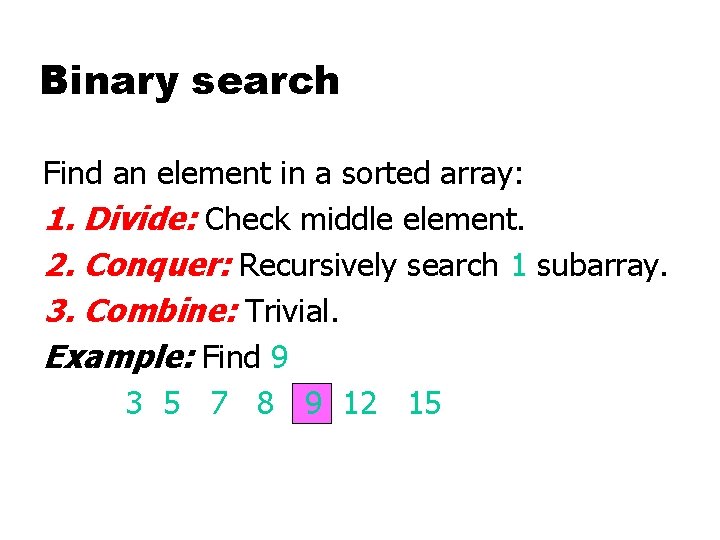
Binary search Find an element in a sorted array: 1. Divide: Check middle element. 2. Conquer: Recursively search 1 subarray. 3. Combine: Trivial. Example: Find 9 3 5 7 8 9 12 15
Binary search Find an element in a sorted array: 1. Divide: Check middle element. 2. Conquer: Recursively search 1 subarray. 3. Combine: Trivial. Example: Find 9 3 5 7 8 9 12 15
Binary search Find an element in a sorted array: 1. Divide: Check middle element. 2. Conquer: Recursively search 1 subarray. 3. Combine: Trivial. Example: Find 9 3 5 7 8 9 12 15
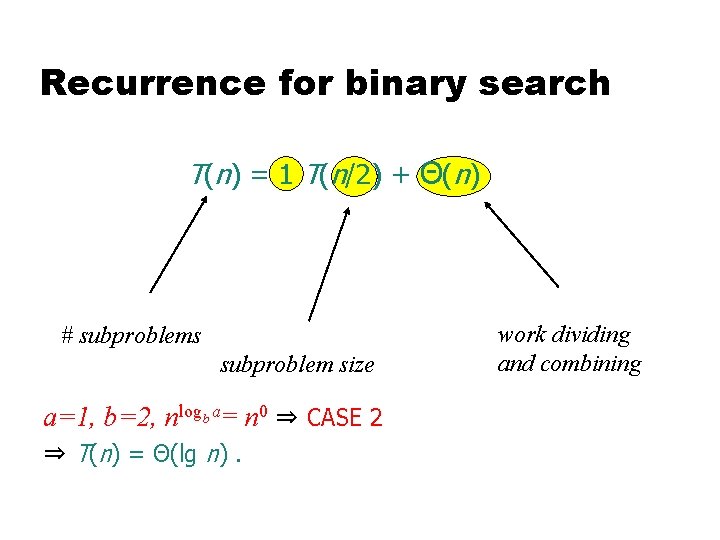
Recurrence for binary search T(n) = 1 T(n/2) + Θ(n) # subproblems subproblem size a=1, b=2, nlogb a= n 0 ⇒ CASE 2 ⇒ T(n) = Θ(lg n). work dividing and combining
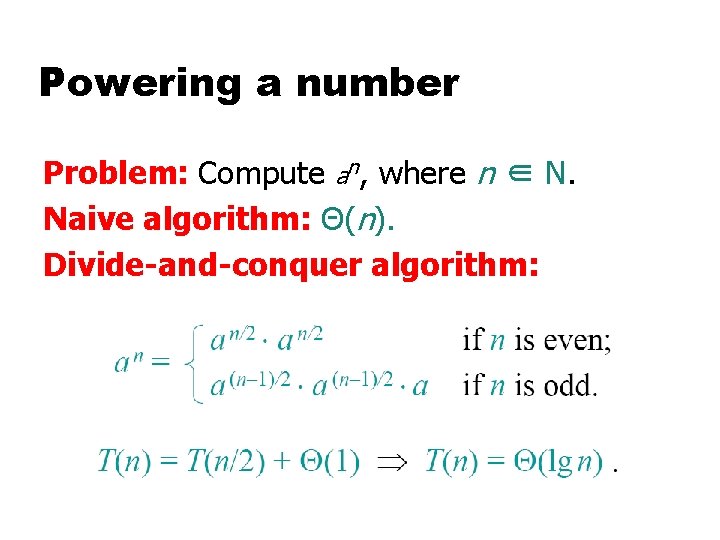
Powering a number Problem: Compute an, where n ∈ N. Naive algorithm: Θ(n). Divide-and-conquer algorithm:
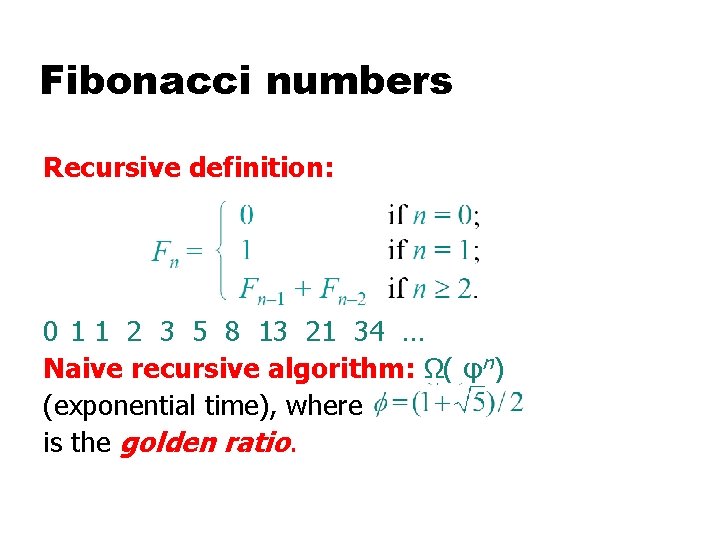
Fibonacci numbers Recursive definition: 0 1 1 2 3 5 8 13 21 34 … Naive recursive algorithm: Ω( φn) (exponential time), where is the golden ratio.
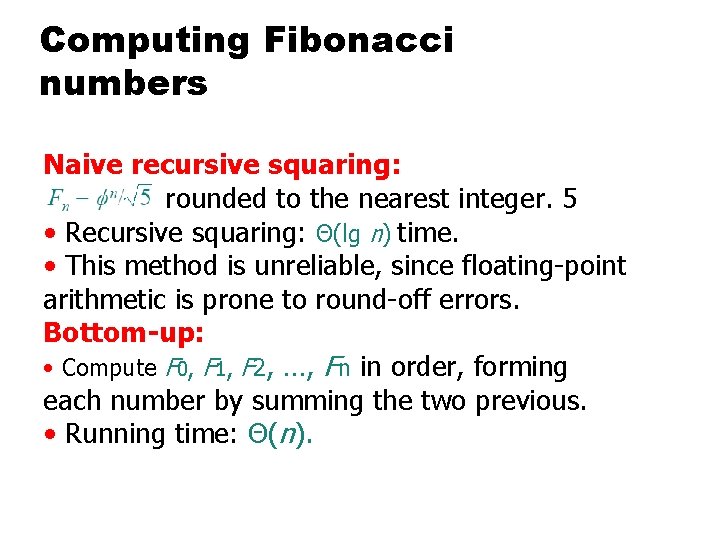
Computing Fibonacci numbers Naive recursive squaring: rounded to the nearest integer. 5 • Recursive squaring: Θ(lg n) time. • This method is unreliable, since floating-point arithmetic is prone to round-off errors. Bottom-up: • Compute F 0, F 1, F 2, …, Fn in order, forming each number by summing the two previous. • Running time: Θ(n).
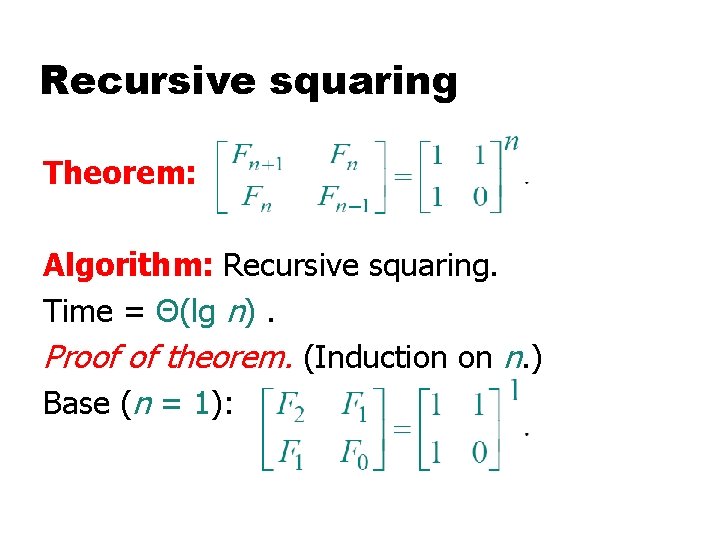
Recursive squaring Theorem: Algorithm: Recursive squaring. Time = Θ(lg n). Proof of theorem. (Induction on n. ) Base (n = 1):
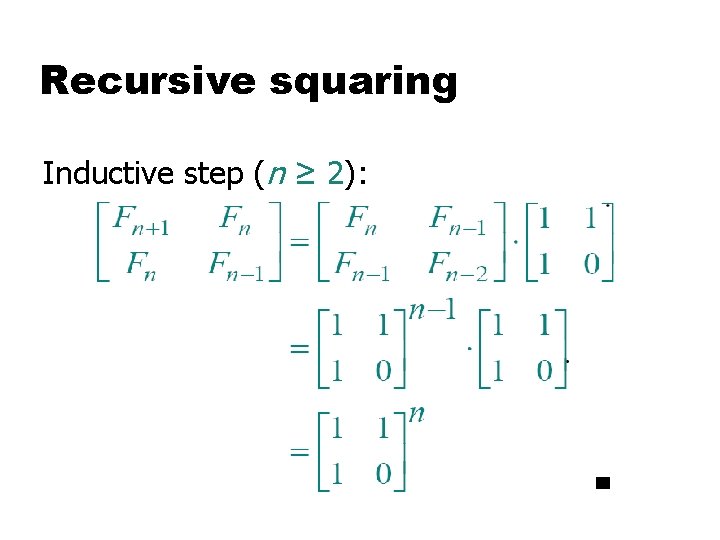
Recursive squaring Inductive step (n ≥ 2):
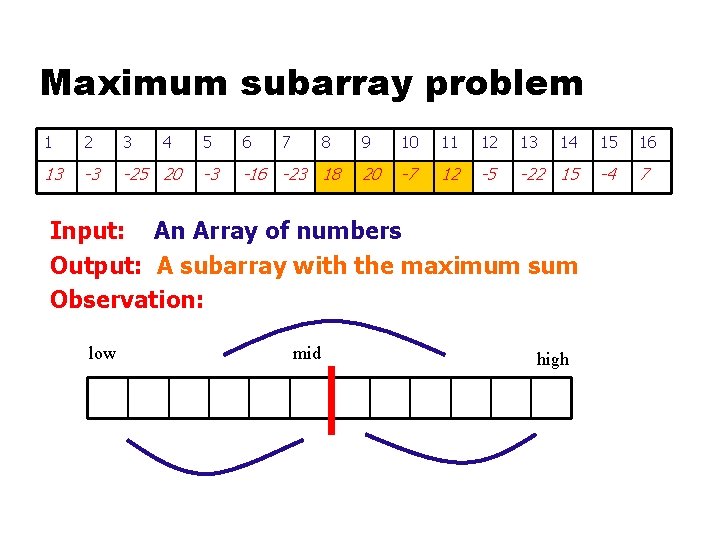
Maximum subarray problem 1 2 3 4 13 -3 -25 20 5 6 7 8 -3 -16 -23 18 9 10 11 12 13 14 15 16 20 -7 12 -5 -22 15 -4 7 Input: An Array of numbers Output: A subarray with the maximum sum Observation: low mid high
low mid high • Subproblem: Find a maximum subarray of A[low. . high]. In original call, low =1, high = n. • Divide the subarray into two subarrays. Find the midpoint mid of the subarrays, and consider the subarrays A[low. . mid] And A[mid +1. . high] • Conquer by finding a maximum subarrays of A[low. . mid] and A[mid+1. . high]. • Combine by finding a maximum subarray that crosses the midpoint, and using the best solution out of the three.
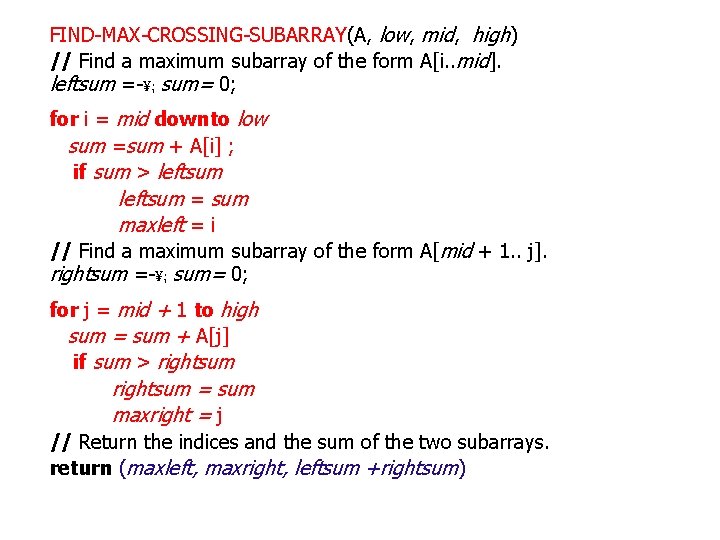
FIND-MAX-CROSSING-SUBARRAY(A, low, mid, high) // Find a maximum subarray of the form A[i. . mid]. leftsum =-¥; sum= 0; for i = mid downto low sum =sum + A[i] ; if sum > leftsum = sum maxleft = i // Find a maximum subarray of the form A[mid + 1. . j]. rightsum =-¥; sum= 0; for j = mid + 1 to high sum = sum + A[j] if sum > rightsum = sum maxright = j // Return the indices and the sum of the two subarrays. return (maxleft, maxright, leftsum +rightsum)
FIND-MAXIMUM-SUBARRAY(A, low, high) if high == low return (low, high, A[low]) // base case: only one element else mid = (low +high)/2 (leftlow; lefthigh, leftsum) = FIND-MAXIMUM-SUBARRAY(A, low, mid) (rightlow, righthigh, rightsum) = FIND-MAXIMUM-SUBARRAY(A, mid + 1, high) (crosslow; crosshigh, cross-sum) = FIND-MAX-CROSSING-SUBARRAY(A, low, mid, high) if leftsum >= rightsum and leftsum >= crosssum return (leftlow, lefthigh, leftsum) elseif rightsum >= leftsum and rightsum >= crosssum return (rightlow, righthigh, rightsum) T(n)=2 T(n/2)+Θ (n) else return (crosslow, crosshigh, crosssum) T(n)=Θ (n log n) Initial call: FIND-MAXIMUM-SUBARRAY(A, 1, n)
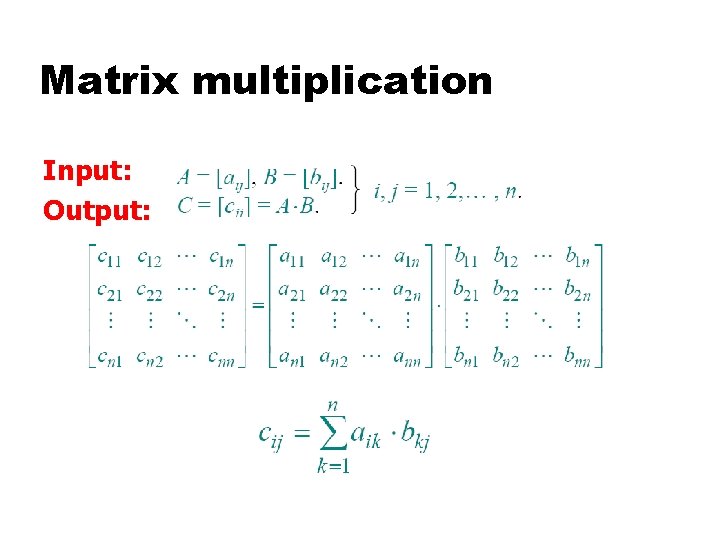
Matrix multiplication Input: Output:
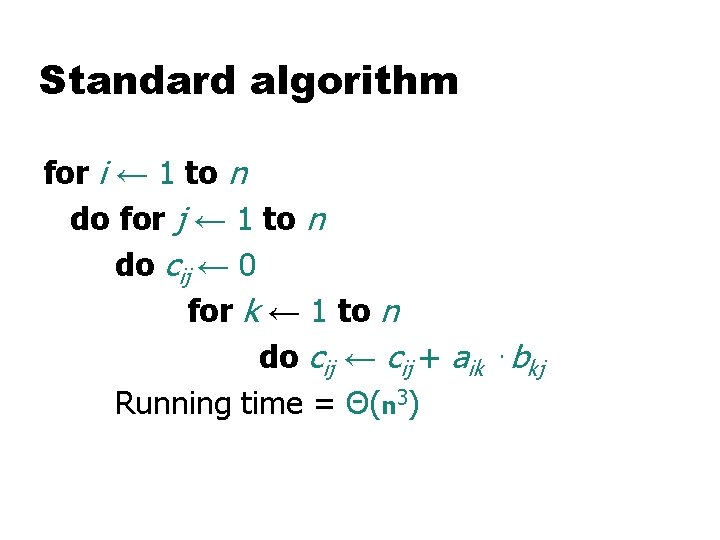
Standard algorithm for i ← 1 to n do for j ← 1 to n do cij ← 0 for k ← 1 to n do cij ← cij + aik ⋅bkj Running time = Θ(n 3)
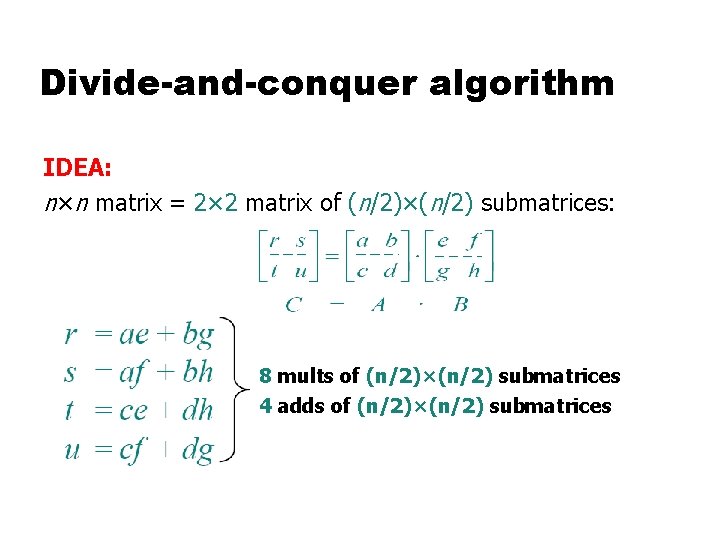
Divide-and-conquer algorithm IDEA: n×n matrix = 2× 2 matrix of (n/2)×(n/2) submatrices: 8 mults of (n/2)×(n/2) submatrices 4 adds of (n/2)×(n/2) submatrices
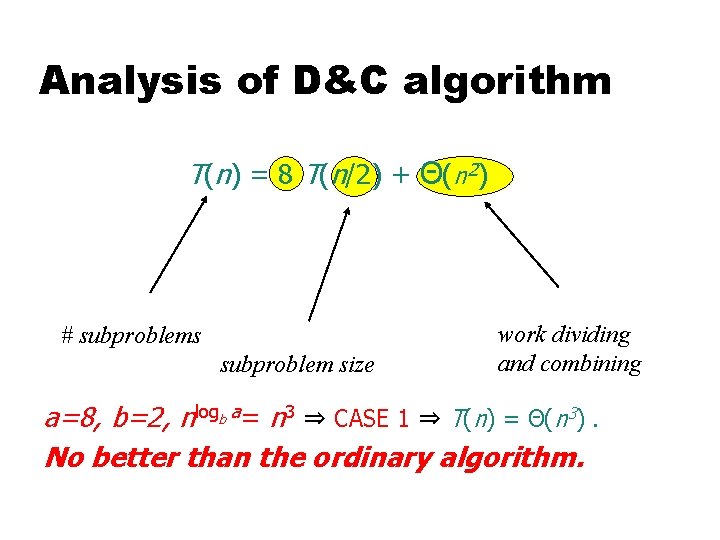
Analysis of D&C algorithm T(n) = 8 T(n/2) + Θ(n 2) # subproblems subproblem size work dividing and combining a=8, b=2, nlogb a= n 3 ⇒ CASE 1 ⇒ T(n) = Θ(n 3). No better than the ordinary algorithm.
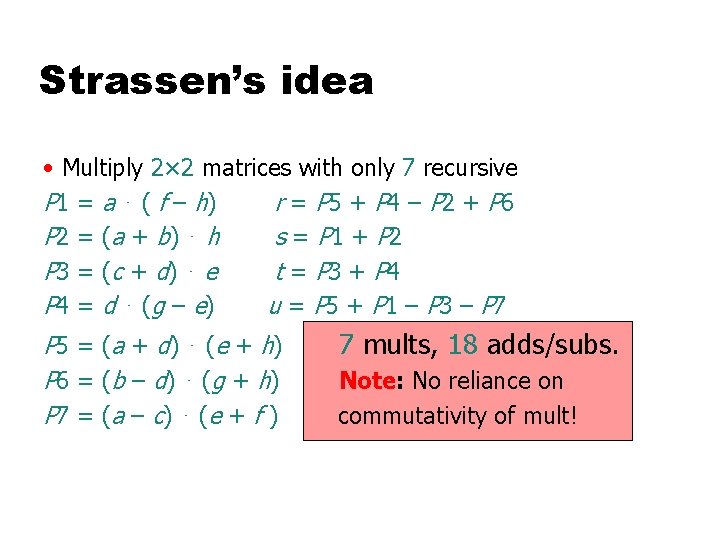
Strassen’s idea • Multiply 2× 2 matrices with only 7 recursive P 1 = a ⋅ ( f – h ) r = P 5 + P 4 – P 2 + P 6 P 2 = ( a + b ) ⋅ h s = P 1 + P 2 P 3 = ( c + d ) ⋅ e t = P 3 + P 4 = d ⋅ ( g – e ) u = P 5 + P 1 – P 3 – P 7 P 5 = ( a + d ) ⋅ ( e + h ) P 6 = ( b – d ) ⋅ ( g + h ) P 7 = ( a – c ) ⋅ ( e + f ) 7 mults, 18 adds/subs. Note: No reliance on commutativity of mult!
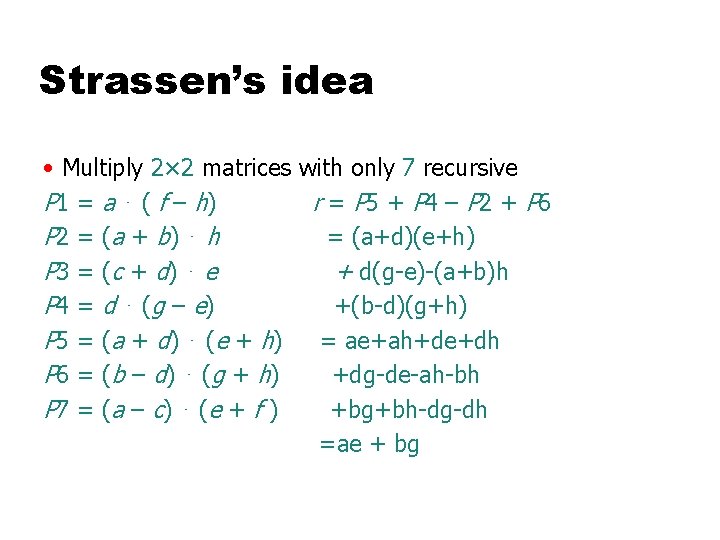
Strassen’s idea • Multiply 2× 2 matrices with only 7 recursive P 1 = a ⋅ ( f – h ) r = P 5 + P 4 – P 2 + P 6 P 2 = ( a + b ) ⋅ h = (a+d)(e+h) P 3 = ( c + d ) ⋅ e + d(g-e)-(a+b)h P 4 = d ⋅ ( g – e ) +(b-d)(g+h) P 5 = (a + d) ⋅ (e + h) = ae+ah+de+dh P 6 = ( b – d ) ⋅ ( g + h ) +dg-de-ah-bh P 7 = ( a – c ) ⋅ ( e + f ) +bg+bh-dg-dh =ae + bg
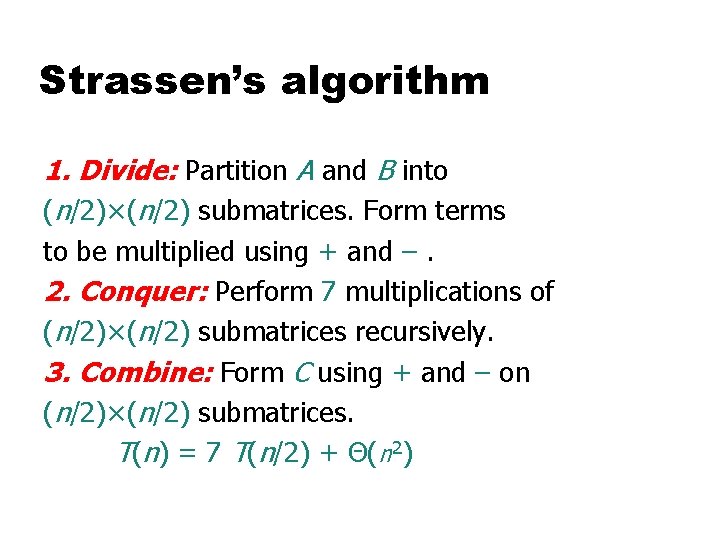
Strassen’s algorithm 1. Divide: Partition A and B into (n/2)×(n/2) submatrices. Form terms to be multiplied using + and –. 2. Conquer: Perform 7 multiplications of (n/2)×(n/2) submatrices recursively. 3. Combine: Form C using + and – on (n/2)×(n/2) submatrices. T(n) = 7 T(n/2) + Θ(n 2)
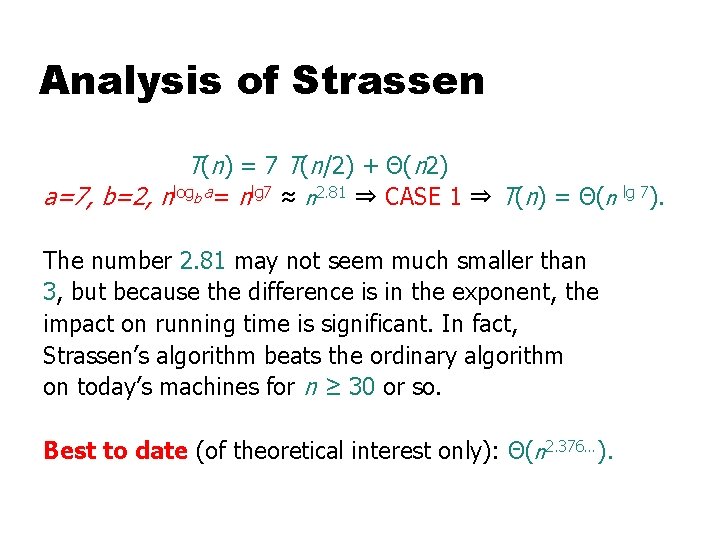
Analysis of Strassen T(n) = 7 T(n/2) + Θ(n 2) a=7, b=2, nlogb a= nlg 7 ≈ n 2. 81 ⇒ CASE 1 ⇒ T(n) = Θ(n lg 7). The number 2. 81 may not seem much smaller than 3, but because the difference is in the exponent, the impact on running time is significant. In fact, Strassen’s algorithm beats the ordinary algorithm on today’s machines for n ≥ 30 or so. Best to date (of theoretical interest only): Θ(n 2. 376…).
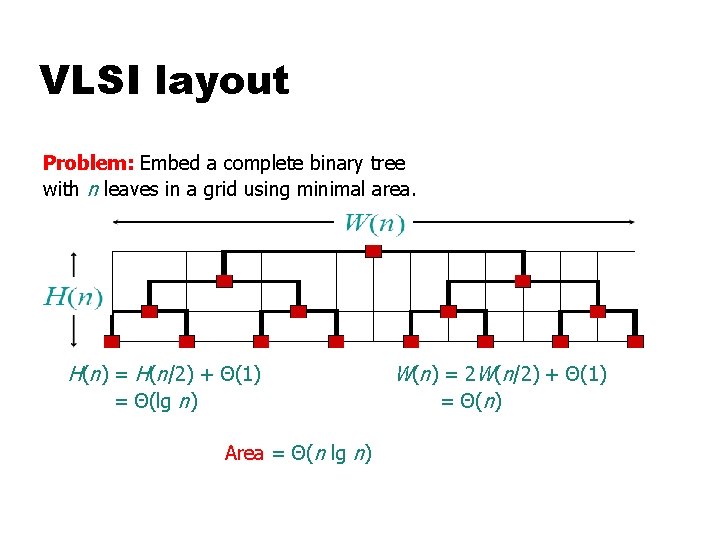
VLSI layout Problem: Embed a complete binary tree with n leaves in a grid using minimal area. H(n) = H(n/2) + Θ(1) = Θ(lg n) Area = Θ(n lg n) W(n) = 2 W(n/2) + Θ(1) = Θ(n)
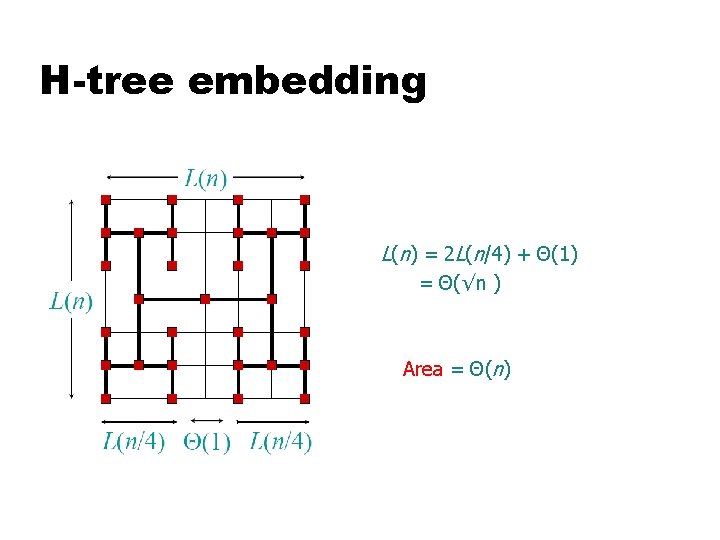
H-tree embedding L(n) = 2 L(n/4) + Θ(1) = Θ(√n ) Area = Θ(n)
Conclusion • Divide and conquer is just one of several powerful techniques for algorithm design. • Divide-and-conquer algorithms can be analyzed using recurrences and the master method (so practice this math). • Can lead to more efficient algorithms