
More Max Compiler Programming Presenter Max Academy Lecture

- Slides: 27
More Max. Compiler Programming Presenter Max. Academy Lecture Series – V 1. 0, September 2011
Lecture Overview • • 2 Counters / loop iteration variables Ways of getting data in and out of the chip Stream offsets How Max. Compiler maps to hardware
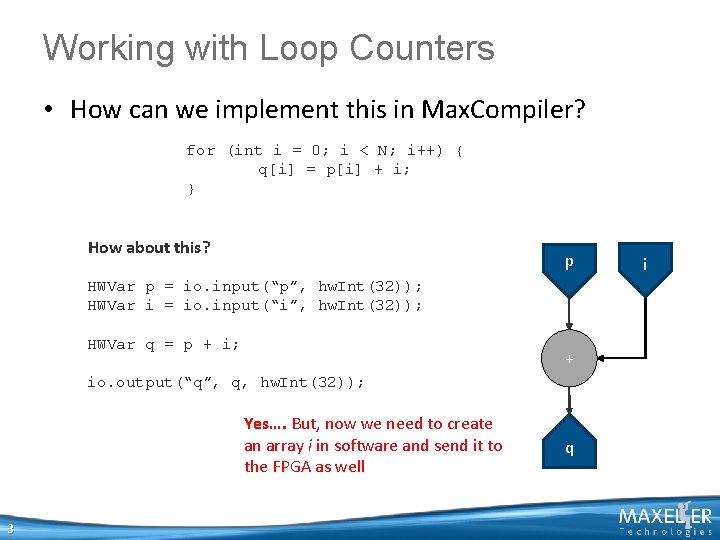
Working with Loop Counters • How can we implement this in Max. Compiler? for (int i = 0; i < N; i++) { q[i] = p[i] + i; } How about this? d HWVar p = io. input(“p”, hw. Int(32)); HWVar i = io. input(“i”, hw. Int(32)); HWVar q = p + i; + io. output(“q”, q, hw. Int(32)); Yes…. But, now we need to create an array i in software and send it to the FPGA as well 3 q i
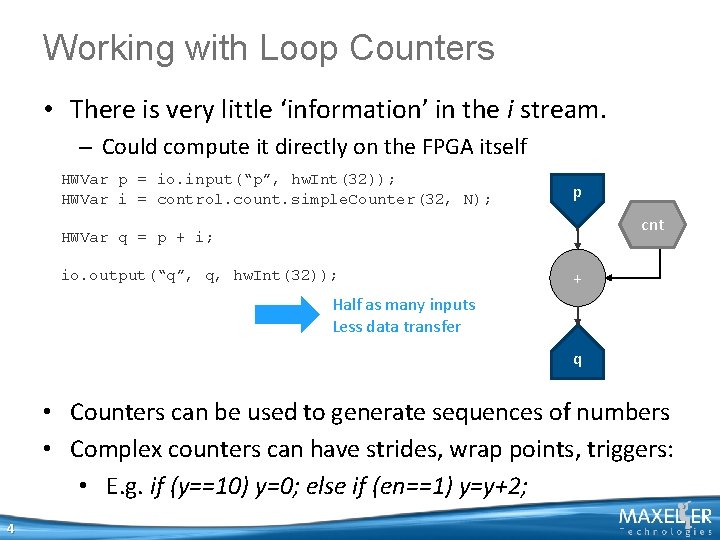
Working with Loop Counters • There is very little ‘information’ in the i stream. – Could compute it directly on the FPGA itself d HWVar p = io. input(“p”, hw. Int(32)); HWVar i = control. count. simple. Counter(32, N); cnt HWVar q = p + i; io. output(“q”, q, hw. Int(32)); + Half as many inputs Less data transfer q • Counters can be used to generate sequences of numbers • Complex counters can have strides, wrap points, triggers: • E. g. if (y==10) y=0; else if (en==1) y=y+2; 4
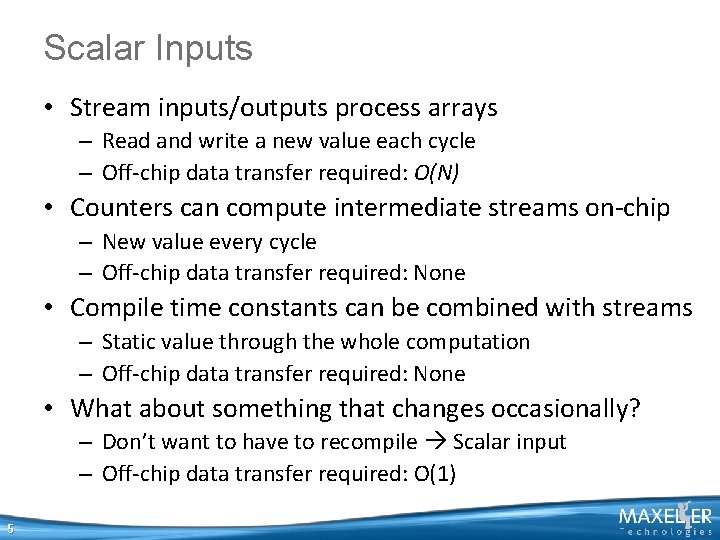
Scalar Inputs • Stream inputs/outputs process arrays – Read and write a new value each cycle – Off-chip data transfer required: O(N) • Counters can compute intermediate streams on-chip – New value every cycle – Off-chip data transfer required: None • Compile time constants can be combined with streams – Static value through the whole computation – Off-chip data transfer required: None • What about something that changes occasionally? – Don’t want to have to recompile Scalar input – Off-chip data transfer required: O(1) 5
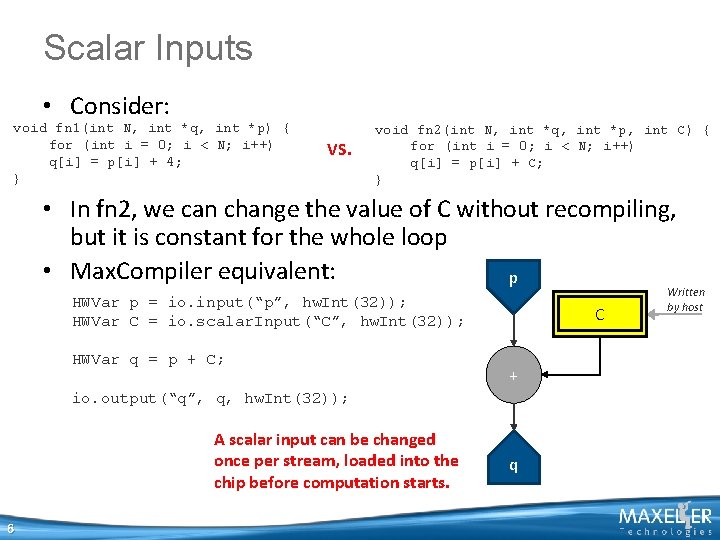
Scalar Inputs • Consider: void fn 1(int N, int *q, int *p) { for (int i = 0; i < N; i++) q[i] = p[i] + 4; } VS. void fn 2(int N, int *q, int *p, int C) { for (int i = 0; i < N; i++) q[i] = p[i] + C; } • In fn 2, we can change the value of C without recompiling, but it is constant for the whole loop • Max. Compiler equivalent: d HWVar p = io. input(“p”, hw. Int(32)); HWVar C = io. scalar. Input(“C”, hw. Int(32)); HWVar q = p + C; C + io. output(“q”, q, hw. Int(32)); A scalar input can be changed once per stream, loaded into the chip before computation starts. 6 q Written by host
Common uses for Scalar Inputs • Things that do not change every cycle, but do change sometimes and we do not want to rebuild the. max file. • Constants in expressions • Flags to switch between two behaviours – result = enabled ? x+7 : x; • Control parameters to counters, e. g. max, stride, etc – if (cnt==cnt_max) cnt=0; else cnt = cnt + cnt_step; 7
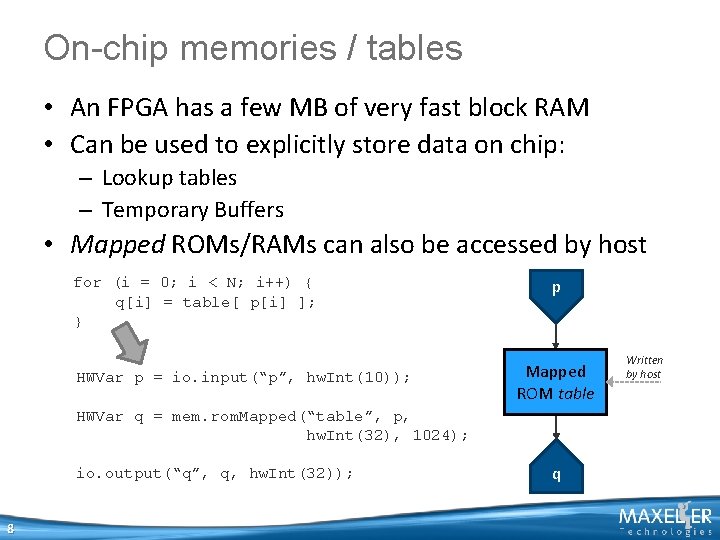
On-chip memories / tables • An FPGA has a few MB of very fast block RAM • Can be used to explicitly store data on chip: – Lookup tables – Temporary Buffers • Mapped ROMs/RAMs can also be accessed by host HWVar p = io. input(“p”, hw. Int(10)); d for (i = 0; i < N; i++) { q[i] = table[ p[i] ]; } Mapped ROM table HWVar q = mem. rom. Mapped(“table”, p, hw. Int(32), 1024); io. output(“q”, q, hw. Int(32)); 8 q Written by host
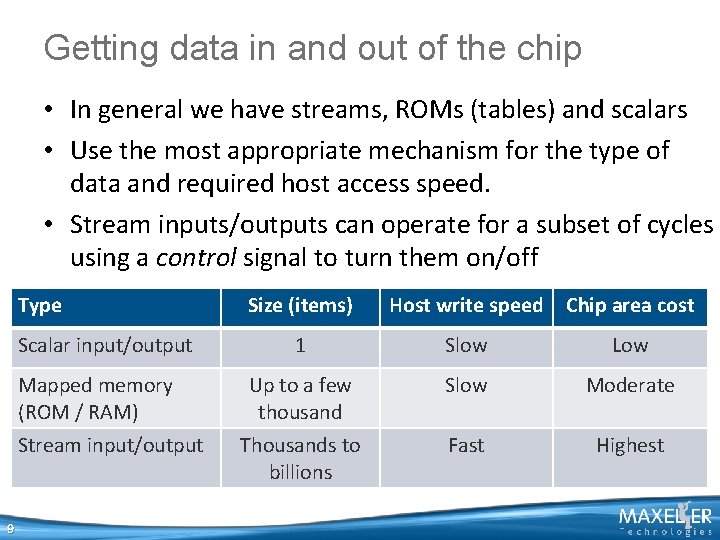
Getting data in and out of the chip • In general we have streams, ROMs (tables) and scalars • Use the most appropriate mechanism for the type of data and required host access speed. • Stream inputs/outputs can operate for a subset of cycles using a control signal to turn them on/off Type Scalar input/output Mapped memory (ROM / RAM) Stream input/output 9 Size (items) Host write speed Chip area cost 1 Slow Low Up to a few thousand Slow Moderate Thousands to billions Fast Highest
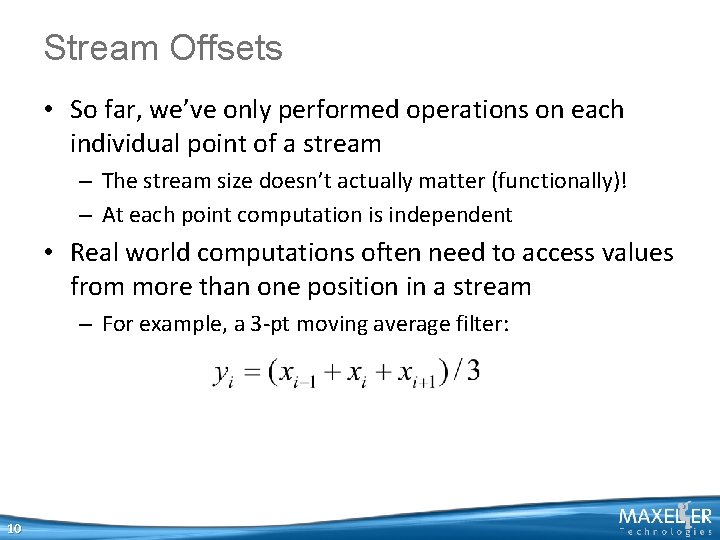
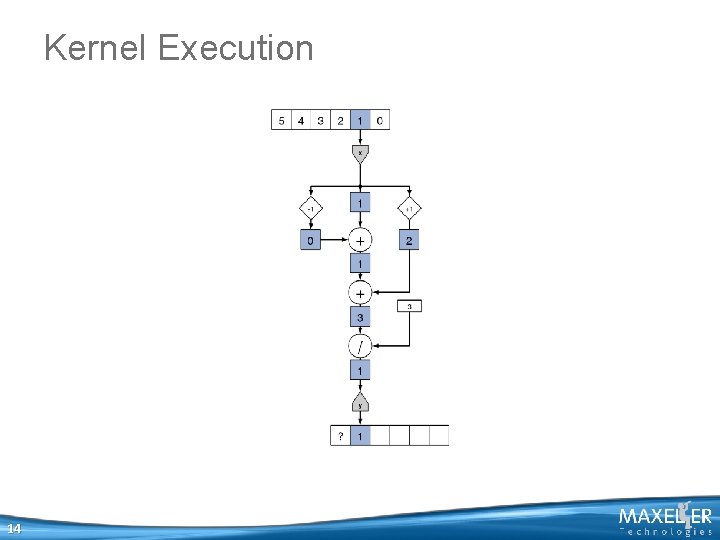
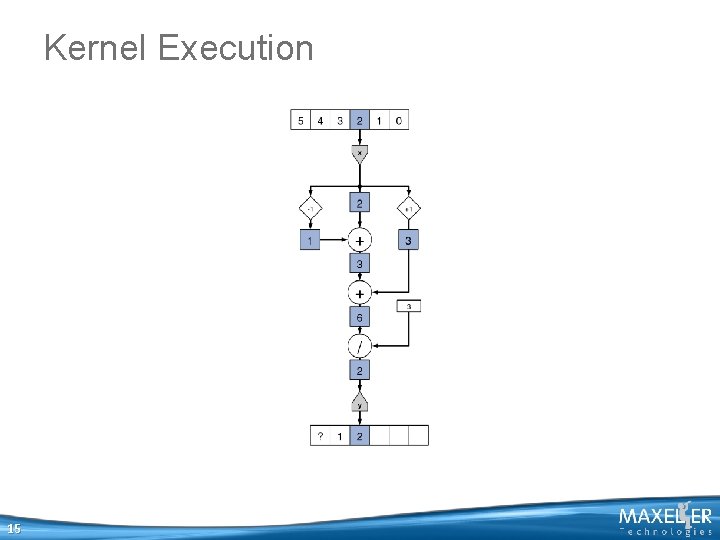
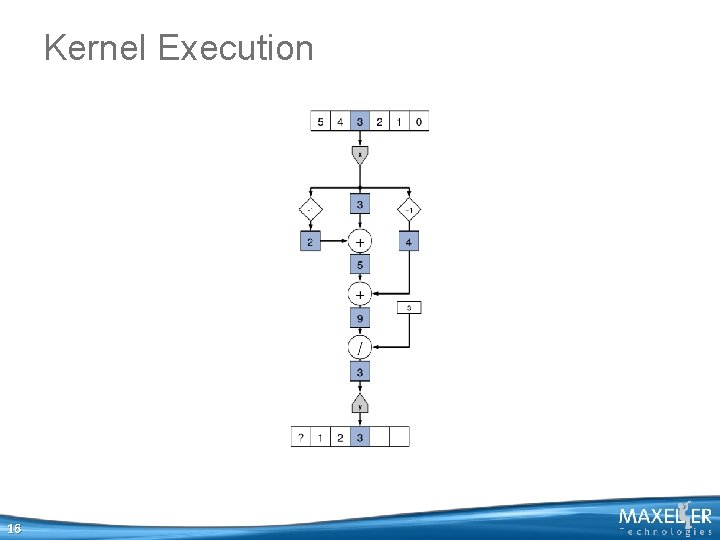
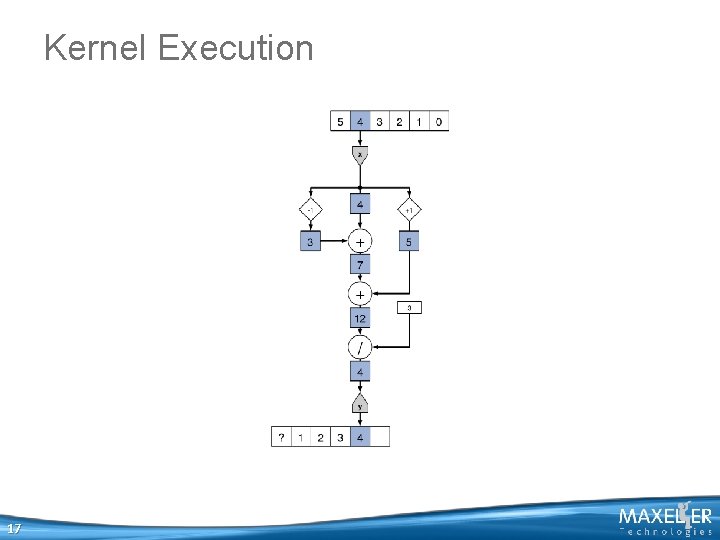
Stream Offsets • So far, we’ve only performed operations on each individual point of a stream – The stream size doesn’t actually matter (functionally)! – At each point computation is independent • Real world computations often need to access values from more than one position in a stream – For example, a 3 -pt moving average filter: 10
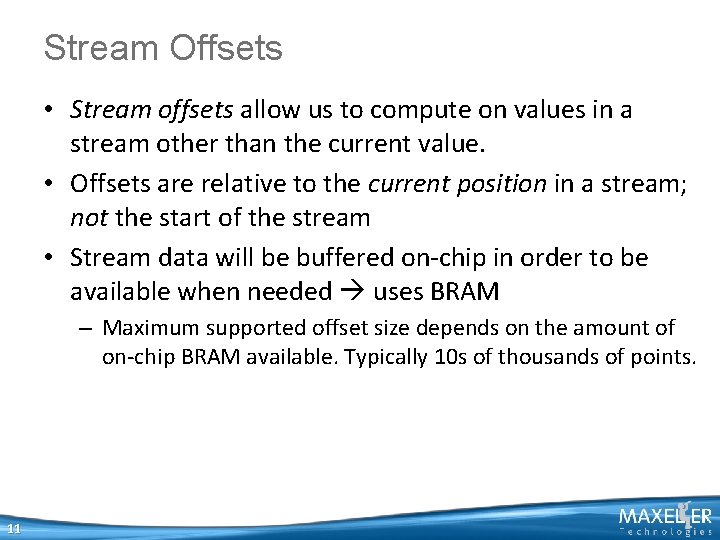
Stream Offsets • Stream offsets allow us to compute on values in a stream other than the current value. • Offsets are relative to the current position in a stream; not the start of the stream • Stream data will be buffered on-chip in order to be available when needed uses BRAM – Maximum supported offset size depends on the amount of on-chip BRAM available. Typically 10 s of thousands of points. 11
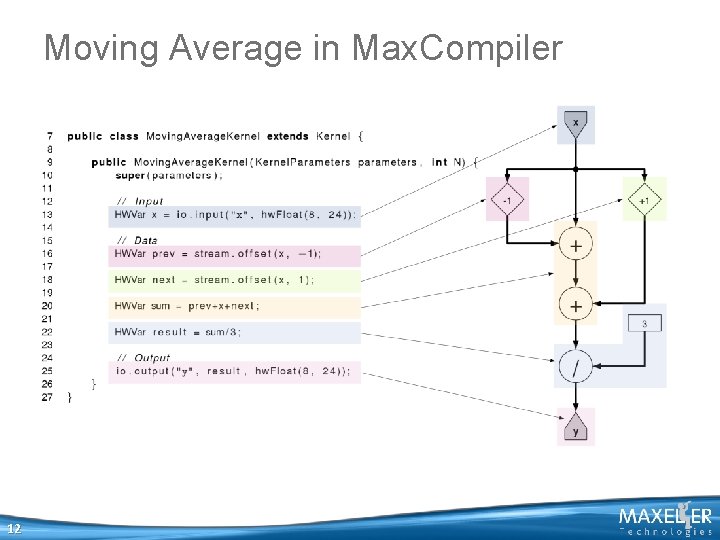
Moving Average in Max. Compiler 12
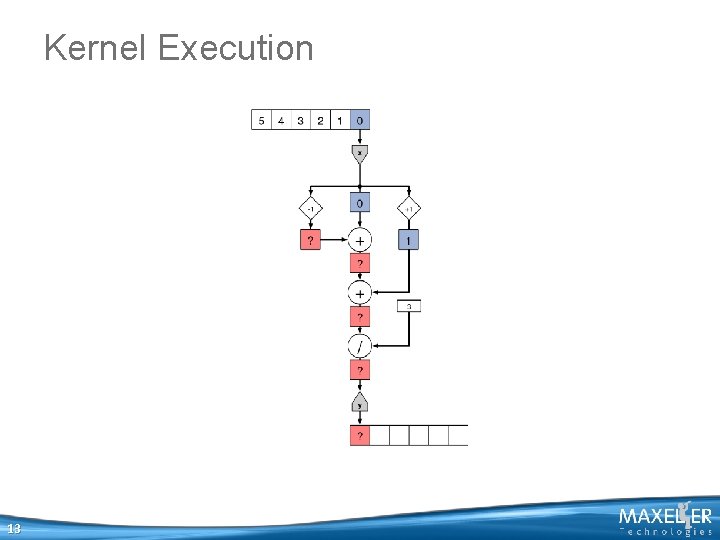
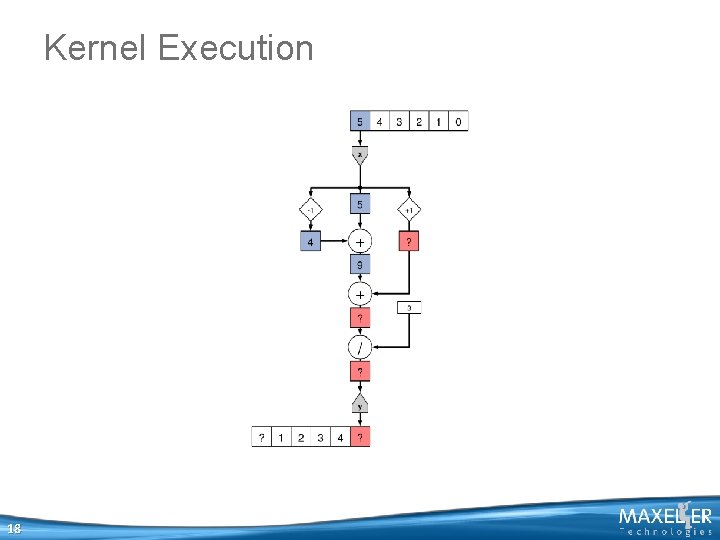
Kernel Execution 13
Kernel Execution 14
Kernel Execution 15
Kernel Execution 16
Kernel Execution 17
Kernel Execution 18
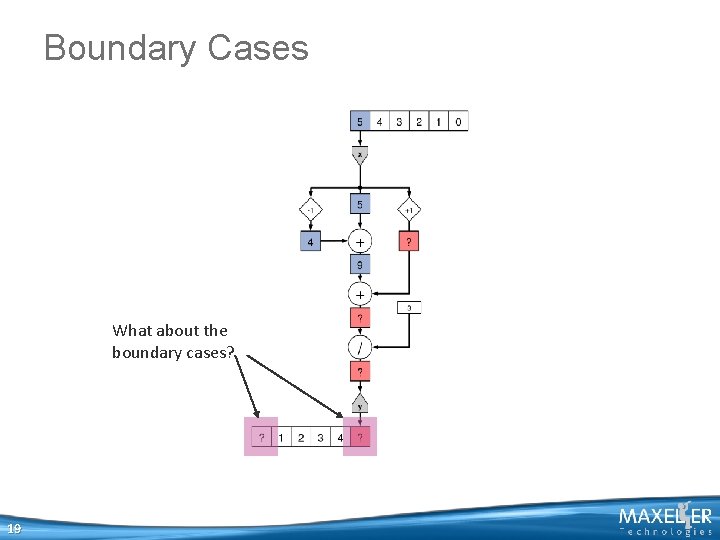
Boundary Cases What about the boundary cases? 19
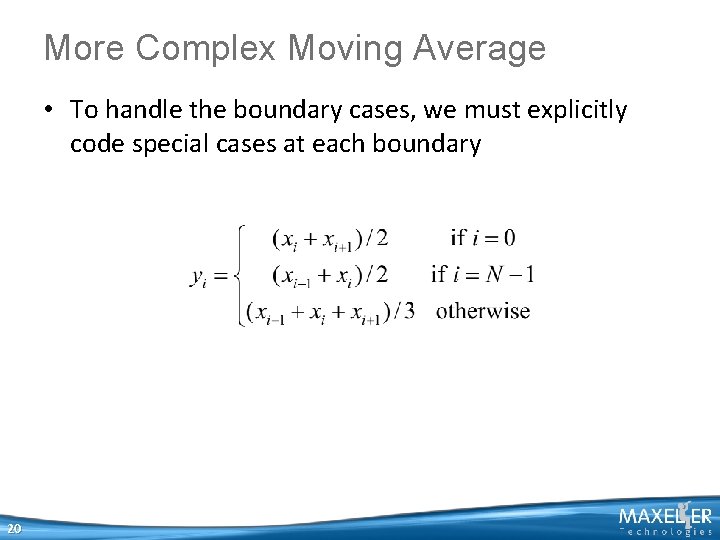
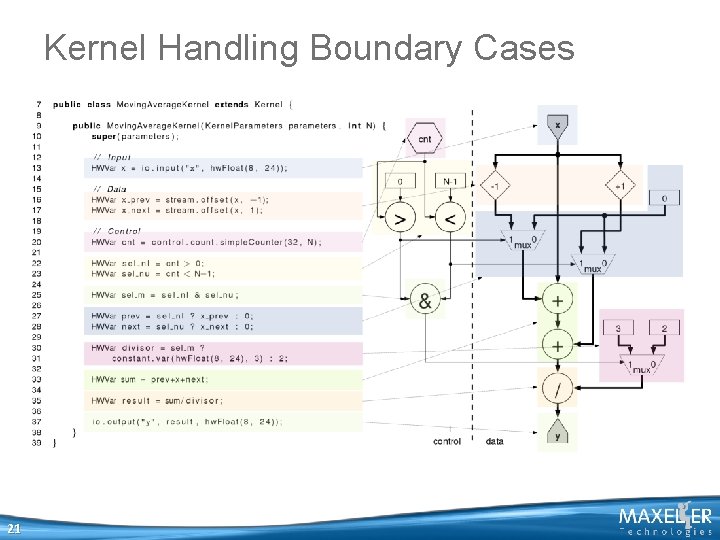
More Complex Moving Average • To handle the boundary cases, we must explicitly code special cases at each boundary 20
Kernel Handling Boundary Cases 21
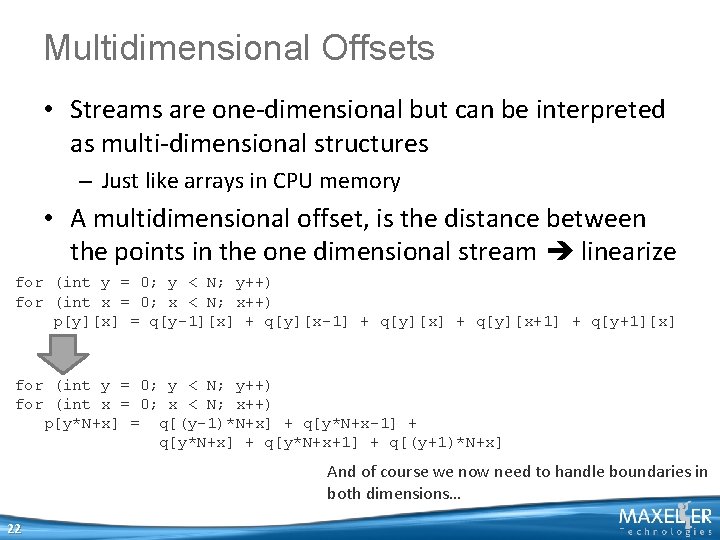
Multidimensional Offsets • Streams are one-dimensional but can be interpreted as multi-dimensional structures – Just like arrays in CPU memory • A multidimensional offset, is the distance between the points in the one dimensional stream linearize for (int y = 0; y < N; y++) for (int x = 0; x < N; x++) p[y][x] = q[y-1][x] + q[y][x-1] + q[y][x+1] + q[y+1][x] for (int y = 0; y < N; y++) for (int x = 0; x < N; x++) p[y*N+x] = q[(y-1)*N+x] + q[y*N+x-1] + q[y*N+x+1] + q[(y+1)*N+x] And of course we now need to handle boundaries in both dimensions… 22
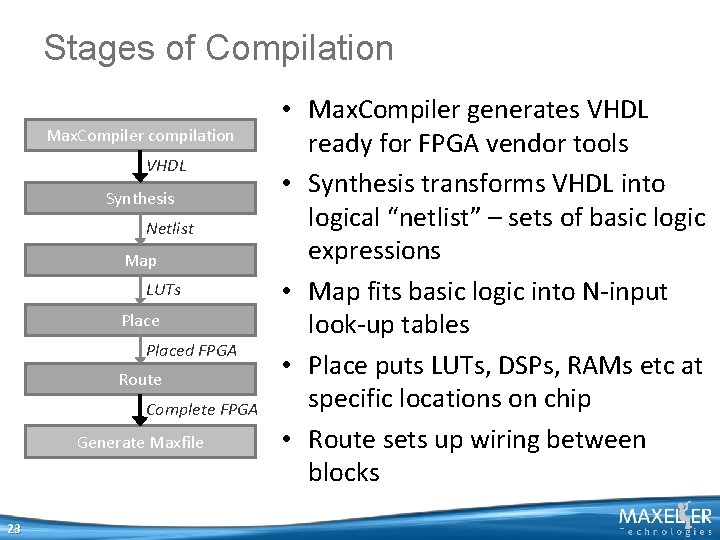
Stages of Compilation Max. Compiler compilation VHDL Synthesis Netlist Map LUTs Placed FPGA Route Complete FPGA Generate Maxfile 23 • Max. Compiler generates VHDL ready for FPGA vendor tools • Synthesis transforms VHDL into logical “netlist” – sets of basic logic expressions • Map fits basic logic into N-input look-up tables • Place puts LUTs, DSPs, RAMs etc at specific locations on chip • Route sets up wiring between blocks
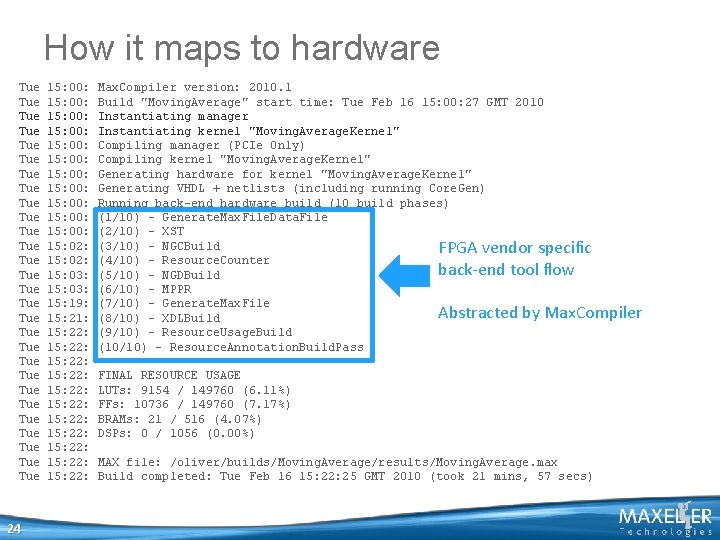
How it maps to hardware Tue Tue Tue Tue Tue Tue Tue 24 15: 00: 15: 00: 15: 00: 15: 02: 15: 03: 15: 19: 15: 21: 15: 22: 15: 22: 15: 22: Max. Compiler version: 2010. 1 Build "Moving. Average" start time: Tue Feb 16 15: 00: 27 GMT 2010 Instantiating manager Instantiating kernel "Moving. Average. Kernel" Compiling manager (PCIe Only) Compiling kernel "Moving. Average. Kernel" Generating hardware for kernel "Moving. Average. Kernel" Generating VHDL + netlists (including running Core. Gen) Running back-end hardware build (10 build phases) (1/10) - Generate. Max. File. Data. File (2/10) - XST (3/10) - NGCBuild FPGA vendor specific (4/10) - Resource. Counter back-end tool flow (5/10) - NGDBuild (6/10) - MPPR (7/10) - Generate. Max. File Abstracted by Max. Compiler (8/10) – XDLBuild (9/10) - Resource. Usage. Build (10/10) - Resource. Annotation. Build. Pass FINAL RESOURCE USAGE LUTs: 9154 / 149760 (6. 11%) FFs: 10736 / 149760 (7. 17%) BRAMs: 21 / 516 (4. 07%) DSPs: 0 / 1056 (0. 00%) MAX file: /oliver/builds/Moving. Average/results/Moving. Average. max Build completed: Tue Feb 16 15: 22: 25 GMT 2010 (took 21 mins, 57 secs)
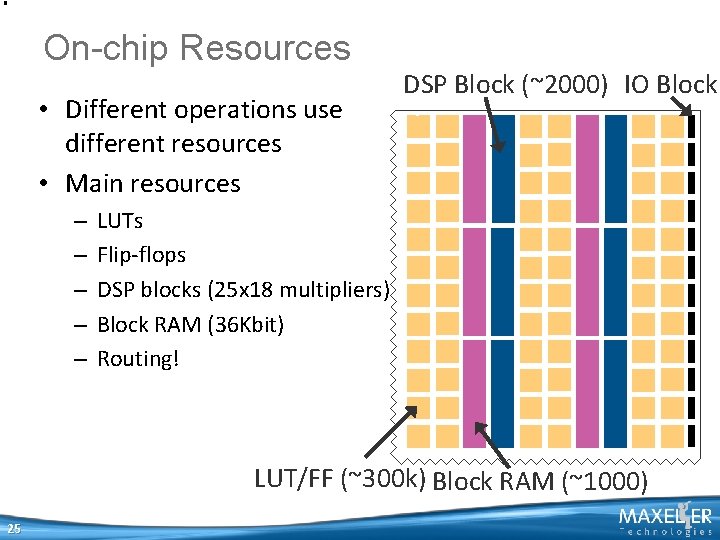
On-chip Resources • Different operations use different resources • Main resources – – – DSP Block (~2000) IO Block LUTs Flip-flops DSP blocks (25 x 18 multipliers) Block RAM (36 Kbit) Routing! LUT/FF (~300 k) Block RAM (~1000) 25
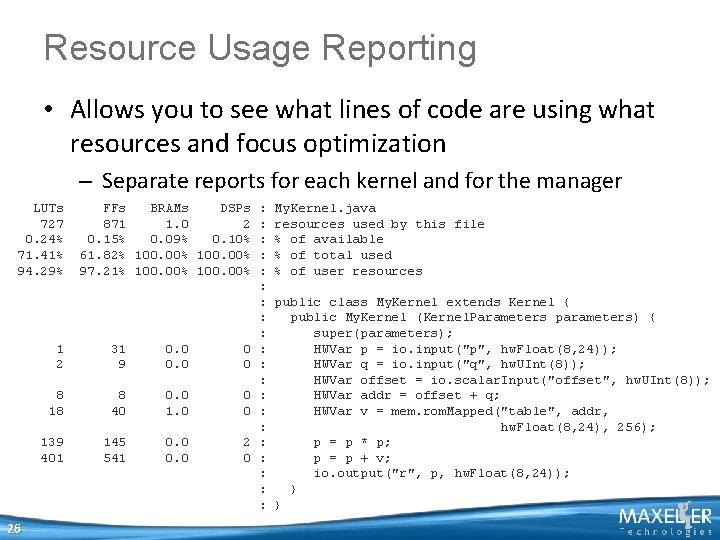
Resource Usage Reporting • Allows you to see what lines of code are using what resources and focus optimization – Separate reports for each kernel and for the manager LUTs 727 0. 24% 71. 41% 94. 29% 26 FFs BRAMs DSPs 871 1. 0 2 0. 15% 0. 09% 0. 10% 61. 82% 100. 00% 97. 21% 100. 00% 1 2 31 9 0. 0 0 0 8 18 8 40 0. 0 1. 0 0 0 139 401 145 541 0. 0 2 0 : : : : : My. Kernel. java resources used by this file % of available % of total used % of user resources public class My. Kernel extends Kernel { public My. Kernel (Kernel. Parameters parameters) { super(parameters); HWVar p = io. input("p", hw. Float(8, 24)); HWVar q = io. input("q", hw. UInt(8)); HWVar offset = io. scalar. Input("offset", hw. UInt(8)); HWVar addr = offset + q; HWVar v = mem. rom. Mapped("table", addr, hw. Float(8, 24), 256); p = p * p; p = p + v; io. output("r", p, hw. Float(8, 24)); } }
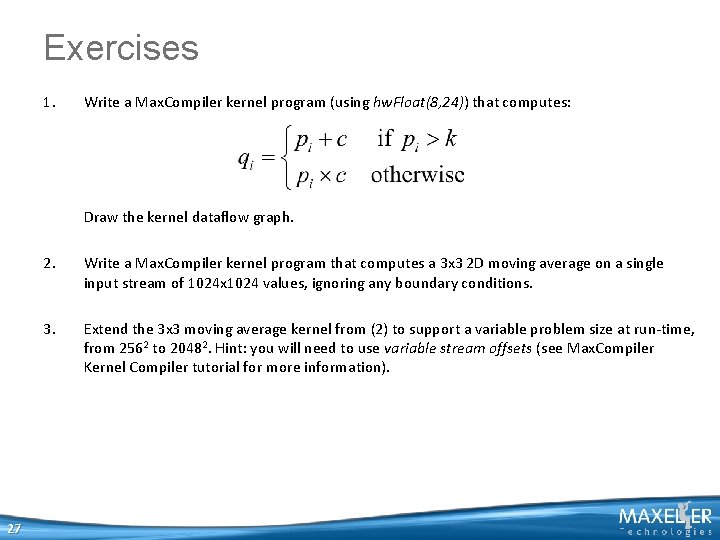
Exercises 1. Write a Max. Compiler kernel program (using hw. Float(8, 24)) that computes: Draw the kernel dataflow graph. 27 2. Write a Max. Compiler kernel program that computes a 3 x 3 2 D moving average on a single input stream of 1024 x 1024 values, ignoring any boundary conditions. 3. Extend the 3 x 3 moving average kernel from (2) to support a variable problem size at run-time, from 2562 to 20482. Hint: you will need to use variable stream offsets (see Max. Compiler Kernel Compiler tutorial for more information).