More implicit More explicit Teacher lack of understanding
- Slides: 3
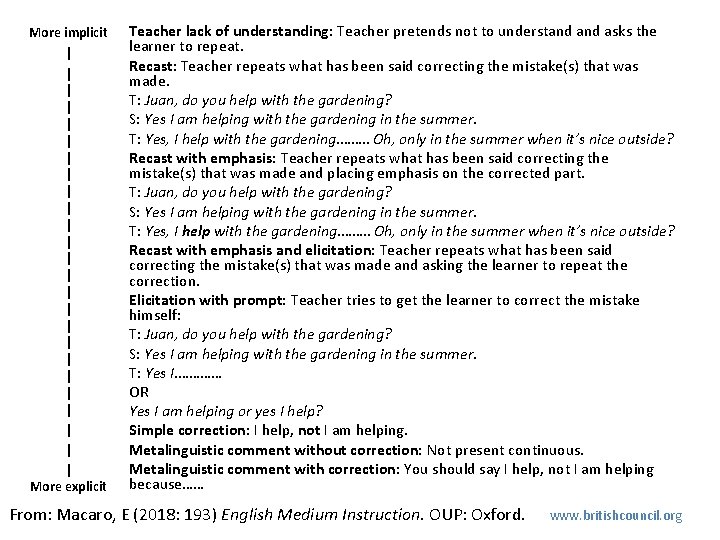
More implicit | | | | | | | More explicit Teacher lack of understanding: Teacher pretends not to understand asks the learner to repeat. Recast: Teacher repeats what has been said correcting the mistake(s) that was made. T: Juan, do you help with the gardening? S: Yes I am helping with the gardening in the summer. T: Yes, I help with the gardening……… Oh, only in the summer when it’s nice outside? Recast with emphasis: Teacher repeats what has been said correcting the mistake(s) that was made and placing emphasis on the corrected part. T: Juan, do you help with the gardening? S: Yes I am helping with the gardening in the summer. T: Yes, I help with the gardening……… Oh, only in the summer when it’s nice outside? Recast with emphasis and elicitation: Teacher repeats what has been said correcting the mistake(s) that was made and asking the learner to repeat the correction. Elicitation with prompt: Teacher tries to get the learner to correct the mistake himself: T: Juan, do you help with the gardening? S: Yes I am helping with the gardening in the summer. T: Yes I…………. OR Yes I am helping or yes I help? Simple correction: I help, not I am helping. Metalinguistic comment without correction: Not present continuous. Metalinguistic comment with correction: You should say I help, not I am helping because…… From: Macaro, E (2018: 193) English Medium Instruction. OUP: Oxford. www. britishcouncil. org
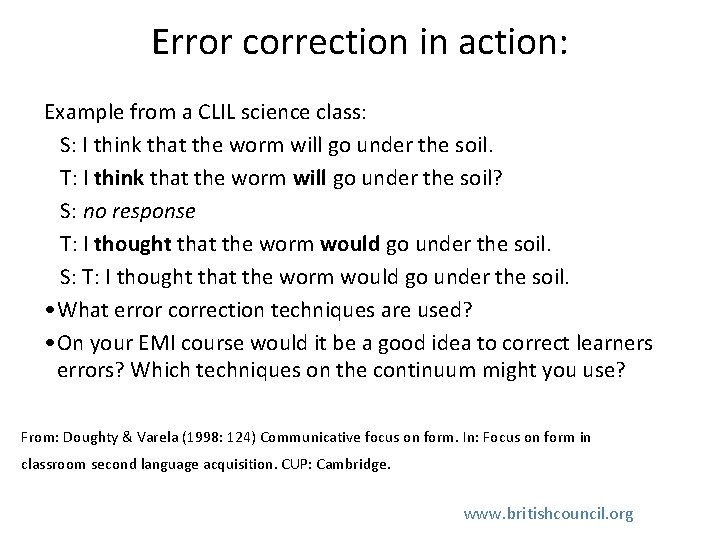
Error correction in action: Example from a CLIL science class: S: I think that the worm will go under the soil. T: I think that the worm will go under the soil? S: no response T: I thought that the worm would go under the soil. S: T: I thought that the worm would go under the soil. • What error correction techniques are used? • On your EMI course would it be a good idea to correct learners errors? Which techniques on the continuum might you use? From: Doughty & Varela (1998: 124) Communicative focus on form. In: Focus on form in classroom second language acquisition. CUP: Cambridge. www. britishcouncil. org
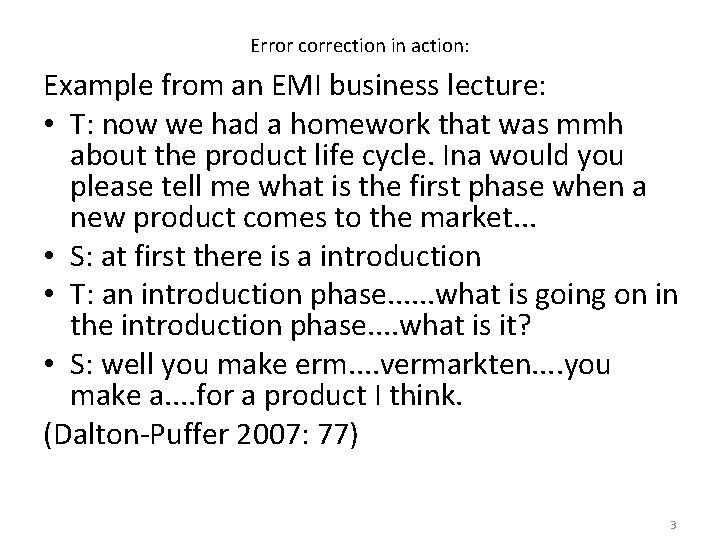
Error correction in action: Example from an EMI business lecture: • T: now we had a homework that was mmh about the product life cycle. Ina would you please tell me what is the first phase when a new product comes to the market. . . • S: at first there is a introduction • T: an introduction phase. . . what is going on in the introduction phase. . what is it? • S: well you make erm. . vermarkten. . you make a. . for a product I think. (Dalton-Puffer 2007: 77) www. britishcouncil. org 3