
More examples of modeling atomic dimensions 1 Electronic
- Slides: 24
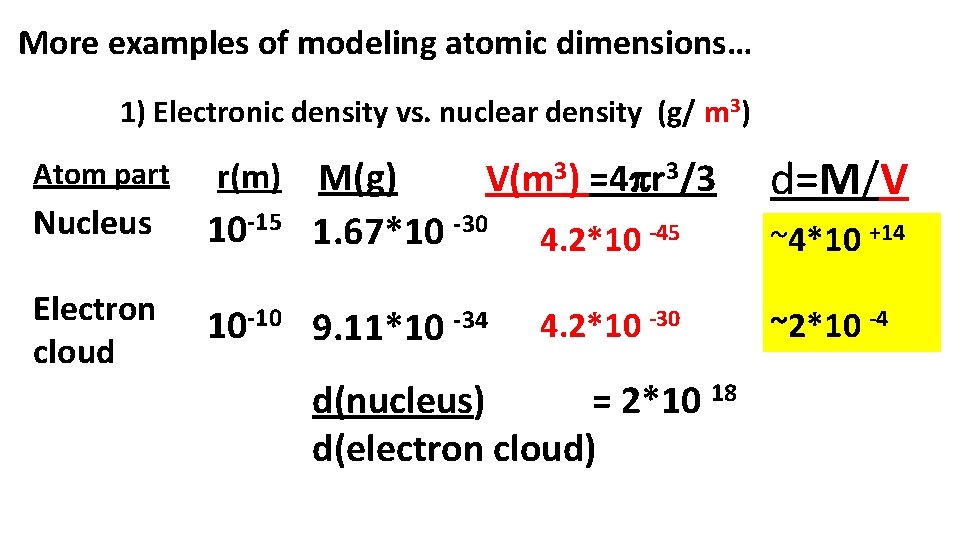
More examples of modeling atomic dimensions… 1) Electronic density vs. nuclear density (g/ m 3) M(g) V(m 3) =4 r 3/3 1. 67*10 -30 4. 2*10 -45 Atom part r(m) Nucleus 10 -15 Electron cloud 10 -10 9. 11*10 -34 4. 2*10 -30 d(nucleus) = 2*10 18 d(electron cloud) d=M/V ~4*10 +14 ~2*10 -4
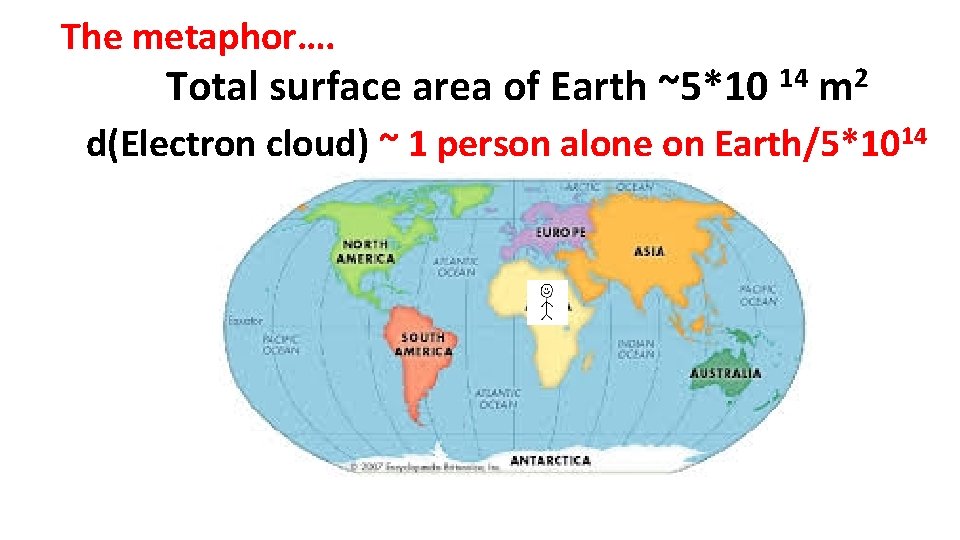
The metaphor…. Total surface area of Earth ~5*10 14 2 m d(Electron cloud) ~ 1 person alone on Earth/5*1014
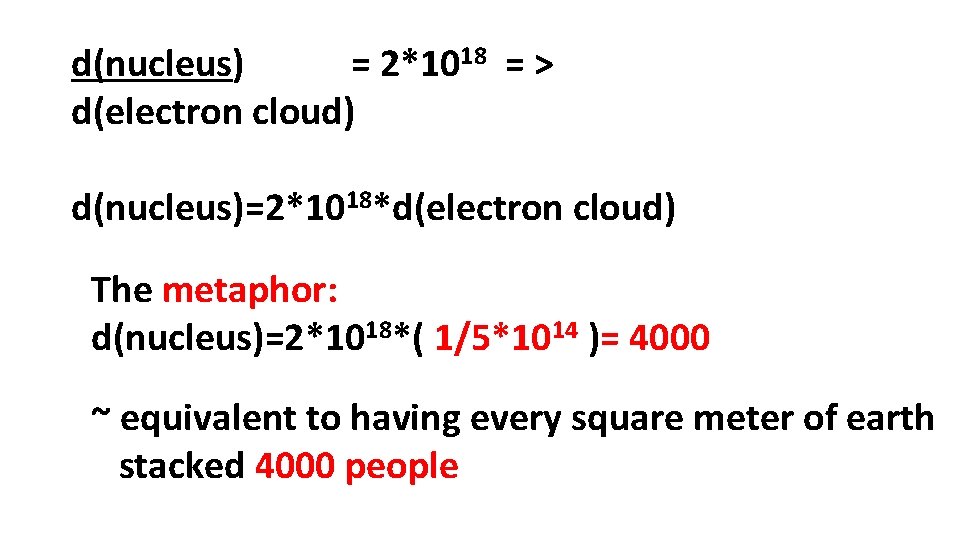
d(nucleus) = 2*1018 = > d(electron cloud) d(nucleus)=2*1018*d(electron cloud) The metaphor: d(nucleus)=2*1018*( 1/5*1014 )= 4000 ~ equivalent to having every square meter of earth stacked 4000 people
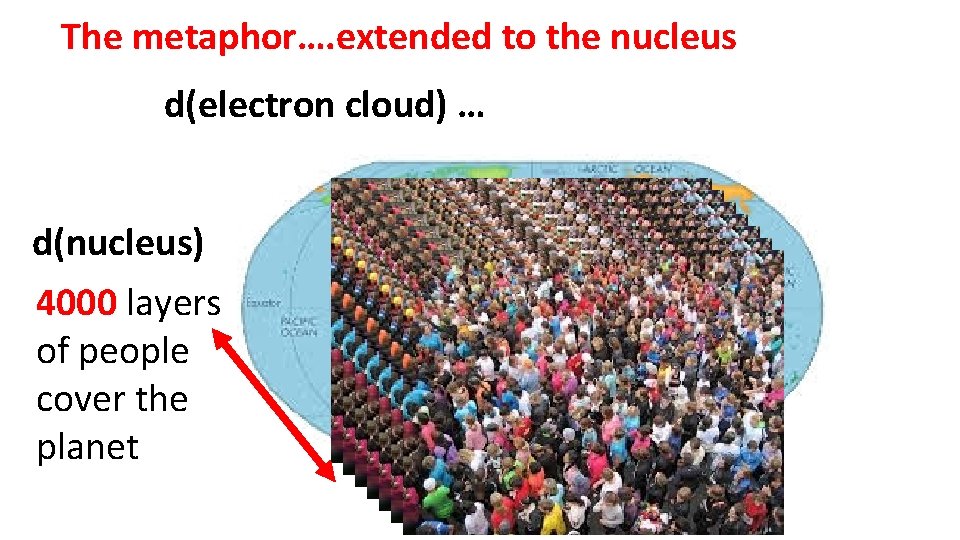
The metaphor…. extended to the nucleus d(electron cloud) … d(nucleus) 4000 layers of people cover the planet
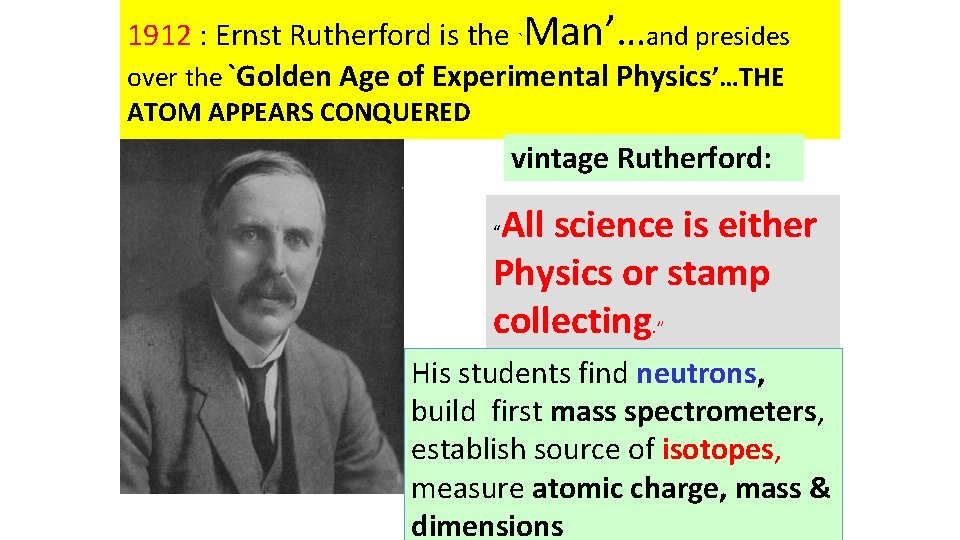
1912 : Ernst Rutherford is the `Man’…and presides over the `Golden Age of Experimental Physics’…THE ATOM APPEARS CONQUERED vintage Rutherford: All science is either Physics or stamp collecting. ” “ His students find neutrons, build first mass spectrometers, establish source of isotopes, measure atomic charge, mass & dimensions
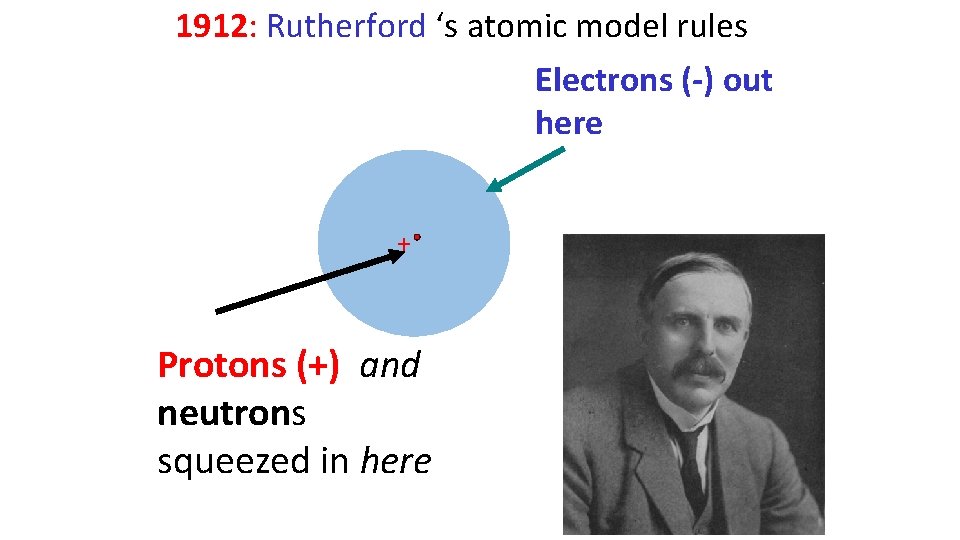
1912: Rutherford ‘s atomic model rules Electrons (-) out here + Protons (+) and neutrons squeezed in here
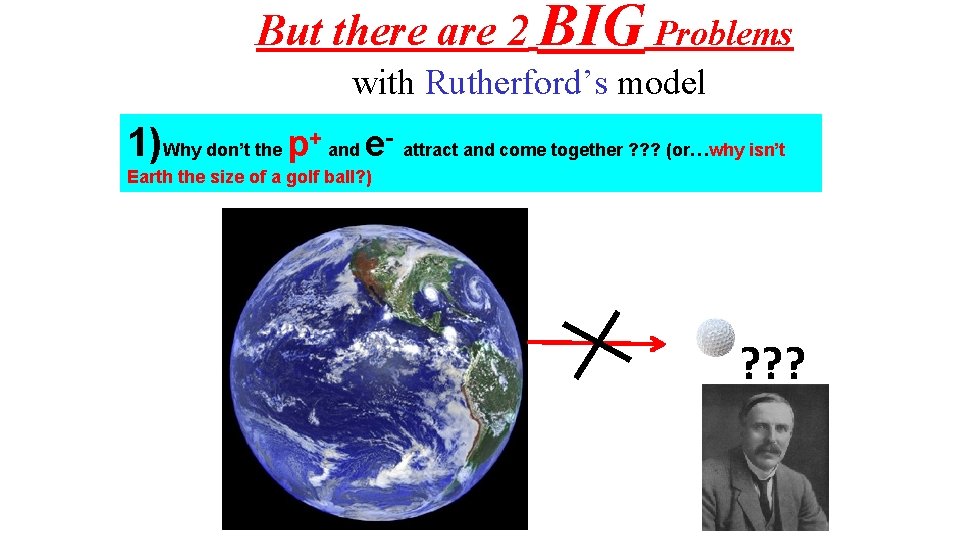
But there are 2 BIG Problems with Rutherford’s model 1)Why don’t the p+ and e- attract and come together ? ? ? (or…why isn’t Earth the size of a golf ball? ) ? ? ?
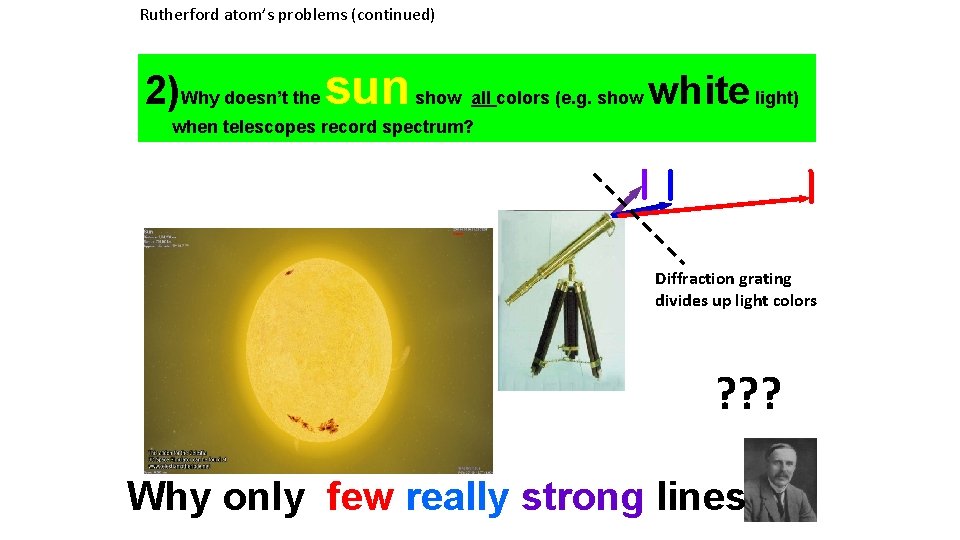
Rutherford atom’s problems (continued) 2)Why doesn’t the sun show all colors (e. g. show white light) when telescopes record spectrum? Diffraction grating divides up light colors ? ? ? Why only few really strong lines
BIGGER third AN EVEN PROBLEM FOR RUTHERFORD’S LAB 3) The photoelectric effect problem and the trouble with theory of light Help!!!!
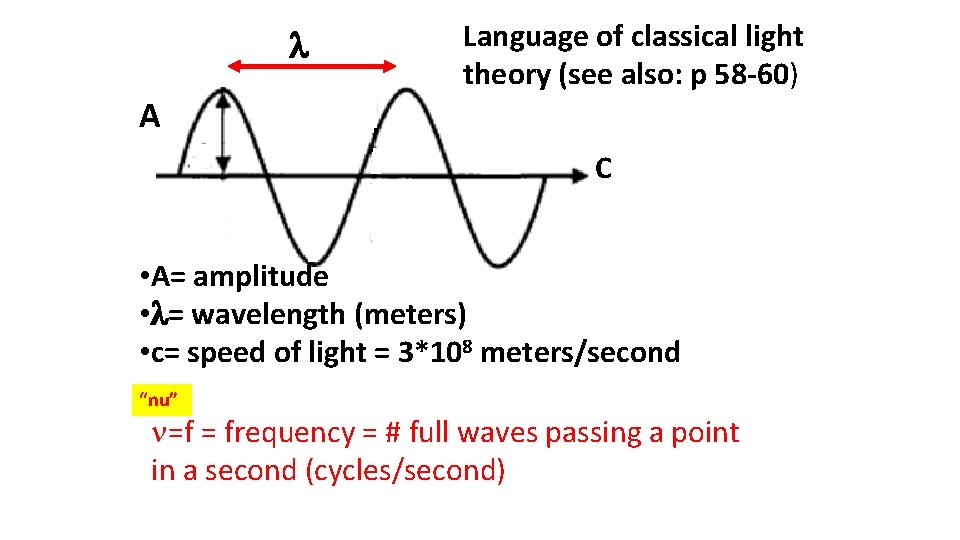
Language of classical light theory (see also: p 58 -60) A C • A= amplitude • = wavelength (meters) • c= speed of light = 3*108 meters/second “nu” =f = frequency = # full waves passing a point in a second (cycles/second)
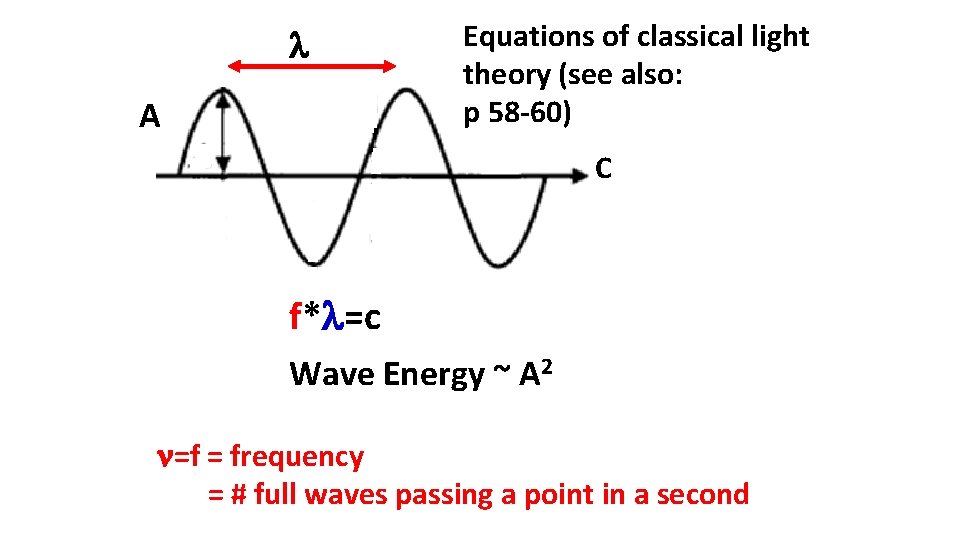
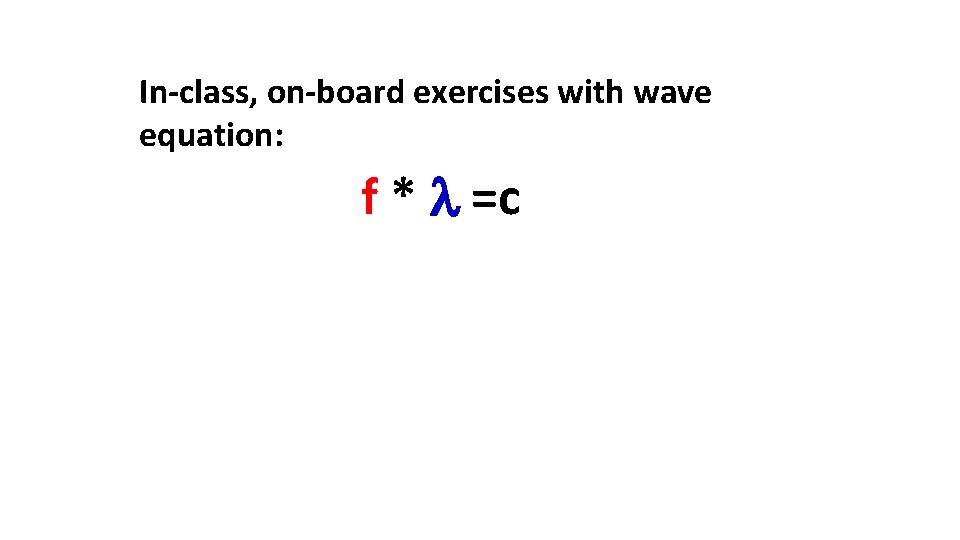
A Equations of classical light theory (see also: p 58 -60) C f* =c Wave Energy ~ A 2 =f = frequency = # full waves passing a point in a second
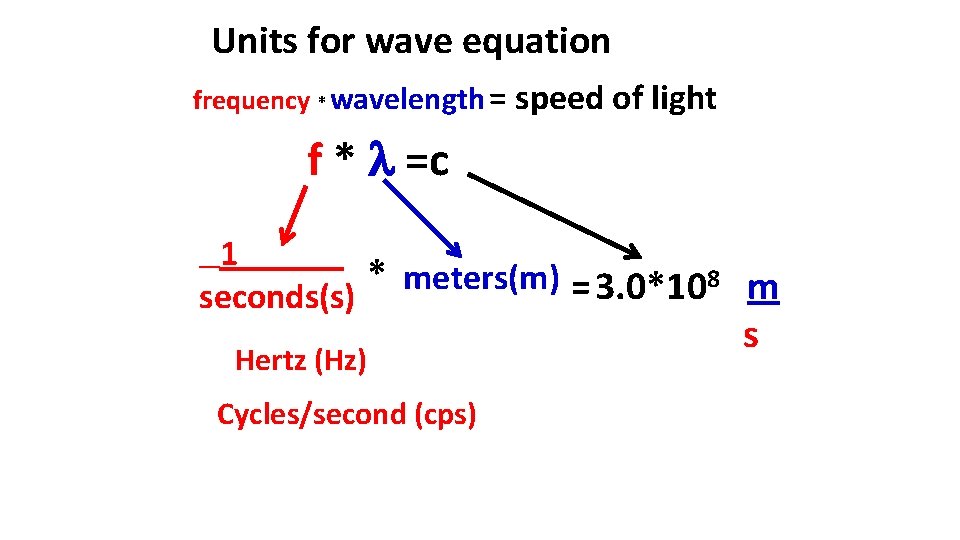
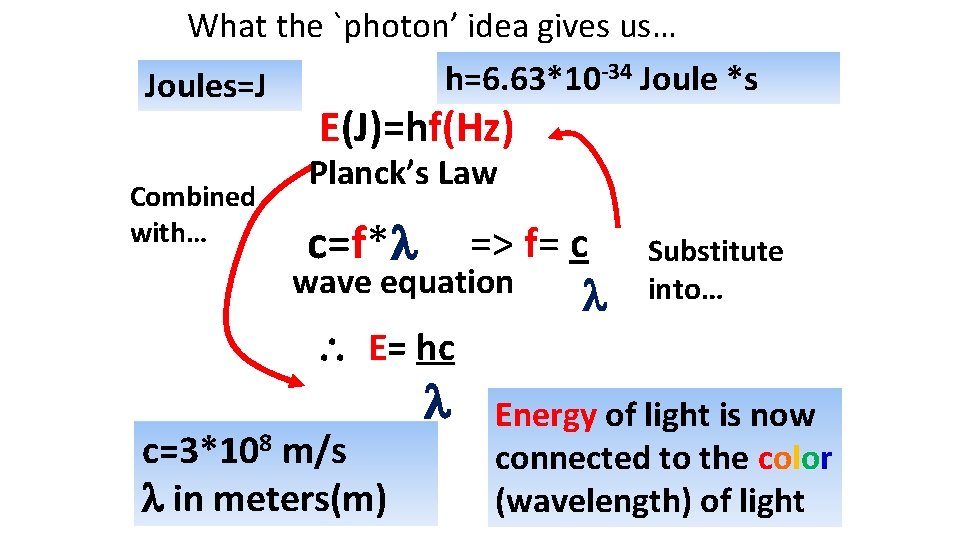
Units for wave equation frequency * wavelength = speed of light f * =c 1 * meters(m) = 3. 0*108 m seconds(s) Hertz (Hz) Cycles/second (cps) s
In-class, on-board exercises with wave equation: f * =c
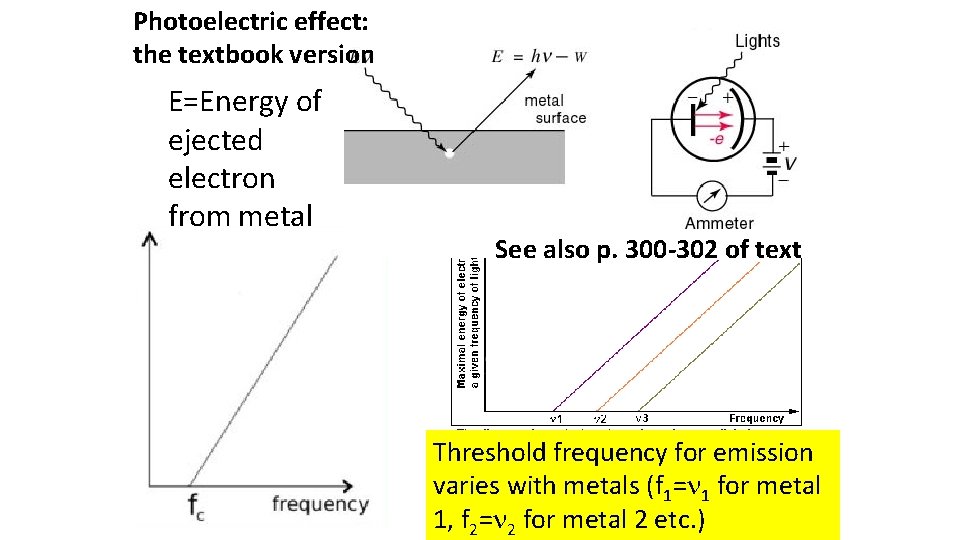
Photoelectric effect: the textbook version E=Energy of ejected electron from metal See also p. 300 -302 of text Threshold frequency for emission varies with metals (f 1= 1 for metal 1, f 2= 2 for metal 2 etc. )
The usual textbook explanations of the photoelectric effect mask the really bizarre, underlying meaning of The Mickey Mouse the experiment. alternative:
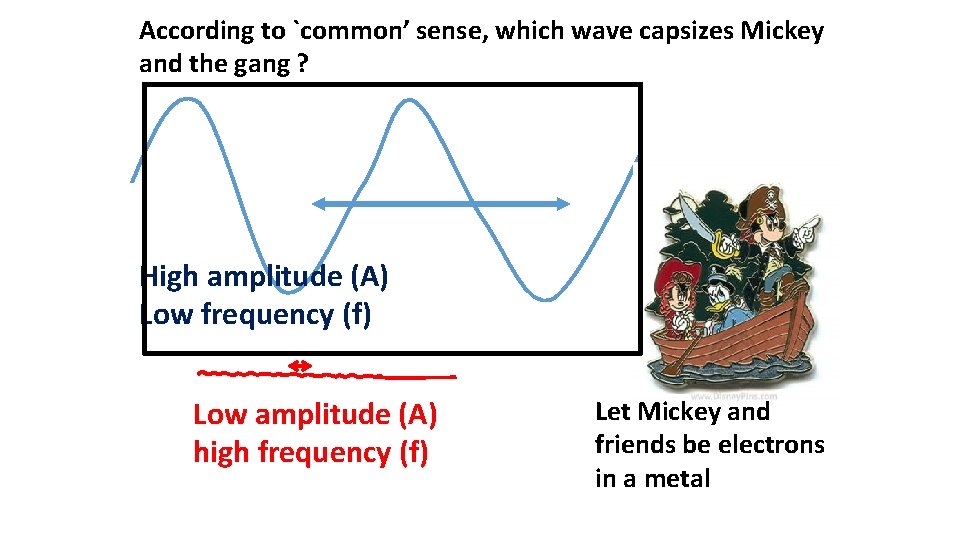
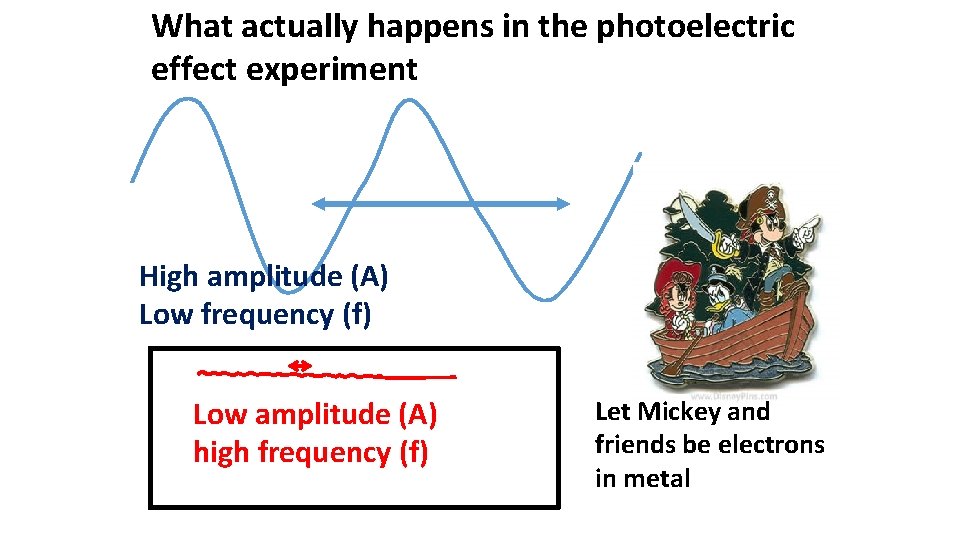
According to `common’ sense, which wave capsizes Mickey and the gang ? High amplitude (A) Low frequency (f) Low amplitude (A) high frequency (f) Let Mickey and friends be electrons in a metal
What actually happens in the photoelectric effect experiment High amplitude (A) Low frequency (f) Low amplitude (A) high frequency (f) Let Mickey and friends be electrons in metal
WHAT THE PHOTOELECTRIC EFFECT MEANS: (SEE PAGE 299 -304) 1) THE ENERGY, E, OF LIGHT IS NOT CONNECTED TO AMPLITUDE
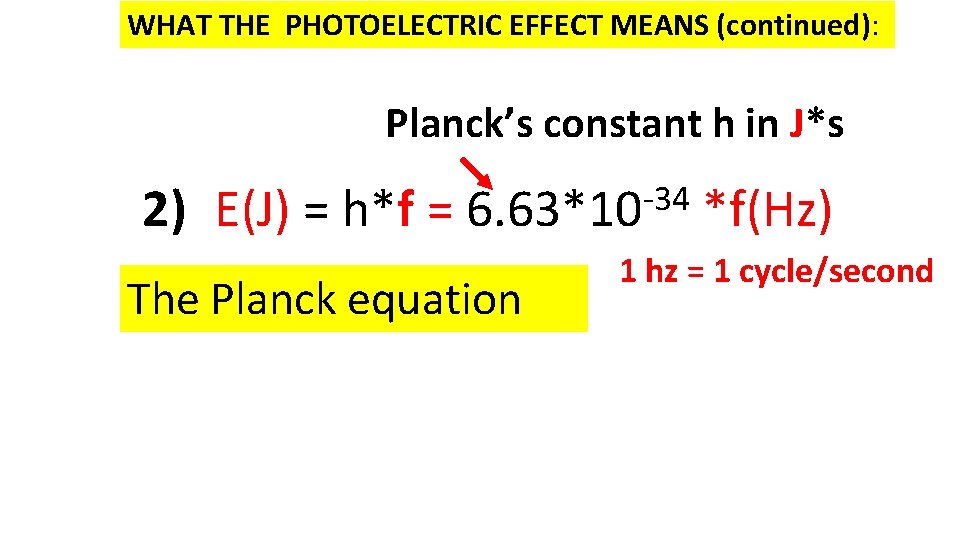
WHAT THE PHOTOELECTRIC EFFECT MEANS (continued): Planck’s constant h in J*s 2) E(J) = h*f = -34 6. 63*10 The Planck equation *f(Hz) 1 hz = 1 cycle/second
WHAT THE PHOTOELECTRIC EFFECT MEANS (continued) 3) LIGHT IS NOT A WAVE !!!!
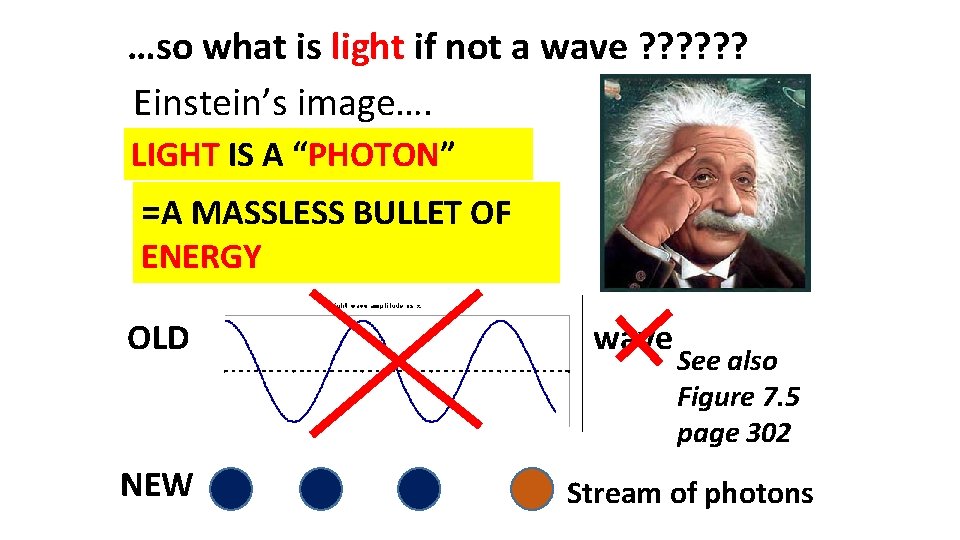
…so what is light if not a wave ? ? ? Einstein’s image…. LIGHT IS A “PHOTON” =A MASSLESS BULLET OF ENERGY OLD NEW wave See also Figure 7. 5 page 302 Stream of photons
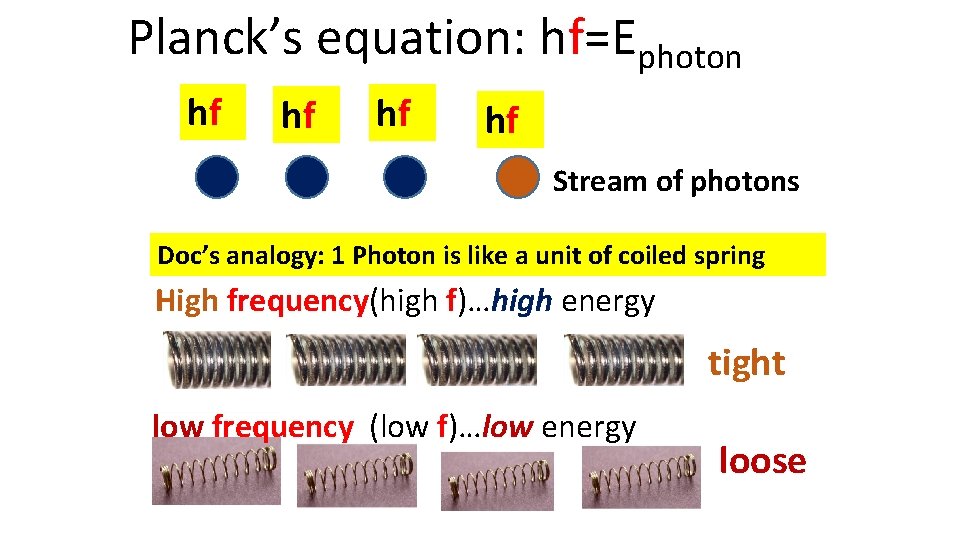
Planck’s equation: hf=Ephoton hf hf Stream of photons Doc’s analogy: 1 Photon is like a unit of coiled spring High frequency(high f)…high energy tight low frequency (low f)…low energy loose
What the `photon’ idea gives us… -34 Joule *s h=6. 63*10 Joules=J E(J)=hf(Hz) Combined with… Planck’s Law c=f* => f= c wave equation Substitute into… E= hc c=3*108 m/s in meters(m) Energy of light is now connected to the color (wavelength) of light
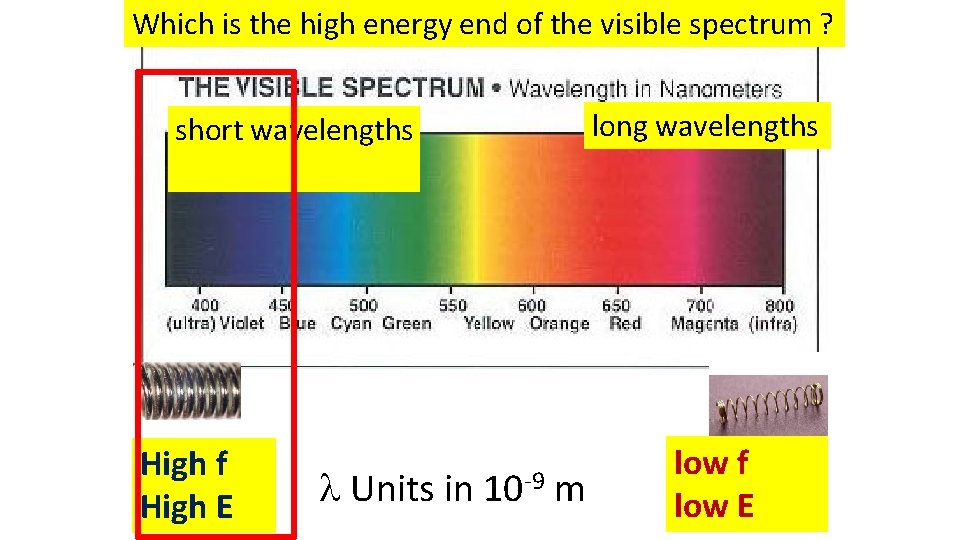
Which is the high energy end of the visible spectrum ? short wavelengths High f High E Units in 10 -9 m long wavelengths low f low E