
More Data Structures Part 1 Stacks 1 Stack
![else { // make a new array with double previous capacity int[] new. Stack](https://slidetodoc.com/presentation_image_h2/0c515d449bab6ff8c723e7adac6039c9/image-25.jpg "else { // make a new array with double previous capacity int[] new. Stack")
![else { // make a new array with greater capacity int[] new. Stack =](https://slidetodoc.com/presentation_image_h2/0c515d449bab6ff8c723e7adac6039c9/image-27.jpg "else { // make a new array with greater capacity int[] new. Stack =")
- Slides: 44
More Data Structures (Part 1) Stacks 1
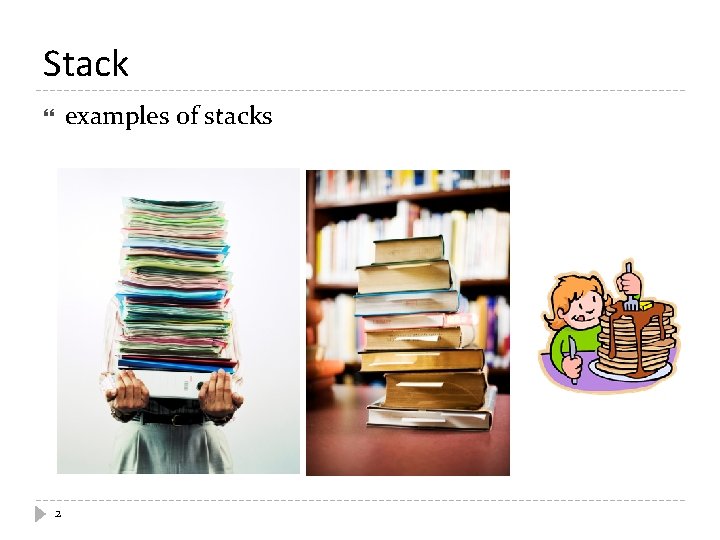
Stack examples of stacks 2
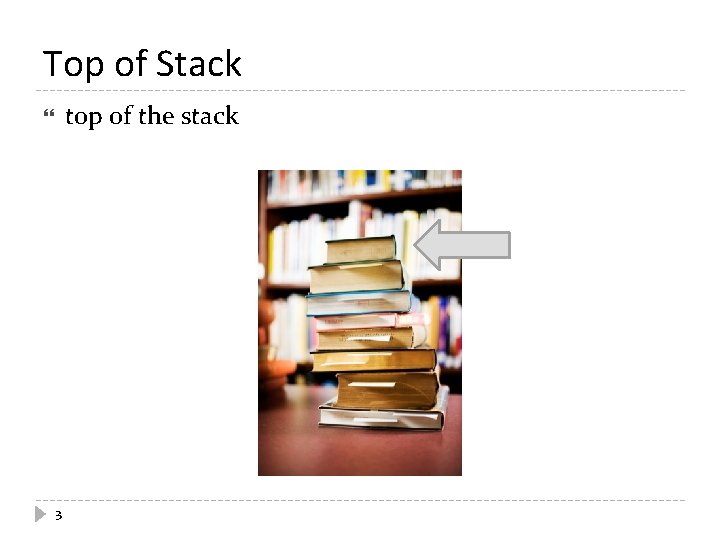
Top of Stack top of the stack 3
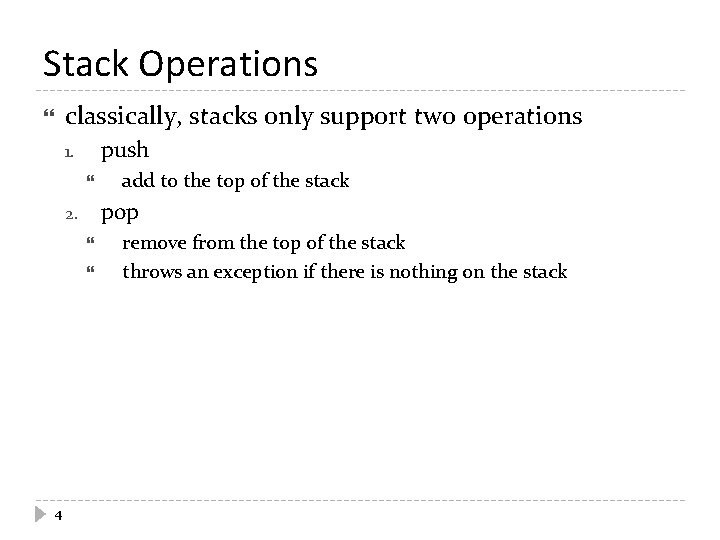
Stack Operations classically, stacks only support two operations push 1. pop 2. 4 add to the top of the stack remove from the top of the stack throws an exception if there is nothing on the stack
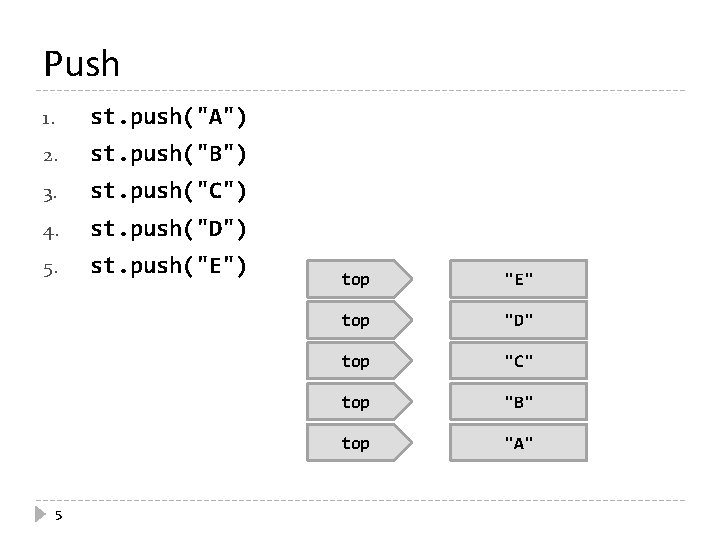
Push 1. st. push("A") 2. st. push("B") 3. st. push("C") 4. st. push("D") 5. st. push("E") 5 top "E" top "D" top "C" top "B" top "A"
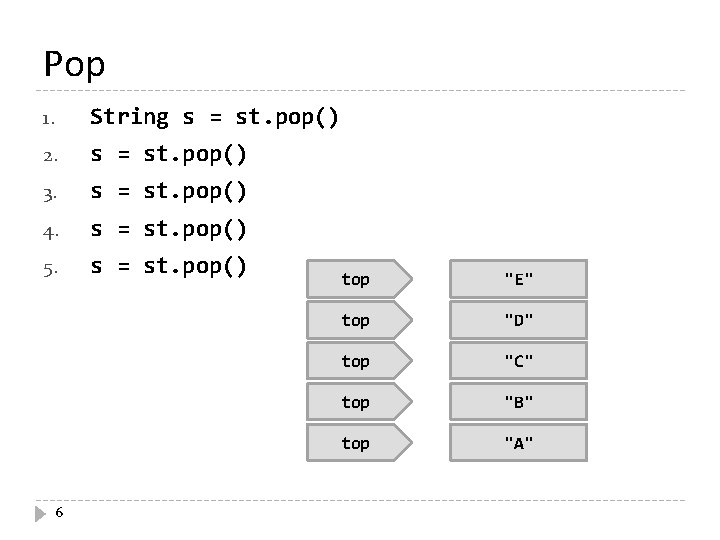
Pop 1. String s = st. pop() 2. s = st. pop() 3. s = st. pop() 4. s = st. pop() 5. s = st. pop() 6 top "E" top "D" top "C" top "B" top "A"
Applications stacks are used widely in computer science and computer engineering 7 undo/redo widely used in parsing a call stack is used to store information about the active methods in a Java program convert a recursive method into a non-recursive one
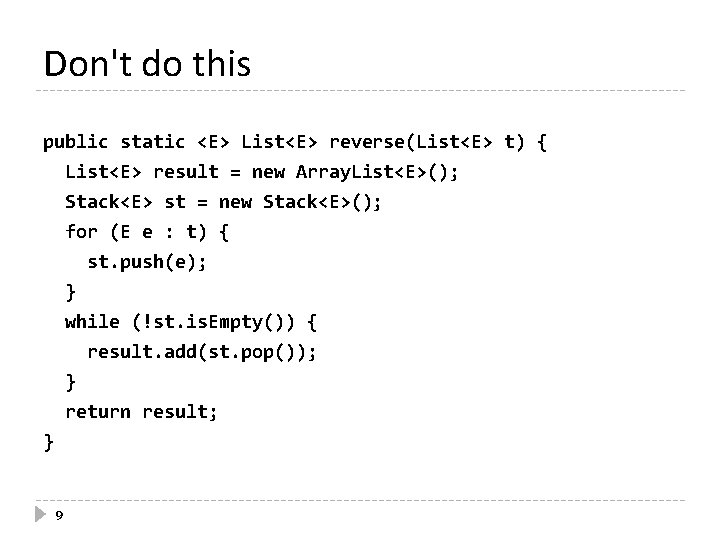
Example: Reversing a sequence a silly and usually inefficient way to reverse a sequence is to use a stack 8
Don't do this public static <E> List<E> reverse(List<E> t) { List<E> result = new Array. List<E>(); Stack<E> st = new Stack<E>(); for (E e : t) { st. push(e); } while (!st. is. Empty()) { result. add(st. pop()); } return result; } 9
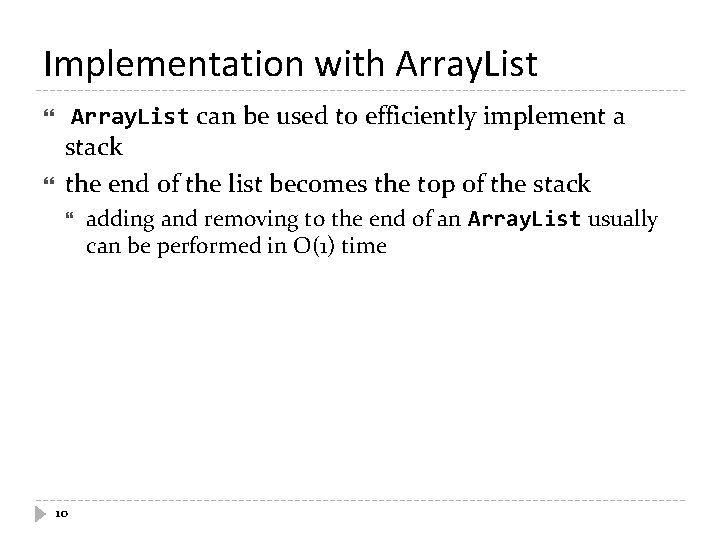
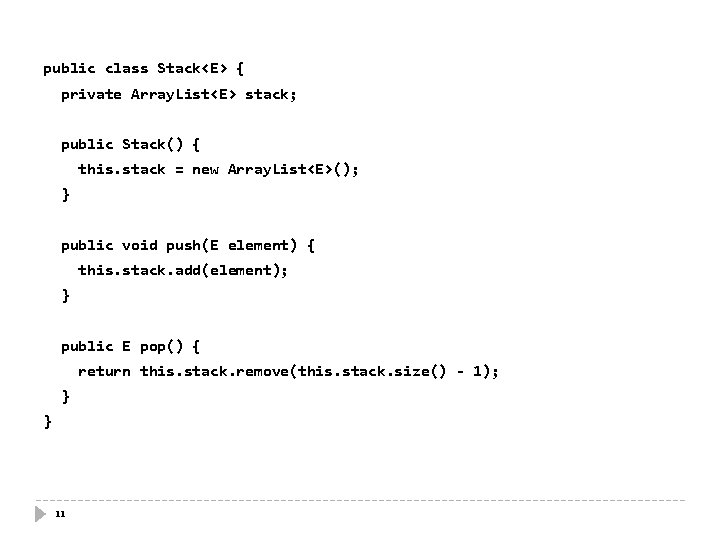
Implementation with Array. List can be used to efficiently implement a stack the end of the list becomes the top of the stack 10 adding and removing to the end of an Array. List usually can be performed in O(1) time
public class Stack<E> { private Array. List<E> stack; public Stack() { this. stack = new Array. List<E>(); } public void push(E element) { this. stack. add(element); } public E pop() { return this. stack. remove(this. stack. size() - 1); } } 11
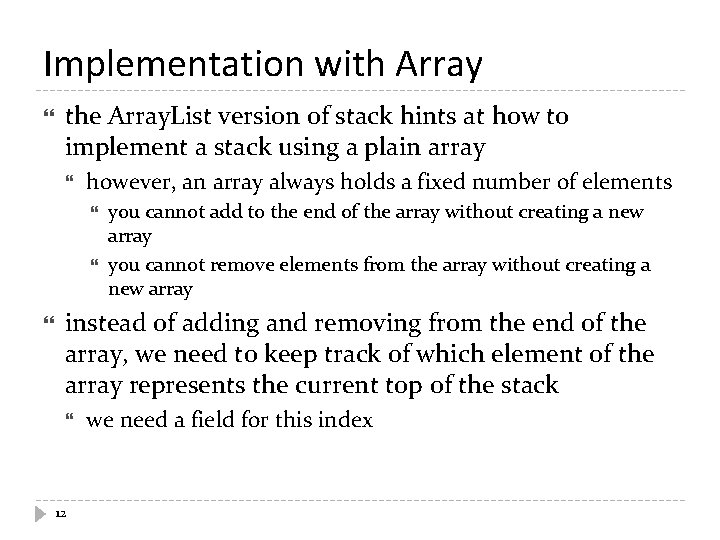
Implementation with Array the Array. List version of stack hints at how to implement a stack using a plain array however, an array always holds a fixed number of elements you cannot add to the end of the array without creating a new array you cannot remove elements from the array without creating a new array instead of adding and removing from the end of the array, we need to keep track of which element of the array represents the current top of the stack 12 we need a field for this index
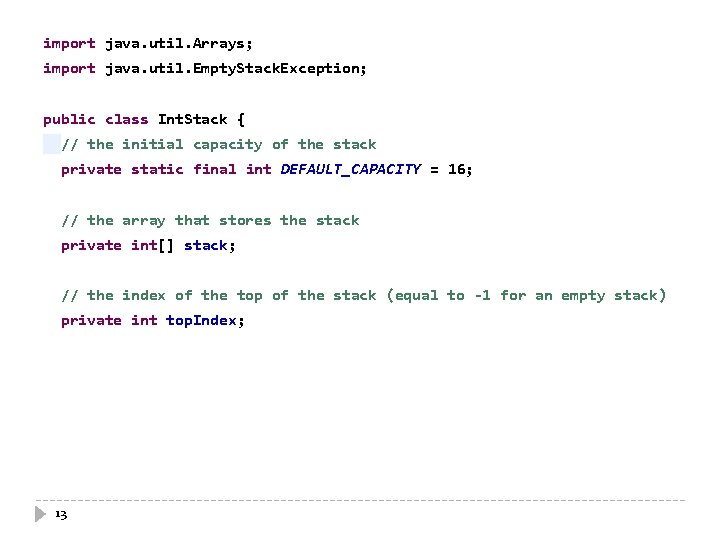
import java. util. Arrays; import java. util. Empty. Stack. Exception; public class Int. Stack { // the initial capacity of the stack private static final int DEFAULT_CAPACITY = 16; // the array that stores the stack private int[] stack; // the index of the top of the stack (equal to -1 for an empty stack) private int top. Index; 13
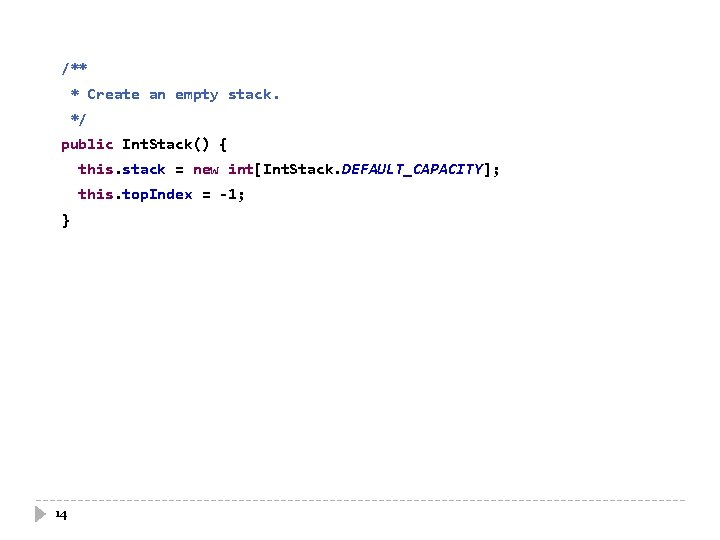
/** * Create an empty stack. */ public Int. Stack() { this. stack = new int[Int. Stack. DEFAULT_CAPACITY]; this. top. Index = -1; } 14
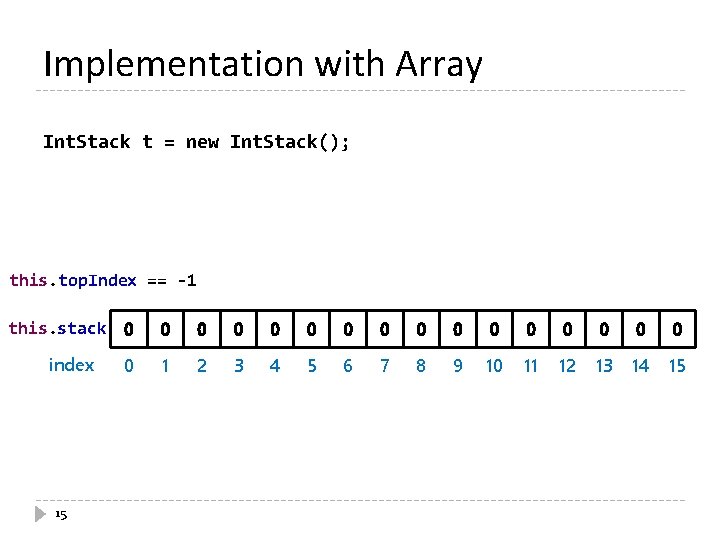
Implementation with Array Int. Stack t = new Int. Stack(); this. top. Index == -1 this. stack 0 0 0 0 index 1 2 3 4 5 6 7 8 9 10 11 12 13 14 15 15 0
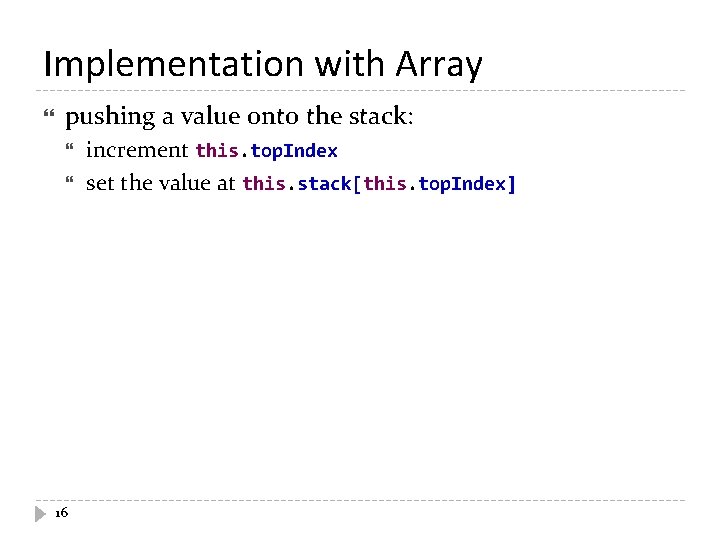
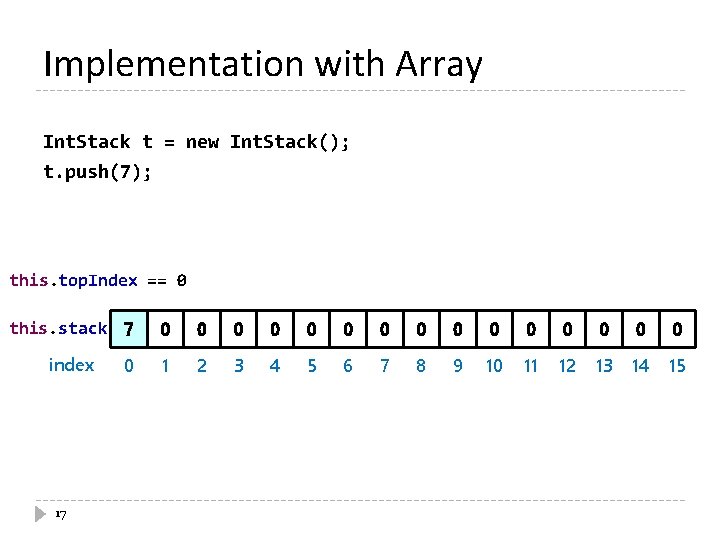
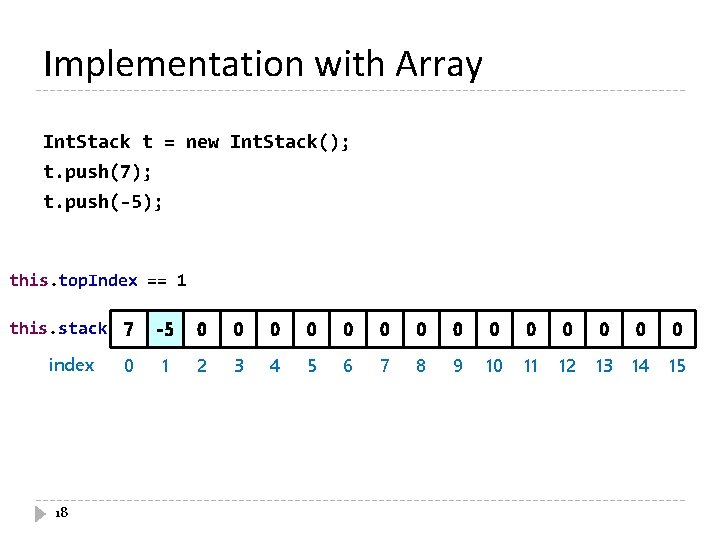
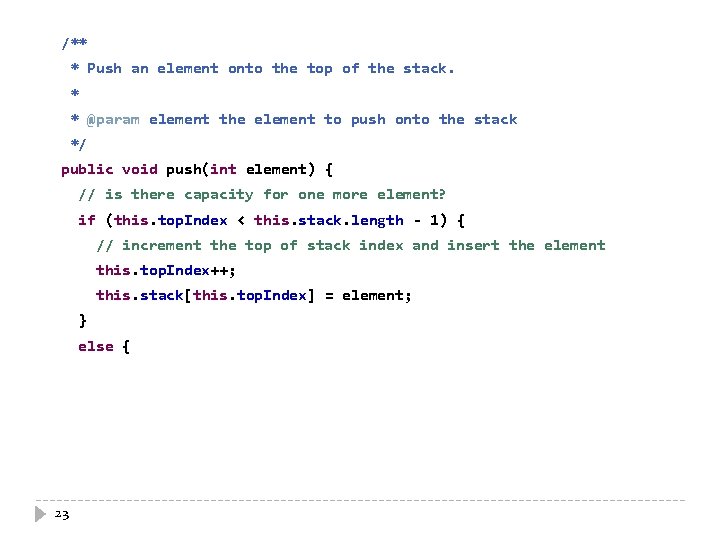
Implementation with Array pushing a value onto the stack: 16 increment this. top. Index set the value at this. stack[this. top. Index]
Implementation with Array Int. Stack t = new Int. Stack(); t. push(7); this. top. Index == 0 this. stack 7 0 0 0 0 index 1 2 3 4 5 6 7 8 9 10 11 12 13 14 15 17 0
Implementation with Array Int. Stack t = new Int. Stack(); t. push(7); t. push(-5); this. top. Index == 1 this. stack 7 -5 0 0 0 0 index 1 2 3 4 5 6 7 8 9 10 11 12 13 14 15 18 0
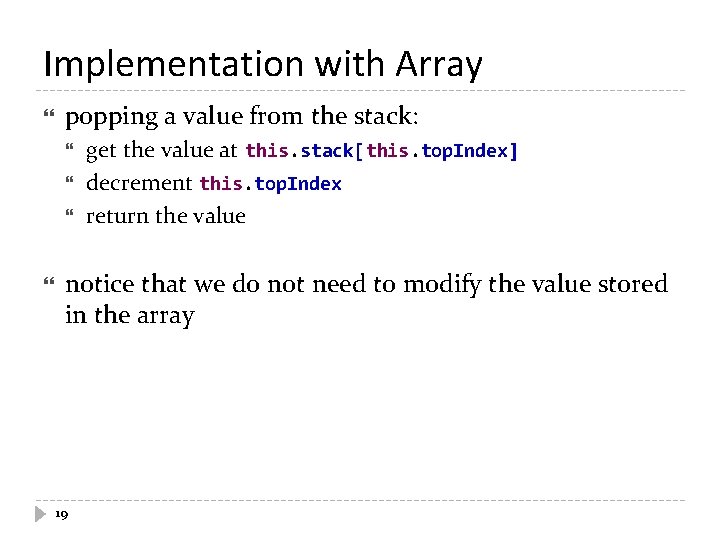
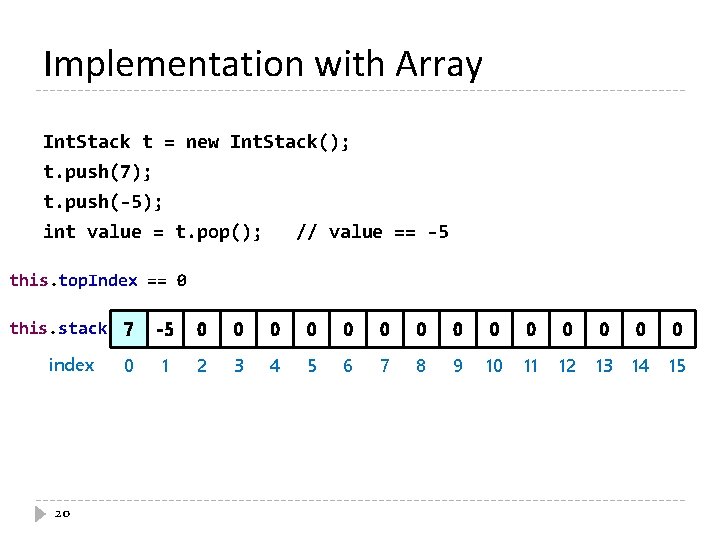
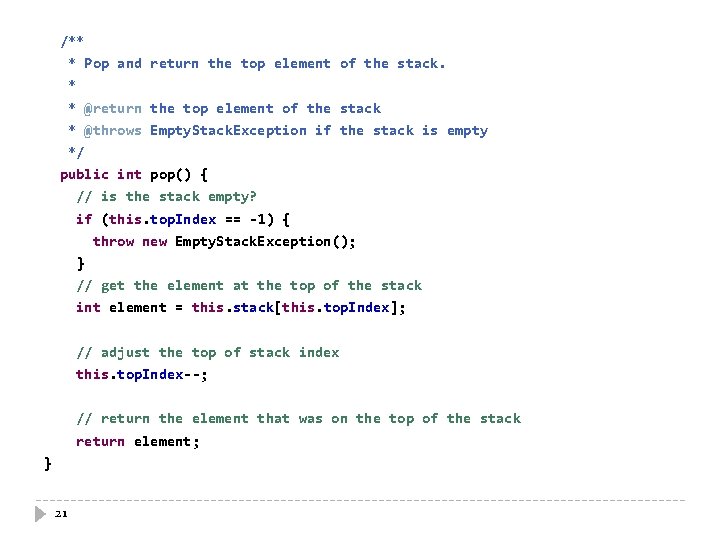
Implementation with Array popping a value from the stack: get the value at this. stack[this. top. Index] decrement this. top. Index return the value notice that we do not need to modify the value stored in the array 19
Implementation with Array Int. Stack t = new Int. Stack(); t. push(7); t. push(-5); int value = t. pop(); // value == -5 this. top. Index == 0 this. stack 7 -5 0 0 0 0 index 1 2 3 4 5 6 7 8 9 10 11 12 13 14 15 20 0
/** * Pop and return the top element of the stack. * * @return the top element of the stack * @throws Empty. Stack. Exception if the stack is empty */ public int pop() { // is the stack empty? if (this. top. Index == -1) { throw new Empty. Stack. Exception(); } // get the element at the top of the stack int element = this. stack[this. top. Index]; // adjust the top of stack index this. top. Index--; // return the element that was on the top of the stack return element; } 21
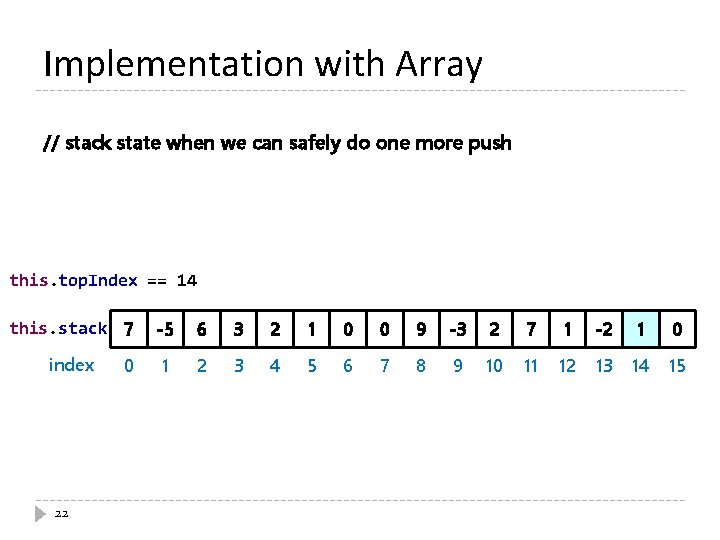
Implementation with Array // stack state when we can safely do one more push this. top. Index == 14 this. stack 7 -5 6 3 2 1 0 0 9 -3 2 7 1 -2 1 0 index 1 2 3 4 5 6 7 8 9 10 11 12 13 14 15 22 0
/** * Push an element onto the top of the stack. * * @param element the element to push onto the stack */ public void push(int element) { // is there capacity for one more element? if (this. top. Index < this. stack. length - 1) { // increment the top of stack index and insert the element this. top. Index++; this. stack[this. top. Index] = element; } else { 23
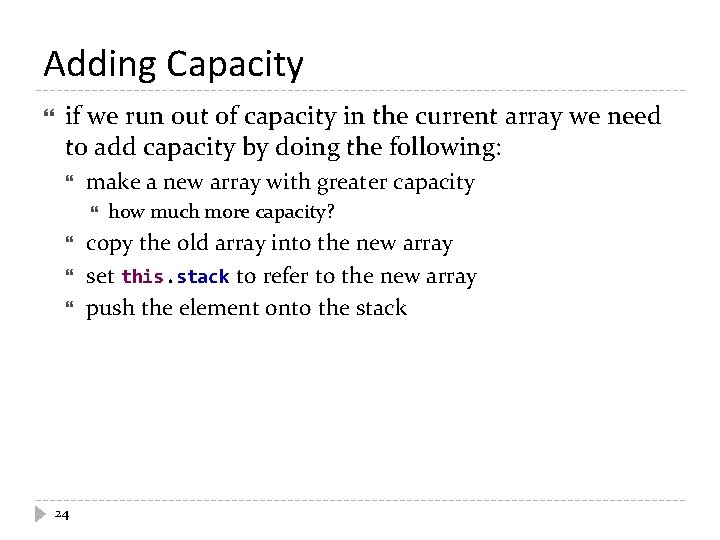
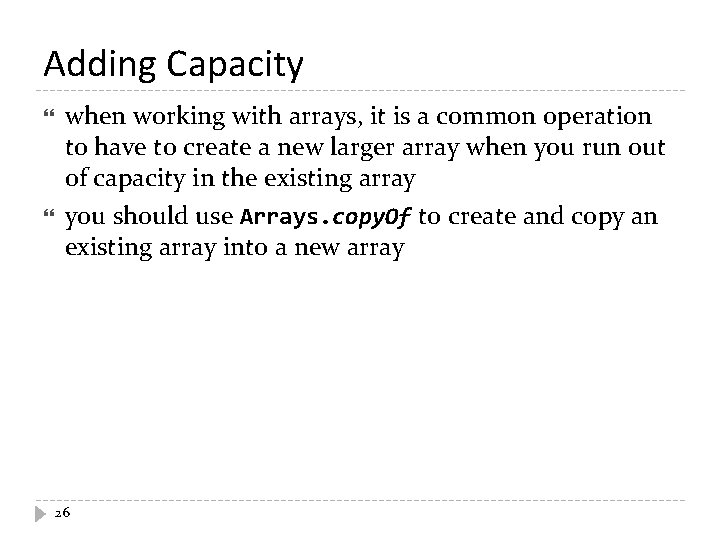
Adding Capacity if we run out of capacity in the current array we need to add capacity by doing the following: make a new array with greater capacity 24 how much more capacity? copy the old array into the new array set this. stack to refer to the new array push the element onto the stack
else { // make a new array with double previous capacity int[] new. Stack = new int[this. stack. length * 2]; // copy the old array into the new array for (int i = 0; i < this. stack. length; i++) { new. Stack[i] = this. stack[i]; } // refer to the new array and push the element onto the stack this. stack = new. Stack; this. push(element); } } 25
Adding Capacity when working with arrays, it is a common operation to have to create a new larger array when you run out of capacity in the existing array you should use Arrays. copy. Of to create and copy an existing array into a new array 26
else { // make a new array with greater capacity int[] new. Stack = new int[this. stack. length * 2]; // copy the old array into the new array int[] new. Stack = Arrays. copy. Of(this. stack, this. stack. length * 2); for (int i = 0; i < this. stack. length; i++) { new. Stack[i] = this. stack[i]; } // refer to the new array and push the element onto the stack this. stack = new. Stack; this. push(element); } } 27
More Data Structures (Part 2) Queues 28
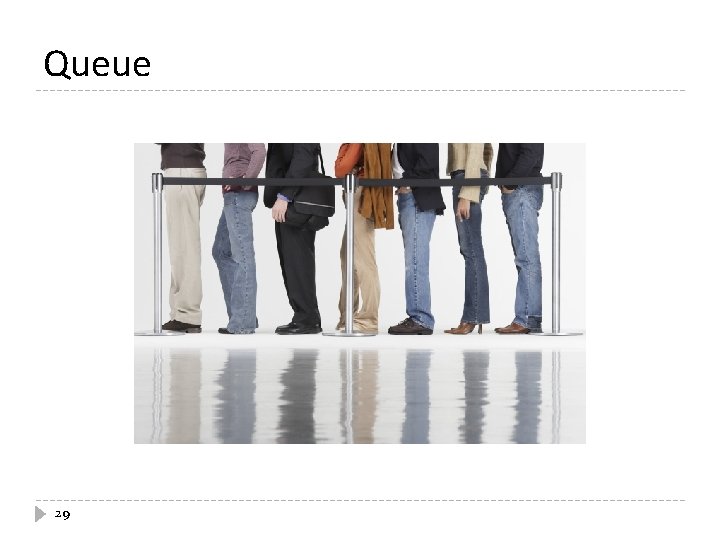
Queue 29
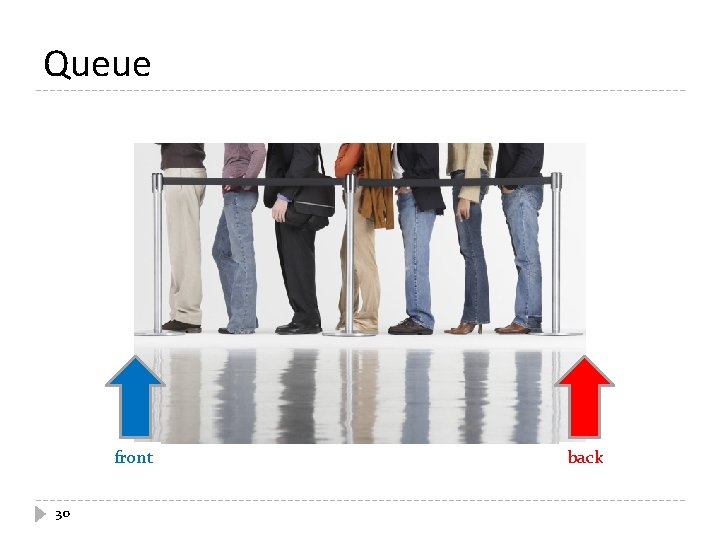
Queue front 30 back
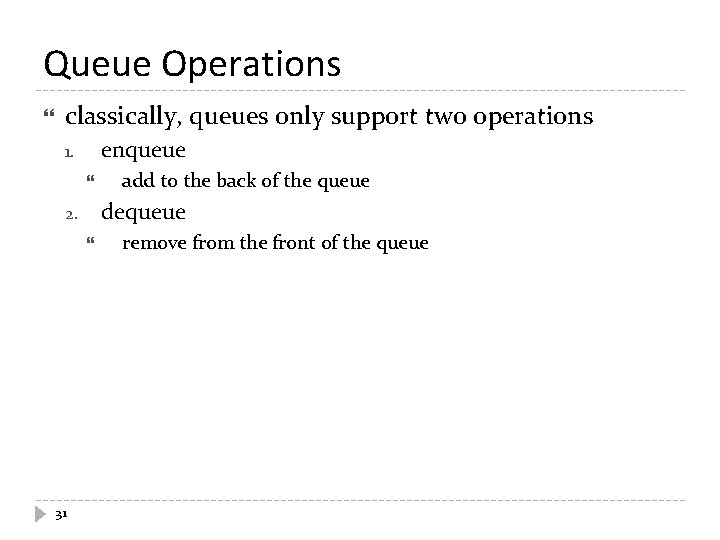
Queue Operations classically, queues only support two operations enqueue 1. dequeue 2. 31 add to the back of the queue remove from the front of the queue
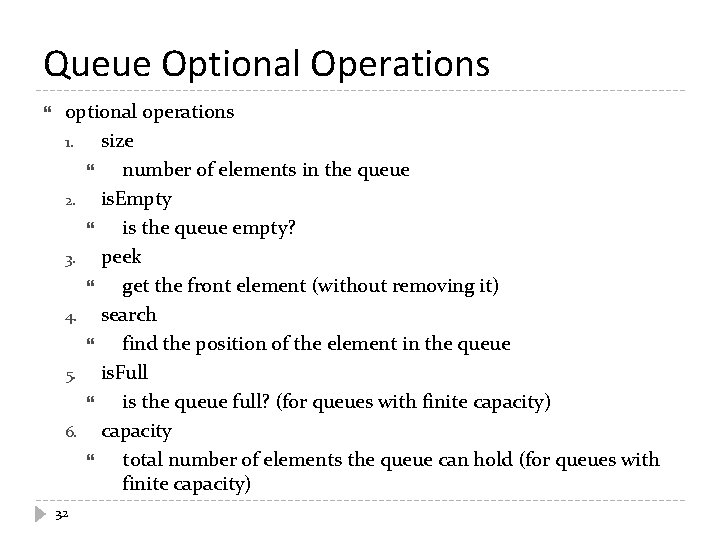
Queue Optional Operations optional operations 1. size number of elements in the queue 2. is. Empty is the queue empty? 3. peek get the front element (without removing it) 4. search find the position of the element in the queue 5. is. Full is the queue full? (for queues with finite capacity) 6. capacity total number of elements the queue can hold (for queues with finite capacity) 32
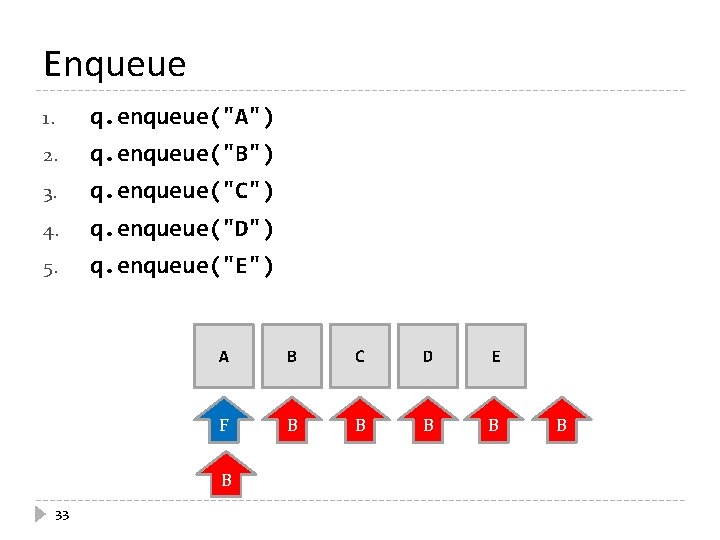
Enqueue 1. q. enqueue("A") 2. q. enqueue("B") 3. q. enqueue("C") 4. q. enqueue("D") 5. q. enqueue("E") A B C D E F B B B 33 B
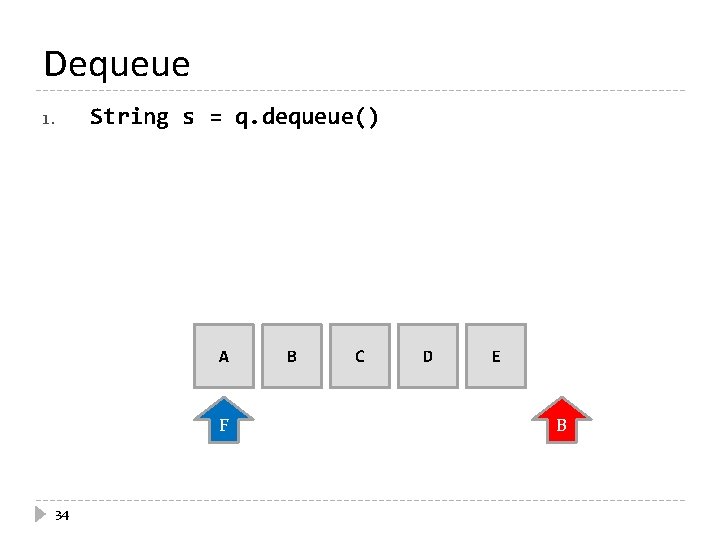
Dequeue String s = q. dequeue() 1. A F 34 B C D E B
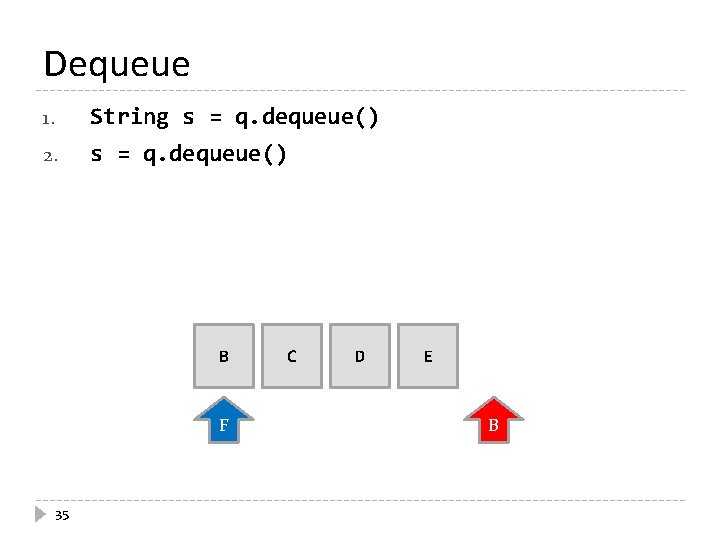
Dequeue 1. String s = q. dequeue() 2. s = q. dequeue() B F 35 C D E B
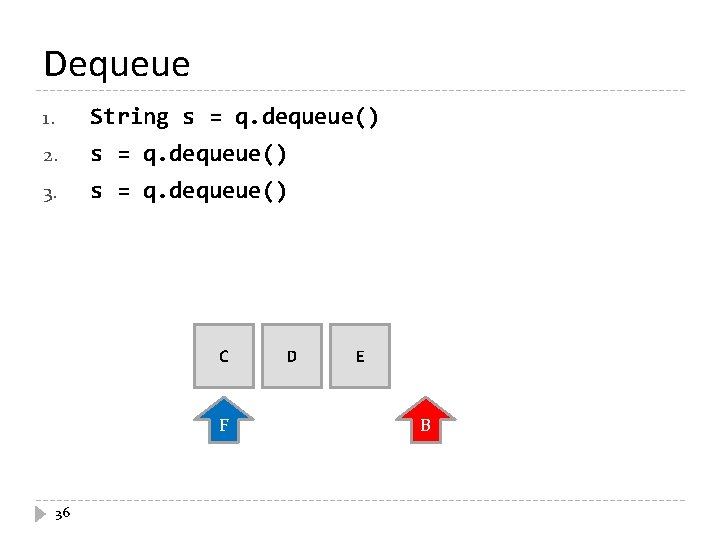
Dequeue 1. String s = q. dequeue() 2. s = q. dequeue() 3. s = q. dequeue() C F 36 D E B
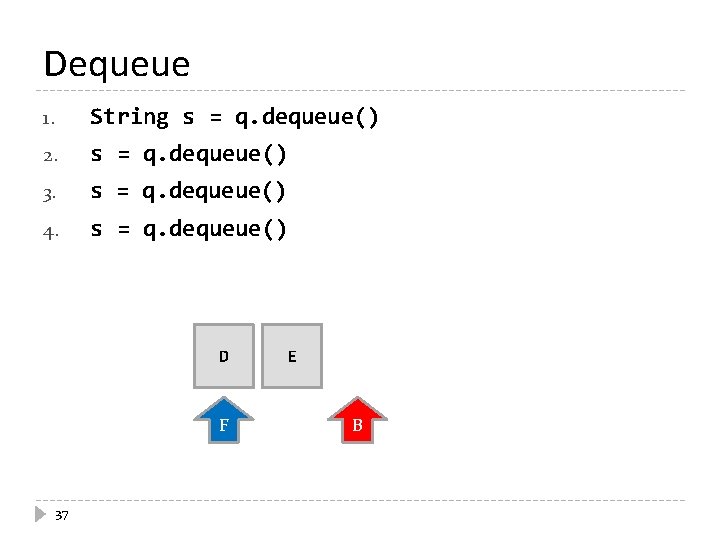
Dequeue 1. String s = q. dequeue() 2. s = q. dequeue() 3. s = q. dequeue() 4. s = q. dequeue() D F 37 E B
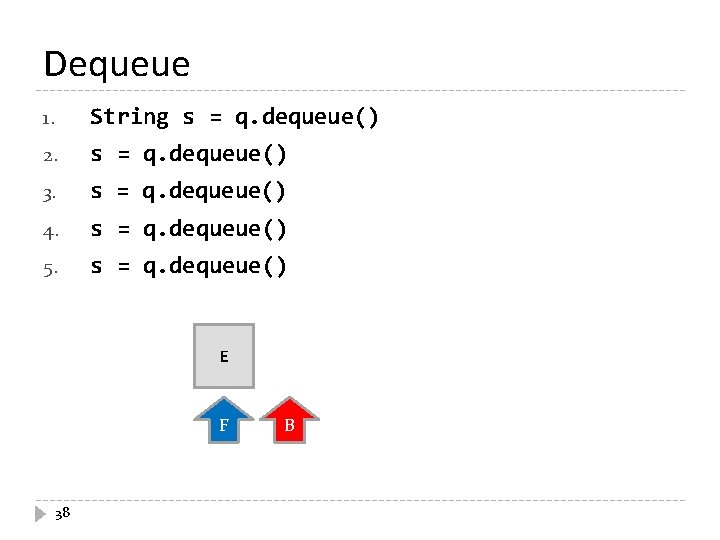
Dequeue 1. String s = q. dequeue() 2. s = q. dequeue() 3. s = q. dequeue() 4. s = q. dequeue() 5. s = q. dequeue() E F 38 B
FIFO queue is a First-In-First-Out (FIFO) data structure 39 the first element enqueued in the queue is the first element that can be accessed from the queue
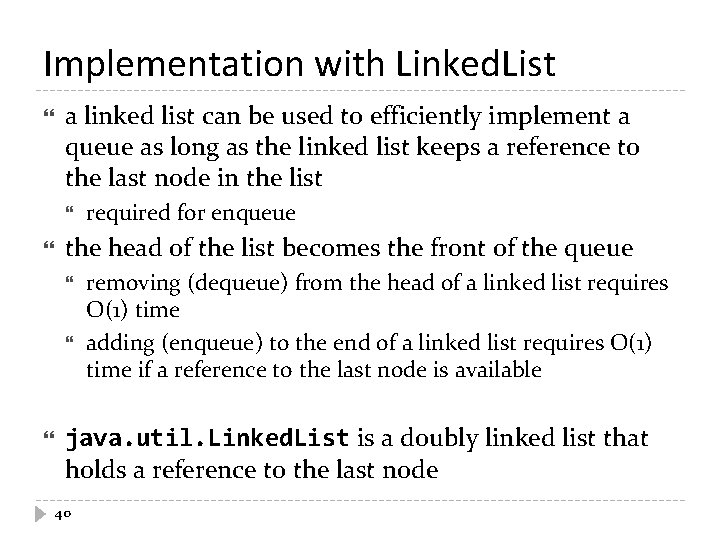
Implementation with Linked. List a linked list can be used to efficiently implement a queue as long as the linked list keeps a reference to the last node in the list the head of the list becomes the front of the queue required for enqueue removing (dequeue) from the head of a linked list requires O(1) time adding (enqueue) to the end of a linked list requires O(1) time if a reference to the last node is available java. util. Linked. List is a doubly linked list that holds a reference to the last node 40
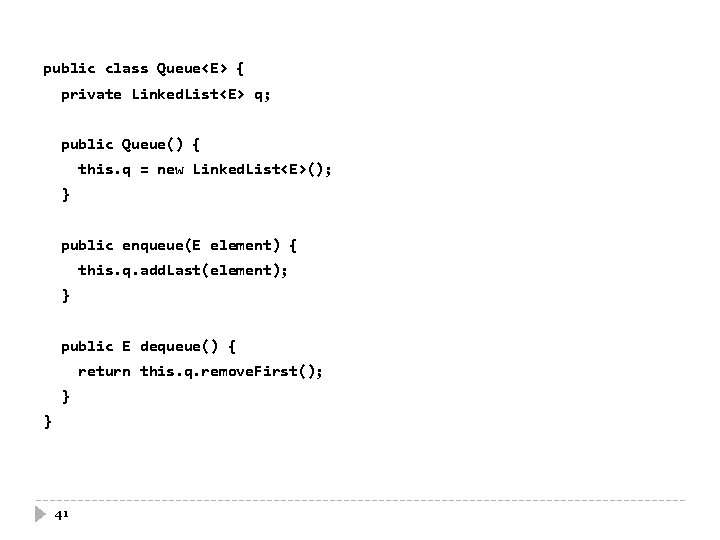
public class Queue<E> { private Linked. List<E> q; public Queue() { this. q = new Linked. List<E>(); } public enqueue(E element) { this. q. add. Last(element); } public E dequeue() { return this. q. remove. First(); } } 41
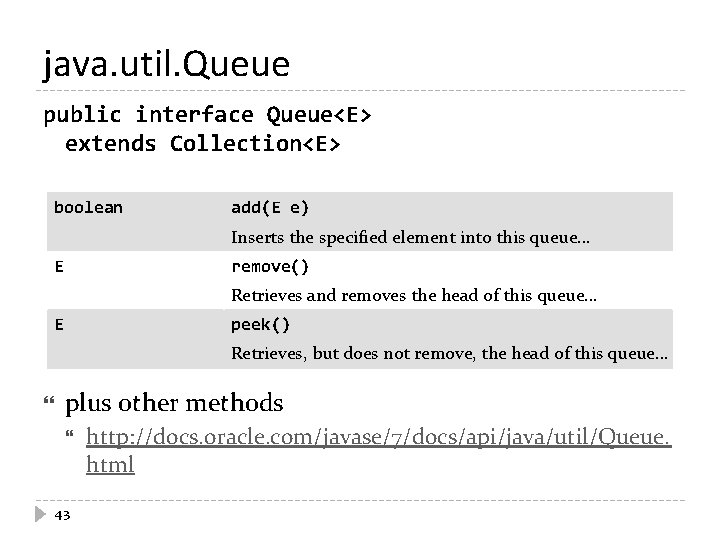
Implementation with Linked. List note that there is no need to implement your own queue as there is an existing interface 42 the interface does not use the names enqueue and dequeue however
java. util. Queue public interface Queue<E> extends Collection<E> boolean add(E e) Inserts the specified element into this queue. . . E remove() Retrieves and removes the head of this queue. . . E peek() Retrieves, but does not remove, the head of this queue. . . plus other methods 43 http: //docs. oracle. com/javase/7/docs/api/java/util/Queue. html
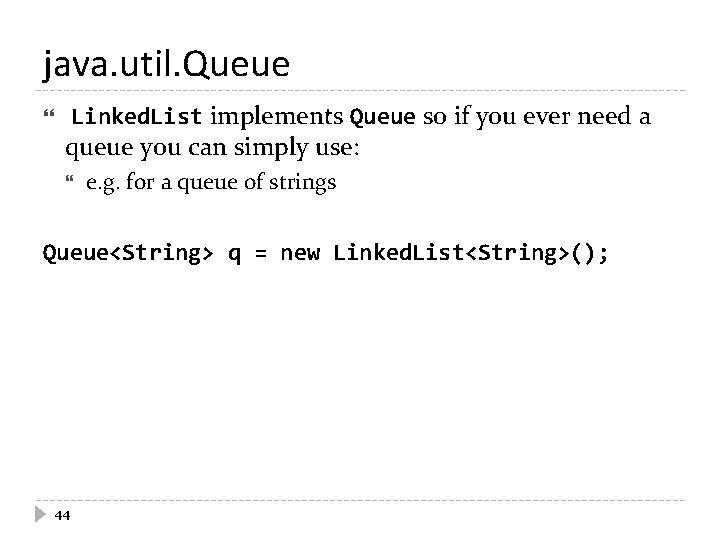
java. util. Queue implements Queue so if you ever need a queue you can simply use: Linked. List e. g. for a queue of strings Queue<String> q = new Linked. List<String>(); 44