
More DAC architectures Current steering DACs 1 Currentsteering

- Slides: 33
More DAC architectures Current steering DACs 1
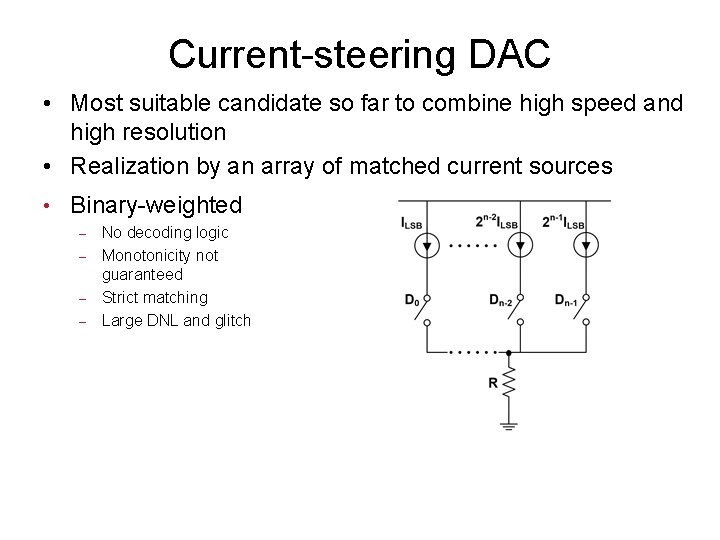
Current-steering DAC • Most suitable candidate so far to combine high speed and high resolution • Realization by an array of matched current sources • Binary-weighted No decoding logic – Monotonicity not guaranteed – Strict matching – Large DNL and glitch –
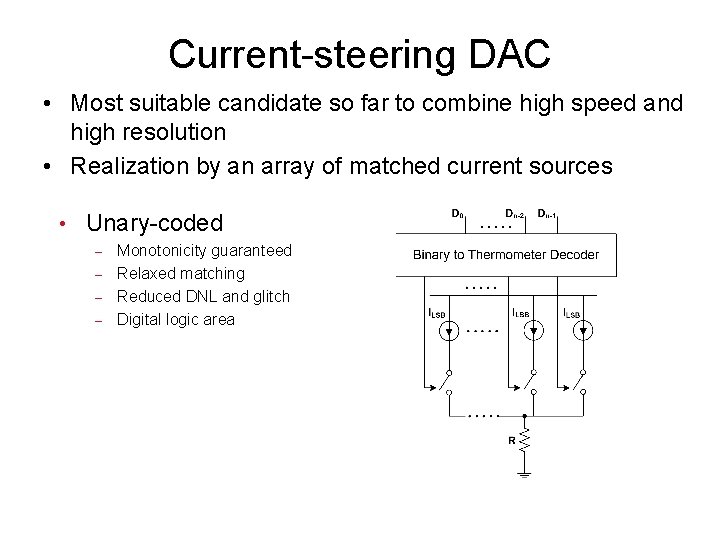
Current-steering DAC • Most suitable candidate so far to combine high speed and high resolution • Realization by an array of matched current sources • Unary-coded Monotonicity guaranteed – Relaxed matching – Reduced DNL and glitch – Digital logic area –
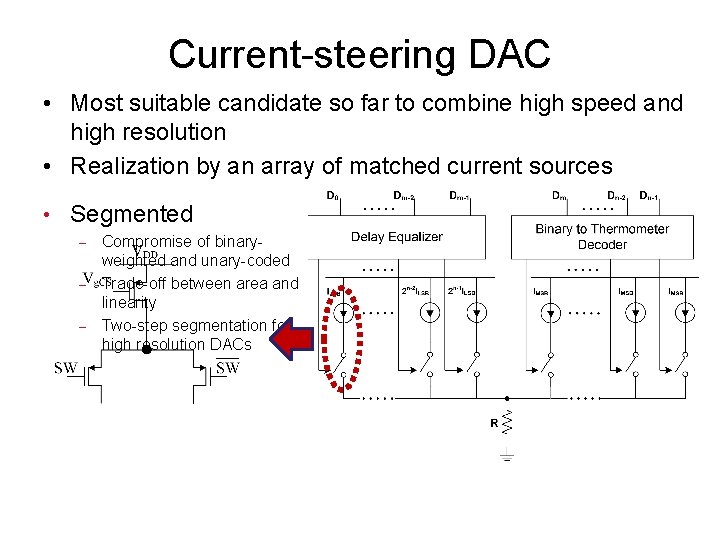
Current-steering DAC • Most suitable candidate so far to combine high speed and high resolution • Realization by an array of matched current sources • Segmented Compromise of binaryweighted and unary-coded – Trade-off between area and linearity – Two-step segmentation for high resolution DACs –
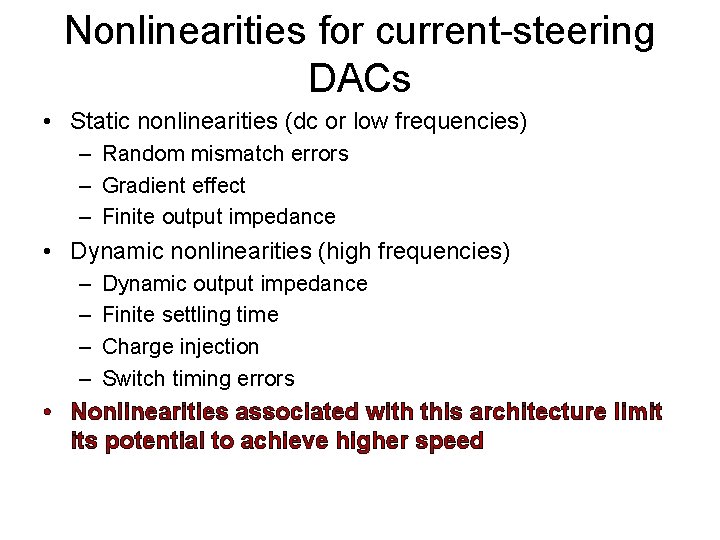
Nonlinearities for current-steering DACs • Static nonlinearities (dc or low frequencies) ‒ Random mismatch errors ‒ Gradient effect ‒ Finite output impedance • Dynamic nonlinearities (high frequencies) ‒ ‒ Dynamic output impedance Finite settling time Charge injection Switch timing errors • Nonlinearities associated with this architecture limit its potential to achieve higher speed
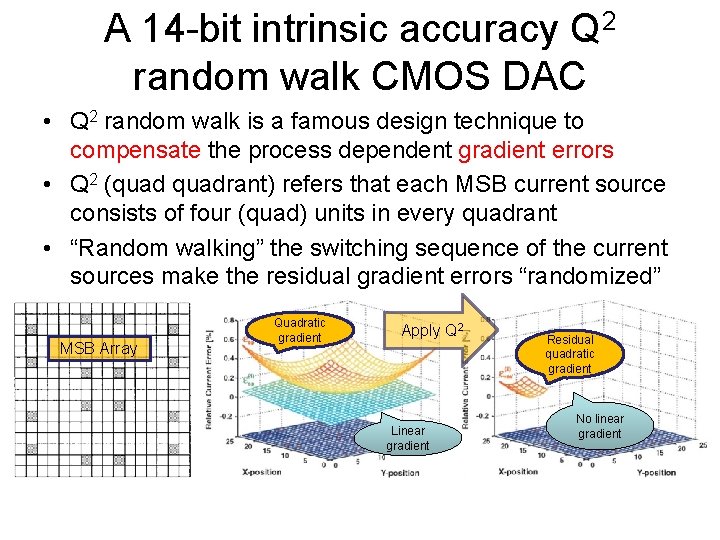
A 14 -bit intrinsic accuracy Q 2 random walk CMOS DAC • Q 2 random walk is a famous design technique to compensate the process dependent gradient errors • Q 2 (quadrant) refers that each MSB current source consists of four (quad) units in every quadrant • “Random walking” the switching sequence of the current sources make the residual gradient errors “randomized” MSB Array Quadratic gradient Apply Q 2 Linear gradient Residual quadratic gradient No linear gradient
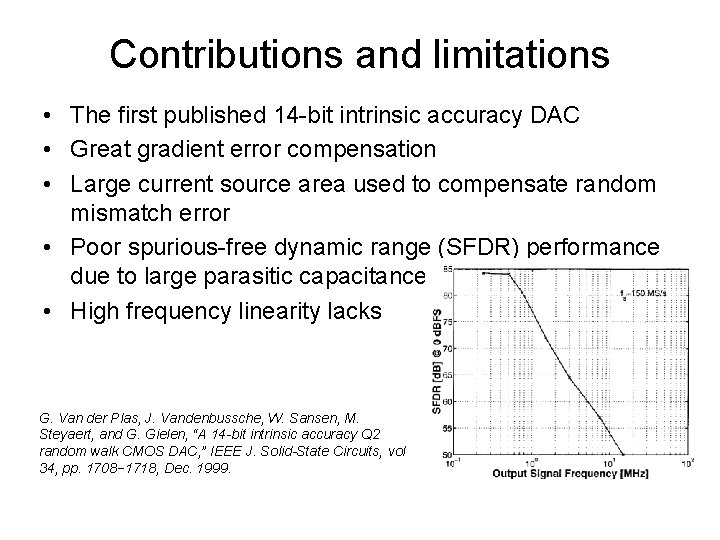
Contributions and limitations • The first published 14 -bit intrinsic accuracy DAC • Great gradient error compensation • Large current source area used to compensate random mismatch error • Poor spurious-free dynamic range (SFDR) performance due to large parasitic capacitance • High frequency linearity lacks G. Van der Plas, J. Vandenbussche, W. Sansen, M. Steyaert, and G. Gielen, “A 14 -bit intrinsic accuracy Q 2 random walk CMOS DAC, ” IEEE J. Solid-State Circuits, vol 34, pp. 1708− 1718, Dec. 1999.
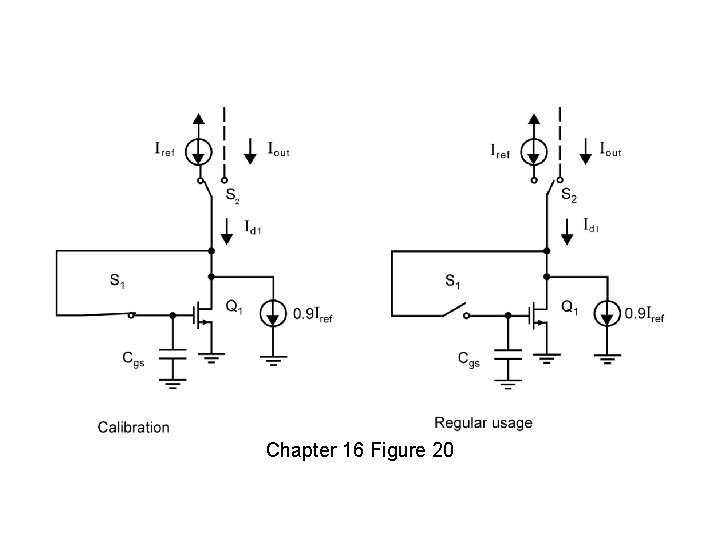
Chapter 16 Figure 20
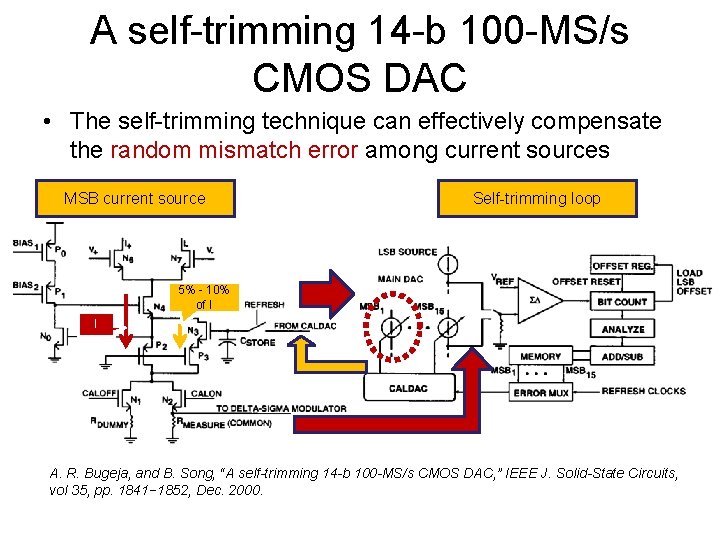
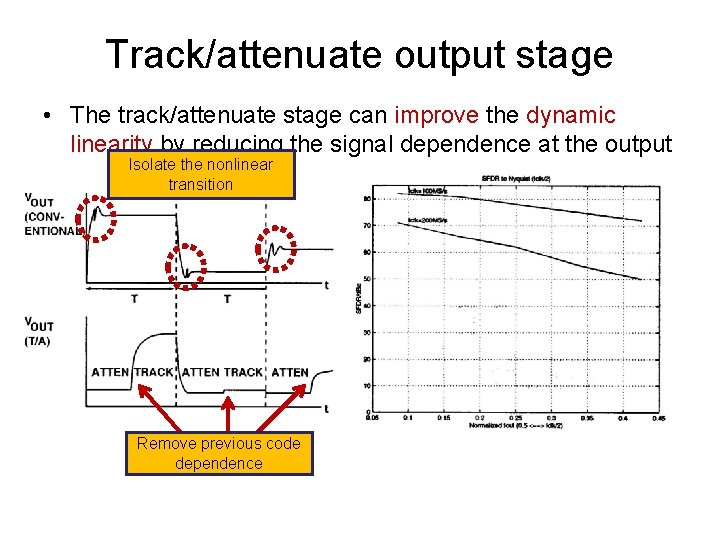
A self-trimming 14 -b 100 -MS/s CMOS DAC • The self-trimming technique can effectively compensate the random mismatch error among current sources MSB current source Self-trimming loop 5% - 10% of I I A. R. Bugeja, and B. Song, “A self-trimming 14 -b 100 -MS/s CMOS DAC, ” IEEE J. Solid-State Circuits, vol 35, pp. 1841− 1852, Dec. 2000.
Track/attenuate output stage • The track/attenuate stage can improve the dynamic linearity by reducing the signal dependence at the output Isolate the nonlinear transition Remove previous code dependence
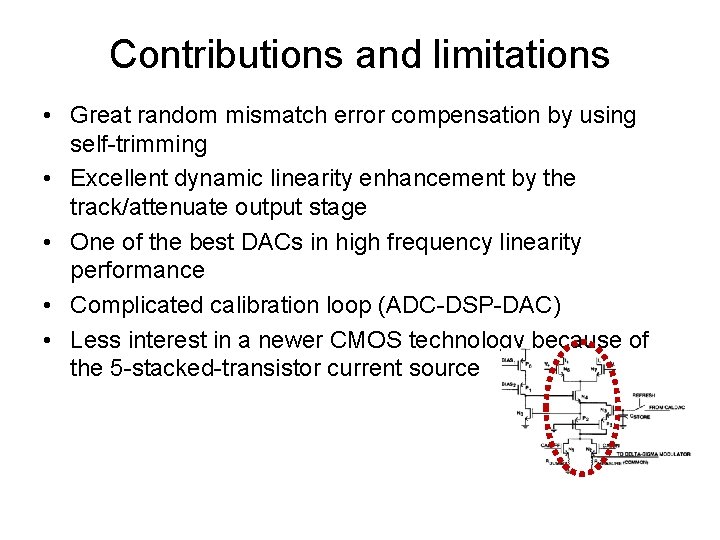
Contributions and limitations • Great random mismatch error compensation by using self-trimming • Excellent dynamic linearity enhancement by the track/attenuate output stage • One of the best DACs in high frequency linearity performance • Complicated calibration loop (ADC-DSP-DAC) • Less interest in a newer CMOS technology because of the 5 -stacked-transistor current source
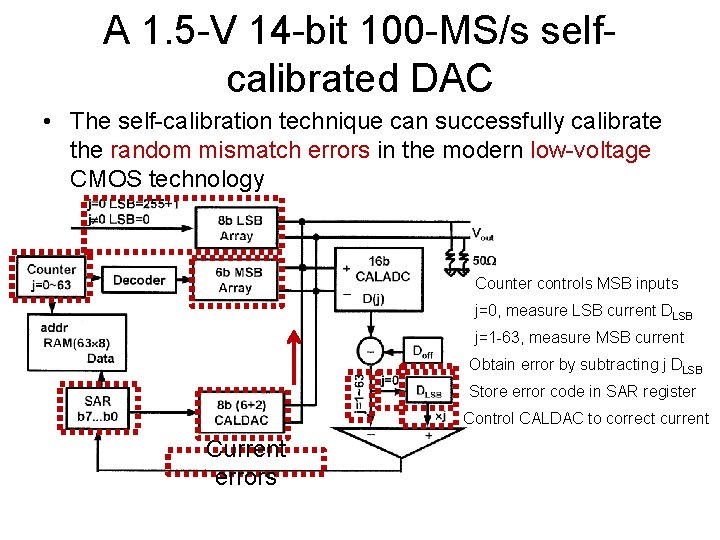
A 1. 5 -V 14 -bit 100 -MS/s selfcalibrated DAC • The self-calibration technique can successfully calibrate the random mismatch errors in the modern low-voltage CMOS technology Counter controls MSB inputs j=0, measure LSB current DLSB j=1 -63, measure MSB current Obtain error by subtracting j DLSB Store error code in SAR register Control CALDAC to correct current Current errors
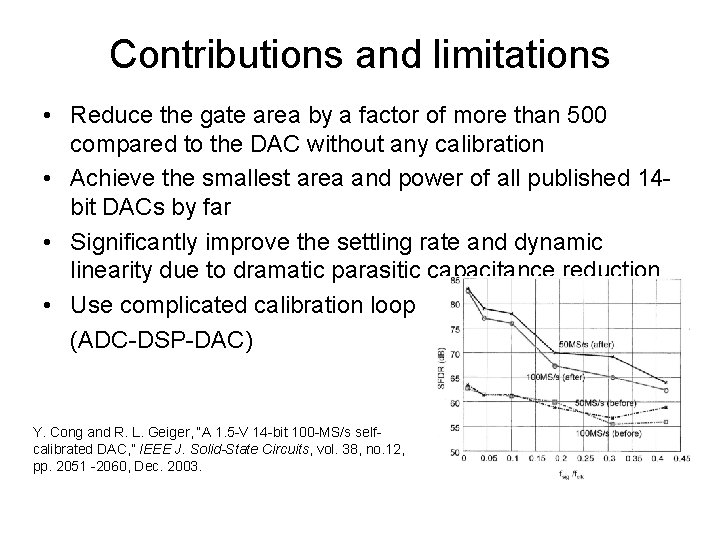
Contributions and limitations • Reduce the gate area by a factor of more than 500 compared to the DAC without any calibration • Achieve the smallest area and power of all published 14 bit DACs by far • Significantly improve the settling rate and dynamic linearity due to dramatic parasitic capacitance reduction • Use complicated calibration loop (ADC-DSP-DAC) Y. Cong and R. L. Geiger, “A 1. 5 -V 14 -bit 100 -MS/s selfcalibrated DAC, ” IEEE J. Solid-State Circuits, vol. 38, no. 12, pp. 2051 -2060, Dec. 2003.
A 14 -bit 200 -MHz current-steering DAC with switching-sequence postadjustment • The SSPA calibration can enhance the matching accuracy by adjusting the switching sequence of current sources after chip fabrication • It uses minimum analog circuits and some digital circuitry instead of the complicated ADC-DSP-DAC loop T. Chen, and G. Gielen, “A 14 -bit 200 -MHz current-steering DAC with switching-sequence post-adjustment calibration, ” IEEE J. Solid-State Circuits, vol 42, pp. 2386− 2394, Nov. 2007.
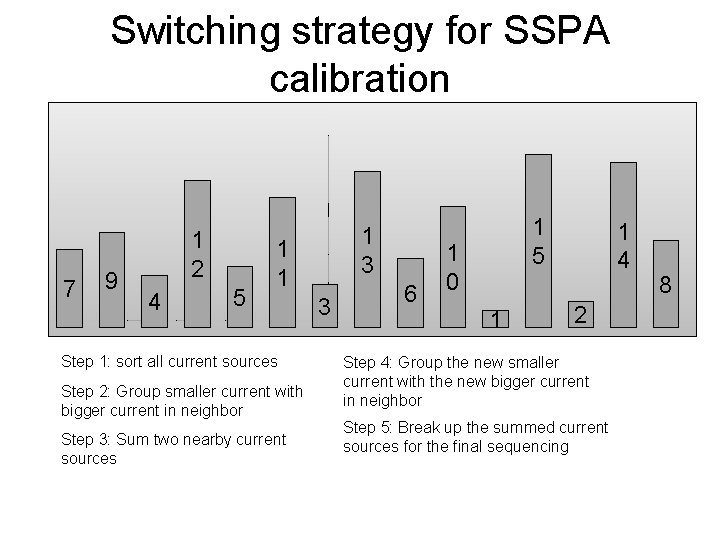
Switching strategy for SSPA calibration 9 1 1 51 5 4 74 29 3 1 7 2 4 1 1 2 41 52 43 2 1 1 1 9 1 1 0 0 2 1 3 1 1 4 1 5 1 11 1 2 3 9 3 1 3 8 2 0 7 6 1 5 61 66 0 7 7 4 5 5 6 4 5 3 3 3 1 2 1 1 3 Step 1: sort all current sources Step 2: Group smaller current with bigger current in neighbor Step 3: Sum two nearby current sources 1 1 14 5 09 8 1 Step 54 Final Sum Step 2 Step 3 Summing Step 1 Sorting sequencing Resequencing 1 5 1 4 2 Step 4: Group the new smaller current with the new bigger current in neighbor Step 5: Break up the summed current sources for the final sequencing 8
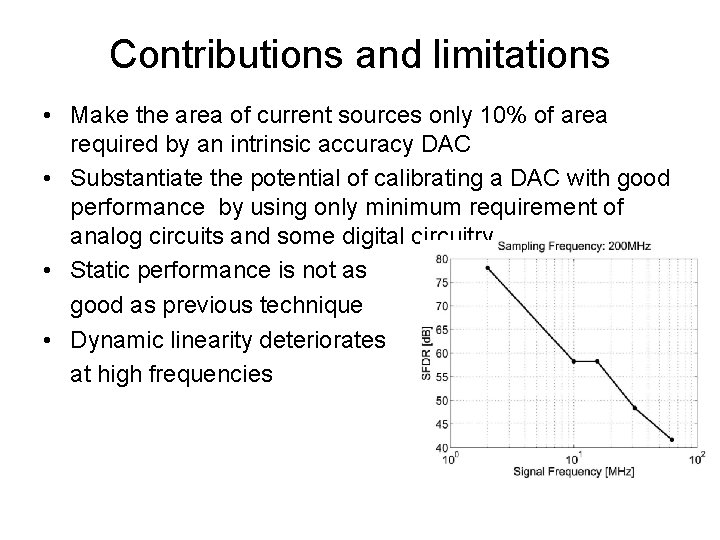
Contributions and limitations • Make the area of current sources only 10% of area required by an intrinsic accuracy DAC • Substantiate the potential of calibrating a DAC with good performance by using only minimum requirement of analog circuits and some digital circuitry • Static performance is not as good as previous technique • Dynamic linearity deteriorates at high frequencies
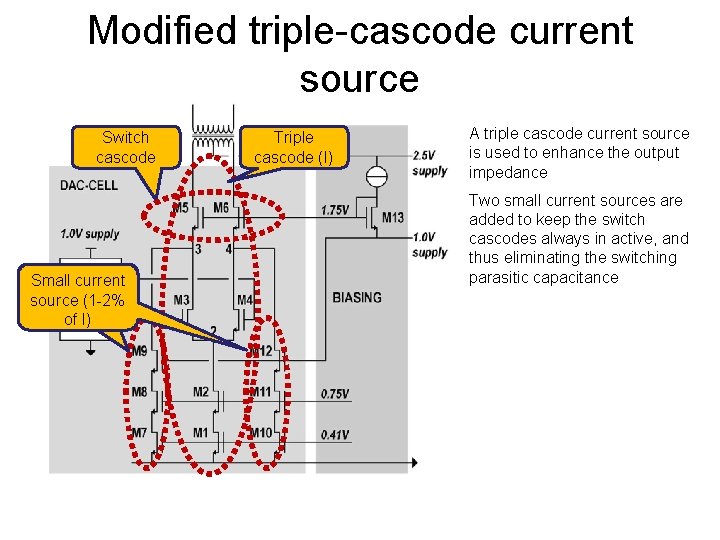
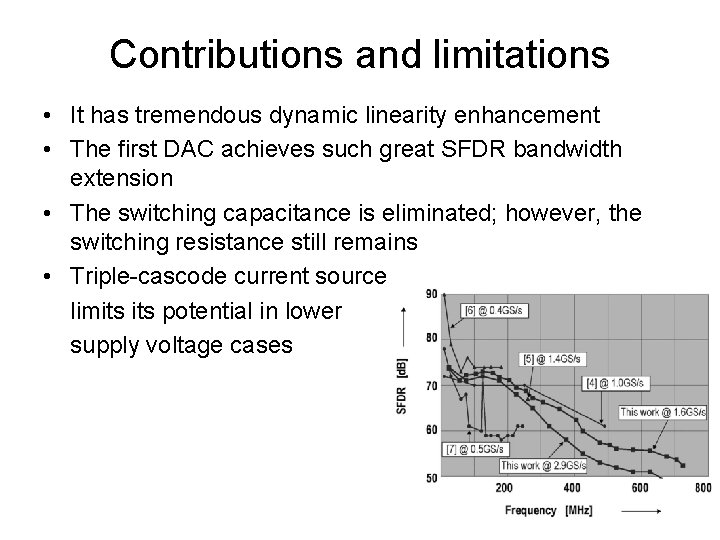
A 12 bit 2. 9 GS/s DAC with IM 3 < 60 d. Bc beyond 1 GHz in 65 nm CMOS • This DAC design extends the 70 d. B and 60 d. B SFDR bandwidths to 225 MHz and 550 MHz with fsamp > 1 GS/s • They recognize the fact that the switching output impedance is a major error source to the DAC’s output distortion • Modified triple-cascode current source is used to improve the dynamic linearity C. -H. Lin, F. M. I. van der Goes, J. R. Westra, J. Mulder, Y. Lin, E. Arslan, E. Ayranci, X. Liu, and K. Bult, “A 12 bit 2. 9 GS/s DAC with IM 3 < 60 d. Bc beyond 1 GHz in 65 nm CMOS, ” IEEE J. Solid-State Circuits, vol 44, pp. 3285− 3293, Dec. 2009.
Modified triple-cascode current source Switch cascode Small current source (1 -2% of I) Triple cascode (I) A triple cascode current source is used to enhance the output impedance Two small current sources are added to keep the switch cascodes always in active, and thus eliminating the switching parasitic capacitance
Contributions and limitations • It has tremendous dynamic linearity enhancement • The first DAC achieves such great SFDR bandwidth extension • The switching capacitance is eliminated; however, the switching resistance still remains • Triple-cascode current source limits potential in lower supply voltage cases
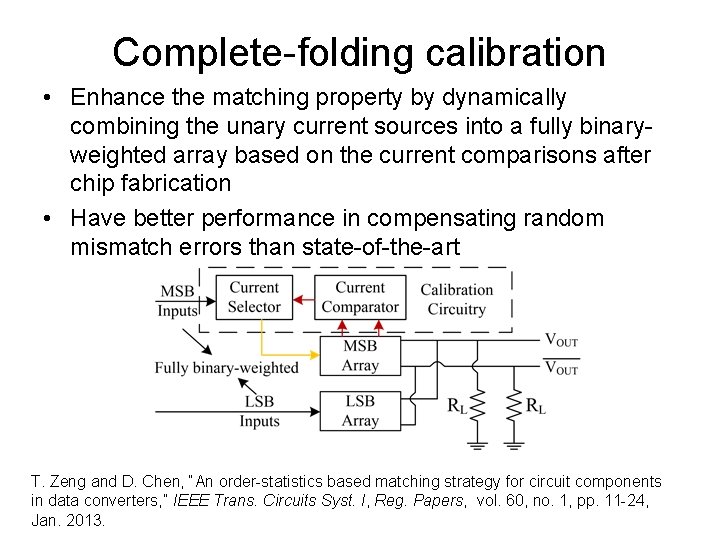
Complete-folding calibration • Enhance the matching property by dynamically combining the unary current sources into a fully binaryweighted array based on the current comparisons after chip fabrication • Have better performance in compensating random mismatch errors than state-of-the-art T. Zeng and D. Chen, “An order-statistics based matching strategy for circuit components in data converters, ” IEEE Trans. Circuits Syst. I, Reg. Papers, vol. 60, no. 1, pp. 11 -24, Jan. 2013.
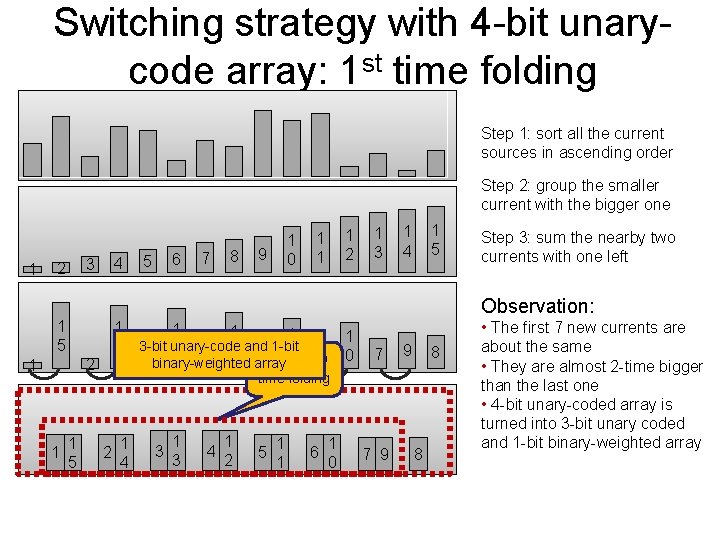
Switching strategy with 4 -bit unarycode array: 1 st time folding Step 1: sort all the current sources in ascending order Step 2: group the smaller current with the bigger one 1 4 3 2 7 8 9 1 2 1 1 1 3 1 5 1 4 Step 3: sum the nearby two currents with one left Observation: 1 5 1 1 3 -bit unary-code 1 -bit 4 3 2 and 5 Use 1 for 26 nd 4 3 binary-weighted array 2 1 1 6 5 1 0 1 5 1 0 7 9 8 time folding 2 1 4 3 1 3 4 1 2 5 1 1 6 1 0 7 9 8 • The first 7 new currents are about the same • They are almost 2 -time bigger than the last one • 4 -bit unary-coded array is turned into 3 -bit unary coded and 1 -bit binary-weighted array
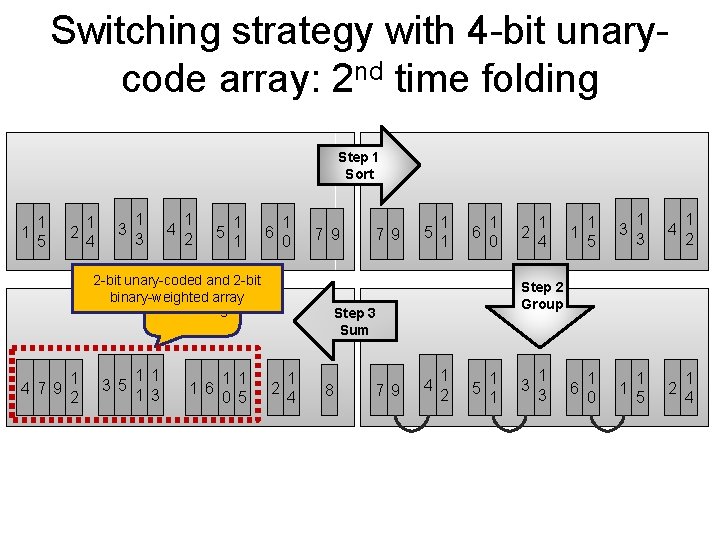
Switching strategy with 4 -bit unarycode array: 2 nd time folding Step 1 Sort 1 1 5 2 1 4 3 1 3 4 1 2 5 1 1 6 1 0 2 -bit unary-coded and 2 -bit rd Use for 3 array binary-weighted time folding 4 7 9 1 2 3 5 1 1 1 3 1 6 1 1 0 5 7 9 5 1 1 6 1 0 1 4 8 7 9 1 4 1 1 5 3 1 3 4 1 2 6 1 0 1 1 5 2 1 4 Step 2 Group Step 3 Sum 2 2 4 1 2 5 1 1 3
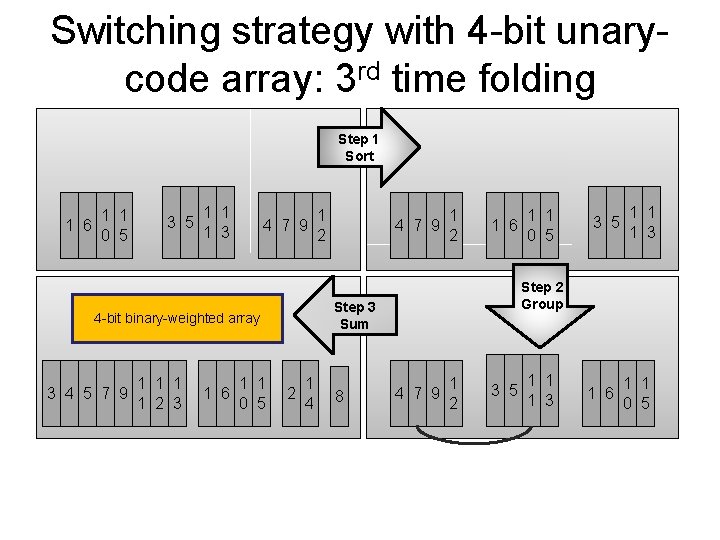
Switching strategy with 4 -bit unarycode array: 3 rd time folding Step 1 Sort 1 6 1 1 0 5 3 5 1 1 1 3 4 7 9 1 1 2 3 1 6 1 1 0 5 4 7 9 1 2 1 6 2 1 4 8 1 1 0 5 3 5 1 1 1 3 Step 2 Group Step 3 Sum 4 -bit binary-weighted array 3 4 5 7 9 1 2 4 7 9 1 2 3 5 1 1 1 3 1 6 1 1 0 5
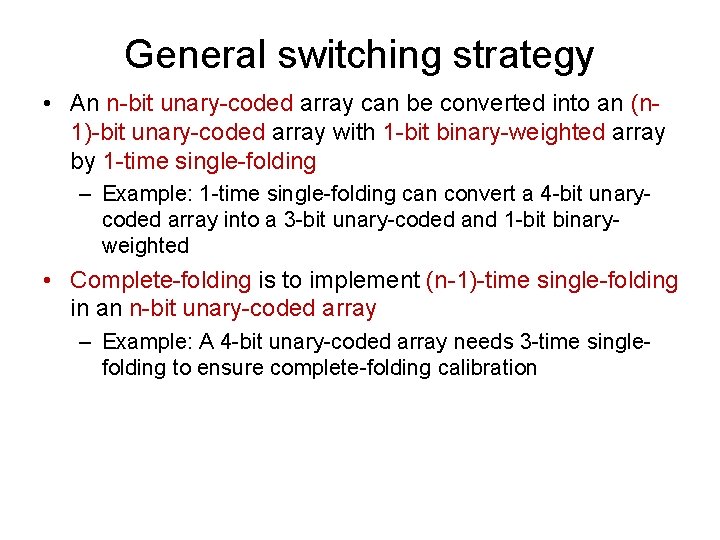
General switching strategy • An n-bit unary-coded array can be converted into an (n 1)-bit unary-coded array with 1 -bit binary-weighted array by 1 -time single-folding ‒ Example: 1 -time single-folding can convert a 4 -bit unarycoded array into a 3 -bit unary-coded and 1 -bit binaryweighted • Complete-folding is to implement (n-1)-time single-folding in an n-bit unary-coded array ‒ Example: A 4 -bit unary-coded array needs 3 -time singlefolding to ensure complete-folding calibration
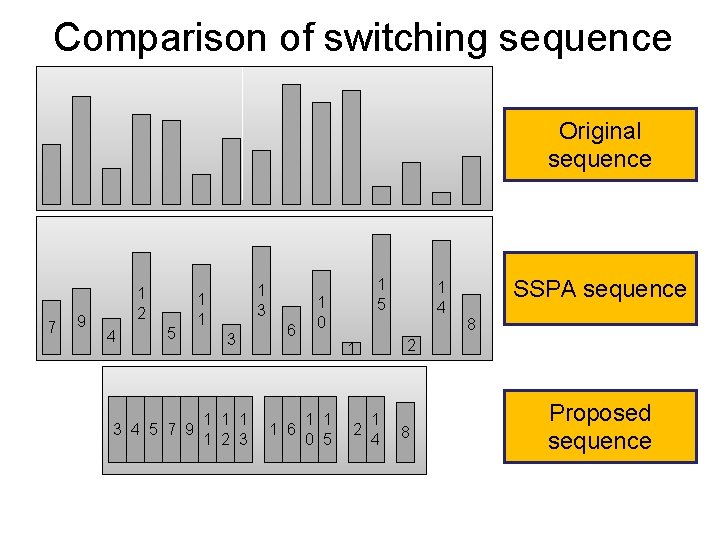
Comparison of switching sequence Original sequence 7 9 1 2 4 5 3 4 5 7 9 1 3 1 1 1 1 2 3 6 1 5 1 0 1 1 0 5 2 SSPA sequence 8 2 1 1 6 1 4 8 Proposed sequence
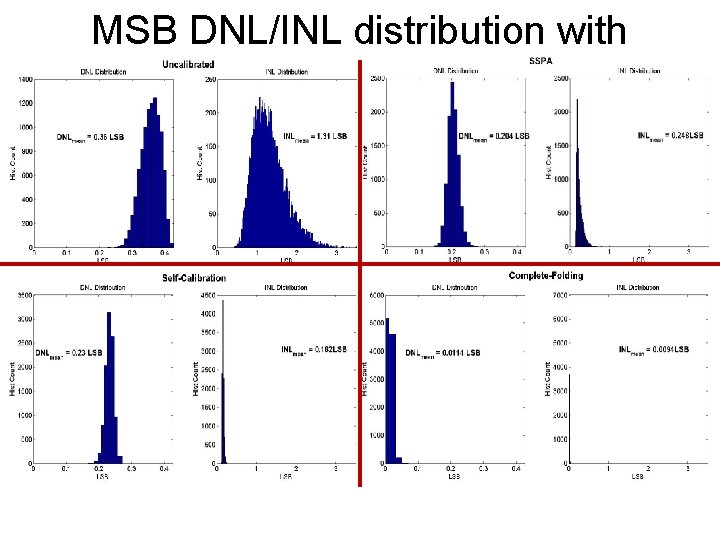
Statistical simulation setup • 10, 000 14 -bit current-steering DAC behavioral models were randomly generated ‒ 7 -bit unary-coded MSB array ‒ 7 -bit binary-weighted LSB array • Implement 3 calibration techniques separately in the MSB array to compare results ‒ SSPA Calibration + 20 statistical outlier elimination ‒ Self Calibration ‒ Complete-folding Calibration + 20 statistical outlier elimination • The LSB array is realized by intrinsic-accuracy method
MSB DNL/INL distribution with different calibration techniques
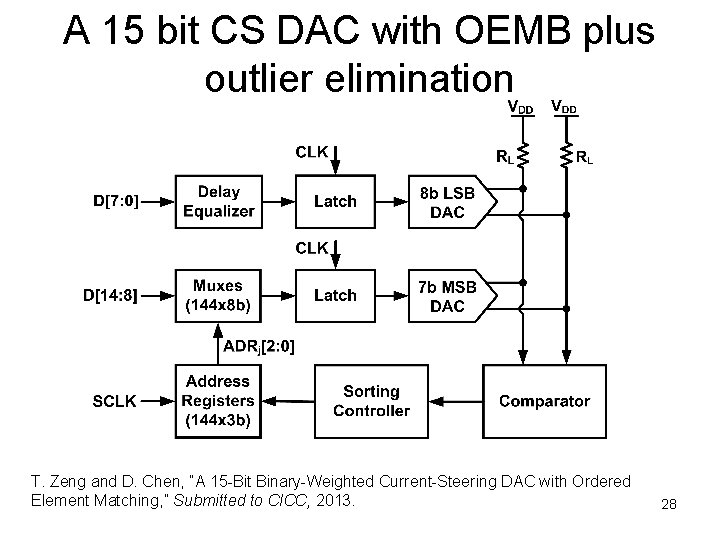
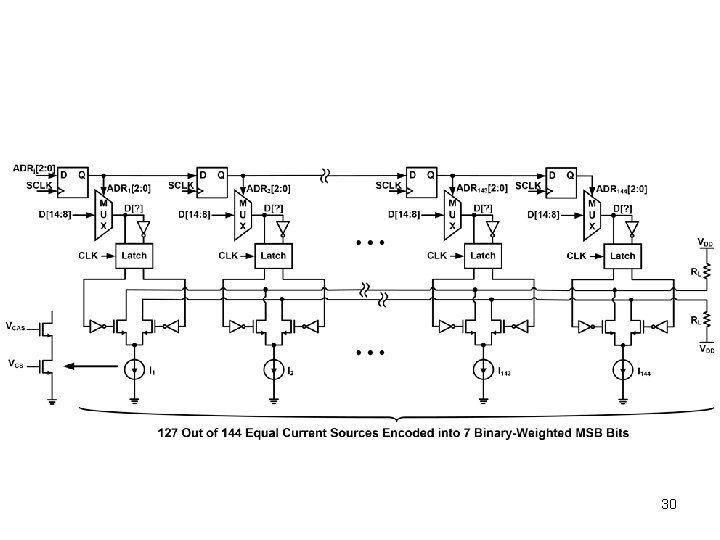
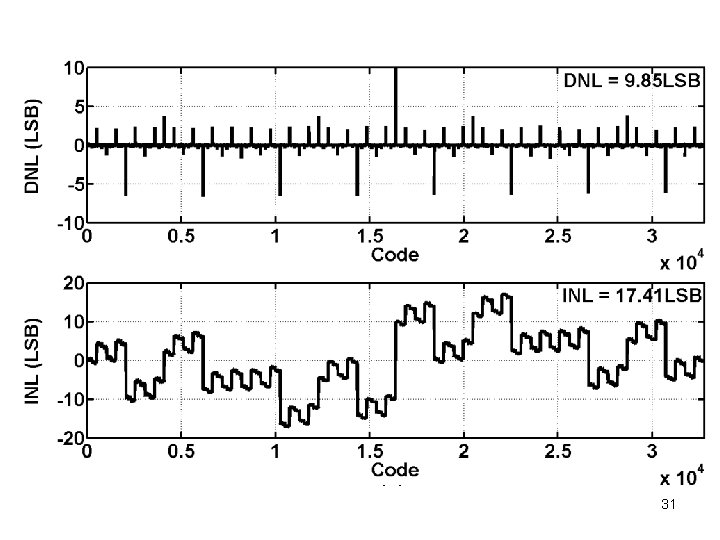
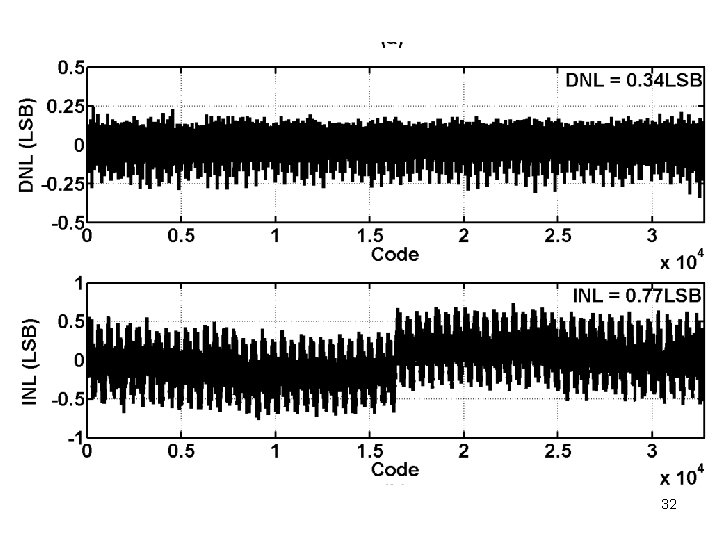
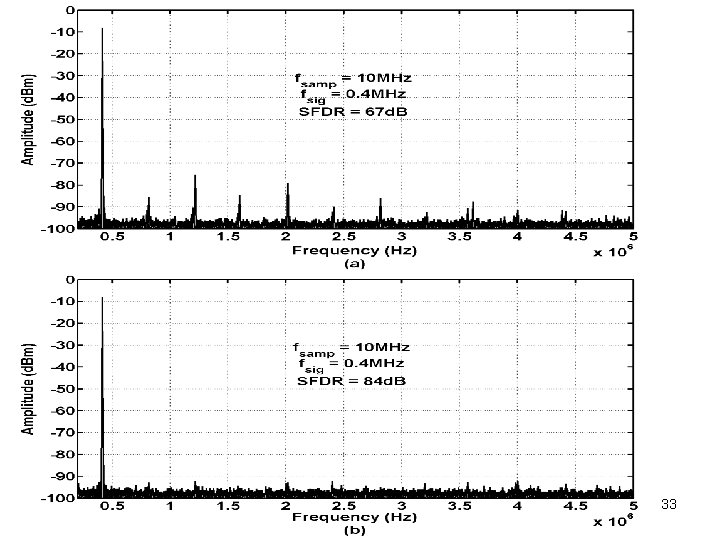
A 15 bit CS DAC with OEMB plus outlier elimination T. Zeng and D. Chen, “A 15 -Bit Binary-Weighted Current-Steering DAC with Ordered Element Matching, ” Submitted to CICC, 2013. 28
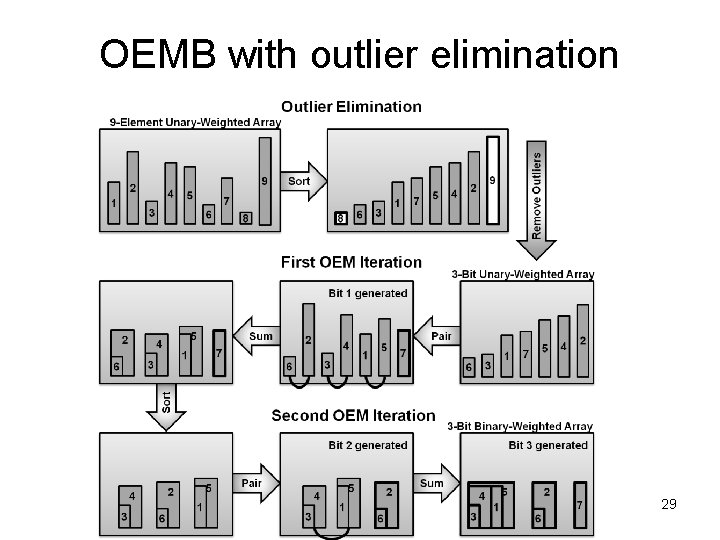
OEMB with outlier elimination 29
30
31
32
33